McCallum doesn’t want to let fraudsters ‘off the hook’ through moratorium on citizenship revocation

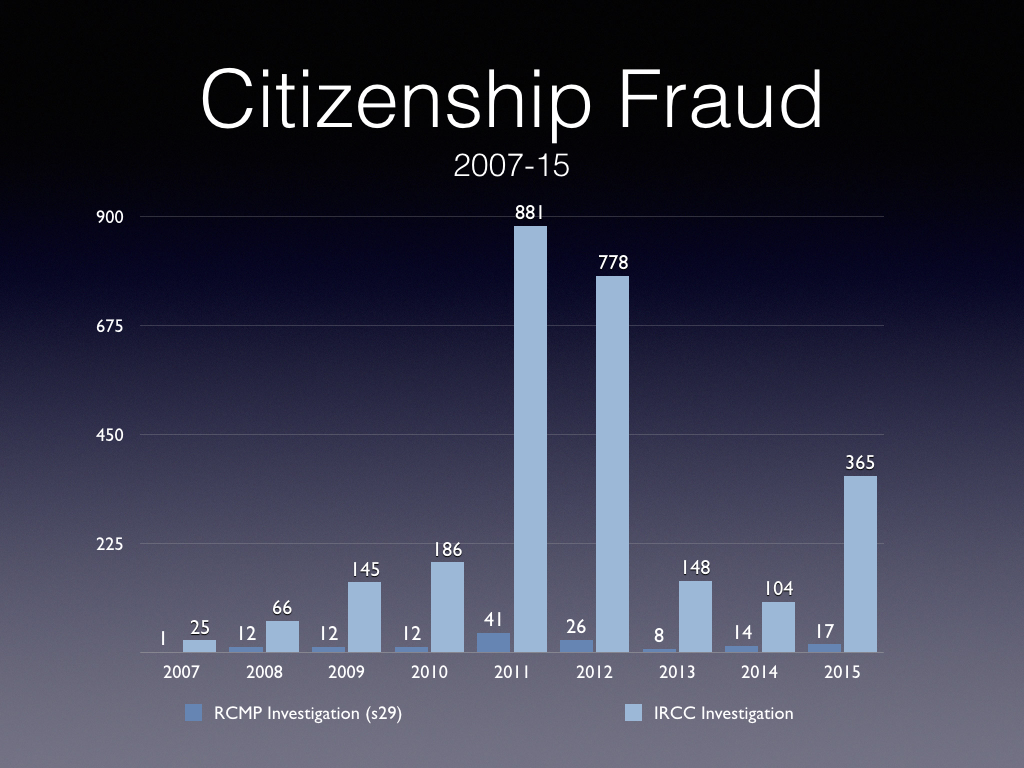
There is a distinction between fraud cases investigated by the RCMP and those investigated by IRCC. The Minister seems to be referring to only the latter. In general, if I recall correctly, the RCMP cases deal more with massive fraud (e.g., consultants submitted multiple fraudulent applications) whereas IRCC deal more with individual cases.

IRCC data shows the vast majority of fraud cases are a result of IRCC internal investigations, not RCMP, as the chart below indicates:

citizenship-data-slides-2015-026

The federal government is trying to revoke the citizenship of fraudsters, and that’s why it won’t agree to a moratorium on citizenship revocation, says Immigration Minister John McCallum.

“We have large numbers of a criminal element unveiled by the RCMP, and reported on by the auditor general. It was actually under the previous government that [investigations began that] we are now dealing with…and those people have really, truly abused our citizenship. So it would not be right to have a moratorium, and let them off the hook,” he said in a phone interview Thursday.

…. He [immigration lawyer Lorne Waldman] is part of a group bringing a constitutional challenge against a law brought in by the previous Conservative government, known as it was as C-24, that means a person who’s received notice of citizenship revocation doesn’t have a right to an appeal or court hearing.

 Mr. Waldman and another lawyer said they’re representing clients in similar circumstances to Ms. Monsef where their citizenship is in jeopardy because another family member is accused of misrepresentation.

Mr. McCallum (Markham-Thornhill, Ont.) acknowledged that the lack of an appeals mechanism needs to be fixed, but wouldn’t go as far as to instruct his department to stop revoking citizenships until one is set up, preferring instead to allow it to be developed through a change to a citizenship bill, C-6, currently at second reading in the Senate.

The bill aims to reverse parts of the Conservative legislation, C-24, that allowed the government to pull citizenship from dual nationals convicted of terrorism, expanded the age range of immigrants subject to language testing, and more.

Mr. McCallum told the Senate during an appearance Oct. 4 for Question Period that he would welcome a Senate amendment to C-6 to put in place an appeals process for new Canadians who had their citizenship revoked for providing false information on their citizenship application.

However, he wavered on whether he would pause revocations while C-6 went through Parliament when asked by Senate Liberal Art Eggleton, saying “no,” then saying he would “consider” it. The federal Justice Department confirmed the government would not impose such a moratorium in a letter to the Federal Court last week, the Canadian Press reported.

The government has increased the rate of citizenship revocations for fraud since the Liberals took power. That includes 104 revocations in the first eight months of this year, compared with 132 in all of last year and just 30 in the previous two years combined, the CBC reported.

‘Never entitled’ to citizenship

Mr. McCallum said the government is not trying to revoke the citizenship of the alleged fraudsters before an amended C-6 could bring in an appeals mechanism.

“Those two are not linked,” he said.

“As a result of that RCMP investigation, they are pursuing cases, which we fully support. It takes a while to pursue those cases, and some of them are just coming to the revocation point now. It wasn’t an effort for any particular reason, except that they were ready. And we are definitely supporting efforts to go after the criminal element and remove citizenship where it was clearly done for fraudulent or criminal reasons,” he said.

In a written statement provided to The Hill Times, Mr. McCallum’s office said “the recent increase in citizenship revocations is the result of large-scale fraud investigations led by our RCMP and [Canada Border Services Agency] partners that began under the former Conservative government.

“These investigations led to criminal convictions of several immigration consultants, and notices of intent to revoke citizenship were sent to their clients who had provided fraudulent documents to suggest they were living in Canada when they were living abroad, in order to gain citizenship. Others changed their identity in order to hide criminal backgrounds.

Source: McCallum doesn’t want to let fraudsters ‘off the hook’ through moratorium on citizenship revocation – The Hill Times – The Hill Times

Trudeau government revoking citizenship at much higher rate than Conservatives

The lack of procedural protections for citizenship revocation in cases of fraud or misrepresentation, flagged as a concern in both hearings on the Harper government’s C-24 and the Trudeau government’s C-6, continues to draw attention, given both the increased number of revocations and the Monsef case (although I would argue misrepresentation of her birthplace by her mother is not material in the way that misrepresenting residency).

And while the Trudeau government continued use of this power is questionable, the higher rate reflects in part the increased number of investigations following implementation of this provision in C-24 on 28 May 2015.

IRCC data shows 24 investigations initiated before this provision came into force, and 324 in the seven months after. The number of cases in the pipeline increased, and thus normal that more revocations would result, as the government applies the law:

The Trudeau government used powers granted by the Harper government’s controversial citizenship law to make 184 revocation decisions without legal hearings between November 2015 and the end of August. About 90 per cent of the decisions resulted in a negative finding and the loss of a person’s citizenship.

The numbers show that the Trudeau government has used the law far more aggressively than the Harper government itself.

But in a Federal Court filing late Friday, the government said it would not grant a moratorium on revocation cases, and added that claims by some that the system was revoking large numbers of citizenship are speculative.

Liberal Leader Justin Trudeau made the sanctity of citizenship an issue in last year’s federal election.

“A Canadian is a Canadian is a Canadian,” Trudeau said in a leaders’ debate three weeks before storming to victory.

He used it to dress down Stephen Harper for passing Bill C-24, a law that aimed to strip dual citizens of their Canadian passports if they were convicted of crimes of terrorism, treason or espionage against Canada, or took up arms against Canada.

Immigrant communities rallied to the Liberal Party, concerned that Canadians born overseas would be reduced by C-24 to an insecure second-class status.

Once elected, one of the Liberals’ first acts was to repeal the parts of C-24 that applied to those convicted of terrorism-related crimes, ensuring that they can keep their Canadian passports.

But the Trudeau government left intact other parts of the law that allow the government to strip citizenship from other holders of Canadian passports for misrepresentation.

The 184 revocation decisions of the first 10 months of the Trudeau government nearly match the total number of decisions over a 27-year period between 1988 and the last month of the Harper government in October 2015.

Revocations increase as Trudeau takes office

Although the powers being used come from a law passed by Stephen Harper’s Conservatives, the law has been used much more aggressively under Trudeau.

In the first full month of the law’s operation, June 2015, only three revocation decisions were made. None were made in July or August, two in September and two more in October.

The Trudeau cabinet was sworn in on Nov. 4, 2015. That month saw 21 revocation decisions. The following month there were 59. The year 2016 averaged 13 decisions a month up to Aug. 31, the latest data CBC News has been able to obtain.

The monthly average under the Harper government from 2013 to 2015 was only 2.4 cases a month, some under the auspices of C-24 and some under rules that existed previously.

Citizenship revocation decisions by year (in persons)

2013 2014 2015 2016 (8 months)
January 13
February 4 7 25
March 17 7
April 5 14
May 5 16 18
June 4 1 3 7
July 10
August 10
September 4 2
October 1 2
November 4 21
December 7 59
Total 15 15 132 104

Source: Immigration, Refugees and Citizenship Canada

Liberals accused of hypocrisy

In recent days, following revelations that the birthplace of one of its own cabinet ministers was misrepresented on her passport documents, the government has said it is open to reforming the system.

But in the preceding months, it had used the revocation measures at an unprecedented rate.

“The Liberals criticized these provisions when they were in opposition,” says Laura Track of the B.C. Civil Liberties Association. “They said they were going to fix it. And yet they have been using it even more than the Conservatives did.”

The government says the revocation decisions are being taken to protect the integrity of the citizenship system and are aimed at cases of fraud.

Nancy Caron of Immigration, Refugees and Citizenship Canada said “many cases that are being processed for revocation are as a result of large-scale investigations into possible residence fraud.”

The department carried out those investigations with Canada Border Services Agency and the RCMP. Investigations led by those agencies have resulted in the conviction of immigration consultants who helped individuals obtain citizenship illegally.

“The revocation process is then undertaken to determine whether the individuals associated with these investigations, fraudulently obtained their Canadian citizenship through having intentionally misled the government of Canada about key aspects of their citizenship application such as concealing past criminal activities or submitting false documents to demonstrate residence in Canada when in fact they were not living in Canada‎. Many of the decisions to revoke citizenship that have been made since May 2015 directly result from those investigations,” Caron said in an email to CBC News.

Source: Trudeau government revoking citizenship at much higher rate than Conservatives – Politics – CBC News

Immigration [citizenship] fraud makes us vulnerable: Hassan

Farzana Hassan on the OAG report on citizenship fraud (Gaps in Ottawa’s detection of citizenship fraud, auditor finds):

According to a Sun story Tuesday: “Michael Ferguson’s report uncovered instances of people with serious criminal records and others using potentially phony addresses, among those who managed to secure Canadian citizenship, thanks to holes throughout not just the Immigration Department but the RCMP and Canada Border Services Agency as well.”

Of course, we should expect some mistakes in any government department, but it is reasonable to ask how widespread is the failure to weed out undesirable people from entering Canada and what will be done to solve the problem?

Immigration Minister John McCallum reacted to the report by saying the Liberal government is already looking into the issue and trying to address the problem. But the public needs something more tangible from the government than a formulaic response.

Andrew Griffith, author of the book, Multiculturalism in Canada: Evidence and Anecdote, writes in his blog entitled Multicultural Meanderings, “One of the lasting legacies of the Conservative government was increased attention to the integrity of the program, beyond the issues identified in the OAG report (e.g., rotating citizenship test questions, more rigorous and consistent language assessment, and the integrity measures of C-24).”

The Trudeau government has retained many of these controls, but the technology solutions enabling effective oversight need to be refined.

Griffith is convinced the problem is not too widespread, but the current high reliance on manual data entry and human triggered searches is so critically prone to error that a simple spelling mistake can cause a failure in the system.

Automated alerts need to be in place. Electronic scanning for data accuracy and compatibility between security organizations needs to be a priority.

The stakes are high, and the current system has too many holes to provide the kind of assurance to which Canadians are entitled.

Despite the optimism of observers like Griffith, it is clear the system needs a thorough overhaul, especially when immigration in many cases is being aggressively and fraudulently pursued in terror-exporting countries like Pakistan and others in the Middle East.

Human error will continue to play a role in any system. But in an electronic age, automatic identification technology and smart systems that use leading-edge applications can significantly reduce mistakes.

Canadians deserve to know they are safe from people with criminal records and jihadi mindsets

Source: Immigration fraud makes us vulnerable | HASSAN | Columnists | Opinion | Toronto

Gaps in Ottawa’s detection of citizenship fraud, auditor finds

I did not find this OAG study all that surprising, particularly the challenges of maintaining accurate and consistent database records (e.g., spelling of addresses) and the lack of consistent follow-up to any cases flagged.

One of the lasting legacies of the Conservative government was increased attention to the integrity of the program, beyond the issues identified in the OAG report (e.g., rotating citizenship test questions, more rigorous and consistent language assessment, and the integrity measures of C-24).

But like many OAG reports, it is weak with respect to the materiality of fraud and the gaps it uncovered.

Six addresses out of 9,778 that IRCC officials missed is 0.06 percent. Other aspects are more problematic, multiple versions of addresses in particular, as well as lack of follow-up to warning flags and coordination between IRCC and RCMP or CBSA.

IRCC’s own number of revocation cases pending is 700, again a relatively small number (0.14 percent) compared to  the large numbers of new citizens in the past two years (500,000). And of course there is no comparative data in the report on permanent residency, EI, CPP or other program fraud to relate compare these numbers with.

So while any fraud is by definition unacceptable, the realities of large programs means that some degree, as small as possible, is inevitable, and ongoing attention to reducing its incidence is necessary:

Canada’s immigration department did not properly detect and prevent citizenship fraud, resulting in the review of some 700 citizenship cases as of January, according to Auditor-General Michael Ferguson’s spring report.

The report, tabled in the House of Commons Tuesday morning, found a number of concerns in the citizenship program affecting the department’s capability to prevent citizenship fraud, including the absence of a method to identify and document fraud risks.

“We concluded that Immigration, Refugees and Citizenship Canada’s (IRCC) efforts to detect and prevent citizenship fraud were not adequate,” said Mr. Ferguson in a prepared statement. “These gaps make it difficult for Immigration, Refugees and Citizenship Canada to assess the impacts of its efforts to combat citizenship fraud.”

…According to the report, the most common reasons for revoking citizenship are residency and identity fraud, and undeclared criminal proceedings.

The report found that citizenship officers did not consistently apply their own methods to identify and prevent fraud when dealing with suspicious immigration documents, such as altered passports. For example, in one region, citizenship officers did not seize any suspicious documents for in-depth analysis since at least 2010, while they did in another.

It was also found that citizenship officers did not have the information they needed to properly identify “problem addresses” when making decisions to grant citizenship. Problem addresses are those known or suspected to be associated with fraud, and used by citizenship applicants to meet residency requirements for citizenship.

“For example, one address was not identified as a problem even though it had been used by 50 different applicants, seven of whom were granted citizenship,” said Mr. Ferguson.

The problem was further complicated by poor sharing of information with the RCMP, which provides information about criminal behaviour among permanent residents, and the Canada Border Services Agency, which leads investigations of immigration fraud, said the report.

While the department did not track the exact number of citizenship fraud risks, it reported 700 pending revocation cases as of January. According to the report, revoking citizenship after fraud is discovered is “time consuming and costly.”

Source: Gaps in Ottawa’s detection of citizenship fraud, auditor finds – The Globe and Mail,

Dozens of fraudsters and suspected criminals became Canadian citizens, watchdog says in damning report

Liberals order investigation into possible citizenship fraud