John McCallum promises probe into immigration consultants’ fees for Syrian refugees

Unfortunately, there are always those who will seek to profit from these situations:

Immigration Minister John McCallum says he has ordered a three-part investigation into the practice of immigration consultants charging Syrian refugees thousands of dollars to process applications and possibly violating federal rules on private sponsorship by asking them to pay resettlement costs that should be paid by their sponsors.

“We are very concerned about this, and we want to explore all avenues as to possible wrongdoing,” McCallum told Rosemarie Barton on CBC’s Power & Politics Tuesday.

The minister was responding to a CBC News investigation that found that some immigration consultants are charging Syrians who want to come to Canada under the private sponsorship program between $3,000 to $6,400 per person to process their applications.

The investigation also found that some consultants are asking refugees to pay the cost of their resettlement in Canada up front before even arriving in the country. Under federal rules, these costs are supposed to be covered by private sponsors, not refugees, for a full year. Refugees can contribute to their settlement costs once they arrive in Canada but cannot be made to prepay or repay them, according to Immigration, Refugees and Citizenship Canada (IRCC).

McCallum said he has asked for investigations on three fronts:

  • Law-enforcement agencies will determine whether any laws have been broken.
  • The Immigration Consultants of Canada Regulatory Council (ICCRC), which oversees immigration consultants in Canada, will determine whether any of its rules have been broken.
  • Immigration, Refugees and Citizenship Canada will determine whether any sponsorship agreement holders have violated federal rules. If they did, those agreements could be nullified.

“I do think it’s a serious allegation. Given how generous the vast majority of Canadians have been, it leaves a bad taste in the mouth,” McCallum said. “With this three-front investigation, we should get some answers.”

McCallum said the investigation will also look into why immigration consultants are getting involved in the refugee sponsorship process at all.

“I don’t see why they’re there,” he said.

Source: John McCallum promises probe into immigration consultants’ fees for Syrian refugees – Politics – CBC News

McCallum reverses changes for intake of privately sponsored Syrian refugees

More flexible approach and response to criticism than the previous government:

Immigration Minister John McCallum is reversing changes to the private sponsorship of Syrian refugees program after a public outcry.

The Canadian Press has learned that the immigration department will now process all applications for Syrians received as of today with an eye towards getting a further 10,000 Syrians to Canada by the end of this year or early 2017.

Private groups were caught off guard after the government scaled back efforts to resettle Syrians once the Liberals achieved their goal of resettling 25,000 people by the end of last month.

In addition to cutting staff processing Syrian applications, the government decided to limit the number of cases it would accept this year.

The move prompted some sponsorship groups to question whether the Liberal government was truly committed to refugees and left many disappointed that it could take as long as a year to welcome Syrians to Canada.

In an interview with The Canadian Press, McCallum says the government is doing all it can to respond to a surge in demand that he called historic and unlikely to be repeated.

Source: McCallum reverses changes for intake of privately sponsored Syrian refugees – The Globe and Mail

McCallum n’est pas surpris de l’accueil réservé à Le Pen

Reinforcing the message:

Le ministre fédéral de l’Immigration, John McCallum, croit qu’en refusant de rencontrer Marine Le Pen lors de son passage au Canada, les politiciens ont fait comprendre à la chef du Front national « qu’au Canada, on n’est pas d’accord avec elle ». Concernant l’accueil des 25 000 réfugiés syriens au pays — « de la folie », selon Mme Le Pen —, le ministre McCallum estime que le message est tout aussi clair. « Il y a un bon consensus parmi la classe politique au Québec et au Canada en faveur de ces réfugiés. Donc le fait que les politiciens ne veulent pas lui parler ne me surprend pas », a-t-il affirmé lundi.

De passage à Saguenay, le premier ministre Philippe Couillard a pour sa part rappelé que Mme Le Pen n’occupe aucune fonction au sein du gouvernement français et qu’il n’a pas l’intention d’entamer un débat avec elle.

Source: McCallum n’est pas surpris de l’accueil réservé à Le Pen | Le Devoir

Immigration: «Il faut faire les choses plus rapidement» | Interview with Minister McCallum

Quebec__Ontario__Canada_Comparison_2015Not much new in Minister McCallum’s messaging but interesting the emphasis on regionalization and his response.

Above chart highlights the ongoing employment challenges for immigrants in Quebec compared to Ontario and Canada in 2015 (Quebec government statistics. It was also one of more striking findings in Multiculturalism in Canada: Evidence and Anecdote):

Encourager les immigrants à demeurer en région, loin des grands centres comme Montréal et Toronto, est un important défi, reconnaît le ministre McCallum. Il note que de nombreux immigrants qui s’étaient d’abord installés en région finissent par s’établir dans les grands centres après quelques années seulement, une situation qu’il attribue aux difficultés à trouver du travail. «Oui, les logements sont abordables [en région]. Oui, les gens sont accueillants. Mais est-ce qu’il y a de l’emploi? Des services linguistiques?»

Intégration plus longue

Constatant que les immigrés affichent de plus hauts taux de chômage que les personnes nées au Canada, particulièrement au Québec, John McCallum croit que le pays intègre moins bien les immigrants que par le passé. «Le taux de chômage est plus élevé pour les immigrants que pour les Canadiens. Ça veut dire qu’on ne fait pas aussi bien aujourd’hui que dans le passé afin d’intégrer ces nouveaux immigrants», dit le ministre. Il ajoute que les immigrés trouvant du travail mettent des années à voir leurs revenus se rapprocher de ceux des personnes nées au Canada.

Source: Immigration: «Il faut faire les choses plus rapidement» | Pierre-André Normandin | Politique canadienne

Liberals shift immigration focus to family reunification, refugee resettlement

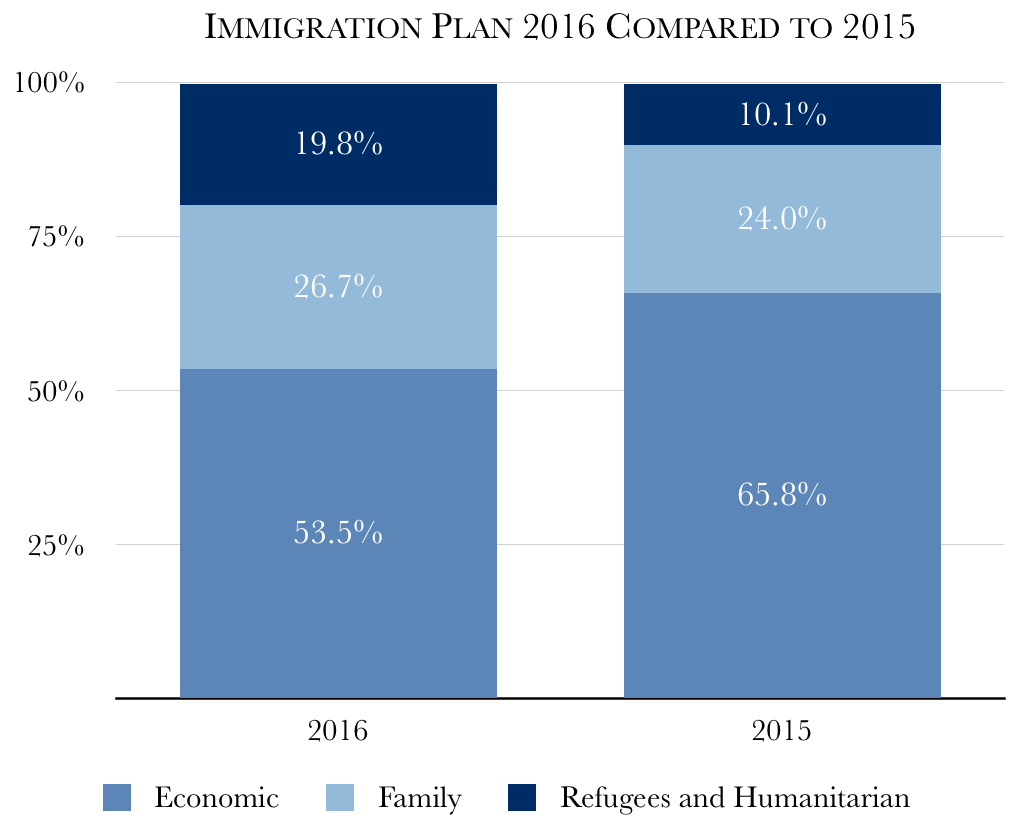
Immigration_Plan_2016One of the more comprehensive reports on the changes, but changes that some of my colleagues more expert in immigration characterize as ‘less change than meets the eye’:

Canada will seek to admit a record number of immigrants as the Liberal government shifts its focus on family reunification and the settlement of refugees, says Immigration, Refugees and Citizenship Minister John McCallum.

“This plan sends a message about the importance of family,” McCallum said in Brampton, Ont., on Tuesday.

“It outlines a significant shift in immigration policy towards reuniting more families, building our economy and upholding Canada’s humanitarian traditions to resettle refugees and offer protection to those in need.”

McCallum said Canada will admit between 280,000 and 305,000 new permanent residents in 2016, a record increase from the 260,000 to 285,000 newcomers the previous Conservative government had planned to welcome by the end of 2015.

The Liberal plan will see Canada admit:

  • 151,200 to 162,400 caregivers, provincial nominees, and other skilled workers under the economic stream.
  • 75,000 to 82,000  spouses, partners, children, parents and grandparents of Canadians under the family reunification plan.
  • 51,000 to 57,000 refugees, protected persons and others admitted for humanitarian reasons.​

The Liberal plan also includes admitting 18,000 privately sponsored refugees, “three times more than in earlier years,” McCallum said.

The government has resettled some 25,000 Syrians, a mix of government-assisted and privately sponsored refugees, in four months. The Liberals have also pledged to resettle another 10,000 government-assisted Syrian refugees by the end of 2016.

Reviewing sponsorship conditions

McCallum said the government will review some of the conditions imposed on Canadians looking to sponsor their children and spouses living overseas, making family reunification a priority.

“The government of Canada will make family reunification an important priority because when families are able to stay together, their integration to Canada and ability to work and grow their communities all improve,” McCallum said in a much-anticipated report tabled in Parliament on Tuesday.​

“We will work to restore the maximum age for dependants to 22 from 19 and re-examine the two-year conditional permanent residence provision for sponsored spouses.”

In its annual report to Parliament, the Liberal government is also pledging to:

  • Eliminate the $1,000 labour market impact assessment (LMIA) fee for families looking to hire caregivers for family members with physical and mental disabilities. An LMIA is a document employers must file to prove the need to hire a foreign worker over a Canadian one.
  • Review the express entry system launched in January 2015 “to provide more opportunities” for applicants who have Canadian siblings.
  • “Expand and monitor the use of biometrics” to verify the identity of all temporary and permanent residents  who need a visa or permit to enter Canada.

Fewer economic immigrants

Conservative immigration critic Michelle Rempel denounced the government’s decision to admit fewer economic immigrants.

“These cuts to economic immigration come at a time when our workforce is aging, our economy is slowing, and refugees are waiting for months to have long-term affordable housing,” Rempel said during question period,

She said the government’s changes to the caregivers program would “leave the most vulnerable Canadians without care.”

Source: Liberals shift immigration focus to family reunification, refugee resettlement – Politics – CBC News

Spouses of Canadians to get permanent residency immediately

Another platform commitment being implemented, reflecting a preference to reduce the risk of spouses being trapped in abusive situations compared to the previous government’s preference for reducing marriage fraud and marriages of convenience:

Immigration Minister John McCallum says he’s planning on introducing changes in the “next couple of months” that will grant permanent resident status to the sponsored spouses of Canadians, immediately, upon arriving in Canada.

“When spouses come in now, they don’t immediately become permanent residents; there’s a two-year period where they are not yet permanent residents,” Mr. McCallum (Markham-Thornhill, Ont.) said in an interview with The Hill Times. “We said in our platform that we will end that so that they will become permanent residents on arrival.”

Currently, sponsored spouses of Canadians receive conditional permanent residency upon arrival in Canada and have to wait for two years to obtain permanent-resident status. If the relationship breaks down, the sponsored spouse’s permanent residency can be revoked. Spouses holding conditional permanent resident status enjoy the same rights and benefits as any other permanent resident.

The Conservatives introduced the conditional permanent-resident provision in 2012 to address the issue of marriage fraud.

Since becoming the immigration minister in November, a number of Liberal MPs in ridings with large visible-minority populations have been asking Mr. McCallum (Markham-Thornhill, Ont.) to take immediate measures to make the application processing time of family sponsorship applications faster. Most MPs representing major urban centres from all parties say that issues related to immigration, refugees and citizenship account for 70 to 80 per cent of their constituency work.

Mr. McCallum, whose riding has the third-highest percentage of visible minority population at 82 per cent, said that he finds it “abominable” that it takes almost two years for the spousal immigration applications to be processed, and after arriving in Canada, another two years to receive permanent-resident status. He said that his department is working on coming up with plans to speed up the application processing times. Mr. McCallum did not offer a specific target timeframe for reducing the application processing times, but said that it will be brought down “radically.”

Source: Spouses of Canadians to get permanent residency immediately: McCallum | hilltimes.com

My Take of the #Citizenship Act Changes: Finding the Centre

The proposed changes to the Citizenship Act announced 25 February by Minister McCallum focussed on implementing the Liberal platform and ministerial mandate commitments, rather than full-scale repeal of the previous Conservative government’s legislation and related measures.

The package of measures is carefully balanced between matters of principle — a “Canadian is a Canadian is a Canadian,” repealing the national interest revocation provisions — with measures both to remove barriers to citizenship while improving integrity.

Given some of the pressures within the Liberal caucus, particularly those with large number of new Canadian voters, to ease language competency and other requirements, this has to be viewed as a relatively moderate package (the Liberals won the vast majority of seats with large number of new Canadians, and have the largest number of visible minorities in their caucus (39).

In many ways, these changes reflect the establishment of a new centre, one that balances facilitation while emphasizing integration, integrity and meaningfulness.

While Michelle Rempel, Conservative critic for Immigration, Refugees and Citizenship, has already lambasted the government on repealing the revocation provisions, she is silent on the extent that many of the integrity and process changes introduced by the Conservative government have been maintained, if not strengthened. This significant legacy of former ministers Kenney and Alexander remains, one that addressed long-standing management and integrity issues with the citizenship program.

In his announcement, the Minister emphasized both what was different — repeal of the revocation provisions and removal of barriers — as well as what was unchanged: emphasis on program integrity, and continued emphasis on ensuring that citizenship means a “real and meaningful” commitment to Canada.

Starting with what is different.

Principle that a “Canadian is a Canadian is a Canadian.”

What will clearly be the most controversial change, judging by the Official Opposition and media, the Government will repeal the revocation provisions for those convicted of terror or treason and restore the citizenship of the one person, Zakaria Amara (a member of the “Toronto 18”), whose citizenship was revoked under the previous government’s legislation.

This was the focus of media questions, and McCallum repeatedly stressed the principle that a Canadian, whether born in Canada or not, whether Canadian only or having dual nationality, should be treated the same and that Canada’s criminal justice system is to punish the convicted. The Government campaigned on this issue and is implementing its platform commitment.

In response to questions regarding that Canada is moving in the opposite direction to other government such as Australia and French, he declined to comment on other governments, and simply reiterated the principle behind the decision, one that the government campaigned on.

Reduce Barriers to Citizenship

As part of efforts to shifting the balance towards making citizenship easier, Bill C-6 includes the following measures:

  1. Restore the previous age limits for knowledge and language testing to 18-54 year olds (the previous government had increased these to 14-64). This change will affect slightly over ten percent of all applicants. The rationale for requiring testing for 14-17 year olds was never clear (they would have been in the Canadian school system for 4-6 years) whereas for older applicants, 64 was believed to be a better and more consistent definition of senior;
  2. Repeal the “intent to reside” provision given concerns regarding how this could be interpreted over time, and become grounds for possible future revocation;
  3. Restoring pre-permanent residency time 50 percent credit towards citizenship, calling the previous government’s removal the “stupidest part” of C-24, given that providing such credit encourages citizenship take-up by international students, in line with the approach of other countries which also ‘compete’ for students. Some IRCC senior officials have previously indicated that this change was prompted in part by concerns of increased competition with Canadian-born students;
  4. Maintaining the physical presence requirement but reducing the time required to three out of five years compared to four out of six (historically, it was three out of four, making it three out of five provides greater flexibility for those whose work or family obligations take them outside Canada);
  5. Although not in legislation (nor in the Liberal platform or the Minister’s mandate letter), revise Discover Canada, the citizenship study guide, given concerns about language and content (McCallum cited too much emphasis on the War of 1812 and references to “barbaric cultural practices”). This will be done jointly with the departments of Canadian Heritage and Indigenous Affairs, reflecting a much more inclusive process than when my former team prepared Discover Canada.

Retain Integrity

McCallum repeatedly stressed that citizenship should mean a “real and meaningful” commitment to Canada. Citizenship misrepresentation and fraud remained a concern. The physical residency  requirement remained as did the language requirements (although he said “modest adjustments” would be made).

He also retained virtually all of the integrity-related measures introduced by the Conservatives:

  1. Physical presence, not just legal residency;
  2. Knowledge requirement must be met in English or French, not through an interpreter;
  3. No change to “lost Canadians” provisions;
  4. No change to expansion of bar granting citizenship to those with foreign criminal charges and convictions;
  5. No changes to regulations for citizenship consultants;
  6. No changes to increased fines and penalties for fraud;
  7. No change in authority for Ministerial authority to revoke citizenship for routine cases (previously, had been Governor in Council);
  8. No change in authority for Minister to decide on discretionary grants of citizenship (previously, had been Governor in Council);
  9. Maintain authority to decide what is a complete application (streamlines processing);
  10. Maintain single-step citizenship processing to reduce duplication (previously was three-step) with reduced role for citizenship judges;
  11. Maintain requirement for adult applicants to file Canadian income taxes;
  12. Maintain fast-track mechanism for Permanent Residents serving in the Canadian Forces.

In addition, the Minister is also proposing to increase citizenship integrity further (not highlighted in his press conference) by:

  1. No longer counting time spent under a conditional sentence order towards meeting the physical presence requirements; and those serving a conditional sentence order are prohibited from being granted citizenship or taking the oath of citizenship;
  2. Retroactive application of the provision prohibiting applicants from taking the oath of citizenship if they never met or no longer meet citizenship requirements to applications still in process received prior to June 11, 2015; and,
  3. Authority to seize documents if there are reasonable grounds to believe they are fraudulent, or being used fraudulently.

Issues not addressed include the high cost of citizenship (which rose from $200 to $630 under the previous government). When asked, McCallum stated that his focus was on implementing Liberal platform commitments and that the issue of fees may be examined in the future. Moreover, there was no commitment to reducing the time required to process citizenship applications, or implement and report on how well the department is doing.

Given the media focus on the revocation changes and the degree the previous government emphasized this provision, this will continue to be the focus of the discussion and debate on Bill C-6. It is also the easiest issue for people to understand and debate, as the other changes are largely adjustments (“tweaks” to use the Minister’s word), as the fundamentals — physical presence, knowledge and language requirements — have been preserved.

Taken as a whole, these proposed changes reflect a re-centring of citizenship, a relatively surgical approach to repealing provisions of the previous Conservative government’s 2014 Strengthening Canadian Citizenship Act (C-24). It aims to define a new balance between facilitating citizenship while maintaining meaningfulness.

Meeting the Liberal government’s public commitments, while retaining virtually all of the previous government’s integrity measures, should reduce fears that the Government is not able to make choices and is not ‘pandering’ to the many ethnic voters which supported it.

Liberals to repeal citizenship law Bill C-24: immigration minister – “coming days”

Whether in the form of “tweaks”, “significant” or “radical” changes (the Minister has used all three terms), likely that the changes will be more substantive than mere tweaks.

But overall, messaging is a reversal of the previous government’s approach of making citizenship “harder to get and easier to lose.”

The extent to which this undermines some of the needed integrity measures introduced by the Conservatives – more rigorous knowledge and language testing, physical residency requirements etc – remains to be seen, although the Minister in Committee did state the importance of language knowledge to integration.

These changes happen in the context of a significant decline in the number of persons applying for citizenship: from an average of around 200,000 in past years, to about 130,000 in the last three years.

Will be hosting a citizenship workshop at Metropolis next week in Toronto and should the Minister literally announce this within days, we will have a good discussion regarding the changes (I will post my deck next week, essentially an updated version of Citizenship – Canadian Ethnic Studies 24 Oct 2015 with more recent data:

Immigration Minister John McCallum says the government will announce significant changes to the Citizenship Act in the coming days.

Mr. McCallum said Tuesday that the Liberals will soon follow through on their election pledge to repeal the Conservatives’ controversial Bill C-24, which gave the government the power to revoke Canadian citizenship from dual citizens convicted of terrorism, treason or espionage.

Asked when the changes will be unveiled, Mr. McCallum told The Globe and Mail to expect an announcement “in coming days, but not very many days.”

During last year’s election campaign, the Liberal platform committed to “repeal the unfair elements of Bill C-24 that create second-class citizens and the elements that make it more difficult for hard-working immigrants to become Canadian citizens.”

Mr. McCallum said the government’s announcement will make it impossible to revoke citizenship.

“A Canadian is a Canadian is a Canadian,” Mr. McCallum said, repeating a line used by Prime Minister Justin Trudeau during a heated election debate last September. “We would not revoke people’s citizenship. … That will certainly be a part of it [the announcement],” the Immigration Minister added.

Mr. McCallum said the government will also remove barriers to citizenship posed by Bill C-24.

“We believe that it’s better to make it easier rather than harder for people to become citizens.”

However, he did not say which specific barriers would be addressed.

Source: Liberals to repeal citizenship law Bill C-24: immigration minister – The Globe and Mail

Business groups fear refugees and immigrant families will crowd out spaces for foreign workers in Canada

Will be interesting to see how the Government balances the different demands and whether or not it raises the overall number of immigrants (levels, currently around 250,000).

And it is not only refugees that are creating pressures on levels, as seen in Minister McCallum’s mandate letter:

  • As part of the Annual Immigration Levels Plan for 2016, bring forward a proposal to double the number of entry applications for parents and grandparents of immigrants to 10,000 a year.
  • Give additional points under the Entry Express system to provide more opportunities for applicants who have Canadian siblings.
  • Increase the maximum age for dependents to 22, from 19, to allow more Canadians to bring their children to Canada.
  • Bring forward a proposal regarding permanent residency for new spouses entering Canada.

Should know the results of these trade-offs March 9:

Provinces and businesses keen to bolster their workforce are worried the push for Syrian refugees this year will lead to a cutback in foreign workers..

The government admits a set number of immigrants each year. In 2015, for example, the Conservative government planned to admit up to 285,000 immigrants. Of those slots, 66 per cent were reserved for economic immigrants; 24 per cent of the slots were for the family members of immigrants; and the remaining 10 per cent were for refugees and other humanitarian entrants.

The federal government is supposed to provide its immigration admission numbers by Oct. 31 each year. Because of last fall’s federal election, the numbers for 2016 haven’t yet been published. The government now has until March 9 to come up with its plan.

But with tens of thousands more refugees being admitted this year compared to 2015, and with the Liberals’ campaign promise to make it easier for immigrants to reunite with their parents and grandparents, the number of slots reserved for economic immigrants may be reduced.

(Economic immigrants are foreign workers, including business people and skilled tradespeople, who are allowed into Canada on a permanent basis. Those admitted through the controversial temporary foreign worker program fall into a different category.)

Immigration Minister John McCallum said last week he has consulted with industry, as well as refugee groups and other organizations about this year’s immigration levels. But he wouldn’t say whether the government is considering reducing the number of economic immigrants allowed.

Critics often accused the Conservatives of turning Canada’s immigration system into little more than a hiring program, with refugees and families being given short shrift. In 2007, foreign workers represented only 60 per cent of immigration admission targets. with 26 per cent family members and 14 per cent refugees.

Given the state of the Canadian economy, with unemployment rising, some question whether the government should continue to admit tens of thousands of foreign workers, including business people and skilled tradesmen, on a permanent basis.

But provinces, industry associations and experts say economic immigrants are essential for meeting Canada’s labour needs. Some bring skills that are in short supply in Canada, while others are willing to do jobs Canadians won’t. The country’s low birthrate also threatens long-term labour force supply.

“We really need immigrants to drive economic growth,” said Sarah Anson-Carter, director of skills and immigration policy at the Canadian Chamber of Commerce. “Economic immigrants make up about 30 per cent of new entrants into the labour force each year.”

Dan Kelly, president of the Canadian Federation of Independent Business, said economic immigrants are even more important now given that the temporary foreign worker program has been effectively frozen while the Liberals review it.

“The small business community does not want to see economic immigration drop in this country,” he said. “TFW has been rendered largely useless for small businesses.”

Provinces are also counting on the government to keep the levels where they are. One provincial official, speaking on background, said provinces loudly protested when federal immigration officials recently suggested that the number of economic immigrants could be scaled back this year.

“Our hope is it would remain the same or have a modest increase,” the official said.

Source: Business groups fear refugees and immigrant families will crowd out spaces for foreign workers in Canada

Changes coming soon to #Citizenship Act, John McCallum says

Messaging is more in the nature of relatively minor changes/reversals, in contrast to his earlier reference to “radical changes” (McCallum promises ‘radical changes’ to Citizenship Act | hilltimes.com). We should know which is it in a few weeks:

But McCallum said the Liberal government has two main goals when it comes to making its changes to the Citizenship Act.

“We would make it impossible for the government to take away someone’s citizenship, and we would reduce the barriers currently in place that people have to overcome,” he said.

One of those barriers is a test to prove language proficiency in English or French. Bill C-24 expanded the age range for people required to take that test, to those aged 14 to 64 from a ranged of 18 to 54.

McCallum hinted the government is considering restoring the original age limit, among other changes.

“We could bring it back to [age] 54,” he said. “That’s an adjustment at the margin on the grounds that some older people coming to this country may not be fully proficient in English, although their children will be and their grandchildren certainly will be.”

“It’s one of the things we are potentially considering,” he added.

But McCallum made clear the government has no plans to scrap the language testing.

“I think you could call it tweaks to the system, and certainly not ditching the system.”

As for when Canadians can expect an announcement from the government, McCallum said to be on watch “in the coming days and weeks, but not very many weeks.”

Source: Changes coming soon to Citizenship Act, John McCallum says – Politics – CBC News