Officials: Pentagon eyes new way to bar Confederate flag

Clever move:

Defence leaders, who for weeks have been tied in knots over the incendiary issue of banning the Confederate flag, are weighing a new policy that would bar its display at department facilities without actually mentioning its name, several U.S. officials said Thursday.

No final decisions have been made, but officials said the new plan presents a creative way to ban the Confederate flag in a manner that may not raise the ire of President Donald Trump, who has defended people’s rights to display it. The officials spoke on condition of anonymity to discuss ongoing internal deliberations.

Secretary Mark Esper discussed the new plan with senior leaders this week, triggering some bewilderment over the lack of an appetite for a straight-forward ban on divisive symbols. The Marine Corp has already banned the Confederate flag saying it can inflame division and weaken unit cohesion. Military commands in South Korea and Japan quickly followed suit and the other three military services were all moving to do the same when they were stopped by Esper, who wanted a more uniform, consistent policy across the whole department.

An early version of the Department plan banned display of the Confederate flag, saying the prohibition would preserve “the morale of our personnel, good order and discipline within the military ranks and unit cohesion.”

That policy was never finalized, and a new version floating around the Pentagon this week takes a different tack, simply listing the types of flags that may be displayed at military installations. The Confederate flag is not among them – thus barring its display without singling it out in a “ban.”

Acceptable flags would include the U.S. and state banners and the widely displayed POW/MIA flag. Official military division and unit flags are also likely to be allowed.

The move is an attempt at finding compromise, as Esper tries to enact a ban that passes legal muster, gives military leaders what they want, but doesn’t infuriate the commander in chief. That delicate balance has proven difficult and officials said Thursday there was no guarantee that this latest version would make the final cut.

An apparent sticking point is whether the military services will be allowed to develop their own more stringent policies on what they consider to be divisive symbols, and whether the policy will state that or leave it unsaid.

Army Secretary Ryan McCarthy told reporters on Thursday that he is still working on a policy that would remove all divisive symbols from Army installations.

He specifically didn’t mention the flag, but said, “we would have any divisive symbols on a no-fly list.”

Confederate flags, monuments and military base names have become a national flashpoint in the weeks since the death of George Floyd. Protesters decrying racism have targeted Confederate monuments in multiple cities. Some state officials are considering taking them down, but they face vehement opposition in some areas.

Trump has flatly rejected any notion of changing base names, and has defended the flying of the Confederate flag, saying it’s a freedom of speech issue.

Source: Officials: Pentagon eyes new way to bar Confederate flag

Beijing says Canadian military participation at Chinese sports competition more proof it’s not losing global support

Another reminder of how the 2020 International Metropolis conference in Beijing will be presented as legitimization of the regime’s repressive policies towards minorities (e.g., “re-education camps” for Uighurs, Tibet) and general human rights abuses.

How DND and others attending didn’t think or consider how this would be presented hard to understand.

If you haven’t already, please consider signing the petition a number of us initiated against the holding of the conference in Beijing: http://chng.it/kfzPmtVk

Beijing’s embassy in Canada says the fact the Canadian military just sent a “big delegation” to a sporting competition in China is more evidence the Asian power is not losing friends.

Canada-China relations are in a deep freeze after Beijing locked up two Canadians in apparent retaliation for Ottawa’s detention of a Chinese high-tech executive on an extradition request from the United States. China banned Canadian pork and beef and severely curbed purchases of Canadian canola seed and soybeans.

China has also come under heavy criticism for how the Beijing-backed administration in Hong Kong is handling unprecedented protests there, and in the mounting scrutiny of the internment of an estimated one million Uyghur Muslims in Xinjiang Province.

But the Chinese government, through its representatives in Canada, wants Canadians to know Beijing is not isolated or losing support.

It posted a statement on the website of its embassy in Canada to criticize a column published in The Globe and Mail last week, titled How China Loses Friends and Alienates People. The guest column by a U.S. academic discussed the backlash from China after Daryl Morey, general manager of the NBA’s Houston Rockets, tweeted remarks in support of the protests in Hong Kong and said bullying is self-defeating behaviour that will cost Beijing support.

The embassy said the list of China’s friends is growing. “More and more countries commend China’s foreign policy and development path. China’s friends are all over the world. This is a fact that can neither be obliterated nor changed by some people’s groundless accusations,” the Chinese embassy said.

“In the future, we will have more and more friends in various fields.”

It highlighted the presence of Canada and other nations in the World Military Games, held in China from Oct. 18 to 27.

International participation in the games, which attracted “9,308 military athletes from 109 countries, including a big delegation from Canada, speaks volumes in this regard,” the embassy said.

Ottawa didn’t issue any news release before or during the games to draw attention to Canada’s participation.

Daniel Le Bouthillier, head of media relations at the Department of National Defence, said Canada sent 114 athletes, 57 coaches and support staff.

Guy Saint-Jacques, a former Canadian ambassador to China, said he’s surprised Canada sent soldiers.

He said Canada must rethink how it engages with Beijing. “Now that we have seen the dark side of China, we have to have a much more realistic approach to China. Yes, we have to engage them … but at the same time we have to take into account they can be very brutal if we do something they don’t like.”

Mr. Saint-Jacques said China’s pressure on other countries and companies to avoid criticism of its conduct is growing: “Their list of red lines is getting longer all the time. It used to be Falun Gong and Tibet and Taiwan. Now it’s Hong Kong and Xinjiang too.”

The Defence Department did not directly answer when asked why Canada sent athletes to China even as Foreign Affairs Minister Chrystia Freeland accuses Beijing of arbitrarily detaining former diplomat Michael Kovrig and entrepreneur Michael Spavor.

The department said Canada “remains deeply concerned by China’s actions, including the arbitrary detention,” added that it hoped the games foster friendship.

“The spirit of the World Military Games is to create a space for friendly competition among armed forces,” Mr. Le Bouthillier said.

China expert Charles Burton, who served in the Canadian embassy in Beijing, said National Defence should not have participated in the military sports games.

“At this time, there shouldn’t be any celebratory activities going on between Canada and China, and I would suggest a major sports competition is about celebrating friendship and therefore I think it was a mistake for our military to go,” he said.

Mr. Burton said Canada’s participation “must be quite offensive” to the families of Mr. Kovrig and Mr. Spavor. The two were arrested and later charged with stealing state secrets after Canada detained senior Huawei Technologies Co. Ltd. executive Meng Wanzhou last December. They have been in prison for almost a year.

Canada’s new ambassador to China, Dominic Barton, undertook consular visits with Mr. Spavor and Mr. Kovrig over the last week.

Mr. Burton, a senior fellow at Centre for Advancing Canada’s Interests Abroad, said he hopes the Canadian government will not send athletes to the Beijing Winter Olympic Games in February, 2022, because that would be signalling “that relations are normal and passively accepting what China is doing.”

Conservative MP Peter Kent said it was inappropriate to send athletes to Beijing.

“It is unacceptable. Basically, the government should be curtailing completely collegial events at a time when Canadians are held hostage and where trade embargoes have been improperly placed on contracted Canadian sectors,” he said.

Mr. Kent also said Canada should also consider boycotting the Olympics.

Source: pointing to

USA: Military Families May Soon Lose Key Immigration Protections

Really hard to understand the ongoing cruelty of some of the Administration’s policies:

The Trump administration is considering changes to immigration policies that had previously protected the spouse and dependents of military service members from deportation, a U.S. Citizenship and Immigration Services official confirmed Monday.

“Parole in Place” is an immigration policy implemented at the height of the Iraq War to help deployed soldiers not worry that their undocumented family members would be deported while they were overseas.

It is one of several immigration options made available to the military in recognition of “the important sacrifices made by U.S. armed forces members, veterans, enlistees and their families. To support these individuals, we provide discretionary options such as parole in place or deferred action on a case-by-case basis,” the agency says on a web page for service members.

Parole in Place grants undocumented dependents and spouses a reprieve to be able to legally adjust their immigration status without having to leave the United States or be deported first. The program was rarely used until senior military leaders and then-members of Congress — including Vice President Mike Pence — urged in 2010 that the Department of Homeland Security increase access to the program.

A USCIS official confirmed exclusively to McClatchy, on condition of anonymity, that the agency is now reviewing the program. Any changes would be limited to dependents of service members, the official said.

Retired Army Reserve Lt. Col. Margaret Stock, an attorney who specializes in military immigration issues, said the administration is expected to issue a decision on whether or not to end Parole in Place at the end of July. She first became aware of the proposed changes when attorneys for some of the service members who could lose their dependents to deportation began expediting requests to get the reprieves for their family members.

The policy review comes at a time when it has become more difficult overall for service members to pursue U.S. citizenship. The number of military naturalizations has plummeted since President Donald Trump took office, and service members are now rejected for citizenship at a higher rate than civilian applicants, according to the most recent USCIS data available.

In the last several years, Parole in Place has been used sparingly, and has not protected all of the dependents of service members from deportation. The federal agency responsible for all adjudication of immigration cases does not track the number of waivers or deportations of service members or their dependents that it has processed.

Source: Military Families May Soon Lose Key Immigration Protections

Immigrant service members are now denied US citizenship at a higher rate than civilians

Another illustration of the effects of the Trump administration hard-line immigration policies and practices:

Immigrants serving in the U.S. military are being denied citizenship at a higher rate than foreign-born civilians, according to new government data that has revealed the impact of stricter Trump administration immigration policies on service members.

According to the same data, the actual number of service members even applying for U.S. citizenship has also plummeted since President Donald Trump took office, the U.S. Citizenship and Immigration Services reported in its quarterly naturalization statistics.

“The U.S. has had a long-standing tradition of immigrants come to the U.S. and have military service provide a path to citizenship,” said retired U.S. Army Maj. Gen. Paul Eaton, a senior adviser to the liberal veterans advocacy group VoteVets.org. “To have this turnaround, where they are actually taking a back seat to the civilian population, strikes me as a bizarre turn of events.”

According to the most recent USCIS data available, the agency denied 16.6% of military applications for citizenship, compared to an 11.2% civilian denial rate in the first quarter of fiscal year 2019, a period that covers October to December 2018.

The fiscal year 2019 data is the eighth quarterly report of military naturalization rates since Trump took office. In six of the last eight reports, civilians had a higher rate of approval for citizenship than military applicants did, reversing the previous trend.

Attorneys for service members seeking to become citizens said new military immigration policies announced by the administration in 2017 and Trump’s overall anti-immigrant rhetoric are to blame.

“I think people are disheartened right now by the immigration climate,” said Elizabeth Ricci, an attorney who is representing immigrant service members. “We talk about a wall all the time. This is an invisible wall.”

Overall, the number of service members who apply to become naturalized citizens is just a fraction of the civilian applications, but both pools have shrunk over the last two years. In the first quarter of the Trump administration, January to March 2017 — which is the second quarter of fiscal year 2017 — there were 3,069 foreign-born members of the military who applied to become naturalized citizens. That same quarter, 286,892 foreign-born civilians applied.

In the first quarter of fiscal year 2019, USCIS reported it received only 648 military applications for citizenship, a 79% drop. For comparison, the agency received 189,410 civilian applications, a 34% drop.

The Defense Department was repeatedly asked for comment by McClatchy, but did not provide a response.

USCIS officials said the drop in applications is not due to any action by their agency, which processes the applications as it receives them.

“The fall in military naturalization applications is likely attributable in significant part to the Department of Defense’s decision not to renew the Military Accessions Vital to the National Interest (MAVNI) program after its expiration at the end of FY17,” USCIS said in a statement.

Deported To Mexico, US Veterans Are Pressed Into Service By Drug Cartels

Immigrants who wish to join the U.S. military fall into three categories: legal permanent U.S. residents, commonly known as “green card” holders; foreign-born recruits with key medical or language skills who came to the United States under student, work or asylum visas and enlisted through MAVNI; and special status non-immigrant enlistees, who are residents of the Federated States of Micronesia, Republic of the Marshall Islands, and Palau.

The Trump administration in 2017 announced major changes to the way the Pentagon would vet and clear foreign-born recruits and other overall changes to when a service member would qualify for naturalization.

Immigrant enlistees previously could join basic training once a background investigation had been initiated, and they could become eligible to start seeking citizenship after one day of military service. Under the new policy, enlistees do not go to basic training until their background investigation is complete, and they have to complete basic training and 180 days of service before they can seek citizenship.

In the months that followed, the Defense Department shut down naturalization offices at some of its basic training locations, citing the new policy.

7 Immigrant Service Members Who Perfectly Capture The Spirit Of Military Service

Other changes appeared procedural but had deep impact, such as the change that only higher-ranking officers, at colonel or above, were authorized to sign key USCIS forms verifying that an enlistee had served honorably. The signatures had to be original, too, which made it much more difficult for troops in outlier areas where the nearest colonel or higher-ranking officer may be hundreds of miles away, Stock said.

The new rules had a chilling effect, military immigration attorneys said. Unit leaders who previously would have shepherded naturalization paperwork through for their service members have stopped doing so, the attorneys said.

“People are telling them ‘wait until you get to your first unit.’ When they get to the unit they are told, ‘we don’t know anything about this anymore,'” Stock said.

The lack of guidance in units for immigrant soldiers “is all intentional,” Ricci said. “It’s part of this overall culture of ‘No.'”

The new rules have left some recruits waiting for years to serve.

Army recruit Ajay Kumar Jaina, 33, came to the United States from India in 2012 on an H-1B visa to work for Veritas Healthcare Solutions. He has a master’s degree in pharmaceutical analysis and wanted to become a military pharmacist. In May 2016 he enlisted under MAVNI for his medical skills.

He’s been in a holding pattern ever since. In the almost three years he’s waited to go to basic training, he’s reported for duty for more than 20 weekends with the 445th Quartermaster Company in Trenton, New Jersey.

He goes to New Jersey knowing that he will be unable to drill with the rest of the unit because he has not yet undergone basic training since the Defense Department has not completed his background check.

So his activities on base are limited to administration and inventory roles.

“When I registered in the Army, at that time I was told my basic training location. I was told within six months my background check would be verified, and then I could go to basic and then (advanced individual training) then I could be come apply for citizenship,” Jaina said.

Jaina said no determination has been made on his background check yet. “Which is actually good!” he said. “I can wait. I can keep my hopes high.”

Jaina’s H-1B visa expires next month and he said he may have to go back to India in order to be able to return to the United States under a new visa as he continues to wait.

Eaton questioned why the Defense Department would make it more difficult to pull from eligible immigrant recruits, particularly in light of the recruiting challenges the military faces overall.

“Only 25% of the U.S. population is eligible to serve, due to academic, health or behavioral issues,” Eaton said.

Last year the Army missed its annual recruiting goal by more than 6,500 personnel. In a statement, the Army would not say whether the immigration policies had impacted its ability to recruit last year.

“Our leaders remain confident that we have laid the foundation to improve recruiting for the Army while maintaining an emphasis on quality over quantity,” the Army said.

Source: Immigrant service members are now denied US citizenship at a higher rate than civilians

[Multicultural Korea] Military changing to embrace diversity

Interesting (Canada still has challenges with respect to women and visible minority representation in the Canadian Forces):

In a country where the phrase “homogenous nation” was once chanted with pride not long ago, there was nothing strange about a provision within the military law that exempted men of mixed heritage from military service if they were “clearly biracial” in appearance, despite being South Korean nationals.

But the presence in Korea of more foreigners and more international couples is slowly leading the country to a change of attitude. Within the past decade, the military law was amended requiring all men of Korean nationality to serve in the military, regardless of race or ethnicity. (Naturalized South Koreans and North Korean defectors can also enlist, but they are not subject to conscription and can still opt out.) The fact that the number of soldiers had decreased due to low birth rates and the aging population also played a part.

The Ministry of National Defense has proposed measures to encourage the rigid military culture to adapt to the increasingly diverse population, but concerns remain over its capacity to do so.

All able-bodied men of Korean nationality between the ages of 18 and 38 are obligated to serve in the military for about two years. An amendment to the law in 2010 also imposed mandatory military service on Korean men from multicultural households.

When the amended act came into force in 2011, the military enlisted 100 multicultural soldiers in the first year, according to the Defense Ministry. While annual counts of soldiers from multicultural households are not available for privacy reasons, the Defense Ministry estimates that more than 8,500 will enlist annually from 2025 to 2031.

In a step toward embracing diversity within the military, one of the first moves the Defense Ministry took in 2011 was to replace the term “minjok,” or ethnic group, with “gungmin,” or citizen, in the oaths that soldiers take when they enlist or become commissioned officers.

In 2016 the ministry also introduced the Framework Act on Military Status and Service to protect the rights of individual soldiers and prevent discrimination among them. Article 37 of the act states that soldiers have to respect “multicultural values” and that the Defense Minister needs to educate soldiers so that they understand and respect multiculturalism.

The ministry said it is careful not to overemphasize differences between the multicultural soldiers and their peers.

“While life in the barracks is basically a corporate life, the commissioned officers and commanders in the military units will consider the different needs of the soldiers,” an official from the Defense Ministry said.

“We have not been informed of soldiers having difficulties with the diet, or religion.”

In a further step, the five-year immigration reform plan announced in 2018 included a proposal to review compulsory military service for naturalized Koreans.

While the discussion arose in the context of fairness, it also encompassed concerns about security, with some arguing that there would be “Chinese troops,” considering that many naturalized Koreans come from China.

While the inclusion of soldiers from diverse cultural backgrounds represents great progress, said Seol Dong-hoon, a sociology professor at Chonbuk National University, it may be premature to discuss conscription for naturalized Koreans.

“While soldiers from multicultural households are born as Koreans and are naturally imposed with the mandatory military service, the situation is different for naturalized Koreans. Besides, it may not be best to make their duty mandatory, because many of them become naturalized Koreans to pursue their professional careers here — like athletes.”

A year has passed since the proposal was announced, but not much has been discussed. The Defense Ministry said it is reviewing the matter and will comprehensively consider what is fair and what influence such a step might have on society.

More efforts are being made, but society’s fundamental perspective needs to change, Navy Lt. Rhee Keun said. Lt. Rhee, who gave up his US citizenship and came to Korea to enlist as a commissioned officer here, said he had endured numerous discriminatory remarks in his eight years of service.

“When I first joined the Navy here, I had regrets. The senior soldiers would often call me ‘Yankee’ and tell me to go back to my country,” he said. Rhee graduated from the Virginia Military Institute in the United States in 2007.

“They bully you when you come from another country. I did not speak Korean well, did not know much about the Korean culture and I was clumsy at first. So it was very stressful,” he said, adding that the closed military culture revolving around regionalism and school ties should be rejected.

A survey of 131 early-career commissioned officers, undertaken for a doctoral dissertation published last year, hinted that contradictory sentiments about soldiers with multicultural backgrounds have not disappeared.

When asked about the pros and cons of having soldiers from different cultural backgrounds, the officers said their presence could lead to more creative thinking and flexibility in the currently rigid, conservative military and could also reduce discrimination against multicultural families, according to “Officers’ Awareness of Multiculturalism in the Military and Implications for Policy Direction” by Youngsan University researcher Lee Yun-soo.

But they also projected doubts about whether soldiers from different backgrounds could have the same loyalty and devotion to the country, with some saying it would be hard to trust those soldiers in the event of war. Respondents raised concerns that there might be a greater risk of military secrets being leaked, or of Korea making “internal enemies.”

They also said cultural and language barriers could cause trouble inside the military.

“Korea is a country that has a relatively ‘high border’ inside the minds (of our people),” Prime Minister Lee Nak-yon said in announcing the five-year immigration reform plan in February 2018.

Still, Lt. Rhee said, it is important that that more people like him, people from different cultural backgrounds, join the military so that social attitudes can change.

“With more exposure, the sentiments will naturally change. I also believe it is important for everyone to contribute to the society they are in, in any way,” he said.

When it made headlines here that former lawmaker Jasmine Lee, a naturalized citizen from the Philippines, had sent her son to the military in 2016, Lee stressed that equal treatment of multicultural families was important to reduce discrimination.

“While the caring treatment (of multicultural children, by extending military exemptions) is appreciated, making such distinctions could also create a sense of alienation and trigger controversies,” Lee said in a media interview around that time.

For Jung Yeom, a naturalized Korean from China, it is important for her children to fulfill their social duty, even if it is worrying for her as a mother.

“I do worry, but I believe it is always difficult in the beginning, for everything. The country operates (its military system) as it should, and those who do not like it will have to leave,” Jung told The Korea Herald. Jung came to Korea in 1997 to marry her Korean husband and has two sons.

Source: [Multicultural Korea] Military changing to embrace diversity

US Army Is Discharging Immigrants Who Were Promised Citizenship

Ironically, Canada was inspired by the US in 2014’s C-24 citizenship legislation to provide a comparable path, one maintained by the current government:

The military is booting out immigrant reservists and recruits who enlisted with the promise of a path to citizenship, according to a AP report. Some said they are being discharged with little warning or explanation, and the Army and Pentagon said they could not comment due to pending litigation.

Last week Lucas Calixto, a Brazilian reservist who came to the U.S. when he was 12, filed a lawsuit against the Army, alleging that he was offered no reason for his discharge aside from “personnel security,” and given no chance to defend himself.

Immigration attorneys told the AP they know of around 40 other people who have been discharged under similar circumstances, or whose status is now questionable.

Immigrants have served in the U.S. military since the Revolutionary War, and there are roughly 10,000 serving currently. The immigrants facing discharge all enrolled in recent years as part of the Military Accessions Vital to the National Interest program, or MAVNI. The recruiting program, which was started under the George W. Bush administration, offered expedited naturalization to immigrants with much needed skills, including military specialists and people fluent in certain languages.

MAVNI came under attack from conservatives when President Obama made DACA recipients eligible, so the military added additional security clearances for recruits. The Trump administration added even more requirements, creating a screening backlog at the Defense Department. Last fall the Pentagon abruptly canceled the contracts of hundreds of immigrants still in the recruitment process, and a few months later the program was suspended.

GOP Congressman Andy Harris, who backed legislation to limit the program, said it should have been established by Congress, not via executive order. “Our military must prioritize enlisting American citizens, and restore the MAVNI program to its specialized, limited scope,” he said.

Immigrants must have legal status to enroll in the military, but now some fear that in addition to losing their military career they could lose their immigration status. An Iranian citizen with a graduate degree in engineering, who was recently discharged, told the AP that he was proud he was “pursuing everything legally and living an honorable life.”

“It’s terrible because I put my life in the line for this country, but I feel like I’m being treated like trash,” he said. “If I am not eligible to become a U.S. citizen, I am really scared to return to my country.”

Source: US Army Is Discharging Immigrants Who Were Promised Citizenship

USA: Fast Track to Citizenship Is Cut Off for Some Military Recruits – The New York Times

This US program inspired a comparable preference in Canada for citizenship applicants who had enrolled in the military in C-24:

Mohammed Anwar enlisted in April 2016 in the United States military through a program that promised him a fast track to citizenship. His ship date for basic training, expected within six months, was postponed twice. “It was common knowledge that there were delays because of new security checks,” said the 27-year-old Pakistani national, who lives in Jersey City.

Each month he donned a uniform and, as required, attended drill training with his Army Reserve unit in Connecticut.

Last week, Mr. Anwar got a call from his recruiter informing him that his enlistment had been terminated. “I was shocked, confused and angry that the United States government didn’t keep up with its commitment to me,” said Mr. Anwar, who was to work as a nurse.

The reason behind the decision to cut Mr. Anwar from the military remains unclear to him.

In the last week, recruiters have rescinded contracts for an unknown number of foreign nationals who had signed up for Military Accessions Vital to the National Interest, or Mavni, a program introduced in 2009 to attract immigrants with certain language and other skills that are in short supply into the armed forces.

More than 4,000 Mavni recruits have been in limbo since late last year, when the Department of Defense began introducing additional vetting. The protracted process has indefinitely delayed basic training for many enlistees, making it more difficult for recruiters to meet their targets. Recruiting stations are flooded with calls from many concerned that their lawful presence in the country could lapse while they await clearance.

“Emotionally, I can’t move forward with my life,” said Mr. Zhu, 27, who has master’s degrees in engineering from Columbia University and the University of Wyoming. “I am sure my contract is on the verge of being rescinded,” he added, because enlistees must report to training within two years of signing a contract.

Paul Haverstick, a Pentagon spokesman, confirmed that the Army must discharge recruits who have not shipped to initial military training within two years.

“Unfortunately, some Mavni recruits have been unable to complete the increased security screening required by the Department of Defense to ship to training within two years of enlistment,” he said, adding that the Army is still seeking ways to help those who have been affected.

“The Mavnis have become a huge problem for the recruiting command because they can’t ship out to their training until they complete mandated background checks,” said Margaret Stock, a retired lieutenant colonel in the Army Reserve who helped create the program. “If they can’t ship out, they aren’t doing the Army any good.”

Ankit Gajurel, a Nepalese mechanical engineer who enlisted in the Army Reserve in May 2016, recently had his training date postponed for the second time. But several of his references had been contacted by security officials, and he had been told by his recruiter that his “counterintelligence interview,” one of the last steps in the vetting process, would be scheduled for November.

100 years ago today, Canada’s black battalion set sail for WWI and made history

Part of our history:

They faced racism and discrimination, and they had to fight a battle at home before they could represent Canada in the First World War.

Now families of the so-called black battalion say the soldiers’ struggles carry new relevance, given the state of the world today.

Many black men were rejected from enlisting during the First World War because of the colour of their skin.

In 1916, Canada allowed them to form the No. 2 Construction Battalion based in Pictou, N.S. It was Canada’s first and only segregated military unit. Nearly half of the battalion’s 600 members were from Nova Scotia.

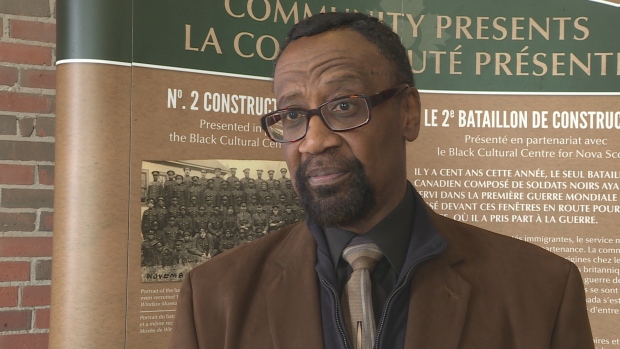
“When they were told ‘This is not your war, this is a white man’s war,’ they were in effect being told ‘This is not your country,” said Douglas Ruck.

‘Wall built of bigotry’

Ruck’s father, the late Senator Calvin Ruck, is credited for bringing the battalion’s untold story to the forefront when he wrote a book about their struggles. Douglas Ruck continues to act as a public speaker, championing their accomplishments.

Douglas Ruck

Douglas Ruck says its unimaginable that the Construction Battalion had to fight to represent a country that didn’t want them. (Carolyn Ray/CBC)

“They were in effect separated by the rest of the forces and the rest of the country by a wall,” said Ruck, drawing parallels to race debates ongoing in the United States.

“A wall built of bigotry, a wall built of prejudice, a wall built of irrational fears, a wall built of hatred.”

Saturday marks the 100th anniversary of the battalion’s departure to Europe. Even getting on the ship was a struggle. They were blocked from getting on their scheduled vessel because they were told they couldn’t travel with white soldiers.

Cultural history

Craig Smith, president of Nova Scotia’s Black Cultural Society, agrees that the timing of this anniversary is significant, coming days after the International Day to Eliminate Racism.

“If there was a time for us to need to come together, for the need for cohesion, the need to bring organizations together, now would be the time,” he said.

“It’s an amazing piece of cultural history in Nova Scotia, not just here, but one that resonates across the country.”

Source: 100 years ago today, Canada’s black battalion set sail for WWI and made history – Nova Scotia – CBC News

Proposed bill would allow undocumented immigrants to serve in military for citizenship | ABC10.com

The US has long had a process for immigrants to join the military and then have a pathway to citizenship. C-24 included a similar provision. This proposal takes it one step further:

A proposed bill would allow qualified young undocumented immigrants to serve in the military and earn citizenship in the United States.

U.S. Representative Jeff Denham (R-Turlock) re-introduced the Encourage New Legalized Immigrants to Start Training Act (ENLIST Act) this week.

The measure applies only to undocumented immigrants who were under the age of 15 when they were brought to the U.S. by their parents prior to 2012.

The ENLIST Act doesn’t guarantee children of undocumented immigrants would be accepted into the military. Applicants still have to meet strict military requirements including speaking English, passing a background check and having a high school diploma.

Denham first introduced the ENLIST Act in 2013. He served with many immigrants during his 16 years in the Air Force where he participated in Operations Desert Storm and Restore Hope.

Denham told ABC10, his history of serving in the military is one of the reasons which inspired the ENLIST Act. He stressed the importance of acknowledging immigrants’ long time role in the U.S. military.

“We have a history over the course of our country,” Denham said.

The congressman also said he’s pushing for immigration reform because the U.S. needs an overall immigration solution to the broken system.

“We need to have a broader discussion about Dreamers,” Denham said in reference to undocumented immigrants who arrived to the U.S. as children and assimilated into American culture, as well as attended U.S. schools.

Denham explained the need to address what happens to this group after high school. While some may advocate for sending children of undocumented immigrants back to their country of origin, the congressman said the U.S. is the only country this group knows.

Source: Proposed bill would allow undocumented immigrants to serve in military for citizenship | ABC10.com

Iran’s Surprising New Foreign Legion

Ironic. Follows US approach of granting preference to those who serve in the military, which Canada also adopted in the 2014 Citizenship Act changes:

Proposed amendments to Iran’s Civil Code under the name “Facilitating Naturalization of non-Iranian Veterans, Warriors and Elites” will offer citizenship to foreigners who join Iranian military units—be it border patrol, militias confronting the so-called “Islamic State” in Iraq and Syria, groups involved with public order operations, or any of Iran’s less “official” military initiatives, including support for Hezbollah in Lebanon. Under the amendments, “revolutionary heroes” can become citizens without undergoing existing naturalization requirements.

Parliamentarians who signed the bill say those who “serve the revolution,” including people who have contributed to Iran’s scientific progress, will be entitled to easier access to the citizenship they deserve. Yet human-rights activists and lawyers say the amendments are part of a political and militaristic strategy to entice immigrants, who have resided illegally in the country since 1979, into fighting Iran’s proxy wars.

If passed, the amendment to Article 980 will allow a new working group—the Committee for Granting Naturalization to non-Iranian Veterans, Warriors and Elites—to decide if a non-Iranian “revolutionary” will be granted Iranian citizenship. The MPs who tabled the bill on January 12 include several conservative parliamentarians who are currently waiting for their amendment to be reviewed.

Who does this new law affect and what is it really trying to achieve?

“After the Soviet Union invaded Afghanistan [in 1979], the government of the Islamic Republic of Iran opened its doors to Afghans, arguing that Islam does not recognize any borders,” explains Shirin Ebadi, an Iranian human-rights lawyer and 2003 Nobel Peace laureate. “At that time, around 4 million Afghans came to Iran, but only around 10 percent of them managed to obtain residency permits.” The rest, she explains, remained illegally, and were thus denied basic rights which citizens enjoy. “At that time,” Ebadi continues, “Iran had begun an eight-year war with Iraq and was naturally in need of inexpensive labor. Iran took advantage of illegal Afghan workers to satisfy this need.” But when the war ended, the policy remained.

Source: Iran’s Surprising New Foreign Legion – The Daily Beast