US Army Is Discharging Immigrants Who Were Promised Citizenship

Ironically, Canada was inspired by the US in 2014’s C-24 citizenship legislation to provide a comparable path, one maintained by the current government:

The military is booting out immigrant reservists and recruits who enlisted with the promise of a path to citizenship, according to a AP report. Some said they are being discharged with little warning or explanation, and the Army and Pentagon said they could not comment due to pending litigation.

Last week Lucas Calixto, a Brazilian reservist who came to the U.S. when he was 12, filed a lawsuit against the Army, alleging that he was offered no reason for his discharge aside from “personnel security,” and given no chance to defend himself.

Immigration attorneys told the AP they know of around 40 other people who have been discharged under similar circumstances, or whose status is now questionable.

Immigrants have served in the U.S. military since the Revolutionary War, and there are roughly 10,000 serving currently. The immigrants facing discharge all enrolled in recent years as part of the Military Accessions Vital to the National Interest program, or MAVNI. The recruiting program, which was started under the George W. Bush administration, offered expedited naturalization to immigrants with much needed skills, including military specialists and people fluent in certain languages.

MAVNI came under attack from conservatives when President Obama made DACA recipients eligible, so the military added additional security clearances for recruits. The Trump administration added even more requirements, creating a screening backlog at the Defense Department. Last fall the Pentagon abruptly canceled the contracts of hundreds of immigrants still in the recruitment process, and a few months later the program was suspended.

GOP Congressman Andy Harris, who backed legislation to limit the program, said it should have been established by Congress, not via executive order. “Our military must prioritize enlisting American citizens, and restore the MAVNI program to its specialized, limited scope,” he said.

Immigrants must have legal status to enroll in the military, but now some fear that in addition to losing their military career they could lose their immigration status. An Iranian citizen with a graduate degree in engineering, who was recently discharged, told the AP that he was proud he was “pursuing everything legally and living an honorable life.”

“It’s terrible because I put my life in the line for this country, but I feel like I’m being treated like trash,” he said. “If I am not eligible to become a U.S. citizen, I am really scared to return to my country.”

Source: US Army Is Discharging Immigrants Who Were Promised Citizenship
USA: Fast Track to Citizenship Is Cut Off for Some Military Recruits – The New York Times

This US program inspired a comparable preference in Canada for citizenship applicants who had enrolled in the military in C-24:

Mohammed Anwar enlisted in April 2016 in the United States military through a program that promised him a fast track to citizenship. His ship date for basic training, expected within six months, was postponed twice. “It was common knowledge that there were delays because of new security checks,” said the 27-year-old Pakistani national, who lives in Jersey City.

Each month he donned a uniform and, as required, attended drill training with his Army Reserve unit in Connecticut.

Last week, Mr. Anwar got a call from his recruiter informing him that his enlistment had been terminated. “I was shocked, confused and angry that the United States government didn’t keep up with its commitment to me,” said Mr. Anwar, who was to work as a nurse.

The reason behind the decision to cut Mr. Anwar from the military remains unclear to him.

In the last week, recruiters have rescinded contracts for an unknown number of foreign nationals who had signed up for Military Accessions Vital to the National Interest, or Mavni, a program introduced in 2009 to attract immigrants with certain language and other skills that are in short supply into the armed forces.

More than 4,000 Mavni recruits have been in limbo since late last year, when the Department of Defense began introducing additional vetting. The protracted process has indefinitely delayed basic training for many enlistees, making it more difficult for recruiters to meet their targets. Recruiting stations are flooded with calls from many concerned that their lawful presence in the country could lapse while they await clearance.

“Emotionally, I can’t move forward with my life,” said Mr. Zhu, 27, who has master’s degrees in engineering from Columbia University and the University of Wyoming. “I am sure my contract is on the verge of being rescinded,” he added, because enlistees must report to training within two years of signing a contract.

Paul Haverstick, a Pentagon spokesman, confirmed that the Army must discharge recruits who have not shipped to initial military training within two years.

“Unfortunately, some Mavni recruits have been unable to complete the increased security screening required by the Department of Defense to ship to training within two years of enlistment,” he said, adding that the Army is still seeking ways to help those who have been affected.

“The Mavnis have become a huge problem for the recruiting command because they can’t ship out to their training until they complete mandated background checks,” said Margaret Stock, a retired lieutenant colonel in the Army Reserve who helped create the program. “If they can’t ship out, they aren’t doing the Army any good.”

Ankit Gajurel, a Nepalese mechanical engineer who enlisted in the Army Reserve in May 2016, recently had his training date postponed for the second time. But several of his references had been contacted by security officials, and he had been told by his recruiter that his “counterintelligence interview,” one of the last steps in the vetting process, would be scheduled for November.

100 years ago today, Canada’s black battalion set sail for WWI and made history

Part of our history:

They faced racism and discrimination, and they had to fight a battle at home before they could represent Canada in the First World War.

Now families of the so-called black battalion say the soldiers’ struggles carry new relevance, given the state of the world today.

Many black men were rejected from enlisting during the First World War because of the colour of their skin.

In 1916, Canada allowed them to form the No. 2 Construction Battalion based in Pictou, N.S. It was Canada’s first and only segregated military unit. Nearly half of the battalion’s 600 members were from Nova Scotia.

“When they were told ‘This is not your war, this is a white man’s war,’ they were in effect being told ‘This is not your country,” said Douglas Ruck.

‘Wall built of bigotry’

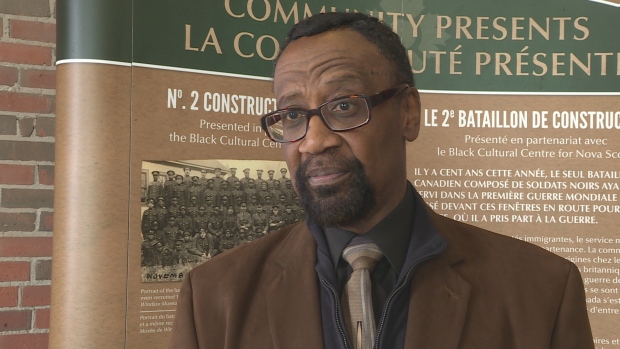
Ruck’s father, the late Senator Calvin Ruck, is credited for bringing the battalion’s untold story to the forefront when he wrote a book about their struggles. Douglas Ruck continues to act as a public speaker, championing their accomplishments.

Douglas Ruck

Douglas Ruck says its unimaginable that the Construction Battalion had to fight to represent a country that didn’t want them. (Carolyn Ray/CBC)

“They were in effect separated by the rest of the forces and the rest of the country by a wall,” said Ruck, drawing parallels to race debates ongoing in the United States.

“A wall built of bigotry, a wall built of prejudice, a wall built of irrational fears, a wall built of hatred.”

Saturday marks the 100th anniversary of the battalion’s departure to Europe. Even getting on the ship was a struggle. They were blocked from getting on their scheduled vessel because they were told they couldn’t travel with white soldiers.

Cultural history

Craig Smith, president of Nova Scotia’s Black Cultural Society, agrees that the timing of this anniversary is significant, coming days after the International Day to Eliminate Racism.

“If there was a time for us to need to come together, for the need for cohesion, the need to bring organizations together, now would be the time,” he said.

“It’s an amazing piece of cultural history in Nova Scotia, not just here, but one that resonates across the country.”

Source: 100 years ago today, Canada’s black battalion set sail for WWI and made history – Nova Scotia – CBC News

Proposed bill would allow undocumented immigrants to serve in military for citizenship | ABC10.com

The US has long had a process for immigrants to join the military and then have a pathway to citizenship. C-24 included a similar provision. This proposal takes it one step further:

A proposed bill would allow qualified young undocumented immigrants to serve in the military and earn citizenship in the United States.

U.S. Representative Jeff Denham (R-Turlock) re-introduced the Encourage New Legalized Immigrants to Start Training Act (ENLIST Act) this week.

The measure applies only to undocumented immigrants who were under the age of 15 when they were brought to the U.S. by their parents prior to 2012.

The ENLIST Act doesn’t guarantee children of undocumented immigrants would be accepted into the military. Applicants still have to meet strict military requirements including speaking English, passing a background check and having a high school diploma.

Denham first introduced the ENLIST Act in 2013. He served with many immigrants during his 16 years in the Air Force where he participated in Operations Desert Storm and Restore Hope.

Denham told ABC10, his history of serving in the military is one of the reasons which inspired the ENLIST Act. He stressed the importance of acknowledging immigrants’ long time role in the U.S. military.

“We have a history over the course of our country,” Denham said.

The congressman also said he’s pushing for immigration reform because the U.S. needs an overall immigration solution to the broken system.

“We need to have a broader discussion about Dreamers,” Denham said in reference to undocumented immigrants who arrived to the U.S. as children and assimilated into American culture, as well as attended U.S. schools.

Denham explained the need to address what happens to this group after high school. While some may advocate for sending children of undocumented immigrants back to their country of origin, the congressman said the U.S. is the only country this group knows.

Source: Proposed bill would allow undocumented immigrants to serve in military for citizenship | ABC10.com

Iran’s Surprising New Foreign Legion

Ironic. Follows US approach of granting preference to those who serve in the military, which Canada also adopted in the 2014 Citizenship Act changes:

Proposed amendments to Iran’s Civil Code under the name “Facilitating Naturalization of non-Iranian Veterans, Warriors and Elites” will offer citizenship to foreigners who join Iranian military units—be it border patrol, militias confronting the so-called “Islamic State” in Iraq and Syria, groups involved with public order operations, or any of Iran’s less “official” military initiatives, including support for Hezbollah in Lebanon. Under the amendments, “revolutionary heroes” can become citizens without undergoing existing naturalization requirements.

Parliamentarians who signed the bill say those who “serve the revolution,” including people who have contributed to Iran’s scientific progress, will be entitled to easier access to the citizenship they deserve. Yet human-rights activists and lawyers say the amendments are part of a political and militaristic strategy to entice immigrants, who have resided illegally in the country since 1979, into fighting Iran’s proxy wars.

If passed, the amendment to Article 980 will allow a new working group—the Committee for Granting Naturalization to non-Iranian Veterans, Warriors and Elites—to decide if a non-Iranian “revolutionary” will be granted Iranian citizenship. The MPs who tabled the bill on January 12 include several conservative parliamentarians who are currently waiting for their amendment to be reviewed.

Who does this new law affect and what is it really trying to achieve?

“After the Soviet Union invaded Afghanistan [in 1979], the government of the Islamic Republic of Iran opened its doors to Afghans, arguing that Islam does not recognize any borders,” explains Shirin Ebadi, an Iranian human-rights lawyer and 2003 Nobel Peace laureate. “At that time, around 4 million Afghans came to Iran, but only around 10 percent of them managed to obtain residency permits.” The rest, she explains, remained illegally, and were thus denied basic rights which citizens enjoy. “At that time,” Ebadi continues, “Iran had begun an eight-year war with Iraq and was naturally in need of inexpensive labor. Iran took advantage of illegal Afghan workers to satisfy this need.” But when the war ended, the policy remained.

Source: Iran’s Surprising New Foreign Legion – The Daily Beast

Why Are Only Three Observant Sikh Men Serving In The U.S. Military? : NPR

Interesting. US appears to be the exception, given Canada, UK and India all allow:

If a Muslim woman may wear a headscarf at work, as the U.S. Supreme Court has now affirmed, perhaps a Sikh man should be able to wear a turban while serving in the U.S. military.

So argues the Sikh Coalition, an advocacy organization that has long opposed a Pentagon ban on facial hair and religious headgear among service members. That campaign got at least a moral boost with this week’s court decision.

“What I’m anticipating with this decision is that we will have a move in this country to recognize the right of individuals from different religious backgrounds to live in an America that does not discriminate against them on the basis of how they appear,” says Simran Jeet Singh, the senior religion fellow for the Sikh Coalition.

As a general rule, the Department of Defense prohibits facial hair and the wearing of religious headgear among service members, though it offers “accommodation” on a case-by-case basis in recognition of “sincerely held beliefs.”

Such waivers, however, are given only when they would not undermine “military readiness, unit cohesion, good order, discipline, health and safety, or any other military requirement.”

In practice, those considerations can present major obstacles. Currently, just three observant Sikh men serve in the U.S. military, all in the Army, and all are in noncombat positions. That’s out of an active-duty military force of 1.4 million.

…Sikh men are currently allowed to serve with beards and turbans in the military services in Canada, the United Kingdom and India, among other countries, and they were permitted in the U.S. military until the early 1980s, when the policy was changed.

The U.S. Supreme Court, in a 1986 decision, upheld the military’s right to ban facial hair and religious headgear, finding that the military is a “specialized society separate from civilian society” and that to “accomplish its mission the military must foster instinctive obedience, unity, commitment and esprit de corps.”

That ruling would suggest that this week’s court decision upholding the right of a Muslim woman to wear her hijab headscarf does not apply to observant Sikh men wishing to wear a turban in the U.S. military, but it may nonetheless hold some political significance.

“The military has shown on many occasions that it is influenced by the court of public opinion and by social change,” says Eugene Fidell, a specialist in military law at the Yale Law School.

Why Are Only Three Observant Sikh Men Serving In The U.S. Military? : NPR.

Ottawa spends more on military history amid criticism over support for veterans

Seems a bit of a unidimensional celebration of Canada’s history in the lead-up to 2017:

The commemorative budget includes roughly $32-million for the Department of National Defence over seven years and nearly $50-million over three years at the Departments of Veterans Affairs for public education, ceremonies, events and remembrance partnerships, according to figures compiled by The Globe and Mail. The budget also includes several million dollars through the Department of Canadian Heritage, the figures show.

This funding is not a complete tally and is in addition to the tens of millions of dollars the Conservatives already dedicated to celebrate the 200th anniversary of the War of 1812, the conflict with the United States the government billed as “The Fight for Canada.”

National Defence has created a special program called “Operation Distinction” to oversee a spate of commemorations, chiefly important anniversaries of the First World War and Second World War. The initiative spans all the way to 2020, which will mark the 75th anniversary of the Second World War’s Victory in Europe Day and Victory over Japan Day.

Ottawa wants to use these occasions to build a “greater understanding that Canada’s development as an independent country with a unique identity stems in significant part from its achievement in times of war,” according to a January 2014 memo from Chief of the Defence Staff General Tom Lawson obtained under access-to-information law.

The government has made boosting appreciation of Canada’s military tradition a priority, in part to fashion a more conservative national identity. It’s cultivated an image as pro-military since taking power but in recent years has alienated a vocal group of veterans and their families, upset over what they consider insufficient federal support.

Ottawa spends more on military history amid criticism over support for veterans – The Globe and Mail.

And:

Return to old-style uniform insignia costs Canadian Forces millions

Pips and crowns? Mere defence diversions – The Globe and Mail

A ‘bread and circuses’ take on restoring some of the traditional, British-inspired military identity.

Pips and crowns? Mere defence diversions – The Globe and Mail.