Moffatt: Ontario experienced a decade’s worth of population growth in just three years. We can’t support that growth without building way more homes

More on housing pressures and noting the importance of curbing demand in terms of numbers of immigrants, permanent and temporary and current government changes (further reductions needed IMO):

…On the population growth side, the federal government has committed to lowering the number of non-permanent residents (NPRs), including international students and temporary foreign workers, living in Canada. They have committed to reducing the proportion of non-permanent residents to under 5 per cent of Canada’s population over the next three years, a reduction of nearly one million people. If achieved, it would ease pressure on rents and ensure that the students we are inviting to the country have the best possible experience while here. However, the Bank of Canada recently called into question the federal government’s commitment to their non-permanent resident growth targets, stating  “it will take longer for planned policies to reduce NPR inflows to achieve the 5% target”. The federal government must release a credible plan, or risk having Ontario’s population grow faster than the housing supply.

Ontario’s housing crisis can be fixed. We have the solutions on both the supply and demand sides, many of which governments have already committed to implementing. They simply need to do so.

Source: Ontario experienced a decade’s worth of population growth in just three years. We can’t support that growth without building way more homes

ICYMI: Douglas Todd: Why Vancouver housing prices became so out of whack

Not much new but neverthelesss telling:

Prices in Canada’s major cities have also been growing extremely fast compared to other countries.

The U.S. Federal Reserve Bank of Dallas, which monitors global economic trends, reports that Canadian housing prices since 2015 have skyrocketed roughly twice as swiftly as prices in the U.S., United Kingdom, Germany and France.

Why? Even the stodgy Bank of Canada, which is hard to accuse of being racist, in January acknowledged that the country’s rapid population growth, 98 per cent of which comes from international migration, has led to higher costs for housing.

The National Bank of Canada’s chief economist, Stefane Marion, is also among the many voices lamenting how years of welcoming record-breaking numbers of new residents is strongly contributing to inflation, especially of shelter costs and rents.

Unfortunately, many politicians and the development industry obfuscate the issue by putting virtually all the blame for lofty prices on a lack of supply, plus mortgage rates and bureaucratic red tape.

But a host of housing analysts, such as Steve Saretsky, John Pasalis, Ron Butler, Stephen Punwasi, Ben Rabidoux, Patrick Condon, Mike Moffat and others, counter that Canadian developers, especially in Metro Vancouver, have been building new housing at a frantic rate — yet still cannot come close to keeping up with demand.

That demand has been exacerbated ever since 2015, when newly elected Prime Minister Justin Trudeau began to crank up targets for new permanent and non-permanent residents to rates far more intense than any other Western country. Last year, Canada’s population grew by a record 1.25 million people because of it.

Meanwhile, a huge cohort of people in Canada who seek a place to live at a reasonable price, including many newcomers, continue to suffer.

For Metro Vancouver, it all adds up to a double whammy: The gateway city has its own distinct house-price problems, and it’s located in a country that compounds them.

Source: Douglas Todd: Why Vancouver housing prices became so out of whack

Douglas Todd: Canadian taboo against debating migration policy is basically over

Yes, having been another of the earlier questioners:

Seven years ago, Simon Fraser University political scientist Sanjay Jeram perceptively said that Canada was one of the last countries in the world where it is not permitted to discuss migration policy.

“The hidden consensus in Canada is that we don’t talk critically about immigration. The taboo against discussing it is very real,” said Jeram, who has a PhD from the University of Toronto, the city in which he was born and raised.

“Prime Minister Justin Trudeau campaigned on openness to immigration without limits,” Jeram said at the time. “I have never heard him talk about the potential consequences that immigration has for overcrowding, housing, opportunities for domestic-born workers, or the welfare state.”

The Canadian housing squeeze was on the top of Jeram’s must-be-discussed list in 2017, since many in Metro Vancouver, Toronto, Victoria and other cities were enduring an escalating affordability crisis. They still are.

The difference is that in the past six months the unspoken taboo against openly talking about migration issues has been mostly broken in Canada.

That is judging by what’s coming from prominent housing analysts, mainstream media coverage, and new polls by Leger, Environics and Abacus. We’re starting to become like most other nations.

Canada’s population grew by almost three per cent in the one-year period ending July 1, 2023 — bringing in 1.2 million, causing catapulting population growth that far exceeds earlier projections.

Many of the newcomers are among this year’s batch of almost 500,000 permanent residents, but most are temporary students and guest workers. The number of such non-permanent residents in Canada now totals 2.2 million.

Even Trudeau’s Liberal government, which was always quick to silence migration skeptics with often-unfounded accusations of xenophobia, is showing hints it might reduce its record-high migration rates, at least in regard to study visas.

Polls confirm most Canadians believe new arrivals offer advantages to the country, which shows they are not concerned about immigrants themselves. The issue, instead, is Ottawa politicians’ actions on migration, which are unilaterally decided without debate in the House of Commons, and which lack any sort of coherent plan.

A new Abacus poll is among those showing the number of Canadians who believe immigration rates are too high has jumped to 67 per cent, up seven percentage points from July.

This negative view is shared by 62 per cent of residents born outside Canada.

Overall, women were most worried. And even 61 per cent of Liberal voters said rates were too high. Just two per cent of Canadians believed migration levels were “too low.”

One issue stood out. Abacus found seven in 10 respondents felt the number of immigrants was having a negative effect on “the cost and availability of housing.”

A smaller cohort, 53 per cent, believe the high volume was having a negative affect on “access to health care,” and 51 per cent felt that way in regard to “congestion and traffic.”

In most countries, there is little migration debate, but not for the reasons many Canadians may think. The relative silence is because most countries take virtually no immigrants — including Japan, China, Turkey and Brazil.

Shelter costs are the main concern behind rising migration concerns in Australia, New Zealand, Britain and even France, with all these governments instituting major policy changes recently.

This week, Australia’s ruling Labor Party said the country’s immigration system is “broken” — contributing to a growing housing crisis and soaring rents. Prime Minister Anthony Albanese will slash record intake levels to 250,000. Visa rules for international students and low-skilled workers will be tightened, and fees on foreign investors in housing will triple.

New Zealand Prime Minister Christopher Luxon has also said his country’s migration totals are “unsustainable.” And British Prime Minister Rishi Sunak this month took to social media to announce cutting future intake by 300,000 people a year, saying, “Immigration is too high. Today we’re taking radical action to bring it down. These steps will make sure that immigration always benefits the U.K.” The French government of Emmanuel Macron, in addition, is engaged in a high-profile legislative attempt to better integrate newcomers.

What of Canada? The nation’s new immigration minister, Marc Miller, was talking tough last week against a backdrop of nationally soaring rents.

He promised to require foreigners applying to study in Canada to have double the amount of funds currently required. He also threatened to shut down “unscrupulous” educational institutions. We can only wait to see if anything comes of Miller’s pledge.

Despite all this political action on the migration file, however, some observers say the taboo against criticism might not have completely vanished.

Their example is the way Conservative party leader Pierre Poilievre this month launched a 15-minute video titled “Housing Hell,” which has been viewed by more than four million people. It lambastes the Liberals on housing unaffordability, but doesn’t mention the demand pressure caused by population growth.

Why dodge the obvious? Riding high in the polls, it’s possible Poilievre didn’t feel it necessary to directly cite what observers in the past called Canada’s “third rail” of migration. When ahead, why would Poilievre take even the increasingly small risk of handing opponents a wedge issue?

Poilievre’s reluctance, however, has definitely not stopped the country’s most listened-to housing analysts — such as Ben Rabidoux, Steve Saretsky, John Pasalis, Ron Butler, Stephen Punwasi, Mike Moffat and others — from leading the way on scrutinizing the evidence on the impact of migration.

And even though bank economists are among the most cautious in the world, in the past year many have had said affordability will not return without big changes. “Unless Ottawa revises its immigration quotas downward, we don’t expect much relief for the 37 per cent of Canadian households that rent,” said economist Stefane Marion of the National Bank.

Every week, responsible economists, scholars, pundits and even some politicians are now making similar statements. If that doesn’t turn migration policy into a valid issue for respectful discussion in Canada, what will?
Source: Douglas Todd: Canadian taboo against debating migration policy is basically over

Clark: The Liberal housing plan is overdue

Indeed. As it is for an annual immigration plan that includes temporary workers and international students:

You have to agree with Housing Minister Sean Fraser’s assertion that the answer to Canada’s housing crisis isn’t new political branding. Still, it would be nice if the federal government had a plan.

The good news is there are signs that the Liberal government is putting together what could be the rudiments of a plan. But it needs an actual plan. And it needs to come to grips with the screaming urgency.

So perhaps the best exercise for the Liberal cabinet retreat taking place in Charlottetown this week would be having all ministers dip their heads in vats of ice water before and after their briefings about the housing crisis. You know, so everyone there feels the kind of shocking wake-up call that should be motivating them now.

It sounded promising when Mr. Fraser, freshly appointed as Housing Minister on July 26, outlined some of the government’s thinking about increasing the housing supply – and even said he thinks the government is thinking of capping the rapidly increasing number of international students coming to Canada. But then he said a decision on that is “premature” right now.

The problem is that Mr. Fraser is mixing up the concepts of “premature” and “overdue.”

The feds have missed a window to cap – and reduce – those numbers for this school year.

Let’s note here that Mr. Fraser is quite right when he says that we should be careful not to “somehow blame immigrants for the housing challenges that have been several decades in the works in Canada.”

That’s absolutely true. We should blame governments. They failed to plan.

Immigration itself isn’t the cause of the problem: It is good for Canada, and international students can be an especially good thing. But successive governments, federal and provincial, encouraged a boom in numbers, especially international student numbers, without planning policies to encourage housing for them.

One of the people briefing the Liberal cabinet Tuesday was economist Mike Moffatt, who has been doing the academic equivalent of waving his arms trying to get governments to pay attention to the problem. “We are in a crisis and a war-time-like effort is needed. The federal government must prioritize speed and act now,” he wrote in The Hub this week.

Mr. Moffatt’s diagnosis boils down to the fact that the population grew quickly in recent years, especially in Ontario, but the pace of home-building was a lot slower. Few places for a lot more people means house prices and now apartment rents skyrocketed.

The rapid population growth went a little under the radar because it was not just an increase in permanent immigrants. The number of temporary residents has ballooned. In 2015, there were 352,325 international students. In 2021, the number was 617,250. The following year, 2022, it was 807,260. But there weren’t a lot more student residences and apartments for rent.

Now the Canada Mortgage and Housing Corporation estimates Canada needs to build 5.8 million homes by 2030 to make housing affordable again. So it’s good the Liberals are talking about policies to encourage more home-building. Mr. Fraser unironically noted that the Liberals campaigned on some of them in the past two elections. In fact, they promised to remove the GST on purpose-built rental housing back in 2015. It’s time to step it up.

It’s true successive federal governments are to blame. Municipal administrations and provincial governments are to blame for a lot of it, too. All for a lack of planning.

Now the plan is urgent, and it will have to include short-term measures like cutting back the number of international students. A government that doesn’t craft such a plan will create more poverty and damage many Canadians’ standard of living. And despite Mr. Fraser’s words, it is not at all clear Prime Minister Justin Trudeau’s cabinet is shaking off the complacency.

Intergovernmental Affairs Minister Dominic LeBlanc said he hadn’t heard talk of the idea of capping the number of international students and hasn’t spoken to premiers about it.

Mr. Trudeau, who was criticized three weeks ago for saying housing is not a primary federal responsibility, provided a nonsensical explanation for that on Monday when he said his point was that his Conservative predecessor, Stephen Harper, had “completely walked away from housing.”

And sure, we have to expect politicians will make points about politics. But this is a bigger issue now, and it’s time to pull together a plan.

Source: The Liberal housing plan is overdue

Clark: Go big or go home on housing, Mr. Trudeau

As well as “going smaller” on immigration given the increased pressure and demand on housing:

Maybe it was just a coincidence that the new federal Housing Minister, Sean Fraser, told the press he’d be taking the train to an announcement in Burnaby, B.C., on Monday.

But Conservative Leader Pierre Poilievre had been talking about building housing next to train stations in a social-media video he posted Saturday that garnered over two million views and won plaudits from housing experts.

That made Mr. Fraser’s arrival on the SkyTrain to talk about housing seem a little late. That’s a recurring problem for the Liberals.

The biggest, loudest, most obvious political issue in Canada is the high cost of housing. Yet Prime Minister Justin Trudeau’s Liberals have been slow to see it build. And they still haven’t matched the public’s angst with governing ambition.

That’s baffling, if only because of the politics. Mr. Poilievre has been banging the housing issue like a drum for a year and half, striking a chord with couples who can’t afford a house and folks facing skyrocketing rents. NDP Leader Jagmeet Singh is now making it his theme in tour stops, too. And housing is a top-of-mind concern for many in cities and suburbs – and that’s core Liberal electoral geography.

Mr. Trudeau likes big policy initiatives in areas like child care or clean energy, yet he has sounded pretty ambivalent about housing lately. A few weeks ago, he backed into a vague answer about Ottawa’s plans with an assertion that much of the problem is in provincial jurisdiction, not federal.

But it should be obvious that Mr. Trudeau has to expand the scale of federal housing policy to another level.

Former Liberal policy adviser Tyler Meredith argues Mr. Trudeau should go big: by bringing the federal government back into funding large-scale development of affordable housing, creating tax incentives for residential building, adjusting infrastructure programs and policies in areas such as immigration and banking. Then, he suggests, the PM should call provincial premiers to a national housing summit.

Mr. Meredith wants to see the Canada Mortgage and Housing Corporation put tens of billions of dollars into developing affordable housing, noting that can be done without a major impact on Ottawa’s budget deficit or net debt, because Ottawa will own the buildings as an asset. It doesn’t have to be a landlord: It might lease those houses to non-profit organizations.

Policy thinkers have already proposed a number of solid, relatively low-cost ways to change the tax system to provide incentives to build – and acting on such things now should be a no-brainer.

One is eliminating the GST on purpose-built rental housing, which should seem like a good idea to Mr. Trudeau because it was in his 2015 Liberal election platform. Another, proposed by economist Mike Moffat and former Stephen Harper adviser Ken Boessenkool, working with the Smart Prosperity Institute, is more generous tax treatment for depreciation of residential buildings. Those two measures would cost the treasury relatively small sums.

Both the Liberals and the Conservatives have proposed using infrastructure spending as a lever to get municipalities to permit more building. Mr. Poilievre has called for Ottawa to withhold funds from cities that don’t approve housing projects quickly, while the Liberals have created a $4-billion “housing accelerator fund” to encourage towns to speed up the process.

And it’s pretty clear money will talk: Municipalities will be reluctant to lower the costs they charge to developers unless someone – Ottawa or the provincial government – replaces the revenue.

Mr. Meredith also thinks the Prime Minister should call premiers to a national housing summit, because a lot of the obstacles are at the provincial or municipal level, from building rules and permits to fees. Provinces are responsible for municipal governance.

Usually, prime ministers are wary of such summits as premiers tend to come to them with demands. But the cynical political calculation could be different for a prime minister launching major federal housing initiatives and inviting premiers to join the mission. It could shift some of the political pressure to act back to the provinces.

At any rate, Mr. Trudeau has reached a point where he has little time to catch up to the urgency many Canadians feel. The alternative is to roll out small initiatives and argue his government has done enough, and that means missing the train on the country’s hottest political issue.

Source: Go big or go home on housing, Mr. Trudeau

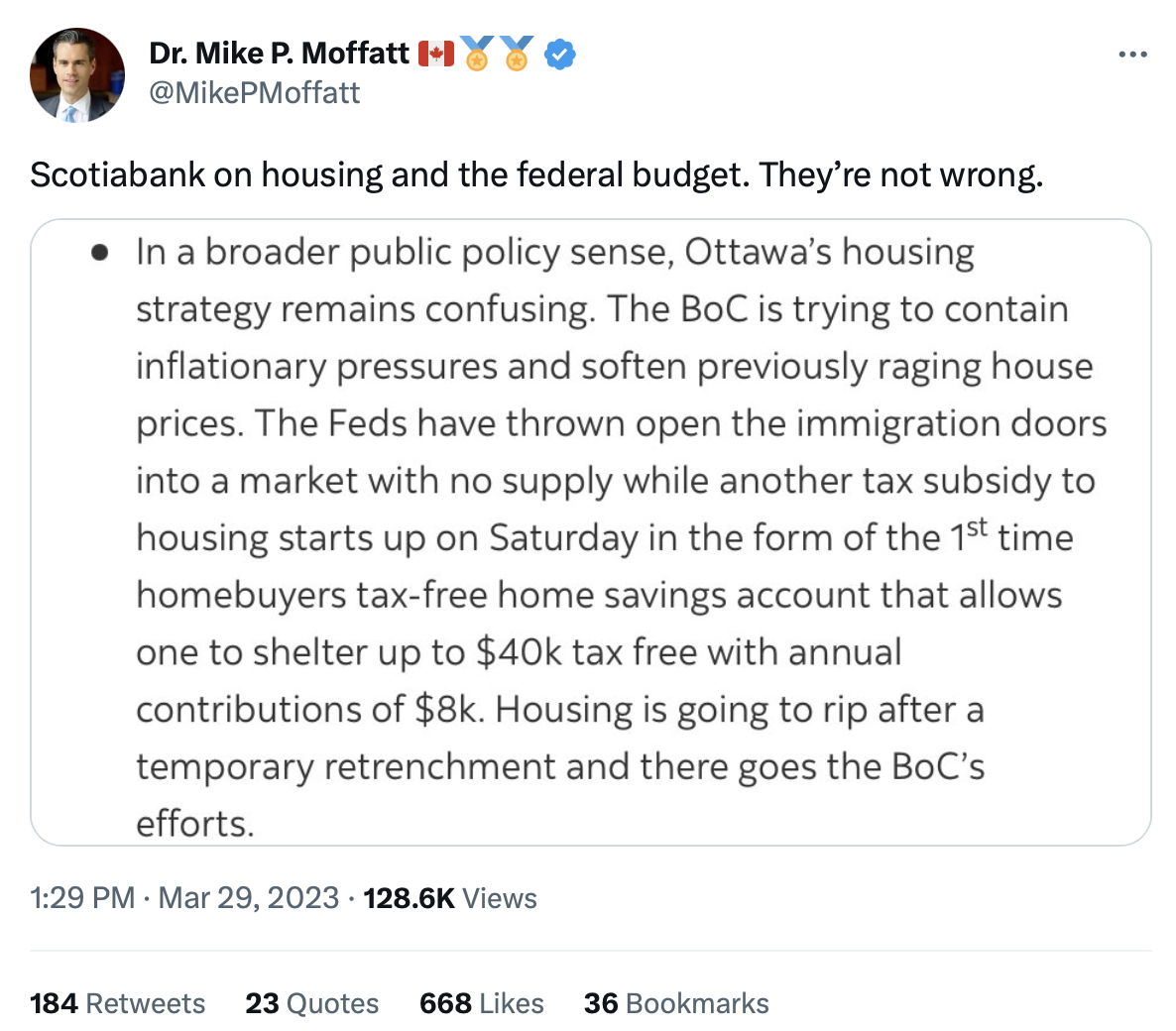
Moffat on disconnect between immigration policy and housing:

Captures the contradiction and policies working at cross-purposes:

Source: https://twitter.com/MikePMoffatt/status/1641130382425833632?s=20

Canada’s hardest-hit economies need immigration to thrive again: Moffat

Mike Moffat on the need to remove the need for a Labour Market Impact Assessment for graduates of Canadian universities in Express Entry point scoring (another issue is to restored pre-Permanent Resident credit towards citizenship residency requirements for international students as was done prior to the 2014 changes in the Citizenship Act):

So how can London, Windsor, St. Catharines et. al. increase their population of talented twentysomethings? The region does an excellent job of importing talent as our institutes of higher education are worldwide magnets for young achievers. In London, Western and Fanshawe bring in some of the most gifted students in the world, teach them skills highly in demand in the region while they become familiar with Canadian culture. We then allow these graduates to stay in the country for a period of up to three years via Canada’sPost-Graduation Work Permit Program(PGWPP); tech companies Darren Meister, Kadie Ward and I interviewed in London told me how incredibly valuable these workers are.

They also told us that, despite these workers having graduated in Canada and being in the country around seven years, the Federal government makes it difficult (and some cases impossible) to keep them in the country. They are sent back home, and London has fewer talented young workers.

The issue stems, in part, from year-old changes to Canada’s express entry system which makes it impossible for someone in the PGWPP program to gain express entry without a Labour Market Impact Assessment, as chronicled by Nicholas Keung:

“The problem, which the federal government denies, lies in the significance given to a certificate called the Labour Market Impact Assessment (LMIA). It is issued by Ottawa to ensure a candidate’s skills are sufficiently in demand to warrant hiring an immigrant.

Ottawa says applicants for Express Entry, such as international graduates, do not need an LMIA to qualify. But Express Entry acceptance is based on a point system and it’s not possible to earn enough points without an LMIA, immigration experts say.

“The new system is flawed,” said Toronto immigration lawyer Shoshana Green. “We want people who went to school and have work experience in Canada. These people are already fully integrated. And now we are ignoring them. It is just bizarre.””

The process to obtain a LMIA is arduous for smaller growth companies, and navigating it can be difficult, as immigration lawyerRonalee Carey describes:

“Last month I sent a young woman back to Japan. She’d come to Canada as an international student first to finish high school, then to attend Sheridan College in their Animation Program. Her employer consulted me after their Labour Market Impact Assessment (LMIA), because her position was denied. They had been paying her the median wage for Ontario, as opposed to Ottawa, which was slightly higher. Meanwhile, they had no idea there were median wages specific to Ottawa. They offered her a raise and resubmitted the LMIA application.”

But it was too late.

The young woman had been working on a post-graduate work permit. It had expired, and she’d applied for an extension. However, a positive LMIA was required for the extension. Ultimately, her work permit application was denied, because the new LMIA application had not yet been processed.

And so on the plane she went.

These stories are all too common according to the tech firms I have spoken to. In order to obtain an LMIA, one must prove to the federal government that “there is a need for the foreign worker to fill the job you are offering and that there is no Canadian worker available to do the job.” Not only does this place a large burden on growth companies to convince a bureaucrat about the lack of Canadians for the position, it is also completely counterproductive for communities where there is a desperate need for young talent. Furthermore, it may be impossible for these companies to prove this point to the government’s satisfaction. As immigration lawyer Evan Green asked the Globe and Mail, “…how do you prove for someone with [little] work experience that there is no Canadian to do the job?”

Southwestern Ontario is desperate for economic growth from startups. Startups are desperate for these talented workers. These workers are desperate to stay in Canada. Yet we are kicking them out. It makes absolutely no sense. If the federal government truly wants to help London and the rest of southwestern Ontario, the place to start is to recognize the region needs talented young people and to reform the Express Entry system to allow us to keep more of our graduates.

Source: Canada’s hardest-hit economies need immigration to thrive again