A Yazidi Refugee Family In Canada: When Safe Harbour Isn’t Enough

Good long read by Naomi Buck on the needs of Yazidi refugees.

Bringing them to Canada by itself not enough given the ongoing effects of their trauma and consequent need for more supports. German model of particular interest:

….It’s tempting to assume that survivors of war and displaced persons’ camps would be grateful for the relative safety of a hotel room in Canada. But the Dasnis didn’t know they were safe. All they knew was what they didn’t know: where to find food, how to use the television, whether hotel staff could be trusted, who or what would come next.

“We cried for two days,” Adiba recalls. “It was worse than in the camps. Our cellphones didn’t work, we couldn’t communicate with anyone. My nephew stopped eating. I thought he was going to die.”

On the third day, there was a knock on the hotel room door. Adiba’s older sister, Hadiya, answered. The man introduced himself as Hayder Essw. He was the first person in Canada to speak to them in their native Kurdish dialect. Hadiya’s first words to him were: “Please take us back to Iraq.”

Essw was there to help, but he wasn’t a caseworker or government employee. He’s a member of the tight-knit Yazidi community in Toronto, a volunteer who, since the first Yazidi refugees began arriving in early 2017, has spent much of his time tracking newcomer arrivals.

Essw reassured the women that things were going to be all right. Now that they had been “discovered” by the community, help would begin to flow. And it did.

It came from the government, in the form of financial support and health care coverage, as it does for all government-assisted refugees. But the arduous process of the Dasni family’s settlement has fallen largely to volunteers. This kind of civic engagement reflects well on Canada, providing such volunteers exist and, importantly, have the newcomers’ best interests in mind. But it’s leaving a lot to chance. And it raises critical questions about the government’s ability to meet the needs of a brutally traumatized people. As Jan Kizilhan, a German expert on trauma and the Yazidi, puts it, “It’s not enough to just offer them a safe country.”

Yes, the Canadian government provides Yazidi refugees with free health care, but who finds them a doctor and shows them how to get there? Yes, ESL classes are free, but who helps them make sense of Canadian customs and culture? The government prides itself on taking in a “vulnerable population,” but who makes sure they are getting the help they need to come to terms with their past? Without that, they can’t begin to shape a future.

Over the course of several visits spanning four months, Adiba tells me her story. It’s hard, but she’s determined. She wants the Canadian government to do more for her people. She can’t let go of her relatives back in Iraq — in camps, in captivity or whereabouts unknown.

The family now lives in a randomly furnished bungalow — the lamps are still wrapped in cellophane, a Canadian flag hangs on the wall — on a quiet suburban street north of Toronto. Hadiya, the mother of six, runs the household; she is perpetually cleaning or cooking. There are two constants to our visits. One is her offer of sweet black tea or food from her busy kitchen. The other is Majed El Shafie.

El Shafie, a stocky 40-year-old with plump jowls and a quick smile, is the founder and director of the Toronto-based human rights organization One Free World International. With his bespoke suits and buffed leather shoes, he seems out of place in this modest suburban setting, but Adiba insists he be here for our meetings. “Without him, we would go back,” says Adiba, speaking through a translator. “He is the only one who is helping us with everything.”

…El Shafie prefers not to discuss the details of Adiba’s release in her presence, but he put up half of the US$15,000 price tag and has promised to compensate Adiba’s father in full. Sitting in the downtown office of One Free World International, he speaks openly about the bleak — and controversial — business his organization has entered: buying back ISIS slaves. “That was the going price at the time,” El Shafie says, referring to the ransom. “It keeps going up…. But we’re talking human lives here.”

For El Shafie, freedom of religion must be defended at any cost. According to its website, his organization is active in 28 countries around the world and he is drawn to extreme cases, like that of the Yazidi. The mission is personal. Born into a prominent Egyptian family, he was imprisoned and tortured in Hosni Mubarak’s Egypt for publicly converting to Christianity and promoting the faith. After escaping to Israel, he came to Canada as a political refugee in 2002.

Since the 2014 massacre, El Shafie has been working with Kurdish partners on the ground in Iraq to help Yazidi families buy back their daughters, sisters and wives. He estimates that One Free World has helped to pay, in part or in whole, for the release of 600 women. The funds come from donations to his organization, from fees from his speaking engagements and out of his own pocket.

When he is not meeting with officials in Brussels or Washington, or visiting a war zone, El Shafie spends much of his time with the Dasnis and roughly 20 other Yazidi families newly arrived in Toronto. He sees himself as a kind of godfather to the Dasnis. Some of what he has provided might be considered frills: outings to Canada’s Wonderland, Niagara Falls and Toronto’s harbour, which the sisters cite as the highlights of their time in Canada. But he has also played, in practice if not on paper, the roles of settlement worker and social worker: finding the family a house, acting as guarantor on the rental agreement, providing cash infusions for several months until government benefits kicked in, sourcing doctors and specialists, intervening at the local school and attending to personal emergencies.

“Freeing them was one operation,” he says. “But what they face now is tremendously difficult: the stigma, the shame, the memories.” He has lobbied Ottawa forcefully, appearing before and making submissions to the House of Commons immigration committee, asking the government to boost aid to the camps, bring more Yazidi into Canada and provide better mental health support once they’re here.

Germany, home to the largest population of Yazidi outside of Iraq, was the first jurisdiction to focus an aid program on the women and children who had escaped sex slavery. Beginning in early 2015, a small German delegation travelled to camps in the region, screening former ISIS captives for the Special Quota Project, an unprecedented program that brought 1,100 women and children to the southern German state of Baden-Württemberg, where they were given protected housing and intensive medical and psychological treatment. After three years, they can choose to stay in Germany or return to Iraq.

…It’s a question architects of refugee policy grapple with constantly: Who needs it most? And who decides what those people most need?

Jan Kizilhan has spent the last few years finding answers. As the chief psychologist on Germany’s Special Quota Project, the 51-year-old was tasked with selecting which 1,100 Yazidi women would come to Germany for treatment. He interviewed every single one of them and has supervised their therapy in Germany over the last three years.

“The Yazidi suffer intergenerational, secondary and collective traumata,” he says over the phone from his office at the Baden-Württemberg Cooperative State University of Villingen-Schwenningen. “Their treatment requires a high degree of specialization.”

Kizilhan, the grandson of Yazidi killed by Kurdish Muslims in Turkey, emigrated to Germany in the 1970s. His expertise is unique, and Canada’s parliamentary immigration committee consulted with him via video conference in November 2016 while IRCC was formulating its plan for the Yazidi. Having been very clear about the importance of addressing their psychological needs, Kizilhan has been perplexed to hear from colleagues and friends in Canada that therapy is playing a minor role, if any, in their settlement. “If you don’t help these people with their health, they have no hope of integrating,” he says. “Mentally, they are not in Canada, they are still in Kurdistan, in Iraq.”

IRCC turned down a request for an interview for this article, but department spokespeople responded to questions by email. They emphasized that the Yazidi “are a very vulnerable population” and that the government is “conscious of not doing anything that may re-victimize or re-traumatize them.” They also stated that “all resettled refugees are linked to appropriate support services,” and that their health coverage, the Interim Federal Health Program, covers 10 hours of counselling sessions, with the possibility of more, if required. More recently, an IRCC spokesperson added that “the department is following families closely,” and that staff meet weekly to discuss how the families are adapting.

via A Yazidi Refugee Family In Canada: When Safe Harbour Isn’t Enough
Tories Push Trudeau To Keep FGM Warning In Citizenship Guide

Of course, the citizenship guide should maintain a reference to FGM.

But this needs to be placed in the broader context of violence against women and the history of how Canadian society has evolved in terms of women’s rights, definition of sexual assault, employment equity and the like, not just with an identity politics bumper sticker of “barbaric cultural practices”:

Federal Conservatives are pressuring the Liberal government to ensure that the final draft of the new citizenship guide includes a warning that female genital mutilation (FGM) is a crime in Canada.

Prime Minister Justin Trudeau did not speak to the guide when pressed about the issue in question period Wednesday, but said he is committed to ending the “barbaric practice” around the world.

Tory immigration critic Michelle Rempel noted in the House of Commons that the United Nations Entity for Gender Equality and the Empowerment of Women — better known as UN Women — tweeted about FGM as part of its “16 days of activism.”

The UN group called FGM — the intentional cutting of female genital organs for non-medical reasons — a human rights violation that has been perpetuated against 200 million women and girls.

“Canada’s citizenship guide informs newcomers that FGM is a crime in Canada. However Canada’s prime minister has decided to delete this information,” Rempel charged.

The MP was referencing a working copy of the new citizenship guide the government is preparing. The draft, which was obtained by The Canadian Press in the summer, reportedly omits lines stating that certain “barbaric cultural practices,” such as FGM and honour killings, are illegal in Canada. The previous Tory government included those warnings in their overhauls of the guide.

Rempel urged Trudeau in the House to stand with FGM survivors and the UN by reversing what she called his “decision.” She made similar comments on Twitter shortly after question period.

Trudeau responded that he “personally brought up this issue” during a visit to Liberia last year, “challenging local leaders and governments to step up on the fight against FGM.”

Then he said something that drew an immediate reaction from Tories.

“We will continue to lead the way pushing for an end to these barbaric practices of female genital mutilation everywhere around the world. This is something… and here in Canada… this is something we take very seriously.”

Tories bashed Trudeau over comments in 2011

The use of the word “barbaric” harkens back to a controversy in 2011, when Trudeau was serving as the immigration critic of the then-opposition Liberals. He initially took exception to the way the Tories’ revamped citizenship guide described honour killings as “barbaric.”

Trudeau said at the time that the government should have instead called all violence against women “absolutely unacceptable” and made a better “attempt at responsible neutrality.” Top Tories, including then-immigration minister Jason Kenney, relentlessly blasted Trudeau over his remarks.

Trudeau later apologized and retracted his initial take on the guide.

“I want to make it clear that I think the acts described are heinous, barbaric acts that are totally unacceptable in our society,” he said in a statement at the time, according to CBC News.

The debate over so-called “barbaric cultural practices” also factored heavily in the 2015 election, when the Tories famously pledged to create a tip line for Canadians to call if they suspected a child or woman could fall victim to forced marriage, FGM, or polygamy. Liberals said then that the Conservatives’ campaign pledge was really about stoking “fear and division.”

PM brings up lessons from 2015 election

Trudeau referenced that ill-fated Tory promise in the House Tuesday while responding to Conservative questions about how his government is handling suspected ISIS terrorists after they return to Canada. The prime minister said Tories have learned nothing from the results of the last federal vote.

“They ran an election on snitch lines against Muslims, they ran an election on Islamophobia and division, and still they play the same games, trying to scare Canadians,” Trudeau shouted.

“The fact is we always focus on the security of Canadians, and we always will. They play the politics of fear, and Canadians reject that.”

via Tories Push Trudeau To Keep FGM Warning In Citizenship Guide

John Ivison: Liberals braced for another ’huge wave’ of illegal asylum seekers from U.S.

Good analysis by Ivison of some of the issues involved but no easy solutions.

Comes out at same time as IRCC annual tracking survey, showing a small but significant increase in those believing immigration levels too high (27 percent vs 23 percent a year earlier) and a small increase, but within the margin of error, of those who believed too many refugees were coming to Canada (32 percent vs 30 percent) – see Federal government immigration poll suggests hardening attitudes:

You have to feel sorry for the 300,000 Central Americans and Haitians in the United States covered by temporary protected status, who look likely to be deported in the next year or so.

The Trump Administration said Tuesday Nicaraguan nationals must leave by January 2019, and that it is seeking additional information on whether to end TPS designation for Hondurans.

The writing would also appear to be on the wall for 50,000 Haitians, who see their protected status end in January, and 200,000 El Salvadoreans, who lose their status next March.

The situation demands compassion – some of the affected people had been allowed to live and work in the U.S. for 20 years.

But it does not mean Canada should step up and offer social assistance, education, health services, emergency housing and legal aid to any asylum seekers who feel like wandering across the border within sight of an official port of entry.

The Liberal government looks set to be swept up by a second wave of illegal asylum seekers along the Quebec border – the direct result of meek acquiescence to U.S. policy.

Both Canada and the U.S. signed the Safe Third Country Agreement that means refugees claim asylum at the first point of entry. If that happens to be in the U.S., then they can’t claim asylum in Canada, unless they have a blood relative here or are an unaccompanied minor.

But the agreement does not apply to claimants who enter Canada at a location that is not a point of entry.

That is why over the summer, 13,000 mainly Haitian refugees crossed illegally near the Saint Bernard-de-Lacolle border station and promptly gave themselves up to the RCMP.

The numbers slowed down from around 200 people a day to 60-70, according to Jean-Pierre Fortin, president of the Customs and Immigration Union. But he says the processing system is already “plugged” – and now the U.S. Administration has signalled its intentions, he expects a “huge wave”.

“We’re talking about a major crisis,” he said.

Jason Kenney, the leader of the United Conservative Party in Alberta and a former federal Immigration minister, said he pushed the Obama Administration to close the loophole that allows asylum seekers to flaunt the Safe Third Country agreement.

The request was refused, in part Kenney believes because the U.S. sees it an avenue for illegal aliens to deport themselves.

Michelle Rempel, the Conservative immigration critic, raised the issue with Ahmed Hussen, the Immigration minister, at committee last month. She asked if Hussen had broached the subject with his U.S. counterpart.

“We haven’t done that,” Hussen conceded.

But if Canada doesn’t challenge a loophole that undermines the spirit of the agreement, we might as well hang out the bunting for the flood of asylum seekers we can expect over the next 12 months.

Canada remains an attractive destination because the system is absurdly generous and completely overwhelmed.

The government has attempted to spread the word that there is no advantage to arriving in the country irregularly. MPs Pablo Rodriguez and Emmanuel Dubourg were dispatched to explain to Latino and Haitian communities in the U.S. that claiming asylum in Canada is not a free ticket into the country – and that half of all claims in 2016 were rejected.

Rodriguez is about to go back on the road, heading to Texas and New York to advise the Latino populations there not to quit their jobs and take their kids out of school until they understand the situation. “I tell them that if they are returned, it may be to their country of origin, not the United States,” he said.

But it remains to be seen whether that message percolates to all potential asylum seekers.

Canada remains an attractive destination because the system is absurdly generous and completely overwhelmed. Only a tiny proportion of asylum seekers have had their claims processed, beyond a cursory health and criminal check.

After a health and security screening, individuals deemed eligible are able to claim a range of social benefits and get a work permit.

Under the Immigration and Refugee Protection Act, asylum seekers have to show they are in need of protection from torture, death or “cruel and unusual treatment or punishment” in their home country.

But if a claim is rejected, they can appeal to the Refugee Appeals division of the Immigration department or ask the Federal Court to review the decision.

Needless to say with a backlog running into the tens of thousands this process takes years.

Taxpayers will be relieved to know that failed refugee claimants under a removal order MAY NOT be eligible for social assistance.

The government says it has a national operations plan that will be used by federal departments in the event of a significant increase in the number of irregular border crossings.

The first evidence of this plan is the delivery of winterized trailers for up to 200 people at the Lacolle border crossing.

But Rempel is concerned the government the integrity of the system is falling apart.

“Our options shouldn’t be limited to putting a winterized trailer at the border. Departmental officials have already warned that this is only going to get worse and worse,” she said. “A long stretch of the Quebec-Vermont border should be designated an official port of entry by law.”

It is not a problem of the Liberal government’s making – the tired, the poor and the huddled masses are being driven from the U.S. by an overtly anti-immigrant president.

But Justin Trudeau’s message that Canada will welcome anyone fleeing persecution, terror and war has made this country sound an attractive proposition to many who just want to increase their standard of living.

The Prime Minister needs to be unequivocal in his messaging – to economic migrants and to the Americans.

via John Ivison: Liberals braced for another ’huge wave’ of illegal asylum seekers from U.S. | National Post

Canada to admit nearly 1 million immigrants over next 3 years

Good overview with some of the preliminary political reaction. Will be interesting to see how this plays out, but the Conservative focus on integration issues and border controls suggests that the increase itself is not a concern:

Canada will welcome nearly one million immigrants over the next three years, according to the multi-year strategy tabled by the Liberal government today in what it calls “the most ambitious immigration levels in recent history.”

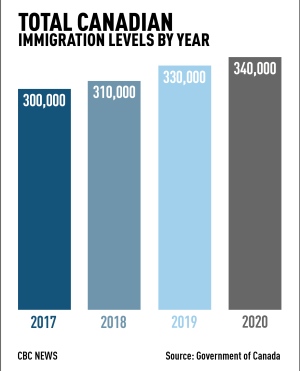
Canadian immigration levels by year

The number of economic migrants, family reunifications and refugees will climb to 310,000 in 2018, up from 300,000 this year. That number will rise to 330,000 in 2019 then 340,000 in 2020.

The targets for economic migrants, refugees and family members was tabled in the House of Commons Wednesday afternoon.

Hussen said the new targets will bring Canada’s immigration to nearly one per cent of the population by 2020, which will help offset an aging demographic. He called it a historic and responsible plan and “the most ambitious” in recent history.

“Our government believes that newcomers play a vital role in our society,” Hussen said. “Five million Canadians are set to retire by 2035 and we have fewer people working to support seniors and retirees.”

In 1971 there were 6.6 people of working age for each senior, Hussen said, but by 2012 that ratio had gone to 4.2 to 1 and projections show it will be at 2 to 1 by 2036, when almost 100 per cent of population growth will be a result of immigration; it stands at about 75 per cent today.

Hussen said immigration drives innovation and strengthens the economy, rejecting some claims that newcomers drain Canada’s resources and become a burden on society.

He said the government is also working to reduce backlogs and speed up the processing of applications in order to reunite families and speed up citizenship applications.

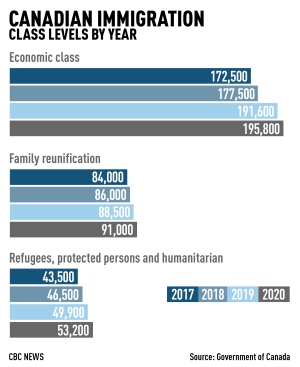
Canadian immigration class levels by year

The federal government’s own Advisory Council on Economic Growth had recommended upping levels to reach 450,000 newcomers annually by 2021. Hussen said the government is taking a more gradual approach to ensure successful integration.

“At arriving at these numbers we listened very carefully to all stakeholders who told us they want to see an increase but they also want to make sure that each and every newcomer that we bring to Canada — bringing a newcomer to Canada is half of the job. We have to make sure that people are able to be given the tools that they need to succeed once they get here,” he said.

Focus on integration: Rempel

Conservative immigration critic Michelle Rempel was critical of the plan, suggesting the government needs to do a better job of integrating newcomers.

“It is not enough for this government to table the number of people that they are bringing to this country. Frankly the Liberals need to stop using numbers of refugees, amount of money spent, feel-good tweets and photo ops for metrics of success in Canada’s immigration system.”

She said the Liberals need to bring Canada’s immigration system “back to order” by closing the loophole in the Safe Third Country Agreement that has seen migrants cross into Canada at unofficial border crossings only to claim refugee status.

She also said the immigration system should focus on helping immigrants integrate through language efficiency and through mental health support plans for people who are victims of trauma.

Dory Jade, the CEO of the Canadian Association of Professional Immigration Consultants, welcomed the news although he suggested the numbers should be higher.

“Canada will greatly prosper and grow once the 350,000 threshold has been crossed,” he said. “Nevertheless, we are witnessing a very positive trend.”

The Canadian Council of Refugees also welcomed the news, but wanted more, saying the share for refugees was only increased slightly from 13 per cent this year to 14 per cent in each of the next three years.

Calls for longer-range forecast

In past, there has been a one-year figure for how many immigrants will be permitted into the country, but provinces and stakeholders have called for longer-range forecasts.

A statement from Ontario’s Immigration Minister Laura Albanese, before the announcement, said the province supports the introduction of multi-year levels plans “to provide more predictability to the immigration system and inform program planning.”

“Significant variation in year-to-year immigration levels can dramatically impact the requirement for provincial year-to-year resources. A longer term outlook would help in planning for appropriate service levels and use of resources.”

The statement said Ontario supports growth in immigration levels, particularly in economic immigration categories to support the growing economy.

Diversity drives innovation

During the government’s consultation period, the Canadian Immigrant Settlement Sector Alliance presented “Vision 2020,” what it called a “bold” three-year plan to address growing demographic shifts underway in the country, calling for increased numbers in the economic, family and refugee categories.

It recommended a target of 350,000 people in 2018, which climbs to 400,000 in 2019 and 450,000 by 2020.

Chris Friesen, the organization’s director of settlement services, said it’s time for a white paper or royal commission on immigration to develop a comprehensive approach to future immigration.

“Nothing is going to impact this country [more] besides increased automation and technology than immigration will and this impact will grow in response to [the] declining birth rate, aging population and accelerated retirements,” he told CBC News.

Source: Canada to admit nearly 1 million immigrants over next 3 years – Politics – CBC News

Opposition accuses Liberals of ‘paralysis’ in crackdown on crooked immigration consultants

Refreshing to see the opposition admitting that its previous approaches failed while pressing the government for action:

Opposition MPs are accusing the Liberal government of failing to protect immigrants from fraudsters and predators as it swings Canada’s door open to more newcomers.

In a formal response to a sweeping study by MPs on the immigration committee tabled four months ago, Immigration Minister Ahmed Hussen said the government is “seized” with issues related to inadequate protection from unprofessional or unethical practitioners, and conceded a strong system of oversight is essential.

But he did not commit to any of the committee’s 21 recommendations, saying only that the government will carry out further study and expects to provide more information on a path forward next year.

“Given the complexity and inter-dependencies of the issues, the impact on public confidence, on clients and authorized immigration and citizenship consultants, the government will carefully consider the committee’s report and undertake a thorough analysis of key recommendations before determining how these issues could be addressed successfully,” his response reads.

A disappointed Conservative immigration critic Michelle Rempel said the response amounts to “typical inertia.”

“There are very substantive proposals on the table on how to manage this, and the government really just needs to make a decision and implement it,” she told CBC News. “The fact they’re not willing to do it suggests a sort of paralysis on their part, and that’s to the detriment of people who are being exploited.”

“We tried self-governance. Clearly, that’s failed,” she said. “I’m willing to say the approach we tried failed, twice, and it’s really now up to the Liberal government to do something, and the status quo is not going to cut it.”

In the spring, the Commons immigration committee carried out weeks of hearings on unregistered representatives often called “ghost” or “crooked” consultants, hearing heart-wrenching stories from clients who were ripped off for thousands of dollars, or brought to Canada with the promise of work only to be dumped at the side of the road or left in a warehouse.

Rempel said it is even more critical that the government crack down on predators in the context of its aggressive immigration strategy.

Source: Opposition accuses Liberals of ‘paralysis’ in crackdown on crooked immigration consultants – Politics – CBC News

Liberals unveil resettlement plan for 1,200 Yazidis and other victims of ISIS

One of the few areas that the Conservative opposition has made a positive contribution. Michelle Rempel deserves full credit for pushing the government:

Canada plans to resettle 1,200 Yazidi refugees and other survivors of ISIS by the end of this year.

Immigration Minister Ahmed Hussen announced today that nearly 400 survivors have already arrived in Canada in the last four months since the House of Commons unanimously supported a Conservative motion that called on the government to provide asylum to an unspecified number of Yazidi women and girls.

Of those, about 74 per cent are Yazidi.

Canada has been given consent from the Iraq and Kurdish regional governments, which are supporting and co-operating with the plan, Hussen said.

The motion recognized that ISIS, also called Daesh, is committing genocide against the Yazidi people and holding many of the group’s women and girls as sex slaves.

Hussen said many of the newcomers will have far greater needs than other refugees who have come to Canada.

“Many have experienced unimaginable trauma and vulnerability, both physical and emotional, and many will have unique physical, psychological and social needs, such as trauma counselling,” he told reporters at a news conference in Ottawa Tuesday.

Survivors arriving at ‘controlled pace’

The survivors have been arriving on commercial flights at a “controlled pace” to avoid over-burdening support services. The federal government will also work with provincial, territorial and municipal governments to ensure unique ongoing needs are met.

Although the motion referred only to providing asylum to Yazidi women and girls, the 1,200 refugees will include male family members. Hussen said ISIS also deliberately targets young boys, so the program will help resettle all child survivors of ISIS.

The government will also facilitate private sponsorships of Yazidi refugees, he said.

Source: Liberals unveil resettlement plan for 1,200 Yazidis and other victims of ISIS – Politics – CBC News

Michelle Rempel demands more from politics—on both the left and right

Impressive and thoughtful speech delivered at a McGill Institute for the Study of Canada event regarding immigration and Canadian exceptionalism:

During the 2015 campaign, I thought all political parties, my party included, acted shamefully on the issue of immigration, because we used the Syrian refugee crisis as a political wedge in a political campaign, and that was wrong. The response to the Syrian refugee crisis became a campaign issue of one-upmanship on numbers, rather than talking about people as human beings. “Who’s going to bring in more?” When the question should have been: “How do we do it in a way that achieves social license in the country in an expeditious way that shows compassion and addresses the situation, and how do we support the integration of people when we come to Canada, such that we build social license for more refugees in the future, and ensure that refugees that come to Canada have a better experience here than where they came from?” That is not a politically sexy conversation, because it’s easier to say, “I’m going to bring in 25,000 and you’re going to bring 15, ergo you’re racist and I’m more awesome.” Not helpful. Also not helpful is to frame the issue of gender isolation in new Canadian women in the term of a tip line.

And what happened out of all that? Where we are today is we had a parliamentary study that looked at the response to the Syrian refugee initiative, and we had Syrian refugees come in front of a parliamentary committee and said: “I’m in a hotel room that’s infected by bed bugs, and my wife can’t go out and learn English because she’s got five kids. How are we going to have any hope to do anything well here?”

It’s not an adequate response to say, “It’s a nation-building project and the provinces are responsible for it,” when I have a school board come to parliamentary committee and say, “We’ve absorbed in our one city the equivalent of a full elementary school of refugees this year, they have needs that we need to address and need to be compassionate to because they’ve been in a war zone for years and their education has been disrupted, and we received no new funding for it. So in a political campaign for any political stripe to say it’s fully costed when there is no plan … not helpful. Not exceptional.

The thought that populist rhetoric can’t happen in Canada is shocking. The reality is that there has been a narrative that has arisen where you have groups of people who feel that their voices aren’t being heard, and it’s easy through 140 characters and short visual soundbites and memes to say it’s someone else’s fault. And in Canada, that’s still here. But the reality is there’s no “them” and “us” anymore. That’s not how the globe operates. We are so interconnected, be it through trade, or simply the reality of understanding our humanity through Twitter, through YouTube. You can see the destruction in Aleppo. To have that narrative be used in political discourse is disgusting and wrong, and oversimplified.

We all have to demand better. Demanding better for someone who’s a centrist like myself has been a very unpopular position. Because it means there’s no real home for me as a politician on some days. But it’s where we all need to be. There’s many other examples of how Canada in public policy has sort of politicized the system—they might not be as firecracker or high-profile as the barbaric cultural practices tip line. It’s things like lifting a visa requirement on a country without a formal review for some unquantified economic benefit. It’s policy around immigration that is politically motivated that is unquantifed and unsubstantiated—and both parties are guilty of this—that diminishes the public confidence that immigration is a good thing, and we are unexceptional in that, especially in Parliament.

Why should we all be listening to these sorts of things with an open mind? It’s because if we don’t do that, I’m really deeply concerned as a legislator about the peace of humanity right now, and that’s not hyperbole. When I see nationalist parties rise and gain seats in European Parliament, we should be very concerned. When I see the level of nationalist rhetoric that is acceptable among people that are pretty educated and smart people, that’s cause for concern. When I see protectionism and the thickening of borders as a populist public policy response in a globalized economy, we should all be concerned.

The way forward is to ensure we have a public policy dialogue that is not alt-right or far-left. It has to be in the middle and we have to focus not on values, but on programming and outcomes that enable what we vision exceptionalism to be. Things like: where is the smart conversation around the burqa? Where’s that safe space? I don’t wear one—women who wear one, where’s their voice on this? And why don’t we talk about the fact there are equally as many other religious groups who use dress as a control for women? So rather than judging them and shaming them, how do we reach out to them, and give them hope? The fact that we can’t even talk about that—I find as a politician, for me as a camera, even saying that is a risk. I’ve done something terribly egregious, by bringing up both sides of that argument. But if we can’t have this argument, how can we ever reduce issues like Islamophobia? The fact that we can’t have a discussion because we’re so polarized is why we need to acknowledge that we’re not exceptional.

You, as the thought leaders on this? It can’t be 140 characters “You’re a racist; you’re a socialist. You’re conservative; you’re Liberal. Your party sucked; your party sucked.” Come on. If we are truly exceptional, we have to show the world we’re better than that. And I’ll be honest with you, after 18 months of banging my head in both my own party and in the House of Commons against the Liberals, you’ve got to help me out too.

Where we are as a country, for us to be having a conference on how exceptional we are and how much better we are than the United States and we’re welcome to refugees is such a disservice to the fact that we’ve got a long way to go.

For all of you, from the bottom of my heart: let’s try to be smarter about this. And let’s demand better from our leaders.

Source: Michelle Rempel demands more from politics—on both the left and right

Monsef could face consequences, immigration lawyers warn 

Lots of coverage on Maryam Monsef and her birthplace.

Most coverage conflate birthplace, citizenship and identity. While they can for many be one and the same, this is not the case for all, particularly in the case of immigrants.

For example, my mother was born in Russia on the eve of the Russian revolution, her family as refugees fled to Latvia, and her Canadian passport listed Riga as her birthplace, likely reflecting that the chaos at the time made it impossible to obtain a Russian birth certificate. But we all knew her true birthplace.

As to the speculation by some regarding whether or not her citizenship and immigration status could or should be revoked, Monsef arrived in Canada at the age of 11 so all documents would have been submitted by her mother. So while her mother’s status could theoretically be subject to review, hard to see why any government would do so some 20 years after the fact and given that it is not material to the family’s status as refugees.

Iran has between one and three million Afghan refugees, which are not well integrated into Iranian society, and largely live within Afghan neighbourhoods.

So I am sceptical of the reasoning of the immigration lawyers contacted by the Sun (Guidy Mamann, Chantal Desloges and Julie Taub):

Canadian immigration lawyers say Democratic Reform Minister Maryam Monsef could suffer consequences if her refugee or citizenship applications included false information.

“It’s extraordinarily serious,” Toronto immigration lawyer Guidy Mamann said. “From a strictly legal point of view – and I’m assuming cabinet ministers want to observe the law – she is a person right now who has citizenship through fraud. It may be intentional or unintentional, but her citizenship in Canada right now is open to attack.”

…“If you had false info on your citizenship application you could be subject to having it revoked,” Toronto immigration lawyer Chantal Desloges explained. “It could not go so far as a criminal charge because for her to be charged criminally you’d have to do it knowingly.”

While lawyers the Sun spoke to disagreed on certain specifics, none doubted that a case such as Monsef’s would typically undergo a review.

“There are differences in cases where they probably decide not to proceed when false info is presented for reasons of safety and security. But that’s rare,” says Ottawa immigration lawyer Julie Taub, a former member of the Immigration and Refugee Board.

“The situation is if she was not an MP, if she was not a cabinet minister, if she was just your average Joe, the government would probably seek to vacate her status and once that protection is gone they could go after her citizenship,” Mamann added.

“I think the government is going to be in a hard position because they obviously won’t want to take any action on it but if they don’t, how is that going to look, that she’s getting preferential treatment?” Desloges said.

Source: Monsef could face consequences, immigration lawyers warn | furey | Canada | News

Michael Friscolanti demonstrates a more sophisticated understanding of the issues involved, and the likelihood of removing her immigrant and citizenship status:

If her mother provided inaccurate information to the IRB, does that mean Monsef could be stripped of her citizenship?

Again, it’s not clear what Basir told the IRB. But even if she failed to disclose where her daughters were born, experts in refugee law are divided about the potential consequences. According to the Citizenship Act, the government has the power to revoke citizenship on the grounds it was obtained “by false representation or fraud or by knowingly concealing material circumstances.” Material is the key word. Simply put, would the evidence that has come to light have altered the IRB’s original opinion that Monsef was a bona fide refugee? “If it was not disclosed that she was born in Iran, that, in my opinion, is a material misrepresentation,” says Toronto immigration lawyer Guidy Mamann. “If you find one lie, then you start questioning the whole story.”

Michelle Rempel, the Conservative Immigration critic, seems to agree, saying there could be “serious consequences” if Monsef’s refugee claim contained false information. But Showler, the former IRB chair, sees it differently. Because Monsef had no legal status in Iran (to repeat: she wasn’t a citizen, despite being born there), her birthplace had zero bearing on the case. “What you are doing with a refugee claim is you’re saying: ‘I cannot go back to my home country because I will be persecuted,’” he says. “Whether or not she was born in Iran is irrelevant. The only country for which she had citizenship was Afghanistan, and that is the country from which she feared persecution.” Showler says “there is not one chance in 1,000″ that Monsef’s immigration status is in jeopardy. “It’s very, very difficult to unwind citizenship status,” he continues. “You can do it, but almost always when it happens, it’s because somebody has committed a serious crime and there are reasons you want to get them out of the country. For something like this, there would be absolutely no reason for doing it.”

What if her mother did tell the IRB that Monsef was born in Iran?

For one thing, it would eliminate any chance, however remote, of the minister being stripped of her citizenship. It would mean Basir provided all relevant facts to the IRB, and that the board concluded all four claimants were genuine refugees. If that’s the case, however, it does raise yet another question.

If the Immigration and Refugee Board was told that Monsef was born in Iran, how could she not know?

Think back to the ensuing document trail. If the IRB was informed of her true birthplace, that same location would have been listed on her subsequent permanent residency forms, her citizenship application, etc. Under such a scenario, it seems implausible that Monsef would have remained oblivious to the truth all this time—or that the Privy Council Office, which conducts a “rigorous vetting process” for would-be cabinet ministers, would not have stumbled upon the evidence. It’s much more likely, as discussed above, that Monsef’s mother chose to hide from the IRB what she hid from her daughters: that they were born in Iran.

Source: Maryam Monsef’s personal revelations leave lingering questions               


Do more to help Yazidis, say Tories as audit of 546 refugees shows they only let in 3

Hard to believe, given all the previous and current rhetoric of the Conservatives. Kind of undermines their case even though I am sympathetic to giving priority to communities at greater risk, including the Yazidis:

As the Conservatives push for more help for Yazidis fleeing persecution at the hands of Islamic militants, new information suggests their efforts to do so while in government were minimal.

Data from a controversial audit of Syrian refugee cases ordered by former prime minister Stephen Harper late last spring reveals of 546 people reviewed, three identified as Yazidi, a Kurdish minority group which practices an ancient faith.

Immigration officials also told a House of Commons committee Monday that Yazidis were never highlighted specifically by the Conservatives as a group that should be prioritized for resettlement, even with their targeted approach to resettlement.

The data and the testimony Monday give both the Liberal and the Conservative arguments over Canada’s refugee policy some new energy after the file was a political flashpoint for most of 2015.

The Conservatives’ areas-of-focus policy drew heavy criticism, with many arguing it flew in the face of international obligations that see the UN choose who is resettled. The Tories argued that they were using the UN criteria, but were drilling down within them to ensure the most vulnerable were helped.

The Tories put religious minorities in that category, but the data obtained by The Canadian Press under access-to-information laws suggest the vast majority of landed Syrians whose files were audited were Sunni Muslim, as is the refugee population at large. About three dozen were Christian.

That few Yazidis arrived under their watch is a fact the Tories haven’t dwelled on as they have been pushing the Liberals for more action.

UN ignores ethnicity when prioritizing refugees

Since 2014, the Yazidis have been subject to forced conversions, murder, rape and enslavement at the hands of Islamic militants — actions recently declared a genocide by the UN.

The Tories now say that declaration should put them at the front of the line for resettlement to Canada.

There are, however, numerous policy roadblocks, especially the fact that most are in their home country of Iraq and as such aren’t eligible for resettlement.

Another challenge is that while a person’s faith or ethnicity might be the reason he or she became a refugee, it’s not something the UN looks at when selecting people for resettlement. In fact, the UN expressly asks states not to prioritize groups that way because the most important criteria must be vulnerability.

The Liberals repeatedly asked Immigration Department officials Monday about the policies of the previous government. While in opposition, they had argued that selecting refugees on the basis of religion — as the Tories were believed to be doing — was wrong. The Liberals have resisted calls to do so with the Yazidis.

But the Tories never gave specific instructions to track Yazidis, the officials said.

What about the Tories’ “areas of focus,” the officials were asked. Were Yazidis placed on that?

“There was no specific group put on the list,” Robert Orr, assistant deputy minister, said.

Source: Do more to help Yazidis, say Tories as audit of 546 refugees shows they only let in 3 – Politics – CBC News

The complicated task of getting more women involved in politics

The debate over how to get more women involved in politics, contrasting the NDP’s Kennedy Stewart’s private members bill linking election expense reimbursement with female candidate share with Michelle Rempel’s encouragement and education approach:

Mr. Stewart’s academic research has shown that the party selection processes are biased, and that men are five times more likely to win nominations just because the selectors are biased against women.

So, the problem is with the political parties, and their old-boy networks and structures.

Equal Voice, a non-partisan group that advocates for more elected women, notes that only 32 per cent of candidates in last year’s federal election were women.

Based on the formula in his bill, Mr. Stewart says $1.25-million would be deducted from the Conservatives’ reimbursement for the 2015 election, because 20 per cent of their candidates were female; the Liberals, with 31 per cent female candidates, would lose about $900,000, and the NDP, which ran 43 per cent female candidates, would have lost about $200,000.

Mr. Stewart’s bill was debated earlier this month in the Commons; it comes back for a vote in September.

Some note that, even if it passes, the desired change might not come. Equal Voice says that in France, for example, the major parties will simply take the financial hit.

For Ms. Rempel, the bill would not make “real change.” She says women need to be educated on how to win nominations – raising money, dealing with the media, and building networks – to prepare them for the “fiery furnace” of a federal election. She believes going through rigorous internal party vetting is a positive exercise for women.

“The propensity is – and frankly you see it in all political parties in Canada – I don’t want to see women that are thrown into non-winnable ridings just to be a token so that [the party] is not financially penalized,” she says. “I think that actually takes women a step back.”

She fears a bill such as Mr. Stewart’s will change the calibre of women in the Commons: “There are women in our House of Commons across party lines that have really strong CVs or really strong life experiences. All of the women that are in the House of Commons are there because they won elections, full stop. They are not there because of tokenism.”

The NDP has the strongest female representation in caucus (41 percent), the Conservatives the weakest (17 percent, identical to 2011 election), the Liberals 27 percent.

Source: The complicated task of getting more women involved in politics – The Globe and Mail