Trump, Trudeau and the patriarchy: Adams

Another interesting piece by Michael Adams on the contrast between the US and Canada:

As icons of masculinity, it would be hard to find a more vivid contrast than that between U.S. President Donald Trump and Canadian Prime Minister Justin Trudeau. One is a macho bully who demands deference, the other a people-pleasing metrosexual. These men are not one-of-a-kind phenomena but very much expressions of the societies that produced them.

This is the obvious conclusion from an analysis of the evolving social values in each country Environics has been conducting every four years since 1992.

In order to understand the orientation to the structure of authority in the family in each country, we periodically ask representative samples of people 15 and older if they agree or disagree with the statement: “The father of the family must be master in his own house.”

In 2016, 50 per cent of the 8,000-plus Americans surveyed agreed with the statement. In Canada, the equivalent proportion (with a sample of 4,000-plus) was 23 per cent.

When we first asked this question in 1992, the proportion in the United States agreeing was 42 per cent. It rose to 44 per cent in 1996, and to 48 per cent in 2000. It remained at that level throughout the post-9/11 George W. Bush years and then declined somewhat during the Barack Obama era, to 41 per cent in 2012.

However, as U.S. Republicans and Democrats were in the process of selecting Mr. Trump and Hillary Clinton as their respective presidential candidates, the proportion returned to its historic high.

It will surprise no one that support for Mr. Trump is highly correlated with support for patriarchy and, conversely, support for gender equality is highly correlated with support for Ms. Clinton.

Meanwhile in Canada, the proportion of patriarchy supporters has been hovering in the low 20s throughout the past two decades. This is in spite of the inflows of migrants from more male-dominated countries (35 per cent of foreign-born Canadians believe dad should be on top), as well as a mild backlash against feminism among Generation X men at the ages of 25 to 44 (foreign-born and Canadian-born alike). In the United States, 56 per cent of immigrants opt for patriarchy in the home.

There was a time when informed Canadians felt the values of the two countries were converging, or that any observed differences in average opinion in the two societies were simply the result of the South pulling the U.S. number in a conservative direction and Quebec pulling Canada the other way. When it comes to this measure of patriarchy, neither generalization stands up to the evidence. Yes, in the United States, there is substantial regional variation. In the Deep South (Tennessee, Alabama and Mississippi), 69 per cent believe the father must be master chez lui, whereas in New England, the figure is only 42 per cent; other regions fall in-between. In Canada, the range is from a high of 26 per cent in Alberta (birthplace of former Republican contender Ted Cruz) to a low of 18 per cent in Atlantic Canada. Canada’s most patriarchal province is significantly less patriarchal than the least patriarchal region of the United States. So much for the theory that nations don’t have national values.

Digging deeper into the demographics, we see some telling patterns: 60 per cent of American men think father should be master at home compared with 41 per cent of American women. In Canada, only 31 per cent of men think dad should be boss, compared with 16 per cent of women. Presumably some of these people live in the same house; must be interesting.

There is little variation by age in either country, or by income, occupational status or community size (rural to urban). In Canada, there is not much difference by education either – but in the United States education matters a lot: 56 per cent of people with a high-school education or less think father should be boss; among those with postsecondary degrees, it is 39 per cent.

Consensus in Canada; some substantial variations in the United States. Patriarchy is only one of more than 50 values we track, but it is clearly among the most meaningful. It is also a value that is highly correlated with other values such as religiosity, parochialism and xenophobia, and views on issues such as abortion, guns and the death penalty.

In 2002, EKOS asked Canadians if Canada was becoming more like the United States or less like it. At that time, 58 per cent said we were becoming more like the United States and only 9 per cent thought we were becoming less like our American cousins. A few weeks ago, we repeated this question in a national survey and found a change of opinion: Only 27 per cent think Canada is becoming more like the United States and a nearly equal proportion (26 per cent) say we are in fact becoming less like our southern neighbour. Perhaps the latter group read The Globe and Mail.

Source: Trump, Trudeau and the patriarchy – The Globe and Mail

The real threat: Immigrants to Canada, or Kellie Leitch’s divisive politics? Adams

Michael Adam’s take:

This surge of worry about cultural integration is stronger among Conservative supporters than it is among Canadians at large. Indeed, when we examine the values of Canadians broken out by party preference, wariness of cultural difference is a key differentiating value of Conservatives. Given that Dr. Leitch is currently running not for prime minister of Canada, but for leader of the Conservative Party, critics who say that her threat of cracking down on anti-Canadian values is itself anti-Canadian are unlikely to do her much harm and may do her some good – for now.

Recent years have shown us that a backlash constituency does exist – a constituency alarmed by some aspects of living in a diverse society, and affronted that they are not permitted to air their alarm without being accused of racism. (It is no accident that Dr. Leitch’s campaign literature had an aggrieved tone: “If you are tired of feeling like we can’t discuss what our Canadian values are, then please help me to fight back by making a donation.…”) U.S. presidential candidate Donald Trump is one champion of this backlash; he proposed ideological screening for immigrants a few weeks before Dr. Leitch did. Here in Canada, there was Rob Ford, lavish in his political incorrectness yet beloved by many newcomers, who embraced his little-guy-fighting-smug-liberal-elites narrative. And there was the Parti Québécois’s Charter of Values, which would likely have won them an election had their leader not careened off-message.

A political opportunity exists with those who feel angry and dismissed, but when Dr. Leitch courts Conservatives who want to “fight back,” she is playing a risky game that may trade short-term partisan gain for long-term political pain.

Yes, the wider Canadian context is more fearful than it was 20 years ago, but it is still positive toward immigrants and, importantly, proud of not being xenophobic. Canadians feel pride in their country (and immigrants are especially proud, surveys show), but one of the things Canadians are most proud of is a belief that different kinds of people can live here in harmony and that immigrants can be just as good citizens as anyone born here – sometimes better.

If voters see particular groups of immigrants as a threat to that harmony, Dr. Leitch might win support among Conservatives. But if many Conservatives and even more ordinary Canadians, including the four in 10 of us who are immigrants or their children, see Dr. Leitch as the threat, she will not become prime minister – and Conservatives will feel that so-called hotline sting for a second time.

Source: The real threat: Immigrants to Canada, or Kellie Leitch’s divisive politics? – The Globe and Mail

The door to reconciliation [with Indigenous peoples] is truly open: Adams

Michael Adam’s overview of the findings of the recent Environics Institute survey on non-indigenous adults on indigenous issues:

The survey measured support for key areas related to the TRC’s recommendations and other long-standing unresolved issues. There is almost universal public support (90 per cent) for increased government spending to ensure that indigenous peoples have decent housing and safe drinking water, basics that most other Canadians take for granted.

Unsurprisingly, the people who support other equity-oriented initiatives like universal health care are the same people who support addressing inequities in indigenous living standards.

Nine in 10 non-aboriginal Canadians (91 per cent) also support the TRC’s recommendation that funding to indigenous schools be increased to ensure that students have equal access to educational opportunities. Canadians today overwhelmingly believe that education is the key to sustained economic well-being.

This finding from the 2016 survey dovetails with findings from our 2010 Urban Aboriginal Peoples Study, which found that the top priority of indigenous people living in Canadian cities was education. Of course, the history of Canadian intervention in indigenous education is a painful one. This country’s policies of forced assimilation through education, which the TRC, Supreme Court Chief Justice Beverley McLachlin and former prime minister Paul Martin have called cultural genocide, robbed tens of thousands of children of family and cultural heritage and inflicted damage across generations.

Our survey shows that awareness not only of the Indian residential school system but of the specific abuses and consequences of that system has grown among non-aboriginal Canadians since 2008; 73 per cent now make this connection.

Canadians see education as not only as a key to economic success, but as one means of unwinding the prejudices and stereotypes that have accrued during Canada’s colonial history. More than nine in 10 non-aboriginal Canadians say that it is very (62 per cent) or somewhat (30 per cent) important for all non-aboriginal Canadians to understand the true history of how indigenous people have been treated by governments and society.

Better indigenous education for all Canadian students has the potential to create a platform for true reconciliation and partnership, a project in which 64 per cent per cent feel strongly that all Canadians have a role to play (a proportion that has increased by 22 points since 2008). Only 6 per cent strongly reject the idea that we all have a role to play in reconciliation.

Our survey did find negative attitudes, including the belief that aboriginal peoples have a sense of entitlement about receiving support from government, and the belief that suffering communities are partly to blame for their own difficulties. Despite the ongoing presence of these sentiments, there is broad public support for key TRC recommendations, some of which the recent federal budget took steps toward.

Of course, government action on issues so deeply rooted in our cultural and political experience will not deliver immediate benefit. But these results suggest most Canadians would rather be moving along the path to progressive change, even if we stumble, than standing still or moving backward.

Source: The door to reconciliation is truly open – The Globe and Mail

Why Muslims are proud Canadians: Adams and Bullock 

www_environicsinstitute_org_uploads_institute-projects_survey_20of_20muslims_20in_20canada_202016_20-_20final_20report_pdfWell worth reading the report in its entirety. The finding that the younger generation demonstrates greater religiosity, within the general context of integration, is of particular interest (same-sex relationships appear to be area of greatest divergence):

Our survey found that young Muslims are often more religious than their immigrant parents. For many, their religious identity is becoming more important to them – not less. At the same time, Canadian-born Muslims are now among the most likely to believe their community wants both integration and to remain distinct, suggesting the development of a unique “Canadian Muslim identity.” More than 90 per cent of young Muslims believe that “other cultures have a lot to teach us; contact is enriching.” Canada promises freedom of religion and young Muslims appear ready to take up this constitutional offer.

Interestingly, while religious practice and identity remain salient, other values change. A big one is patriarchy. In Muslim households, as in most other Canadian families, gender roles are becoming more equal. In our 2006 survey, 70 per cent of Muslims strongly agreed “that taking care of home and kids is as much a man’s job as a woman’s.” In 2016, that number is up to 76 per cent. Among those born in Canada, more than eight in 10 reject the notion that the “father in the family must be the master in his own house,” signalling value convergence over time between many in the younger Muslim community and the broader Canadian society.

Modernization and secularization evolve in different ways in different countries as majorities and minorities interact; groups can fight each other, or they can accommodate. Canada has the aspirational ideology of multiculturalism, as well as the policy framework that goes by the same name. Neither inoculates against discrimination or injustice, but if we look at public attitudes, citizenship acquisition among immigrants and minority representation in our legislatures, it seems that ours may be the worst system in the world, except for all the others.

Muslims report positive feelings toward Canada and non-Muslim Canadians are more likely to have positive impressions of Islam than negative ones. As well, the more Canadians report encountering Muslims in daily life, the more positive their impressions: familiarity breeds good feeling, not contempt.

These findings may explain why we see so little conflict between Muslims and other Canadians; when such conflict does erupt (as when a hijab-wearing woman in Toronto was harassed last fall), public figures are unanimous in their condemnation. The data may also help to explain why Canadians, in sharp contrast to Americans, have been so supportive of accepting Syrian refugees by our government and through private sponsorships.

These numbers are the big picture against which the news of the day unfolds. They offer an empirical grounding against which individual incidents – stories of harmony or harassment – can be judged as typical or unusual and they serve as a useful corrective to inflammatory anecdotes and stereotypes.

Whatever the headlines of the day, the deeper story is that Muslims are proud to be Canadian and they appreciate the same things about Canada that other Canadians do.

Source: Why Muslims are proud Canadians – The Globe and Mail

Some of the better analysis of the study to date:

A third of Canadian Muslims say they’ve experienced discrimination (Nicholas Keung)

Muslim Canadians are different — but not that different: Neil Macdonald

Take pride that Parliament reflects the face of Canada – The Globe and Mail

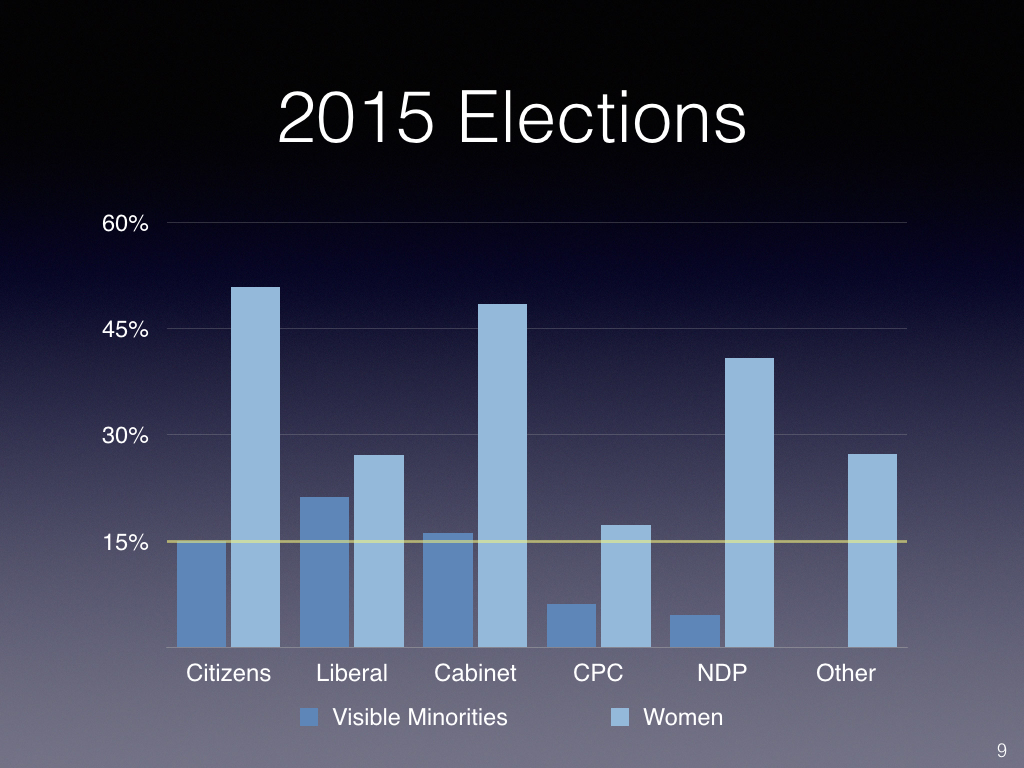
Election 2015 - VisMin and Foreign-Born MPs.002Michael Adams and my take on the composition of the new Parliament:

So what is new about the 42nd Parliament, aside from altered partisan composition and a gender-balanced cabinet? In fact, not too much, considering that the previous Parliament was quite diverse. But the Liberal government is doing more to make diversity – and an aspirational vision of an inclusive Canada – central to its agenda, and there is no doubt that some of the energy that came out against the Conservative government during the election campaign was a renunciation of tactics that pitted Canadians against each other along ethnic and religious lines.

So when it comes to the composition of the legislature itself, the 42nd Parliament is not so much a watershed as it is one more significant, if incremental, step in a long move toward a national legislature that represents the identities, experiences and perspectives of all Canadians.

Source: Take pride that Parliament reflects the face of Canada – The Globe and Mail

Distinct societies: Why Canada, U.S., diverge on Syrian refugees: Adams

Michael Adams on the contrast between Canada and the USA:

Americans certainly enjoy unique latitude in the individual pursuit of happiness, but the pursuit of happiness doesn’t always look like much fun. In an environment where there is a lot to fear (financial ruin in an unforgiving system, illness leading to bankruptcy, gun violence inflicted by a stranger, a family member, or an unsupervised toddler), it is perhaps not surprising that some are eager to control the one variable that seems like a no-brainer: don’t give jihadists a green card. But one of the San Bernardino jihadis seems to have been born in Chicago. The “big and beautiful wall” Donald Trump proposed to build to keep dangerous people out of America would require complex architecture indeed. No society is or can be perfectly safe. But societies that have traditionally put a little more stock in collective well-being seem to have better odds. To be fair, those safer, quieter places have also not been the birthplaces of Apple, Google, Tesla, Amazon, Wikipedia and the first man on the moon.

As I have written elsewhere, despite the current apparent spasm of xenophobic sentiment and the din of gun violence, our values research suggests that in fact Americans’ values are tilting in a slightly more Canadian direction – toward greater openness to social difference, a more nuanced sense of personal autonomy, and even a less suspicious attitude toward government. The shift is by no means a sea change, but the election of Mr. Obama (twice) was indeed the product of deep and meaningful changes in the electorate, no matter how lonely he may sometimes appear in White House press briefings these days. As younger voters, women (especially single women), and America’s diverse, city-dwelling voters become more influential politically, America is changing. But those who are on average less keen on this direction of social change (older, more conservative, whiter, more religious and patriarchal voters) have some innings left, as the tremendous polarization of U.S. political discourse attests.

What will become of America in the next election cycle and beyond? And how will the noisy debates and decisions of our neighbour to the south influence our own public conversations and political aspirations? As we wait to welcome 25,000 Syrian refugees, Canada feels like a fairly peaceable corner of a turbulent world. Recent reports suggest, however, that of the more than 25,000 refugees interviewed by the UN, fewer than 2,000 were interested in coming to Canada. Many are likely hoping for reunification with family members in Europe. It would be interesting to know how many are holding out for their shot at the American Dream.

Source: Distinct societies: Why Canada, U.S., diverge on Syrian refugees – The Globe and Mail

Economy? Health care? No, the deciding factor of this election was Canadian values: Adams

Good reflections on the deeper values of Canadians by Michael Adams:

While polls in this election may have indicated that the economy and health care were the campaign’s top issues, Stephen Harper wasn’t defeated last week because he was seen as a poor steward of the economy or an enemy of Canadians’ beloved public health care system. Rather, he offended the values of two-thirds of Canadians. Despite some suggestions to the contrary, these values did not change much during Harper’s time in office. Canada’s political centre of gravity has not shifted.

In addition to a divided centre-left, Stephen Harper’s success could mainly be traced to deft riding-by-riding tactics and to the use of wedge values issues to build out incrementally from his base (not very far, but enough for a majority in 2011). In addition to customized offerings for specific groups of voters (such as targeted foreign policy gestures and boutique tax cuts), our outgoing PM did find a few issues on which he could appeal to large majorities of Canadians.

On crime, Harper took populist positions that were out of step with the evidence about crime reduction and represented sharp departures from both Liberal and Progressive Conservative policies of the past. Public opinion has historically been more punitive than government policy. Mr. Harper saw an opportunity and took it: his government gave the people (especially his base) what they wanted: a tough stance on bad guys.

During this campaign, another values issue came to the fore when a decision by the federal court of appeal enabled Zunera Ishaq to swear her citizenship oath while wearing a niqab. A government-sponsored poll had shown that 82 per cent of Canadians agreed with the Conservative government’s attempt to prevent her from doing so – including 93 per cent in Quebec, where secularism and gender equality have become religion. While Ms. Ishaq exercised her clear Charter right to cover her face, the government put its impotent – but widely shared – objection on prominent display.

Crime and punishment, the niqab, revoking the citizenship of convicted terrorists, establishing a “barbaric cultural practices” hotline, foot-dragging on Syrian refugees (and, earlier, revoking refugees’ health care) – all these symbolic gestures appealed to the Conservative base, but some in fact appealed to large majorities of Canadians.

If some of these moves were so popular, why didn’t they gain Conservatives more traction in the election?

The reason is that other Canadian values run deeper. Research by the Environics Institute tells us that Canadians deeply value their pluralistic society; they believe government has a role to play in building a fair country; they believe in empathy and compromise as social habits.

Many Canadians might be uncomfortable with the niqab, but they take the Charter seriously and in the grand scheme they want a just, inclusive society. Most Canadians’ thinking on sentencing for offenders might be driven more by emotion than by reviews of criminology literature, but traditionally most have not objected when governments have acted on data rather than gut. Over time, a collection of wedge-politics gestures, however cleverly designed, were no longer able to hold back the tide of public sentiment that wanted another kind of big picture.

American poet Walt Whitman wrote: “Do I contradict myself?/Very well then, I contradict myself/(I am large. I contain multitudes.)” Like Whitman, the Canadian public contains multitudes. We have lesser angels and better angels. When we are not fearful we try to be inclusive, fair, and generous. And perhaps even when we are fearful, we try to find our way back to being otherwise.

Source: Economy? Health care? No, the deciding factor of this election was Canadian values – The Globe and Mail

The “Ethnic Vote”: All Over the Map – Adams and Griffith

Further to our earlier op-ed in the Globe (Why Canada’s politicians fixate on the ethnic vote), Michael and I expanded it to include more information of visible minority representation and comparisons to the US:

Remarkably, the immigrants who were elected to Canada’s parliament in 2011 had not only become citizens, gotten themselves nominated, and then won election—but they represented all five main political parties and included many visible minorities: 18 Conservatives (15 visible minorities, of 166 elected), 18 New Democrats (12 visible minorities, of 103), four Liberals (2 visible minorities, of 34), and one each in the Bloc (1 visible minority, of 4) and the Green Party (no visible minority).

The Green Party is 100 per cent foreign-born: Elizabeth May is from Hartford, CT.

Another “only in Canada” fact is that our most right-wing party, the Conservative Party of Canada, attracts a substantial contingent of candidates born abroad.

The Bloc is dedicated to dismantling the country, but managed to be inclusive of the foreign-born and visible minorities. Only in Canada!

With respect to visible minorities (defined in the U.S. as non-white races and Hispanic), the U.S. has worse representation than Canada: 20 per cent in the House of Representatives compared to their population share of 37 per cent, only six per cent in the Senate), the vast majority of these are American-born visible minorities, mainly African Americans and Hispanic/Latinos, not immigrants.

Only 16 foreign-born members sit in either of the two houses. But many of these were born abroad to American parents, the most famous being John McCain and Canada’s Ted Cruz.

But even if we include all of these legislators as foreign born, they are still less than three per cent of Congress, where demographic parity would suggest that almost 70 foreign-born “should be” in both houses (to match the 13 per cent of “legal” Americans who are foreign-born).

Another “only in Canada” fact is that our most right-wing party, the Conservative Party of Canada, attracts a substantial contingent of candidates born abroad. In most countries, right-wing parties are anti-immigrant and would be unlikely to either attract or accept foreign-born candidates.

The “Ethnic Vote”: All Over the Map – New Canadian Media.

Why Canada’s politicians fixate on the ethnic vote – The Globe and Mail

From the piece Michael Adams and I did in today’s Globe on the importance of the ethnic vote and Canada’s uniqueness in that all parties compete for it:

In the 2011 federal election, voters sent 42 foreign-born citizens to represent them as MPs in Ottawa. That’s about 13 per cent of the then-308-member House of Commons. That proportion falls short of parity with our foreign-born population (20 per cent of us are foreign-born), but it comes quite close to matching the proportion of us who are foreign-born and Canadian citizens: 16 per cent.

Remarkably, the immigrants who were elected to Canada’s Parliament in 2011 had not only become citizens, gotten themselves nominated and then won election – but they represented all five main political parties: 18 Conservatives (of 166 elected), 18 New Democrats (of 103), four Liberals (of 34), and one each in the Bloc Québécois (of four) and the Green Party (of one). The Green Party is 100-per-cent foreign-born: Elizabeth May is from Hartford, Conn. The Bloc is dedicated to dismantling the country but managed to be inclusive of the foreign-born. Only in Canada.

Another “only in Canada” fact is that our most right-wing party, the Conservatives, attracts a substantial contingent of candidates born abroad. In most countries, right-wing parties are anti-immigrant and would be unlikely to either attract or accept foreign-born candidates. Stephen Harper may loathe much of the progressive agenda the Liberals and NDP have embraced over the past half-century, but he sure loves multiculturalism.

The high proportion of foreign-born MPs suggests a willingness to elect people not born in Canada – but are Canada’s immigrant MPs all from countries like Britain and France, of which the dominant ethnocultural and religious groups mirror Canada’s? No. Canada’s foreign-born MPs came from everywhere: 15 from Europe, 11 from Asia, 11 from the Americas and five from Africa.

Canada’s history of large immigrant inflows combined with a high naturalization rate (citizenship acquisition) has made it an electoral imperative to court – not dismiss – the “ethnic vote.”

Why Canada’s politicians fixate on the ethnic vote – The Globe and Mail.

Dad rules when sex ed collides with religion: Adams

Michael Adams on how patriarchy is a proxy for conservative views:

If conservative Protestants and mainline Protestants mark the high and low ends of the patriarchy spectrum, non-Christians (8.8 per cent of Canadians) are in the middle. On average, 30 per cent of these Canadians believe father must be master. For Jews, Sikhs, Buddhists, and Hindus, our sample is too small to analyze. Muslims, who now make up 3.2 per cent of the population, score high on deference to Dad (58 per cent) but they haven’t cornered the market on patriarchy: Canadian-born Muslims are outscored slightly by foreign-born conservative Protestants.

For the time being, Canada and its progressive social mores – a willingness to question dad, religious leaders, and tradition; and a willingness to respect individuals’ self-determination, sexual and otherwise – enjoy the assent of the majority. This majority includes the non-religious, members of mainline Christian denominations, substantial proportions of non-Christian religious groups, and even progressive members of more conservative religious groups (Christian and non-Christian).

The minority who feel stronger attachment to traditional authority will make their distress about this mainstream permissiveness known, as they have in Ontario. Whether their children will be persuaded by their parents or by the wider culture remains to be seen – but if trends in my generation of Catholics and in past waves of second-generation immigrants are any indication, most of those kids will give Dad a hug and then go their own way. Still, the year 2050 will likely find at least some of them marching in front of some legislature, protesting against the latest assault on religious patriarchy.

  Dad rules when ex ed collides with religion – The Globe and Mail.