Over due, but test will be how it interprets Switzerland’s role in persecution of Jews and others during the Nazi regime:
Switzerland’s executive body agreed Wednesday to help pay for a national memorial to honor the six million Jews and other victims of the Holocaust and Nazi persecution, in what the leading Swiss Jewish group is calling the country’s first official monument of its kind.
The Federal Council, the seven-member executive branch, approved 2.5 million Swiss francs (about $2.8 million) for the memorial that will be erected at an unspecified “central location” in the capital, Bern, at a time when the number of Holocaust survivors has dwindled and antisemitism has risen again.
“The Federal Council considers it of great importance to keep alive the memory of the consequences of National Socialism, namely the Holocaust and the fate of the six million Jews and all other victims of the National Socialist regime,” a government statement said.
Switzerland and its capital, through the move, were “creating a strong symbol against genocide, antisemitism and racism, and for democracy, the rule of law, freedom and basic individual rights,” it said.
The statement did not mention whether the memorial would make any direct reference to any Swiss role in the persecution of people during the Nazi regime in Germany.
The Swiss Federation of Jewish Communities, an umbrella group, said Switzerland has about 60 small, private sites remembering the Holocaust and other crimes of the Nazis.
“There is, however, no official or national memorial for the numerous Swiss victims of persecution, for the thousands of refugees repelled at the borders or deported, but also for the many courageous helpers in this country,” it said, noting that the memorial would be created to honor them all.
The group says recent studies have shown that a “sizeable number” of Swiss citizens were victims of the Nazi regime, “persecuted because they were, for example, Jews, socialists, Sinti or Roma.” Both Sinti and Roma are peoples who live predominantly in eastern Europe.
It noted that thousands of people flocked toward Swiss borders during World War II seeking protection, only to be “repelled and, in many cases, sent back to certain death.”
Switzerland has long grappled with its ties to Nazi Germany — not least through a call for national introspection on the issue from its first Jewish and woman president, Ruth Dreifuss, in 1999.
The country was neutral during WWII, but a government-appointed panel in 1997 found Switzerland had taken part in over three-fourths of worldwide gold transactions by Nazi Germany’s Reichsbank — both as buyer and intermediary.
Austria on Tuesday opened its first public memorial listing the names of all 64,440 Austrian Jews killed in the Holocaust.
The country where Adolf Hitler was born was annexed by Nazi Germany in 1938 and Vienna was a crucible of Third Reich anti-Semitism. Yet Austria was slow to recognise its role, and for decades it called itself the first victim of Nazism.
“They were deported, starved in ghettos, shot dead in forests or brutally murdered in extermination camps,” conservative Chancellor Alexander Schallenberg told the opening ceremony for the memorial – an ellipse of stone walls in a park opposite Austria’s central bank.
“With this wall of names we pull their names and their history out of oblivion. We give them back their identity, their individuality and with that part of their humanity. And they once again have a place in their homeland.”
The only other Holocaust memorial in Vienna naming the victims is in the city’s main synagogue.
The project was first backed in 2018 by a previous coalition government of Schallenberg’s conservatives and the far-right Freedom Party, which was founded in the 1950s and whose first leader had been an SS officer.
Although the Freedom Party (FPO) has long said it has abandoned its anti-Semitic past, it has been plagued by racism and anti-Semitism scandals.
The conservatives now govern with the left-wing Greens.
Another policy put forward under the conservative-FPO government, granting citizenship to the descendants of Austrian Holocaust victims, has been taken up by more than 6,000 people since it was introduced last year, Schallenberg said.
“Too many people stood on Heroes’ Square in March 1938 and celebrated,” Schallenberg said of the huge crowd that greeted Hitler in Vienna.
“Too many watched and took part as their fellow human beings were robbed, driven out and murdered. And we looked away for too long, until we became aware of our role as perpetrators.”
On a balmy September evening locals stroll in a leafy park in Kyiv. Parents push prams. Couples kiss. Young men perch on benches with cans of beer and shawarmas. Among the trees and promenaders stand slabs of granite the height of a person. Implanted in each is a peephole, like the lens of a camera. Peer into one of them, and you see a colour photograph taken on this spot 80 years ago: a ravine, scattered clothes, three German officers looking over the edge. This is Babyn Yar.Listen to this story
The picture was taken at the beginning of October 1941. A few days earlier, on September 29th and 30th, Nazi forces shot 33,771 of the city’s Jews in the ravine (a figure that excludes small children). It was the biggest such massacre of the second world war. Over the next two years, perhaps 100,000 more people were killed, dumped and burned in the same place, including Roma, communists, Ukrainian resistance fighters and patients of a nearby psychiatric hospital. But the slaughter in Nazi-occupied Kyiv began with Ukraine’s Jews; 1.5m had perished by 1945, a quarter of all victims of the Holocaust.
The tragedy of Babyn Yar was never forgotten. Yet as both a topographical feature and a site of mourning, it all but vanished from the map after the war. Now, an international team of artists, scholars, architects and philanthropists is transforming the landscape again, physically and emotionally. The photographs are a small part of a vast project that involves museums, art installations, books, education initiatives and films. Endorsed by Volodymyr Zelensky, the country’s president, it is funded by businessmen including Mikhail Fridman, a Ukrainian-born Russian tycoon, his associate German Khan, and Viktor Pinchuk, a Ukrainian oligarch.
The mix of painful history, Russian involvement and oligarchs is explosive in today’s Ukraine. But the memorial’s ramifications go wider. Many countries have mass graves, “but nobody wants to remember [the victims]”, says Patrick Desbois, a Roman Catholic priest and adviser to the project who spent years documenting the “Holocaust by bullets”. The new memorial, he says, is a message to mass-murderers everywhere: “We always come back.”
For decades Babyn Yar was a place not only of murder but of the physical suppression of memory, first by the retreating Nazis, who scrambled to conceal their crimes, then by the Soviets. Josef Stalin wanted to celebrate his triumph, not mourn tragedy; after the war he launched a new anti-Semitic campaign of his own. Official historiography depersonalised the victims of Nazism as undifferentiated Soviet citizens.
Babyn Yar was levelled. In 1952 some of its cavities were flooded with pulp from a brick factory. There were plans to build a football stadium and entertainment park on top of it. The ravine did not go quietly: in 1961 a dam securing the pulp gave way and a mudslide carrying human remains hit a residential neighbourhood. Hundreds died (the exact toll was hushed up).
Later in the 1960s Viktor Nekrasov, a Kyiv-born Russian writer who had fought at Stalingrad and wrote about it movingly, spoke up about Babyn Yar. To him, covering up the Nazi genocide made the Soviet government complicit. Of the murder and “the subsequent attempt to forget about this murder, to eradicate the very memory of it”, he wrote in 1966, “the first is more tragic. The second is more shameful.”
Nekrasov led one of the first big commemorations of the massacre. Mourners, many of whom had known the victims, gathered at the edge of a Jewish cemetery that had been vandalised by both the Nazis and the Soviets. They held flowers and cried. The kgb cringed. The crowd was quickly dispersed; Nekrasov was expelled from the Communist Party and forced to emigrate. Then, in the early 1970s, Babyn Yar became a rallying point for Jewish dissidents. The Soviet authorities finally put up a monument near the site of the ravine, dedicated “to the Soviet citizens, prisoners and officers executed by the German occupiers”. There was no mention of Jews.
Murder and memory
If Soviet ideology had little room for the Holocaust, it has been a sensitive subject for some Ukrainians for other reasons. Millions of them fought in the Red Army; millions died, in and out of uniform. But in some places the Nazi slaughter was abetted by Ukrainian auxiliary policemen. In others Jews were slain by nationalist partisans. (In the 1960s Ivan Dziuba, a non-Jewish poet who spoke of his shame over anti-Semitism in Ukraine, was imprisoned.)
After the Soviet Union collapsed in 1991 and Ukraine won independence, the area that had been Babyn Yar became a park. A jumble of plaques and memorials were erected; politicians paid their respects. But the main theme of historical restitution was the Holodomor—the famine Stalin inflicted on Ukraine in the 1930s, killing millions of peasants. As historical trauma often is in new states, the Holodomor became a central plank of national identity.
Five years ago Mr Fridman, the tycoon, saw an opportunity. Born in 1964, he grew up in Lviv, a city in western Ukraine where the large pre-war Jewish population had been all but obliterated. As a student in the 1980s he moved to Moscow and became one of Russia’s richest businessmen. After the revolution that overthrew Ukraine’s Kremlin-backed government in 2014, business and civil society helped fill a void left by the state’s confusion. Having made his fortune in the turbulence that followed the Soviet collapse, Mr Fridman knew that such moments should be seized.
In 2016 he assembled a coalition of businessmen, politicians, activists and intellectuals, both Jewish and gentile, and launched the Babyn Yar Holocaust Memorial Centre. “Private money frees the project from state ideology,” Mr Fridman says.
How to remember the second world war is always a neuralgic subject. In Poland, references to Polish complicity in Nazi atrocities can result in legal action; in Russia, comparison between Stalinism and Nazism is now a crime. And the idea of private cash shaping memory of the conflict, and of the Holocaust, would be jarring anywhere. Given Russia’s annexation of Crimea and the war in the Donbas—not to mention Kremlin propaganda that tars Ukrainians as fascist—the involvement of Russian citizens at Babyn Yar inevitably riled politicians and others. Some feared that the Holodomor would be downplayed. Petro Poroshenko, who as president until 2019 supported the initiative, now worries that representatives of Russia are using history to “discredit the Ukrainian state and Ukrainians”. Some local Jewish activists were irked by the outsiders too.
The appointment in 2019 of Ilya Khrzhanovsky, a Russian film director, as the project’s artistic overseer led to more controversy. His previous work includes a dark film installation exploring coercion and power in a Soviet physics institute, which caused scandals in Ukraine and elsewhere. Mr Fridman has been accused of nefarious meddling; Mr Khrzhanovsky’s initial ideas, such as a suggestion of role-playing by visitors as victims and killers, led to charges that he was planning a sort of Holocaust theme park.
The role-playing was dropped—but Mr Khrzhanovsky is determined to make an emotional impact on an audience for which the war is no longer part of living memory. Anton Drobovych, who left the project and now leads the Ukrainian Institute of National Remembrance, a state body, is sceptical about both the approach and what he sees as the aloof way it has been implemented. “You can’t build a memorial of such national and international significance,” he thinks, “without a proper dialogue and consultation with society.”
The work is ongoing. Four museums, tackling different aspects of Babyn Yar’s history, are still to be built. But Mr Fridman, whose outlook is shaped as much by his Jewish roots and upbringing in Ukraine as by his affiliation to Russia, does not see the memorial as a way to attribute blame; for him it is a means to empower Ukrainian society. “The ability of a country to talk about its past is a sign of maturity,” Mr Fridman says. “People who assume the role of victim can rarely achieve success.”
Sergei Loznitsa, an unflinching Ukrainian film-maker, agrees. “Telling the truth about the Holocaust is intertwined with state-building in Ukraine and the forging of its national identity,” he says. His dispassionate documentary, “Babyn Yar. Context”, which was partly funded by the memorial project, had its premiere at this year’s Cannes film festival, to great acclaim. Based on German and Soviet archive footage, it shows devastated Soviet soldiers surrendering to German troops; Jews being abused by their neighbours in Lviv; jubilant crowds tearing down Stalin’s portraits and cheering the Nazis as liberators, and less jubilant crowds greeting Soviet soldiers a few years later.
The massacre at Babyn Yar was not filmed. Instead viewers see pictures of Kyiv’s Jews and a long, scrolling tribute from “Ukraine without Jews”, an essay by Vasily Grossman, a Soviet war correspondent and author of the epic novel “Life and Fate”, whose mother died in the Holocaust:
“Stillness. Silence. A people has been murdered. Murdered are elderly artisans…murdered are teachers, dressmakers; murdered are grandmothers who could mend stockings and bake delicious bread…and murdered are grandmothers who didn’t know how to do anything except love their children and grandchildren…This is the death of a people who had lived beside Ukrainian people for centuries, labouring, sinning, performing acts of kindness, and dying alongside them on one and the same earth.”
Grossman’s essay (translated by Polly Zavadivker) captures the ultimate purpose of the memorial as Mr Khrzhanovsky sees it: to rescue faces and voices from oblivion; to make them real, so they can be remembered, mourned and loved for who they were. “We want it to be a place of living memory and of empathy, where people—whatever their age or nationality—can establish their own emotional connection with those who died here. And you can only feel empathy for concrete people.”
He began by collecting names and scanning archives to construct biographies of victims and perpetrators. A team of forensic architects and historians studied old maps, soil samples, photographs and witness statements to reconstruct the lost topography, and the terrible events that followed the Nazi invasion. The information has been used to produce a3d model depicting scenes, buildings and people, which will be encased in a huge kurgan, or burial mound, erected on what was the edge of the ravine. The more detailed and tangible the story of Babyn Yar, the more universal its meaning is intended to be.
The life that was
Among the first art installations to be unveiled was a “mirror field”, designed by Maksym Demydenko and Denis Shibanov. A large stainless-steel disk covers the ground, from which rise ten vertical columns, shot through with bullets of the same calibre used by the Nazis in 1941 (see lead picture). Visitors see their own reflections in the perforated columns and are immersed in sounds that emanate from below—names, prayers and snippets of everyday life recorded in Kyiv before the war. When night falls, the field becomes a mirage of this extinguished life.
A path leads to the “crying wall” (pictured), created by Marina Abramovic, a feted Serbian artist, which will be completed before a state memorial service on October 6th. A 40-metre-long wall, made of Ukrainian coal, is embossed at the level of the head, heart and stomach with quartz crystals, meant to reflect the diversity of victims at Babyn Yar. Water weeps out. Nearby is a symbolic synagogue, designed by Manuel Herz, a Basel-based architect, made from Ukrainian oak and partly open to the elements. Once again, the past is present: the interior is decorated with copies of ornaments from long-gone synagogues in western Ukraine.
“Memory is not the past. It is the consequence of the past, it is what makes present life possible,” says Anna Kamyshan, who grew up in Ukraine and helped develop the project. Some of her forebears died in the Holocaust; others cheered the murderers. What defines her identity, she says, “is not my blood, but this landscape, this environment, this soil. This Babyn Yar.”
Construction of Austria’s first public monument naming all the country’s Holocaust victims began on Monday, a further step by Adolf Hitler’s native land towards confronting an issue it has long struggled with.
For decades after World War Two, Austria denied responsibility for crimes committed by the Nazis, arguing that it was their first victim despite the enthusiasm with which many citizens had welcomed annexation by Hitler’s Germany in 1938.
The country now recognises that Austrians were perpetrators as well as victims of Nazi crimes but it has not confronted that chapter of its history as openly or directly as Germany.
“Berlin has one. Paris has one. Vienna had none. But the day has finally come today,” Oskar Deutsch, president of the Jewish Community (IKG), the body officially representing Austria’s Jews, said at a ceremony marking the start of construction work.
The new monument, located in a park next to Austria’s central bank, will comprise a ring of upright stone slabs around an island of trees, and will name all 64,259 Austrian victims of the Holocaust. It is due to be inaugurated in a year’s time.
“Remembering means commemorating the victims of the Shoah. This remembering and our history increase our responsibility, the responsibility daily and together to do everything to ensure that something like this never happens again,” said Deutsch.
Ironically, the project was first backed in 2018 by a previous coalition government of current Chancellor Sebastian Kurz’s conservatives and the far-right Freedom Party (FPO), which was founded in the 1950s by former Nazis and whose first leader had been an SS officer.
Although the FPO says it has abandoned its anti-Semitic past and now denounces the Holocaust, it has been plagued by racism and anti-Semitism scandals, and the IKG still refuses to deal with party officials. The FPO crashed out of government last year and Kurz now governs in coalition with the Greens.
There are Holocaust memorials in Vienna but the only one naming the Jews who lived in Austria and were murdered is in the city’s main synagogue.
Another Holocaust legacy a government having difficulty addressing:
It has been called one of the world’s ugliest structures, pointing above Prague like a jabbing metallic finger while offering visitors panoramic views of the Czech capital’s more aesthetically pleasing sites.
Now the city’s looming 216-metre (709ft) television tower – one of the most distinctive architectural legacies of communism – is the subject of renewed complaints from the Prague Jewish community, which says it is a brooding reminder of the antisemitism of the regime that ruled the former Czechoslovakia for more than 40 years and whose dark history needs to be officially recognised.
“Part of our community is still present under the ground here and people should know about it,” said Pavel Vesely, a history and tourism coordinator with the Prague Jewish community. “It reflects our history in the second half of the 20th century, when there was pressure – part state-organised antisemitism, part anti-religion – to erase the remnants of a Jewish presence in Prague. And the communists did a thorough job, because if you speak to people visiting the tower, they have no idea a Jewish cemetery was here.”
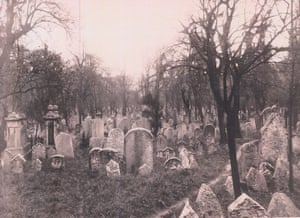
The ancient Prague Jewish cemetery before the tower was built over it, involving the disinterment of human remains. Photograph: Archive of the City of Prague
Local officials are calling for a memorial acknowledging that the tower, believed to have been conceived partly as a cold-war gambit to block western TV and radio broadcasts, stands on what was once Prague’s biggest Jewish cemetery, where rabbis, distinguished scholars and leading industrialists, among others, were laid to rest.
Graves in the former cemetery in the Žižkov neighbourhood were disturbed after workers began drilling in 1985 to lay the tower’s foundations. While some remains were reburied in other cemeteries, others were reportedly dumped in a landfill site outside Prague, in violation of Jewish law forbidding the disinterment of buried bodies.
The Jewish community sold the site, under pressure from the communist authorities, to the state broadcaster after it was deemed the ideal location for the tower. Most of the headstones in the once sprawling cemetery – first established in 1680 and the burial place for about 40,000 people – had previously been flattened and grassed over in the early 1960s to convert it into a park, also at the demand of the communist regime.
By the time the tower was completed in 1992, the cold war had ended after communist regimes in Czechoslovakia and other eastern bloc countries lost power. It is now marketed as a tourist attraction, boasting an observatory, a restaurant and even a one-bedroom hotel.
It stands at the centre of a square hosting a restaurant, an underground parking facility and a mini-golf course, part of which is said to be sited where the grandest tombstones once stood. There is also an ice rink in winter.
The cemetery’s oldest section survived the developments and remains in relative obscurity at one end of the square, Jewish community leaders having spent heavily to rescue it from the decay it had fallen into during the communist period.
However, they say a memorial is needed out of respect for the much larger, disappeared part of the cemetery, and as a reminder of what is seen as a state-sponsored effort to erase the last vestiges of Jewish identity after the Holocaust.
Some local schools have taken pupils on tours of the site to raise awareness. Magdalena Novotná, a teacher leading a group of nine-year-olds around the cemetery as part of a class project, said: “The communist regime was not sensitive to spirituality or religious traditions. What touches me is that we know the Jewish belief that we cannot move bodies once they are in the soil, but they moved them completely. This is what we teach the children in the project.”
Anna Tumova, a spokesperson for České Radiokomunikace, the tower’s owners, said the company had not been approached, but that it would consider any proposal for a memorial. A plaque on the body of the tower itself would need permission from its architect, Václav Aulický.
The structure already carries the figures of several sculpted “babies” designed by a Czech artist, David Černý, copies of which were refitted earlier this year after the originals were removed.
The tower is the latest focal point of the Jewish community’s drive to restore scores of cemeteries, synagogues and other cultural sites destroyed or allowed to fall into ruin under communism. Some 105 synagogues were demolished during the communists’ reign – compared with 70 during the Nazi occupation.
Stonework for many abandoned sites was sold and later reused for private gardens, car parks or pedestrianised streets. Prague city council recently agreed to allow Jewish community leaders to examine cobbled paving stones dug up for a forthcoming redevelopment of Wenceslas Square. Some stones are believed to have been taken from Jewish cemeteries and repurposed for the pedestrianisation of the area carried out by the communist regime in the 1980s.
Rabbi Daniel Friedman is Chair of the National Holocaust Monument Development Council puts the plaque controversy in context:
Last month, Canada unveiled our incredible Holocaust Monument. Let me tell you about my proudest moment that day. It wasn’t when, for the very first time, I walked into the awe-inspiring monument. It wasn’t when, alongside our prime minister, I addressed the nation. And, despite my great reverence for them, it wasn’t when I met the hundreds of inspiring survivors and generous donors.
My proudest moment was watching Justin Trudeau step off stage after his speech. Just then, he noticed a familiar face towards the back of the room, that of Tim Uppal. Uppal is the former MP who introduced the Holocaust Monument bill in Parliament. When Trudeau spotted him, he strode up to the back of the room, grabbed Tim by the hand, and escorted him to the front. At the end of the ceremony, the prime minister turned and gave him a big hug.
That’s the epitome of Canadianism. You see, Tim Uppal was a Conservative MP. Trudeau could have snubbed his former rival and basked all alone in the glory of his government’s day in the sun. But he chose to include him, making sure that he was every much a part of this historic hour.
That’s why Canadians deserve the monument we’ve built together. Many in the world today pay lip service to eradicating hatred and promoting love, respect and tolerance for all humankind. But they never miss an opportunity to attack those who don’t agree with their views, attacks often having little to do with any real matter of substance.
The monument is the product of a partnership between many organizations. Designed by the Lord Cultural Group and Daniel Libeskind, built by the National Capital Commission, facilitated by Canadian Heritage, and overseen by the Monument Development Council, a lot of people have coordinated their efforts to build this piece of our nation.
Along the way we had disagreements. Some bigger, some smaller. Along the way, we made mistakes. Some bigger, some smaller. Along the way we switched governments, which meant a whole host of new players and opinions entering the fray. But we’re Canadians. And we figured it out. We didn’t point fingers. We didn’t politicize things. We were proud of the fact that the Monument bill passed unanimously.
On the big day, we suddenly realized that an egregious error had been made. In amongst the debates over wording and plaque positioning, somehow the one plaque that introduced the others – and made no sense outside the context of the plaques detailing the Nazi genocide of six million Jews along with homosexuals, the disabled and others – ended up mounted all on its own on a separate wall. Visitors to the site were rightly disturbed to encounter this major injustice to the memory of the six million Jews for whom the monument was built. All of the parties involved are deeply remorseful and we apologize unconditionally for the pain we have caused by this oversight.
I want to thank the Trudeau government for acting expeditiously to amend the plaque as soon as the error was brought to its attention. Mistakes happen; most can be fixed quickly and decorously. Without questioning, the government did the right thing, which has been our experience with Trudeau’s government throughout. And that’s why when I saw his interaction with Tim Uppal at the unveiling, my respect for our leader grew ever stronger. The man is a true Canadian. The man is a mensch.
Canadians don’t look for fights. We seek opportunities to embrace and boost other people who are different from us, whether those differences involve political views, religion or skin colour. The last thing we would want to politicize is the Holocaust.
The National Holocaust Monument was initiated by the Stephen Harper government. It was brought to fruition under the Trudeau government. We live in the most tolerant country in the world, and probably, of all time. Let us never take that blessing for granted. Let us be a little more forgiving of one another. And let us continue to work together, across party lines, ethnic lines and religious lines, to lead the international community, and make this world a better, safer place for all peoples.

 Multicultural Meanderings