For women of colour, there’s a gap within the pay gap: Melayna Williams

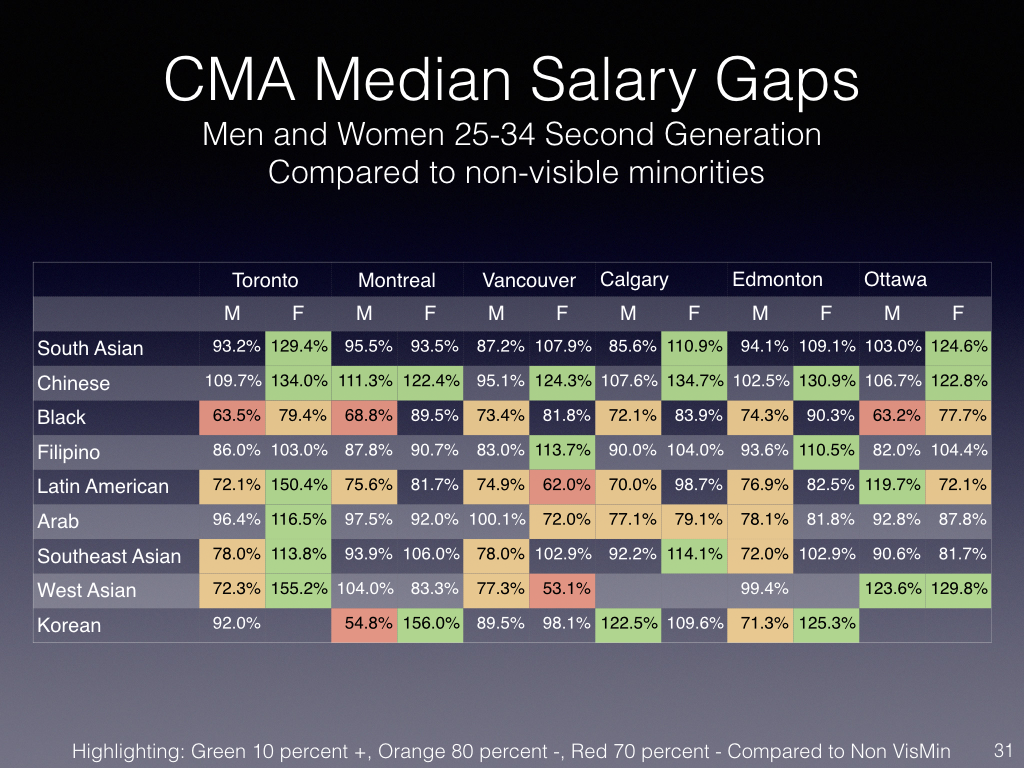
Have been working through some of the Census data and the gender gap works both ways depending on the group as the above chart indicates.

Given Williams’ focus on the Black community, which the data supports, her perspective is understandable but the data shows a more complex reality among the different minority groups and gender:

The gender wage gap remains a pertinent issue in Canada, despite how long women have been lending their labour to the workforce. And we often hear statistics that contrast two categories: men and women. On this, the numbers are stark.

But that data doesn’t incorporate filters around identity and background of women, an omission that effectively erases the compounding discrimination faced by non-white women in Canada. A lens that compares only men and women sets up women’s rights as a replica of patriarchy, where one group is favoured over everyone else; in doing so it reinforces the rigid power structures that have brought us to this point. But including race in the analysis reveals a different kind of gender gap that’s perhaps even more alarming than the broader issue.

In a 2011 Canadian Centre for Policy Alternatives report examining census data from 2006, Sheila Block and Grace-Edward Galabuzi found dire income disparities for racialized Canadians. They earn 81.4 cents for each dollar white Canadians make, and the jobs are typically less desirable: low wages, precarious, non-permanent. Add the filter of gender, though, and a much wider, more worrisome gulf appears: “Racialized women earned 55.6 cents for every dollar non-racialized men earned in 2005 . . . Racialized men made 77.9 cents for every dollar non-racialized men earned,” wrote Block and Galabuzi. “The gap narrows even further when comparing racialized and non-racialized women. Racialized women earned 88.2 cents for every dollar that non-racialized women earned.”

Research has been done to identify the core issues and advance solutions around the position of Indigenous and Canadian women of colour in the work market. “Inequality, discrimination and a segmented labour market have left women of colour with earnings at just 64 per cent of men’s, and Aboriginal women’s earnings at just 46 per cent of men’s,” wrote Lisa Lambert in a 2010 paper titled “Gender wage gap even more pronounced for Aboriginal women.” For women of colour and Indigenous women in Canada, she writes, “the earnings situation is inexcusable.”

How are we closer to gender parity in Canada when the gender gap we often think about ignores the unique struggles of women of colour and Indigenous women? If white men are still making more money than white women, can this be acknowledged while addressing the fact that women of colour fall far below both? If we actually believe in the principles of equality with which Canada so proudly associates itself, we must acknowledge both crises: the gap between men and women, and that between racialized women and everyone else.

Source: For women of colour, there’s a gap within the pay gap

Does Ontario’s Black Youth Action Plan do enough? – Melayna Williams

The paragraphs on data collection, part of Ontario’s Anti-Racism Strategic Plan are key (the question of enough is more rhetorical as governments have to balance priorities, and activists will never admit that there is “enough”):

Indeed, a conversation about Black youth in Ontario cannot be viewed in isolation. The layers of oppression that characterize a system that fails to serve Black youth is a failure of many systems that often work in conjunction: our education system, justice system, and child welfare system. That consideration is bolstered a timely report recently released by the United Nations Working Group of Experts on People of African Descent on its Mission to Canada. While the report’s buzziest recommendation may have been its suggestion for the federal government to consider paying reparations to African Canadians and apologize for past injustices and slavery, it also offered insight into the shortcomings of Ontario’s plan.

For one thing, the working group flagged the lack of nationwide data collection that’s disaggregated by race, colour, ethnic background, nation of origin, and other identities, something that the racial justice community in Canada has long been lobbying for. While activists and citizens living in neighbourhoods consistently targeted by law enforcement are instinctually aware of realities like carding, educational streaming and over-incarceration without statistics, a lack of data often makes it easy to ignore or disbelieve realities of oppression and inequality. Data is raw policy-driven proof that is indisputable, and simply helps to create better policy.

“Lack of disaggregated data obscures the degrees of disparity and in this case, highlights the inequities that we noticed in the treatment and specific human rights concerns of African Canadians,” says Ahmed Reid, a member of the UN Human Rights Council and one of the five independent experts on the working group who visited and met with groups in Ottawa, Montreal, Toronto and Halifax. “We hope the government will take it on board; Canada has a serious lack of race-based data.”

The report also noted issues around racial profiling, citing research on carding and street checks from York University and the Ontario Ombudsman. It flags the “excessive use of force and killings by the police, especially in response to cases involving vulnerable people of African descent, who are mentally ill or otherwise in crisis,” and the working group calls for a trained mental health professional to be on the ground when police are called to a scene. “We looked at interactions and noticed where you see an African Canadian being killed by law enforcement, oftentimes you will read this person had a mental problem,” says Reid.

The link between deficiency of police accountability for killing Black people cannot be separated from the failure by governments to collect and analyze the data. The report notes that Ontario’s police watchdog, the Toronto Police and the Ministry of Community Safety and Correctional Services do not collect race-based statistics on fatal police incidents; Statistics Canada and the Canadian Centre for Justice Statistics only track fatal police shootings if an officer is criminally charged, and doesn’t track data on race.

Also, the compounding of issues that Black women confront—which also affects their children and families—have a wide-ranging effect on the Black community in Canada. An understanding of intersectionality can go a long way in addressing the unique issues Black youth face by contextualizing not only their circumstances, but their caregivers.

“Every city that we went to, we realized that people understood the racialization of the issues, but the feminization understanding was stark from our vantage point,” says Reid. “We hope the provinces deal with issues of intersectionality—this goes back to disaggregated data—this is where you can identify disparities and issues, as it relates to education, housing, and other issues.”

The report cites the alarming rates of Black child apprehension by child welfare agencies across the country, stating that 41.8 per cent of the children and youth in the care of the Children’s Aid Society of Toronto are of African descent, despite Black Canadians making up only 6.9 per cent of Toronto’s population and just 8 per cent of the city’s population is under the age of 18. These are the same youth that Ontario’s action plan seeks to lift up. If the state lacks the cultural competency to support and trust Black women in building and sustaining their families, how can communities have faith that the government has the tools to encourage Black youth to succeed?

The Ontario Black Youth Action Plan is an important step in recognizing the unique barriers faced by Black youth. But it remains to be seen if the provinces and the federal government will divest in the systemic barriers that manifest institutionalized anti-Black racism; without that, plans, strategies and consultations will continue to fail in achieving real change for Black Canadians.

Source: Does Ontario’s Black Youth Action Plan do enough? – Macleans.ca

Confronting Canada’s ugly record of anti-Blackness

A needed counterpoint to the sanitized version of Canadian history. However, the arguments might be stronger if the book was not only”grounded in the work of countless renowned Canadian anti-racist scholars and activists,” but included a wider range of scholars:

In the early 20th century, the Canadian Department of Immigration went to great lengths to dissuade Black Americans from immigrating to Canada. Working with doctors, they provided them with monetary rewards for turning Black migrants away at the border and mandated that these medical professionals inflict invasive and unnecessary examinations as deterrence from entering Canada. The government also sent doctors to Oklahoma and Kansas to spread propaganda to Black Americans around the unlivable weather conditions of Canada—some even going as far as telling Black men their daughters would be vulnerable to sexual abuse and exploitation.

This was done alongside two things: active courting of white settlers and a deep investment in the public appearance of a polite and welcoming neutrality, set apart from the outward race-based discrimination of the United States. This is just one of hundreds of seamless historical examples cited in the new book Policing Black Lives: State Violence in Canada From Slavery to the Present, written by Black feminist writer, activist and educator, Robyn Maynard.

Maynard plainly corrects and downright disrupts the friendly, welcoming and multicultural narrative on which Canada’s national identity relies. Her book examines anti-Black racism alongside every historical moment that Black people have been present in this country, starting from settler colonialism to present day. By characterizing Canadian nation-building as settler colonialism, Maynard effectively calls out the white theft of Indigenous land in the building of Canada and traces it through to a white-dominated hierarchy that exists to this day. It is grounded in the work of countless renowned Canadian anti-racist scholars and activists.

Maynard traces the 200 years of slavery in Canada, often erased or downplayed in the study of our history, noting the same dehumanizing and violent treatment of Black bodies we see in accounts of slavery in the U.S. Anti-Blackness through segregation characterized the post-slavery abolition period, an era often reimagined in Canada as purely positive.

Maynard recounts “Canada’s Jim Crow”, government-enforced racial segregation that had an impact on housing, employment, education and immigration for Black people in Canada. “Racial segregation—a form of violence in and of itself—entails the enforced (rather than voluntary) confinement of racialized populations to particular spaces (e.g. particular neighbourhoods, schools, public spaces, and businesses),” she writes. “The segregation of Blacks—which, like slavery, was a form of controlling Black movement and institutionalizing subordination—was based on the idea that Black people were both inferior and a danger to whites. Formally and informally, segregation was one of Canada’s foremost strategies for maintaining white dominance across all aspects of society after slavery’s end.”

Source: Confronting Canada’s ugly record of anti-Blackness – Macleans.ca

Too many Canadians don’t recognize the Islamophobia in their country

Melayna Williams on Islamophobia:

Indeed, plenty of work has already been done to capture, contextualize and fully understand what Islamophobia means. A paper published in 2011 by the Ontario Human Rights Commission highlights the “negative stereotyping and discrimination as a result of pre-existing perceptions of Muslims as ‘different’ from the rest of Canadian society, along with negative associations of their communities with violence and terrorism” in the decade following the Sept. 11, 2001, terrorist attacks in New York City.

These problems even occur in institutions that pledge tolerance and inclusion, like Canadian universities. Following the Quebec City mosque attack, Muslim students publicly recounted incidents that are part of their daily reality: the defacing of posters for a conference on Islam at Durham College and the University of Ontario Institute of Technology; and the distributing of anti-Muslim flyers and insults on student election materials at McGill University, the University of Calgary and the University of Ottawa. A student at Simon Fraser University was told to remove her hijab, and horrifyingly, last year, a woman had her hijab pulled, was punched and spat on in a grocery store in London, Ont.

We don’t need more evidence—yet there’s still denial by many white Canadians. Exercising privilege in this way has clear detrimental effects, argues Tim Wise, an anti-racism writer and activist. “That white Americans don’t by and large see what people of colour see doesn’t mean that white folks are horrible people, of course,” he writes in an essay called “White Denial.” “What it does suggest is a degree of isolation and provincialism that should lead us to think twice before pontificating about a subject that we simply don’t have to know nearly as well as those who are the targets of it.”

This is why “recognition of Muslims as part of the fabric of this country is so critical,” argues Shirazi. Many Canadians have the luxury of not acknowledging racism, and they’ve done so to the extent that white denial has become its own narrative. Any attempt to ignore the problem—or treat its victims as “other”—undercuts any effort toward inclusion in the next 150 years.

Source: Too many Canadians don’t recognize the Islamophobia in their country – Macleans.ca