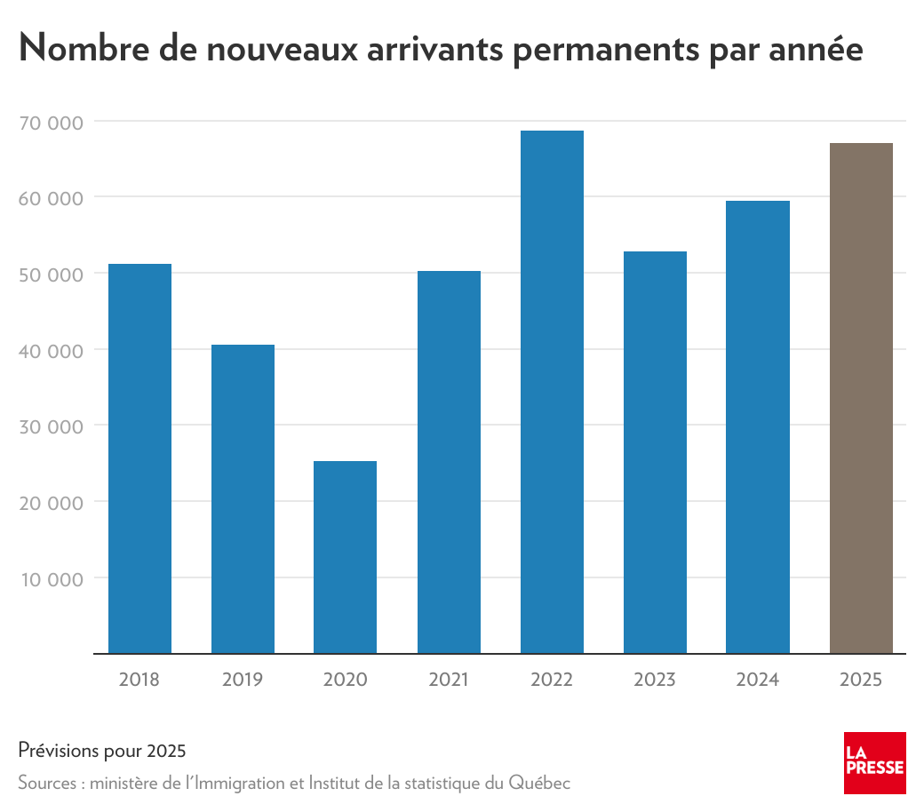
Québec pourrait choisir un seuil d’immigration de 25 000 par année

Sharp contrast with the l’Institut du Québec recommendation of 90,000:

Le gouvernement Legault évaluera la possibilité d’accueillir 25 000, 35 000 ou 45 000 nouveaux arrivants par année à partir de l’an prochain. Des seuils d’immigration réduits qui s’accompagneraient d’une baisse du nombre de travailleurs temporaires à Montréal et à Laval.

Ces informations, d’abord rapportées mercredi après-midi par TVA Nouvelles et par Le Journal de Québec, ont été confirmées au Devoir de source sûre. Le gouvernement doit consulter des experts à ce sujet l’automne prochain, dans le cadre de la planification pluriannuelle de l’immigration, un processus prévu dans la loi.

En octobre, le ministre de l’Immigration, Jean-François Roberge, avait déjà laissé présager des scénarios de cibles à la baisse. En 2025, le gouvernement évalue qu’il accueillera autour de 67 000 nouveaux résidents permanents. Québec pourrait donc réduire de plus de moitié ses seuils 2026-2029.

Pendant la campagne électorale de 2022, le premier ministre François Legault, qui cherchait alors à se faire réélire, avait dit qu’il serait « un peu suicidaire » pour le statut du français au Québec d’accueillir annuellement plus de 50 000 immigrants, la cible de son parti à l’époque. Depuis, le Québec a systématiquement dépassé ce nombre. L’an dernier, le ministre Roberge avait justifié ce surnombre en affirmant devoir réduire les listes d’attente en immigration — composées de personnes déjà établies au Québec en attente d’un statut permanent.

Dans un rapport paru mercredi, l’Institut du Québec a pour sa part plaidé pour une augmentation des seuils à 90 000. Cette hausse permettrait, selon le document, à plus d’immigrants temporaires d’obtenir un statut permanent, pour que les seuils soient réduits graduellement ensuite….

Source: Québec pourrait choisir un seuil d’immigration de 25 000 par année

The Legault government will assess the possibility of welcoming 25,000, 35,000 or 45,000 newcomers per year starting next year. Reduced immigration thresholds that would be accompanied by a decrease in the number of temporary workers in Montreal and Laval.

This information, first reported on Wednesday afternoon by TVA Nouvelles and Le Journal de Québec, was confirmed at the Devoir de source sûre. The government is due to consult with experts on this subject next fall, as part of the multi-year immigration planning, a process provided for in the law.

In October, the Minister of Immigration, Jean-François Roberge, had already suggested downward target scenarios. In 2025, the government estimates that it will welcome around 67,000 new permanent residents. Quebec could therefore reduce its 2026-2029 thresholds by more than half.

During the 2022 election campaign, Prime Minister François Legault, who was then seeking re-election, said that it would be “a little suicidal” for the status of the French in Quebec to welcome more than 50,000 immigrants annually, the target of his party at the time. Since then, Quebec has systematically exceeded this number. Last year, Minister Roberge justified this surplus by saying he had to reduce immigration waiting lists — made up of people already established in Quebec waiting for permanent status.

In a report on Wednesday, the Institut du Québec called for an increase in thresholds to 90,000. This increase would allow, according to the document, more temporary immigrants to obtain permanent status, so that the thresholds would then be gradually reduced….

Immigration au Québec | Un rapport propose d’accueillir 90 000 résidents permanents par année

Of note:

La cible proposée dans ce rapport, publié ce mercredi, contraste fortement avec les intentions de Québec, qui examine trois scénarios pour l’immigration permanente, tous sous la barre des 50 000 par année, selon des informations obtenues par La Presse1.

Le Québec compte aujourd’hui plus de 615 000 personnes à statut temporaire, un record. Travailleurs étrangers, étudiants internationaux, demandeurs d’asile : leur présence a soutenu la croissance, mais a aussi mis sous pression les services publics, le logement et les capacités d’intégration.

Parmi eux, les travailleurs étrangers temporaires (TET), notamment ceux recrutés par les employeurs à l’international, s’installent majoritairement en région. Selon le rapport de l’IDQ, 81 % des TET vivent à l’extérieur de Montréal, où leur apport a permis à plusieurs localités de freiner le déclin démographique et de maintenir certains services essentiels.

Face à cette situation, l’IDQ propose une solution de transition : réduire progressivement les admissions temporaires, tout en offrant la résidence permanente à un plus grand nombre de personnes déjà sur le territoire.

Le rapport recommande d’admettre temporairement 90 000 immigrants permanents par an. Il s’agirait en grande partie de personnes qualifiées, diplômées, bien intégrées, qui vivent déjà au Québec.

Le but est de réduire le roulement de main-d’œuvre précaire et d’offrir une trajectoire claire à ceux qui ont démontré leur capacité d’intégration.

Deux vitesses

Le recours massif aux statuts temporaires, qui ne mènent pas automatiquement à la résidence permanente, a créé un système à deux vitesses. Les employeurs recrutent rapidement, parfois en dehors des filières économiques prévues, tandis que les personnes admises temporairement restent dans l’incertitude, souvent confinées à des emplois peu qualifiés et à bas salaire.

« Ces dernières années, on a vu un peu les limites de ce modèle. Accueillir beaucoup d’immigrants, s’ils ont de la difficulté à trouver un emploi ou s’ils occupent des emplois moins bien rémunérés ou qui ne répondent pas à leurs aspirations, ça fait grossir la taille de l’économie, mais ça ne crée pas nécessairement de la richesse », affirme Emna Braham, directrice générale de l’IDQ….

Source: Immigration au Québec | Un rapport propose d’accueillir 90 000 résidents permanents par année

Is Canada’s immigration system actually broken? Here’s how it changed under Justin Trudeau

Good overview and series of informative charts:

Canada’s rapid population growth recently has been driven by immigration, which accounted for 97.3 per cent of the 724,586 net growth in the country in 2024.

Since the early 1990s, successive federal governments had maintained a steady immigration level yearly that averaged 0.75 per cent of Canada’s overall population, regardless of the boom-and-bust economic cycle. Skilled immigrants were viewed as an economic stimulant during a recession and as a source of labour supply in time of prosperity.

The number of temporary residents was relatively small. Most international students came primarily to study while foreign workers ebbed and flowed supposedly based on labour needs; those whose time was up had to go home. In the mix were asylum seekers who would become permanent residents if granted protected status. 

Riding the popularity of Prime Minister Justin Trudeau’s “sunny ways,” the Liberal government welcomed tens of thousands of displaced Syrians and slowly raised the annual immigrant intake to 0.9 per cent of Canada’s overall population in 2019.

After a nosedive in immigration in 2020 — to 0.49 per cent of the population — due to pandemic border closures, Trudeau not only extended the stay of most temporary residents, but opened the door to more in response to skyrocketing job shortages, which reached about a million vacancies….

It didn’t help that Canada’s immigration system over recent years has prioritized the transition of temporary residents in the country, many toiling in lower-skilled jobs, to permanent residents. Instead of picking skilled economic immigrants with high scores in the point selection system, so-called targeted draws were introduced in 2023 to favour candidates with lower scores but who work in an in-demand occupation or are proficient in French.

“We are not selecting the best of the best,” said Planincic. “The intent is to meet labour market needs, but it really muddies the waters, especially when the categories can change at political whims.” 

A better indicator of an immigration candidate’s value to the community and the country, she suggested, is their current earnings, which should be part of the point system….

Immigration lawyer Mario Bellissimo attributes much of the system’s chaos to the myriad “ministerial instructions,” temporary directives issued by the minister to address intake, processing, selection, or to create pilot programs.

The extraordinary authority endowed with the minister — introduced in 2008 by Stephen Harper’s Conservatives — has contributed to a patchwork of ad-hoc immigration policies with little transparency.

The ballooning temporary resident population is further fuelled by Canada’s evolving “two-step” permanent residence selection system that favours those already in the country, with Canadian education credentials and work experience. In 2022, 36 per cent of all new permanent residents had previously been in Canada on work permits, up from 19 per cent in 2010 and 33 per cent in 2019.

The population of temporary residents got out of control “because they wanted this mass pool to draw from,” said Bellissimo, adding that immigration officials have been stretched thin handling these student, work and visitor applications, compromising services….

Most people used to look past the struggles of immigrants and focus on the success of their children, but now they expect newcomers themselves to hit the ground running. Paquet said it’s time for Canadians to have a debate about the objectives of immigration.

Immigration had generally been a non-issue in modern Canadian politics because of a consensus that it’s good for the country. Might this federal election be different?

Although Donald Trump and tariffs have dominated the early part of the campaign, immigration has become a major political issue in the last few years of Trudeau’s government.

“How much will the parties talk about it and how much of a central theme will it be?” asked Paquet, research chair in politics of immigration at Concordia. “When a party decides to do that, then that tells us a lot about how the political system is changing.”

Source: Is Canada’s immigration system actually broken? Here’s how it changed under Justin Trudeau

New immigration minister says Trump presidency could prompt best and brightest to choose Canada 

Of note (HESA also made a similar pitch):

The new Immigration Minister Rachel Bendayan thinks the Trump presidency is creating an “incredible opportunity” for Canada to attract the best and brightest from around the world – including talented people currently living in the United States.

In her first interview since being appointed to the portfolio in the cabinet shuffle last week, Ms. Bendayan said she had already discussed with fellow ministers the prospect of successful and highly educated people wanting to live here instead of the U.S.

“What I’m hearing is that people are thinking more and more about Canada, whether it’s in the United States, and Americans thinking about making the trip north, or quite frankly right around the world,” she said. “I think we could attract some of the best minds around the world, just as the United States once did. I think there’s an incredible opportunity to attract the best and the brightest, including from the United States to Canada.”

Donald Trump has criticized Canada’s immigration policies, implying they are lax, an accusation that Ms. Bendayan said is ”very far from the truth.”

She said Canada has “a robust immigration system” and “we take security very seriously.”

She said there is already a lot of co-operation and information sharing with the U.S. “in order to make sure that North America is a secure environment” and that is increasing.

But Ms. Bendayan said she wanted to make further reductions to the number of migrants living in Canada – including temporary migrants.

Last November, the government sharply tightened migration targets as part of its annual immigration levels plan. Ms. Bendayan said she wanted to maintain a downward trend for both permanent and non-permanent residents.

She said figures released this week showing a big reduction in the number of temporary residents are “important and certainly trending in the right direction.”

“But that number still needs to continue to come down,” she said….

Source: New immigration minister says Trump presidency could prompt best and brightest to choose Canada

Québec | Vers une baisse de l’immigration permanente

A noter:

C’est une grande contradiction du gouvernement Legault. Et il tentera de corriger le tir dans les prochaines semaines.

À moins d’un revirement de dernière minute, il proposera trois scénarios de baisse du seuil d’immigration permanente pour les prochaines années. Ces scénarios fixeront le seuil sous les 50 000 nouveaux arrivants par année à compter de 2026, année électorale. On pourrait donc avoisiner les 35 000 promis par le Parti québécois dans son plan présenté l’automne dernier. Les scénarios seront soumis à une consultation ce printemps pour être adoptés d’ici juin.

Le ministre de l’Immigration, Jean-François Roberge, a préparé le terrain à cette réduction en imposant l’automne dernier un moratoire sur deux importants programmes d’immigration permanente : le Programme régulier des travailleurs qualifiés (PRTQ) et le Programme de l’expérience québécoise destiné aux diplômés (PEQ-Diplômés). Québec n’accepte plus de nouvelles demandes depuis. Le moratoire est en vigueur jusqu’en juin.

Cette décision n’a toutefois pas une incidence à très court terme. À preuve, le gouvernement prévoit tout de même jusqu’à 67 000 nouveaux arrivants cette année, frôlant le record de 2022.

Sans le moratoire, le Québec était en voie d’en accueillir environ 70 000. Pourquoi ? En bonne partie parce qu’il y a eu explosion des demandes de la part des diplômés via le PEQ, à la suite d’une décision prise en 2023.

Christine Fréchette, alors ministre de l’Immigration, avait décidé que les personnes sélectionnées dans le cadre de ce programme seraient admises « en continu », sans aucun plafond. Québec a pour ainsi dire ouvert les vannes, plaidant que le PEQ était réservé surtout aux étudiants ayant obtenu un diplôme dans un programme donné en français.

Le premier ministre François Legault n’est donc pas parvenu à respecter sa promesse électorale : maintenir un seuil de 50 000. Dépasser ce seuil est « suicidaire » pour la nation québécoise, plaidait-il pourtant en campagne électorale en 2022. Il avait eu la même difficulté dans ce dossier durant son premier mandat, alors qu’il avait promis un maximum de 40 000 nouveaux arrivants par année.

Dans les faits, Québec a réduit le seuil d’immigration seulement au début de son premier mandat. Il l’a abaissé à 40 000 nouveaux arrivants en 2019. Si on met de côté la pandémie, qui a évidemment freiné l’immigration en 2020, le seuil a augmenté à au moins 50 000 par année depuis 2021 avec un sommet de 68 700 en 2022.

Au-delà du nombre, l’important est aussi de connaître le profil des immigrants que l’on accepte. Sur ce plan, le gouvernement Legault récoltera-t-il les fruits attendus de ses décisions ? Il y a deux ans, il a rehaussé les exigences en matière de français pour l’ensemble des immigrants permanents. Les indications entre les mains du gouvernement laissent croire que 80 % des nouveaux arrivants qui seront admis cette année auront une connaissance du français. Ce serait 10 points de plus qu’en 2024 et les années précédentes. À suivre.

Angle mort

À quoi bon débattre d’un seuil pour réduire l’immigration permanente si l’immigration temporaire continue d’augmenter ? C’était l’angle mort du dossier jusqu’ici, et Québec va corriger le tir là aussi.

Pour la toute première fois, la « planification pluriannuelle » du gouvernement Legault tiendra compte de cette immigration temporaire.

Le nombre de résidents non permanents a plus que doublé depuis 2021 pour dépasser les 600 000. Parmi eux figurent les demandeurs d’asile, dont le nombre a triplé au cours de la même période. Le Québec compte 40 % des demandeurs d’asile du pays.

Cette immigration temporaire met sous pression les services publics, martèle le gouvernement. François Legault en fait d’ailleurs la cause sous-jacente de la crise du logement et de la pénurie d’enseignants. Et la semaine dernière en Chambre, il a même établi un lien avec la crise de l’itinérance à Montréal.

Le gouvernement a commencé à agir pour réduire cette part de l’immigration. Il a décidé de limiter le nombre d’étudiants étrangers. Il a suspendu le Programme des travailleurs étrangers temporaires pour certains emplois dans l’île de Montréal, une mesure qui est reconduite jusqu’à la fin de novembre et qui sera étendue à Laval en mars.

Surtout, le premier ministre fait pression sur Ottawa, qui contrôle une partie de l’immigration temporaire et qui a pris certaines mesures pour la réduire dans les derniers mois.

M. Legault veut que le fédéral aille plus loin et, notamment, qu’il réduise de moitié le nombre de demandeurs d’asile installés au Québec. Quitte à les déplacer de force dans d’autres provinces, a-t-il suggéré l’automne dernier, une proposition qui a soulevé la controverse.

Le gouvernement a soupesé d’autres options afin de pousser 80 000 demandeurs d’asile à quitter le Québec pour une autre province. Par exemple, payer une indemnité aux demandeurs en échange de leur départ et réduire les services offerts par l’État, comme le chèque d’aide sociale.

Il faut s’attendre à ce que François Legault tente d’augmenter la pression sur les partis politiques fédéraux alors que des élections approchent. Mais il a fait chou blanc jusqu’ici avec sa principale demande de rapatrier les pleins pouvoirs en immigration.

Source: Québec | Vers une baisse de l’immigration permanente

This is a great contradiction of the Legault government. And he will try to correct the shot in the coming weeks.

Unless there is a last-minute turnaround, it will propose three scenarios for lowering the permanent immigration threshold for the next few years. These scenarios will set the threshold below 50,000 newcomers per year starting in 2026, the election year. We could therefore be close to the 35,000 promised by the Quebec Party in its plan presented last fall. The scenarios will be submitted for consultation this spring to be adopted by June.

The Minister of Immigration, Jean-François Roberge, prepared the ground for this reduction by imposing a moratorium last fall on two important permanent immigration programs: the Regular Skilled Worker Program (PRTQ) and the Quebec Experience Program for Graduates (PEQ-Diplômés). Quebec has not accepted new requests since then. The moratorium is in effect until June.

However, this decision does not have a very short-term impact. As proof, the government still expects up to 67,000 newcomers this year, close to the record of 2022.

Without the moratorium, Quebec was on its way to welcoming about 70,000. Why? In large part because there has been an explosion of requests from graduates via the PEQ, following a decision taken in 2023.

Christine Fréchette, then Minister of Immigration, had decided that the people selected under this program would be admitted “continuously”, without any ceiling. Quebec City has almost opened the floodgates, arguing that the PEQ was reserved mainly for students who obtained a diploma in a given program in French.

Prime Minister François Legault therefore failed to meet his electoral promise: to maintain a threshold of 50,000. Exceeding this threshold is “suicidal” for the Quebec nation, he pleaded in the election campaign in 2022. He had had the same difficulty in this case during his first term, when he had promised a maximum of 40,000 newcomers per year.

In fact, Quebec only reduced the immigration threshold at the beginning of its first term. He lowered it to 40,000 newcomers in 2019. If we put aside the pandemic, which obviously slowed down immigration in 2020, the threshold has increased to at least 50,000 per year since 2021 with a peak of 68,700 in 2022.

Beyond the number, the important thing is also to know the profile of the immigrants we accept. On this level, will the Legault government reap the expected fruits of its decisions? Two years ago, he raised French requirements for all permanent immigrants. The indications in the hands of the government suggest that 80% of the newcomers who will be admitted this year will have a knowledge of French. That would be 10 points more than in 2024 and previous years. To be continued.

Blind spot

What is the point of discussing a threshold to reduce permanent immigration if temporary immigration continues to increase? It was the blind spot of the file so far, and Quebec will correct the shot there too.

For the very first time, the Legault government’s “multi-year planning” will take this temporary immigration into account.

The number of non-permanent residents has more than doubled since 2021 to exceed 600,000. These include asylum seekers, the number of whom has tripled over the same period. Quebec has 40% of the country’s asylum seekers.

This temporary immigration puts pressure on public services, the government hammers. François Legault makes it the underlying cause of the housing crisis and the shortage of teachers. And last week in the Chamber, he even established a link with the homelessness crisis in Montreal.

The government has begun to act to reduce this share of immigration. He decided to limit the number of foreign students. It suspended the Temporary Foreign Worker Program for certain jobs on the island of Montreal, a measure that is renewed until the end of November and will be extended to Laval in March.

Above all, the Prime Minister is putting pressure on Ottawa, which controls some of the temporary immigration and has taken certain measures to reduce it in recent months.

Mr. Legault wants the federal government to go further and, in particular, to halve the number of asylum seekers living in Quebec. Even if it means forcibly moving them to other provinces, he suggested last fall, a proposal that raised controversy.

The government has weighed other options to push 80,000 asylum seekers to leave Quebec for another province. For example, paying compensation to applicants in exchange for their departure and reducing services offered by the state, such as social assistance cheques.

It is to be expected that François Legault will try to increase the pressure on federal political parties as elections approach. But he has done white cabbage so far with his main request to repatriate full powers to immigration.

Chrystia Freeland’s housing plan ties immigration to supply, cuts development charges

Remarkable and somewhat comical, depressing and revealing, walking back from previous government positions where she was Deputy PM. I don’t disagree with the changed policy thrust, just wonder why it took so long….:

Liberal leadership candidate Chrystia Freeland’s plan to fix the housing shortage would tie the number of newcomers Canada admits to housing availability.

The former finance minister made the promise in a 10-point policy document her campaign issued Monday morning. Freeland said the move would slow down population growth until housing affordability stabilizes.

Conservative Leader Pierre Poilievre has been promising for some time now to tie immigration numbers to housing starts.

Under the federal government’s current immigration plan, the number of permanent residents being admitted is set to decline annually until it reaches 365,000 in 2027. The previous goal was to admit upwards of 500,000 permanent residents annually from 2024 to 2026.

The link between immigration and housing starts isn’t the only thing the Freeland and Poilievre plans have in common….

Source: Chrystia Freeland’s housing plan ties immigration to supply, cuts development charges

Poilievre suggests capping immigration at Harper-era levels, deportations for wrongdoers

Back to Kenney-era levels, about half of current levels (no specific mention of levels of temporary workers and international students). Unclear whether the provinces would accept such a major reduction but good to have Poilievre provide specific numbers.

Ramping up deportations will be more challenging than a “deport bogus refugees” or “deport hate” slogans:

Conservative Leader Pierre Poilievre has confirmed his plans to reduce immigration levels to Stephen Harper-era levels and deport those who break Canada’s laws while on temporary visas, in an exclusive interview with Juno News co-founder Candice Malcolm.

Juno News is a reader-supported publication. To receive new posts and support my work, consider becoming a free or paid subscriber.

On the broader issue of immigration levels, Poilievre stated that the current annual intake of permanent residents — set to reach 500,000 in 2025 — is unsustainable and has contributed to Canada’s housing crisis.

He proposed a return to the levels of previous Conservative governments, around 200,000 to 250,000 per year, aligning population growth with the number of new homes being built.

“It would be a lot more like the Harper numbers that were basically the same for 40 years before Trudeau took office — we were bringing in about 200,000 to 250,000 a year,” said Poilievre.

“We were building about the same number of homes as we were adding people, so we had a housing surplus. I would bring in a simple mathematical formula: we cannot bring in people faster than we add houses.”

According to Poilievre, the formula would be based on the homebuilding numbers from the prior year as well as population growth targets.

“I would actually make sure that we’re building housing surpluses over the next four years because that’s how we close the gap that has built up,” said Poilievre.

Poilievre also made it clear that his government would swiftly deport non-citizens who commit crimes while in Canada on temporary status. He emphasized that those engaging in violent acts, such as firebombing businesses or places of worship, should be immediately arrested and deported.

“I don’t know how anybody can disagree with that. If someone shows up in our country claiming to be a student or a temporary worker and they start firebombing coffee shops, bakeries, synagogues, or any other place, then they need to be immediately arrested and deported,” said Poilievre in reference to recent pro-Hamas protests rocking Canada.

“If someone is obviously a citizen, they should be prosecuted through our legal system and put in prison here in Canada for those sorts of crimes.”

Poilievre added the federal government also has to take the issue of illegal immigration seriously and expedite deportations for those found to be in Canada under false pretences.

“If someone comes in, makes a false asylum claim, and it gets rejected, they’re supposed to leave today,” said Poilievre.

“The challenge we’re going to face is that under nine years of the Carney-Trudeau Liberals’ open border policies, we now have millions of people whose permits are going to expire over the next two years. If they don’t leave, we have a very hard time even knowing they’re still here, finding them, and then carrying out a deportation.”

The Conservative leader, however, did indicate that among illegal immigrants there were “some among them that we do want to keep.”

“They could be a master’s graduate in computer engineering with a six-figure job in Kitchener-Waterloo, someone who has started a family, integrated, speaks the language. This is someone we want to keep,” said Poilievre.

“But we need to be able to make that decision ourselves through selection based on these criteria — not just by accident because people who are not eligible to stay decide they’re not going to leave.”

According to Poilievre, the Canadian government should implement further refugee reviews for claims, including what he calls a “last in, first out” approach.

“This is how it works: if you’re the last person to enter the country, your claim is immediately heard. Within a couple of weeks, if your claim is false, you’re sent back. What that does is send the signal to everyone who might come in the future that they’re going to be sent home automatically,” said Poilievre.

“The problem right now is that if someone gets in illegally — even if they’re not a real refugee, they’re not fleeing danger — they have seven or eight years of appeals, during which we’re paying for their hotels, lawyers, food, and healthcare, above and beyond what Canadians get.”

Source: Poilievre suggests capping immigration at Harper-era levels, deportations for wrongdoers

FIRST READING: Trudeau government already missing targets on pledge to bring down immigration

Annual changes in chart below. Monthly data indicates that change is happening:

In October, Prime Minister Justin Trudeau announced a suite of new controls on immigration designed to “pause population growth.” In a video at the time, Trudeau even expressed regret that he hadn’t curbed immigration sooner, saying, “We could have acted quicker and turned off the taps faster.”

Although admissions of international students have gone down dramatically in the interim four months, a new analysis by Desjardins finds that Canada is still accepting roughly the same amount of temporary foreign workers and permanent immigrants.

As such, the report said that Canadian population growth is about the same as it was before the October cuts, and isn’t likely to change without “more aggressive reductions.”

“We remain skeptical that the Government of Canada will be able to reach its (lower) target for admissions of newcomers,” it read.

Desjardins added that the Trudeau government often seems to make promises that it fails to fulfill, and that immigration reduction is a prime candidate for this.

Source: FIRST READING: Trudeau government already missing targets on pledge to bring down immigration

Provinces warn Ottawa slashing immigration program in half will hurt economy

As noted in many of my posts, the provinces were complicit with the federal government, business and colleges and universities in the excessive growth of permanent and temporary residents without considering the practicalities of housing, healthcare and infrastructure:

The federal government has told most provinces and territories they must cut their allotted spaces for economic immigration programs by half this year, triggering concerns about drastic impacts on labour and the economy.

The provincial nominee programs (PNPs) are used by all provinces and territories except Quebec and Nunavut. All 11 jurisdictions with PNP slots have been told they will receive a 50 per cent reduction for 2025.

“We are quite reliant on that program. Our employers are quite reliant on the program,” Drew Wilby, Saskatchewan’s deputy immigration minister, told CBC News. “Obviously it’s our key driver of economic immigration.”

Saskatchewan’s share of the program will be cut to 3,625 spots, its lowest number since 2009. Wilby says the province wasn’t consulted about the cuts before they were announced.

The move is part of an overall cut to immigration targets. Ottawa announced in October it would cut the projected number of new permanent residents to 395,000 in 2025, down from 485,000. It’s planning further cuts to 380,000 in 2026 and 365,000 in 2027.

The PNPs target workers who have the skills to contribute to the economy of a specific province or territory and want to become permanent residents in Canada. Each province and territory has its own streams and requirements.

In a statement sent to CBC News, a spokesperson for Ontario’s Immigration Department said the reductions undermine “the province’s ability to meet employer demands and support economic growth.”…

Source: Provinces warn Ottawa slashing immigration program in half will hurt economy

Seuils d’immigration et logement | Les fonctionnaires d’Immigration Canada ont sonné l’alarme dès 2022

Although not new (see Ottawa was warned two years ago high immigration could affect housing costs, documents show), bears repeating:

« En tant que responsables de la gestion de l’immigration, les décideurs politiques doivent être conscients du désalignement entre la croissance démographique et l’offre de logements, ainsi que de la manière dont l’immigration permanente et temporaire influence la croissance démographique », relève Matthew Saayman, analyste en politiques au ministère Immigration, Réfugiés et Citoyenneté Canada, dans un document coécrit avec ses collègues chercheurs au même ministère, Sébastien Vachon et Dan Hiebert (ce dernier à titre d’universitaire en résidence).

Intitulé Population Growth and Housing Supply (en français, « Croissance démographique et offre de logements »), ce document a été rendu public après une demande d’accès à l’information de Richard Kurland, un avocat spécialisé en droit de l’immigration en Colombie-Britannique.

La croissance rapide du nombre d’arrivants, « en particulier des étudiants internationaux, n’a pas été anticipée et les modèles n’ont pas été ajustés assez rapidement pour prendre en compte ces nouvelles tendances », peut-on aussi lire dans l’étude.

Les auteurs précisent que « les indicateurs du marché immobilier montrent à quel point le Canada se classe parmi les pires de ses pairs. Entre 2005 et le quatrième trimestre 2021, le ratio entre les prix des logements et les revenus des ménages au Canada a augmenté de 163 %, la hausse la plus importante parmi les pays du G7, indiquant que le logement est devenu moins abordable ».

Au surplus, insistent les fonctionnaires, « la demande [en logements] pourrait être sous-estimée : la taille moyenne des ménages canadiens a diminué au cours du siècle dernier. En général, cela a entraîné une augmentation de la demande de logements par habitant au Canada ».

Aussi, « l’offre pourrait être surestimée : il y a eu une augmentation du nombre de logements qui ne sont pas réellement occupés ».

Dans quelle mesure la crise du logement affecte-t-elle la réputation du Canada quand une personne se cherche un pays d’accueil ?

L’étude ne s’attarde pas trop sur cette question, mais souligne tout de même à quel point l’accession à la propriété d’un nouvel arrivant est considérée comme un « jalon important dans son établissement et son intégration au Canada ».

Les nouveaux arrivants « recherchent des logements dans toute la gamme des prix, des unités locatives les plus abordables jusqu’aux maisons de luxe les plus chères. Pratiquement tous les segments du marché sont affectés ».

Dans les échanges de courriel aussi obtenus par une demande d’accès à l’information, il est mentionné que le document sera aussi envoyé à la Société canadienne d’hypothèques et de logement.

Les seuils revus à la baisse

MRichard Kurland indique qu’il lui a fallu beaucoup de temps pour obtenir sa réponse à sa demande d’accès à l’information et ainsi recevoir le rapport et les échanges de courriels entre fonctionnaires.

Selon lui, ces documents démontrent que « les fonctionnaires étaient au fait de la crise du logement causée par Immigration [Canada]. Ils ont servi des avertissements, qui ont été ignorés. Un mea culpa d’un ministre ne va pas diminuer le coût des loyers ni enlever le mal qui a été causé aux familles canadiennes ».

Le nombre d’immigrants a continué de croître après 2022, donnant lieu à un bras de fer entre Justin Trudeau et les premiers ministres des provinces, notamment François Legault.

En avril 2024, Justin Trudeau a fini par admettre que l’immigration temporaire des dernières années avait atteint un rythme « bien supérieur à ce que le Canada a été en mesure d’absorber » (la « capacité d’absorption » étant précisément le thème abordé en 2022 par les analystes d’Immigration Canada).

Ce n’est qu’en octobre 2024 que le gouvernement Trudeau a consenti à revoir ses seuils d’immigration à la baisse.

À partir de 2025, le nombre de résidents permanents acceptés au pays passera de 485 000 en 2024 à 395 000 en 2025.

En plus d’accentuer la crise du logement, l’arrivée massive d’immigrants s’est fait sentir dans les écoles, entre autres sur l’île de Montréal.

Selon le bilan démographique de l’Institut de la statistique du Québec publié jeudi, Montréal a accueilli 91 300 personnes supplémentaires entre 2023 et 2024, soit une augmentation de 4,2 %. Ce taux représente la plus forte croissance jamais enregistrée pour une région du Québec.

Source: Seuils d’immigration et logement | Les fonctionnaires d’Immigration Canada ont sonné l’alarme dès 2022

“As immigration managers, policymakers must be aware of the misalignment between population growth and housing supply, as well as how permanent and temporary immigration affects population growth,” notes Matthew Saayman, a policy analyst at Immigration, Refugees and Citizenship Canada, in a document co-written with fellow researchers at the same department, Sébastien Vachon and Dan Hiebert (the latter as an academic in residence).

Entitled Population Growth and Housing Supply, this document was made public after a request for access to information from Richard Kurland, a lawyer specializing in immigration law in British Columbia.

The rapid growth in the number of arrivals, “especially international students, has not been anticipated and the models have not been adjusted quickly enough to take into account these new trends,” we can also read in the study.

The authors state that “the real estate market indicators show how much Canada ranks among its worst peers. Between 2005 and the fourth quarter of 2021, the ratio between housing prices and household incomes in Canada increased by 163%, the largest increase among G7 countries, indicating that housing has become less affordable.”

Moreover, officials insist, “demand [for housing] could be underestimated: the average size of Canadian households has decreased over the last century. In general, this has led to an increase in the demand for housing per capita in Canada.”

Also, “the supply could be overestimated: there has been an increase in the number of homes that are not really occupied”.

To what extent does the housing crisis affect Canada’s reputation when a person is looking for a host country?

The study does not dwell too much on this issue, but nevertheless underlines the extent to which the ownership of a newcomer is considered an “important milestone in his establishment and integration in Canada”.

Newcomers “look for housing in the full range of prices, from the most affordable rental units to the most expensive luxury homes. Virtually all market segments are affected.”

In email exchanges also obtained by a request for access to information, it is mentioned that the document will also be sent to the Canadian Mortgage and Housing Corporation.

Thresholds revised downwards

Richard Kurland indicates that it took him a long time to get his response to his request for access to information and thus receive the report and the exchanges of emails between officials.

According to him, these documents show that “civil servants were awere of the housing crisis caused by Immigration [Canada]. They served warnings, which were ignored. A mea culpa by a minister will not reduce the cost of rents or remove the harm that has been caused to Canadian families.”

The number of immigrants continued to grow after 2022, giving rise to a tug-of-war between Justin Trudeau and provincial prime ministers, including François Legault.

In April 2024, Justin Trudeau finally admitted that temporary immigration in recent years had reached a pace “much higher than what Canada was able to absorb” (the “absorption capacity” being precisely the theme addressed in 2022 by Immigration Canada analysts).

It was only in October 2024 that the Trudeau government agreed to revise its immigration thresholds downwards.

From 2025, the number of permanent residents accepted in the country will increase from 485,000 in 2024 to 395,000 in 2025.

In addition to exacerbating the housing crisis, the massive arrival of immigrants was felt in schools, including on the island of Montreal.

According to the demographic assessment of the Institut de la statistique du Québec published on Thursday, Montreal welcomed an additional 91,300 people between 2023 and 2024, an increase of 4.2%. This rate represents the highest growth ever recorded for a region of Quebec.