ICYMI – Keller: Why the Trudeau government was right to close Roxham Road

Good commentary pointing out the reality of trade-offs and the unreality of “open borders” and permanent residence for all:

If you’ve been dreaming of a guilt-free, morally pure, no-hard-choices solution to the problem of irregular border crossers into Canada, illegal border crossings in the United States, overwhelmed refugee determination systems in both countries and people smuggling in all directions, I offer you this simple answer: open borders.

Under open borders, anyone who wanted to move to Canada could. Simple as that. If 10 million immigrants wanted to come to Canada this year, then 10 million would.

There’d be no more refugee claimants sent back to the United States under the Safe Third Country Agreement. Anyone would be free to enter Canada, work as soon as they arrived, remain as long as they liked and become a citizen. There would be no need for an Immigration and Refugee Board to determine who is or isn’t a genuine legal refugee; there’d be no need for refugee claims at all. We would also get rid of Canada’s immigration points system, which gives priority to people with advanced educations and in-demand skills. We’d admit everyone, and give priority to no one.

There would be no annual immigration targets, such as this year’s target of 465,000 immigrants, including 266,000 economic immigrants, 78,000 spouses and children, 28,500 parents and grandparents and more than 92,000 refugees and compassionate cases. Under open borders, Canada would not select immigrants, and “no one is illegal” would not be a slogan. It would be the law.

While you ponder that, I should make it clear that I don’t think an open border is right for Canada. But unless you do, there’s no way to design an immigration system that doesn’t involve choices – sometimes hard and unpleasant ones – about who gets in and who doesn’t. There’s no avoiding it.

Many Canadians are uncomfortable with the closing of the Roxham Road-sized loophole in the Canada-U.S. Safe Third Country Agreement. I believe the government made the right move, but the discomfort of the critics is not without reason – real people are affected, and not in pleasant ways.

However, unless you go all the way to open borders, every approach to immigration and refugee policy involves at least some people who want to come to Canada being denied entry. It’s inevitable.

The Roxham Road loophole was not a principled response to any of that. A Canadian family hoping to bring in their grandparents still had to apply from overseas and wait in a queue. Ditto regular immigrants from overseas. Same story for refugee claimants from Syria or Afghanistan in a refugee camp.

But if you were from a country where U.S. visa rules are loose enough, and you had enough cash for a plane ticket, you could fly to the United States and then slide into Canada’s refugee-determination system at Roxham Road. Or if you were able to get to Mexico, make it across the U.S. border and then head north, you could similarly jump the queue and make your claim directly on Canadian soil.

But every successful refugee claim at Roxham Road was quietly but effectively reducing the number of spots available to people in refugee camps an ocean away.

What’s more, unless our policy is that everyone who claims asylum gets asylum, we need some sort of legal process to figure out who is a refugee and who isn’t. Canada has such a system and, after detailed investigations that tend to last for years, it finds that many refugee claimants are not refugees, and orders them deported. That’s what happened to one of the families that recently died trying to illegally cross from Canada into the United States though Akwesasne Mohawk territory.

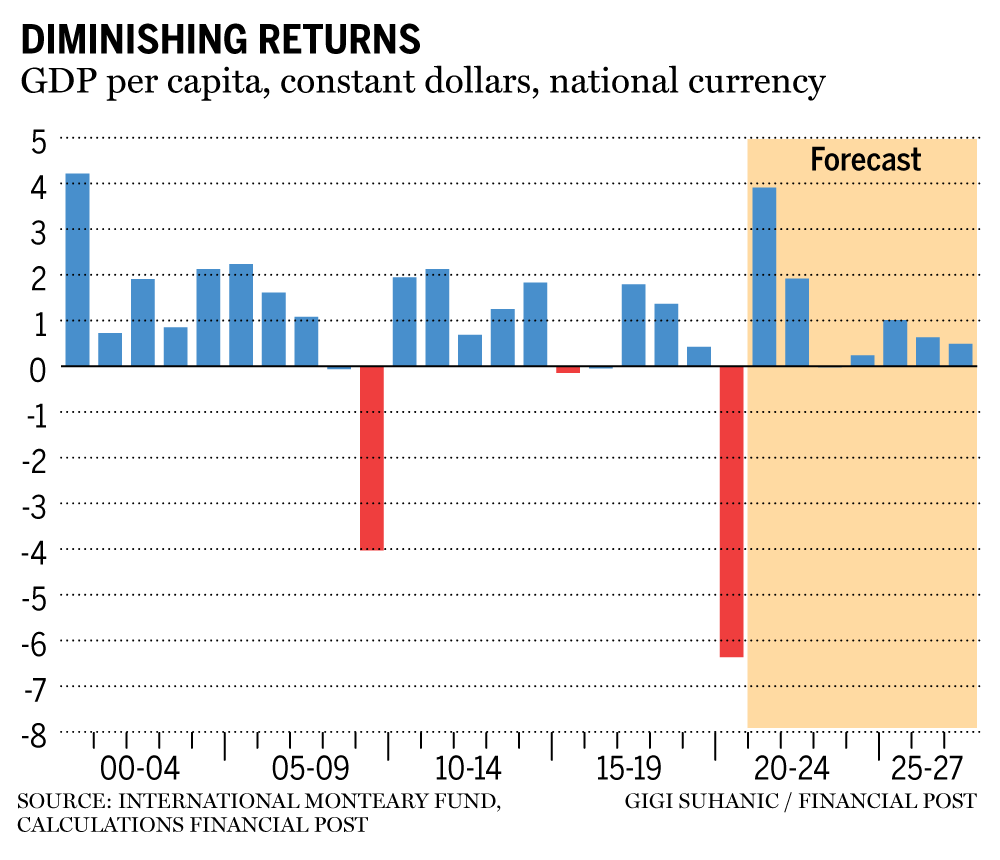
And then there’s the underpinning of our entire immigration strategy. The Trudeau government aims to raise immigration to 500,000 permanent residents a year by 2025 – roughly double the level under the Harper and Chrétien governments. That move was justified in 2016 by the government’s Advisory Council on Economic Growth as a plan for, well, economic growth. A higher population, said the council, would expand the economy, but only if new immigrants are more productive than average Canadians will each slice of pie grow faster than the number of forks. If immigrants are less productive than Canadians, the number of forks will grow faster than the pie.

“An increase in overall economic output (GDP) is a positive thing for Canada,” wrote the council, “but only if the expansion translates to a rise in living standards for the average Canadian (GDP per capita). This goal can be achieved by focusing the recommended increase in immigration flows among educated and highly skilled workers, and those with specialized skill sets lacking in Canada.”

In other words, Canada’s immigration policy is not just about having more Canadians, but more educated, skilled and productive Canadians. To do that, newcomer immigrants have to be mostly young, educated and skilled. One big knock against the Liberal government is that while many new immigrants meet the criteria, too many do not. Immigration can raise everyone’s living standards, but only if we’re selective about who we let in, and who we do not.

To govern is to choose. There’s no getting around it. Nowhere is that more true than at the border.

Source: Why the Trudeau government was right to close Roxham Road

Wudrick: Canada needs immigration reform that is fair and constructive

Right-leaning outlets cautioning on the risk to the social consensus in favour of immigration, particularly perceptions of queue jumping. But not xenophobic to raise these and other concerns:

Much has been written recently on rising concerns about Canadian immigration levels, and specifically the Trudeau government’s announcement of significantly higher immigration targets. As commentators have noted, Canada has historically had cross-party consensus on immigration that can be legitimately described as a uniquely Canadian phenomenon.

This good news has been a point of Canadian pride (or smugness) in a time of global political turbulence, given that in many of our peer countries, immigration backlash has manifested itself in sometimes ugly and xenophobic ways.

But here’s the bad news: This consensus is at risk, and may already be little more than a mirage. It’s consoling that immigration skepticism has not coalesced around any single political party, where it could become a political wedge issue. But fraying support for immigration across party lines exposes an even greater risk: that the issue will be ignored by all parties until it reaches a dangerous boiling point.

Part of the challenge is that Canadians concerned about immigration are often afraid to say so out loud for fear of being called racist or xenophobic. And to be clear, there are racist and xenophobic Canadians, as in every country. But it would be a colossal mistake for our political class to wave away any misgivings about our immigration policy as mere prejudice.

Politicians must understand some of the factors that stoke concerns with our policies and targets. Start with the Roxham Road border crossing between New York State and Quebec, where unlawful (irregular) refugee crossings have skyrocketed in recent years. Recently, news broke that New York City is paying for bus tickets to help asylum-seekers reach the border.

Roxham Road matters because it is about fairness. It represents a legal loophole that people are exploiting. Refugees are a legitimate humanitarian issue, but allowing a class of people to essentially “skip the line” will undermine support for a rules-based system that the public can believe is fair to all.

Second, for many Canadians the concern is not who is coming, so much as how many: for a population already dealing with serious supply strains, immigrants represent a demand spike that will only worsen the situation. Housing is an obvious example; so is access to health care. Just ask the six million Canadians who cannot find a family doctor.

Some argue, fairly, that new immigrants actually represent part of the solution to these supply challenges, providing much-needed additional labour, from construction workers to nurses and doctors. But such tangible factors are not used to inform government immigration targets, which smack of central planning. Perhaps it’s time we shifted away from immigration by fiat and adopted a more market-based approach.

Consider the relative success of refugees to Canada based on their path of entry. Experience shows that privately sponsored Syrian refugees have a better chance of finding employment than those brought in under government programs. This suggests that when migrants have non-government partners invested in their success, their integration into Canadian society is likely to go more smoothly.

While humanitarian refugees require sponsorship and charity from individual Canadians and communities, for many economic immigrants the relevant invested partner will be employers who, given labour supply challenges, are often among the loudest champions of high immigration levels.

Here, too, a legitimate criticism is often raised, since efforts by employers to create cheap pools of labour can drive down wages for all Canadians. But this blurs the immigration discussion with a separate issue: the difference between employers unwilling to pay higher salaries, and those who simply cannot find job candidates at any economically viable salary level.

Canada’s immigration consensus has served our country well for half a century. If we are to salvage it, we will need to listen to those with legitimate concerns about high immigration rates — and more importantly, adjust our approach away from government targets towards a system that prioritizes matching our supply of and demand for immigrants and refugees as smoothly as possible.

Aaron Wudrick is Director of the domestic policy program at the Macdonald-Laurier Institute.

Source: Wudrick: Canada needs immigration reform that is fair and constructive

John Pasalis: Canada’s immigration policies are driving up housing costs

Although correlation is not causation given that other factors given domestic migration (rural to urban, interprovincial) and housing policies, high immigration levels are one of the more significant factors. Signal that some of the various analyses and commentary making the link are becoming more widespread, with Pasalis challenging a “third rail” of Canadian politics, immigration:

Ask a Canadian why home prices are so high and you’ll certainly get a whole host of answers from foreign buyers to greedy investors and, up to recently, a long period of low interest rates.

But the most common answer you are likely to hear is that a lack of supply of new housing in Canada is the primary cause of the high cost of housing.

The lack of supply narrative has been the dominant explanation for high home prices in Canada over the past five years. Every level of government in Canada cites a lack of supply as the primary cause for high home prices and countless academic and bank economists have made the same argument. Scotiabank’s chief economist went so far as to argue that a lack of supply was the underlying cause “for rising prices and diminished affordability”. When an economist says A causes B they mean that the relationship is a statistical fact rather than an opinion.

The debate regarding the key drivers of high home prices has been so one-sided it led Howard Anglin, former deputy chief of staff under Stephen Harper, to write a column in The Hub in 2021 titled, “The one factor in the housing bubble that our leaders won’t talk about.”

What’s the one factor not talked about? How Canada’s immigration boom is impacting the demand for housing and, by extension, increasing the cost of housing.

Over the previous decade, Canada admitted roughly 275,00 new immigrants each year. In 2022, Canada saw a record 431,645 new permanent residents and this number is expected to reach 500,000 annually by 2025.

An unequal two-sided problem

When considering these two demand and supply factors alone, demand for homes due to changes to Canada’s immigration level and the lack of supply of new homes to meet this demand, we see an interesting phenomenon. One factor, the lack of supply, has been discussed for many years, and year after year, political efforts to mitigate this issue have failed. The other factor, immigration, is one that policymakers have far more control over.

Policymakers don’t have any direct control over the number of new homes developers launch and complete each year, a number that has always been hard to achieve due to labour shortages and other factors, and is only expected to decline in the years ahead due to higher interest rates and the current economic uncertainty.

So why has the debate about the high cost of housing focused on a solution that policymakers have no direct control over, building more homes, as opposed to addressing the demand for housing from changes in our immigration level, something policymakers have direct control over?

I’ll highlight what I believe are the two primary reasons.

The false lure of the zoning panacea

A popular area of academic research has been to explore the role that local zoning policies have on the supply of new housing and home prices, and the academic conclusions on the surface sound very intuitive.

Municipalities that have relatively few zoning restrictions on the supply of new housing tend to have more affordable homes and experience more moderate growth in house prices because builders can more easily adjust to changes in demand by building more homes. Academics also argue that these cities with few zoning restrictions have fewer and shorter housing bubbles.

I’ll admit, it’s a wonderful story! If cities simply remove zoning barriers to new housing, builders will flood our market with new homes putting an end to years of rapid price growth and leaving us with an affordable housing market for all.

Unfortunately, the academic theories don’t hold up very well in the real world. Many of the cities that economists cite as having relaxed zoning policies which, in theory, should see modest price growth, such as U.S. cities like Houston, Atlanta, and Charlotte, have all seen a significant surge in home prices over the past decade. Cities like Phoenix in the U.S. and Dubai more globally which have relatively relaxed zoning policies experienced housing bubbles during the first decade of the 2000s because the supply of housing wasn’t able to keep up with the sudden surge in demand from investors.

The fact is that even with relaxed zoning policies, it’s very hard for the construction sector to respond to a rapid surge in demand for housing.

A report by the Bank of Montreal found that countries with higher rates of population growth also saw the most rapid increase in home prices, a result that is intuitively obvious, and one we are seeing in Canada. While it’s very easy for our government to double the number of immigrants moving to Canada each year, it’s extremely hard for them to double the number of homes being built to house these new Canadians. When housing completions don’t increase enough to match a country’s immigration goals, the result is what we are experiencing in Canada: a spike in the cost of housing.

Despite the evidence, the solution to our housing crisis promoted by our policymakers and expert economists continues to be rooted in the delusion that housing supply can respond to any sudden surge in the demand for housing if we simply reform zoning policies.

This does not mean supply-side reforms that encourage more housing and more density are not important, they are. But supply-side policies alone are not the panacea to our housing crisis that some academics and economists make them out to be.

A politically sensitive issue

The other likely reason that many economists have argued that a lack of supply is the cause for high home prices is because any suggestion that Canada’s record high immigration levels may in fact be the bigger driver of home prices runs the risk of being called xenophobic. I’ve experienced this myself from self-described “housing advocates” who believe that with the right zoning reforms, there is no limit to how many homes Canada can build.

But questioning what is the right level of immigration for our country, and whether the current level is doing more harm than good, isn’t xenophobic at all. It’s a critical policy question that for a long time has been ignored out of fear that one might be called a racist for even raising the question.

But the times are changing.

Over the past month we have seen a significant shift in this discussion. More journalists, economists, and editorials are questioning the goal of our federal government’s immigration strategy and whether their current immigration targets are doing more harm than good.

After years of silence regarding the impact our government’s immigration policies are having on healthcare, housing, and wages, more and more experts are starting to ask some very important questions. And not surprisingly, in virtually every column the author clarifies that they are not xenophobic or against immigration, but are noting some of the negative side effects of our country’s aggressive immigration strategy.

Why are more experts starting to talk about our government’s immigration targets?

It’s becoming clearer that the federal Liberal government’s strategy to nearly double the number of immigrants admitted to Canada each year without making the necessary investments to support them is straining our housing markets and health-care system.

A demand crush that further hurts renters

The other important factor is that many of the negative side effects of Canada’s immigration strategy are starting to be felt most by the poorest and most marginalized communities in Canada—including many of these immigrants themselves.

While the discussion about Canada’s housing crisis often centres around the high price of homes and its impact on first-time buyers, a bigger concern should be how our government’s policies are driving up the cost of renting as renters typically have much lower household incomes as compared to homeowners, and unlike homeowners they don’t benefit financially from the rising cost of housing.

To provide some context to the recent acceleration in rents, it is helpful to compare how average rents have changed before and after the current Liberal government took office in 2015.

Under the previous federal Conservative government, the average rent for a Toronto condominium went from $1,570 in 2006 to $1,866 in 2015, a $297 (or 19 percent) increase in nine years. In contrast, average rents under our current Liberal government have climbed from $1,866 in 2015 to $2,657 in 2022, a $791 (or 42 percent) increase in just seven years.

Am I suggesting that our current government’s change in immigration policy alone is responsible for this outsized increase in average rent in Toronto? Of course not, but of the most common explanations for the high cost of housing, from foreign buyers to low interest rates and even irrational exuberance, this one has the most direct impact on rents.

Calculating the demand and price of a property is more complex as the source of capital and the cost of debt are all important factors, alongside the usual factors such as the number of households requiring housing. Rent, on the other hand, is simply the cost of housing services, a cost more closely linked to the demand and supply for housing services, and not as impacted by other factors.

It’s worth noting that the higher appreciation in condo rents since 2015 was not due to a lack of building. Average annual condo completions were 12 percent higher after 2015 when compared to the period before 2015. This additional supply didn’t cool condo rents because Canada’s population was growing faster than these housing completions.

The impact of—and on—foreign students

The other aspect of Canada’s immigration policies that is often overlooked is the growth in the number of international students attending universities, which are not directly included in Canada’s immigration numbers today. An important part of Canada’s immigration pipeline, the number of foreign study permit holders in Canada has climbed from 352,330 in 2015 to 621,565 in 2021.

The Globe and Mail’s Matt Lundy argues that there is a simple explanation for this boom in foreign students: money.

The annual tuition for foreign students is five times what domestic students pay, so post-secondary institutions are doing what any profit-maximizing corporation would do: they are admitting as many foreign students as they can.

But unlike Canada’s program for permanent residents, there are no targets for foreign study permit holders—post-secondary institutions can admit as many students as they want each year. But while these institutions have the right to maximise their profits by admitting as many foreign students as possible, they have no obligation to ensure there is adequate housing for the students they are admitting. The lack of planning and investment from post-secondary institutions into the housing needs of their students means that the burden of Canada’s housing crisis has fallen in part on these often financially stretched students who are moving to Canada for a better life but are left feeling exploited. When foreign students are fighting for the most affordable rentals in their community, it also puts pressure on low-income households looking for the same.

It’s time to start asking harder questions about the negative side effects of Canada’s immigration policy. As economist David Green wrote, immigration is not some magic pill for saving the economy.

John Pasalis is President of Realosophy Realty, a Toronto real estate brokerage that uses data analysis to advise residential real estate buyers, sellers, and investors.

Source: John Pasalis: Canada’s immigration policies are driving up housing costs

Liberal minister says Canada needs more immigration as targets get mixed reviews

Mixed reviews are from me and Ted McDonald of UNB:

As Canada plans to significantly ramp up its immigration levels in the coming years, some policy experts are worried about potential effects on health care, housing and the labour market.

But Immigration Minister Sean Fraser insists that Canada needs more newcomers to address labour shortages and demographic changes that threaten the country’s future.

“If we don’t continue to increase our immigration ambition and bring more working-age population and young families into this country, our questions will not be about labour shortages, generations from now,” Fraser said in an interview with The Canadian Press.

“They’re going to be about whether we can afford schools and hospitals.”

In November, the federal Liberal government announced a new immigration plan that would see Canada welcome 500,000 immigrants per year by 2025.

A record-breaking 431,645 people became permanent residents in 2022.

The new immigration rates will be substantially higher than rates in similar countries, such as Australia, said University of New Brunswick political science professor Ted McDonald.

That’s not a bad thing in itself, he said. But in his view, raising immigration levels isn’t the right way to address current labour shortages.

“I think the policy would make more sense if it’s aligned with what are seen as underlying structural labour market shortages that are going to persist,” McDonald said.

At the same, he said one justification for immigration is clear: Canada has a declining birthrate.

According to Statistics Canada, the country’s birthrate fell to a record low of an average of 1.4 children per woman in 2020. That’s well below the 2.1 rate needed to maintain a population without immigration.

That doesn’t stop others from worrying about how more newcomers could put a strain on other perennial issues such as housing affordability and health care.

“There’s no assessment that I have seen of the impact of these targets on housing affordability and availability, no assessment of these targets in terms of additional pressures on health care,” said Andrew Griffith, a former high-ranking official at Immigration and Citizenship Canada.

But Fraser said that many of the new permanent residents already live in Canada. For example, 157,000 international students became permanent residents in 2021.

“It’s not as though there are half a million people coming to Canada who are not already here,” the minister said.

He said changes are also coming to the Express Entry system in the spring so that immigrants can be selected based on the sector and region in Canada they’re heading to.

That will help alleviate some of the strain on things like health care and housing, he said.

The ongoing debate on whether the new targets are too ambitious is also coinciding with heightened scrutiny regarding what — or who — is influencing government policy.

Radio-Canada reported last week that two sources within Immigration, Refugees and Citizenship Canada said McKinsey & Company’s influence on immigration policy has grown in recent years.

A government response to a Conservative MP’s written question, which was tabled in the House of Commons in December, says the department has not recently awarded any contracts to the consulting firm — at least, not during the timeframe the MP asked about, which was from March 2021 until October 2022.

And during the interview Thursday, Fraser said McKinsey has had no role to play in the new immigration levels plan.

“I’m not being influenced by them,” Fraser said.

“This is something that I’ve arrived at independently.”

The minister said he came to the decision regarding the immigration plan on the advice of department officials. He said he also took into consideration what he’s heard from different organizations, stakeholders, and provincial and territorial leaders.

Policy experts often worry about the outsized influence stakeholders can have on government policies, since interest groups lobby the government to implement policies that are in line with their priorities, and some are more powerful than others.

Business groups in Canada have seen ongoing labour shortages as a major concern, and they have called on the government to help fill vacancies.

Following the announcement of the new plan, the Business Council of Canada applauded the targets in a press release, saying that “an economy that is chronically short of workers cannot achieve its potential.”

Griffith said that in his opinion, the current government is “fairly responsive to the pressures of stakeholders,” whether they are business groups or organizations that work with immigrants.

While the interests of stakeholders can sometimes align with what is actually good policy, McDonald said stakeholder groups have “vested interests.”

“We have to be aware of where the advocacy is coming from, and not being naïve about it,” he said.

Source: Liberal minister says Canada needs more immigration as targets get mixed reviews

Coyne: Relax – higher immigration alarmism makes more noise than sense

Cute opening line but false comparison. Babies have an intensive integration and settlement program, called parenting.

And ironic, given that many of his columns focus on government delivery and implementation failures, largely dismisses issues related to housing, healthcare etc by largely assuming the market will deal with them despite evidence to date that it is failing by any measure:

I don’t wish to be alarmist, but I wonder how many Canadians know their country is being invaded. It doesn’t get a lot of attention in the mainstream media, but there is a massive influx of people coming into this country every year: nearly 400,000 in the past year alone.

These are people, I should point out, who have no means of supporting themselves; who have no knowledge of Canadian history or culture; who not only cannot speak either official language, but cannot walk or feed or even dress themselves; people who will be a net drain on the taxpayer for many years after their arrival.

I speak, of course, of the hundreds of thousands of babies born in Canada every year. There are fewer of them, proportionately, than in the past – at just under 1 per cent of the population, the birth rate is barely a third of its postwar peak – but they still have an enormous impact, not least in terms of public spending. Yet somehow, whenever the discussion turns to population growth and the eternal question of my God how will we ever accommodate all these people, the native-born in our midst never seem to come up. It’s always about immigrants.

Just now we are having one of our periodic flutters of panic over immigration, occasioned by the recent release of the latest federal immigration plan. From 405,000 in 2021, to 431,000 in 2022, to 465,000 this year, the annual intake of immigrants is projected to continue to rise to 500,000 by 2025. And that’s not counting those here on temporary work or study permits.

These are invariably described as “record” numbers, and so they are, in absolute terms. But relative to population, immigration is not particularly high: At just over 1 per cent of the receiving population, it is roughly in line with its historical average. There have been periods when it was lower, but there have also been periods when it was higher – much higher: before the First World War (in some years it exceeded 5 per cent of the population), and after the Second. Even today, population flows across our borders are dwarfed by population movements within; again, while the former excites all the attention, the latter passes unremarked.

What people mean when they say immigration is “high” is that it is higher than it was in the recent past. The implication is that recent levels of immigration are “natural,” such that anything higher must inevitably invite disaster. But in fact there is no such thing as a natural rate of immigration, any more than there is a natural level of population; if there were, it would be a remarkable coincidence to find that we were exactly at it. Current immigration rates have no more or less claim to being natural than any other. They are just more familiar.

At one time, immigration hysterics focused on its alleged doleful effects on unemployment, or wages: The increase in the supply of labour, it was reasoned, must surely outpace the demand. That’s proved hard to sustain in the face of today’s record-high employment rates and real wages. So instead the focus has shifted to the ways in which immigration must lead to an excess of demand over supply: in housing, say, or health care.

It never seems to occur to anyone that immigrants might be a source of both demand and supply – that they are not just workers, but consumers, and not just consumers, but workers, at the same time.

Will immigrants add to the demand for housing? Undoubtedly. Hmm. We’ll certainly need to build a lot more houses for them to live in. I wonder where we’ll find the workers to build them? Ah yes: from immigration. The health care system is a mess at the moment. It was also a mess, you may recall, 30 years ago, when there were 10 million fewer Canadians using it.

A moment’s thought, and a little research, should make clear: Neither the unemployment rate, nor the standard of living, nor the level of environmental degradation, nor anything else about a country is primarily a function of the number of people in it. The decisive factor, rather, is the organization of economic life – how efficiently or otherwise resources are used.

In an economy based on prices, that means “getting the prices right” above all – letting prices signal where resources are in greater or lesser demand relative to supply, so as to avoid either shortages or surpluses. Get the prices right, and wealth will be maximized, waste minimized, no matter how many people a country contains; get the prices wrong, and the reverse will be the case, no matter how few.

That works both ways, of course. We don’t “need” immigration to maintain a particular standard of living, either: Lots of countries that are smaller than us, with slower population growth, do just fine. Canada would have a higher GDP with a larger population, but not a hugely greater GDP per capita.

Still, that’s not to say immigration has no impact, or that there are no reasons to favour higher immigration rates to lower. Larger populations, first, can spread fixed costs over larger numbers of people – economies of scale – in ways that cannot readily be duplicated through international trade: Trade within nations, research shows, is of much greater “intensity” than trade within. Countries with higher population density, likewise, enjoy cost savings relative to those whose population is scattered over greater distances.

Less quantifiably, bigger countries offer more opportunities to their citizens, in the same way that big cities offer more opportunities than small towns. They are magnets for the ambitious, the talented and the entrepreneurial. And they have a clout in the world to match – a greater ability, other things being equal, to shape events in line with their interests and their values.

We should not underestimate the impact on our sense of selves. It is striking to read commentators from those early 20th-century days, when our population was growing at such a torrid rate: the exuberance, the self-confidence, the conviction that we were destined to be the next big thing. You know Sir Wilfrid Laurier’s famous line about the 20th century being the century of Canada? In the same 1904 speech he predicted that, within the lifetimes of some members of his audience, Canada would have a population of 60 million people. That was only a commonplace of the time. Others predicted we’d have 100 million people by now.

Needless to say, we fell a long way short of that. Yet it’s hard not to notice the positive effects of the population growth we have enjoyed. Canada is a much more interesting, dynamic place than it was in my childhood, when it was half its current size. It is also a more tolerant place. Had you predicted then that nearly a quarter of Canada’s population would one day be foreign-born – it is over 50 per cent in our largest cities – you would no doubt have been met with terrified prophecies of racial conflict.

Yet we seem more at ease with each other than ever. Popular support for immigration, likewise, is not only strong, but growing. The national and international data on this are conclusive: The greatest hostility to immigration is found in places with relatively little experience of it. Where people regularly encounter people from different backgrounds to their own, on the other hand, it is popular. Familiarity, it turns out, breeds respect.

Source: Relax – higher immigration alarmism makes more noise than sense

Mason: It’s not racist or xenophobic to question our immigration policy

Good column by Mason questioning the current approach of governments and stakeholders. Money quote:

“We should be able to have this conversation without fear of being labelled a racist or xenophobe. We should be able to have that conversation in the best interests of those already living here, and the ones yet to arrive.”

Canada is experiencing a population boom.

Figures released recently by the federal government are quite staggering: the country grew by 437,000 new residents in 2022 and projections from Ottawa indicate that roughly 1.45 million more will join them over the next three years. According to a recent story in The Globe and Mail, since 2016, Canada has grown at nearly double the average rate of its G7 peers.

In most cases, however, it isn’t newborns enhancing our population growth but adults coming to Canada through our immigration and refugee program – a fact that has consequences far and wide.

For years we have been told that economic growth depends on robust immigration. Immigrants are needed to bolster a work force being weakened, even decimated in some cases, by the demographic bulge of boomers who are retiring. Also, immigrants are core to the Canadian identity, something of which we are unquestionably, and quite rightly, proud.

At the same time, it is fair to ask whether the pace at which we are growing is in our best interests. Or whether in attempting to solve one problem, we are creating others.

We may be about to find out.

For starters, we need to figure out where all the newcomers will be staying. In recent years, headlines have been dominated by stories chronicling the housing crisis in Canada, especially in our major cities. The lack of supply has been responsible for a spike in prices.

Douglas Porter, chief economist with the Bank of Montreal, recently said that the countries with the fastest population growth up to 2020 – countries such as this one and New Zealand – had greater house price inflation than those with stable populations or ones that decreased. If this is correct, one can assume house prices will only continue to reach levels that are unattainable for many, despite assurances from all levels of government that they are “on” the problem.

Supply can’t keep up with demand as it is, let alone meet the challenge of adding nearly 1.5 million more residents over the next three years.

The furious pace of immigration will also put enormous pressure on a rental market that is already making life unbearable for many with a tight supply and soaring rents. The problems that this level of population growth contributes to would likely not be as bad if these newcomers were moving to towns and cities that could use more people. But that’s not the case. The vast, vast majority of new immigrants are congregating in our biggest cities.

It’s also fair to ask what these intake rates will do to our already overburdened health care system. Yes, some of those arriving here will fill critical voids in our health care front lines, but not nearly enough to make up for those who are retiring or leaving the profession because of burnout. And not nearly enough to compensate for the population boom we are anticipating.

There are, for example, more than a million British Columbians without a family doctor, a number that is likely to only increase as more physicians retire and newcomers arrive each year by the tens of thousands.

There are also voices suggesting that massive immigration on the scale we are witnessing may not be the great economic elixir being promoted by the federal government and the business sector. In fact, David Green, an economist with the University of B.C., says this is a contention that turns out not to be true. His research shows immigration often lowers the wages for people competing with new immigrants for jobs.

None of this is an argument for stopping immigration, of course. It is an indisputable fact that immigration has enriched our country beyond any measure, making it the envy of the world. We are a more vibrant and culturally enriched nation as a result of it.

Still, you can be pro-immigration and question the pace at which we are currently welcoming newcomers. You can be pro-immigration and ask whether we are at a moment when it would be prudent to step back and analyze the situation, and see whether we are exacerbating critical problems for which we have not yet found solutions.

We should be able to have this conversation without fear of being labelled a racist or xenophobe. We should be able to have that conversation in the best interests of those already living here, and the ones yet to arrive.

Source: It’s not racist or xenophobic to question our immigration policy

Watt: In 2023, Canadians deserve a grand vision from our political leaders

Watt notes the need for an actual plan how to address the impact of high immigration levels, which by its nature would require joint federal and provincial collaboration and much more medium and longer term policy and program measures:

A federal election in 2023?

Though far from a certainty, more and more, it feels like one. Federal minority governments have seldom endured more than a few years and the current Liberal-NDP agreement is unlikely to be an exception tothis rule.

If the plug is pulled and the current Parliament Hill tone continues, the election will be waged on decidedly pessimistic terms. Take, for example, Conservative leader Pierre Poilievre’s and Prime Minister Justin Trudeau’s recent exchange played out over the closing weeks of 2022.

To great effect, Poilievre has repeatedly asserted that “it feels like everything is broken in this country” — a message that resonates strongly with Canadians. At a year-end Liberal holiday party, Trudeau countered that “Canada is not broken.”

While Canada is far from broken, it’s time we acknowledged that there are significant cracks in the land and the current government’s continued approach of ignoring the legitimate concerns of families battling record inflation and a housing crisis can’t continue.

As Poilievre tells it, Justin Trudeau’s excessive spending, runaway deficits and second-rate commitment to infrastructure mean that a continued Liberal reign poses no less than an existential threat to our nation.

Trudeau’s challenge is that circumstances beyond his control — namely brutal economic conditions — make defending against Poilievre’s charges harder and harder. He is left, as many long-term governments are, selling a hypothetical alternative narrative of another kind of doom and gloom.

And so, Trudeau paints a sloppy picture of a Poilievre-inspired hellscape where you pay for groceries with Ethereum and carbon costs less than an FTX token.

Source: In 2023, Canadians deserve a grand vision from our political leaders

Sabrina Maddeaux: Liberals bring in influx of immigrants without a plan to support them

Yet another commentary questioning the impact of high immigration levels on housing, healthcare, infrastructure etc.

But Maddeaux is silent on the “complicity” of provincial governments who are responsible for addressing many of the externalities and costs, the business community in pushing for high levels of both permanent and temporary residents, and the various stakeholders supporting the increased and increasing levels:

The federal Liberals are well on their way to meeting at least one of their marquee goals: 500,000 new immigrants per year by 2025. The stats for 2022 just came in, and last year saw a record 431,645 new permanent residents.

That’s a 6.4 per cent increase over 2021 — and this year aims to admit 465,000 new residents, which will be another 7.7 per cent increase over 2022. These numbers don’t include temporary foreign workers or international students, which are also rising at record rates.

This sort of rapid swell isn’t just historic for Canada, it makes us the fastest-growing country in the G7. This would be great news, if not for the fact that we’re also among the least equipped to accept a mass influx of new people.

To put those earlier numbers in context, the population of Halifax is about 440,000. Quebec City’s is around 550,000. We are, or soon will be, adding the equivalent population of one of those cities each year.

Diversity is a pride point for many Canadians, and we’re undoubtedly a stronger and better country thanks to immigrants’ many contributions over the decades. However, this doesn’t mean we should blindly open the floodgates to hundreds of thousands more per year, when there’s scant evidence we can support them.

As much as we may want to welcome more immigrants into the fold, there needs to be a debate about whether now is the best time to boost targets. We may find that, until we get our house in order, the risks outweigh the potential rewards.

Immigration isn’t inherently good for a country, or even for immigrants, in and of itself. Positive outcomes for all parties require careful planning and a sense of realism. Unfortunately, it appears the Liberals have neither.

Our health-care system ranks poorly against peer countries and seems to be only getting worse. We can barely even care for sick children in our major urban centres, let alone rural areas. Family doctors are practically the new Polkaroo.

Our housing situation is dismal. We don’t have enough homes, and the ones we do have are exorbitantly expensive and out of reach for all but the very wealthiest young Canadians and newcomers.

It seems like we have shortages of every type of basic infrastructure and service, from transit to schools and childcare spots.

International students are frequenting food banks, living in crowded and often unsanitary rooming houses and even driving five hours –– each way –– to attend classes.

Many immigrants still can’t work in their trained fields because we haven’t taken the time to sort our credentialing systems. Despite just about everyone agreeing that foreign-trained doctors shouldn’t be driving taxi cabs, it always seems to be a problem for another day.

Meanwhile, Liberals argue that we need more newcomers to boost our economy and address labour shortages. Not only does this seem callous and exploitative in light of our inability to provide for needs like housing and health care, there’s little evidence our current immigration system can produce these desired outcomes.

At a certain point, we will get diminishing returns. While more immigrants mean more tax dollars, we don’t get to just take from them without giving anything back. They, too, require doctors, affordable homes, schools and passports in a timely manner. They use subways and parks and, eventually, long-term care homes.

By failing to invest heavily in infrastructure and government services, the Liberals are exacerbating resource scarcity and intensifying competition for fundamental goods and services.

Historically, this never ends well. Eventually, people look for someone to blame for their declining quality of life, and that group tends to be newcomers.

To be clear, such scarcity isn’t the fault of immigrants. It’s the fault of governments that either failed or didn’t bother to properly plan to support their targets. Yet that will be of little consolation if Canadians’ historically welcoming nature begins to take a turn.

Canada’s success with immigration is thanks to its record of sustainable growth. For the Liberals to throw that ethos out the window isn’t just irresponsible, it’s dangerous.

Source: Sabrina Maddeaux: Liberals bring in influx of immigrants without a plan to support them

Grubel: Canadians are right to worry about immigration levels 

While I disagree with Grubel on many of his points and overall approach, he is right on the negative impacts and externalities of current and projected high levels of immigration.

His proposed solution, essentially only admitting economic class immigrants with a job offer is completely unrealistic (what government would stop family reunification, given the impact in ridings with large numbers of immigrants, or completely stop refugees, which is practically and legally impossible). While sidestepping the numbers questions, a column a few years back referenced 50,000 if I recall correctly.

And Leger is only one poll and its question phrasing, as it often is, was designed to elicit this response:

Canadians are increasingly worried about immigration. A recent Leger Poll found that 49 per cent of us think the federal government’s new target of 500,000 immigrants a year is too many, while fully 75 per cent are concerned the plan will result in excessive demand for housing and social services. For his part, the immigration minister, Sean Fraser, tells us we need not worry: immigrants themselves will provide the labour needed to build the housing stock they’ll need.

The majority of Canadians have always welcomed immigrants and believe they benefit the economy and themselves. What worries them today is the prospect of mass immigration that they believe the housing market cannot absorb without much higher prices. They know the minister’s soothing reassurance is not supported by experience. Past immigration did increase the labour force but did not prevent high housing costs. Excessive regulations and rent control are the main reasons housing is so expensive, not a shortage of labour.

Immigrants not only add to the demand for housing, they also increase congestion for a wide range of public services: doctors, hospitals, schools, universities, parks, retirement homes, and roads and bridges, as well as the utilities that supply water, electricity and sewers. In theory, the supply of all these things could be expanded reasonably rapidly. In practice, expansion is slow. But the main reasons for that are, not a shortage of labour, but inadequate planning, insufficient financial resources and, as a result, construction that lags demand.

The case for keeping annual immigration at traditional or even somewhat lower levels rests on more than the effect on house prices and public services, however. Immigration also depresses the wages of low-income workers, which results in greater income-equalizing transfers and the higher taxes required to pay for them. It also reduces employers’ incentives to adopt labour-saving technology, an important source of growth in labour productivity and wages, and it allows employers to avoid the cost of operating apprenticeship programs to train skilled workers.

Japan’s widespread success in using robots to deal with labour shortages caused by its aging population illustrates what could be done in Canada. In Germany employers operate apprenticeship programs to train skilled workers in the numbers industry needs. In this country, such programs could relieve the shortage of skilled labour while benefiting people already here, rather than new immigrants brought in specially to take highly paid skilled jobs currently going asking.

Despite the Leger numbers suggesting many Canadians have concerns about big increases in the rate of immigration, the debate about it tends to be one-sided. We hear from the many groups that benefit from mass immigration: employers, immigration lawyers and consultants, real estate developers, political parties that traditionally do well in immigrant communities, idealists who want us to “imagine there’s no countries” and so on.

On the other side, the Leger numbers suggest, is a majority that is not at all opposed to immigration in principle but begins to inform itself on the subject and maybe even become politically active only when the costs become so large they can’t be ignored any longer.

In Switzerland during the 1970s an economic boom led to labour shortages and immigration was liberalized. It turned out that the need to produce housing infrastructure and public services for these immigrants actually worsened the labour shortage. The silent majority of Swiss citizens organized and took advantage of the opportunity to get government policy changed by demanding a public referendum that ultimately ended the liberal immigration policy.

In Canada, changes in policies come through Parliament and the election of politicians. Numbers like those in the Leger poll may begin to suggest to politicians that they can increase their election chances by catering to the majority who would prefer somewhat reduced immigration but also a fundamental reform of the system currently used to determine the number and characteristics of immigrants.

Such a reform would put greater emphasis on market forces rather than politicians and bureaucrats in setting immigration levels. Immigrants would be admitted only if they possessed a formal offer of employment in Canada that paid at least the average earned by workers in the region where they would be employed.

Under this system, employers’ self-interest would ensure that workers would have the skills and personal characteristics required for success on the job. The requirement for minimum pay would prevent floods of immigrants competing with Canada’s low-wage workers and ensure that those who did come had the income needed for a life free from the need for public subsidies.

Worrying about immigration is not enough. Only the election of politicians committed to this kind of reform will restore mental peace.

Herbert Grubel, himself an immigrant to Canada, is an emeritus professor of economics at Simon Fraser University and a senior fellow at the Fraser Institute.

Source: Opinion: Canadians are right to worry about immigration levels 

Immigration to Canada hits record high in 2022

Some cheerleading along with critical comments on housing affordability and IRCC service delivery. Numbers more than twice as high given temporary residents (workers and students):

Canada took in a record number of immigrants last year, a result of a federal planto compensate for a lack of new arrivals in the first year of the pandemic, and to make up for the country’s aging population and holes in the work force.

The country added just over 437,000 new permanent residents in 2022, according to Immigration, Refugees and Citizenship Canada (IRCC). This topped the department’s target for the year, as well as the previous high of 405,000, reached in 2021.

Immigration now accounts for three-quarters of Canada’s population growth. The federal government’s immigration plan calls for the admission of 1.45 million more new permanent residents over the next three years, which is equivalent to 3.8 per cent of the country’s population

The majority of the permanent residency spots have been set aside for economic immigrants, a term for newcomers who either have money to invest, or specific desirable skills, or can demonstrate that they are capable of opening businesses.

The federal government has said immigration is crucial for the economy, and that it accounts for as much as 90 per cent of labour force growth in Canada.

But critics of the plan have raised questions about the effects of higher immigration targets on the country’s already-unaffordable urban housing markets. And it is unclear whether Ottawa’s plan will help make up for shortages of labour in low-paid fields such as accommodation, food services, retail and health care assistance.

NDP immigration and housing critic Jenny Kwan said the federal government has missed an opportunity to give temporary foreign workers and undocumented workers permanent resident status. This would give them access to taxpayer-funded health care and allow them to live and work anywhere in Canada, indefinitely. (Temporary foreign workers are typically restricted to one employer and not allowed to switch jobs.)

“The government must stop relying on vulnerable workers and give them the protection of permanent status and ensure their rights are respected,” Ms. Kwan said in an e-mailed statement.

The flood of new permanent residents is expected to bring new homebuyers and renters to communities across the country. That could increase activity in the residential real estate market, which has slowed since early last year, when borrowing costs jumped with a rise in interest rates.

“There is little debate that strong population growth goes hand-in-hand with strong real home price gains over time,” said Douglas Porter, Bank of Montreal’s chief economist.

Mr. Porter analyzed the relationship between population growth and home prices in 18 developed countries. He found that countries with the fastest population growth during the decade leading up to 2020 – such as New Zealand and Canada – had greater home price inflation than those where populations remained stable or decreased.

But, considering the rise in borrowing costs, Mr. Porter said he believes that the influx of permanent residents will not immediately create a new pool of homebuyers. “Just as last year’s large population increase was unable to avert a double-digit drop in home prices, another large increase in 2023 won’t keep home prices from falling heavily again this year,” he said.

The typical home price across the country is down 10 per cent from February, 2022, when the market peaked.

Where Mr. Porter does expect the surge in newcomers to make a difference is in the rental market, where borrowing costs are less of a factor. Rents have already risen sharply over the past year, and he expects increased competition will push prices higher still.

The largest share of immigrants usually end up in major cities in Ontario, followed by cities in British Columbia, Quebec and Alberta. Last year was no different. Just over a quarter of new permanent residents intended to settle in the Toronto region, according to the most recent data from IRCC, which cover January, 2022, through October.

The government has said its immigration plan includes placing new permanent residents in small towns and rural communities.

In past years, people from southern and eastern Asia accounted for the largest share of immigrants to Canada. According to the IRCC data, this continued to be the case during the first 10 months of last year. During that period, nearly 110,000 new permanent residents were from India, nearly 30,000 were from China and about 20,000 were from the Philippines.

Canada also admitted nearly 20,000 refugees from Afghanistan in the first 10 months of last year, up from 8,570 in 2021. Ottawa has promised to bring at least 40,000 Afghans to Canada, under a pair of resettlement programs introduced around the time of the Taliban takeover of Afghanistan in August, 2021.

IRCC could have difficulty handling the large numbers of new permanent residency applicants. It has been dealing with a backlog of applications since 2021, when Ottawa bumped up its immigration targets.

Source: Immigration to Canada hits record high in 2022