Hill: About that word, and about those books

Sensible commentary. Hill’s Book of Negroes had to be retitled for the US market however to Someone Knows My Name:

…When I reached out to the London District Catholic School board for comment, Susan Nickle, the board’s Executive Officer (Superintendent) People and Culture and General Counsel, wrote back to me to say that the board “does not, and will not, censor or ban your book” and that my work “will continue to be available as options for student engagement and learning within our libraries and classrooms across our district.

“However, we must also be mindful of the diverse sensitivities and experiences of our students,” she continued. “Due to the triggering language and content present in The Book of Negroes, and several students who have expressed concerns, we are not able to make it required/mandatory reading for formal assessment. That being said, your book remains an important resource that students can continue to voluntarily select for classroom novel study. Our objective is to create an inclusive and supportive educational environment for all students.”

I followed up to ask about the board’s policy with regard to the use of any books containing the word, but Ms. Nickle did not reply. I reached out again to Ms. Hamilton, who said she had taught the novel to 900 students over the years without receiving any objections. She said that every student is allowed to opt out of reading an assigned text and that Ms. Nickle’s reply skirted the key issue – that Ms. Hamilton said she was told “that under no circumstances am I to teach a novel using the n-word.”…

If we truly worry about protecting students from “harm” caused by the word “nigger,” then we have that much more need to discuss it in class. And if teachers cannot provide a safe and civilized space for students to learn about the hateful history of the word, if they must ignore the fact that many Black people have re-appropriated it, and if they cannot teach about the history and present lives of Black people in Canada, then how exactly are our students to be challenged?

Students need books by Black authors. Unflinching books that employ authentic language. Educators need to offer those books, and to lean on their research and their training to do so. Banning books with the word “nigger” does not protect students. It only protects educators from doing one of their most difficult but important jobs.

Source: About that word, and about those books

How Harper Lee helped Canadians ignore racism in our own backyard – Hill

Lawrence Hill makes valid points regarding the teaching of To Kill a Mockingbird in Canadian schools:

However, the rote and ongoing use of To Kill a Mockingbird in the classroom points to our very Canadian-ness, and to our collective disinclination in Canada to examine racism and black history in our own backyard. How utterly convenient it is for Canadian children and adults from Dawson City to St. John’s to read about racism in the Deep South of the United States in the Great Depression, and to avoid discussions about slavery, segregation, other forms of racial injustice as well as the civil-rights movement in Canada itself.

In my experience, one of the unfortunate offshoots of the success of To Kill a Mockingbird and its hold on our psyche has nothing to do with the author or the book, but rather, how we have allowed it to dominate our meditations – especially in school – about racial injustice in Canada.

Harper Lee cannot be blamed for her own success. She is not at fault for our own collective disinclination to look beyond her novel and acknowledge the existence and eventual rooting out of slavery in the Maritimes and present-day Quebec and Ontario.

We have only ourselves and our own reticence to confront history to blame for the fact that many Canadians to this day are more familiar with the American Civil War and with the life of Martin Luther King Jr. than they are with the struggle to eradicate racial segregation in Southwest Ontario and in Nova Scotia; the movement of the black Loyalists from New York to Nova Scotia in 1783 and then, for many, back to Africa a decade later; the movement of 600 blacks from California onto Vancouver and Salt Spring Island in the mid-19th century; the settlement of blacks from Oklahoma and Texas in the Canadian prairies at the outset of the 20th century; the waves of immigrants coming to Canada from Caribbean nations starting in the late 1960s, and the simultaneous bulldozing of Africville in the north end of Halifax.

Black history in Canada is as complex and varied as the history of any racial or ethnic group, but we have lost sight of that, partly as a result of our obsession with evil in another era and another country.

Although it richly written and wonderfully drawn, To Kill a Mockingbirdemploys a narrative approach that has been used time and time again to address racism in North America. Racism and injustice is perceived through the eyes of benevolent whites, and the stories feature white characters over black. Indeed, in To Kill a Mockingbird, as well as in Harper Lee’s follow-up novel Go Set a Watchman, published in the last year of her life, black characters are minimally sketched. With the exception of Calpurnia, a black woman who works in the house of Atticus Finch, Harper Lee presents to her readers racism and evil, minus dimensional black characters.

Source: How Harper Lee helped Canadians ignore racism in our own backyard – The Globe and Mail

More commentary on Syrian Refugee crisis: Impact of previous policy changes and recommendations what should Canada do?

Syrian_Refugees_MacleansStarting with the use of refugee or migrant:

For most of the Syrians we are hearing about, I would argue, the right term is “refugee.” The origins of that word also belong to the 17th century, when it referred to Protestants who fled religious oppression in a triumphantly Roman Catholic France. Over time the word’s meaning extended to include all those who were escaping war, persecution, or intolerable conditions at home. Kurdi’s family were determined to get away from a civil war that has all but destroyed Syria. They were not making a rational economic decision or a calm political choice. Just like the Vietnamese boat people in the late 1970s, they were fighting for their lives.

Are they refugees or migrants? Why what we call the people fleeing Syria matters

On the implications of the policy changes made to reduce fraud for family sponsorships with respect to Syrian refugees and the Kurdi case:

In earlier humanitarian crises, Canada went directly to the migrants and accepted large numbers quickly. That stands in stark contrast to Thursday’s response from the federal immigration department to the death of a boy found on a beach in Turkey. A group of Canadians had applied to bring in his uncle’s family and hoped to sponsor the boy’s family next. But the family had not been certified as refugees by the UN refugee agency, UNHCR, or a foreign state.

…Canada has required such certification since October, 2012 – when the Syrian crisis was developing – for “group of five” sponsorships, a reference to the minimum number of adult Canadians needed to bring over a refugee family.

…Among the other bureaucratic hurdles is the fact that the waits at visa offices for Canadian officials to review applications – a review that happens after that of the UNHCR – range from 11 months in Beirut to 19 months in Amman to 45 months in Ankara, according to Canadian government figures.

And the immigration department’s central processing office in Winnipeg – which handled the application for the boy’s extended family – takes two or three months to look at applications.

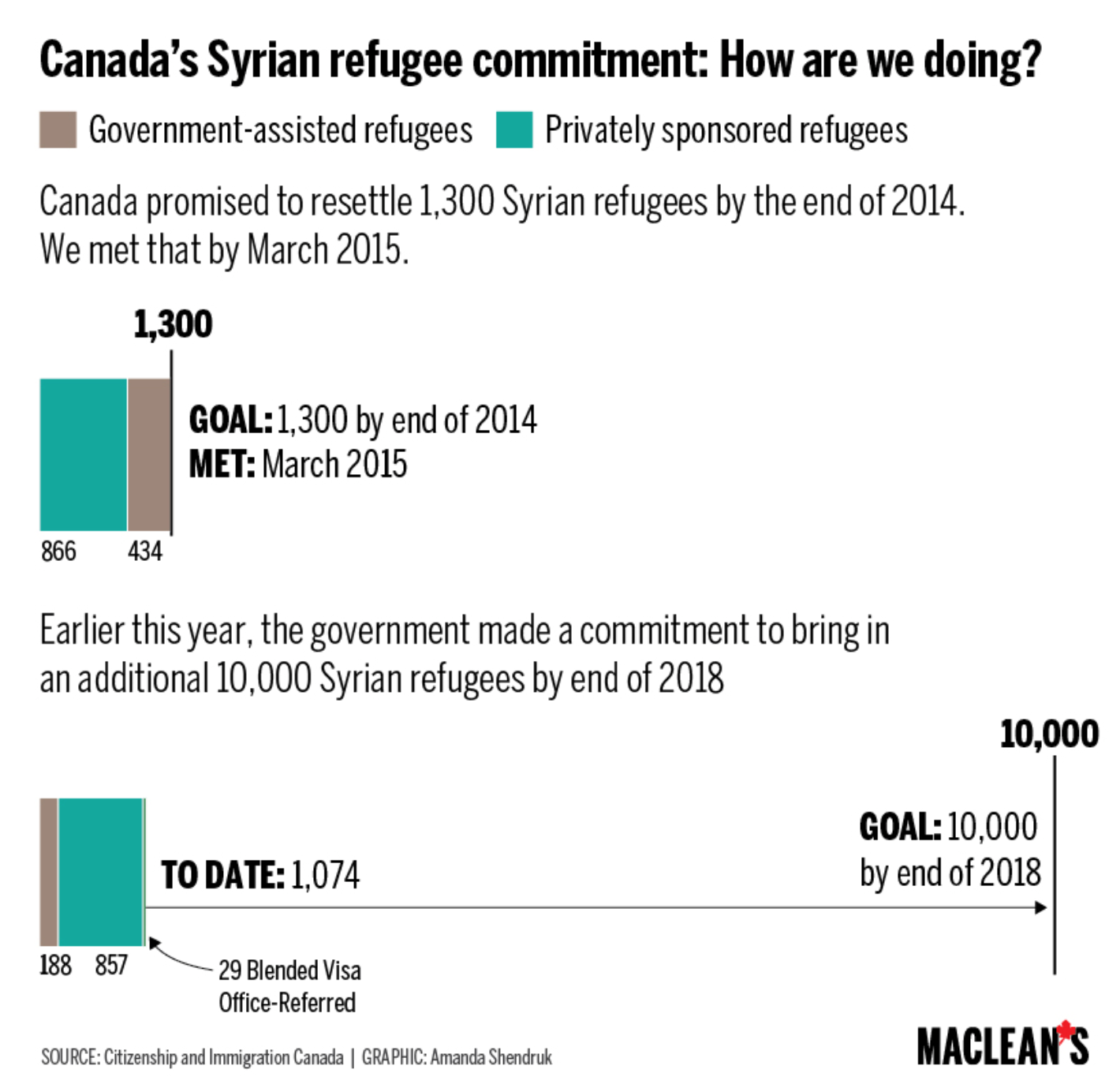
Decades before the current crisis, Canada airlifted 5,000 people from Kosovo in the late 1990s, 5,000 from Uganda in 1972, and 60,000 Vietnamese in 1979-80. From January, 2014, to late last month, Canada resettled 2,374 Syrian refugees.

Canada’s response to refugee crises today a stark contrast to past efforts

Amira Elghawaby and Bernie Farber criticize the Government for providing preference to Christian refugees:

The Canadian government’s departure from established refugee norms began in 2012 with the passage of new laws which created a two-tier system based on country of origin. Canada began to categorize refugee claimants based on group characteristics rather than using a case-by-case approach.

“Group labelling tends to exclude, not welcome. Placing individuals above categoric exclusions is the best way to ensure Canada continues granting asylum to people who need it most,” migration expert Dana Wagner wrote in a 2013 article for the Canadian International Council. It isn’t to deny the role of group identity in understanding why individuals and their families may fear persecution, or violence, in their countries of origin. It is simply to include it as one of many factors that must be examined in an individual’s claim.

While I understand the rationale for their critique, I equally appreciate the Government rationale for its focus on those communities which appear to be most at risk such as Christians and Muslim minorities such as the Yazidis.

 Forget labels when we witness such dire human need 

Ratna Omidvar’s suggests some practical actions:

First: Triple the number of visa officers processing Syrians.

Second: Relax visa requirements out of the European Union.

Third: Canada should grant prima facie refugee status to all Syrians outside their country. Full stop.

Fourth: Allow Syrians in Canada to quickly reunite with their families through a temporary resident permit.

A final requirement is political will. Without it, Canada will neither exceed nor meet its initial pledge.

Practical solutions for refugees flow from political will 

Peter Showler, former head of the Immigration and Refugee Board (IRB):

There are solutions. In addition to the 1979-80 boatlift when Canadians welcomed over 60,000 refugees, Canada has used emergency immigration programs and special teams of immigration officers to bring thousands of refugees quickly from Uganda and Kosovo. Refugees are processed efficiently and quickly and are granted temporary status in Canada. Private sponsorship groups can be enlisted to help them establish in Canada, providing financial support and helping families to integrate into their communities. Later, the refugees can apply for permanent residence from within Canada, if they so choose.

We have done it before. Canada has the expertise and capacity to do it again. Bringing 25,000 Syrian refugees to Canada does not end the war but it saves individual lives and sets an example for other nations to also open their doors. The government often invokes the historical generosity of the Canadian people but has done little to truly encourage it. In 1986, the Canadian people were awarded the Nansen Medal by the United Nations for their extraordinary generosity in welcoming the boat people. It is the only time the medal was given to an entire people.

Canada and its government once again have an opportunity to lead the world to relieve an excruciating humanitarian crisis.

Peter Showler: Canada can do more

Lawrence Hill reminds Canadians of the values at play:

We could do much, much more. We should, and we must. We should live up to the promises we have made – so far undelivered – to accept thousands of Syrian refugees. And then we should increase our quotas and meet them too. We have room for more people. We should send officials in large numbers into refugee camps to process people more expeditiously, cut through red tape, and bring them more quickly to Canada. It’s possible. We’ve done it before. We should demand greater action on the part of our politicians, not just to respond to the crises of famine, war and natural disasters but also to invest more in international development. By helping people develop stronger social and economic infrastructures in their own countries, we help them develop peaceful, organized means to cope with their own crises.

The refugee crisis that rocks the world today belongs to the world. And it belongs to Canada. For one thing, many active, engaged Canadians come from the countries most affected. For another, we have fought in wars – in Afghanistan, for example, and we are now participating in air strikes in Syria – that add to the mayhem forcing people to flee. And we have signed onto refugee conventions committing us to humanitarian principles and action with regard to accepting and assisting refugees. Most important, we owe it to ourselves to respond. To remember what it means to be human. To remember what it means to be Canadian.

 A moment to revisit our Canadian values 

Lastly, some fairly severe criticism of the the role that Gulf countries are (not) playing:

Gulf countries have funded humanitarian aid. Saudi Arabia has donated $18.4-million to the United Nations Syria response fund so far this year, while Kuwait has given more than $304-million, making it the world’s third-largest donor. The United States has given the most, $1.1-billion, and has agreed to resettle about 1,500 Syrians.

….This week, Kuwaiti commentator Fahad Alshelaimi said in a TV interview that his country was too expensive for refugees, but appropriate for laborers.

“You can’t welcome people from another environment and another place who have psychological or nervous system problems or trauma and enter them into societies,” he said.

Cartoonists have lampooned such ideas. One drew a man in traditional Gulf dress behind a door surrounded by barbed wire and pointing a refugee to another door bearing the flag of the European Union.

“Open the door to them now!” the man yells.

Another cartoon shows a Gulf sheikh shaking his finger at a boat full of refugees while flashing a thumbs-up to a rebel fighter in a burning Syria.

…Michael Stephens, the head of the Royal United Services Institute in Qatar, said the decision by the United States not to directly intervene against Assad had left many in the Gulf unsure of how to respond.

“The Gulf Arabs are used to a paradigm in which the West is continuously stepping in to solve the problem, and this time it hasn’t,” Stephens said. “This has left many people looking at the shattered vase on the floor and pointing fingers.”

 Gulf monarchies bristle at criticism over response to Syrian refugee crisis 

Asra Nomani takes a similar tack with a harder edge:

It is not politically correct to utter, but it has to be acknowledged that the arrival of millions of refugees from, yes, mostly Muslim regions raises serious long-term demographic and policing concerns for countries in the West, which will likely see the character and values of their communities completely transformed by refugees who may have values and attitudes about secularism very different from the countries they would be calling home. Already, countries like the United Kingdom struggle with issues of Islamic extremism among legal immigrants that have transformed British culture to the point that London is nicknamed “Londonistan.”

There are serious issues of ideology and identity at risk here.

Reasonable, rational, tolerant folks are saying that the refugee crisis isn’t Europe’s problem to fix, and it is, in fact, a form of reverse racism to let Muslim countries off the hook, as if they are just too backward, intolerant and incapable of finding homes for these refugees. The family of young Aylan, after all, was fleeing Turkey, a Muslim country, for the West, because the father said that the refugees weren’t treated respectfully in Turkey. That is a policy problem in Turkey that needs to be fixed, not displaced to other countries.

Last December, Amnesty International released statistics highlighting that the five Gulf countries—Qatar, United Arab Emirates, Saudi Arabia, Kuwait, and Bahrain—“have offered zero resettlement places to Syrian refugees.”

Mideast Needs To Save Its Own Refugees

Mohawk bloodline rule is indefensible – Simpson

Jeffrey Simpson on the bloodline rule:

The band council argues that mixed relationships dilute the Mohawk blood line. The council insists that residents be pure Mohawk, defined as having four Mohawk great-grandparents. But in other contexts, this bloodline business has a long and tattered history. It has led to grievous examples of racial discrimination and pseudoscience.

Mohawk bloodline rule is indefensible – The Globe and Mail.

Lawrence Hill, in his Massey Lectures, Blood, takes a similar line:

Let’s drop the idea of what you are not allowed to be, or to do, because of who you are, but encourage each other to look for the good in our blood, and in our ancestry. We should let hatred and divisiveness spill from us as if it were bad blood, and search for more genuine and caring ways to imagine human identity and human relations.

Lawrence Hill on the power of blood – Life – Macleans.ca

Jonathan Kay: The one place in Canada where racism is still tolerated: native reserves

Jon Kay tackles the thorny integration vs accommodation issue with respect to First Nation reserves:

On the other hand, let’s give the Mohawk Council of Kahnawake their due, shall we? In the modern context, what is the point of the reserve system except to give natives a space that provides them with a measure of autonomy and cultural “authenticity”? Having embraced the notion that one’s bloodline dictates ones rights a notion dismissed as racist in every other context of public discussion and policy formation, Canadian liberals have been forced to accept its noxious corollary — which is that the presence of white people in the midst of reserves comprises a sort of cultural pollutant.

This is the reason politicians and public figures are so loathe to take a strong stand against the Mohawk Council of Kahnawake and other native groups that strike militant postures on behalf of native identity: Such criticisms implicitly strike at the very heart of the utopian liberal notion that natives flourish best among their own, in protected, demographically homogenous enclaves that are geographically rooted in their traditional lands.

In every other context, Canadian liberals zealously embrace the idea of diversity and multiculturalism. In liberal cities such as Toronto, Vancouver and Montreal, the sight of people of every skin colour living side by side, including as husband and wife, is taken as a neighbourhood’s badge of enlightenment. But if the neighbourhood happens to be a native reserve, the exact opposite premise holds sway: Run whitey out of town.

Eventually, Canadians are going to have to make up their mind on the diversity-versus-segregation question. It’s simply untenable to say that while the United Colors of Benetton are ideal for whites, natives should be free to construct miniature societies based on racist principles that were decisively rejected by Abolitionists two centuries ago. It’s an embarrassment to Canadian values and a cruelty upon those natives who have committed no crime except to fall in love with someone of a different skin colour.

Lawrence Hill in his Massey Lectures in Blood picks up a similar theme from an identity perspective (see Blood by Lawrence Hill):

Jonathan Kay: The one place in Canada where racism is still tolerated: native reserves

Blood by Lawrence Hill

I finally got around to reading Blood: The Stuff of Life by Lawrence Hill (author of The Book of Negroes among other books). An incredible read, both in terms of the science and history of the science of blood (and as someone with blood cancer, I thought I knew this stuff!), and how blood plays into our language, culture and identity. Fascinating just how much a drop of blood could determine whether you were deemed white or black (and the range of terms used to describe mixed parentage (e.g., quadroon, octoroon). But the most powerful is his discussion on identity, as per this wonderful excerpt:

If we were not so wedded to the arcane notions of blood, we would be freer to celebrate our various, complex and divergent identities relating to family and notions of talent and ability, citizenship and race. We would be more whole, self-accepting people, and less judgmental of others. In this day and age, who among us is not all mixed up?

…. Let’s drop the idea of what you are not allowed to be, or to do, because of who you are, but encourage each other to look for the good in our blood, and in our ancestry. We should let hatred and divisiveness spill from us as if it were bad blood, and search for more genuine and caring ways to imagine human identity and human relations.

Lawrence Hill on the power of blood – Life – Macleans.ca.

Lawrence Hill on the power of blood – Life – Macleans.ca

And for a change of pace, and a more profound look at some of the issues around identity, a wonderful excerpt from Lawrence Hill from his Massey Lecture, Blood: The Stuff of Life, to be published shortly (his Book of Negroes is wonderful, and I will have to add this one to my reading list).

Well worth reading. My favourite quotes:

If we were not so wedded to the arcane notions of blood, we would be freer to celebrate our various, complex and divergent identities relating to family and notions of talent and ability, citizenship and race. We would be more whole, self-accepting people, and less judgmental of others. In this day and age, who among us is not all mixed up?

…. Let’s drop the idea of what you are not allowed to be, or to do, because of who you are, but encourage each other to look for the good in our blood, and in our ancestry. We should let hatred and divisiveness spill from us as if it were bad blood, and search for more genuine and caring ways to imagine human identity and human relations.

Lawrence Hill on the power of blood – Life – Macleans.ca.