A Toronto principal’s suicide was wrongly linked to anti-racism training. Here’s what was really said

The alternative reflexive perspective but one that discounts the assessment by the WSIB (Workplace Safety and Insurance Board). And just as Paradkar can state “government organizations are often given credulity even when not merited,” the same can often be said for DEI consultants and activists:

One man’s fatal mental health crisis has been co-opted by political opportunists and turned into an attack on anti-racism training while also, chillingly, targeting one Black woman.

Former Toronto school principal Richard Bilkszto, 60, ended his life July 13. Suicide is a horrendous loss, no ifs, no buts. It’s terrible to contemplate the mental torture that leads to that decision and terrible to experience its crushing aftermath.

While experts say suicides are rarely caused by single factors, the man’s lawyer linked his death to a 10-minute interaction two years ago at a mandatory Toronto school board training run by the highly respected Kike Ojo-Thompson of the KOJO Institute, and her subsequent reference to that interaction.

His lawyer, Lisa Bildy, said in a tweet, “He experienced an affront to that stellar reputation” at that workshop and “succumbed to his distress.”

The predictable backlash from the right rested its moral might on two claims:

  • a statement of claim after Bilkszto filed a civil lawsuit against the TDSB in April for not defending him in that workshop; and
  • the opinion of an insurance case manager at the WSIB (Workplace Safety and Insurance Board) that allowed Bilkszto to file a claim for mental stress injury in August 2021. The case manager wrote that Ojo-Thompson’s conduct “was abusive, egregious and vexatious, and rises to the level of workplace harassment and bullying.”

This was not a finding based on a credible investigation, but government organizations are often given credulity even when not merited. In a statement on the KOJO website Thursday evening, Ojo-Thompson, who has done training at the Star previously, said she only heard about the lawsuit through media enquiries. “Additionally, KOJO was not part of the Workplace Safety and Insurance Board (WSIB) insurance claim adjudication.”

At issue, based on news reports, were two statements. One, Ojo-Thompson challenging a beloved Canadian myth by stating “Canada is more racist than the United States” and, two, “reacting with vitriol” when the former principal objected as well as “humiliating” him by calling him a “white supremacist” and a “resistor.”

The Star obtained a copy of the recording of the two sessions in question from a source who was present at the meetings. Based on it:

Ojo-Thompson never said: “Canada is more racist than the United States.”

She never called Bilkszto a “white supremacist and resistor.”

The recordings reveal for the first time a fuller picture of the conversation and disagreement that has been cherry-picked, shorn off context and nuance, and presented by those with an agenda to villainize diversity initiatives.

They show that the Canada-U.S. comparisons — although perfectly legitimate — were not initiated by Ojo-Thompson but were repeatedly brought up by participants in the “questions, comments, aha-s” that she invites.

For instance, one white TDSB leader says reflectively: “We as Canadians like to say we’re not as bad as our neighbours to the south and we need to stop.” Another leader brings up an example of a Black person from the U.S. moving to Canada “in hopes of a better future for her two sons,” and says “she was furious with me. She said, ‘I thought it was better up here. … I cannot believe it’s worse.’”

In response, Ojo-Thompson leans on her personal experience as a Black woman to say: “I felt more normalized as a Black woman there than I do here. We’re invisibilized from the cultural fabric of this nation. Canada has never reckoned with its anti-Black history,” and, “I lived in the South. And I’m saying this factually without any hiccup. The racism we experience is far worse here than there.”

There is a vast difference between a Black woman comparing her personal experiences of racism in two countries and a blanket statement that one is worse than the other.

About 10 minutes before the session ends, Bilkszto speaks for the first time. He says he spent a lot of time in the U.S. and, “I invite everyone here to do some research and look at things like education and look how you think about a system we have in Ontario where every student is funded equally. But go to United States, they’re funded based on their tax base.”

Ojo-Thompson replies: “What you’re saying is not untrue, but … all I’m saying is that the Jane and Finch kids are not having the same experience as the Forest Hill kids. They’re just not. And that’s despite our equal laws.”

Bilkszto responds by adding: “We have a health-care system here where everyone has access to health care. It is not the same way in the United States. So to sit here and say, in all honesty, we’re talking about facts and figures and to walk into the classroom tomorrow and say Canada is just as bad as the United States, I think we’re doing an incredible disservice to our learners.”

That’s not a help-me-understand question typically posed by workshop participants to trainers. That’s a man saying to a woman, an expert on anti-racism, at the end of a session that is replete with history, data, experience and nuance, that she’s flat-out wrong.

Ojo-Thompson points out a fallacy in his argument. “What I’m finding interesting is that this is in the middle of this COVID disaster, where the inequities in this fair and equal health care system have been properly shown to all of us.”

She then pivots to the principle of the point behind his original challenge of her experience of racism as a Black woman in Canada versus the U.S.

“So we’re here to talk about anti-Black racism, but you in your whiteness think that you can tell me what’s really going on for Black people? Like, is that what you’re doing? Because I think that’s what you’re doing, but I’m not sure. So I’m going to leave you space to tell me what you’re doing right now.”

Anti-racism training sessions are by definition challenging discussions. In every session, Ojo-Thompson references the normalcy of emotions coming up and the importance of accepting them rather than going into flight or freeze defensive postures.

At in-person sessions, defensiveness comes across in the body language, in whether an attendee is participating or avoiding engaging, in whether they choose to cry (you’ll be surprised). You can also tell by the tone of the questions.

Since this was a Zoom session, Ojo-Thompson made a note about that last point. She noted that there were people in the session who were Black, well-informed, well-educated. “Part of this work is listening to Black people,” she says. “Remember, as white people. There’s a whole bunch going on that isn’t your personal experience. … You will never know it to be so. So your job in this work as white people is to believe. And if what you want is clarification, ask for that. Truly. Not with a foot in the: ‘Yeah, but I’m going to tell you how you’re wrong.’ It’s the: ‘Help me understand further, please, because I actually don’t know.’”

She concludes by calling it “a profound and an appropriate teachable moment.”

That was 10 minutes done. Disagreement? Yes. Bullying and harassment? Not seeing it.

At a subsequent meeting the next week, Ojo-Thompson began by revisiting the concept of resistance that she mentioned even before the interaction with Bilkszto and how resistance upholds white supremacy. “I want to open by going back to the concept of resistance,” which “is going to be the most transformational, because we don’t talk enough about the many, many responses to the work, what they look like.”

Soon after she says, “One of the ways that white supremacy is upheld, protected, reproduced, upkept, defended is through resistance.”

Then she references the interaction with Bilkszto from the previous week, saying, “who would have thought my luck would show up so well last week that we got perfect evidence of a wonderful example of resistance that you all got to bear witness to. So we’re going to talk about it, because it doesn’t get better than this.”

This is Ojo-Thompson, doing the hard job of managing a zoom session with 199 people, training leaders on not just the presumptions that lead to discriminations but also how to recognize the resistance to it. This cannot be considered shaming Bilkszto by calling him “a resistor.” Nor is suggesting upholding white supremacy the same as calling someone a white supremacist.

In the previous session, before Bilkszto spoke, Ojo-Thompson had pointed out how one doesn’t even having to be white to uphold white supremacy, that there are “all kinds of kickbacks and rewards” for upholding white supremacy and “you see all kinds of non-white people, for example, attempting to uphold the values of white supremacy, even among Indigenous people, Black people.”

The far-right media ecosystem — organizations and commentators — quickly plumbed the depths of opportunism after Bilkszto ended his life and turned it into an international firestorm.

They martyred Bilkszto to their cause of villainizing diversity, equity and inclusion work and made a target of Ojo-Thompson not just by framing her as a bully but by suggesting her words drove him to suicide. They splashed her face across stories, sometimes multiple times in one story.

The malice spread, and in short order Ontario announced a review of these allegations with a view to “reform professional training.”

On Thursday, the TDSB said it launched an investigation into the circumstances surrounding Bilksztoszto’s death.

Consider this: On the one hand, reams of data that show racism maims and kills. That the system of white supremacy has caused an epidemic of suicides among Indigenous peoples. That the risk of suicide among LGBTQ2+ people is rising.

On the other hand, an isolated tragedy, contentiously linked to a conversation the anti-anti-racists don’t want to have.

Guess which of the two the system comes down on.

If Canadians want to do nothing about our racism, then let’s be open about it. Otherwise, we better believe Black women. Protect Black women.

Source: A Toronto principal’s suicide was wrongly linked to anti-racism training. Here’s what was really said

RIP, Richard Bilkszto, a Toronto Educator Who Stood up to Woke Bullying—and Paid the Price

Of note, an egregious example of DEI training run amok and a cautionary tale regarding engaging American DEI consultants:

In late April, 2021, a Diversity, Equity, and Inclusion (DEI) trainer named Kike Ojo-Thompson presented a lecture to senior Toronto public-school administrators, instructing them on the virulent racism that (Ojo-Thompson believes) afflicts Canadian society. Canada, she said, is a bastion of “white supremacy and colonialism,” in which the horrors unleashed by capitalism and sexism regularly lay waste to the lives of non-white and female Canadians.

Anyone who lives in Canada knows this to be a preposterous claim. But in the wake of the George Floyd protests, which opportunistic DEI entrepreneurs in Canada treated as a gold rush, such lies have been treated as unfalsifiable. The same is true of the (equally preposterous) claim that Canada’s experience with anti-black racism directly mirrors that of the United States. And so it was expected that Ojo-Thompson’s audience would simply nod politely and keep their mouths shut until her jeremiad had concluded.

But one audience member refused to submit: Richard Bilkszto, a long-time principal at the Toronto District School Board who’d also once taught at an inner-city school in upstate New York. Having worked on both sides of the Canada-U.S. border, he told Ojo-Thompson that her generalizations about the two countries seemed misguided; and that denouncing Canada in such a vicious manner would do “an incredible disservice to our learners.”

RIP, Richard Bilkszto, a Toronto Educator Who Stood up to Woke Bullying—and Paid the Price

Bilkszto’s descriptions of Ojo-Thompson’s presentation (a recording of which was verified by at least one Canadian journalist) suggest that she is indeed quite ignorant of both American and Canadian history. Her claim that Canada’s monarchist tradition marks it as more racist than the United States is particularly absurd, given that the British outlawed slavery decades before both Canada’s creation and the U.S. Civil War.

National Post columnist Jamie Sarkonak describes what happened after Bilkszto began speaking up:

“Ojo-Thompson is described to have reacted with vitriol: ‘We are here to talk about anti-Black racism, but you in your whiteness think that you can tell me what’s really going on for Black people?’ Bilkszto replied that racism is very real, and that there’s plenty of room for improvement—but that the facts still show Canada is a fairer place. Another KOJO training facilitator [KOJO Institute is the name of Ojo-Thompson’s company] jumped in, telling Bilkszto that ‘if you want to be an apologist for the U.S. or Canada, this is really not the forum for that.’ Ojo-Thompson concluded the exchange by telling the class that ‘your job in this work as white people is to believe’—not to question—claims of racism.”

This is not a unique story. I have reported for Quillette on other instances in which audience members have been smacked down for raising their voices when confronted with this kind of diatribe. It is part of the pattern of hypocrisy that surrounds the DEI industry more generally: While these consciousness-raising sessions are typically conducted on the conceit of teaching participants to be “brave” and ”disruptive,” the well-paid corporate trainers who lead them often demand a climate of craven subservience.

Ojo-Thompson didn’t confine herself to rebuking Bilkszto in that moment. She also allegedly attacked Bilkszto in a subsequent lecture as exemplifying the forces of white supremacist “resistance.” In Ojo-Thompson’s view, her original treatment of Bilkszto had presented everyone with a valuable template for how they should respond when “accosted by white supremacy.”

For his part, Bilkszto responded by suing the Toronto District School Board (TDSB) for harassment. He also sought a TDSB investigation of Ojo-Thompson’s actions, which the school board refused to conduct. But Ontario’s Workplace Safety and Insurance Board (WSIB) took the incident more seriously, determining that Bilkszto was owed seven weeks of lost pay due to the mental stress he’d endured.

The WSIB judgment, later obtained by the National Post, concluded that Ojo-Thompson’s behaviour “was abusive, egregious and vexatious, and rises to the level of workplace harassment and bullying,” and that she’d intended to “cause reputational damage and to ‘make an example’” of Bilkszto.

I spoke with Bilkszto several times over the last two years, and he would often email me stories about other Canadians who’d been targeted as heretics. He took a leading role in a group of Toronto educators looking to address the problem of ideological extremism, and brought me in once as a guest speaker in late 2021.

Although Bilkszto and I never met (this was still the COVID era, when almost every meet-up was done over Zoom), we quickly bonded over our shared principles, both of us being traditional urban liberals who’d become concerned by the social-justice fanaticism that now suffused the TDSB.

Yet nothing in my own experience allowed me to fully comprehend the pain that Bilkszto was experiencing. A political progressive who’d devoted more than two decades of his life to the TDSB, Bilkszto never fully recovered from being falsely smeared as a supporter of white supremacy in front of his peers.

This month, Bilkszto, aged 60, committed suicide. I don’t know if he left a note. But according to his family, his suicide related to the false accusations of racism he’d endured in April 2021.

Bilkszto was particularly devastated by the fact that some of his TDSB bosses, whom he’d naively expected to defend him (or at least have the courtesy to say nothing at all), eagerly piled on with the public shaming meted out by their external DEI consultant.

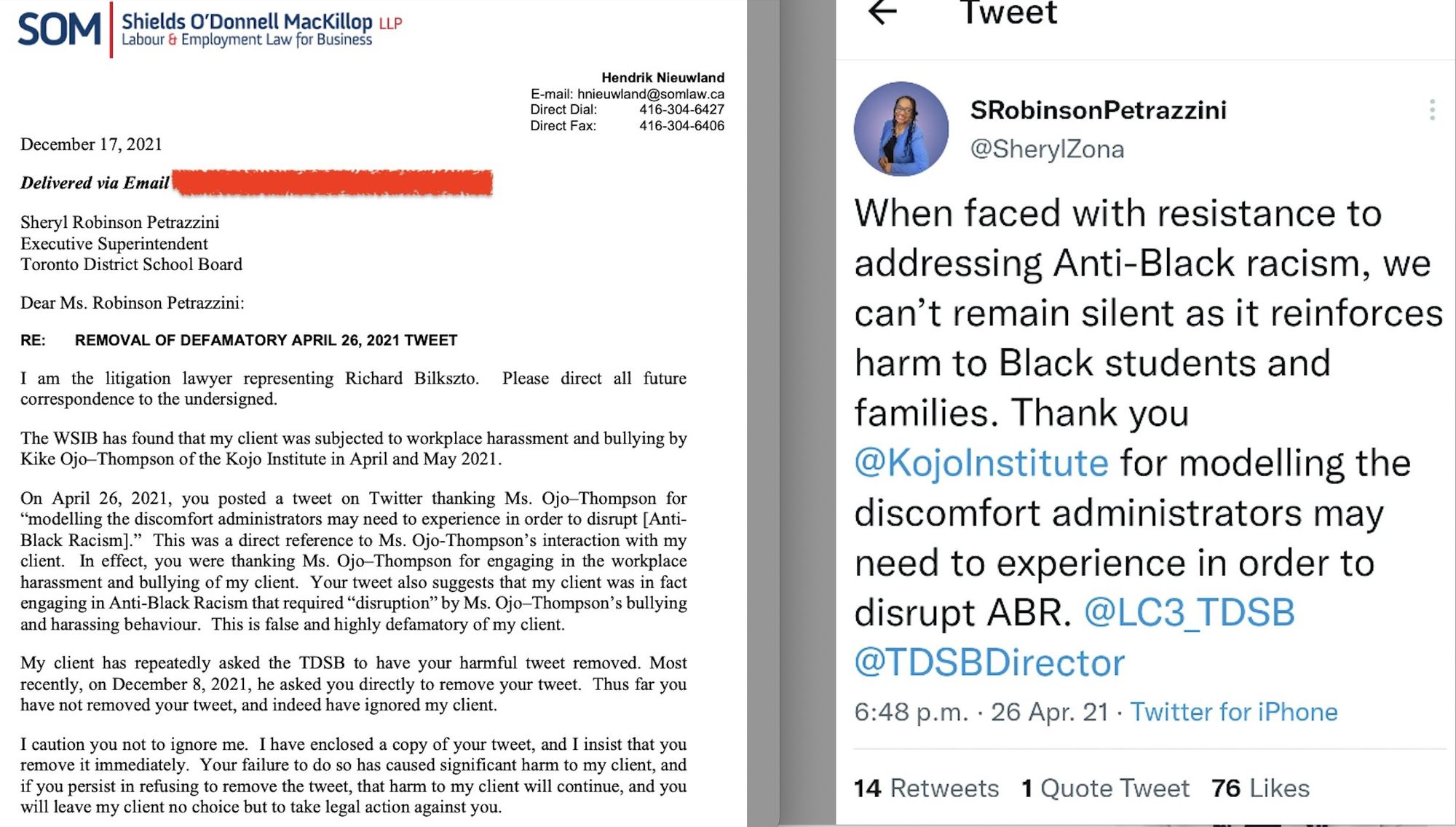
On Twitter, Sheryl Robinson Petrazzini, then the TDSB’s Executive Superintendent, thanked Ojo-Thompson and her KOJO colleague for “modelling the discomfort [that] administrators”—i.e., Bilkszto—“may need to experience in order to disrupt ABR [anti-Black racism].”

For good measure, Robinson Petrazzini also suggested that Bilkszto (whom she did not name, but was the obvious subject of her Tweet) was allied with the forces of “resistance” to anti-racism, and so was abetting “harm to Black students and families.”

Bilkszto personally asked Robinson Petrazzini to delete the Tweet. She did so only eight months later, and only after receiving a letter from Bilkszto’s lawyer warning her that she’d be sued unless she did so.

RIP, Richard Bilkszto, a Toronto Educator Who Stood up to Woke Bullying—and Paid the Price

According to Bilkszto, his other bosses also refused to support him, instead attacking him for his “male white privilege.” And yet, once Bilkszto filed a lawsuit against the TDSB, seeking $785,000 damages for the emotional and reputational harm he’d endured, those same administrators now began claiming that it was Ojo-Thompson who’d gone rogue.

While they’d been perfectly happy to throw Bilkszto under the bus when the stakes were confined to emotional “discomfort,” the TDSB suddenly decided to sue Ojo-Thompson for negligence and breach of contract, demanding that she effectively indemnify the school board for any payout that might become due to Bilkszto. (The TDSB later claimed that it planned to discontinue this suit. But Sakornak reported that it was still a going concern as of June 6.)

I live in Toronto, where my own children have all passed through TDSB schools. Their experience has been a positive one, and I’m happy with the education they’ve received, notwithstanding the sometimes excessive pedagogical focus on race and genderwang. In fact, I have come to sympathize with the teachers—most of them smart hard-working people who find themselves being pressured by their own unions and administrators to adopt militant social-justice postures in their classrooms.

In some school boards, moreover, professional advancement is limited to those who explicitly embrace “anti-racist, high anti-oppressive” leadership principles. So while social-justice puritans comprise a small minority at most schools, they are able to exert disproportionate power in their bid to censure, humiliate, or even oust colleagues, such as Bilkszto, who speak up for the silent majority. In some cases, these ideological enforcers work closely with local race activists and their media allies, so as to harass or censor educators and parents accused of wrongthink.

While the work of anti-racism careerists such as Ojo-Thompson and TDSB Director of Education Colleen Russell-Rawlins is often justified as a righteous crusade against the forces of privilege, it would be difficult to find a more privileged clique of professionals in the field of Canadian public education.

Prior to getting her $300K-per-year TDSB gig, for instance, Russell-Rawlins served as the anti-racism czar at the (even more dysfunctional) neighboring Peel District School Board. Since coming to the TDSB, she’s presided over a series of embarrassing scandals, including an aborted student census that was discovered to be full of overt social-justice propaganda, a revamping of specialty schooling that was found to have been based on a plagiarized research report, and the cancellation of a speaking event by a Nobel-winning ISIS survivor on the grounds that it might be seen as Islamophobic. She’s blithely sailed through all of this without suffering any career repercussions.

The same is true of Robinson Petrazzini, the former $200K/year TDSB superintendent who went on Twitter to spike the football when Bilkszto was humiliated by Ojo-Thompson. Shortly after Bilkszto lawyered up, Robinson Petrazzini became Director of Education at the neighbouring Hamilton-Wentworth District School Board.

As for Ojo-Thompson, she continues to be feted by numerous Canadian organizations and media outlets. In 2022, she served on the board of directors of Parents of Black Children, a Toronto-area lobby group that’s made a name for itself largely by urging school boards to implement the same anti-racism instructional modules that constitute Ojo-Thompson’s own stock-in-trade. (Her partner Rohan served until recently as Workplace Equity Manager with the Peel District School Board, and the two would appear together on stage to talk about “the Impact of Systemic Racism on K-12 Workplace Well-Being.”) The market for the sort of militant anti-racist diatribes that Ojo-Thompson peddles seems inexhaustible within Canada’s corner offices, and I seriously doubt whether even the negative attention resulting from Bilkszto’s death will dent her income.

And in any case, she’s been through this before—for this was not the first time that Ojo-Thompson has encountered “resistance”: A 2021 diversity training session that she delivered to councilors of Sarnia, a small Ontario city on the shores of Lake Huron, reportedly sparked a revolt among some audience members, causing Ojo-Thompson to quit that gig in a huff.

“The undisputed, uncorrected, and unabated hostility demonstrated by some members of Council toward our Principal Consultant Kike Ojo-Thompson was wholly inappropriate,” declaimed the KOJO Institute’s director of client services, Craig Peters. “There were things that were said in that meeting—that we won’t divulge—that led us to believe that it wasn’t in the organization’s best interest to continue.”

When contacted by The Sarnia Journal, Ojo-Thompson added that the comments she’d heard had made her feel unsafe.

“Safety isn’t always physical,” said Ojo-Thompson. “There is emotional and mental harm that can be done.”

No doubt, Richard Bilkszto (1963-2023) would agree.

Source: RIP, Richard Bilkszto, a Toronto Educator Who Stood up to Woke Bullying—and Paid the Price

The term ‘BIPOC’ is a bad fit for the Canadian discourse on race

Joseph Heath’s piece questioning the prevailing wisdom of Canadian diversity discourse and its reliance on American language and context struct a nerve and provoked a debate that earlier articles had not, including his defence of the term visible minorities rather than separating Blacks from other visible minority groups.

While I agree with his focus on Indigenous peoples and visible minorities, and use of those terms until the employment equity act terminology is changed. We also need to recognize the differences and the similarities with the USA, both overall and with respect to specific groups.

I am less convinced by his arguments of French as the other group, given constitutional guarantees and a provincial government with extensive powers (nationalist currents in Quebec might agree on the “oppression” aspect but would likely bristle at being lumped together with visible minorities):

One of the biggest problems in Canadian politics is that large segments of our population seem to think they live in the United States. How else can one explain the fools running around in MAGA hats and holding demonstrations in support of former U.S. president Donald Trump? Sometimes, I feel like I should shake them by the shoulders and shout, “You live in Canada!”

Unfortunately, I am beginning to feel the same way toward people who talk about “BIPOC issues,” as though it were normal for Canadians to use that expression. After all, BIPOC (“Black, Indigenous and People of Color”) is an acronym developed in the U.S. to discuss domestic race relations, just as BAME (“Black, Asian and Minority Ethnic”) is used in Britain.

Rather than developing our own acronym to reflect the reality of race relations and multiculturalism in Canada, far too many people have chosen just to use the American term. This cognitive capture by American social-justice discourse is, in many ways, just a left-wing version of what’s been happening with MAGA on the right.

All three components of the acronym, B, I and POC, are problematic in a Canadian context. Let’s start with “Black.” In the United States, there is good reason to put the B first, because Black people are by far the most important minority group in that country, making up more than 12 per cent of the population. Furthermore, as descendants of slavery, most can trace their ancestry in the U.S. back hundreds of years.

The situation in Canada is quite different. When I was born, in the 1960s, Black Canadians made up 0.2 per cent of the population. This number has grown to more than 3.5 per cent today, but the consequence is that the Black population in Canada consists almost entirely of immigrants and their immediate descendants. Furthermore, Black Canadians are not the largest group of recent immigrants, as they are outnumbered by both people of South Asian and East Asian ancestry.

Because of their distinctive history in the U.S., it makes sense to treat Black people as a separate category in that country. And because of their demographics, it may make some sense to put them before Indigenous people, who make up only 1.6 per cent of the U.S. population. In Canada, however, where Indigenous people make up almost 5 per cent of the population, it makes no sense at all to put the B before the I, or even to treat Black people as a separate category from other ethnic groups. Indeed, it is in many ways offensive to the distinctive status of Indigenous peoples in Canada to put the B first. From the perspective of many Indigenous people, the Black population of Canada are settlers, just like white Canadians – that is, part and parcel of the continuing colonial project.

As far as discrimination is concerned, comparative victimization claims are difficult to assess, but only someone who was confused about the differences between American and Canadian history could think that the suffering of Black Canadians outranks that of Indigenous peoples.

This brings us to the “POC” part of the acronym. This is slightly less important, but the term traditionally used in Canada is “visible minority.” And apart from being American, “person of colour” is not very popular among those it used to describe.

Finally, it is worth noting that the largest group of people in this country who were victimized by British colonialism, subjugated and incorporated into confederation by force, are French Canadians. This is why the status of the French language has served as the major flashpoint for conflict over minority rights in this country.

And so, if there is the need for an acronym to identify the most important minority groups in Canada, I would propose “FIVM”: Francophone, Indigenous and Visible Minority.

For all those who have enthusiastically adopted the BIPOC acronym – along with the American habit of analyzing social conflict through a racial lens – it is worth keeping in mind that the U.S. approach to race relations has been a recipe for conflict. Why anyone would want to import this way of thinking into Canada is a mystery to me. When people around the world look for models of pluralist integration to emulate, Canada’s federalism and multiculturalism policies are generally pointed to as among the most successful.

An important feature of these policies, traditionally, is that Canada has not sought to racialize what amount to ethnic differences among peoples. The idea that a recent immigrant from Ethiopia has something important in common with a descendant of African slaves whose ancestors have been on this continent for 300 years is not just a fiction – it is pernicious misrepresentation. Even the suggestion that all Black communities here face the same racism is likely to obscure more than it reveals.

The idea that we should continue with the failed American BIPOC model instead of using the far more appropriate FIVM acronym is difficult to understand – except as a consequence of American cultural imperialism. How else could anyone get the wild idea that it might advance the cause of social justice to import American racial politics?

Source: The term ‘BIPOC’ is a bad fit for the Canadian discourse on race

More neutral and less controversial question of the term BIPOC is seen in this piece by Azra Rashid:

On April 20, a jury in Minnesota found Derek Chauvin guilty of second-degree unintentional murder, third-degree murder and second-degree manslaughter in the killing of George Floyd. Following the verdict, Canadian media was filled with extensive coverage and endless analyses of the story.

Many Canadians watched the racism unfold in the United States with a sense of moral superiority and relief that “this kind of thing does not happen in Canada.” The Canadian response to racism south of the border can be described as an Americanization of Canadian history. The media’s lack of coverage of racism in Canada, in its historically accurate context, is a cause for concern.

Different histories of racism

Canada’s history of racism is different than the United States.

In 1619, the first slave ship docked on North American shores, bringing 20 enslaved Africans. This was the start of the transatlantic slave trade that saw at least 300,000 Africans brought to and sold at U.S. ports. Historians estimate that in Canada, between 1671 and 1834, there were 4,200 slaves – about two-thirds were Indigenous and one-third were Black.

Outlawing the slave trade and restrictions on non-European immigration later slowed down the growth of the Black population both in the U.S. and in Canada.

Immigration regulations introduced in 1962 in Canada eliminated preferences for immigrants of European origin for a points-based system, prioritizing skilled labour. As a result, the immigrant population became more diverse in Canada. Similarly, in the U.S., the Immigration and Nationality Act of 1965, the Refugee Act of 1980 and the Immigration Act of 1990 have helped to increase the number of immigrants in the country.

Immigrants today account for 13.7 per cent of the U.S. population compared to 22 per cent in Canada.

The history of slavery and immigration provides an important context to contemporary conversations on racism. But an increase in immigration does not automatically lead to more or less racism.

In a country like Canada, it’s important for us to acknowledge our differences in history from the U.S., account for racism within a particular historical context and reflect on what racism actually looks like here.

Difference can provide a space for understanding the implication of race in defining the various experiences of racialized groups, instead of a universalized representation of race and racism.

Racism towards Indigenous people

Canada has a long history of racism towards Indigenous people – from the colonization of their land and enslavement to the violation of treaties and policies that led to residential schools and the ‘60s Scoop.

Abuse and racism suffered by First Nations, Inuit and Métis people at the hands of the government continue to take a toll on Indigenous lives. Many remote communities face challenges accessing basic necessities like clean drinking water.

Indigenous people in Canada also experience the highest levels of poverty: 25 per cent of Indigenous people live in poverty while 40 per cent of Indigenous children live in poverty.

Accessing health care has also been a challenge for many First Nations people. Several months ago, Joyce Echaquan died in a hospital in Joliette, Que. Not only did she not receive the help she needed, but hospital staff told her that she would be better off dead. Meaningful action to fight the systemic racism Indigenous people are experiencing is yet to come.

In the U.S., genocidal policies aimed at Indigenous people changed when legislators passed a number of laws, most importantly the Indian Self-Determination and Education Assistance Act of 1975, which resulted in the U.S. government’s recognition of Indigenous statehood.

In recent years, some policies, especially those implemented by former president Donald Trump’s administration, have been diminishing tribal land rights, sovereignty and resources. The Keystone XL Pipeline project, approved by the Trump administration and cancelled by U.S. President Joe Biden, was met with strong resistance from Indigenous people in Canada and the U.S. The project had the backing of Canadian government.

The American influence

The U.S. influences Canadian lives in many ways – from the economy to culture. Canadians often mindlessly consume U.S. media and politics without thinking twice about how those issues manifest themselves in Canada and what the differences are in the history of race and racism between the two countries.

The Americanization of Canadian culture is not new. In 1926, in an essay titled Is Canada Being Americanized?, journalist and philosopher C.H. Bretherton offered reflections on Canada’s movement toward American models of social and economic life. However, Americanization of Canadian history is a rather new phenomenon.

About a decade ago, a national survey of 18- to 24-year-olds found that only 46 per cent of respondents knew Sir John A. Macdonald was the first prime minister of Canada, let alone the racist policies he implemented in the country. Polls conducted more recently by Historica Canada show a similar lack of knowledge of Canada’s history.

The blame falls not only on our education system, but also on our news and media that continue to lead with American stories and fail to report on what is historically important and relevant in Canada. In the last 100 years, immigration reforms have made Canada more diverse, but the systemic racism faced by Indigenous peoples and immigrants fails to make a mark on the Canadian conscience.

The same day a jury reached a verdict in the Chauvin trial, a superior court in Québec decided to uphold Bill 21. The law prohibits public sector workers who are in positions of authority (including teachers, police officers and judges) from wearing religious symbols (such as hijabs, niqabs, kippas, yarmulkes, crucifixes or turbans) at work. The judge made an exception for individuals working in English-language schools. That story, however, was buried under the coverage of the Chauvin verdict.

While news outlets are flooded with stories on anti-Black racism, many stemming from the other side of the border, there’s still no uproar in Canada about legitimizing racism by targeting non-white communities.

Source: Racism & the Americanization of Canadian history: Why we shouldn’t look at ourselves through a U.S. lens