Liberals reshape judicial bench with appointments of women

The Globe finally catches up to the story of the increased diversity of the government’s judicial appointments, almost exclusively focussing on gender with only cursory reference to the increased number of visible minority (8.5 percent) and indigenous (5.1 percent) judicial appointments (after Thursday’s latest batch of appointments).

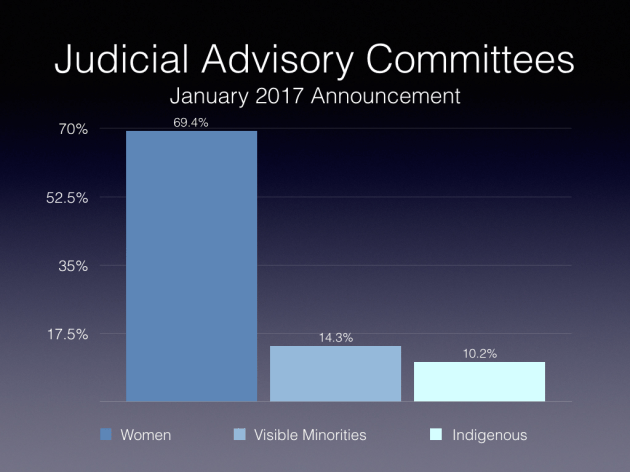
The Globe also misses another key aspect: the increased diversity in the Judicial Appointments Advisory Councils named to date: 62.9 percent women, 11.4 percent visible minorities, and 10.0 percent Indigenous peoples:

The Liberal government is reshaping the bench, appointing a substantial majority of women, even though they make up a minority of applicants. The approach is winning praise from some in the legal community, while sparking concern about “quotas” from others.

A year and a half after taking office, the government has appointed 56 judges, of whom 33 are women – 59 per cent. Yet women make up only 42 per cent of the 795 people who have applied to be judges since the Liberals put in place a new appointment process in October.

Making federal institutions more reflective of Canadian diversity has been a theme of the Liberal government. Its cabinet has an equal number of men and women, and it announced a plan last week to ensure more women and minorities are named to federally funded research chair positions at universities.

Justice Minister Jody Wilson-Raybould says a more diverse bench will build the public’s confidence in the judiciary. “We are beginning to demonstrate how it is possible to have a bench that truly reflects the country we live in,” she said in an e-mail to The Globe and Mail.

But some in the legal community question the government’s commitment to the merit principle in appointing judges to federally appointed courts, which includes the superior courts of provinces, the Federal Court and Tax Court.

“I’m not really in favour of a quota system – those are alarming discrepancies,” Brenda Noble, a veteran family lawyer in Saint John, said in an interview, referring to the gap between female appointees and applicants. “You want to have the best people in the job.”

Ian Holloway, the University of Calgary’s law dean, said it is hard to fault the government for increasing the proportion of women judges. Even so, he said he worries the government is putting too much emphasis on gender.

“In the old days, it was offensive that people got judgeships just because they were Liberals or Tories. That helped breed contempt for the judiciary. What we don’t want to do is replicate that in a different form.”

But others say the government is doing the right thing.

Brenda Hildebrandt, a Saskatoon lawyer and governing member of the Saskatchewan Law Society, was pleased. “Do I think it’s a good thing women are more represented on the bench? Yes, I do, and I would hope that those are qualified candidates and that the fact that they’re women is just one consideration, albeit important.”

Rosemary Cairns Way, a University of Ottawa law professor who has studied diversity on federally appointed courts, supports the government’s move as a way of achieving gender parity. “When there is no shortage of meritorious candidates, it seems to me the government can legitimately choose judges who, in addition to being independently qualified, will fulfill other institutional goals such as a more diverse and gender-balanced bench.”

When the Liberals took office, 35 per cent of the federal judiciary (full-time and semi-retired) were women, according to the Office of the Commissioner for Federal Judicial Affairs. Given a similar time frame to the Conservatives – a decade in office – the Liberals would ultimately put women in the majority among the full-time federal judiciary if they maintain the current ratio of appointments. The previous government appointed more than 600 full-time federal judges, 30 per cent of them women; women also made up 30 per cent of applicants during the Conservatives’ years in office.

The government’s emphasis on creating a bench more reflective of Canada’s diversity does not extend quite as much to racial minorities as it does to women. However, there are at least seven visible minorities among the new appointees – two of Indigenous ancestry, three of South Asian background, one Japanese-Canadian and one Chinese-Canadian.

The Liberals have authorized the judicial-affairs commissioner to collect, for the first time, data on race, Indigenous status, gender identity, sexual orientation and physical disability of applicants and appointees. But the office would not release those numbers to The Globe and Mail for this story, saying it is still preparing the data and it intends to publish them soon.

The Globe asked Ms. Wilson-Raybould whether she has a numerical target for the appointment of women to the federal judiciary. She replied that the government appoints judges based on merit and the needs of the court. “In assessing merit, I do not discriminate against applicants based on their gender, ethnic or cultural background,” she said in an e-mail.

She acknowledged that the pace of racial-minority appointments is lagging and suggested the problem is a lack of minorities in the legal profession.

“We know that more needs to be done to increase the number of visible minorities in our law schools. As that happens, the face of the profession will change and evolve to better reflect the rest of the population.”

Rob Nicholson, a former Conservative justice minister, and the party’s current justice critic, said his chief concern is that qualified people be appointed. “If it’s 55-per-cent women and 45-per-cent men, as long as we get qualified people for this,” he said.

Source: Liberals reshape judicial bench with appointments of women – The Globe and Mail
Judicial Advisory Committees: Clear signal of increased diversity

English media slower to pick this up than Le Devoir.

By way of context, Rosemary Cairns Way in her Deliberate Disregard: Judicial Appointments under the Harper Government, analysed the diversity of the Committees as of May 2014. 12 of the 17 committees were chaired by men, with 70 percent of filled positions held by men (her analysis did not include visible minorities or Indigenous peoples).

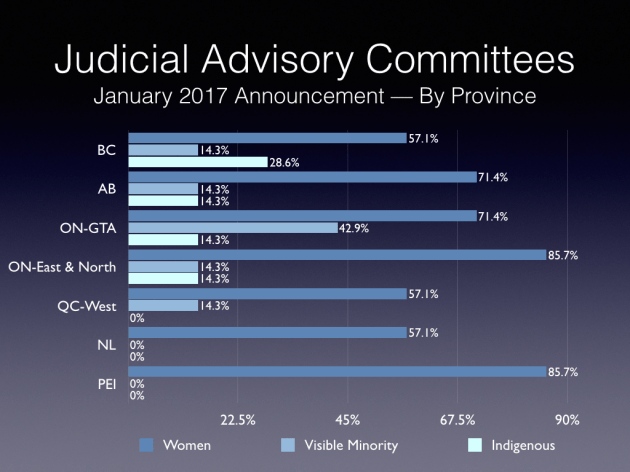
The Government, in a significant implementation of the government’s diversity and inclusion agenda, has essentially flipped this around as the following charts demonstrate for seven of the appointment committees.

election-2015-and-beyond-implementation-diversity-and-inclusion-083

election-2015-and-beyond-implementation-diversity-and-inclusion-084

The regional variations generally overweight all groups in relation to the local demographics with some exceptions (e.g., Ontario GTA representation of visible minorities). Three of the seven committees are headed by women.

Overtime, and in line with the 2016 judicial appointments, this should further increase diversity on the bench:

With the number of judicial vacancies reaching near-record levels, the Liberal government has revived a dormant appointment process, and signalled that it intends to change the face of the judiciary.

It named the members of seven newly constituted screening committees for the federal bench last week. Each of the committees has a majority of women.

The announcement of the judicial advisory committees comes as full-time vacancies are at 57 across the country, and as courts are struggling to meet Supreme Court deadlines for timely justice. In the fall, murder charges in Alberta and Ontario were thrown out for unreasonable delay. All judicial advisory committees from Ontario to Newfoundland and Labrador have been without any members at all since at least last April. And the government removed the members of all other committees in October.

The government announcement still leaves 10 of the 17 committees across Canada without members. A spokeswoman for Justice Minister Jody Wilson-Raybould said the government named the committees in areas with high numbers of judicial vacancies.

The federal government asked members of the public, including non-lawyers, to apply for three federally appointed spots on each committee back in mid-October, allowing one month to do so. The Liberals were critical of the appointment process under the Conservatives for what they called its lack of openness and a lack of diversity in appointments. While the government devised a new system, it appointed just 39 judges (some of them promotions, or the naming of regional judges) in the 16 months since the Liberals took office. Chief Justice Neil Wittmann of the Alberta Court of Queen’s Bench said publicly his court had grown desperate.

Rob Nicholson, the Conservatives’ justice critic, is critical of delays in the appointment process. “I still don’t understand why it has taken them so long to make the judicial appointments that it is their responsibility to make,” he said in an interview. It is important to make timely appointments “because when there’s an absence of judges, cases will get thrown out. That does not help the credibility of the justice system.” He said he is “fine” with the majority of members being women.

The Justice Minister did not respond to questions about when the committees would begin recommending candidates, and when the government would make its first appointments from those recommendations. The committees do not pick judges, but they create the pool of approved candidates from which the federal government makes its choices.

Some legal observers consider the federal government’s authority to appoint judges a major yet underappreciated exercise of its power. Former prime minister Stephen Harper changed the process soon after taking office to give Ottawa’s appointees on the committees a voting majority: he added a police representative, and took away the vote from judges who sat on committees. He also removed the “highly qualified” category, to leave the government more leeway to choose. Under the Conservatives, 30 per cent of applicants for the federal judiciary, which includes the Federal Court, Tax Court and superior courts in the provinces, were women, and 30 per cent of appointees were women. Little more than a handful of new judges were visible minorities, though in its decade in office the Conservatives did promote several minorities from lower courts to higher ones.

The Liberals have now undone all the Conservative changes. The police representative is gone. The legal community (the Canadian Bar Association, the law society, the provincial Attorney-General and a Chief Justice) appoints four of the seven members, and the federal government advertised for candidates for the remaining three positions from the general public. While the names of members on previous committees were public, the government now publishes capsule biographies on each. Several have a background in social causes, such as Bruce Rivers of Toronto, executive director of Covenant House, which serves homeless youth, and Jelle Jeen Van Ens of Beaver County, Alta, a social worker.

In all, 34 of the 49 members named so far to the committees are women. On two of the new committees, there is just one man out of seven members, and on two others, just two men. That contrasts sharply with the committees during the Conservative years; most committees had a majority of men, and some committees (Saskatchewan’s and the one for Ontario West and South) had no women members at all.

There are also several visible-minority members on the seven committees announced last week, including an African-Canadian former deputy police chief from Toronto, and two members of First Nations from British Columbia.

In a news release, Ms. Wilson-Raybould said the committee members will receive training in the importance of judicial diversity from Supreme Court Chief Justice Beverley McLachlin. An accompanying fact sheet explains that they will watch her give a speech on videotape. It’s a shortened version of one she gave in Scotland in 2012: “The first attitude that the judge must cultivate is introspectiveness. A judge must be willing to take moral stock of herself. … In a diverse society introspection is essential to ensuring that the phenomenon of difference confronting the judge does not skew the decision-making process.”

Of the 39 judges appointed by the Liberals since they took office in November, 2015, 24 are women.

Source: Petite révolution judiciaire à Ottawa | Le DevoirNew advisory committees could change the face of Canada’s judiciary