Stephen Harper leaves divisive legacy at home as he eyes global business – The Globe and Mail

Good comments on new Canadian voters:

They can blame him [Harper] for other things, too. His scorched earth election strategy drove suburban immigrant voters out of the Conservative coalition, leaving the party weakened in the all-important ridings of Greater Toronto and Greater Vancouver. The niqab debate. Barbaric cultural practices. Worst of all, according to senior Conservatives, the law to strip dual citizens who commit certain crimes of their citizenship. That one killed them at the door in the 905.

Whoever Mr. Harper was trying to win over with these toxic policies during the 2015 election campaign, the price he paid in immigrant votes and the votes of those who welcome immigrants was high. The new leader will have a long row to hoe to win them back.

Source: Stephen Harper leaves divisive legacy at home as he eyes global business – The Globe and Mail

It’s time for Canada to right historic wrongs against LGBTQ community: John Ibbitson

While the focus of Ibbitson’s article is with respect to LGBTQ issues, the broader discussion of apologies was the aspect I found most interesting.

When we were implementing the Conservative government’s historical recognition program for wartime internment and immigration restrictions, the legal aspects of apologies was raised regularly, and appropriately, by Justice Canada officials given fears over liability. At one point in time, we considered doing a policy paper on the question of apologies, their typology, and delivery. In the end, other priorities emerged, but good to see the work that has been done elsewhere:

The Government of Canada should also apologize to the thousands in the public service and military who were dismissed or otherwise discriminated against because they were homosexual, a practice that continued right up until the late 1980s.

The Liberals have been studying both questions for months. Justice Department lawyers often warn that political apologies can expose governments to expensive lawsuits from victims, with the apology serving as proof of guilt.

But as a leading authority in the field points out, not only are such fears overblown, “a meaningful, effective apology can have the opposite effect. Rather than encourage litigation, it can cause people to accept the past more easily.”

Leslie Macleod, a former assistant deputy attorney-general of Ontario, teaches dispute resolution at York University’s Osgoode Hall law school and is a leading authority in mediating and resolving disputes.

“The kind of apology that could be made here would address not only the emotional and psychological interests of those who suffered very dire consequences, it would also address the concerns that we as a society have about how people were treated in the past,” she says.

In that sense, people who see no reason for governments to apologize for acts that no one alive today committed miss the point: We apologize to remind each other of when we fell short in the past, so that we do not fall short in some other way going forward.

A meaningful, effective apology conforms to what could be called the Seven Rs. As described by Ms. Macleod, it involves the specific recognition of the harm caused; expresses remorse for that harm; takes responsibility and repents for the transgression; gives reasons for how the situation came about; offers reparation by way of making amends; and promises reform so nothing similar happens again.

The legislation to prevent discrimination against transgender people could be seen as in the spirit of fulfilling the seventh, and most important, of the seven Rs.

As for reparations, public servants I have talked to who lost their jobs because of their sexuality have, for the most part, gone on with their lives. They do not want money; they just want to be told that, on the terrible day when they were brought into a room, accused of being a homosexual and fired, the person on the other side of the table was in the wrong, not them.

Lawyer Dale Barrett has written about the apology laws on the books in most provinces, which make it easier for governments to apologize by reducing their liability. “It’s very important for government and society to reflect upon the changes in law and changes in sentiment and changes in attitude,” he says, “to acknowledge that society has changed, and to consider what changes we should be making in the future.”

With this new law protecting the rights of transgender people, Mr. Trudeau has advanced the cause of equality for Canada’s LGBTQ community. He should also acknowledge, on behalf of all Canadians, our collective responsibility for those in this community who suffered in the past at the hand of their own government.

Source: It’s time for Canada to right historic wrongs against LGBTQ community – The Globe and Mail

Diversity of Senate Appointments – Comparing Chrétien and Harper

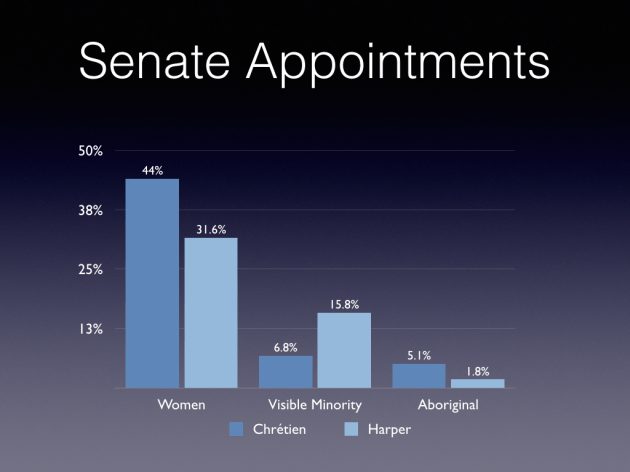
Senate Appointments.001Given the push for gender parity and greater diversity in upcoming Senate appointments (see Trudeau urged to create gender-balanced Senate), I thought it might be interesting to compare the Chrétien and Harper records with respect to diversity.

Chrétien, with his 75 appointments, achieved close to parity for women, with aboriginal peoples slightly over-represented. Visible minorities were under-represented, however.

Harper with his 57 appointments, in contrast, slightly over-represented visible minorities while under-representing women and aboriginal peoples (the fewer number of appointments over a comparable time period reflects his decision to stop appointing senators in response to the Duffy and other scandals).

Will see what PM Trudeau and the advisory body come up with.

John Ibbitson’s take on how gender parity would result in a more ‘progressive’ Senate:

 The other reason Trudeau would want gender parity in the Senate 

ICYMI: How does Canada compare when it comes to resettling refugees? Ibbitson

Good survey article, and noting correctly the advantages of relative geographic isolation:

So Canada’s contribution stacks up well in comparison to some of our closest allies. But our effort pales in comparison with that of Germany, which has taken an estimated one million Middle Eastern refugees this year. “We can do this,” Chancellor Angela Merkel repeats over and over, and she appears to be right.

Sweden has also been exceptionally generous. The nation of 9.6 million people took in 150,000 Syrian refugees in the past year, although authorities have started to crack down in the wake of increasing public resistance.

The absence of any similar backlash here to high intakes of refugees and immigrants – not only during this crisis, but year after year – is Canada’s special blessing. Part of the reason is that most of us are either immigrants or the descendants of immigrants. Our settler culture welcomes settlers.

But the real secret to Canada’s generosity may be its oceans. It is very difficult for a refugee to reach Canada uninvited, making it easier to screen applicants for criminal, security or health risks, and to choose refugees who have a good chance of integrating successfully into Canadian society.

European nations pushing back against the daily tide of desperate humanity flooding north out of the Middle East have no such luxury. Authorities must either admit people about whom they know little or seal their borders.

Mr. McCallum is right. History will not record what targets were missed by how many weeks. It will, instead, note Canada’s impressive humanitarian achievement in rescuing Middle Eastern refugees, even as it looks upon what Germany accomplished with awe.

Source: How does Canada compare when it comes to resettling refugees? – The Globe and Mail

Why is Canada the most tolerant country in the world? Luck – Ibbitson

John Ibbitson nails it with respect to the culture of accommodation, brought on by our French and English heritage (and to some extent with aboriginal peoples given the Royal Proclamation of 1763 setting a different tone than south of the border):

We are as lucky in our cultural geography as we are in our physical. Canada was originally a union of French and English, who had been at war with each other in Europe for much of the past 800 years. The only way to make the dominion work was for each to give the other plenty of breathing room. That respectful distance made it impossible for Canada to gel as a nation, but it also prevented immigrants from feeling they were outsiders in some nationalist club. Multiculturalism is the greatest gift of our Constitution, even though the Fathers of Confederation hadn’t the faintest clue they were bequeathing it.

That same culture of accommodation makes it possible for sexual minorities in Canada to feel safe, even welcomed. There is not a city, town or village in Canada where my husband Grant and I would hesitate to live.

Of course, things are far from perfect. The legacy of intolerance and abuse by the Europeans toward the aboriginal community is Canada’s shame.

Why is Canada the most tolerant country in the world? Luck – The Globe and Mail.

Justin Trudeau can’t ignore domestic concerns in foreign policy

John Ibbitson on diaspora politics and how that will influence any future Liberal government’s foreign policy. He is right, of course, that all Canadian governments, whether Liberal or Conservative, respond to diaspora concerns, always have, and always will, and the change is more in the number and relative influence of diasporas, rather than the principle. Democracy, as he notes, responds to interests; the more organized, cohesive and large the diaspora, the more the influence. We are living in a “shopping for votes” world.

But what he and others get wrong is the assumption that diaspora voters are single issue voters (some are, most likely not) and that they all share the same views on diaspora issues. There is political diversity within ethnic communities with respect to both domestic and international issues. Of course, for every diaspora pushing one perspective another exists with an opposing one (e.g., Canadian Jews and Arab Canadians, Armenian and Turkish Canadians etc):

“Diasporas are a huge problem in foreign policy,” he observed. Immigrants’ unwillingness to sever political ties with their homeland “is a problem with diasporas everywhere,” he added. The duty of political leaders is to transcend the “old views” of immigrant communities and craft a responsible, enlightened foreign policy, something Mr. Westall believes the Harper government has conspicuously failed to do.

Mr. Westall is absolutely right. Canadian Tamils influence Conservative foreign policy toward Sri Lanka; Canadian Sikhs influence Conservative foreign policy toward India; Chinese Canadians influence the Harper government’s approach to China; Ukrainian Canadians influence the Harper government’s approach to Ukraine.

But what would you expect? When Canada’s population was mostly of French, English, Irish and Scottish descent, does anyone believe our foreign policy was anything other than diaspora-driven?

Forgive this repetition, but over the past two decades we have imported the equivalent of two Torontos-worth of immigrants, almost all of them from what used to be called the Third World. Any political party that wants to succeed must earn their support. Political parties that lose the immigrant vote lose the election.

The Liberals believe that they can reconnect with Canada’s immigrant community without pandering to parochial concerns. They believe they can improve Canada’s reputation abroad and revitalize the Canadian economy through trade while recognizing the hard realities of today’s global environment.

If so, Mr. Trudeau’s supporters may be surprised to discover that Canada’s foreign policy under his leadership is essentially what it was under the Conservatives, but with softer language and a warmer smile.

Again, governments of any stripe make policy choices of which diasporas to support, and which organizations within each diaspora. How they express that support, how they manage it, and how they dismiss an opposing diaspora’s concern, however, can make a difference.

The Government has chosen a more muscular approach in articulating these choices. In some cases, this is appropriate, in others, “softer language and a warmer smile” may be more effective to “harsher language and a cooler scowl” both domestically and internationally.

Justin Trudeau can’t ignore domestic concerns in foreign policy – The Globe and Mail.

Immigrants don’t turn ‘blue’ the moment they arrive – The Globe and Mail

A useful counterpoint to the thesis of John Ibbitson and Darrell Bricker in The Big Shift, by Michael Adams and Robin Brown, nuancing the Ibbitson-Bricker argument that Canadian immigrants and new Canadians are inherently more conservative politically:

But the story is more complicated.

The idea that migrant attitudes are defined by a focus on economic mobility is outdated. These days, middle-class Chinese and Indians who are solely focused on material gain are better off staying in their home countries. Today’s migrants are often people who voluntarily accept a decline in status and even income to move to Canada. Young professional immigrants who choose Canada are often seeking gains in quality of life more than standard of living. Focus group participants have told us they want to raise their children outside the hierarchies and pressures of their home countries. South Asian immigrants, in particular, are attracted to Canada’s multicultural society, believing they and their children are enriched through exposure to diverse cultures. Many of the Chinese immigrants we speak to are tired of “striving” and are trading off more opportunity in China for less stress in Canada.

One of the success stories of Canada’s model of immigration, citizenship and multiculturalism is that all parties engage ethnic communities. Minister Kenney is the best illustration of this approach, given his extensive and energetic outreach.

Unlike in Europe or the US, there is no xenophobic political party. Immigration-related debates are over policy and program approaches, not the fundamental view of Canada as a diverse, multicultural society.

Immigrants don’t turn ‘blue’ the moment they arrive – The Globe and Mail.

The reply by Bricker and Ibbitson based upon a wider survey and the election results, showing gains for the Conservatives in ridings with a large proportion of ethnic voters:

 You have to figure immigrants out to win elections 

The counterpart to both articles is of course Susan Delacourt’s Shopping for Votes, which downplays macro trends given that parties, and the Conservatives have done that particularly well, are micro-targeting in terms of policies and programs, treating voters more as consumers than with fixed party preferences.

How Quebec’s charter turned the Tories into ethnic champions – The Globe and Mail

Another article, by Inder Marwah of University of Chicago, and Phil Triadafilopoulos, of UofT, on how the Conservative Party has learned to embrace the “fourth sister” of Canadian politics (ethnic communities) and how the proposed Quebec Charter has furthered that embrace. Not much new compared to commentary by Tom Flanagan, John Ibbitson or others, but it still is a remarkable change.

How Quebec’s charter turned the Tories into ethnic champions – The Globe and Mail.

Case study highlights conflict between bureaucrats, Minister Kenney on direction of multiculturalism programs – The Globe and Mail

John Ibbitson of The Globe on my book, Policy Arrogance or Innocent Bias: Resetting Citizenship and Multiculturalism. Excellent summary.

As to his suspicion that I was more comfortable with the old ways, initially yes, but my perspective changed as I thought through the issues, and broadening multiculturalism to include all groups, not just mainstream/visible minority relations, and focusing on citizenship integrity (knowledge, language, residency) were all policy changes that I support generally. Implementation and some of the details is another matter as he points out.

As this is behind the insider pay wall, full text below:

Policy Arrogance or Innocent Bias is a case study by Andrew Griffith, who spent four years as Director General for Multiculturalism under Mr. Kenney. He chronicles the conflict between public servants steeped in consensus on how citizenship and multiculturalism programs should be run, and a minister who was determined to transform both the programs and the assumptions on which they were based.

“In many cases, officials had to work through the Kubler-Ross states of grief and loss – denial, anger, bargaining, depression and acceptance – in dealing with the traumatic changes to their role,” Mr. Griffith writes.

Officials relied on surveys and reports to shape policy; Mr. Kenney relied on anecdotal evidence. Officials followed procedures for recommending grants and contributions to non-governmental organizations. Mr. Kenney vetoed most of them.

At root, bureaucrats embraced a set of assumptions laid down in the days of Pierre Trudeau and maintained by every Conservative and Liberal government that followed: Multiculturalism programs should foster mutual tolerance among cultural communities. Citizenship should be easy to acquire, and citizenship classes and programs should emphasize the federal government’s contribution to peacekeeping, the United Nations and expanding civil liberties at home and abroad.

The Harper government saw things differently. As Minister of State for Multiculturalism, and then as Minister of Citizenship and Immigration, Mr. Kenney preferred the word “plurality” to “multiculturalism.” Instead of an emphasis on cross-cultural understanding, he wanted to promote the integration of new Canadians into a socially cohesive society. (“Exactly!” Quebec Premier Pauline Marois might respond.)

Anti-racism programs should focus less on oppression by the majority toward minorities and more on conflicts within and between minority groups, he believed. There should be more outreach to religious groups within each community and greater attention paid to the concerns of the Jewish community.

Citizenship should be harder to acquire, language requirements should be stricter, and new Canadians should hear less about peacekeeping and gay marriage and more about Canada’s military past and the importance of the Queen.

Bureaucrats would produce plans and priorities based on evidence-based research of key concerns within different cultural communities. Nonsense, Mr. Kenney would retort; I talk to these people and that’s not what they’re saying.

Between 2007 and 2011, the Minister delivered 273 speeches and statements: 37 concerned Canadian Jews; Chinese Canadians were the target of 30 and Indo-Canadians of 22. The other seven in the top 10 included Black Canadians, Christians, Muslims, Asian Canadians, Ukrainian Canadians, American Canadians and Ismali Muslims. Mr. Kenney believed he had his finger on the pulse of immigrant communities.

To their surprise, when public officials convened focus groups to test Mr. Kenney’s assertions, they often found that those interviewed reflected the minister’s priorities more than their own research had indicated.

In the best Yes, Minister tradition, officials also found that they could secure Mr. Kenney’s acceptance of a proposal more easily if it was larded with quotes from the Minister’s speeches. Over time, the bureaucrats found ways to satisfy the new boss’s demands while also sliding in a few of their own priorities.

Mr. Griffith’s conclusion is a surprising admission for a former public servant: “All of us, including public servants, have our biases and prejudices, which influence our evidence base, networks, and advice,” he writes. “…Public servants did not have the complete picture and were often too disconnected from the realities on the ground to understand the limitations of their analysis and advice.”

That does not mean that Mr. Kenney in particular or the Harper government in general were without blame. Mr. Griffith’s decries the cutbacks that have degraded the bureaucracy’s ability to create and test policy, the rush to decision and implementation and the mistakes that resulted. And although the language and the judgments are carefully balanced, one suspects that Mr. Griffith still believes the old ways and assumptions were better than the new Conservative ones.

That said, he predicts that because of Mr. Kenney’s reforms, “multiculturalism will, over time, become closer to the original Reform Party objective … of abolishing multiculturalism and strengthening a strong common narrative of citizenship.”

Unless, of course, the Conservatives are defeated in the next election and the universe goes back to unfolding as it should.
Case study highlights conflict between bureaucrats, Minister Kenney on direction of multiculturalism programs – The Globe and Mail.

Sorry, republicans, the monarchy is here to stay – The Globe and Mail

Good overview of the embedded nature of the Crown and Monarchy in Canada.

Sorry, republicans, the monarchy is here to stay – The Globe and Mail.