A tale of Tory, tories and the torah

Emma Teitel’s well-argued rebuke to Conservative targeting of Jewish voters:

In a larger context, the Tory Pride comments are a microcosm of a fallacy to which well-meaning conservatives who support Israel’s right to exist are prone. I’ve mentioned before that Prime Minister Stephen Harper’s ongoing defence of Israel, genuine though it appears to be, is so automatic and unreserved, it can be, for someone who’s Jewish, almost a bit creepy. No Israeli I know is as one-sided in his analysis of his homeland. Usually, when you live in a place for a while, you have at least a few critical things to say about it. I love Toronto, but I don’t like T.O. fixtures Rob and Doug Ford.

Conservatives love to deride knee-jerk liberals who can’t take a joke—the kind of liberals in whose company you dare not make off-colour remarks about sexuality or ethnicity. But conservatives are equally skewed by their own PC touchiness. Their breed simply takes a different form: Israel these days is one of their sacred cows, an object of their guaranteed optimism and goodwill. By this formula, Tel Aviv isn’t allowed to be just a gay-friendly city; it has to be one of the most gay-friendly cities in the world. Israel can’t just be an admirable, resilient country with flaws, it has to be, in its current form—in every form—irreproachable. To suggest that Israel can act immorally is to reveal your true colours: that you’d rather it didn’t exist.

These are false equivalencies, and they put Jews like me in an awkward position—the position, for instance, of having to defend the QuAIA (which I wish would disappear) from John Tory (for whom I’ll probably vote).

When everything constitutes anti-Semitism, nothing is anti-Semitism; words like holocaust and racism lose their meaning, and the resulting fog of moral relativism is bad for more than just Jews. And so, Mr. Tory and attendant candidates running for office, if we’re not part of the story, please leave us alone.

A tale of Tory, tories and the torah.

Stephen Pollard: Appeasing the mob? That ain’t kosher

Pollard has a point:

In response to those protesters outside Sainsbury’s Holborn branch calling for a boycott of its Israeli goods, the manager ordered his staff to clear the shop of all its kosher goods. Clearly the manager is not the brightest spark in the firmament, since kosher produce — which is the only food observant Jews are allowed to eat — is not the same as Israeli produce which is simply food produced in Israel. The kosher produce in the shop was apparently made in the UK and Poland, and had never been near Israel.

It’s easy to imagine what went through the manager’s mind: “Israelis, Jews – heh, they’re all the same. Let’s just get rid of this stuff pronto and keep the protesters happy.” According to the witness whose Facebook posting of the empty shelves revealed the story, a staff member then defended the move, saying: “We support Free Gaza.”

…. Some hapless Sainsbury’s spokesperson issued a statement saying that the company was “an absolutely non-political organisation,” and went on: “It was an isolated decision made in a very challenging situation.”

Challenging. What a wonderful word that is, designed as a catch-all to excuse all sorts of inexcusable acts. So – given how challenging things are in Iraq at the moment – presumably Sainsbury’s will be removing all halal goods from its shelves because Islamic State is slaughtering Yazidis. No? You mean Sainsbury’s does not believe all British Muslims should be punished for the actions of a foreign body with which they have no connection?

Mistakes happen. But the way they are dealt with is usually more indicative of the way an organisation is run. And Sainsbury’s is refusing even to investigate the incident.

Stephen Pollard: Appeasing the mob? That ain’t kosher

Sponsored travel helping Israel win over Canadian MPs

Good piece in iPolitics on the influence of sponsored travel, focussing on Israel but not unique (i.e., Taiwan):

Independent MP Brent Rathgeber says he enthusiastically accepted the chance to visit Israel when he was invited in 2010.

“It was a fascinating trip. It was a great trip. I learned a great deal on all aspects of it. I grew up in a Christian home and it was fascinating to visit the holy sites.”

Rathgeber says the trips deliver value for the CIJA and could be having an effect on the reaction of Canada’s MPs to the current conflict.

“The sponsors of these trips, although in fairness they try to provide some balance on the conflict, obviously have a goal in mind in the education that they provide by taking you there. So, I am not surprised that all of the major parties seem to have a certain perspective with respect to this ongoing conflict in Gaza.”

Norman Spector, a former Canadian ambassador to Israel, is among those who have met with MPs on trips sponsored at the time by the Canada Israel Committee.

Spector said he also set up meetings and tours for MPs when he was ambassador but his tours included elements he suspects the CIJA tours are lacking – like a wide range of Palestinian views including members of Hamas before it was declared a terrorist organization and some of the far right voices in Israel.

“I doubt that many MPs have been taken on these missions to a refugee camp in Nablus or if any has seen raw sewage flowing at Jabalya camp in Gaza.”

Sponsored travel helping Israel win over Canadian MPs. (pay wall)

The Guardian view on Gaza and the rise of antisemitism | Editorial | Comment is free | The Guardian

The Guardian’s take on increased antisemitism in relation to Israeli government actions:

It should not need saying, but it does: people can be as angry as they like at the Israeli government, but to attack a synagogue, threaten children at a Jewish school, or throw a brick through the window of a Jewish grocery store is vile and contemptible racism. It cannot be excused by reference to Israeli military behaviour. The two are and should be kept utterly distinct.

Some may counter that that is impossible, given the strong attachment of most Jews to Israel. But this is less complicated than it looks. Yes, Jews feel bound up with Israel, they believe in its right to survive and thrive. But that does not mean they should be held responsible for its policy, on which some may disagree and over which they have no control.

Nor should they be required to declare their distance from Israel as a condition for admission into polite society. We opposed such a question being put to all Muslims after 9/11 and, though the cases are not equivalent, the same logic applies here. This is a test for those who take a strong stance in support of the Palestinians, but in truth it is a test for all of us.

The Guardian view on Gaza and the rise of antisemitism | Editorial | Comment is free | The Guardian.

Mirror Images: Antisemitism and Islamophobia – New Canadian Media – NCM

My take on the similarities and differences between antisemitism and islamophobia:

And for those protesting or supporting Israel, a do’s and don’t guide see How to Support Israel without Being Racist and How to Criticize Israel without Being Antisemitic for additional thoughts:

1.       Protest against the political entity Israel, Hamas, not the religion or ethnicity Jews, Muslims, Arabs.

2.       Never protest outside a mosque or synagogue. Find a neutral place e.g., federal or provincial parliaments, City halls.

3.       Avoid any use of Nazi imagery and language no ‘death to the Israelis, no death to the Jews,’no death to the Arabs, no death to the Muslims’ language.

4.       No violence or threats of violence.

5.       Hard as it may, try to understand where the other side is coming from. Not necessarily to accept, but to understand.

Mirror Images: Antisemitism and Islamophobia – New Canadian Media – NCM.

Israel, Gaza, War & Data — i ❤ data — Medium

Twitter Mid-East solitudesFor data visualization geeks, as well as those more broadly interested in social networks and how they reinforce our existing views, this article by Gilad Lotan is a must read (Haaretz, the left-wing Israeli newspaper, draws the most from both sides):

Facebook’s trending pages aggregate content that are heavily shared “trending” across the platform. If you’re already logged into Facebook, you’ll see a personalized view of the trend, highlighting your friends and their views on the trend. Give it a try.

Now open a separate browser window in incognito mode Chrome: File->New Incognito Window and navigate to the same page. Since the browser has no idea who you are on Facebook, you’ll get the raw, unpersonalized feed.

How are the two different?

Personalizing Propaganda

If you’re rooting for Israel, you might have seen videos of rocket launches by Hamas adjacent to Shifa Hospital. Alternatively, if you’re pro-Palestinian, you might have seen the following report on an alleged IDF sniper who admitted on Instagram to murdering 13 Gazan children. Israelis and their proponents are likely to see IDF videos such as this one detailing arms and tunnels found within mosques passed around in their social media feeds, while Palestinian groups are likely to pass around images displaying the sheer destruction caused by IDF forces to Gazan mosques. One side sees videos of rockets intercepted in the Tel-Aviv skies, and other sees the lethal aftermath of a missile attack on a Gazan neighborhood.

The better we get at modeling user preferences, the more accurately we construct recommendation engines that fully capture user attention. In a way, we are building personalized propaganda engines that feed users content which makes them feel good and throws away the uncomfortable bits.

Worth reflecting upon. I try to have a range of news and twitter feeds to reduce the risk.

Israel, Gaza, War & Data — i ❤ data — Medium.

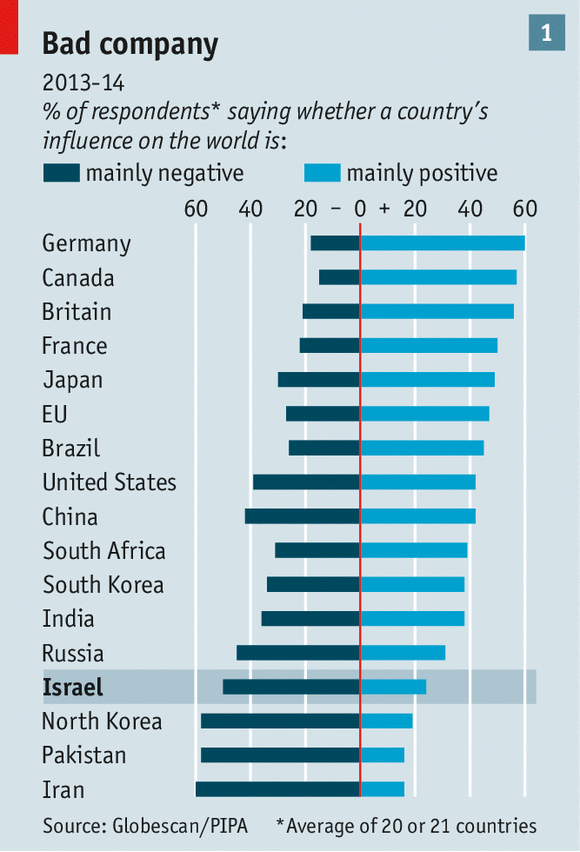
Israel and the world: Us and them | The Economist

Israel in World
Not encouraging:

Daphna Kaufman of Reut wonders whether Israel is also moving away from Europe. The secular and social-democratic leanings of Israel’s early decades dovetailed with western Europe’s. But the 1m migrants from the former Soviet Union, who arrived in the 1990s, have scant democratic tradition; many seek salvation in a strongman, a Jewish Putin, to rescue Israel from its enemies.

A similar number of national-religious Jews, heavily represented in government, see Israel as part of the divine plan for the Messiah’s coming, and worry that democracy might get in the way. More often now, Israel finds it easier to deal with non-democratic regimes, in the region or in the Asia-Pacific, where politics intrudes less on business. All of that bodes ill for co-operation with the country’s European critics and perhaps its American ones too.

Some hope that the common threat of a jihadist menace will yet induce Europe to treat Israel as its frontline bulwark and to overlook the plight of the Palestinians. “Ours is the fight of the free world,” says Mr Steinitz. But others see only greater divergence ahead. “Within 50 years, Europe’s lingua franca will be Arabic, and Britain will have a Muslim majority,” Moshe Feiglin, a hardline member of Mr Netanyahu’s party, Likud, tells a nodding audience in Bet Shemesh, a commuter town between Jerusalem and Tel Aviv. His listeners see a future in which Israel is increasingly forced to rely on its own devices—and its own might.

Haven’t seen any recent Canadian polling on attitudes with respect to Israel and Palestine.

Israel and the world: Us and them | The Economist.

Peacemaking through film and pastrami: Caplanskys signs on to sponsor Toronto Palestine Film Festival

Nice contrast with some of the ugliness in display during recent demonstrations supporting or opposing Israel’s actions in Gaza:

Caplansky’s desire to find common ground traces back to high school, when as president of York Mills Collegiate, he visited the home of the school’s vice-president, who was Palestinian.

“He had a map of Israel on the wall, and it said, ‘Palestine,’” he recalled. “I realized he has a different perspective, and we can still be friends.”

He said he made the decision several months ago to supply the film festival with one of his signature blue-and-white food trucks, emblazoned with the slogan, “Sometimes you just have to Jew it up.” “I’m not sure how well that’s going to go over,” he said, with a laugh.

On offer during the screening of Laila’s Birthday, a dark comedy by Palestinian director Rashid Masharawi, will be a selection of the Caplansky classics: smoked meat sandwiches; barbecue brisket; smoked meat poutine; maple beef bacon doughnuts.

“I hope they eat. I hope they enjoy,” Caplansky said. “I hope they understand that we’re in this together. This isn’t us and them. This is just us.”

Peacemaking through film and pastrami: Caplanskys signs on to sponsor Toronto Palestine Film Festival | Toronto Star.

I hate the hatred | Coren Toronto Sun

Michael Coren, whose writings I generally disagree with, nevertheless is worth reading in general for a different perspective, and particularly this piece on Israel and Gaza:

I hate the way some on the right and in Zionist circles refuse to listen to the Palestinian experience and believe Israel can do no wrong. I hate the way some evangelical Christians think the ghastly battle over Israel and Palestine is some sort of Biblical combat and modern Armageddon to be fought vicariously by Jews and Arabs. I hate the hatred.

I hate it when North African thugs in Paris attack synagogues in the name of Palestine, beat up Jews in the street and then scream about human rights. I hate it that kids from Pakistan will say not a word about their home country’s blasphemy laws and murder of Christians but roar their hatred of Israel when they probably couldn’t even find it on a map. I hate the hatred.

I hate the singling out of Israel for condemnation but the ignoring of the murderous regimes that surround it. I hate the fact that Iran can hang young gay men, Syria can murder tens of thousands and Turkey can occupy two countries and deny the Armenian genocide but there are no demonstrations. I hate the hatred.

I hate it that when supporters of Israel, like myself, argue that there has to be another way, that Palestine has to exist and that the settlements are wrong, we are mocked as compromisers – I actually wear that badge with pride. I hate it when the same people who welcomed Soviet diplomats, sportsmen and artists and now welcome diplomats, sportsmen and artists from repugnant Arab dictatorships, boycott Israeli kids who can kick a ball or play an instrument. I hate the hatred.

I don’t have a solution, I don’t even have much hope — and for someone who has spent so long in the Middle East, read so much, met so many people, listened to so many stories, I am I suppose a terrible disappointment. I’m obviously not as clever as those on both sides who know exactly how all of this can be settled. But I do know that I hate the damned hatred.

I hate the hatred | Coren | Columnists | Opinion | Toronto Sun.

How to Support Israel Without Being Racist/How to Criticize Israel Without Being Antisemitic

A practical guide to either supporting or opposing Israel in relation to Gaza and Palestinian issues, starting with supporters of Israel:

  1. Do go ahead and criticize Hamas.
  2. Don’t use racist or Islamophobic stereotypes or tropes.
  3. Don’t conflate Arabs, Palestinians, and Muslims as if they were interchangeable terms or groups.
  4. Don’t dehumanize Palestinians.
  5. Don’t erase their existence, history, or culture.
  6. Do engage Palestinians and their allies in conversation on the issues of Israel and of racism, rather than simply shutting them down for disagreeing.
  7. Do try to be sensitive to the fact that Palestinians are largely powerless, poverty-stricken, and violently oppressed, and that any “war” or negotiation between Israel and the Palestinians can in no possible way be construed as a meeting of equals.

For for Palestinian supporters:

  1. Do go ahead and criticize Israel.
  2. Don’t use anti-Semitic stereotypes or tropes.
  3. Don’t use overly expansive language that covers Jews as a whole and not just Israel.
  4. Don’t use lies to boost your claims.
  5. Do engage Jews in conversation on the issues of Israel and of anti-Semitism, rather than simply shutting them down for disagreeing.
  6. Do try to be sensitive to the fact that, fair or not, many people take verbal or violent revenge for the actions of Israelis on Diasporan Jews, and Diasporan Jews are understandably frightened and upset by this.

To these lists I would add:

  • protest outside Embassies and Consulates, not synagogues or mosques;
  • non-violent only.

Any other suggestions?

This Is Not Jewish How to Support Israel Without Being Racist.

This Is Not Jewish (How to Criticize Israel Without Being Anti-Semitic)