Reaction in Canada to Israel-Palestine war has me feeling spiritually homeless and disconnected

Thoughtful reflections, although it would appear that the activists on the Palestinian side have been engaging in more anti-Jewish community activities than vice-versa and her social media posts are more one-sided than this commentary:

The last few months have shown me that the Israel-Palestine war has changed what diversity, inclusion and respect for freedom of speech and religion means in Canada.

Whether these changes are permanent are yet to be determined. It is a sad waiting game and I wonder if my children will grow old in the Canada that is the only home they know.

Suffice to say, two things are true: Almost all Canadians have some opinion on this war, and almost all Canadians have zero control over what is happening in Gaza right now. The same applies to what happened in Israel on Oct. 7.

Where does that leave us? Are broken professional and personal relationships salvageable? Is there any way we can find our way back to one another? Is this the actual hill that professionalism and respect for religion will die on?

Everyone (including me) says this is not a Muslim and Jewish issue. My quivering voice is losing conviction, and here is why:

The social media campaigns are stronger than ever. The protests and public outcry (on both sides) around the atrocities in the Middle East are still making headlines (and they should). People continue to remain obsessed on what qualifies as hate speech conflating freedom of expression with the same. Furious onlookers continue to call for arrests at protests, conflating the right to demonstrate freely with targeted hatred toward a group of people.

People are angry and while they cannot control what is going on there, they are trying hard to control what is happening here. 

Jewish and Muslim businesses, places of worship and neighbourhoods are being targeted. Antisemitism and Islamophobia are rapidly on the rise. Those angry about the war are only targeting members of the Muslim and Jewish communities. That makes this a Muslim and Jewish issue in a morbidly tangible sense.

Our politicians have contributed to this religious divide. Put another way, even when they whisper about respecting religious values, their actions contradict them — loudly.

In the holy month of Ramadan, certain Canadian politicians have failed to offer customary Ramadan well wishes to Canadian Muslims. They have publicly solidified their anger toward Muslim communities. Conversely, other politicians say nothing to remind Jewish communities that they cannot and should not be targeted. They have left Jewish communities feeling painfully isolated.

The silence has incensed both sides, because these politicians care far more about their voter base and less about Canadians in general. A true failure as elected officials.

In my legal community, the divide is vicious and the criticism is relentless. The professional advocates on LinkedIn have spoken and in comparison to your average Canadians, they say they know best. They hold zero sympathy for anyone who disagrees with their view and I know with certainty that some relationships of many years are over — forever.

While I have no interest in debating the politics (to what end?), I would be the first to sit with my fellow Canadians to work toward a solution on how we continue forward with respect and professionalism. This has become imminent in my view. It our right as Canadians to continue to protest, to continue to advocate and to continue to support the causes that are nearest and dearest to us.

Let us also work to repair the damage to relationships preventing us from working together, learning together and respecting one another. Without a commitment from all sides to simply pause and forgive before saying something hateful here about what is happening there, the continued erosion of our Canadianness will continue.

We can protest and disagree, but not in a way that creates hate and division for any group in Canada. This present-day Canada has me feeling spiritually homeless and disconnected. If you are a leader of any kind, take a moment and ask yourself what steps you can take to cultivate safety in your home — if in fac fact, you still consider Canada to be your home.

Muneeza Sheikh is an employment lawyer.

Source: Reaction in Canada to Israel-Palestine war has me feeling spiritually homeless and disconnected
Irwin Cotler: Canada needs to fundamentally rethink its approach to the Israel-Palestine conflict

Missed opportunity in not addressing the blockage by the current Israeli government over many years and the need for political renewal on the Israeli side and reduced political influence by religious hardliners and extremists, although I agree on how the debate reflects poorly on parliamentarians:

The debate, amendment and passing of the NDP motion on Palestine on March 18 was a perfect representation of the current state of discourse on the Israeli-Palestinian conflict in Canada today: chaotic, toxic, reactive and polarized; grounded in disinformation and misrepresentations; and performative rather than productive.

From a procedural standpoint, the motion made a mockery of the parliamentary process. After hours of polarized debate, it was amended significantly. These amendments were presented with mere minutes to spare, leading to parliamentarians raising concerns about the lack of debate on the substantially changed motion. Notably, the amendments were initially tabled without any French translation, characterizing the chaotic and ad-hoc nature of the process.

The substance of the debate was similarly flawed. Members of Parliament speaking in favour of the motion consistently relied on statistics provided by the Gaza Health Ministry — an arm of Hamas, a listed terrorist group in Canada. Even the text of the motion itself relies on these flawed statistics. Sadly, this is emblematic of the preponderance of disinformation and misrepresentations in current Canadian discussions on Israel and the Palestinian territories.

The ultimate result — the adoption of a watered-down motion that served primarily to inflame sectarian tensions and incentivize the anti-democratic behaviours of a domestic mob — is representative of Canada’s unproductive, performative and harmful approach to this issue.

It is clear that Canada needs a new framework for the Israeli-Palestinian conflict — one that is coherent, principled, fact-based and characterized by long-term strategic thinking; one that promotes both coexistence in Canada and peace in the Middle East.

This new framework should encompass four dimensions: (1) it must be informed by, and anchored in, the global context; (2) it must contribute to a new regional reality; (3) it must centre on justice and accountability in Israel and the Palestinian territories; and (4) it must involve responsible leadership here at home.

The first dimension is necessary because the global context plays a substantial role in shaping the conflict and our perceptions of it. We are in the midst of a new global struggle between liberal democracies and authoritarian regimes that are seeking to undermine liberal democracies and dismantle the rules-based international order.

The new authoritarian “axis of evil” — led by Iran, Russia and China — is using the Israeli-Palestinian conflict as a powerful tool to further their destabilizing agenda. They are spreading Hamas propaganda and disinformation, co-opting international institutions, weaponizing international law and directly funding, arming and supporting Hamas and other terrorist groups.

This facilitates their efforts to weaken and divide liberal democracies, undermine international norms and distract the West from their ongoing crimes — including the Russian invasion of Ukraine, the Uyghur genocide in China and the horrific repression of Iranian women.

This authoritarian destabilization campaign is aided by pervasive, systemic, global antisemitism, which has been used by autocrats to further their repressive ends for centuries. Antisemitism is responsible for Israel being held to higher levels of scrutiny than any other country, and enables hatred of, and lies about, Israel to spread with unparalleled ease. Canada’s new policy framework on the Israeli-Palestinian conflict must both account for, and actively counter, these harmful global factors.

The second dimension is that discourse and policy on Israel and the Palestinian territories must both acknowledge and support the new regional reality in the Middle East. The Abraham Accords provide new opportunities for working towards peace. Canada should encourage these new and potential allies to play a key role in regional peace-building.

As part of this, Arab countries must take greater responsibility for supporting and aiding the Palestinian people, rather than simply criticizing Israel. They should provide funding, humanitarian aid and other forms of assistance to Gaza and the West Bank. Arab countries should also be held accountable for their cynical treatment of Palestinians within their own countries, keeping them stateless and dispossessed as a political tool against Israel.

Crucially, Canada must also work with its regional partners to counter the malign influence of Iran and its proxies — the greatest enemies of peace in the Middle East — which are currently instigating a multi-front war against Israel, an asymmetrical dynamic that is noticeably absent from Canadian discourse.

The third dimension is the most important: ensuring justice and accountability for actors on the ground in Israel and the Palestinian territories. The status quo — for international institutions, governments, the media, human rights organizations and grassroots activists — is to hold Israel to an inequitably high threshold of accountability, while allowing the Palestinian leadership to shirk accountability altogether.

While it is true that democracies can be expected to demonstrate greater adherence to international laws and norms, it is an inversion of justice to impose stringent accountability on the lesser rule-breaker, and minimal accountability on the greater rule-breaker. Basic principles of fundamental justice demand the precise opposite — graver crimes and more persistent rule-breaking must result in greater sanctions and more accountability.

In addition to being unjust, the status quo creates perverse incentive structures that facilitate a continuous cycle of hatred and violence. Although, like any other state, Israel must be held accountable for any violations of international law, it is demonized and attacked no matter what it does, which contributes to its threat perception and domestic support for leaders who are obstacles to peace.

Hamas is able to garner global sympathy no matter how abhorrent its crimes, thus enabling its continued criminality, which culminated in the heinous mass atrocities of Oct. 7. Furthermore, Hamas is incentivized to ensure maximum Palestinian casualties and suffering, because it knows that all the blame will be placed on Israel.

This informs and emboldens Hamas’s comprehensive strategy of using its own citizens as human shields, including by placing its headquarters, weapons arsenals and rocket launchers under hospitals, next to mosques and in schools.

To bring justice and accountability, Canada must dedicate vastly more resources and energy towards holding Hamas, other Palestinian terrorist groups and the Palestinian Authority accountable for their contraventions of international law, their role in the continuation and deepening of the conflict, and their repression of their own citizens.

For Hamas, this requires more than lip-service condemnations. It requires pressure to be put on its allies in Qatar, Iran, South Africa and elsewhere; the mobilization of international legal mechanisms to put Hamas, rather than Israel, in the docket of the accused; and combating the spread of Hamas propaganda and disinformation on social media and in the mainstream media.

For the Palestinian Authority, accountability means refusing to accept its continued corruption and refusing to ignore the fact that its leader is in the 19th year of his four-year term and frequently engages in antisemitic incitement and Holocaust denial.

Accountability means ensuring that terrorism is not incentivized through the PA’s infamous “pay-for-slay” program. Accountability means the media shining a light on how Hamas and the Palestinian Authority repress their own citizens. Accountability also means putting strict conditions on funding for organizations such as UNRWA, which was not only complicit in the Oct. 7 crimes against humanity, but has indoctrinated children with hate and helped to keep Palestinians stateless for decades.

The fourth and final dimension is that of responsible leadership here at home. Responsible leadership means actively combating hatred and incitement rather than merely condemning it. A simple way for policymakers, pundits, the media and activists alike to embody responsible leadership on this charged and complicated issue is by always “starting with the endpoint.”

Hopefully, Canadians broadly agree that the ideal endpoint is: (a) peaceful coexistence in Canada, characterized by lowering tensions, reducing hate and polarization, and bridging communities; and (b) peace in the Middle East, characterized by a two-state solution, with mutual acknowledgement of each other’s legitimacy — two democratic states for two peoples.

When making statements or taking policy actions, responsible leadership means stopping to consider whether those statements or actions will bring us closer to that endpoint, or move us further away from it. Divisive and polarizing motions, such as the NDP’s opposition motion, fail this test by creating greater rifts between Canadians and perpetuating the perverse incentives that feed the cycle of hatred and violence in the Middle East.

Source: Irwin Cotler: Canada needs to fundamentally rethink its approach to the Israel-Palestine conflict

Poilievre wades into Middle East conflict during speech to Montreal-area synagogue

More fulsome account of CPC leader Poilievre’s views on Israel, Palestine, Gaza/Hamas that let to the CP analysis of political fall-out with Canadian Muslims (‘We won’t forget’: How Muslims view Pierre Poilievre’s stance on Israel-Hamas war):

It can be one of the thorniest issues for Canadian politicians — highly divisive and filled with decades of fighting, with potential for political blowback from one side or the other.

While conflict has raged in the Middle East in recent months, federal Conservative Leader Pierre Poilievre has tended to focus on bread-and-butter domestic issues, such as inflation and the Liberal government’s carbon tax.

In the House of Commons, Poilievre has referred to Israel or Gaza only a handful of times.

However, during a speech at a Montreal-area synagogue last week, Poilievre provided one of the most comprehensive glimpses since becoming Conservative leader of his relationship with Israel, his views on the conflict in the Middle East and the history of the Jewish people.

His speech at Beth Israel Beth Aaron Congregation — an Orthodox synagogue in Côte Saint-Luc, Que. — also potentially foreshadows the approach a Poilievre government would take on issues such as the Middle East, which he described as a difficult question, and antisemitism.

Officials from Poilievre’s office have not yet responded to requests from CBC News for comment.

The synagogue is located in Liberal MP Anthony Housefather’s riding of Mount Royal. Housefather, a longtime Liberal who is Jewish, is currently reflecting on his future in the party after most of his fellow caucus members voted on March 18 in favour of a controversial but non-binding NDP motion to work toward the recognition of the State of Palestine as part of a negotiated two-state solution.

Conservatives, three Liberals, including Housefather, and independent MP Kevin Vuong voted against the motion.

Speech gets standing ovation

At the March 26 event at the Quebec synagogue, Poilievre was introduced as the “next prime minister of Canada.” A video of the event that was shot by a member of the audience, who allowed CBC News to view it, shows Poilievre’s 33-minute speech peppered by applause and standing ovations. Conservative MP Melissa Lantsman, the party’s deputy leader, later posted video of the speech to YouTube.

The event provided a showcase for Poilievre’s knowledge of Jewish religion and culture. He recounted the story of Purim, where the Jewish people refused to relinquish their religion, and sprinkled his speech with familiar expressions, referring to himself as “a simple goy from the Prairies.”

Poilievre recounted his hitchhiking trip to Israel in his youth and the impressions it left on him — such as participating in a Shabbat in Betar and hearing songs being sung in Hebrew.

“The Jewish people are the only people I know of who, in the same language, worship the same faith on the same land in the same country as they did 3,000 years ago. That is a true indigenous people,” Poilievre said to applause and cheers.

Israelis and Palestinians both maintain that they are indigenous to the area.

Poilievre talked about staying in a kibbutz near Ein Gedi, a historic site and nature reserve located near Masada and the Dead Sea — then standing in the Golan Heights in the north, watching missiles being fired from Lebanon.

“We literally witnessed with our own eyes Hezbollah lobbing missiles into northern Israel and the courageous IDF forces flying back into south Lebanon to retaliate against the attack,” he said.

The Canadian government does not recognize permanent Israeli control over the Golan Heights.

Poilievre said when he returned to Canada, he helped launch “a full-scale campaign to criminalize Hezbollah.”

Palestinians ‘a chess piece in an evil chess game’

As he has done in recent months, Poilievre blamed the Oct. 7 attacks in Israel on Iran, saying it has been occupying Gaza through its intermediary, Hamas, and wanted to prevent peace accords.

About 1,200 people were killed in the Hamas-led attacks on southern Israel and about 250 people were taken hostage, according to Israeli tallies. More than 32,000 Palestinians in Gaza have been killed during Israel’s military response since then, health officials in the territory say.

“It was the fear that discord would come to an end and that hope would take root that most terrified the regime in Iran,” Poilievre told the audience. “And so, they orchestrated the attack. The Hamas leaders travelled to Tehran. They got funding and weapons from Tehran and ultimately co-ordination.”

Duration 1:17Conservative Leader Pierre Poilievre, asked about civilian deaths in Gaza, said Israel has the right to defend itself and Hamas is ‘in violation of international law by using human shields.’

“I’m sorry, but I refuse to believe that rag-tag terrorists in Gaza were able to accumulate all of those weapons and all of that intelligence and co-ordination on their own,” the Conservative leader said to applause. “This was an outside job.”

Poilievre repeated his past call for Canada to ban Iran’s Islamic Revolutionary Guard Corps, saying it was responsible for the downing in 2020 of a Ukraine International Airlines plane that killed 55 Canadian citizens and 30 Canadian permanent residents.

“This group operates legally on Canadian territory,” he said. “It can recruit, co-ordinate, mobilize, fundraise legally on Canadian soil over three years after they murdered 55 of our citizens.”

Poilievre said his heart goes out to the families of dispossessed Palestinians, saying the “Palestinian people have been made by the Iranian regime and other dictators in the regime, in the region, into a chess piece in an evil chess game.”

“I understand why the political pressures are high, and I understand why our Muslim friends and neighbours are suffering and are legitimately speaking out for the suffering of their loved ones in Gaza and in the West Bank.”

Poilievre told the audience he says the same things in mosques as he does in synagogues: “I love meeting with the Muslim people. They are wonderful people. When the issue of Israel comes up, I say, ‘I’m going to be honest with you. I am a friend of the State of Israel, and I will be a friend of the State of Israel everywhere I go.'”

Poilievre wants UN relief agency to be defunded

Poilievre accused Prime Minister Justin Trudeau of delivering different messages to different groups for political gain.

“He sends one group into synagogues to say one thing, and then he sends another group of MPs into mosques to say precisely the opposite.”

Poilievre said he believes in a negotiated two-state solution, with Palestinians and Israel living in peace and harmony. He said a Conservative government would stand up for Israel’s right to defend itself and would reject any motions or resolutions at the United Nations that it believes unfairly target Israel.

The Canadian government should defund the United Nations Relief and Works Agency for Palestinian Refugees in the Near East (UNRWA) and ensure that “Canadian aid actually goes to the suffering Palestinian people and not to those promoting terrorism in UNRWA,” he said.

“We, as a rule, around the world, common-sense Conservatives under my leadership will be cutting back foreign aid to terrorist dictators and multinational bureaucracies and using the money to rebuild the Canadian Armed Forces.”

Poilievre pledged to “remove the bureaucracy and streamline the funding” for the federal government program that funds security infrastructure for places of worship and to “defund antisemitism.”

“We will go line by line through all the groups that get dollars from the federal government, and we will defund every single one of those that promote antisemitism in our country.”

Poilievre recalled a trip he made to Auschwitz, a concentration and extermination camp primarily for Jews that was run by Nazi Germany in Poland during the Second World War, and said it left him in tears. In April 2009, when he was parliamentary secretary to then-prime minister Stephen Harper, Poilievre attended the Conference Against Racism, Discrimination and Persecution in Geneva, and also visited Auschwitz and Birkenau to commemorate the victims of the Holocaust.

He praised the resilience of the Jewish people.

“I don’t know what the world will bring tomorrow. I don’t know, much less 100 years from now. But I do know this, that a thousand years from now, whatever is going on, on Fridays, as the sun goes down, there will be a Shabbat in Israel,” Poilievre said to a standing ovation. “Those songs will be sung. The Jewish people will go on.”

Source: Poilievre wades into Middle East conflict during speech to Montreal-area synagogue

Rahim Mohamed: National Muslim group demands MPs denounce Israel or face wrath

We shall see the extent the relevant priority that this issue has in 2025 in relation to other issues, and what percentage of Muslim voters decline to vote or vote NDP (CPC harder pro-Israel line). Seen some analysis of the Michigan results that the absolute number of uncommitted not out of line with traditional numbers.

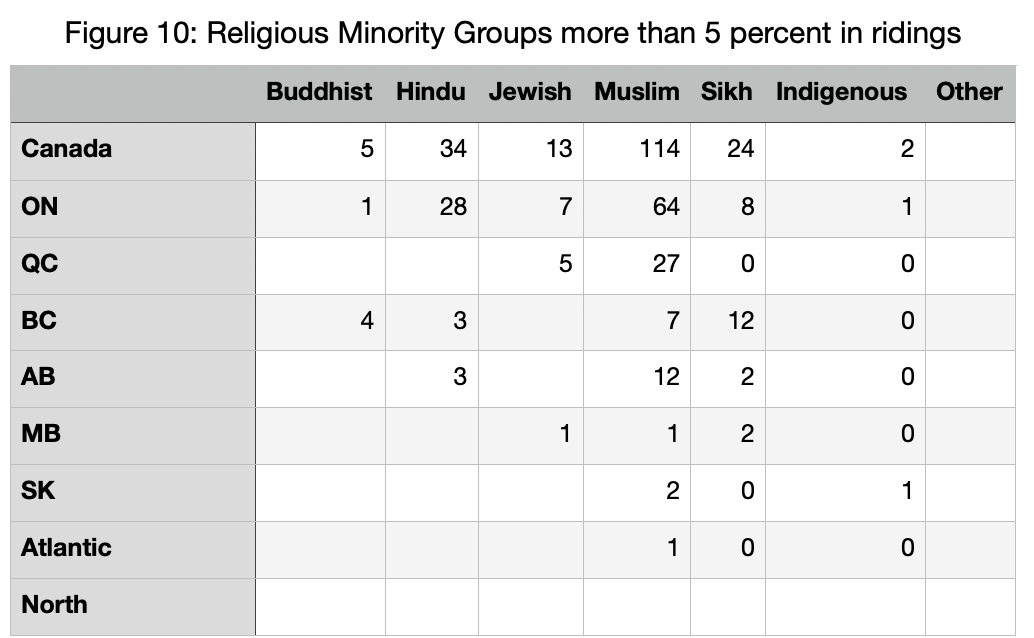
That being said, there are 114 ridings where Muslims form more than 5 percent of the electorate.

… Liberal party insiders were no doubt looking at the Michigan primary results with trepidation. The backlash among Muslim voters to the Stephen Harper government’s niqab ban for citizenship ceremonies and “barbaric cultural practices” hotline likely played a role in helping the Justin Trudeau-led Liberals secure a surprise majority in 2015. Since then, the party has made relations with the community a priority. Trudeau himself stages regular photo-ops at mosques, no doubt savouring every chance he gets to flex his sock game in a setting where shoes are prohibited.

But Trudeau, who appeared to be losing his touch with Muslim Canadians even before Oct. 7, now looks to be in freefall with the community. His multiple calls for a “sustainable ceasefire” in Gaza haven’t been enough to placate intransigent pro-Palestinian activists, who’ve even mobbed the prime minister in public settings. Trudeau has likewise found mosques to be less receptive to him than normal in recent months.

For now, Trudeau doesn’t appear to be too worried about the prospect of a Ramadan mosque ban. When asked on Thursday about the open letter, Trudeau said he’d visit any mosque that would extend him the invitation and gave no indication that he’d publicly commit to the terms enumerated in the statement. Yet Trudeau can’t be overjoyed about the prospect of having to keep his socks firmly in shoe during Islam’s holiest month, especially after seeing Biden’s humiliation in Michigan.

The results of Michigan’s just-held Democratic primary hint that the war in Gaza has triggered a rising tide among Muslim voters in the U.S. Whether electorally vulnerable members of Parliament cede to the demands of the NCCM and its affiliates or risk being shut out of mosques during a critical month for Muslim outreach could be an indication of just how strong the pull of this tide is in Canada.

Source: Rahim Mohamed: National Muslim group demands MPs denounce Israel or face wrath

Jesse Kline: Amira Elghawaby defends antisemitic protest in front of Toronto hospital

Not a great look:

…Not that the protesters themselves would ever admit this, as doing so would expose them to hate crime charges. The group Toronto4Palestine said that Mount Sinai “just happens to be along our regular rally route.” How were they supposed to know it’s the one hospital in that area with strong ties to the Jewish community?

It’s not hard to see through their thinly veiled excuses, but that hasn’t stopped their fellow travellers from putting on blinders and coming to their defence — including Elghawaby, Canada’s “special representative on combating Islamophobia.” Taking to the social media platform formally known as Twitter on Tuesday, Elghawaby noted that blocking the entrance to a public hospital was “troubling,” but also criticized “the rush to label protesters as antisemitic and/or terrorist sympathizers.”

Never mind that they deliberately targeted an institution with Jewish roots. Never mind that signs could clearly be seen portraying terrorists as freedom fighters. And never mind that they were loudly chanting, “Long live the intefadeh,” a reference to the two Palestinian uprisings, in which hundreds of Israeli civilians were killed in suicide bombings and other terrorist attacks, many of which were committed by Hamas, the perpetrator of the Oct. 7 massacre.

You’d think that someone whose job is to combat hatred would be the first to denounce a hate-filled rally such as this, even if it was antisemitism being espoused, rather than Islamophobia. But according to Elghawaby, such displays should only be condemned “if police determine any action was motivated by hate.” (Which is a little hard to do since we can’t read minds, and highlights the folly of creating a separate class of crimes that are dependant on the thought processes of the perpetrators.)

source: Jesse Kline: Amira Elghawaby defends antisemitic protest in front of Toronto hospital