Islam Makes Stronger Patriots, US Study – The Atlantic

American_Faith_GroupsWorth noting:

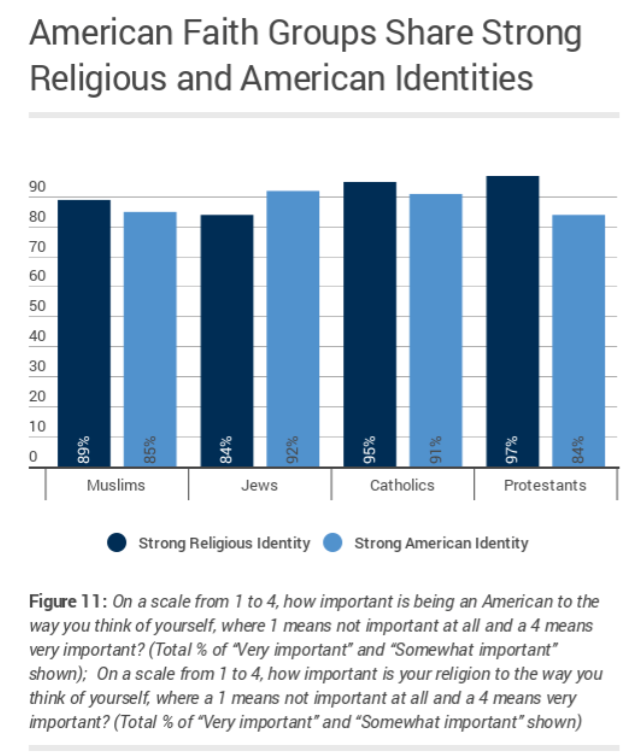
Donald Trump’s calls for a ban on Muslim immigration and the closing of American mosques seem to reflect suspicion that Islam and American citizenship are incompatible. But religion and patriotism are not opposing forces for American Muslims; in fact, they’re strongly correlated.

That’s one of the key findings of a first-of-its kind poll conducted by the Institute for Social Policy and Understanding, a non-profit focused on studying this section of the American population. The poll compares Muslims to American Jews, Protestants, and Catholics with respect to their levels of religiosity, patriotism, activism, and general outlook on the state of the country and on their lives. “In this election cycle, specifically, Muslims have been a topic of debate but seldom participants in that discussion,” said Dalia Mogahed, ISPU’s research director.

“We found that there was no correlation between mosque attendance and support of violence,” Mogahed said. On the contrary, she suggested, the results indicate that mosques are ideal places where community organizers might start engaging people because those who attend regularly “are more receptive to a message of civic engagement.”

“The research shows that mosques are actually a force for moderation. Muslims frequent a religious service as much as Protestants, and those who do go more frequently are not in any way more likely to condone violence,” Mogahed said. Muslims who said they attend services more frequently were more likely not to condone violence, with 65 percent saying “it is never justified,” compared to 45 percent of similarly devout Jews, 43 percent of Catholics, and 40 percent of Protestants.

The survey also found that American Muslims were more likely than members of other faith communities to reject attacks on civilians by the military, and as likely as any other group to also reject attacks on civilians by an individual or a small group, Mogahed said. They are “at least as likely as other faith communities to reject violence unequivocally,” she said.

Source: Islam Makes Stronger Patriots – The Atlantic

US election 2016: What does ‘Islam’ think of America? – BBC News

Useful summary of what some of the polling data indicates:

The Pew Research Centre, which surveys global attitudes, said anti-Americanism was strong around the word around the time of the US invasion of Iraq.

However, currently there is little evidence of profound anti-American sentiment except for in a handful of countries, it says.

Bruce Stokes, director of global economic attitudes at Pew, says sentiment towards the US varies widely between Muslim-majority countries.

“We tend to see more negative sentiment among Muslims in the Middle East, such as those from Egypt and Jordan,” he says.

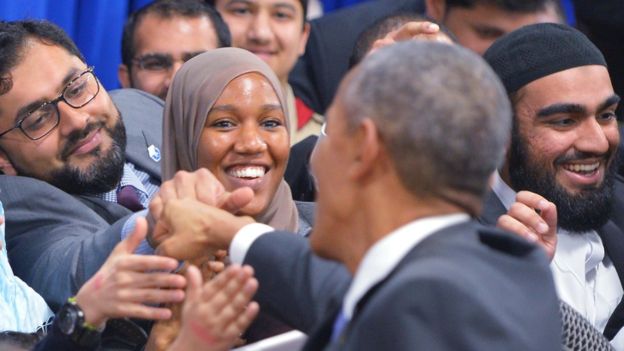
Barack Obama meeting American MuslimsImage copyrightGetty Image
“But Muslims outside the Middle East generally have a more positive outlook,” he adds.

In Indonesia, the world’s most populous Muslim country, 62% of people hold a favourable opinion of the US, Pew’s latest data suggests.

That figure rises to 80% in Senegal, a country which is over 90% Muslim. Mr Stokes points out that this is a stronger approval rate than Germany.

“Attitudes have also been changing over time. We’ve seen a gradual rise in positive sentiment since President Barack Obama came to power,” Mr Stokes says.

“Even in the Palestinian Territories, where sentiment is 70% unfavourable, that’s an improvement on 82% in Barack Obama’s first year.”

The BBC World Service commissioned its own poll of global attitudes in 24 countries in 2014.

Among other things, it asked respondents if they thought the US “had a mainly positive or mainly negative influence in the world”.

Pakistanis generally held the worst view of the US, with 61% saying the US had a negative influence.

But both China and Germany were not far behind, scoring 59% and 57% respectively.

Turkey, almost 98% Muslim, was split between 36% positive, 36% negative and 28% neutral.

Source: US election 2016: What does ‘Islam’ think of America? – BBC News

Douglas Todd: Divorce, Shariah and gold coins

 I always find Todd’s articles of interest and this one is no exception:

Lawyer Zahra Jenab often comes face to face with couples embroiled in acidic disputes over a small fortune in gold.The West Vancouver family lawyer, who was born in Iran and raised in Canada, works frequently with ex-partners wrangling over thousands of gold coins, which may or may not have been given by the husband in a dowry under Islamic Shariah law.

Canadian courts are increasingly being called upon to rule on religious laws of the Middle East and Asia. But they’re finding it tricky to distribute family property across nations and in an era when dowries contain symbolic promises of Qur’ans along with valuable coins.

Jenab has made her way through hundreds of trans-national divorces in which Canadian family law clashes with traditions from Iran, Egypt, Pakistan, East Africa and East Asia, and her desk is piled with yellow case files.

When separating immigrant women and men ask her why their divorces can’t follow the rules of their old country, Jenab has to tell them: “Because we’re in Canada, now.”

Estranged couples can be devastated when they discover the religious laws of their homelands don’t apply in Canada.

“My heart often breaks for the suffering couple,” Jenab said. “But the driving issue is Shariah property law.”

As trans-national divorce increasingly falls under the scrutiny of Canadian judges, the decisions they’re making about what Shariah says about the distribution of property are “all over the map,” Jenab said.

Unfortunately, an expert witness on Shariah has not emerged to guide Canada’s courts.

The focus of many trans-national divorces in Canada is the often-considerable dowry, sometimes known as a mahr or meher, which is customary in most countries containing the world’s 1.5 billion Muslims.

“The dowry is financial security for the female. It is the man’s promise to provide finances, often in gold. It can be claimed by her at any time.”

When discord tears apart the bonds of matrimony, as it often does in all cultures, conflicts over often-unwritten promises about dowries can become intense.

In some countries where Shariah is enshrined, Jenab says, men can be arrested for not providing the dowry when the wife demands it.

…Property rights are also often not equal in many Muslim countries, where males are favoured.

Trans-national divorces, as a result, are often complicated when spouses work, or hold property, in their country of origin. “That makes the fair division of property hard to enforce.”

Many of Jenab’s clients, women and men, end up wanting both the benefits of Canada’s relatively equal family law and the advantages of their traditional religious culture.

They’re often stunned or angry, she said, when they learn Canadian family law — including the ideal of parents sharing joint custody of children — doesn’t line up with their religious customs.

“It’s difficult to see families struggle as they move out of their marriages, especially the children,” Jenab said. “That’s why I try to talk everyone down from taking a scorched-earth approach.”

http://www.vancouversun.com/opinion/columnists/douglas+todd+clash+cultures+divorce+shariah+gold/11753275/story.html

Belgium, Christianity and Islam: In and around Brussels, the practice of Islam is outstripping Christianity | The Economist

Interesting article regarding religion in Belgium and the implications of greater religiosity among Muslims:

All that is part of the background to a study of religious attitudes among Francophone Belgians, conducted by the Observatory of Religion and Secularism, a helpful resource for the study of faith in Europe.  Respondents came in equal numbers from Wallonia, the country’s Gallic-oriented south, and the Francophone majority in Brussels.

The pollsters were surprised by how many respondents still professed some attachment to a religion. Among all respondents, 20% called themselves practising Catholics and 43% non-practising Catholics; 6% were practising Muslims and 1% non-practising Muslims. With other religions accounting for a few points each, that left 26% who called themselves atheist or agnostic. Jean-Philippe Schreiber, a professor of religous studies who co-commissioned the poll, said a remarkably high number of Belgians “claimed a religious identity” even if it did not affect their behaviour much. That certainly applied to loosely affiliated Catholics; and it might also be true that not every respondent who identified with Islam actually prayed and fasted as the rules lay down.

Then turn to Brussels, some parts of which host large communities of Moroccan and Turkish immigrants, mostly from religiously conservative regions of those countries. Among respondents in the city, practising Catholics amounted to 12% and non-practising ones to 28%. Some 19% were active Muslims and another 4% were of Muslim identity without practising the faith. The atheist/agnostic camp came to 30%.

Among all respondents, levels of active adherence to Catholicism seemed to diminish dramatically with age, while the practice of Islam increased correspondingly. Thus among respondents aged 55 and over, practising Catholics amounted to 30% and practising Muslims to less than 1%; but among those aged between 18 and 34, active adherence to Islam (14%) exceeded the practice of Catholicism (12%). Admittedly the sample (600 people in all) is small. But if this trend continues, practitioners of Islam may soon comfortably exceed devout Catholics not just in cosmopolitan Brussels, as is the case already, but across the whole of Belgium’s southern half.

The pollsters are struck by the fact that many Belgians retain a cultural loyalty to the Catholic faith. albeit a diminishing one. The percentage of avowedly “practising Catholics” far exceeds the numbers who actually turn up at mass, as any cleric will confirm. But one thing is pretty clear. If anything holds Belgium together through its third century of existence, Catholicism will not be the glue.

Source: Belgium, Christianity and Islam: In and around Brussels, the practice of Islam is outstripping Christianity | The Economist

‘We respect Islam and gay people’ …UK: The gay teacher transforming a Muslim school

Sharp contrast to some of those opposed to the new Ontario sex education curriculum and their fears that it undermined parent values, as well as a good example of school-parent relationships:

It took one complaint from a parent “as a Christian” to undo all Andrew Moffat’s work teaching children respect for people of different sexual orientation. A meeting of 40 parents followed with calls for an apology and the removal of books he had used in lessons.

Above all, the parents objected that he had told children he was gay. Moffat felt he could no longer continue and resigned. Far from retreating to a safe haven, however, he crossed Birmingham to take up an even greater challenge: assistant headteacher at Parkfield Community school, where 98.9% of pupils are from Muslim families.

The award-winning school is in the heart of a devout area where three inquiries have been held into the alleged “Trojan horse” plot by hardline Muslim governors to take over state schools, though Parkfield was not affected.

That was two years ago. With the backing of Hazel Pulley, the headteacher, Moffat went on to introduce a No Outsiders policy promoting diversity at the 770-pupil school, where 23 nationalities are represented. That includes welcoming people of any race, colour or religion and those who are lesbian, gay, bisexual or transgender.

A gay teacher teaching gay rights to pupils from a faith that believes homosexuality is a sin, punishable by death in some countries? It doesn’t seem possible and yet the school’s Muslim parents appear to have accepted that children can be taught about Britain’s anti-discrimination laws without undermining their religious beliefs. Learning from his unhappy experience at his previous school, Moffat has been careful to centre the policy around the Equality Act 2010, to first gain the support of the governing body, and to keep parents fully informed, inviting them in to see the books that would be used.

Now he has published a handbook about creating an ethos where everyone is welcome, regardless of differences: No Outsiders in Our School: Teaching the Equality Act in Primary Schools.

Moffat felt he had no alternative but to leave his previous school: “I knew I was letting down any pupil who might in years to come identify as LGBT and remember what had happened to me – if you ‘come out’ you risk a backlash and having to disappear. I was worried about that but in the end I decided that leaving was right for me and the school.

“It was a very difficult time and I was quite damaged by the experience. However, it gave me the opportunity to pick myself up and start again, learning from mistakes. There was no point in going to an area where it would be an easy task. I had to go where I might meet the same challenges in order to find a different way to meet them. I was determined to make LGBT equality a reality in any community. I could not afford to get it wrong a second time.”

Pulley says she appointed Moffat because she already knew of his work, in particular on improving pupil behaviour and on diversity. “I thought his approach was admirable. We already had similar work going on at school but we needed someone to lead it and give all the staff confidence,” she says.

It is possible to teach the law against discrimination in Britain without undermining any religious faith, she says: “Everyone knows we respect Islam here. One parent asked if he could not contradict what the school said. I told him that whatever parents said in the home was their decision but it’s lovely that the children will hear both views.”

The good relationship between governors, teachers and parents has helped, she says, and the fact parents have confidence in the school’s high standards – 97% of 11-year-olds reached or exceeded the expected standard for their age in both maths and English last year.

Last week parents, collecting their children before taking them to madrasas, the religious classes, spoke of their support. The school is “shedding light” on the minds of children, said one mother. Parents’ initial response had been “How dare they? How can the government make this law?” But their anger had abated once they learned more about the approach, they said.

“If they don’t learn about gay, lesbian and transgender people in society from school they will learn it from the outside world and they could hear things like ‘that’s disgusting’. I don’t want that,” said another. “I agree,” said a third. “I’d rather my children hear it at school. When they are at home we teach them that in our culture gay is not allowed but we respect people who are different from us and hope they too will respect us and the boundaries of our religion.”

The parent of a 10-year-old admitted her views differed from her husband’s: “My husband is a strict Muslim and my son asked him about the difference between what the school says and our religion. He did not give him a good reply. My reply was that God has created us and he is the only one who can judge us. I have told my son that it wouldn’t matter if he came home to me and said he was gay, you are my son and I will love you no matter what.”
Source: ‘We respect Islam and gay people’ … The gay teacher transforming a Muslim school | Education | The Guardian

Islam was a religion of love, and the Taj Mahal proves it – The Washington Post

 on the Islam of medieval times:

The Mughals are of course long gone now, and so is their world. It’s been done in by colonialism, sectarianism, a rush to modernization, and the great cultural distance that has opened up over centuries. But perhaps it’s worth revisiting, even a little bit.

I’m not rosy-eyed about that past. I certainly don’t think medieval monarchy is a model for the modern Muslim world, or any part of the world. These were kings and queens, who came to power through force. But that doesn’t mean they can’t speak to us.

The Mughals and Ottomans were more tolerant than many of their contemporary rivals. They were progressive for their time, and I don’t just mean compared to Muslims. These certainly weren’t secular democracies with any concept of human rights, but they also didn’t force their subjects to change religions.

They also cultivated a culture, rich and dynamic, that easily crossed boundaries, and that left us with world heritage. Instead of destroying the world’s heritage. And at the center of that philosophy was love. It was love that animated Rumi’s poetry; far from being some outlier in the Muslim world, he was a traditionally trained Sunni Muslim scholar, who communicated in unforgettable verse a worldview that most Muslims would have shared.

How else, after all, would you make sense of a God you cannot see, and a relationship that must be exclusive, except through love, which is, like God, invisible but nigh omnipotent, capable of moving men and mountains—no enemy ever unseated Shah Jahan’s empire in his time, but the loss of his love nearly broke the man. That idea of love was enough to animate a Muslim world that was tolerant enough to see Sunni and Shiite married, not mired in enmity.

There’s a reason South Asian Islam is so incredibly diverse and pluralistic—and that openness ran from everyday villagers who mingled across sect and religion all the way up to an emperor and empress, so deeply in love that their romance remains etched upon the face of the world. The interior of the building is adorned with Koranic verses, not only in a fervent wish to see the queen, and the husband who so honored her, sped by God to paradise.

But because love of one’s wife and love of one’s God were not just seen as complementary, but of the same kind; the former was the model for the latter. The Taj Mahal is of course many things to many people. For my beloved wife, it’s an unfair marker to hold a husband to. (I swear I would if I could.) It should also be a monument to Sunni and Shiite harmony, a reminder of a time when the core of the Muslim faith was love: Love of a person for himself, for his family, for his neighbors, for his Prophet, for his God. A time that shall come again. When Islam can be progressive for its time, when we will make the world beautiful, when we can be unapologetically Muslim and shamelessly besotted, because God is beautiful, as Muhammad said, and loves beauty.

Source: Islam was a religion of love, and the Taj Mahal proves it – The Washington Post

ICYMI: Woman wearing burka denied service in Edmonton shop because of ‘no-mask policy’

Will be interesting to see whether a complaint is filed and if so, how will it be handled:

The owner of a north Edmonton shoe repair store says the reason he refused to serve a woman wearing a burka was motivated by safety, not religious or cultural reasons.

“We have a no-mask policy in the store and I certainly cannot discuss any race, religion, politics on the (sales) floor,” said Ryan Vale, owner of Edmonton Shoe Repair in Northgate Centre mall.

The response comes in the wake of accusations from 19-year-old Sarii Ghalab who claimed Vale told her he could not serve her because it goes against his ethical beliefs.

“He blatantly told her not to touch anything in his store and that he will not offer her any service,” Ghalab’s sister wrote in a Reddit post while searching for online advice.

A burka is a traditional dress worn by some Muslim women that covers everything except the eyes.

Ghalab later told CBC News that she tried to deliver flowers to Vale along with a letter explaining the reasons she wears the burka. But she said he simply ushered her out of the store.

Vale said that isn’t the case.

“I certainly did not bring up the issue of race,” said Vale, pointing out a hand-written sign on his counter saying “Please, for security reasons no facial coverings Thank you” as well as another printout saying “For security reasons NO MASKED CUSTOMERS ALLOWED” with a silhouette of a head wearing a balaclava.

“That’s the way it’s always been. I know lots of businesses adhere to that business — strictly a no-mask, veiled mask, policy in the store; for white people, black people, dogs, anything. Please show who you are for safety,” Vale said.

Ghalab said she isn’t looking for retribution (though her sister posted she would file a human rights complaint) and the incident details remain he-said-she-said.

Source: Woman wearing burka denied service in Edmonton shop because of ‘no-mask policy’

Obama’s Mosque Visit: The President Criticizes Islamophobia and Jabs at Republicans – The Atlantic

Welcome contrast to some of the language current in the USA:

Obama’s comments were aimed at a triple audience. He placed greatest emphasis on making an impassioned case to the entire American population to accept Muslims, speaking in terms that were reminiscent of President George W. Bush’s famous post-9/11 “Islam is peace” remarks. Second, he spoke to American Muslims themselves, telling them they have a place in the country but also insisting they must help resist extremism. Finally, he spoke to Muslims around the world, calling for religious freedom and pluralism and saying the U.S. is not at war with Islam.

“Most Americans don’t necessarily know, or at least don’t know that they know, a Muslim personally. And as a result, many only hear about Muslims and Islam from the news after an act of terrorism, or in distorted media portrayals in TV or film, all of which gives this hugely distorted impression,” Obama said. “And since 9/11 but more recently since the attacks in Paris and San Bernardino, you’ve seen too often people conflating the horrific acts of terrorism with the beliefs of an entire faith. And of course, recently we’ve heard inexcusable political rhetoric about Muslim Americans that has no place in our country.”

In rebuke to politicians like Donald Trump, Obama presented Islam as an essential part of the nation’s heritage, going back to Muslim slaves brought to the British colonies and running through Thomas Jefferson’s Virginia Statute for Religious Freedom up to Fazlur Rahman Khan, who designed two of Chicago’s tallest skyscrapers. And he spoke emotionally about mail he received from Muslim American children and parents who felt persecuted and unsafe.

“We’re one American family. And when any part of our family starts to feel separate or second-class or targeted, it tears at the very fabric of our nation,” he said.

Obama’s visit comes at a time of particular tension for the American Muslim community. Advocates report an increasing number of Islamophobic incidents, which are mirrored in the Republican presidential race. Donald Trump endorsed the suggestion of a registry of Muslims in the U.S., and he suggested barring Muslims from entering the country—even citizens returning from abroad. Other candidates have suggested a link between refugees fleeing Syria and Iraq and terrorism. Although there was a spate of attacks and incidents against Muslims after 9/11, the support of President George W. Bush made them feel that those attacks were mostly from the fringe.

….Obama took pains to condemn Islamophobic rhetoric during his State of the Union address in January. “When politicians insult Muslims, whether abroad or our fellow citizens, when a mosque is vandalized, or a kid is called names, that doesn’t make us safer,” he said. “That’s not telling it like it is. It’s just wrong. It diminishes us in the eyes of the world. It makes it harder to achieve our goals. It betrays who we are as a country.”

On Wednesday he responded to critics—especially Republican contenders to replace him in the White House—who complain that he won’t label Islamic terrorism as such, saying demands to label by religion only play into extremist propaganda.

“I often hear it said that we need moral clarity in this fight. And the suggestion is somehow that if I would simply say, ‘These are all Islamic terrorists,’ then we would actually have solved the problem by now, apparently,” he said. “Let’s have some moral clarity: Groups like ISIS are desperate for legitimacy…. We must never give them that legitimacy. They’re not defending Islam. They’re not defending Muslims.”

Implicitly responding to tiresome calls for the “moderate Muslims” to speak out against terrorism, Obama said that they are speaking—but not enough people are listening. He vowed to work to amplify their voices.

But unlike in the past, when Obama has sometimes sought to question the Muslim bona fides of groups like ISIS, he acknowledged that the group draws its power in part from its interpretation of Islam—even if that interpretation is, as Obama said Wednesday, “perverted.” (That was a vast improvement on Secretary of State John Kerry’s baffling decision to label ISIS members “apostates” in comments Tuesday.)

Before speaking publicly, the president met with a group of Muslims: mostly young, foreign- and American-born, people born into Muslim families and converts, and from various ethnic backgrounds. Speaking specifically to young Muslims during his speech, Obama offered both reassurance that they belong in America, and a lecture on the importance of religious freedom. He said the government can’t deal with Muslim Americans simply through the lens of law enforcement, a nod to consistent complaints about intrusive policing and civil-liberties violations.

“You’re right where you belong. You’re part of America too. You’re not Muslim or American, you’re Muslim and American,” he told young Muslims. But Obama also warned them not to “respond to ignorance by embracing a worldview that suggests you must choose between your faith and your patriotism.”

Source: Obama’s Mosque Visit: The President Criticizes Islamophobia and Jabs at Republicans – The Atlantic

ICYMI: Islam isn’t inherently violent or peaceful

Good lengthy piece by Andrew Mack providing context and data regarding violent extremism:

The reality is that Islam—like Christianity, Judaism, Hinduism, and other major world religions—is neither inherently violent nor inherently peaceful. Like every other great religion, the history of Islam is darkened by periods of violent bloodletting. And the holy texts of all religions can be mined for quotes to legitimize terrorism—or indeed principled nonviolence.

Thus ISIS and other extreme Islamist radicals have no difficulty finding justification in medieval Islamic texts for their ultra-violent ideology and barbaric practices. But these extreme interpretations have minimal support among Muslims around the world and tell us nothing about the propensity for violence in mainstream Islam.

In October 2014, the first opinion polls on public attitudes toward ISIS were published in three Arab countries for the Fikra Forum. The findings were instructive. Just 3 percent of Egyptians held favorable views of ISIS. The figure for Saudi Arabia was 5 percent and for Lebanon less than 1 percent. A year later Pew Research found that just 1 percent of Lebanese held “favorable opinions” of ISIS, 3 percent in predominantly Sunni Jordan, and 1 percent in Israel. In the Palestinian territories the figure was 6 percent, but even here a massive 84 percent held unfavorable opinions of ISIS. Previous polls revealed very similar trends about Muslim opinions toward al-Qaida.

Discussions about the violence of contemporary Islam focus overwhelmingly on armed conflict and terrorism. But a more appropriate metric for determining the propensity for violence of a particular society, culture, or religion is the incidence of intentional homicide.

In almost all societies it is murder, not war, that accounts for the large majority of intentional killings. And perpetrating homicide, unlike embarking on wars or terror campaigns, does not require long preparation, intensive organization, a huge range of weaponry, complex logistics, political mobilization, intensive training, or a great deal of money—which is one reason why war and terrorism death tolls around the world are far smaller than the number of homicides. It is far more difficult to mount an armed campaign against a state than to kill an individual.

And even today, wars directly affect only a relatively small minority of countries. All countries suffer from homicides, however. In 2015, the Global Burden of Armed Violence published by the Geneva-based Small Arms Survey, found that between 2007 and 2012, for every individual killed in war or terror campaigns around the world, seven individuals were murdered. Worldwide, for most people, in most countries, most of the time, murder is a far greater threat to human security than organized political violence.

So if there really is an inherent—Islam-driven—propensity for deadly violence in Muslim societies, we should expect to find that the greater the percentage of Muslims in society, the greater would be the numbers of homicides. In fact, the reverse is the case: The higher the percentage of Muslims in a society, the lower the homicide rate.

In 2011, a major study by University of California, Berkeley, political scientist M. Steven Fish presented cross-national statistical data showing that between 1994 and 2007, annual homicide rates in the Muslim world averaged just 2.4 per 100,000 of the population. That was approximately a third of the rate for the non-Muslim world and less than the average rate in Europe. It is also approximately half the homicide rate in the United States.

In comparing individual countries, the difference is even greater. The latest homicide statistics from the U.N.’s Office on Drugs and Crime reveal that for every murder perpetrated in Indonesia, the world’s most populous Muslim state, seven people are murdered in the United States. This reality should give American Islamophobes pause.

It is possible in principle, as some critics have argued, that the lower murder rates in Muslim countries could be due not to a generally low propensity for homicide but to authoritarian governments whose harsh anti–violent crime policies are more effective in reducing the incidence of murder than those of democracies like the United States. But Fish’s careful statistical analyses controlled for this possibility and found no evidence to support it.

When it comes to war, Fish found no statistical evidence to support Samuel Huntington’s controversial “clash of civilizations” thesis that Muslim societies are inherently more war-prone than non-Muslim states.

Moreover, a lot depends on what type of war is being counted. A 2011 analysis by the Human Security Report looked at which states had fought most international wars—including colonial wars—since the end of World War II. The top four were France, Britain, Russia/Soviet Union, and the United States—in that order. No Muslim-majority country was in the top eight.

Yet another metric for determining the violence-proneness of countries is the “conflict year,” the number of armed conflicts—civil as well as international—that a country experiences in a calendar year. Some particularly conflict-prone countries—Burma is the prime example—have frequently found themselves fighting several different wars in a single calendar year for decades. Here the Human Security Reportfound that the countries that had experienced most “conflict years” since the World War II were—in this order—Burma, India, Ethiopia, the Philippines, Britain, France, Israel, and Vietnam. Again no Muslim-majority country was in the top eight.

Fish does not, however, claim that Muslim societies are less violent than those in the non-Muslim world with respect to all forms of deadly violence. Indeed, he points out that when it comes to terrorism, Islamist radicals were responsible for 70 percent of deaths from “high-casualty terrorist bombings” around the world between 1994 and 2008. This means, he suggests, that while terrorism is very far from being a uniquely Muslim phenomenon, “… its perpetrators in recent times are disproportionately Islamists.” Since 2010, the incidence of Islamist terrorism has increased sharply.

But in this context it is instructive to note that approximately 600 million of the world’s 1.8 billion Muslims live in Southeast Asia and China, while a little more than half that number—317 million—live in the Middle East and North Africa. Yet the rate of deadly political violence associated with radical Islamist groups in Southeast Asian and China today is only a tiny fraction of that of the less populous Muslim states of the Middle East and North Africa region.

Why should the level of political violence in the populations of these two regions differ so dramatically even though they share the same allegedly violence-prone religion? One possible answer is that religion is not the primary driver of conflict in these regions. In Southeast Asia, national governments in Muslim-majority countries have what political scientists call “performance legitimacy”—meaning they deliver the goods and services that their citizens want. With few exceptions, the governments of their co-religionists in the Middle East and North Africa do not.

In the radical Islamist conflicts that are tearing apart Syria, Iraq, and other parts of the region, the exclusionary politics, state repression, rights abuses, corruption, and incompetence of the regimes that the radicals have sought to overthrow provide more compelling insights into what drives the abhorrent violence of ISIS than does the extreme Islamist ideology that seeks to legitimize the killing.

Source: Islam isn’t inherently violent or peaceful.

Azeezah Kanji: Counterpoint: While on the topic of Muslims, here are a few other numbers to note

Kanji effectively rebuts Barbara Kay’s early piece stoking fear of Muslims (Barbara Kay : Most Muslims aren’t jihadists, of course. But some of them are), providing context to the numbers Kay uses and comparisons to attitudes within other religious groups:

In order to cast her net of suspicion beyond the small number of Muslims actually involved in violent activity, Kay cites data regarding the percentage of Muslims around the world who “hold beliefs in retrograde cultural practices that cannot co-exist in harmony with Western civilization.” These beliefs include a minority of Muslims’ endorsement for capital punishment for apostasy, adultery, and homosexuality: opinions which are certainly disturbing, and are vigorously opposed by Muslim activists in those countries. But the Pew study Kay relies on does not suggest that Muslims are trying to impose these beliefs in “the West” (on the contrary, available research indicates the opposite) — so on what basis is the threat to Western civilization construed?

Indeed, when it comes to attitudes deleterious to “harmony,” surveys suggest that Kay should be directing her gaze elsewhere. American Muslims are more likely to oppose attacks on civilians (which Barbara Kay defines as “terrorism”) than any other major religious group polled in the United States. And while Kay claims that “support for terrorism is high in Islamic countries” (where, according to Pew, support for such attacks ranges from 1 per cent to 40 per cent), a 2011 Gallup poll question on whether it is ever appropriate for a military to target civilians reveals it is proportionately far higher among Christian Americans (58 per cent) and Jewish Americans (52 per cent). Curiously, Kay references the numbers on Muslim support for “terrorism” but is silent on the non-Muslim statistics.

Kay’s tunnel-vision perspective leaves out more than half the picture. In addition to her selective use of statistics, Kay also makes unsubstantiated accusations about Muslims’ use of the legal system and “political/institutional membership” to advance some nefarious but unspecified agenda — recalling the fomentation of moral panics about other minority groups in other periods of history. Exaggerated narratives about the “disease of radical Islam” have been debunked by government dataacademic analyses, and expert commentary. The fact that they still have any purchase reveals the perturbing resistance of stereotypes to reality.

Source: Azeezah Kanji: Counterpoint: While on the topic of Muslims, here are a few other numbers to note | National Post