Terence Corcoran: Open our doors to the world
2015/09/12 3 Comments
 Terrence Corcoran advocates for unlimited immigration:
Canada has never settled on a guiding principle for its immigration policy. It has no moral touchstone to guide policy. If a country the size of Canada — small population, vast land mass, ingrained individual freedom, unbelievable economic potential — were to install a founding principle of immigration, a starting point for policy, it should be simple, clear and clean. “Canada,” it should say, “is a free country open to all who are willing to abide by its laws, regardless of race, creed, wealth, income, nationality, status or shoe size.” From this principle, it follows that immigration policy should be directed toward as free a border as possible, a border across which the world’s people can immigrate and emigrate at will.
Do not send me your whining and angry letters to the editor and tweets about how such a principle would open Canada’s doors to terrorists, criminals, freeloaders, welfare bums, health-care cheats, anti-Western religious and ethnic groups, low-lifes, genetically inferior races, job-destroyers, communists, fascists and bearers of strange cultural habits and beliefs that will destroy Canada as we know it, bringing more pollution, urban congestion, resource depletion, welfare loads.
Stop. Don’t. It has all been said and alleged before, over and over again, all through Canada’s sometimes impressive but rarely magnificent immigration history.
…So what are we afraid of? More importantly, what are we losing by continuing to freeze the flow of new Canadians at some artificial level that has no rationale beyond the expedience of simultaneously catering to all the various economic, cultural and ideological interests who have a multitude of arguments against increased immigration. Today’s policy clashes over Syrian and other Middle Eastern refugees are a function of a century-old immigration regime that pretends to be objective and is in fact based on prejudice, ignorance and fear.
Instead of fear, we need optimism. Irwin Studin, an assistant professor at the University of Toronto’s School of Public Policy and president of the Institute for 21st Century Questions, proposed five years ago that Canada should aim to raise its population to 100 million by the end of the 21st century. There is only one way to do that. In an interview, Prof. Studin said Canada would need to increase immigration levels by 50 per cent.
We need to install the idea that “Canada is a building proposition” in which, through immigration, there is a constant sense of growing toward a greater future. Studin sees Canada as a greater geo-political power and a much stronger economic performer. “The Canada of 100 million has a far larger national market and the attendant economies of scale and scope — for ideas, for debate, for books, for newspapers, for magazines … for all species of goods and services.”
Above all, Studin is rightly contemptuous of the idea that immigrants take jobs away from Canadians. People are jobs. Without people, capital cannot invest. When regions of Canada complain that there are no jobs for new immigrants, Studin’s response is: “There are no jobs because there are no people.”
Not only are there no jobs without more people, there is less growth and less wealth creation for everyone. Robert Fairholm, now an economist with The Centre for Spatial Economics in Toronto, forecast in 1997 that Canada was heading for a major period of slow and stagnant growth. Due to an aging population, slack immigration rates and declining rates of worker participation in the economy, Fairholm forecast that Canada’s annual growth rate would fall to 2.6 per cent in the first decade of this century, then to 1.6% per cent over the following decade, heading to 1.3 per cent by 2020.
Fairhholm’s 1997 forecast now looks to be dead right. All the investment capital in the world cannot overcome slow population growth and a lack of young working people starting their careers. Canada’s natural trends cannot, and will not, provide the working-age population needed to maintain strong economic growth rates. “That’s why it is useful to bring in people in their 20s and 30s,” Fairholm said in an interview. The existence of a growing working-age population “is a major determinant of how fast an economy will grow.”
To a significant degree, immigration policy — driven by incessant political pandering — is strangling the economy, suppressing growth and condemning Canadians to a slow growth future.
For more growth, in other words, add people, let immigrants land in an open country where all are free and the national aim is 100-million Canadians by 2199.
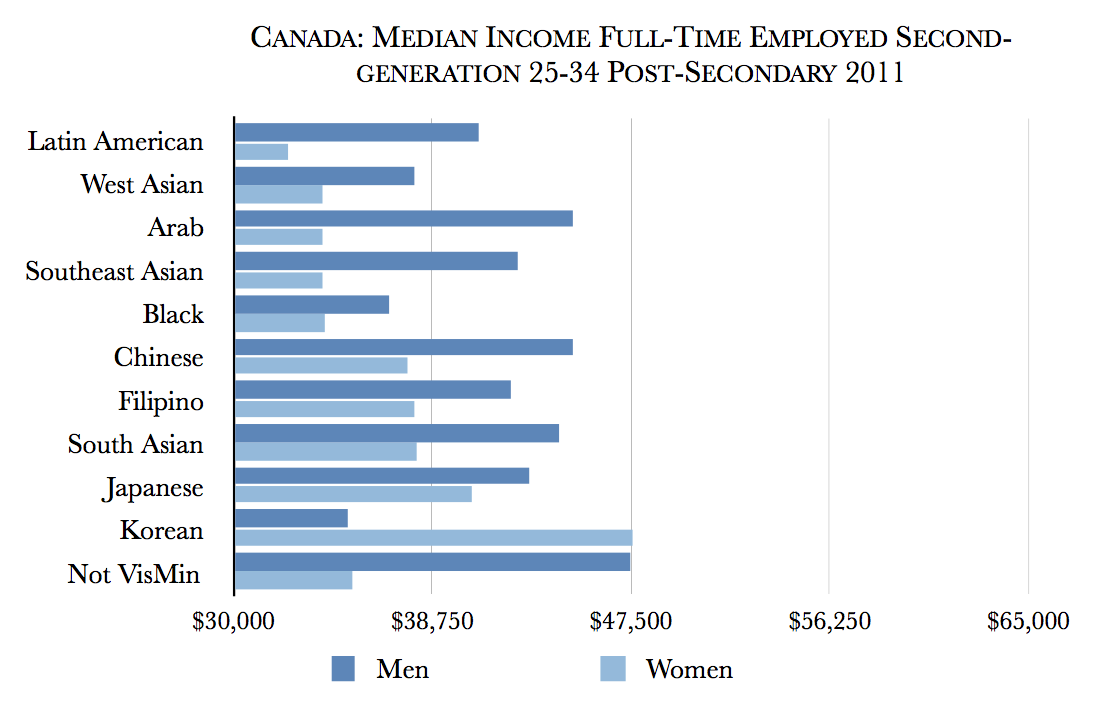
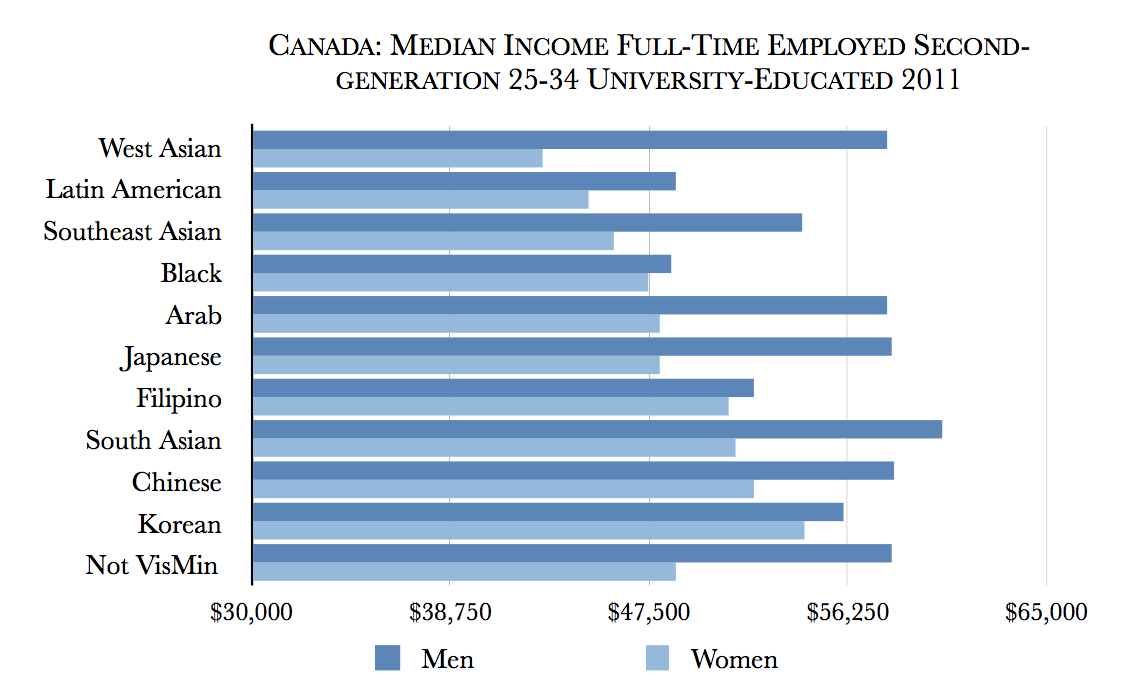
Substantively, silly to argue that Canada is large when the vast majority, despite some dispersion, settle in our major urban centres and that immigrant economic outcomes, including for second-generation, still lag behind non-visible minorities (save for the university-educated 25-34).

 Multicultural Meanderings