Acceptance rate for asylum seekers in Canada at a 27-year high

Nice to see this data driven analysis:

Canada is accepting a higher proportion of asylum seekers than it has at any time in nearly three decades, a CBC News investigation has found.

CBC obtained almost 90,000 asylum claim decisions made by the Immigration and Refugee Board of Canada between January 2013 and September 2017.

The decisions indicate where each asylum seeker comes from, why they said they had to flee their homeland and whether their bid to stay in Canada was successful.

Download the raw data and see CBC’s full analysis here

The acceptance rate increased significantly in the past five years, to 70 per cent in the first nine months of 2017, up from 44 per cent in 2013.

The last time acceptance rates were this high was in 1991.

When asked what’s behind the increase, IRB spokeswoman Melissa Anderson said each refugee claim is reviewed on its own merits and decided on the basis of the facts and evidence presented.

Many asylum seekers say they were forced to flee criminals or gangs.

Most immigration experts who spoke with CBC News agree an important factor was likely changes to the IRB system introduced at the end of 2012.

The result was that, in most cases, a claim had to be heard within 60 days of being accepted by the IRB. Before that, cases wouldn’t be heard for about 18 months, said Vancouver refugee lawyer Douglas Cannon.

Because lawyers had so much lead time, board members expected to see considerable evidence in order to approve a claim, he said.

But with the drastically shortened timelines, those expectations became unreasonable, he said, and board members had to make a call based on the evidence that could be gathered within two months.

Before the changes, for example, it may have been possible to get a police statement from Colombia documenting a reported assault, but likely not within 60 days.

Because refugee law requires board members to give the claimant the benefit of the doubt, acceptance rates went up, Cannon said.

“It’s not a judgment of the board lowering its expectations in order to render a positive. It’s a board doing the job that it needs to do in a much more efficient manner. And that is a good thing.”

Catherine Dauvergne, dean of the University of British Columbia’s Allard Law School, said it’s also possible a new training program for board members introduced in 2013 contributed to the bump in approvals.

The more comprehensive program gave board members a better understanding of all the factors that go into deciding a refugee claim and the obstacles the claimants face, she said.

Dauvergne said another factor could be an infusion of new board members replacing old ones who may have been suffering from “compassion fatigue.” A rule change in late 2012 scrapped the appointment system to allow any qualified federal civil servant the opportunity to apply for a spot with the IRB.

Reasons for fleeing

The data obtained by CBC also showed the top reason for seeking asylum was to flee criminals or gangs, but individuals who made such claims were among the least likely to be approved by the IRB.

One of the criteria for a successful refugee claim is to what degree a claimant fits the United Nations definition of a convention refugee: Having a well-founded fear of persecution for reasons of race, religion, nationality, political opinion or membership in a particular social group.

Those fleeing criminals or gangs often do not meet these criteria.

Political and religious refugees were the most likely to be accepted.

Source countries

Another key finding was that asylum seekers from China had the highest number of refugee claim decisions over the five-year period, but that number began dropping significantly in 2015.

The drop was attributable to two factors unique to that country: fewer claims from the Falun Gong spiritual group and the end of the one-child policy in 2016.

Decisions on claims from Hungary also dropped from almost 2,000 in 2013 to about 400 in the first nine months of 2017. This was due to substantially fewer claims from members of the Roma ethnic group.

Meanwhile, Nigeria surpassed China as the country with the most refugee claim decisions in Canada last year. Many of the claims from Nigerians relate to sexual orientation and gender persecution.

Claims from Turkey have also increased significantly, making that country Canada’s second-largest source of asylum seekers. These claims were mostly political in nature, or from members of the Kurdish ethnic group.
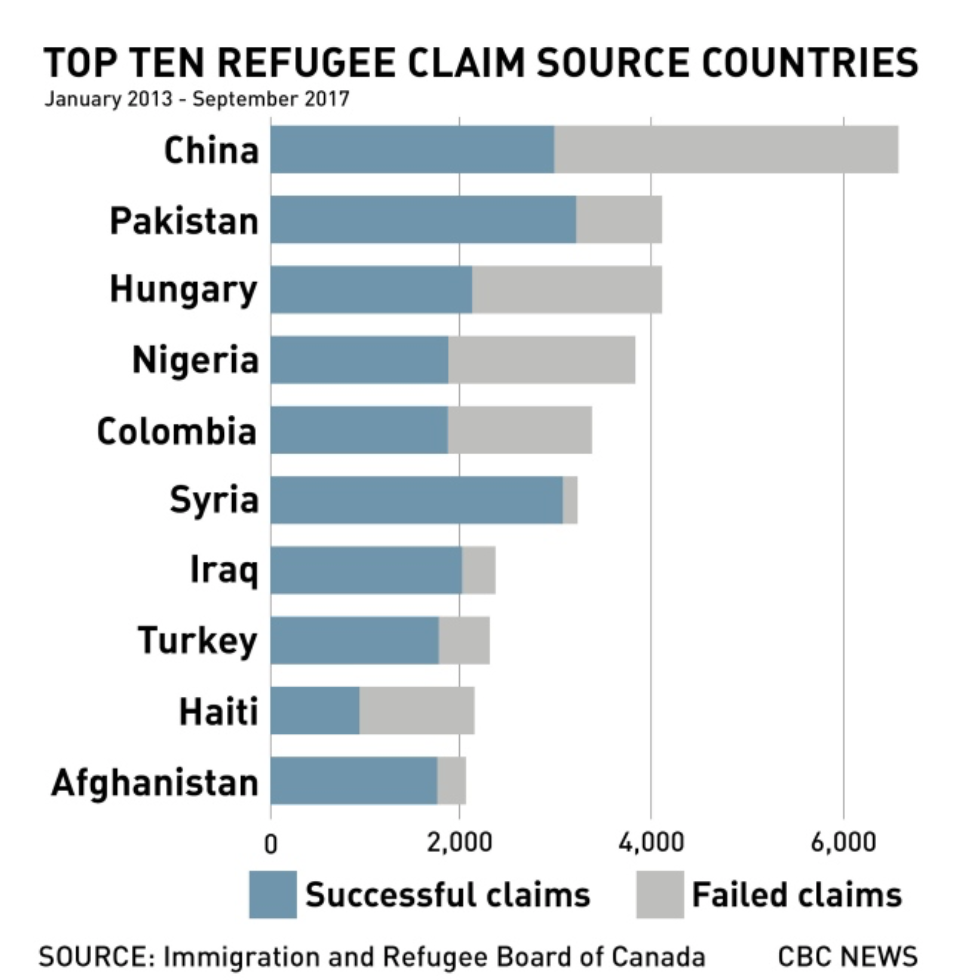
via Acceptance rate for asylum seekers in Canada at a 27-year high – Canada – CBC News

Decision-maker slammed as ‘moral police’ for refusing immigration to HIV-positive man | Toronto Star

Understandable Federal Court decision given the comments by the decision-maker on the “morality” rather than possible medical burden:

The Federal Court has slammed an immigration tribunal adjudicator for acting as “moral police” in denying an HIV-positive man permission to reunite with his daughters in Canada, blaming him for contracting the virus from an affair.

In chastising Michael Sterlin, the decision-maker at the immigration appeal division (IAD) tribunal, the court said that how the 62-year-old immigration applicant got HIV had nothing to do with the sponsorship case. To protect the man’s privacy, he was only randomly identified by court as A.B.

“The circumstances under which Mr. A.B. contracted HIV are wholly irrelevant to the issue before the IAD, as are any issues related to the applicant’s father’s moral character,” said Justice Shirzad Ahmed in a recent decision to send the case back to the tribunal for a new assessment.

“The IAD appears to make judgments against Mr. A.B.’s moral character, and in doing so, the IAD acts as moral police.”

In 2009, one of A.B.’s two daughters — who are both Canadian citizens living in Ottawa — applied to sponsor him and his wife to come to Canada under family reunification.

During the course of A.B.’s medical exam, a routine requirement in the immigration process, it was discovered that he is HIV-positive. In 2013, immigration officials informed the family that his health condition would cause “excessive demand” on Canadian health services and his sponsorship application would probably be denied.

Although the family was willing and able to cover the cost of A.B.’s anti-retroviral medications and requested humanitarian and compassionate relief, Immigration Canada refused the application in 2014. The family subsequently appealed to the tribunal.

Last year, the tribunal upheld the immigration decision, concluding that there were “insufficient humanitarian and compassionate considerations to grant special relief.”


A.B.’s two daughters had argued that they were the only children and had the responsibility to care for their parents, who would be ostracized in their native China and suffer discrimination and prejudice because of his HIV status.

“The reason why it is claimed the family will shun (the couple) is a perception that such patients have loose morals, in that a key way the virus is transmitted is by having sex,” Sterlin, the tribunal adjudicator, wrote in dismissing the family’s appeal.

“In fact, it turns out that the father did get the virus from having an affair. It is noteworthy, perhaps, that this did not come out until the panel directly asked the appellant why her father had the virus.

“If there is any antipathy, the panel finds, then it would most likely be against the father for risking a long-standing marriage by having an affair in his middle age or later,” continued Sterlin, who left the tribunal last June shortly after he rendered his decision on A.B.’s case.

“It is unfortunate that the father had an affair which led him to become HIV positive. However this was, again, a risk he took, which was unlikely but reasonably foreseeable, and it has unfortunately presented him with very significant problems.”

Wennie Lee, the family’s lawyer, said her clients were pleased that the court quashed the tribunal decision and ordered a new hearing into the request for humanitarian and compassionate relief.

“It is a significant court decision as it provides clear direction to the tribunal to truly apply compassion in deciding whether to exercise (the humanitarian and compassionate) relief,” she said.

“For my clients, in the Chinese culture, where personal and community connections are of paramount importance, social exclusion because of HIV status takes on added significance and importance.”

Lawyer Meagan Johnston for the HIV & AIDS Legal Clinic Ontario, one of two intervening parties in the court case, said people with the virus are a dominant group negatively affected by immigration’s “medical inadmissibility” policy that prevents them from immigrating.

In fact, immigration data shows 74 per cent of economic-class immigration applicants with HIV were found to be inadmissible to Canada in 2014 alone, she said, while 61 per cent of those with the virus were denied a work permit or study visa.

“It is repugnant that they are not given a fair chance and their HIV status and morality is used against them in their applications,” Johnston said. “That kind of attitudes against people with HIV is more common than what Canadians would like to admit.”

The immigration appeal tribunal declined to comment on the decision. Sterlin could not be reached for comment.

A spokesperson for the tribunal, which is part of the Immigration and Refugee Board, said the board does not have guidelines addressing cases involving person with HIV and AIDS specifically, but its procedures with respect to “vulnerable persons” speaks to the need to treat vulnerable individuals with “sensitivity and respect.”

via Decision-maker slammed as ‘moral police’ for refusing immigration to HIV-positive man | Toronto Star

Thousands of refugee claims from asylum seekers remain unprocessed: federal immigration officials

One of the few articles with more detailed numbers, showing the relatively small number of claims that have been processed to date compared to the number of asylum seeks (13,000):

Only 300 refugee claims filed by the thousands of asylum seekers flowing across the Canadian border in Quebec in recent months have been processed by the federal tribunal that decides who gets refugee status, officials told the House Immigration and Citizenship Committee on Tuesday.

Only half of those 300 asylum seekers have been granted refugee status, representatives from the federal Immigration and Refugee Board revealed in testimony to the committee.

The surge in asylum seekers crossing into Canada slowed in the first half of September; IRB officials told the committee that from Sept. 1-17 about 2,000 asylum claims were filed from those who illegally entered Canada, a drop from the more than 8,000 claims made in July and August.

Asylum seekers who illegally entered Canada have filed roughly 13,000 refugee claims this year, according to officials from the IRB, which is responsible for assessing the validity of refugee claims.

In response to a question about why it had only processed 300 of the claims so far, IRB spokesperson Anna Pape wrote in a written statement to The Hill Times that it was “based on the readiness of the claims to proceed to a hearing and our capacity to hear them.”

“Although the [Refugee Protection Division] makes every effort to be as efficient as possible in it’s scheduling it can sometimes be faced with cases that cannot proceed for reasons outside of its control,” Ms. Pape wrote, referring to the division of IRB tasked with handling the refugee claimants.

Many of the recent asylum seekers have crossed the southern Quebec border, leaving the United States to avoid a possible deportation from there to another country, including 1,928 Haitians this year, according to the IRB.

President Donald Trump announced an extension in May to the temporary protection status given to Haitian nationals in the U.S. after the island nation’s horrific 2010 earthquake, but only until January 2018.

A large number of refugees arriving in Quebec are also from Colombia and Burundi, while many were born in the United States, according to the IRB. Around 60 per cent of Quebec border crossers were male, and 20 per cent were children, with a sizeable number of families arriving together.

Source: Thousands of refugee claims from asylum seekers remain unprocessed: federal immigration officials – The Hill Times – The Hill Times

Refugee approval rates reflect subjectivity of decision-makers, prof says

Rehaag does good serious analysis, demonstrating the challenge of ensuring consistency among a diverse group of decision-makers. The replacement of political appointees by public servants appears to have reduced somewhat the previously wide variation among decision-makers:

The rate at which refugee claims are accepted by Canada’s Immigration and Refugee Board varies widely depending on who hears the case, according to a professor who obtained data from the federal government.

Sean Rehaag is an associate professor at Osgoode Hall Law School at York University in Toronto, who specializes in immigration and refugee law and human rights. Through an access to information request, he was able to obtain IRB decisions for refugee claims filed in 2016.

‘Some board members are just more likely to believe claimants than other board members.’ Sean Rehaag, university professor

He found a wide variability in acceptance rates, from as low as a quarter of cases heard to a high of 96 per cent.

“I do think that who we appoint as decision-makers really matters,” said Rehaag, specifying it is important to “appoint people who have a solid understanding of refugee law and who are not predisposed to denying claims.”

Rehaag’s work may provide insight into how the 7,000 asylum seekers who have crossed the border on foot at Roxham Road in Hemmingford, Que., will be handled over the next few months as they begin to appear in front of the IRB to test their refugee claims.

Some of that variability in deciding cases is due to the fact that different board members can specialize in different regions of the world.

“It makes perfect sense that if you are mostly hearing cases today from, let’s say, Syria, you are going to have a much higher grant rate than if you were mostly hearing cases from Western European countries, because Syria is much less safe,” said Rehaag.

But even when specializations are taken into account, said Rehaag, there’s still a lot of variation.

“My view is that the variation that remains reflects subjectivity in decision-making,” he said.

Variance to be expected, IRB says

In a statement, IRB spokesperson Line-Alice Guibert-Wolff said variance in acceptance rates from one member to another is to be expected.

“Members render decisions based on the evidence and argumentation presented (or not presented) and each refugee protection claim is unique, and must be determined on its individual merit,” she wrote, adding that there are many factors that impact a decision.

While consistency in its decision-making is the goal, Guibert-Wolff said that, in a quasi-judicial setting where each case is determined on its own merits, based on the evidence presented, consistency is not always possible.

However, the variance in acceptance rates is subject to a periodic review.

New system better than old one

The process for people seeking asylum in Canada changed in 2012, affecting how cases were heard and who heard them. Under the old system, decision-makers were political appointees, but under the reformed system, the decision-makers are public servants who are appointed instead.

As a result, Rehaag noticed a change in how many cases are accepted.

“There used to be decision-makers who denied every single case that they heard over several years. Those were political appointees and that no longer happens,” he said. “There is still subjectivity in decision-making, but it’s not as bad as it was before.

“To me, though, the biggest challenge that the Immigration and Refugee Board is facing right now is a resourcing question,” said Rehaag.

Procedural protections

One way to change the variation rate is to create procedural protections, similar to the criminal justice system.

For example, many asylum seekers are denied access to appeal, which Rehaag said would never happen in a criminal law context.

In 2016, 33 per cent of appeals were granted, a rate Rehaag characterizes as “remarkably high.”

Some claimants, especially those who came to Canada through the United States, are denied access to appeal and are ineligible for automatic stays of removal pending judicial review at the Federal Court.

That means once they’ve gotten a negative decision, they are forced to leave Canada quickly.

IRB spokesperson Guibert-Wolff said the majority of refugee claimants can appeal to the refugee appeal division, except if they fall under a few categories listed.

He said the government must properly fund the IRB so that there are not only enough decision-makers, but administrators, managers and support staff for the system to work smoothly.

Source: Refugee approval rates reflect subjectivity of decision-makers, prof says – Montreal – CBC News

Immigration tribunal to audit long-term detention practices

Needed:

The Immigration and Refugee Board (IRB) will conduct what it calls an independent audit of the long-term detention of non-citizens, after two court rulings in the past three weeks found detainees may be denied basic fairness.

The audit, to be completed this fall on a sample of cases from closed files, comes after Ontario Superior Court Justice Edward Morgan likened a refugee claimant’s treatment at the hands of adjudicators to that of Joseph K in Franz Kafka’s novel The Trial. The claimant was detained off and on for 17 months in a maximum-security provincial jail, even though he had done nothing wrong, the judge said in a ruling on Monday.

The IRB oversees the detention-review system, conducted by members of its Immigration Division – civil servants paid between $89,112 and $101,892, very few of whom are lawyers. More than 6,200 refugee claimants and permanent residents have been detained in fiscal year 2016-17, of whom more than 400 have been inside for more than 90 days. Reasons include being a danger to the public, of uncertain identity or a flight risk.

One of those, Ricardo Scotland, a 38-year-old single father from Barbados, went before Justice Morgan and was released on a writ of habeas corpus – a declaration that his detention was unlawful. He had been held as a flight risk and had been convicted of no crimes. At his last detention review before he asked Justice Morgan for his freedom, the Canadian government told the Immigration Division that it supported his release. But the adjudicator still refused to grant it.

Subodh Bharati, a lawyer who represented Mr. Scotland, said he welcomed the audit, but questioned how independent it would be. He said that, at a minimum, Immigration Division members need basic legal training on the principles of fundamental justice and the importance of procedural fairness.

“As Mr. Scotland’s case has clarified, there are fundamental problems that will require substantive change,” he said in an e-mail. “I hope that this audit is a starting point of more thorough overhaul which includes consultations with detainees and immigration lawyers.”

Audrey Macklin, a University of Toronto law professor, called the audit a positive and long overdue step by the IRB to initiate internal reform, after external pressure. “These [pressures] have variously exposed detention decisions as procedurally unfair, arbitrary, incompetent, unnecessary, and indifferent toward the value of liberty, the best interests of children and the needs of people with mental-health problems,” she said.

She said the audit should examine the qualifications, background and competence of Immigration Division adjudicators, “especially in relation to their capacity to understand, interpret and apply the relevant law.” It should also examine whether the adjudicators “genuinely apply the rule that the burden is on the state to justify ongoing detention, not on detainees to justify release.”

The announcement of the audit also follows a July 25 ruling by the Federal Court in Ottawa, in response to a constitutional challenge to the detention-review system brought by a Jamaican immigrant who had been in Canada since he was 8. As an adult, he amassed multiple criminal convictions and was detained for five years while Jamaica confirmed his nationality.

The Federal Court said the laws as written are not inherently flawed, but there may be shortcomings in how the Immigration Division applies them.

Justice Simon Fothergill set out several “minimum requirements” for the system, such as that the burden of showing why someone should be detained is always on the government, and that the adjudicator must always consider alternatives to detention. Also, the total time in detention should be “reasonable in all of the circumstances.”

The IRB said in a news release on Wednesday that “while recognizing that Immigration Division members make thousands of well-reasoned decisions each year, often in challenging circumstances, the gravity of these decisions – determining for example whether or not an individual will continue to be deprived of their liberty – requires the IRB to be proactive in identifying and pursuing opportunities for improvement.”

Source: Immigration tribunal to audit long-term detention practices – The Globe and Mail

Thousands of refugee cases suspended due to border agency delays

More on ongoing refugee determination delays, beyond IRB unfilled positions:

Despite law that requires all refugee hearings to be heard within 60 days once a claim is initially deemed eligible by an immigration officer, more and more asylum hearings like Ahmad’s have been suspended indefinitely because of delays at the Canada Border Services Agency in issuing clearances of what is known as front-end security screening.

According to the refugee board, only 46 per cent of asylum claims were heard within the statutory timeline in April, far below the 84 per cent mark two years ago.

Failures to observe the scheduling timelines are caused by delays in security clearances, operational limitations or unavailability of interpreters or counsel.

However, the proportion of hearing cancellations due to delays in obtaining a security clearance has ballooned from just 6 per cent two years ago to a peak of 55 per cent in December, meaning more than half of cancelled hearings were due to border officials’ inability to meet timelines for assessing if a claimant poses threats to Canada due to criminal or security concerns.

Although cancellations due to a pending security clearance were down to just 13 per cent in April, cases cancelled due to so-called operational limitations such as unavailability of refugee judges was up to 32 per cent from 8 per cent in 2015 and 13 per cent in 2016.

In the first four months of this year, 1,769 refugee hearings were cancelled because claimants’ security clearances were not ready. The border agency performed 12,997 security checks for refugees in 2015 and 19,449 last year.

“The (former) Conservative government has put in place a system with strict timelines without the resources to meet the timelines,” said Ahmad’s lawyer, Max Berger.

“Lots of claimants are devastated. They are psyched to tell their stories and have their date in (refugee) courts. The hidden cost is the delays in their family reunification.”

The refugee board said the border agency is responsible for informing it that security screening has been completed. The board doesn’t receive the actual security screening report but only a confirmation if a hearing can go ahead.

“Security screening is done to ensure that individuals who might pose a risk to Canada would not be granted protection and could not use the refugee determination process to gain admittance to Canada,” said Line-Alice Guibert-Wolff, a spokesperson for the board.

“In those cases where confirmation of security screening has not been received in time for the initially scheduled hearing, the (refugee board) will remove the hearing from the schedule and set a new date and time for the hearing as soon as feasible upon confirmation of the security screening.”

It is not known how long it takes to schedule a new hearing but claimants often are given a “target” date six months later.

“Front-end securing screening for an individual refugee claimant may take time depending on complexity or requirements for additional research,” said border agency spokesperson Patrizia Giolti.

“While there is no one specific factor that may impact the (security clearance) processing workload and timelines, 2016 has seen a significant increase over the previous year, in the number of asylum claims.”

The agency has started to give the refugee board two weeks’ notice if a screening is expected to be completed in time for a hearing and has brought in additional staff to work over the summer to perform security screening to address the backlog, said Giolti.

Calling the situation a “nightmare,” lawyer Raoul Boulakia said he has had a case where a refugee judge felt there was compelling reasons to grant asylum to a persecuted Afghan journalist and was ready to proceed with a hearing. However, the case was held up without a completed security clearance.

Recently, the refugee board has introduced a “50/50” policy by postponing 50 per cent of all new asylum cases to deal what’s known as legacy cases, which were put on the back-burner after December 2012, when the then Tory government overhauled the system to impose the statutory timeline to expedite the processing of refugee claims.

By delaying the hearings without injecting more resources, Boulakia said the problem is simply snowballing and gets worse down the road.

Source: Thousands of refugee cases suspended due to border agency delays | Toronto Star

‘Impossible to close the gap’: Immigration board boss says more resources needed to process legacy refugees – Canada – CBC News

More on IRB problems – Dion is polite in not flagging the number of adjudicator issue (see Globe editorial: The Trudeau government is failing refugee claimants, and Canadians):

Faced with a swelling backlog and a promise to resolve five-year-old asylum claims, the chair of the Immigration and Refugee Board of Canada admits he needs more funding and more people.

Mario Dion insists the IRB has become more efficient in dealing with cases, but it’s not enough.

“I am afraid the way things are at this point we will need additional resources … because there is a limit to how much you can stretch one person’s time,” Dion said in an interview with CBC News.

He said it’s “essentially impossible to close the gap using existing resources.”

Immigration Minister Ahmed Hussen recently announced a review of the asylum system, but he’s offered no guarantee of additional funding.

The bulk of the backlog is made up of Canada’s so-called legacy refugees.

They are a group of about 5,500 people who have yet to have their asylum claims heard. That’s because they arrived in Canada in 2012, just before the federal government passed a law that requires new refugee clams to be heard within 60 days. Since the IRB had to comply with the law, it put thousands of existing files to the side — where they’ve stayed ever since.

Source: ‘Impossible to close the gap’: Immigration board boss says more resources needed to process legacy refugees – Canada – CBC News

Globe editorial: The Trudeau government is failing refugee claimants, and Canadians

Valid points – backlogs will only increase, requiring more funding and personnel to handle.

Hard to understand why IRB appointments are taking so long – after all, the government has been able to appoint almost 100 judges over the past year and a half (after a slow start):

Our neighbour to the south has taken a pronounced nativist turn in recent months, and the government of Canada’s response has been to throw the doors open – rhetorically, at least.

Last January, Prime Minister Justin Trudeau took to social media and proclaimed, “To those fleeing persecution, terror & war, Canadians will welcome you, regardless of your faith. Diversity is our strength #WelcomeToCanada.”

As political marketing goes, it was nicely timed. But to be completely insulated from truth-in-advertising complaints, it should have included a disclaimer – “Offer available only to genuine refugees, as defined by law. As we are experiencing an unusually high number of claimants at this time, it could take many years for our government to decide whether you are legally entitled to welcome, or removal.”

According to the latest federal statistics, more than 14,000 people have registered their intention to seek asylum in Canada through the first five months of 2017.

That number doesn’t include refugees from Syria, who are being fast-tracked, and it adds upon the 23,900 who arrived in 2016 – itself a sharp increase from the 16,000 who came in 2015.

Last month, the federal government offered a modicum of good news to 5,500 people whose claims had been shunted to the back burner by the former Conservative government. Most have been waiting in limbo since at least 2012; their cases are expected to proceed in the fall.

Unfortunately, this will barely dent the application backlog, which is estimated at close to 40,000 cases.

The wait faced by refugee claimants – legitimate or otherwise – is too lengthy, and also unfair. It is well known that the longer an application is delayed, the lower the chance of it being accepted.

Meanwhile, the influx of asylum-seekers is unlikely to abate. There’s been a surge in the number of claimants showing up at Canada-U.S. border crossings since President Donald Trump took office in January, but even that is not the whole story.

The United Nations’ Refugee Agency calculates there are more displaced people on the planet right now – 65 million – than at any point since the Second World War.

A government analysis obtained by the Canadian Press forecasts the number of refugee claimants in Canada will hit 36,000 this year, and rise by as much as 20 per cent a year after that.

If the current trends hold, the time required to process an application will reach 11 years in 2021, and could cost $3-billion in social support payments. This must not be allowed to happen.

Hiring more staff and expanding budgets are an unavoidable aspect of correcting the situation, but it isn’t a matter of applying a simple fix.

The new federal appointments process announced earlier this year, billed as independent and competence-based, has been a disaster for the Immigration and Refugee Board. Dozens of key jobs remain vacant, while the number of claims is rising rapidly.

On June 21, the IRB announced its Western Canada immigration appeal division – which deals primarily with applications involving family members and dependents abroad – would be working at reduced capacity “for at least the next six months” because of staffing shortages.

The re-appointment of two outgoing members to one-year terms, announced that same day, won’t do much to ease the bottleneck. There should be 11 on the job, but there are currently only four.

Across all regions, the IRB’s refugee and immigration appeals divisions have a shortage of at least 29 members, and the terms of another 29 are set to expire at the end of this year, according to one news report.

The vacancies, and the slowness with which the Trudeau government is filling them, have led to accusations that Ottawa is culling IRB members who were appointed by the Conservatives in order to replace them with Liberal supporters.

Whatever the reasons, the IRB is unable to handle the load because Ottawa is allowing members’ terms to end while failing to appoint new people in a timely fashion.

Immigration Minister Ahmed Hussen recently announced a third-party review to examine resource levels and the various bureaucratic mechanisms involved. However, it won’t be concluded until next year, and that’s not good enough.

The IRB has raised the alert about under-staffing for years. An overwhelmed immigration and refugee process, already buffeted by an ill-advised overhaul under the Harper government, has real-world impacts. It’s bad for asylum seekers, and undermines public confidence.

Ottawa must move quickly to show Canadians that their government is doing more than drifting in its response. Tweeting “#WelcomeToCanada” is an empty gesture by the Prime Minister, if it’s not accompanied by action.

Source: Globe editorial: The Trudeau government is failing refugee claimants, and Canadians – The Globe and Mail

Refugee board set to finally hear ‘legacy’ asylum claims

To note – these kinds of backlogs should not happen:

The Immigration and Refugee Board is finally taking action to process asylum claims languishing in the system under pre-2012 rules, some of which have been waiting to be heard for more than six years.

There are about 5,500 so-called “legacy” claims filed before December 15, 2012, when the former Conservative government overhauled the asylum system by introducing statutory timelines to hear new claims and expedite removals of failed claimants — leaving the old cases on the back burner.

All legacy claimants are being asked to immediately contact the board and make any needed updates to their applications, so the board can start scheduling their hearings for September. Those who are ready have been asked to fill out an “intention to proceed form” online.

“We understand how difficult it is for the people to have been waiting for a minimum of four years in the legacy backlog,” said Mario Dion, chair of the refugee board. “Their lives and well-being are at stake and we are committed to start scheduling these cases as soon as possible.”

This spring the board launched a legacy task force and dedicated $3 million yearly to address the legacy backlog by hiring more than 20 retired refugee judges to focus on these drawn-out cases, the majority of them filed in 2011 and 2012. It also released a YouTube video to advertise the effort.

Although most post-2012 claims are generally heard by adjudicators within 60 days, the board is facing tremendous pressure at its refugee protection tribunal with a backlog of pending asylum claims that is expected to exceed 37,000 by the end of the year, partially due to the surge in claims at border entry points from the United States since President Donald Trump was elected.

For years, the Canadian Council for Refugees and the Canadian Association of Refugee Lawyers have called on the federal government to introduce some form of amnesty to legacy claimants to allow them to move on with their lives, but the plea has been ignored.

They said the longer people wait for a refugee hearing, the less chance they have of being accepted as refugees as memories fade and country conditions change with the processing delay.

“Fairness requires that we give them the opportunity to regularize their status in Canada without delay,” said Loly Rico, chair of the refugee council.

Source: Refugee board set to finally hear ‘legacy’ asylum claims | Toronto Star

Asylum claim wait times could hit over 11 years: federal analysis

Appears problem will likely get worse before it gets better (current number of IRB vacancies is 39):

An increase in asylum claims in Canada could eventually mean a staggering 11-year wait for a hearing and $2.97 billion in federal social supports for claimants in the meantime, an internal government analysis has concluded.

The Immigration and Refugee Board is already trying to whittle down its current backlog, but received no new money in the latest federal budget.

With 2017 application numbers expected to far exceed earlier projections, the board simply can’t keep up, says the memo, obtained by The Canadian Press under the Access to Information Act.

The Immigration Department memorandum was drawn up this spring amid a flood of people illegally crossing into Canada from the U.S. to claim asylum, dominating headlines and raising pointed House of Commons questions about the integrity of Canada’s borders and immigration system.

The department was asked to explore estimated backlogs at the Immigration and Refugee Board and the associated wait times under different scenarios, following a meeting about the U.S. border-crosser issue in March.

Since January, at least 2,700 people have been intercepted by the RCMP between legal border points; most went on to file claims. The memo does not directly address the impact of the border crossers, though certain sections were redacted.

But those numbers are only part of the mix.

Asylum claims have been steadily rising since 2015; that year, there were 16,115, and in 2016 there were 23,895. As of April this year, the last month for which data is publicly available, there were already 12,040 claims in the system.

The memo projects that claim levels will hit 36,000 this year and could continue to increase after that.

“This scenario best reflects current concerns around increased volumes of claimants observed to date in 2017, and takes into account overall increases in asylum intake from 2015 to 2016,” it says.

The memo goes on to say that by the end of 2021, the new system inventory would grow to approximately 192,700 claims, equivalent to 133 months’ worth of output from the board, or a wait time of approximately 11 years.

The social support costs for claimants were $600 a month each in 2016-17, the memo said. At that claim volume, those costs could climb to $2.97 billion from 2017 through 2021.

The other two scenarios examined were what would happen if intake for 2017 remained at the originally projected number of 28,000 claims, or what would happen if there was 36,000 claims with no growth after that.

In the first scenario, wait times would be between four to five years; in the second, around six years.

The IRB has been sounding the alarm for months over its ability to keep pace with the rising numbers.

They cite a number of factors, including dozens of vacancies for decision-maker positions and also a legislative regime that requires hearings to be scheduled within certain timelines.

A backlog has arisen, the note explains, because hearings need to be scheduled as soon as the claims are filed, and the board simply can’t keep up with the pace.

The time required to actually make a decision on the claims has remained relatively stable at about five months; the challenge is getting them heard in the first place.

The board has tried to deal with the backlog on its own by, among other things, redeploying half its capacity to address backlogged claims. Repeated pleas for more money, however, have only been met by the immigration minister’s insistence that the board find ways to be more efficient.

That might not be enough, says the analysis.

“The rate of backlog growth presented in these scenarios could be mitigated in part by these efficiencies, but not avoided altogether,” the note said.

Last Friday, Immigration Minister Ahmed Hussen announced a wide-ranging review of the IRB, bringing in a former deputy minister in the department to study the system and report back by the summer of 2018.

“Canada’s asylum system must strike a balance between providing protection to those fleeing persecution and ensuring that the system is not misused by those who do not need Canada’s protection,” he said.

A budget for the program has not been established, but a spokesperson for the department said it will be paid for by them and the IRB.

Source: Asylum claim wait times could hit over 11 years: federal analysis – The Globe and Mail