Trump immigration policy sparks anxiety among Canadians studying in U.S.

No surprise:

Questions over whether thousands of international students could be deported from the U.S. under a new Trump administration policy are causing consternation among school officials and anxiety among Canadians studying south of the border.

The policy — which triggered a lawsuit from Harvard University and the Massachusetts Institute of Technology (MIT) on Wednesday — stipulates that international students who take a fully virtual course this fall will not be allowed to remain in the country.

Under the new guidelines, international students would still be able to take more online courses than normal, but will have their visa rescinded if they attempt to take a fully online course load.

According to a statement released by the U.S. Immigration and Customs Enforcement agency on Monday, international students will only be able to remain in the country if they are taking a mix of in-person and virtual classes.

While Canadians do not need a visa to study in the U.S., they are still required to produce a similar form, known as an I-20, signed by the school they are attending. That school will now need to offer hybrid courses in order for Canadian students to stay in the country.

Sarah Klassen, an accounting student at Wichita State University, said her school has not yet determined how it will deal with the policy.

But Klassen, 19, notes that being forced to leave the U.S. would likely be a death blow for her studies, as she relies on a bowling scholarship to pay her tuition.

“I’m scared even going down (to the border) now that I might not be able to get back in. There’s so many strict guidelines,” Klassen said over the phone from her family home in Niagara-on-the-Lake, Ont.

Yvonne Kang, who is earning her law degree at the University of Connecticut, said being forced to move back home to Toronto would involve breaking a newly signed lease on an apartment and cost her thousands of dollars in unnecessary expenses.

Kang, 23, said says she doesn’t understand why ICE is targeting international students when they are such a major contributor to the American economy.

“We pay American landlords, we go grocery shopping in American stores, they charge international students double the tuition (of domestic students),” she said.

The Institute for International Education puts the number at roughly $45 billion in 2018, with more than $1.1 billion of that coming from Canadians. A report from the institute estimated there were 26,170 Canadians studying in the U.S. in 2018-2019.

The new guidelines have provoked backlash from universities across the U.S., with Harvard president Lawrence Bacow saying the order’s “cruelty” is surpassed only by its “recklessness.”

“It appears that it was designed purposefully to place pressure on colleges and universities to open their on-campus classrooms for in-person instruction this fall, without regard to concerns for the health and safety of students, instructors, and others,” Bacow said.

“This comes at a time when the United States has been setting daily records for the number of new (COVID-19) infections, with more than 300,000 new cases reported since July 1.”

Edward Alden, a senior fellow with the Council on Foreign Relations, a New York-based think tank, said the new policy creates an “onerous” task for students and institutions to undertake.

“Most schools are still trying to figure out what their mix (between online and in-person classes) is going to be,” Alden said.

“Now they’re going to have to scrape together a new program and reissue I-20s — and make it all happen in under a month.”

ICE is enacting the policy through a program that was introduced after 9/11 to handle the screening and verification of international students.

The program designates whether an individual qualifies for the F, M or J-class visas that are required to enter and reside in the U.S. as a student.

Normally, guidelines forbid international students from taking more than one course online per semester, but that restriction was relaxed when the COVID-19 pandemic caused a global lockdown in March.

International students who were outside of the country when the pandemic began and continue to take online courses from abroad will not have their status affected, nor will their visa be rescinded, according to documents from ICE.

But students who are currently living in the U.S. and whose schools are going fully online next semester will have only two options: leave the country or transfer to a different school.

The news from ICE, released on the same day Harvard announced that all of its 2020-2021 fall classes would be online-only, sent ripples of outrage across the country.

Dozens of colleges have said they plan to offer at least some classes in person this fall, but some say it’s too risky.

The University of Southern California last week reversed course on a plan to bring students to campus, saying classes will be hosted primarily or exclusively online.

Source: Trump immigration policy sparks anxiety among Canadians studying in U.S.

ICE: Foreign Students Must Leave The U.S. If Their Colleges Go Online-Only This Fall

Yet another Canadian advantage, short-lived should Trump be defeated:

Foreign students attending U.S. colleges that will operate entirely online this fall semester cannot remain in the country to do so, according to new regulations released Monday by U.S. Immigration and Customs Enforcement.

As college students across the United States and around the world contemplate what their upcoming semester might look like, the federal guidance limits options for international students and leaves them with an uncomfortable choice: attend in-person classes during a pandemic or take them online from another country.

And for students enrolled in schools that have already announced plans to operate fully online, there is no choice. Under the new rules, the State Department will not issue them visas, and U.S. Customs and Border Protection will not allow them to enter the country.

“Active students currently in the United States enrolled in such programs must depart the country or take other measures, such as transferring to a school with in-person instruction to remain in lawful status,” read a release from ICE’s Student and Exchange Visitor Program. “If not, they may face immigration consequences including, but not limited to, the initiation of removal proceedings.”

The agency said students already in the country and faced with a fully online course of study may take alternative measures to maintain their nonimmigrant status, “such as a reduced course load or appropriate medical leave.”

The rule applies to holders of F-1 and M-1 nonimmigrant visas, which allow nonimmigrant students to pursue academic and vocational coursework, respectively.

More than 1 million of the country’s higher education students come from overseas, according to the nonprofit Institute of International Education.

Typically, foreign students are limited in how many online courses they can take and are required to do the majority of their learning in the classroom, according to immigration lawyer Fiona McEntee. Once the pandemic struck, students were given flexibility to take more online classes — but only for the spring and summer semesters.

“It’s an unprecedented public health crisis, and I don’t think it’s too much to ask for the allowances that they made to continue, especially given the fact that we clearly, quite clearly do not have a handle on the pandemic here right now, unlike other countries that have,” McEntee said. “This makes no sense.”

McEntee said the decision is especially puzzling given the value of foreign students, which is quantifiable economically.

According to an economic analysis by NAFSA: Association of International Educators, international students studying at U.S. colleges and universities contributed $41 billion and supported 458,290 jobs during the 2018-2019 academic year.

McEntee added that losing foreign students is a huge blow to university budgets, something that will impact domestic students as well. Similarly, the decision to attend classes in person impacts all students present.

“If students can study online successfully from an academic point of view, why are we forcing them to come into a situation where they could put their health at risk and also the health of their classmates at risk?” she asked.

Students attending schools operating as usual will remain bound by existing federal regulations that permit them to take a maximum of one class or three credit hours online.

Students attending schools implementing a hybrid model can take more online classes or credits, though their school must certify “that the program is not entirely online, that the student is not taking an entirely online course load this semester, and that the student is taking the minimum number of online classes required to make normal progress in their degree program.”

The announcement comes as higher education institutions are releasing frameworks for reopening in the fall semester. Schools are preparing to offer in-person instruction, online classes or a mix of both.

Eight percent of colleges are planning to operate online, according to the Chronicle of Higher Education, which is tracking the reopening plans of more than 1,000 U.S. colleges. Sixty percent are planning for in-person instruction, and 23% are proposing a hybrid model, with a combined 8.5% undecided or considering a range of scenarios.

Harvard University is one of the latest institutions to unveil its plans, announcing on Monday that all undergraduate and graduate course instruction for the academic year will be held online. Nevertheless, the university plans to bring 40% of undergraduates, including all freshmen, onto campus.

Harvard President Larry Bacow said in a statement emailed to NPR that the ICE policy is “a blunt, one-size-fits-all approach to a complex problem.”

“We must do all that we can to ensure that our students can continue their studies without fear of being forced to leave the country mid-way through the year, disrupting their academic progress and undermining the commitments—and sacrifices—that many of them have made to advance their education,” the statement said.

School reopening plans may be subject to change because of the evolving nature of the pandemic, especially with daily case totals continuing to break records in parts of the country.

In acknowledgment, the agency instructs schools to update their information in the Student and Exchange Visitor Information System within 10 days of making the switch to online-only classes.

Immigration lawyer McEntee, a former international student herself, said leaving for school can be challenging enough, not to mention during a pandemic and in a landscape of near-constant immigration restrictions. She called the new rule, both in substance and timing, “not right.”

“This is not the America that I think foreign students come to live in,” she said.

The American Council on Education, a higher education lobbying group, also condemned the rule change in a statement issued Monday afternoon. ACE President Ted Mitchell said the guidance “provides confusion and complexity rather than certainty and clarity” and called on ICE to rethink its position.

“At a time when institutions are doing everything they can to help reopen our country, we need flexibility, not a big step in the wrong direction,” he wrote. “ICE should allow any international student with a valid visa to continue their education regardless of whether a student is receiving his or her education online, in person, or through a combination of both, whether in the United States or in their home country, during this unprecedented global health crisis.”

Source: ICE: Foreign Students Must Leave The U.S. If Their Colleges Go Online-Only This Fall

Will Chinese students want to study abroad post-COVID-19?

Well, we will know for sure this summer, the peak period for arrivals.

But an interesting snapshot of intentions, carried out by Ka Ho Mok of Lingnan University, Hong Kong, but without baseline data that would make it more meaningful.

And interesting, given the large number of Chinese students in Canada, that Canada was not mentioned, along with the importance of health and safety concerns.

Of course, intentions are different than behaviour, and the work that Dan Hiebert, Howard Ramos and I are doing will provide the basis for deeper analysis:

The world is facing an unprecedented health crisis with the spread of COVID-19 across different corners of the globe. Well before the present global health crisis, growing debates have been emerging with regard to the future of internationalisation of education, especially as people begin to question the value and benefits that international education brings. The COVID-19 pandemic again raises the issue of the future of international higher education.

Will COVID-19 adversely affect international education and student mobility? A recent study published by the British Council in April 2020 shows that 39% of Chinese students who were considering studying in the United Kingdom are unsure about whether to cancel their study plans.

China is the largest source of international students in the UK, with 115,014 study visas issued to Chinese students in 2019, representing 45% of international study visas.

When asked about their major concerns regarding overseas learning, the majority of the respondents overwhelmingly rated health and well-being (79%), personal safety (87%), finances (86%) and application difficulties (70%) as their major worries.

Worse still, the international media report a number of cases showing Asian students and residents have experienced discrimination or even assaults when wearing face masks in the UK, Europe and Australia. Such images will have affected Chinese students’ plans and choices for international education.

Studying abroad: Chinese student perspectives

It is against the context of confronting the COVID-19 pandemic that a Lingnan University research team distributed questionnaires to non-local students in Hong Kong and students in mainland China, asking them to share their plans regarding study overseas after the global health crisis.

In addition, we also invited them to indicate their preferred destinations when choosing to study abroad.

The questionnaires were distributed online in late April to early May 2020. By mid-May, we had successfully reached out to around 2,900 respondents and secured 2,739 valid responses after data cleaning.

Hong Kong, as an international metropolis, is also a traditionally popular choice for mainland Chinese students to further their studies.

This survey about Chinese students’ plans for overseas learning was conducted after another survey reported that citizens living in the Greater Bay Area (GBA) in Guangdong province held negative perceptions of Hong Kong earlier in April 2020 following the protests in Hong Kong after the introduction of the Fugitive Offenders amendment bill by the Hong Kong government.

The GBA survey shows people in Guangdong, China, find Hong Kong no longer friendly, safe or well managed in terms of urban governance. Such perceptions will inevitably affect mainland students’ preferences when it comes to making Hong Kong their destination for further studies.

Whether people outside the city perceive Hong Kong as performing well in social management, safety, tolerance and friendliness will have a direct impact on their decisions about studying and working in Hong Kong.

According to our survey about Chinese students’ overseas study plans, most of the respondents (84.4%) said they would choose not to study overseas and only 16% of the interviewees still have plans to study abroad when the global health crisis is over.

When asked about their preferred destinations for overseas learning, the United States remains the most popular destination for study abroad in higher education, followed by Hong Kong.

One point which deserves particular attention is that many of the respondents prefer to study in Asian countries or regions, with Japan and Taiwan being equally popular (on 10.8%), though the UK is rated third (12.2%) among the top five destinations.

The less preferred countries are as follows: France (3.3%), New Zealand (3.3%), South Korea (3.04%), Malaysia (0.94%) and Italy (0.94%).

We found that those students who had previous overseas learning experiences or had enrolled in transnational education programmes through the Sino-foreign cooperative universities based in mainland China showed more interest in pursuing higher degrees through international education.

Among this cohort of students, the intention to study overseas is around 20% higher than among the rest of the survey participants.

Interestingly, Hong Kong is chosen as the second most popular destination by these students.

The above findings are consistent with recent research examining how Chinese students who graduate from UK universities assess the relevance of the overseas learning experiences they received to job acquisition or career development. The present survey again shows the perceived importance of international learning to Chinese students.

Policy implications

Despite the fact that the above data indicate a declining interest in international learning, Hong Kong stands out as a popular destination for those who opt for overseas learning, despite GBA citizens’ concerns about the city being friendly and safe.

A successful world city depends on attracting and retaining world talent. The two surveys draw important policy insights not only for the Hong Kong government but also for society at large. The city is facing unprecedented challenges and concerted efforts are urgently needed to be put together to make Hong Kong competitive and to rebuild its reputation as a friendly and hospitable city for mainland Chinese students.

After fighting COVID-19, academic leaders in Hong Kong need to develop appropriate strategies to attract students from the GBA to come to the city for higher education, seriously engaging with universities in the GBA to promote innovation-centric entrepreneurship.

Our research findings on Chinese students’ choice when planning their international education offer useful policy insights for higher education institutions across different parts of the world, especially when institutions of higher education have relied heavily on Chinese students as one of their major funding sources or incomes.

For small university towns across the UK, Europe, US and Australia, the survey indicates that whether students feel safe and secure will become a major factor influencing their study plans.

Are we ready to embrace internationalisation of education when the COVID-19 crisis is over?

Is it ethical to take in foreign students if local residents are not ready to adapt to diverse understandings and experiences when managing the global health crisis, including the acceptance of ‘wearing face masks’ as a preventive measure?

These are critical issues for us to reflect upon.

Professor Ka Ho Mok is vice president and dean of the School of Graduate Studies and Lam Man Tsan Chair Professor of Comparative Policy at Lingnan University, Hong Kong.

Extend pandemic relief supports to international students

An expect call, one that is unlikely to enjoy widespread political support given other resource demands and that the government has generally been flexible in its response to the situation of international students (e.g., on line courses counting as time in Canada, access to CERB):

COVID-19 has affected us all in one way or another. But there is always beauty behind the chaos.

The beauty is that we have the opportunity to be emotionally closer to each other while being physically distant and to help and think of each other even more than before. This pandemic requires a global effort to return to our normal lives. In the past couple of months, we learned how important it is to cover our faces in public places to avoid the spread of COVID-19. We learned that it is equally important to ensure there’s enough personal protective equipment for everyone to don face coverings, too.

But what does the global pandemic mean for thousands of international students living in Canada?

Canada has a reputation of being an inclusive community, where evidence-based decision is a guiding principle, and where thousands of students dream of starting a new life. International collaboration has always been key in advancing science and technology in Canada, and international students have made contributions.

International students compromise more than 24 per cent of the student body at the University of Toronto. But they are excluded from recent benefits and crisis reliefs.

International students face additional challenges in the time of this global pandemic. Financial uncertainty has always been an issue. They have lost their jobs and have limited access to financial support. The $9-billion investment for students and recent graduates, including the Canada Emergency Student Benefit, announced by the federal government does not include international students.

Additionally, some international students could not return to their home countries because of imposed worldwide travel restrictions. The federal government recently set an exemption from travel restrictions for immediate family members of Canadian citizens and permanent residents. The immediate family members of international students were excluded from this.

A recent survey from the International Students’ Caucus suggested most international students at U of T consider “financial matters” and “sense of belonging and community” to be among the top mental health concerns they face while studying abroad.

They try to adjust to their new cultural and academic environment and feel privileged to spend the best years of their lives in Canada. But the lack of adequate support for international students at this time could worsen the already concerning mental health situation of this group of students.

The absence of such support would be detrimental to Canadian higher education as well. The operating revenues of Canadian universities such as U of T are strongly tied to students’ enrolment. In the absence of federal support, the incoming international students would see more obstacles to engage with and become part of their new community. This would eventually result in their lower enrolment at Canadian universities.

Maybe it is time for national support where no one is left behind.

Source: Extend pandemic relief supports to international students

Coronavirus has increased interest in immigrating to Canada

The optimistic view based upon an April World Education Services survey. Survey intentions, of course are intentions, we shall see over the next few quarters the extent to which they materialize:

The economic impacts of coronavirus have largely not changed people’s plans to immigrate to Canada. In most cases, prospective immigrants still expect that Canada will endure less economic hardship than their own country.

Of the 4,615 people who responded to a recent survey from World Education Services (WES), 38% say they are more interested in immigrating to Canada, 57% say that the pandemic does not impact their interest, and 5% say they are less interested. Researcher Joan Atlin said she was surprised to see such a small percentage of people who were less interested in immigrating to Canada.

“The research was done in April, so quite early in the pandemic, and I would have expected that number to potentially be a little bit higher,” Atlin told CIC News, “It was very encouraging to see.”

The survey was conducted by WES from April 15 to 21 in an effort to understand how COVID-19affected the intentions of prospective Canadian immigrants. The non-profit credential evaluation provider collected survey results from their clients, most of whom are in the pre-arrival phase and are on track to immigrate to Canada.

All respondents were outside of Canada at the time the survey was conducted. More than half of the people surveyed from the Philippines (64%), China (64%), and Nigeria (58%) said they are more interested in immigrating to Canada as a result of COVID-19. There was largely no impact on the desire to immigrate to Canada for respondents from Pakistan (58%), the U.K. (59%), the U.S. (57%), India (64%), and France (73%).

Just over half of respondents, 52%, do not expect COVID-19 to impact their ability to pay for the costs of immigrating to Canada; however, about 35%, do expect it to negatively impact their ability to pay the costs.

More than a third, 39%, say that personal and family economic hardships would make them more interested in immigrating.

Most are still interested despite worsening job prospects. The loss of job opportunities in a respondent’s occupation in Canada had the biggest impact on attitudes toward the move, with 31% saying it would make them less interested to come to Canada. Even so, the majority, 46%, said job loss would not impact them.

Most report that they would not be impacted by immigration obstacles such as increases in IRCC processing times, a reduction in immigration targets, or travel restrictions. The risk of contracting COVID-19 was the biggest hurdle with 36% reporting they would be less interested in immigrating to Canada, however 42% still reported that it would not impact their interest.

Just over a third, 35%, of respondents are considering delaying immigration to Canada to a future date, and 42% said they were unlikely to delay. The biggest reason for the delay was the risk of contracting coronavirus.

WES is conducting at least two more surveys on this topic. One is expected for this month and another is scheduled for August.

Source: https://www.cicnews.com/2020/06/coronavirus-has-increased-interest-in-immigrating-to-canada-0614757.html#gs.8cw8es

Douglas Todd: Number of Chinese students in Canada plunges 44 per cent

Latest from Douglas Todd on the decline in international students as a result of COVID-19 travel and related restrictions.

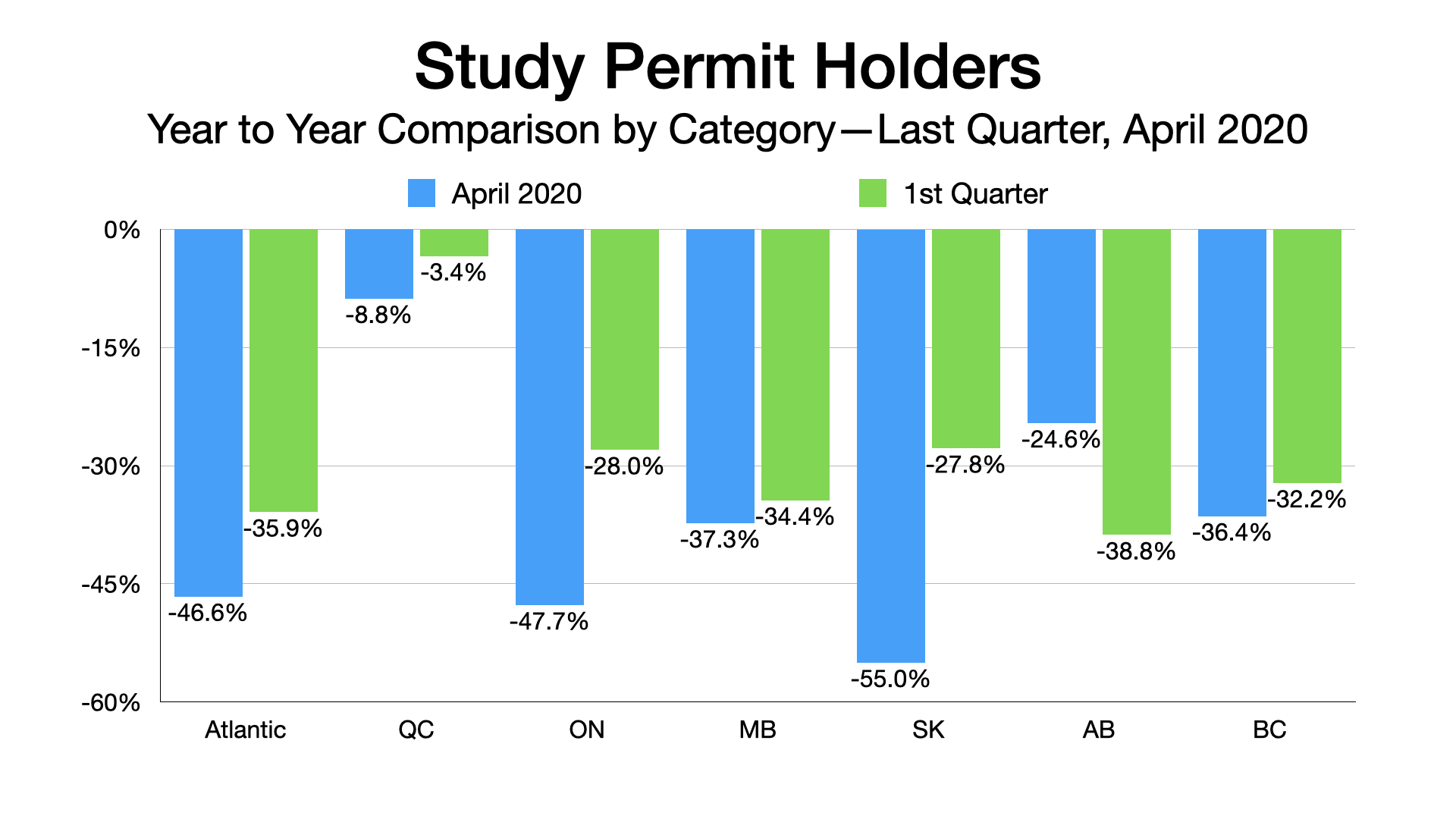
The three charts below highlight the extent of the decline starting in late 2019, along with the impact of the largest 10 source countries (2018 basis) contrasting the April 2020 change with the the first quarter of 2020.

The extent to which COVID-19 will impact the third quarter, when most students arrive, is of course the big question facing universities and colleges and the related economic impact:

The number of people from China obtaining Canadian study permits nosedived 44 per cent in the first four months of this year as COVID-19 restrictions and diplomatic battles took their toll.

Australia is experiencing an even more precipitous slump in what has been its largest foreign-student contingent — as China’s leaders this week warned against studying in Australia, which it said discriminates against Asians.

In addition, Canada has in the past two months come up with several incentives designed to limit the drop in study visas and woo high-fee-paying international students, who numbered 642,000 in Canada at the end of 2019, making up one in five of all those in higher education.

More than 150,000 Mainland Chinese citizens studied and worked in Canada in 2019, the second largest foreign-student group after India. Greater Toronto last year was the temporary home to 53,000 students from China, while Metro Vancouver had 34,000 and Victoria hosted 4,000.

This year, however, a Chinese study visa downturn appears to be coming in response to COVID-19 lockdowns, diplomatic tensions, border restrictions, a switch to online teaching and massive job losses in labour sectors that often get filled by foreign students.

The latest Immigration Department figures show just 12,065 citizens of the People’s Republic of China obtained study visas in Canada in the first four months of 2020. That’s down 44 per cent from the same period last year.

It’s more severe than the 31 per cent overall decline in study visas from all foreign students. Of the four other largest source countries sending students to Canada, the number of Indians has dropped by 29 per cent this year, South Koreans are down 35 per cent, French have declined 29 per cent and Vietnamese dipped 15 per cent.

When it comes to China’s 640,000 foreign students, almost all have chosen to study in five English-language countries, including the U.S., Britain and New Zealand. But Australia and Canada have welcomed by far the highest number per capita.

While specialists say the international-student market will struggle over the next few years because of coronavirus restrictions, students from China, who have arguably flocked the most to foreign institutions, appear now to be among those most reluctant to head abroad.

When the pandemic hit and Australian politicians urged all foreign nationals who couldn’t financially support themselves to go home, the country’s leaders in effect began saying goodbye to many of the nation’s 720,000 international students, including 212,000 from China.

Australia’s plunge is coming at the same time China has singled out the country, telling citizens “by no means travel to Australia,” and citing “racist incidents targeting Asians.” It also brought up health risks from COVID-19, even though Australia has a much lower rate of coronavirus deaths than the U.S. and Canada. Some reports say only a tiny trickle of Chinese students have obtained study visas in Australia this year.

For his part, Australian Prime Minister Scott Morrison on Thursday told China, which has also cut its Australia beef imports, that he wouldn’t be bullied by offshore “coercion.”

The reaction from Canadian Prime Minister Justin Trudeau has been almost the opposite, even while China has unfairly placed two Canadians in solitary confinement and drastically cut Canadian canola imports.

In addition to speaking softly about China, Canada’s Liberal government has recently offered unprecedented incentives to international students, which it says bring $21 billion annually into higher education and the economy.

In an effort to head off more drastic drops, Ottawa recently removed the cap on how many hours most foreign students can work while studying.

In addition, the Liberals changed policy so that up to a million foreign students, refugees and guest workers already in Canada could apply for the government’s Canada Emergency Response Benefit of $2,000 a month without providing proof of a work permit.

In late May, the Liberals also announced that foreign students will be permitted to complete 50 per cent of their studies outside Canada. Perhaps most importantly, Ottawa also said such students will still be able to get a postgraduate work permit for up to three years.

How far should Ottawa continue to go to lure international-student dollars and workers, including from China? Clearly, a lot of transnational money is at stake.

Last year, students from China made up 40 per cent of the 153,000 foreign students in B.C. The University of B.C. recently enrolled 6,281 students with Chinese citizenship, taking in $184 million a year from their fees. Almost half of Simon Fraser University’s foreign students have been from China, paying $126 million in fees in the 2018-19 school year. They also typically fill low-wage jobs and pay rent.

There is no doubt Canada has built a significant reliance on China and its students. Now, dealing with COVID-19 and country-to-country tensions, that dependence is being put to the test.

Source: Douglas Todd: Number of Chinese students in Canada plunges 44 per cent

We don’t need China to tell us Australian racism exists – just ask international students

From a student’s perspective:

Choosing to study abroad is as much a leap of faith as it is a financial commitment. The decision to uproot one’s life from the comforts of home is always made with the belief that the new place we have chosen to stake a formative portion of our lives will ultimately value our presence.

For many Chinese international students enduring the pandemic on Australian shores, that belief has been shaken. In the latest round of political sparring between China and Australia, the Chinese government has advised its citizens and students to reassess travel plans to Australia, citing a rise in racial discrimination and incidents of abuse towards people of Asian descent. Australia was quick to categorically reject the assertions as “disinformation”and “demonstrably untrue”. But political posturing rarely provides clarity on issues, and more often exposes the insecurities of the players rather than the intended show of strength.

Whether China’s caveat stems from a genuine concern for the wellbeing of its citizens or is part of a broader punitive strategy to condemn Australia’s push for an independent review into Covid-19’s origins will be dissected ad nauseam in the coming weeks. But instead of the preoccupation with how foreign powers choose to define Australian society, perhaps the more deserving and pressing matter for the government is to listen to the voices of those who live under its care.

Indictments don’t have weight without context, and whether or not it’s convenient for those in power to acknowledge, the pandemic has unearthed the reality of strained race relations that permeate Australian society. The Australian Human Rights Commission and Anti-Discrimination NSW have documented a surge in anti-Asian racism, while the Asian Australian Alliance has reported almost 400 racist incidents since April. Behind the dispassionate statistics is a traumatic inventory of lived experiences by the Asian Australian community: a bus driver verbally assaulted, two sisters spat at while crossing the street, a family’s home vandalised with hateful graffiti, an international student punched for wearing a face mask.

These racist sentiments were not spawned by Covid-19 – the virus merely amplified their potency and provided an unabashed avenue for their release. And yet, when China’s travel warnings were issued, Chinese international students quickly came to Australia’s defence, rebuking the notion that studying here was dangerous and expressing dismay that they were being used as bargaining chips in the escalating economic tug-of-war between China and Australia.

#COVID-19 UK: Reduction in Overseas Students Revealed in Immigration Statistics

No surprise. Broadly consistent with other countries:

On 21st May 2020, the government released its ‘Immigration statistics, year ending March 2020’, and it confirmed what those in the world of academia already knew; that there was a sharp drop in the number of international students when the lockdown took hold at the end of March. While the publication was not intended to provide a full analysis of the impact of Coronavirus on the immigration system, it did find a significant fall in applications for study visas in March 2020; it states, “in March 2020, Tier 4 visa applications fell significantly when compared to March 2019, in particular for Chinese nationals, and likely related to COVID-19. At the same time, the number of Tier 4 (sponsored study) visas issued in the first quarter of 2020 increased by 84&#x c;ompared with the same quarter in 2019, although there were falls towards the end of March 2020”.

The fall in student numbers follows record increases in 2019

The clear reduction in student numbers is all the more jarring given that the sector has seen a boom in international students in recent years, helped in large part by the reversal of Theresa May’s student immigration policy which required students to depart only four months after completing their studies. According to Government data, in the year ending September 2019, sponsored study visas increased by a not inconsiderable 13&#x (;258,787 students), of which 86&#x w;ere for university education.

UK universities planning for a return of students

There is no doubt that UK academic institutions have been hit hard by COVID-19, not least because of the large black hole which now exists in place of the regular supply of domestic and international student fee revenue. According to a recent analysis by London Economics for the University and College Union, it is expected that UK universities will see a £2.6 billion shortfall in the next academic year due to the ongoing impacts of COVID-19. Of this £2.6 billion is from domestic students and the remainder from international students. It is clear; therefore, how important overseas students are to UK universities and positive and reassuring that plans are now in place to allow some students to return to campus-based learning.

Some UK universities are planning to reopen from June 2020 with a range of essential measures to ensure the safety of staff and students being put place. Smaller class sizes and an increase in the number of online lectures will become normal from the middle of this year. While not all universities have a plan to reopen yet and are instead waiting for clarity from the government before reopening, some have mature plans almost ready to go. The University of Wolverhampton, for example, will be offering a “full digital suite of course material”, and will prioritise the opening of building openings over time. The university’s vice-chancellor Geoff Layer stated, “We will be looking at a gradual return to certain buildings being open and we will develop a plan which prioritises which parts can open first. It won’t be ‘we’re all back’. Social distancing has to be part of what we do, so I’d imagine we would be opening selected spaces over time”.

At Birmingham City University some, but not all, of the 2019-20 cohort of students will be returning for lessons from June 2020. The 2020-21 intake will start their courses in September 2020 with a new set of COVID-19 safety measures designed to protect the wellbeing of students and teachers in place. The university’s vice-chancellor, Professor Philip Plowden, says that students will be returning to the campus “on a limited basis”, and that changes are being made to the way in which buildings are utilised to ensure adherence with social distancing. Professor Plowdon believes that this partial reopening is essential to allow students who are reliant on-campus facilities to complete their courses; “Our priority for this year is to ensure that every student gets the qualifications for which they are working, or are able to make progress towards getting those qualifications. Our absolute priority is the safety of our staff and students and all of our decisions continue to be made with the safety of our community in mind.”

Even if academic institutions won’t be back to where they were before the COVID-19 pandemic, the confidence and boost to sentiment, not to say, cash flow, will be warmly welcomed by the sector.

Those universities which are not reopening in June 2020 will no doubt be watching those that do with considerable interest, not only to see whether it can be done but also to understand the measures which they too will need to put in place in the near future. It is also likely that international students will be watching to see how safe UK universities are over the next few weeks in anticipation of resuming their own studies in September 2020. As such, UK learning institutions can do much to inspire confidence in prospective overseas students by responding effectively now.

Returning students will be required to self-isolate

Anyone arriving in the UK from the 8th June 2020, including those holding a Tier 4 study visa, will be required by law to self-isolate. They will be asked to provide an address for where they will be in quarantine and will face fines of up to £1,000 and random spot checks. Unfortunately, there is no guarantee these additional measures put in place by the government will be lifted by September 2020 for the start of the new academic year, hence it is best to plan for an earlier arrival.

Wrapping up

The impact of COVID-19 on the UK’s education sector will be remembered for many years, but hopefully, with time, students from overseas will be able to continue their studies in earnest. Global events such as this allow us to truly appreciate the wonderful opportunities provided by the overseas study. As we start to see the light at the end of the tunnel, our immigration specialists look forward to helping international student clients and their families over the coming months to return to the UK to resume their studies.

Source: COVID-19: Reduction in Overseas Students Revealed in Immigration Statistics

@DouglasTodd Three reasons why rents suddenly dropped in Metro Vancouver

Very good article by Todd regarding the COVID-19 immigration related impacts on rental rates:

The advertised rent for a two-bedroom apartment has plunged by 15 per cent in the city of Vancouver, one of the biggest drops in Canada, as COVID-19 makes its bewildering way through the economy.

Many of the more than 800,000 tenants across Metro Vancouver were riveted when Rental.ca posted the city’s rent-price declines last week. The average rent demanded for a two-bedroom apartment in the city of Vancouver dropped by almost $450, to $2,478 a month.

But why, exactly, have Vancouver and Toronto and their suburbs been slammed?

“A lack of immigration, a decline in international students, a decline in short-term contract employment, and continued affordability concerns because of job losses are to blame,” said Ben Myers, president of Bullpen Research, an affiliate of Rental.ca, in a commentary.

All of which makes sense. But it needs unpacking.

Vancouver and Toronto are subject to some of the same COVID-19 forces — tremendous job loss and swelling household debt — that weakened countless rental markets in the world because of lockdown.

But Metro Vancouver and Toronto also contain some of the world’s highest proportions of foreign-born residents — immigrants and especially temporary residents, such as international students and guest workers. Most are young. And most rent.

That makes these two large Canadian metropolises more vulnerable to global migration patterns and to Canada’s clampdown on its international border, which has abruptly cut inbound flows of people to a trickle.

That lead Paul Danison, another analyst for Rental.ca, to go so far as to imagine the tenants of Vancouver and Toronto possibly being dug out of the hole they have found themselves trapped in: Rental-vacancy rates of less than one per cent.

“Imagine if you can, Toronto and Vancouver with a healthy three per cent vacancy rate, and rents falling by the end of the year rather than rising. A few months ago, that would have been laughable,” said Danison.

“But because of COVID-19, Canada will have less immigration, fewer international students and, with the border closed, not nearly as many seasonal and part-time workers. All typically are renters.”

Several factors are at play.

Tighter borders means landlords who once offered costly short-term rentals, like those on Airbnb, have been hammered in attractive cities like Vancouver, whose economies rely more than most on travellers.

Short-term rental providers have been moving their often-stylish apartments to the long-term rental market, which has been increasing supply, offering tenants more choices.

Rohana Rezel, a housing advocate and past candidate for Vancouver city council, is part of a group monitoring Craigslist and other real-estate forums. They’ve discovered short-term rentals are “collapsing” and hundreds of units are now switching to long-term rentals.

“People offering their places for rent on Craigslist are now blatantly saying it used to be an Airbnb. They’re boasting it was rated five stars,” says Rezel, who adds that many such landlords started off charging outlandish long-term rents, which they were forced to slash.

As in many cities around the world, many owners in Vancouver and Toronto are also feeling pressure to somehow off-load their homes, either because they have lost wages or are going into deeper debt. But they’re in a bind, because it’s no longer a house-seller’s market.

The Canada Mortgage and Housing Corporation, Moody’s and other analysts are predicting double-digit house price declines over the next year or two. So some would-be sellers are trying to wait out the downturn by renting their places, thus also increasing supply.

Thirdly, and perhaps most distinctly for a desirable cosmopolitan city like Vancouver, there are strong indications many of the region’s young temporary residents (foreign- and Canadian-born) have climbed on planes and headed home, often to live with their parents.

That means a hefty drop in demand for rental suites.

A CMHC analyst, Andrew Scott, has found an astonishing 46 per cent of Metro Vancouver residents between the ages of 18 and 44, the group most likely to rent, have been non-permanent migrants — a ratio almost unheard of in other parts of the world.

Until recently, at least 100,000 international students have been living and working in Metro Vancouver, plus another 50,000 so-called “international mobility” employees and temporary foreign workers.

“Many temporary residents just packed up and left,” says Rezel, a high-tech professional who first came to Canada from Sri Lanka as a graduate student.

Like me, when Rezel visits the city’s restaurants, pubs and cafés, he says he often asks friendly servers and others about themselves. Four times out of five such hospitality staff invariably answer that they are in Canada on study or work visas.

As colleges and universities began in March to offer their courses only on the internet and most service jobs disappeared overnight, a large portion of these intrepid young people were compelled to leave behind the country and their rental apartments. Rezel’s Japan-born wife, who is involved in her expatriate community in Vancouver, said that’s what happened in her circle, too.

Who knows when or if most of these temporary residents will return?

All of which goes to suggest Metro Vancouver’s suddenly lower rental rates are likely to remain so for at least the medium term.

Source: Douglas Todd: Three reasons why rents suddenly dropped in Metro Vancouver

No need to show proof of work permit to get CERB, Ottawa tells temporary foreign residents

Generous flexibility:

The federal government has taken new steps to make it easier for international students and other temporary foreign residents to receive emergency benefits, another sign of Ottawa’s determination to disburse the payments quickly and widely.

Such short-term immigrants need only give their word they have a valid work permit or have applied for a renewed one to obtain the Canada Emergency Response Benefit (CERB), says a memo sent this week to staff vetting the claims.

Until last Thursday, they had to email Employment and Social Development Canada an image of their valid work or work/study permit, or confirmation they had applied to renew an expired one.

But a memo sent to Employment and Social Development Canada officials handling CERB applications said that condition is waived “effective immediately” and agents “are only required to verbally obtain work permit details.”

The directive applies to everyone who claims to meet the programs other requirements and has a “900-series” social insurance number — people ranging from students to refugee claimants to temporary foreign workers and executives transferred from other countries. None are Canadian citizens or permanent residents.

One source familiar with the system said people with valid permits would typically email proof within a few minutes, barely slowing the process. But now there is no way for staff to verify whether someone is in the country legally, the person said.

And if an applicant does receive the $2,000-a-month payments inappropriately and then leaves Canada, it would be virtually impossible to recover the money, said the source, who’s not authorized to discuss internal matters and asked not to be named.

Outside experts offered differing opinions, with one immigrant advocate calling it an “excellent” policy that should get important help to temporary residents faster, and an immigration lawyer saying it shows an “astonishing” disregard for taxpayer funds.

Maya Dura, a spokeswoman for Ahmed Hussen, the families, children and social devlopment minister, said such claimants “may be asked to provide additional documentation to verify their eligibility at a future date.”

“The Government of Canada will, whether it be in the upcoming weeks or at tax time next year, reconcile accounts and make sure people did not defraud the CERB,” she added via email.

Asked about 900-series residents generally, Dura provided statistics just for international students, saying 39,319 had applied for CERB through ESDC by May 18, and 30,645 have received payments so far.

The CERB program has wide support from all parties as a way to soften the blow for people left jobless or unable to find work by the pandemic and lockdowns. It provides $500 a week to people who “have stopped working” because of COVID-19, so long as they made $5,000 within the previous 12 months and did not quit voluntarily.

But there has been increasing scrutiny of the program in recent days amid revelations about how it’s being managed. Previous memos, obtained by the National Post, directed staff to approve applicants even if they see evidence of potential abuse, and even if people quit their jobs voluntarily or were fired for alleged misconduct, seemingly contrary to CERB rules.

Prime Minister Justin Trudeau has said the government will claw back unwarranted or fraudulent payments later, but had to get cheques out quickly because of the millions of people put out of work.

Sergio Karas, a Toronto immigration lawyer, condemned the latest change, saying it means even an individual who is facing a deportation order or who had already left the country could now obtain CERB.

“It’s truly astonishing,” he said. “The person could potentially be overseas if the payment is going to a Canadian bank account. That is extremely troubling.”

“That money is not free,” he added. “That money is going to have to come out of someone’s pocket at some point. It is going to be the taxpayers of Canada, citizens or not.”

But Debbie Douglas, executive director of the Ontario Council of Agencies Serving Immigrants, praised the policy as “an excellent move by the federal government.”

“Many of these individuals through no fault of their own are unable to have their SINs and-or work permits renewed during this health emergency,” she said by email. “At the same time many have lost their jobs or have experienced significant reduction in hours of work. Many were or are vulnerable to evictions. “

Thursday’s directive is “very useful” as it will help speed up CERB cheques for people who haven’t had time to apply for a permit renewal, said Douglas.

The memo last week notes that to be eligible for benefits like Employment Insurance or CERB a temporary resident with a 900-series SIN “must prove they are legally allowed to work in Canada.”

But “due to COVID-19 the 900-series SIN procedures have been simplified,” it said in explaining the change to requiring merely verbal proof,

The government had paid out $39 billion under CERB to more than eight million claimants by May 21.

Source: No need to show proof of work permit to get CERB, Ottawa tells temporary foreign residents