The Citizenship Problem | Essay | Zócalo Public Square

While his overall critique of the many inequalities intrinsic to citizenship is largely correct, no discussion of realistic alternatives (because there are none with the exception of the mixed success of the EU).

The more practical approach is to assess individual citizenship policies and practices as to their degree of inclusion or exclusion:

Why do we still cling to citizenship?

Certainly, it’s not required to protect your rights. We live in a world of human rights, where slavery is outlawed, gay people can marry, and thinking for yourself (rather than obedience to authority) is valued. So why, in societies based on the ideal of equal human worth, does citizenship still exist?

Citizenship is typically justified with romantic notions—self-determination, democracy, preservation of values. But at its core, citizenship is little more than a certain legal status within a certain legal system. By defining its rights and privileges as bound to a particular state, citizenship itself violates our cherished idea of equal human worth. Instead, citizenship is most effective at upholding caste systems both within and among nations.

In most cases, citizenship is granted more or less at random, based on where your family was from, or where you were raised. Public authorities grant citizenship; the actual citizen typically has no participation in the decision. Once granted, citizenship cannot be refused—or changed before obtaining some other citizenship, without the risk of becoming a “stateless” person, deprived of the rights of citizenship anywhere in the world.

Citizenship was created to legally proclaim equality among the haves and have-nots. It did not eliminate socioeconomic inequality; it merely explained it away through the incomplete promise of “one person one vote.” This made extracting obedience from the population easier and drove nationalism. Today, even the most awful political systems boast glorified citizenships.

For most of its history, citizenship has been useful for a very ugly reason. Citizenship allows us to ignore the basic tenets of the enlightenment—the presumption that humans are equal—without real argument. It is enough to say “She is not a citizen” to justify excluding someone from rights, entitlements, and respect.

For most of its history, citizenship has been useful for a very ugly reason. Citizenship allows us to ignore the basic tenets of the enlightenment—the presumption that humans are equal—without real argument. It is enough to say “She is not a citizen” to justify excluding someone from rights, entitlements and respect.

Citizenship, thus, can divide as much as it unites. We see that in the U.S. with DACA kids, the Dreamers, who are threatened with being thrown out of their home country because they lack citizenship. And America is not alone. Citizenship divides not only people within a nation, but confers unequal status based on the privileged status of some nations over others. Think of those who possess the all-entitling super-citizenships of nations of the global north, versus the limitations against people who come from former colonies—it’s clear that the status quo of citizenship is racist.

Racism is just one of the core building blocks of citizenship; sexism is another, as citizenship was routinely denied to women as well as minorities until well into the 20th century.

Citizenship is at a crossroads now: the dominant narrative that the global equality of human beings can be assured within states is in reality eroding. Different citizenships are not equal, and the allocation of citizenship rights worldwide is neither logical nor clear.
At the macro level, citizenship enables the perpetuation of rigid pre-modern caste structures. The son of an American is an American, and the son of a brahman is a brahman. We do not ask ourselves whether this is just.

To argue for citizenship at a micro level is utterly confounding and contradictory. Being a tenured professor is irrelevant to citizenship in Germany, but was crucial to securing immediate citizenship in Austria until 2008. “Being active in the diaspora” is irrelevant to Austrians, but can make you a Pole. Having a Lebanese mother is irrelevant to Lebanese citizenship, but having a Jewish mother, even without Israeli citizenship, can make you Israeli.

Examples of this disparity in the rules of citizenship are countless: what is taken for granted as best practice in one country can seem almost outrageous in another. But the contradictions should point us to the bigger problem with citizenship: there cannot be a “worse” or a “better” method of assignment to a caste. Any caste system depends on repugnant assumptions and should be intolerable, at least in modern democracies.

All citizenships are described often as equally valuable—even though this assumption is flawed. Equality of different citizenships would only work in a world where authorities could enforce standards of self-fulfillment and personal empowerment in every country. In such a world, citizenship would provide rights, not liabilities.

And in such a glorious world, citizenship would then be irrelevant.

But we live in a world where there are Pakistanis, whose citizenship is a global liability; they must hold a visa to travel to any other country, and hold no settlement rights abroad—and also Norwegians, who enjoy countless rights at home and can settle in more than 40 of the richest democracies without any formalities. In our world, citizenships do not have equal dignity. We are treated differently according to the color of our passport, and citizenship upholds random privilege. Look from Europe across the Mediterranean, or peer from the U.S. across the wall President Trump is building, and you see a world order where punishing randomness and hypocrisy reign.

The quality of our citizenship correlates very neatly with the global distribution of wealth. Most of the world’s people are losers of what prominent scholar Ayelet Shachar called ‘the birthright lottery.’ That is because they are denied the mobility and security that comes with a passport from an economically advanced nation and got their status at random. By controlling the borders between states, citizenship is the most important tool in the world to keep it that way.

Source: The Citizenship Problem | Essay | Zócalo Public Square
Workers have been left to save capitalism from COVID-19

Too early to assess the longer-term impacts but hopefully improvements in wages and working conditions (but experience at meat packing plants not encouraging):

Since the arrival of a novel coronavirus in the United States, workers at Whole Foods have carried out a mass “sickout,” demanding that management provide them not just with masks, but with hazard pay, virus testing and paid leave if they have to self-quarantine. Gig workers at grocery-service Instacart went on strike as well, demanding a pay raise, disinfectant wipes and hand sanitizer. Warehouse workers at Amazon facilities in Detroit, Chicago and New York City staged walkouts, demanding that their workplaces be temporarily closed for deep cleaning. And it isn’t just new-economy companies whose workers are concerned for their safety. Bus drivers in Birmingham, Ala., refused to work because of unsafe conditions, and across the country, drivers for Target’s delivery service, fast-food workers and gas-station attendants have all staged walkouts as well.

More than 750 cases of coronavirus, which accounted for roughly half of the confirmed cases in South Dakota last month, were traced to the Smithfield meat processing plant in Sioux Falls, which partly reopened Monday after nearly three weeks of closure. Deemed “essential workers,” which means they must remain on the front lines, most of its employees are immigrants – some 80 languages are spoken at the plant – who make between US$14 and US$16 an hour. According to union representatives speaking to the BBC, workers’ requests for protective clothing, temperature checks and sanitation stations had been ignored, while sick workers were incentivized to remain on the job. It’s a page that might have been ripped out of Upton Sinclair’s The Jungle.

Late-stage capitalism, it turns out, still looks an awful lot like it did back in the days of William Blake’s “dark satanic mills.” The consequences are not just morally appalling, but economically unsustainable. The economy cannot stay up and running through the crisis, and it won’t be able to recover over the long term, so long as essential workers don’t have the protections necessary to do their jobs. Capitalists are so oriented to the short term that they don’t realize that workers are the people keeping their factories, companies and the economy, broadly, up and running.

Roughly three in 10 workers have jobs that require physical proximity to their co-workers and close interaction with the people they serve. They are disproportionately women, immigrants and visible minorities.

In what may be the strangest of the many strange turns spurred by the COVID-19 crisis, these front-line workers are telling capitalists what they need to do in order to save their factories, their companies, and themselves. Late capitalism sees these workers not as essential but as dispensable cogs in the machine, as costs to be minimized. Pay is low and working conditions are terrible, as workers are left to fend for themselves when it comes to securing the protective gear they need – if they are even allowed to wear it.

While leading companies, including large profitable ones, shirk their responsibilities to their workers and hence to their customers and society at large, it’s our front-line heroes who are calling this out. Demanding the protective equipment and spacing they need to do their jobs safely will not just protect them, it protects factories and warehouses from becoming hot spots for spread of the virus, and ultimately means production lines, supply chains and delivery systems and stores can all continue to function.

This emerging working-class movement for higher wages, more protective equipment, and better working conditions bears an eerie similarity to the movement of industrial workers that emerged a century ago in the wake of the 1918 Spanish flu pandemic, when low-paid workers in crowded and dangerous factories organized for higher pay and safer working conditions. Like then, it may take time to bear fruit. That earlier pandemic was immediately followed by the roaring 1920s, which featured horrifying levels of economic inequality that echoed the conditions of today. It took the better part of two or three decades before the labour reforms of the New Deal and the economic mobilization of the Second World War gave rise to the golden era of the 1950s and 1960s, when factory workers finally vaulted into the middle class.

Hopefully, a reinvigorated movement of essential-service and factory workers can garner support from professional and “knowledge” workers, who depend on the products and services that essential workers deliver. What’s clear is that neither our political leaders nor our capitalists are up to the task.

In an irony that would have Marx himself rolling over in his grave: it is workers who may end up saving capitalism from itself.

Corak: COVID-19 is not the great leveller. It’s the great revealer

Great and accurate commentary by Corak:

In a medical sense, COVID-19, as highly contagious as it is, can be thought of as the great leveller. No one has immunity, and we face the health risk of this virus with a sense of our common humanity.

But in a socio-economic sense, it is not as contagious. The jobs some of us hold give us an economic immunity, and we face the economic risk of this virus with a very different sense of our interconnectedness.

Last week Statistics Canada reported that more than one million jobs were lost as social distancing and mandated work shutdowns took force. A further two million people saw their hours of work fall dramatically, implying that over three million Canadians were directly impacted.

The big hope, the hope upon which the entire government response rests, is that the COVID-19 economic shock will be temporary. The goal is to freeze the economy until the winds of illness pass by, allowing us to start again where we left off. Public policy is focused on the challenge of adjustment and rebound.

But Statistics Canada’s look into the socially distanced economy also reveals longstanding inequalities that have been growing wider and wider for decades.

For many families, the bottom end of wage inequality means an insecure standard of living and lower prosperity for the next generation.

The usual economic parable claims that this is the price paid to foster growth, and eventually more prosperity for everyone. We need to adjust to win.

The market has sent a signal: tool up, get better skilled, move elsewhere and move onward. The next and better job is just around the corner!

And after all, if you have a job, even if you need more than one to stay afloat, there is always a sense of hope, a shred of dignity, the aspiration of a better tomorrow. Income inequality is easier to ignore in a full employment economy.

But the great revealer has arrived in the form of a virus, its economic fallout showing almost perfectly the divides between those who are vulnerable and those who are not.

Now, some of us do work that is not public-facing.

Some of us do work that is flexible and supported by technology and computers.

And of course some of us do work that gets us an income well above average, offering security, health, a home with space, and a comfortable family life.

This work gives us an economic immunity.

What is the big deal about working at home if you normally spend half your time working from an airplane seat?

But underlying Statistics Canada’s report are some dramatic differences.

The employment change among managers and those working in professional, scientific, or technical jobs was “decimal point dust,” but 300,000 people working in accommodation and food services lost work, a fall that wiped out 20 years of growth.

The foot soldiers in this very first economic battle against COVID-19 were the young and women, those who work in part-time and temporary jobs, with no union contracts and lower wages. Students and those who were already unemployed were also out of luck finding their next job.

Now that we are collectively facing a health risk that is spreading across space, we’ve been given the opportunity for empathy with many people who individually confront risks that repeat over and over again during the course of their lives, an accumulation of bad draws over time that leads to lower and more precarious incomes, housing that is less stable and of lower quality, families that are less secure.

In much of this there is no question of merit and just desert, it’s just bad luck.

It is nice for premiers and prime ministers to thank truck drivers and grocery store clerks for their essential work, but it will be hypocrisy of the highest order for our governments to only hope to start up again where we left off.

Inequality has been robbing many Canadians of security, prosperity and dignity for decades. That is what COVID-19 reveals.

No, we don’t just have an adjustment problem. We have — as we have long had — an inequality problem.

Source: ContributorsOpinionCOVID-19 is not the great leveller. It’s the great revealer

Their work is keeping Canada safe. But they earn a fraction of the national average

Another example of the COVID-19 class divide (‘White-Collar Quarantine’ Over Virus Spotlights Class Divide):

They’re the workers keeping Canada safe and healthy in the midst of a pandemic. But some — like cashiers — bring home just around a quarter of the average Canadian’s annual income.

From food processing to warehouses to delivery services, the workers deemed essential to maintaining the country’s vital supply chain are significantly more likely to be low-wage and racialized compared to the rest of the labour market, according to new statistics from the Canadian Centre for Policy Alternatives.

In some cases, they are bringing home less than half of the average Canadian worker a year.

“In the midst of a pandemic, many of us are going back to the essentials. We need to put food on the table for ourselves and our families. We need to have the medications that we require. And as there have been many new reports on, we all need toilet paper,” said Sheila Block, a senior economist with the CCPA.

“To keep us in these essentials, we rely on these workers whose work has often been undervalued and who are often marginalized.”

The CCPA study relied on 2016 census data, which showed average annual earnings across the entire Canadian economy stood at around $49,500. Analyzing the earnings of workers in essential jobs by both industry and occupation, Block’s research found that grocery store workers — a category that includes managers — earned on average half of that. Cashiers took home just 26 per cent.

Light duty cleaners fared poorly too, earning just over 40 per cent of the national average. Couriers and door-to-door messengers brought home just over 50 per cent.

Racialized workers make up 21 per cent of the total workforce in Canada, but they were overrepresented in sectors deemed essential during the COVID-19 pandemic, the CCPA’s analysis found.

In warehousing and storage, for example, racialized workers made up 37 per cent of the workforce; in food manufacturing, that figure was 30 per cent.

Kulwinder Singh, a truck driver based out of Mississauga, says he is working 10 to 12 hour days bringing goods to Shoppers Drug Mart, Sobeys, and the LCBO. He says the deliveries he makes every day are “essential” — but he’s afraid to come home at the end of his shift to his wife and daughter.

“It’s very risky,” he said.

As an independent owner/operator, he is technically self-employed — meaning he has no health insurance, no medical leave, and no access to protective equipment except for what he purchases himself.

“Everything I’m paying for out of my own pocket,” he said, adding that some companies will not let him use washroom facilities to wash his hands.

The CCPA study notes that many of the sectors deemed essential have low unionization rates; in Canada, less than 8 per cent of retail workers have a union.

Many essential workers — including truck drivers and most gig workers — are classified as independent contractors, meaning they struggle to join unions and or access basic employment protections.

“There is a real divide between the people who can self isolate and who can work from home and the people that we rely on to make that possible,” said Block.

“We have to be particularly concerned that we are relying on industries that have a history of rights violations in this time. These rights violations have historically been threatening to workers’ health for sure and sometimes lives,” she added.

“Now we are actually putting the health of the public at risk if we don’t have good enforcement of health standards.”

Some companies, including Amazon and Loblaws, are offering employees a $2 an hour premium for working during the COVID-19 pandemic — measures Block called a “welcome but insufficient response.”

“We have to really look at governments to respond in a longer term manner by increasing minimum wages, easing access to unionization, and increasing both protections and enforcement under minimum employment standards,” she added.

Last week, federal labour minister Filomena Tassi said experts at the Canadian Centre for Occupational Health and Safety were drawing up best health and safety practices to share with provincial labour ministries for at-risk workplaces such as trucking and food processing.

Enacting 21 emergency leave days during the pandemic — plus seven permanent paid sick days — is also a critical step at the provincial level, Block said.

Source: Star ExclusiveTheir work is keeping Canada safe. But they earn a fraction of the national average A new study by the Canadian Centre for Policy Alternatives shows low-wage and racialized workers are overrepresented in jobs deemed essential during COVID-19 pandemic.

‘White-Collar Quarantine’ Over Virus Spotlights Class Divide

Not unique to the USA but gaps wider:

For about $80,000, an individual can purchase a six-month plan with Private Health Management, which helps people with serious medical issues navigate the health care system.

Such a plan proved to be a literal lifesaver as the coronavirus pandemic descended. The firm has helped clients arrange tests in Los Angeles for the coronavirus and obtained oxygen concentrators for high-risk patients.

“We know the top lab people and the doctors and nurses and can make the process efficient,” said Leslie Michelson, the firm’s executive chairman.

In some respects, the pandemic is an equalizer: It can afflict princes and paupers alike, and no one who hopes to stay healthy is exempt from the strictures of social distancing. But the American response to the virus is laying bare class divides that are often camouflaged — in access to health care, child care, education, living space, even internet bandwidth.

In New York, well-off city dwellers have abandoned cramped apartments for spacious second homes. In Texas, the rich are shelling out hundreds of thousands of dollars to build safe rooms and bunkers.

And across the country, there is a creeping consciousness that despite talk of national unity, not everyone is equal in times of emergency.

“This is a white-collar quarantine,” said Howard Barbanel, a Miami-based entrepreneur who owns a wine company. “Average working people are bagging and delivering goods, driving trucks, working for local government.”

Some of those catering to the well-off stress that they are trying to be good citizens. Mr. Michelson emphasized that he had obtained coronavirus tests only for patients who met guidelines issued by the Centers for Disease Control and Prevention, rather than the so-called worried well.

Still, a kind of pandemic caste system is rapidly developing: the rich holed up in vacation properties; the middle class marooned at home with restless children; the working class on the front lines of the economy, stretched to the limit by the demands of work and parenting, if there is even work to be had.

“I do get that there are haves and have-nots,” said Carolyn Richmond, a Manhattan employment lawyer who is advising restaurant industry clients from her second home, on Long Island, as they engineer layoffs. “Do I feel guilty? No. But I do know that I am very lucky. I understand there’s a big difference between me and the people I work with every day.”

Long before the new coronavirus, another kind of equalizer was being promoted: the internet. For decades, tech evangelists cited the democratizing power of the World Wide Web, which they said would bring high-quality services to strata of society that had previously gone without them.

Some of those predictions have come to pass. In recent days, time spent on the site of the Khan Academy, a well-regarded online curriculum that is free, is up about two and a half times from this time last year.

In March, the federal government broadened its coverage of so-called telemedicine services through Medicare, giving many more people access to a doctor over the web.

Still, the technology that makes these services accessible remains out of reach for many Americans. While data on internet access is inexact, the most recent Federal Communications Commission figures, from 2017, showed that 30 percent of households did not have even a slow broadband connection.

Jessica Rosenworcel, a Democratic member of the commission, said millions of Americans had only phones, often with strict caps on data usage. “Imagine using a mobile device to look up your class work, type out a paper,” she said. “No parent would choose that as the primary tool for their child’s learning.”

Like many districts around the country, the Brownsville Independent School District in Texas sought to transfer much of its curriculum online when it closed its doors this week. Schools encouraged students to use digital platforms like Google Classroom, Apple Teacher and Seesaw to keep up with their studies.

But unlike wealthier areas, Brownsville has notoriously spotty internet access. Nearly half of households there lacked broadband in 2018, putting it at the top of a list of worst-connected citiescompiled by the National Digital Inclusion Alliance, an advocacy group. “We’re limited when it comes to online services in our community,” said the district’s superintendent, René Gutiérrez. “It’s not where it needs to be.”

The situation has sent many families scrambling. Anahi Rubio, 11, and her mother just moved into an apartment that lacks an internet connection. Anahi has struggled with balky access while using a laptop at her aunt’s house, where she couldn’t get the videoconferencing app Zoom to work.

“They’re always telling you to use YouTube to learn multiplication, or to look something up on Google,” said her mother, Betsy Rubio. “Online, everybody gets to be on the same page. But if not everyone has good internet, like my daughter, you don’t. I’m concerned about her falling behind.”

And internet access is far from the only challenge confronting the less affluent. Marc Perrone, the president of the United Food and Commercial Workers, which represents over one million workers in industries like groceries and meatpacking, said child care was a top concern when the union held a telephone town hall this week with about 5,000 supermarket workers in New York State.

“In some cases, if they’re old enough, they’re latching them — becoming latchkey kids,” Mr. Perrone said, alluding to the option of leaving a child home alone.

Until a few weeks ago, Darlyne Dagrin would drop her 22-month-old son off at a day care facility on her way to work at a nursing home in Cedar Grove, N.J. But the center has closed temporarily amid the pandemic, leaving her with no choice but to skip work when she can’t find a friend or relative to care for him.

“This week I called out twice,” Ms. Dagrin said Wednesday. “They called me and said: ‘We won’t accept no more callouts. If you call out again you’re out of a job.’” She said she didn’t know what she was going to do for the rest of the week.

Unlike Ms. Dagrin, Maggie Russell-Ciardi doesn’t have to choose between going to work and providing child care for her young child. A nonprofit consultant in New York City and part-time yoga teacher, Ms. Russell-Ciardi can slot work around her 3-year-old son’s sleep and play schedule — even if it sometimes requires waking up in the wee hours — and simply makes do when he’s awake and active.

“It’s better for me to do my own practice when he’s sleeping,” she said of the yoga classes she now teaches online. “But it’s nice to have him growing up feeling like he’s part of the yoga community even if it’s now a virtual one. It’s an important teaching for him.”

The ability of the middle class to quickly shift life online has been striking. The Brooklyn Conservatory of Music, where roughly 100 faculty members on site teach several hundred students each week, has shifted its entire music instruction to videoconferencing. Over 95 percent of the students enrolled in private lessons have resumed their classes since the school reopened online last Friday.

By contrast, said Dorothy Savitch, an administrator, the school operates a music education program in 25 local public schools, with large numbers of children below the poverty level. Ms. Savitch said about one-third of those children might take part when the program resumes online next week, though she hopes to reach 60 percent of them eventually.

But the middle class is not free of anxiety in this pandemic moment. Otherwise-privileged people have become acutely aware of the options they lack. “For the first time in my life, I feel the difference between myself and my more affluent friends,” said Deb Huberman, a freelance television producer living on the Upper East Side of Manhattan. “I desperately want to get out of the city but I can’t afford to rent something.”

Ms. Huberman estimates that half the neighbors in her building have fled to second homes. Many have joined other wealthy New Yorkers in the less densely populated East End of Long Island.

“I feel guilty about friends and colleagues who don’t have the ability to leave,” said Joe Bilman, who moved with his family from Park Slope in Brooklyn to his vacation house in East Hampton. “We knew it would be easier for us to isolate and be part of the quarantine. We have a backyard and the kids can go for bike rides.”

Hamptonites have often managed to recreate the amenities of home, except with more space and beachfront views. Many children enrolled in Manhattan prep schools continue to be taught by teachers in conventional classroom formats, albeit over the internet, while public schools have frequently substituted individual study with materials supplied online.

MyTennisLessons.com advertises that “coaches are continuing to give 1-on-1 lessons” and lists a few pros available in Hamptons ZIP codes. Zabar’s, the Upper West Side food emporium, will deliver an assortment of noshes for a $300 to $400, depending on the distance.

“I don’t even take a markup — it’s whatever the messenger service charges me,” said Scott Goldshine, the general manager. “Obviously, for most of the people out there getting these types of delivery, money is not an issue.”

At some summer retreats, like Martha’s Vineyard and the Jersey Shore, local officials have taken to discouraging second-home owners and renters for fear of overtaxing local infrastructure.

In other cases, the rich aren’t going east or west, but down. Gary Lynch, general manager of Rising S, a Texas maker of safe rooms and bunkers that range in price from $40,000 to several million dollars, said he had added a second shift of 15 workers to handle the flood of new orders, mostly for underground bunkers.

“I’ve never seen interest like there is now,” said Mr. Lynch, who has taken to turning his phone off at night so he can get some sleep. “It has not let up.”

Study Finds Racial Gap Between Who Causes Air Pollution And Who Breathes It

Another interesting disparity but one that makes intuitive sense given income disparities:

Pollution, much like wealth, is not distributed equally in the United States.

Scientists and policymakers have long known that black and Hispanic Americans tend to live in neighborhoods with more pollution of all kinds, than white Americans. And because pollution exposure can cause a range of health problems, this inequity could be a driver of unequal health outcomes across the U.S.

A study published Monday in the journal PNAS adds a new twist to the pollution problem by looking at consumption. While we tend to think of factories or power plants as the source of pollution, those polluters wouldn’t exist without consumer demand for their products.

The researchers found that air pollution is disproportionately caused by white Americans’ consumption of goods and services, but disproportionately inhaled by black and Hispanic Americans.

“This paper is exciting and really quite novel,” says Anjum Hajat, an epidemiologist at the University of Washington who was not involved in the study. “Inequity in exposure to air pollution is well documented, but this study brings in the consumption angle.”

Hajat says the study reveals an inherent unfairness: “If you’re contributing less to the problem, why do you have to suffer more from it?”

The study, led by engineering professor Jason Hill at the University of Minnesota, took over six years to complete. According to the paper’s first author Christopher Tessum, a postdoctoral researcher at the University of Washington, the idea stemmed from a question at a conference.

Tessum presented earlier research on how blacks and Hispanics are often more exposed to air pollutants than whites. After he finished, someone asked “if it would be possible to connect exposure to air pollution to who is doing the actual consuming,” says Tessum. According to Tessum, no one had ever tried to answer that question.

It’s a big, complicated issue, but studying it could address a fundamental question: Are those who produce pollution, through their consumption of goods and services, fairly sharing in the costs?

What kind of data could even answer such a multifaceted question? Let’s break it down:

For any given area in the U.S., the researchers would need to know how polluted the air was, what communities were exposed to pollution, and the health effects of that level of exposure.

Then, for the same area the researchers would need to identify the sources of that exposure (coal plants, factories, agriculture to name a few), and get a sense of what goods and services stem from those emissions (electricity, transportation, food).

Finally, whose consumption of goods and services drives those sectors of the economy?

“The different kinds of data, by themselves, aren’t that complicated,” says Tessum. “It’s linking them where things get a little trickier.”

The most relevant air pollutant metric for human health is “particulate matter 2.5” or PM2.5. It represents the largest environmental health risk factor in the United States with higher levels linked to more cardiovascular problems, respiratory illness, diabetes and even birth defects. PM2.5 pollution is mostly caused by human activities, like burning fossil fuels or agriculture.

The EPA collects these data through the National Emissions Inventory, which collates emissions from specific emitters, like coal plants or factories, measures of mobile polluters like cars or planes, and natural events like wildfires, painting a detailed picture of pollution across the U.S.

The researchers generated maps of where different emitters, like agriculture or construction, caused PM2.5 pollution. Coal plants produced pockets of pollution in West Virginia and Pennsylvania, while agricultural emissions were concentrated in the Midwest and California’s central valley. “We then tied in census data to understand where different racial-ethnic groups live to understand exposure patterns,” says Hill.

Tessum then used previous research on the health effects of different exposure levels to estimate how many premature deaths per year (out of an estimated 102,000 from domestic human-caused emissions) could be linked to each emitter.

“We wanted to take this study further by ascribing responsibility of these premature deaths to different sectors [of the economy], and ultimately to the consumers, and maybe consumers of different racial and ethnic groups,” says Hill.

To do that, the researchers actually worked backwards, following consumer spending to different sectors of the economy, and then ultimately to the main emitters of air pollution.

Consider one major contributor to emissions: agriculture. Consumer expenditure surveys from the Bureau of Labor Statistics provide detailed data on how much money households spend in various sectors of the economy, including food.

These data gave the researchers an idea of how much blacks, Hispanics, and whites spend on food per year. Other expenditures, like energy or entertainment, are also measured. Taken together these data represent the consumption patterns of the three groups.

To translate dollars spent on food into air pollution levels, the researchers traced money through the economy. Using data from the Bureau of Economic Analysis, the researchers can estimate, for example, how much grocery stores or restaurants spend on food. Eventually, these dollars are linked back to the primary emitters — the farms growing the food or the fuel that farmers buy to run their tractors.

The researchers have now completed the causal chain, from dollars spent at the grocery story, to the amount of pollution emitted into the atmosphere. Completing this chain for each source of pollution revealed whose consumption drives air pollution, and who suffers from it.

After accounting for population size differences, whites experience about 17 percent less air pollution than they produce, through consumption, while blacks and Hispanics bear 56 and 63 percent more air pollution, respectively, than they cause by their consumption, according to the study.

“These patterns didn’t seem to be driven by different kinds of consumption,” says Tessum, “but different overall levels.” In other words, whites were just consuming disproportionately more of the same kinds of goods and services resulting in air pollution than minority communities.

“These results, as striking as they are, aren’t really surprising,” says Ana Diez Roux, an epidemiologist at Drexel University who was not involved in the study. “But it’s really interesting to see consumption patterns rigorously documented suggesting that minority communities are exposed to pollution that they bear less responsibility for.”

Diez Roux thinks this is a good first step. “They certainly make assumptions in their analysis that might be questioned down the line, but I doubt that the overall pattern they found will change,” she says.

Tessum points to some hopeful results from the study. PM2.5 exposure by all groups has fallen by about 50 percent from 2002 to 2015, driven in part by regulation and population movement away from polluted areas. But the inequity remains mostly unchanged.

While more research is needed to fully understand these differences, the results of this study raise questions about how to address these inequities.

Tessum stresses that “we’re not saying that we should take away white people’s money, or that people shouldn’t be able to spend money.” He suggests continuing to strive to make economic activity and consumption less polluting could be a way to manage and lessen the inequities.

Diez Roux thinks that stronger measures may be necessary.

“If want to ameliorate this inequity, we may need to rethink how we build our cities and how they grow, our dependence on automobile transportation,” says Diez Roux. “These are hard things we have to consider.”

Source: Study Finds Racial Gap Between Who Causes Air Pollution And Who Breathes It

Liberals say immigration enforcement is racist, but the group most likely to benefit from it is black men

Not quite sure whether the studies cited represent a consensus view or not. Look forward to any comments by those more familiar with the various studies:

President Trump’s election victory over Hillary Clinton seemed to herald a new era for border security and immigration enforcement. But his polarizing and occasionally ignorant comments about immigrants have handed his adversaries a convenient pretext for stymying compromise on immigration reform: racism.

Left-leaning advocacy groups and a host of Democrats all too often shy away from the specifics of the debate and instead lean on cries of bigotry, resorting to claims like that of House Minority Leader Nancy Pelosi, who has described Trump’s approach to immigration reform as an effort to “make America white again.”

Claims that immigration enforcement equals racism ignore the reality that the group most likely to benefit from a tougher approach to immigration enforcement is young black men, who often compete with recent immigrants for low-skilled jobs.

This dynamic played out recently at a large bakery in Chicago that supplies buns to McDonald’s. Some 800 immigrant laborers, most of them from Mexico, lost their jobs last year after an audit by Immigration and Customs Enforcement. The Cloverhill Bakery, owned by Aryzta, a big Swiss food conglomerate, had to hire new workers, 80% to 90% of whom are African American. According to the Chicago Sun Times, the new workers are paid $14 per hour, or $4 per hour more than the (illegal) immigrant workers.

In this case, and in many others, the beneficiaries of immigration enforcement were working-class blacks, who are often passed over for jobs by unscrupulous employers.

The labor force participation rate for adult black men has declined steadily since the passage of the 1965 Immigration and Nationality Act, which ushered in a new era of mass immigration. In 1973, the rate was 79%. It is now at 68%, and the Bureau of Labor projects that it will decline to 61% by 2026.
The beneficiaries of immigration enforcement [are] working-class blacks, who are often passed over for jobs by unscrupulous employers.

In 2016, the Obama White House produced a 48-page report acknowledging that immigration does not help the labor force participation rate of the native-born. It concluded, however, that “immigration reform would raise the overall participation rate by bringing in new workers of prime working age.”
Although the report used the term “new workers,” Democrats may also be tempted by the prospect of new voters. But they should be aware that in courting one group, they risk losing others.

African Americans tend to be a reliable voting bloc for the Democratic Party, but they have repeatedly indicated in public opinion surveys that they want significantly less immigration.

A recent Harvard-Harris poll found that African Americans favor reducing legal immigration more than any other demographic group: 85% want less than the million-plus we allow on an annual basis, and 54% opted for the most stringent choices offered — 250,000 immigrants per year or less, or none at all.

These attitudes are rational.

In a 2010 study on the social effects of immigration, the Cornell University professor Vernon Briggs concluded: “No racial or ethnic group has benefited less or been harmed more than the nation’s African American community.”

The Harvard economist George Borjas has found that, between 1980 and 2000, one-third of the decline in the employment among black male high school dropouts was attributable to immigration. He also reported “a strong correlation between immigration, black wages, black employment rates, and black incarceration rates.”

In a 2014 paper on neoliberal immigration policies and their effects on African Americans, the University of Notre Dame professor Stephen Steinberg argued that, thanks to the Immigration and Nationality Act of 1965, “African Americans found themselves in the proverbial position of being ‘last hired.'” Steinberg also noted that “immigrants have been cited as proof that African Americans lack the pluck and determination that have allowed millions of immigrants from Asia, Latin America and the Caribbean to pursue the American dream.”

The struggles of black men obviously cannot all be linked to immigration, but it’s clear that the status quo does not benefit them.

As elected leaders consider changing our immigration laws, the interests of America’s most vulnerable citizens shouldn’t be overlooked. The first step toward honest reform is for the Democratic Party to admit that while liberal immigration enforcement might help them win new voters, it also harms and disenfranchises their most loyal constituency.

via Liberals say immigration enforcement is racist, but the group most likely to benefit from it is black men

50 Years After a Landmark Report on Race, Inequality Remains Entrenched

Sobering study:

Barriers to equality are posing threats to democracy in the U.S. as the country remains segregated along racial lines and child poverty worsens, says a study examining the nation 50 years after the release of the landmark 1968 Kerner Report.

The new report released Tuesday blames U.S. policymakers and elected officials, saying they’re not doing enough to heed the warning on deepening poverty and inequality as highlighted by the Kerner Commission a half-century ago, and it lists a number of areas where the country has seen “a lack of or reversal of progress.”

“Racial and ethnic inequality is growing worse. We’re resegregating our housing and schools again,” former U.S. Sen. Fred Harris of Oklahoma, a co-editor of the new report and last surviving member of the original Kerner Commission created by President Lyndon Johnson in 1967. “There are few more people who are poor now than was true 50 years ago. Inequality of income is worse.”

The new study titled “Healing Out Divided Society: Investing in America Fifty Years After the Kerner Report” says the percentage of people living in deep poverty — less than half of the federal poverty level — has increased since 1975. About 46% of people living in poverty in 2016 were classified as living in deep poverty — 16 percentage points higher than in 1975.

And although there has been progress for Hispanic homeownership since the Kerner Commission, the homeownership gap has widened for African-Americans, the report found. Three decades after the Fair Housing Act of 1968 passed, black homeownership rose by almost 6 percentage points. But those gains were wiped out from 2000 to 2015 when black homeownership fell 6 percentage points, the report says.

The report blames the black homeownership declines on the disproportionate effect the subprime crisis had on African-American families.

In addition, gains to end school segregation were reversed because of a lack of court oversight and housing discrimination. The court oversight allowed school districts to move away from desegregation plans and housing discrimination forced black and Latino families to move into largely minority neighborhoods.

In 1988, for example, about 44% of black students went to majority-white schools nationally. Only 20% of black students do so today, the report says.

The result of these gaps means that people of color and those struggling with poverty are confined to poor areas with inadequate housing, underfunded schools and law enforcement that views those residents with suspicion, the report said.

Those facts are bad for the whole country, and communities have a moral responsibility to address them now, said Harris, who now lives in Corrales, New Mexico.

The new report calls on the federal government and states to push for more spending on early childhood education and a $15 minimum wage by 2024. It also demands more regulatory oversight over mortgage leaders to prevent predatory lending, community policing that works with nonprofits in minority neighborhoods and more job training programs in an era of automation and emerging technologies.

“We have to have a massive outcry against the state of our public policies,” said the Rev. William J. Barber II, a Goldsboro, North Carolina pastor who is leading a multi-ethnic “Poor People’s Campaign: A National Call for Moral Revival” next month in multiple states. “Systemic racism is something we don’t talk about. We need to now.”

The late President Johnson formed the original 11-member Kerner Commission as Detroit was engulfed in a raging riot in 1967. Five days of violence over racial tensions and police violence would leave 33 blacks and 10 whites dead, and more than 1,400 buildings burned. More than 7,000 people were arrested.

That summer, more than 150 cases of civil unrest erupted across the United States. Harris and other commission members toured riot-torn cities and interviewed black and Latino residents and white police officers.

The commission recommended that the federal government spend billions to attack structural racism in housing, education and employment. But Johnson, angry that the commission members didn’t praise his anti-poverty programs, shelved the report and refused to meet with members.

Alan Curtis, president of the Milton S. Eisenhower Foundation and co-editor of the new report, said this study’s attention to systemic racism should be less startling to the nation given the extensive research that now calls the country’s discriminatory housing and criminal justice systems into question.

Unlike the 1968 findings, the new report includes input from African-Americans, Latinos, Native Americans and women who are scholars and offer their own recommendations.

“The average American thinks we progressed a lot,” said Kevin Washburn, a law professor at the University of New Mexico, a citizen of the Chickasaw Nation of Oklahoma and one of the people who shared his observations for the report. “But there are still some places where Native people live primitive lives. They don’t have access to things such as good water, electricity and plumbing.”

Like the 1968 report, the new study also calls out media organizations for their coverage of communities of color, saying they need to diversify and hire more black and Latino journalists.

News companies could become desensitized to inequality if they lack diverse newsrooms, and they might not view the issue as urgent or newsworthy, said journalist Gary Younge, who also gave input to the report.

“It turns out that sometimes ‘dog bites man’ really is the story,” Younge said. “And we keep missing it.”

Source: 50 Years After a Landmark Report on Race, Inequality Remains Entrenched

Income gap persists for recent immigrants, visible minorities and Indigenous Canadians

The Stars’s highlighting of the recent Census release:

As the face of Canada grows more diverse, the income gap between residents who identify as visible minorities, Indigenous or recent immigrants and the rest of Canadians remains a yawning chasm, data from the 2016 Census shows.

The income gap for these groups barely budged between 2006 and 2016, narrowing by just two percentage points for Indigenous Canadians and recent immigrants and widening by one percentage point for visible minorities, according to census data released Wednesday.

Total income was 26 per cent lower for visible minorities than non-visible minorities and 25 per cent lower for Indigenous Canadians than non-Indigenous Canadians.

But recent immigrants — many of whom are also visible minorities — face the toughest economic challenge with total incomes that fall 37 per cent below total incomes for Canadians born here, the data shows.

It means for every dollar in the pocket of someone born in Canada, a recent immigrant has just 63 cents.

More than 22 per cent of Canadians — including 51.5 per cent of Torontonians — reported being from a visible minority community in 2016, up from 16.3 per cent nationally in 2006.

In Toronto, more than 55 per cent of visible minority residents were living on less than $30,000 in 2016 compared to fewer than 40 per cent of the rest of the city’s population, according to census data provided to the Star.

While almost 14 per cent of non-visible minorities in Toronto reported total incomes of $100,000 or more, just 4 per cent of people from visible minority communities had access to that amount of cash in 2016.

“The latest census data simply confirms the reality that racialized people, recent immigrants, and Indigenous people continue to face discrimination and that income inequality doesn’t just magically reverse itself,” said Sheila Block senior economist for the left-leaning Canadian Centre for Policy Alternatives.

“That takes political leadership,” added Block who crunched the national income gap from the latest census data on immigration, ethnocultural diversity and aboriginal peoples.

“As these populations increase and continue to lag behind, it becomes a bigger issue for everybody,” she said.

“We know this kind of inequality doesn’t only have a negative impact on the population that’s affected, but it has a negative impact on us overall as a society.”

Increases to income support programs such as social assistance, employment insurance and pensions are part of the solution, she said. But labour reform, including more access to unionization and a higher minimum wage are also key.

Nadira Begum, who has a master’s degree in social work from her native Bangladesh, juggles three part-time jobs and numerous volunteer positions in the non-profit sector but still hasn’t been able to land full-time work.

“I have been looking for a full-time job in my field for more than 10 years,” said the Regent Park mother of three. “I have the skills, the experience and the knowledge, but if they don’t hire me, how can I show them? It is a common story in our community.”

Begum’s part-time jobs have often involved substantially similar work as full-time employees, and yet she has been paid a lower wage. Friends with part-time jobs as grocery store clerks who were hired the same time as full-time clerks are paid less and enjoy fewer benefits, Begum added.

“We are not equally paid, even though we do the same work,” she said. “And we can’t complain because we can’t afford to lose our jobs.”

Deena Ladd of the Workers’ Action Centre says Ontario’s planned $15 minimum wage by 2019 will be a huge boost for visible minorities, recent immigrants and Indigenous workers, who are more likely than the rest of Canadians to be toiling for minimum wage.

But changes to the province’s proposed Fair Workplaces, Better Jobs Act are needed to ensure these workers, who like Begum are often stuck in temporary, part-time and contract positions, are paid the same as permanent and full-time staff, Ladd said.

Wording in the proposed minimum-wage legislation currently mandates equal pay for equal work if the job is “substantially the same,” Ladd said. But that allows employers to change one aspect of the job and still be allowed to pay temp, contract and part-time workers less.

Instead, the proposed legislation should be reworded to say these workers are entitled to equal pay if the job is “substantially similar” to work performed by a full-time employee, she said.

Another problem with the proposed law is the definition of seniority. Unlike all other provisions of the Employment Standards Act which measure seniority by the date an employee was hired, the equal pay amendments include a definition of seniority as “hours worked.” If this is not changed, workers from economically disadvantaged groups who are more likely to work part-time, will never achieve equal pay for equal work, Ladd said.

“The new legislation has the potential to address the kinds of inequities highlighted by the census,” she said. “But if we don’t strengthen the language so workers can use the equal-pay protections in their workplaces in a strong way, then it will be just words on paper.”

The legislation, which just passed second reading, is expected to become law later this year.

Ryerson University professor Myer Siemiatycki, who teaches immigration and settlement studies, says the census findings are a wake-up call and a reminder of why the census is important.

“These are worrying statistics,” he said. “They reflect the adverse living conditions of huge numbers of Canadians who fall into these three categories of population . . . It’s an alarm bell and we need to respond.”

Source: Income gap persists for recent immigrants, visible minorities and Indigenous Canadians | Toronto Star

Whites Have Huge Wealth Edge Over Blacks (but Don’t Know It) – The New York Times

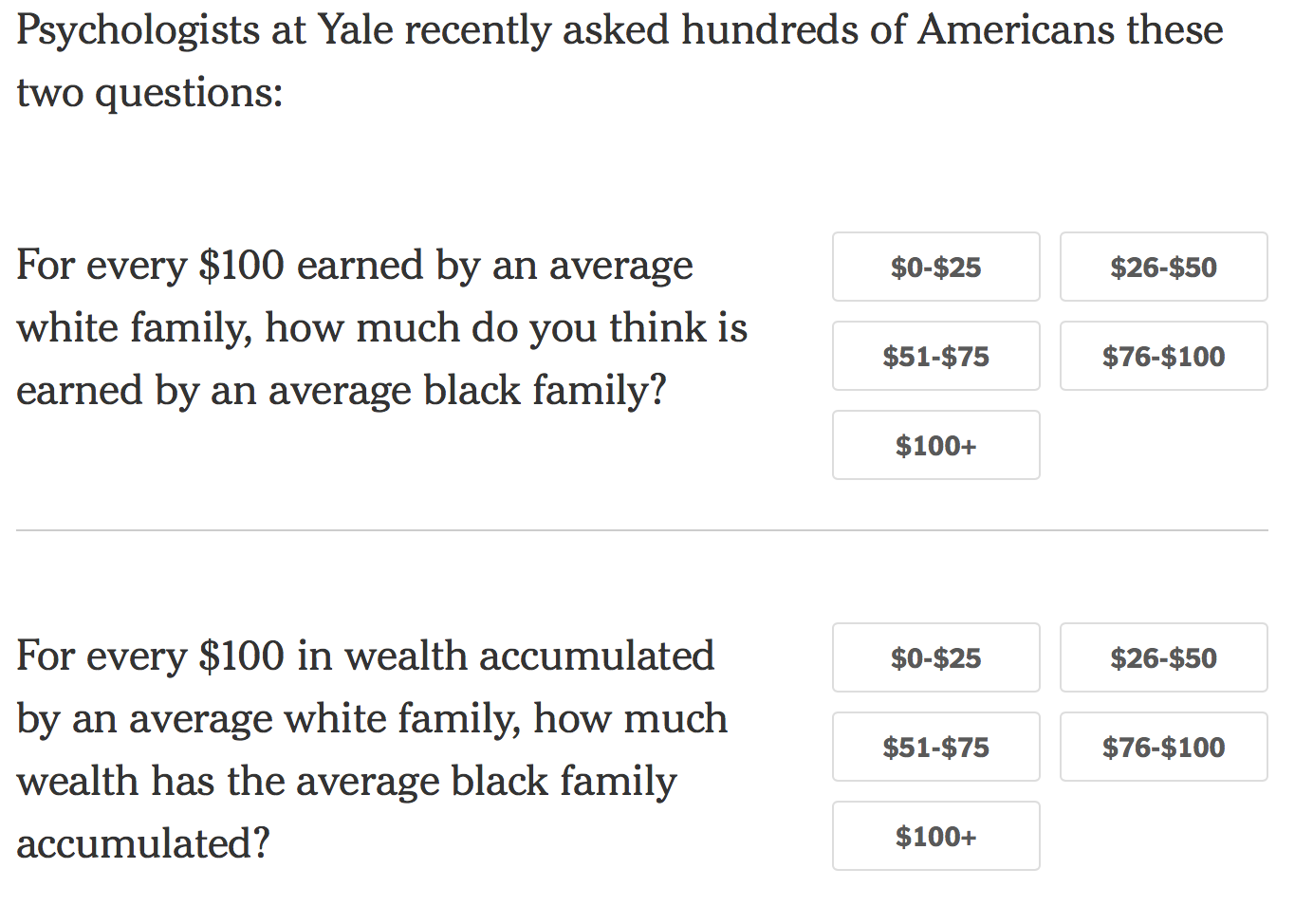
The Yale researchers suspected that many people would not get the answers right.

“I’m a person who studies inequality, who should really know how inequality looks,” said one of the psychologists, Michael Kraus, who researches the behaviors and beliefs that help perpetuate inequality. “And I look at the black-white gap, and I’m shocked at the magnitude.”

Black families in America earn just $57.30 for every $100 in income earned by white families, according to the Census Bureau’s Current Population Survey. For every $100 in white family wealth, black families hold just $5.04.

If Mr. Kraus, of all people, is taken aback by these numbers, what are the odds that most Americans have a good understanding of them? The answer, he and his colleagues fear, has broad implications for how we understand our society and what we’re willing to do to make it fairer.

Americans, and higher-income whites in particular, vastly overestimate progress toward economic equality between blacks and whites, the psychologists reported Monday in the Proceedings of the National Academy of Sciences. Americans believe that blacks and whites are more equal today than they truly are on measures of income, wealth, wages and health benefits. And they believe more historical progress has occurred than is the case, suggesting “a profound misperception of and unfounded optimism” regarding racial equality.

“It seems that we’ve convinced ourselves – and by ‘we’ I mean Americans writ large – that racial discrimination is a thing of the past,” said Jennifer Richeson, who was another of the study’s authors, along with Julian Rucker, a doctoral student. “We’ve literally overcome it, so to speak, despite blatant evidence to the contrary.”

To understand how people have perceived that progress, the researchers asked blacks and whites of varying income levels to estimate answers to the questions above in both recent years and historically. They also asked about how much black workers with a high school diploma but no college degree earn relative to whites of the same education level, and how the earnings of blacks and whites with a four-year college degree compare.

The present-day results, aggregated across several surveys used in the study, are compared here with actual government data:

The researchers suspect that the answer in part has to do with how little exposure Americans have to people who are unlike them. Given how economically and racially segregated the country remains, many Americans, and especially wealthy whites, have little direct knowledge of what life looks like for families in other demographic groups.

But the pattern this study identifies isn’t simply about lack of access to accurate information. As Mr. Kraus points out, popular videos and charts regularly circulate on social media highlighting the startling levels of inequality in America. And yet, many people who click on them forget about the severity of inequality just long enough to be surprised by it again in the future.

“Despite this information being out there, we don’t really take it in,” Mr. Kraus said. This happens “in a way that suggests that maybe we’re motivated to forget it, or motivated to distort it in our own minds.”

He and Ms. Richeson suspect that we also overgeneralize from other markers of racial progress: the election of a black president, the passage of civil rights laws, the sea change in public opinion around issues like segregation. If society has progressed in these ways, we assume there’s been great economic progress, too.

We’re inclined, as well, to believe that society is fairer than it really is. The reality that it’s not — that even college-educated black workers earn about 20 percent less than college-educated white ones, for example — is uncomfortable for both blacks who’ve been harmed by that unfairness and whites who’ve benefited from it.

“It’s very difficult to consider the possibility that some of what we’ve achieved or gained is due to forces that aren’t our own individual hard work,” Ms. Richeson said. “That’s hard to grapple with, especially in American society. We really believe in egalitarianism and meritocracy.”

These findings suggest that the motivation to see the world as fair may be even stronger in this context than stereotypes white Americans hold, for instance, equating blacks with poverty.

The researchers found in some additional surveys that whites answer these questions more accurately when they’re first asked to consider an America where discrimination persists. If we want people to have a better understanding of racial inequality, this implies that the solution isn’t simply to parrot these statistics more widely. It’s to get Americans thinking more about the forces that underlie them, like continued discrimination in hiring, or disparities in mortgage lending.

It’s a myth that racial progress is inevitable, Ms. Richeson said. “But it’s also dangerous insofar as it keeps us blind to considerable inequality in our nation that’s quite foundational,” she said. “Of course we can’t address it if we’re not even willing to acknowledge it.”

And if we’re not willing to acknowledge it, she adds, that has direct consequences for whether Americans are willing to support affirmative action policies, or continued enforcement of the Voting Rights Act, or renewed efforts at school desegregation.