International student graduates earn much less than Canadian peers, study shows

Of concern, particularly at masters and PhD levels:

International students earn substantially less than their Canadian counterparts upon graduation, and a larger proportion of them end up in sales and service jobs, new research from Statistics Canada shows.

The data – part of a report by the agency examining the labour-market outcomes of university and college graduates in Canada – capture the inequity in wages and types of jobs that international students eventually obtain compared with Canadian graduates.

Over all, international student graduates earned 19.6 per cent less than Canadian graduates three years after graduating, the report found. Moreover, their annual incomes were lower than Canadian graduates at all levels of study, regardless of if they earned a diploma or a doctorate degree.

The report used data from a 2023 national survey of graduates conducted by Statscan, and focused on the graduating class of 2020.

Foreign students with a bachelor’s degree, for example, earned a median annual income of $52,000, compared with Canadian graduates at $65,200. At the master’s level, international students earned 16.6 per cent less than Canadians – $70,000 compared with $83,900, annually.

A critical difference in the employment outcomes for foreign students compared to Canadian graduates can be seen in the proportion of international students who work in sales and service occupations. Across all education levels, approximately 28 per cent of international student graduates worked in sales and service jobs, compared with roughly 12 per cent of Canadian graduates.

Some examples of sales and service occupations, according to the National Occupation Classification system, include retail and restaurant workers, door-to-door salespeople and call-centre operators. These jobs tend to pay lower wages than, for example, management occupations or jobs in business and finance.

Brittany Etmanski, the report’s author, suggested that one reason for the significant earnings differential between foreign graduates and Canadian graduates was because more of the former group tended to be college and bachelor’s degree holders employed in the low-wage sales and service sectors.

“However, this does not explain the difference in income at the masters and doctoral levels,” she wrote….

Source: International student graduates earn much less than Canadian peers, study shows

Matthew Lau: Education, not racism, drives the difference in earnings between races

What Lau fails to consider are the barriers that affect education levels and enrolment in STEM disciplines. The numbers are correct but the analysis is overly simplistic:

Significant federal program spending is premised on the idea that visible minorities in Canada are systemically disadvantaged.

Take the latest: Earlier this fall, the federal government released a 45-page anti-racism strategy for 2024-2028, which “aims to tackle systemic racism and make our communities more inclusive and prosperous.” Such a strategy is necessary, according to the government, because systemic racism exists throughout our institutions and “[perpetuates] a position of relative disadvantage for racialized persons.”

But where is the evidence for this premise? Not in the income statistics.

Directly contradicting the idea that visible minorities are systemically oppressed, a new Statistics Canada study shows many Canadians from minority backgrounds thrive and even do better on average than their white counterparts.

The StatCan study started with 1996 and 2001 census data, used T1 and T4 tax files and other data to measure cumulative earnings over 20 years among Canadian-born men and women from four racial cohorts — white, South Asian, Chinese, and Black — and found minorities outperforming the majority population.

Specifically, among Canadian-born men, cumulative earnings over 20 years were highest on average among Chinese men ($1.58 million in 2019 dollars), followed by South Asian men ($1.51 million). Only Black men ($1.06 million) earned less than white men ($1.31 million).

Clearly, if Chinese and South Asian men have higher earnings power than white men, it is difficult to conclude Canada is systemically racist against minorities.

What about the inverse? Does the data suggest Canada is systemically racist against white men? No. “The fact that Chinese and South Asian men have higher education levels than white men and are more likely to be in STEM fields is the single most important factor explaining why these two groups have higher cumulative earnings than white men,” the StatCan report found.

In other words: education, not racism, drives the difference in earnings.

So what happens when we control for education and other factors like employer size, industry, and geography? The earnings gap between white and Black men remains. As well, while Chinese and South Asian men out-earned white men, after controlling for education and other factors, white men actually earned more.

Alas, have we found evidence of systemic racism? Is this evidence that the country is systemically racist because these employers paid minorities less than their white counterparts with similar educational backgrounds?

There’s no hard evidence of this. First, discrimination by employers against visible minorities has been illegal for decades. Second, as the study itself even suggests, many factors affect earnings besides the ones researchers can observe and control for, including differences in social networks, job search methods, and preferences for certain working conditions, so automatically blaming racism doesn’t make much sense. Third, if Canada is systemically racist against minorities, how did Chinese and South Asian men find themselves overrepresented in the higher-paying STEM fields to begin with?

And if racism against Black Canadians is to blame for the earnings gap among men, what explains the fact that Black women earned more than white women? Among Canadian-born women, before controlling for education and other factors, the cohort that earned the least over two decades was white women ($0.80 million). Chinese women had the highest cumulative earnings ($1.14 million), followed by South Asian women ($1.06 million), and then Black women ($0.82 million). Is Canada full of racists who only discriminate against Black men but not Black women?

Another outcome of the StatCan analysis is that after controlling for the same factors (e.g. education), Chinese women out-earned white women — by $38,000, on average. So, do racist employers systematically favour white men over Chinese men, while also disfavouring white women relative to Chinese women?

The narrative that Canadians from visible minority backgrounds are systemically disadvantaged just doesn’t hold up to the data.

Moreover, this latest StatCan study only considered four groups (Chinese, South Asian, white, and Black) of Canadian-born individuals, but other StatCan research provides similar evidence against systemic racism. Weekly earnings data from 2016 show that in addition to Chinese and South Asian men, Canadian-born Japanese and Korean men had higher earnings than their white counterparts. Among women, seven of ten minority groups (Korean, Chinese, South Asian, Japanese, Filipino, “other visible minorities,” and Arab or West Asian) had higher average weekly earnings than the white population.

Simply, the earnings data do not provide evidence that Canada is a society that systemically disadvantages minorities. Rather, the data show the exact opposite. Politicians and bureaucrats might want to consider these facts before wasting large sums of taxpayer dollars drawing up lengthy “anti-racism” plans.

Source: Matthew Lau: Education, not racism, drives the difference in earnings between races

Earnings of one-step and two-step economic immigrants: Comparisons from the arrival year – Statistique Canada

Another useful study, highlighting that two-step immigrants had better economic outcomes (annual earnings) than one-step immigrants:

Since the early 2000s, the two-step immigration selection process, through which economic immigrants are chosen from the pool of temporary foreign workers, has expanded rapidly. Previous research indicated that following their landing, high-skilled two-step immigrants had higher earnings than comparable one-step immigrants—those directly selected from abroad. However, an important question that has not been fully examined is whether the earnings advantage of two-step immigrants over one-step immigrants persisted if the two groups were compared from their arrival year rather than the year when they became permanent residents. At that point, neither group possessed any Canadian work experience, eliminating its potential influence on their earnings differences. The results of this study reveal that two-step immigrants consistently had higher annual earnings than their one-step counterparts within the same admission class when the comparison started from their initial arrival year. These earnings differences, although reduced, remained substantial after accounting for sociodemographic differences between the two groups and after 10 years following the initial arrival. Furthermore, these patterns generally held across successive arrival cohorts. The conclusion includes a discussion of the implications of these findings and explores potential reasons for these outcomes.

Source: Earnings of one-step and two-step economic immigrants: Comparisons from the arrival year – Statistique Canada

Minorités visibles sur le marché du travail: Des avancées importantes, mais encore du chemin à faire

Notable improvement in terms of employment rates, less positive with respect to incomes but still showing improvement compared to 2016:

Un taux d’emploi comparable

L’étude montre une participation de plus en plus active des personnes noires sur le marché du travail, souligne Luc Cloutier-Villeneuve, analyste en statistique du travail à l’ISQ et auteur de l’étude. Selon lui, il s’agit d’un des éléments les plus frappants. « Les taux d’activité sur le marché de l’emploi chez les universitaires et les détenteurs de formations postsecondaires sont relativement identiques à la population qui n’est pas issue d’une minorité visible », indique l’expert. De fait, tous âges compris, le taux d’emploi atteint le seuil du 78,8 % chez les Noirs, comparé à 77,5 % pour les personnes non issues de minorités visibles. 

Le Québec derrière la Colombie-Britannique

Le Québec présente une meilleure équité entre personnes issues des minorités visibles et personnes blanches que certaines autres provinces du Canada, dont l’Ontario. Les Noirs (78,8 % au Québec, contre 68,8 % en Ontario), les Latino-Américains (76,2 %, contre 71,4 %) et les Arabes (70,8 %, contre 57,4 %) ont tous un taux d’emploi supérieur dans la Belle Province. Toutefois, la Colombie-Britannique est plus paritaire du côté des personnes noires (76,1 %) et arabes (60,6 %). Luc Cloutier-Villeneuve constate que plusieurs changements positifs ont été réalisés depuis le recensement précédent, en 2016, mais la partie est loin d’être gagnée. 

Un écart de revenu qui diminue

Le revenu moyen d’emploi des personnes issues de minorités visibles âgées de 25 ans à 64 ans (43 240 $) est toujours inférieur au revenu moyen d’emploi des personnes blanches (56 250 $), confirme l’étude. Mais cet écart diminue. En 2019, il était de 22 %, alors qu’en 2015, soit quatre ans plus tôt, il atteignait 28 %. Plus précisément, en 2019, le revenu d’emploi moyen allait d’environ 41 800 $ (personnes noires) à 47 700 $ (personnes arabes). 

Différences selon l’âge

La parité varie selon l’âge, indique l’étude de l’ISQ. Chez les personnes de 55 à 64 ans, l’écart est petit, ce qui révélerait une meilleure intégration à la société, soutient Luc Cloutier-Villeneuve. « On sait qu’il y a des variables qui jouent sur l’intégration, que ce soit la langue maternelle, la scolarité, la durée de résidence [au Québec], et l’ordre dans l’arbre généalogique », explique l’expert. 

Connaissance du français, un facteur

Un certain nombre de facteurs peuvent expliquer les écarts constatés dans l’étude, souligne Luc Cloutier-Villeneuve. Parmi eux, l’analyste en statistique mentionne la connaissance du français ou encore la reconnaissance des diplômes. « Ce qui est clair, c’est qu’en termes d’analyse subséquente, ce serait intéressant d’aller creuser ces aspects pour comprendre pourquoi ces écarts persistent. » 

Source: Minorités visibles sur le marché du travail: Des avancées importantes, mais encore du chemin à faire

It’s time to stop talking about productivity

Interesting suggestion on how to reframe the productivity discussions and debates. But the government focus on immigration as a major driver of economic growth (total not per capita GDP) highlights the lack of focus on productivity and increased incomes:

Should Canada take steps to boost its long-term productivity growth, including measures to accelerate the substitution of capital for labour and to increase the pace of upskilling?

Translated from policy-ese: would you like a $13,500 raise?

A lot of the debate over increasing productivity and competitiveness resembles that first sentence, and sounds like a note from the boss telling you to stop lollygagging. Canadians could be forgiven for tuning out of a debate that seems to centre on why they should work harder to plump up corporate profits.

But what if the productivity debate were framed around individual prosperity — the question being whether you want a low-wage or a high-wage economy?

A speech by former federal finance minister Bill Morneau last week hinted at that approach. After some familiar bemoaning of the lack of urgency about fixing our lack of competitiveness, Mr. Morneau pivoted to a frame of individual prosperity. “Let me put it another way,” he said in a speech Wednesday evening to the C.D. Howe Institute. “If we had maintained our rate of productivity growth from 2000 on, the average annual income for a Canadian worker would have been about $13,500 higher in 2019.”

To be sure, there’s nothing to guarantee that the benefits of higher productivity flow to workers. Some of that extra income will take the form of higher profits — and rightly so, if businesses are to expected to invest heavily in robots and other forms of automation.

But Mr. Morneau’s words brought to mind a recent tour I had of a printing plant in southern Manitoba owned by Friesens Corp. Like many companies in Manitoba and elsewhere in Canada, Friesens has had to contend with an ongoing labour shortage. Unlike many, the company is automating parts of its production lines. One result: the back-breaking job of lifting and stacking is now performed by robots, not humans. It’s safer, cheaper — and has freed up those humans for more technically demanding work. And their wages are higher, too.

So, a suggestion for Mr. Morneau, or anyone else looking to pontificate on the need for a focus on higher productivity: Don’t. Instead, talk about the choice between low-paid grunt work, and better paid, more interesting jobs.

Source: It’s time to stop talking about productivity

USA: The Value of Foreign Degrees by Source Country

Interesting analysis, broken down by country of study. Not sure if anyone has done the same for Canada but would not be surprised to see a similar pattern:

Whether assessing the education level of recent arrivals or designing a “high-skill” system for selecting future immigrants, analysts should be careful not to treat foreign degrees as equivalent to U.S. degrees. Using data from the National Survey of College Graduates, this report shows not only that foreign degrees as a whole are less valuable in the U.S. than U.S. degrees, but also that their value varies substantially depending on the specific country or region where the degrees were earned.

The findings below refer to full-time U.S. workers with at least a bachelor’s degree:

  • After controlling for a traditional set of earnings-related characteristics, foreign-educated immigrants earn 17 percent less than natives who were educated in the U.S.
  • The foreign-degree penalty is driven primarily by immigrants educated in non-Western countries.
  • Immigrants educated in Latin America (24 percent salary penalty), Eastern Europe (27 percent), China (28 percent), the Philippines (35 percent), and Africa (39 percent) all experience penalties that exceed the foreign-degree average.
  • By contrast, immigrants educated in Western Europe, Australia, and India earn roughly the same salaries as comparable U.S. natives.
  • Canadian-educated immigrants earn 20 percent more than U.S. natives.
  • Controlling for the type of entry visa that each immigrant receives does not eliminate the variation in foreign-degree value.

Source: The Value of Foreign Degrees by Source Country

It’s Time for an Honest Conversation About Affirmative Action

Needed reference to income diversity or class:

On Monday, the Supreme Court announced it would hear arguments in Students for Fair Admissions v. President and Fellows of Harvard College. In 2014, the group sued the university, accusing it of discriminating against Asian students during its admissions process. After years of court filings and an actual trial, S.F.F.A. ultimately lost its case but immediately appealed to the Supreme Court.

I spent much of 2018 and 2019 covering that trial and getting to know its main players. Edward Blum, the conservative legal activist pushing the lawsuit, was behind Fisher v. University of Texas, the last college admissions affirmative action case to reach the Supreme Court. In the 2010s, he also spearheaded Shelby County v. Holder, which effectively gutted the 1965 Voting Rights Act. He is a tireless activist who will now have his hearing in front of a 6-3 conservative majority on the Supreme Court. If the justices find in S.F.F.A.’s favor, Blum will have had a hand in both disenfranchising thousands of voters and ending affirmative action as we know it.

This work has turned Blum into a villain in progressive circles, and some have denounced the whole package as a right-wing program to end racial preferences and remediations in every corner of American life. I generally agree with this assessment and fear the world Blum might bring about.

But it’s also important to assess the specifics of the Harvard case. When excised from the context of Blum’s crusade, they reveal a profoundly broken system that relies on obfuscation and misdirection, especially when it comes to the treatment of Asian applicants.

Did Harvard discriminate against Asian students?

This is a question with a both complicated and simple answer. On the one hand, proving that Harvard violated the legal standards set by earlier Supreme Court rulings on affirmative action is difficult, given both the amorphous nature of the admissions process and the intricacy and various contradictions in the law. As it stands now, colleges are allowed to consider the race of an applicant, but only to a limited extent and not in a way that resembles a quota system.

But when you apply the normative definition of discrimination, in which race hinders an applicant’s acceptance into an institution, the case becomes much clearer. The evidence against Harvard on that front is, frankly, overwhelming. Asian applicants to Harvard routinely scored significantly lower than students of other races on their “personal scores,” a metric cobbled together from alumni interviews, essays and teacher recommendations. During the trial, Harvard’s attorneys did not really explain why this disparity existed, but only tried to prove that it did not come out of intentional or even implicit bias from anyone inside the admissions office. What seemed to be happening was that the people writing the appraisals were routinely downgrading Asian students, judgments that Harvard apparently accepted without any further investigation.

I don’t really know why Asians got low personal scores, but I do know that if Harvard drapes itself in the mantle of diversity, inclusion and equity, it should probably also take a look at the way it uses evaluations that seem to reflect bias. Harvard continues to use recommendations today.

One of the clearest examples of Harvard’s history of anti-Asian discrimination that was presented at the trial centered around “sparse country,” a term Harvard uses to describe geographic regions that generally do not send a lot of students to the Ivy League. Sparse country students generally get a bump in the admissions process because the university seeks to have a student body that’s geographically as well as racially diverse.

In the past, Harvard recruited students from sparse country after they took the Preliminary SAT exams. To receive an invitation to apply to Harvard — yes, some students receive invitations to apply to Harvard — a Black student in sparse country needed to score above 1100 on the exams, a white student needed 1310, an Asian female student needed 1350 and an Asian male student needed 1380.

This, by itself, seems like enough to prove that Harvard created a system for recruitment that certainly preferences one race over the other. The testimony given by William Fitzsimmons, the longtime dean of Harvard admissions, only made his office look worse. When asked to explain why Asian students from sparse country needed to score so much higher than white students, Fitzsimmons said, “There are people who, let’s say, for example, have only lived in the sparse-country state for a year or two.”

What he seems to be saying is that Harvard believes Asian students from sparse country are Asian before they are Arkansan or Nevadan or Alaskan and that whatever diversity benefit they might bring to the school will be based on their ethnicity, not from the state where they may have spent their whole lives. To Fitzsimmons, evidently, and by extension, the Harvard admissions office, Asian applicants are not citizens with legitimate ties to a community but are instead newcomers who should be thought of by their race.

Evidence of this type of reductive racial thinking could be found throughout the trial. Past documents brought to light showed that Harvard would consider your “ethnicity” a “plus” only if you wrote your personal essay about its significance in your life or if it led to extracurricular involvement in ethnic community groups. If you were a minority student who did not belong to an affinity group in high school and you did not share a moment of trauma or triumph with strangers on the admissions committee for the most prestigious university in the world, Harvard would withhold the “plus” on your application.

Does anyone really believe in a version of “equity” and “diversity” that forces minority students to, in essence, perform their ethnicity for Harvard, of all places?Sign up for the Jay Caspian Kang newsletter, for Times subscribers only.  A wide-ranging cultural critic and magazine writer tackles thorny questions in politics and culture. Get it in your inbox.

So, if all this is done in the name of diversity, what exactly does it look like at places like Harvard?

I am an alumni of Bowdoin College, which at the time I attended, in the late ’90s and early 2000s, had a very small percentage of Black, Latino and Asian students. The school has changed quite a bit since then, thanks to strong diversity initiatives. On the occasions I’ve returned to campus, I’ve come across students of all sorts of ethnic backgrounds who simply would not have been at Bowdoin in my era. This more inclusive atmosphere made me feel excited to be on campus, even as an adult, and undoubtedly would have improved my undergraduate experience. When you read the case law of affirmative action cases or diversity statements from exclusive colleges, they largely speak of the need to make all students feel comfortable and represented on campus. I do not dispute the importance of this.

But while the percentage of “students of color” at Bowdoin has gone up to 35.1 percent in 2021 from an abysmal 7.5 percent in 1988, there has been little meaningful change in socio-economic backgrounds. Twenty percent of Bowdoin students come from families who make $630,000 or more a year. Sixty-nine percent come from families in the top 20 percent of income earners in the country. Only 3.8 percent come from the bottom 20 percent. Increased racial diversity has not changed the fact that exclusive schools cater almost entirely to a wealthy population.

Bowdoin is far from being an outlier. A full 15 percent of Harvardstudents come from families who make $630,000 or more a year, and only 4.5 percent from the bottom fifth of income earners. Elite state institutions aren’t much better. Two-thirds of students at the University of Virginia, for example, hail from the top fifth; only 2.8 percent come from the bottom 20 percent.

What do “diversity” and “equity” really mean, then, at an institution that has more than three times as many kids from the top 1 percent as from the bottom 20?

The browning of these elite institutions should be seen as progress on its own, and it would be harmful if these trends were suddenly reversed. But to what extent is all this just window dressing? Elite schools in liberal cities, whether they are private elementary schools or the Ivy League schools, do not populate their websites with all kinds of faces out of some heartfelt desire to contribute to an equitable society. Rather, they push diversity because they know their customers — the students and their parents — want it. Plus, they couldn’t get away with being majority white or even white and Asian without attracting a great deal of scrutiny.

The impending Supreme Court decision will change none of this. Schools like Harvard that can fill their incoming freshman class many times over with top-tier applicants of every race are likely to maintain their diversity levels, more or less.

Over the past two decades, there’s also been a quiet but fierce argument over who, exactly, constitutes the Black and Latino student populations at elite colleges. At a Harvard Black alumni gathering in 2004, Henry Louis Gates Jr. and the late Lani Guinier, professors at the school, noted that perhaps as many as two-thirds of Harvard’s Black students were first- or second-generation immigrants from Africa or the Caribbean or the children of biracial couples.

This is an extremely fraught conversation to have because it asks a person to rank Black people in terms of oppression and could encourage schools to enact an even more specific and potentially xenophobic set of hierarchies. Black immigrants appear to be overrepresented at elite colleges when compared with African Americans who have descended from slavery. This, of course, is not the fault of Black immigrants who attend these schools, but rather the schools themselves, who have turned college admissions into a brutal, zero-sum game in which each minority applicant must also double as a racial statistic.

“I just want people to be honest enough to talk about it,” Gates said in 2004. “What are the implications of this?”

For me, the implications are as follows: At elite schools, affirmative action mostly serves an increasingly ethnically varied group of wealthy students and their families. As a result, the narrative around diversity in these places has been reduced to pure racial representation, which, while important enough, does not exactly fulfill the social mission that most people think is inherent to any affirmative action program — helping students whose families have suffered under generations of white supremacy. Anti-Asian discrimination, which I believe to be as clear as day, is one of the byproducts of all this balancing and weighting and obfuscation.

Schools like Harvard have no one to blame but themselves. Their flimsy approach to “diversity” and their desire to stay as academically exclusive as possible have created an indefensible system of racial nonsense that demeans not only its Asian and Black applicants, but everyone else who has to play this absurd game.

This, I believe, would be the honest starting point for conversations about affirmative action at elite schools.

On Monday, I will write about what an alternative might look like.

Source: https://www.nytimes.com/2022/01/27/opinion/affirmative-action-harvard.html

The immigrant groups that make the most money

Neat chart:

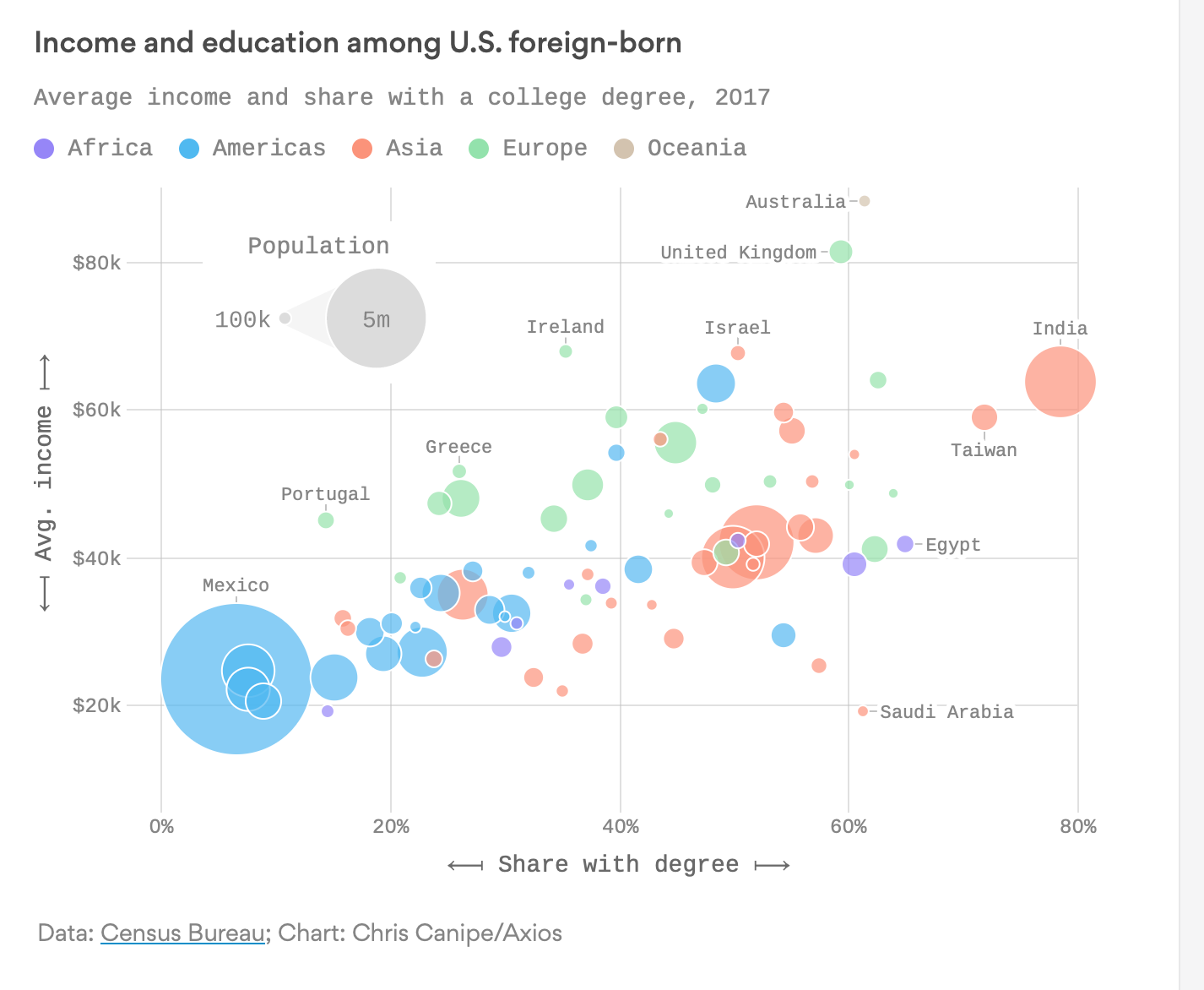
Asians tend to be among the best-educated immigrants to the U.S., and also land in some of the most lucrative careers. But, according to U.S. Census data, the image of privilege is true for only some Asians.

The bottom line: Data shows that income inequality is greater among Asian immigrants than for those arriving from anywhere else.

  • Indians on average earn $64,000 a year, and 78.6% have college degrees.
  • But but but … Compare that to Afghans ($22,000), Nepalis ($25,000) and Laotians ($32,000).

How to read the chart (above), via Axios visual journalist Chris Canipe: The circles represent each country’s population in the United States. Those on the lower left tend to have smaller average annual incomes and are less likely to have college degrees. Those in the upper right have the highest average incomes and are more likely to have degrees.

  • The red circles — representing Asian countries — are spread wider across the chart than circles of other colors, indicating higher inequality.

Source: The immigrant groups that make the most money

Douglas Todd: Offspring of Chinese and South Asian immigrants reaping high-skilled jobs

The overall national numbers somewhat amplify the differences between visible minorities and not visible minority given rural Canada is overall not visible minority, and where levels of university education are lower. However, even at the city level, the differences are significant in terms of income but with the same relative pattern of visible minority groups that are doing better compared to those that are not:

Second-generation immigrants are proving adept at moving into high-skilled careers in Canada.

The offspring of Chinese and South Asian immigrants, especially women, stand out for obtaining a much higher percentage of high-skill careers in Canada than the rest of the population.

A new Statistics Canada analysis reveals more than 40 per cent of second-generation Canadians of Chinese or South Asian background — the two largest minority groups in Canada — have found mid-career jobs in high-skill sectors.

That compares to less than 30 per cent of second-generation male Southeast Asian or white immigrants — and 20 per cent of white males whose parents are not immigrants. The study’s surprising, mixed results may cause some public-policy makers to re-think their traditional understanding of employment equity.

The StatsCan analysis, by Wen-Hao Chen and Feng Hou, shows children of nearly all immigrants are significantly more educated than their parents. And second-generation Chinese, South Asian, Japanese, Korean and West Asians are obtaining the highest proportion of university degrees and strongest percentage of jobs that rely on such educations.

But other second-generation immigrants — particularly Filipinos, blacks and Latin Americans — are not doing nearly so well at snagging high-skill jobs.

Neither are whites whose parents are not immigrants, whom the report refers to as “third-plus generation whites.” The StatsCan analysis did not include data on Indigenous people, who tend to score low on educational and labour rankings.

“Second-generation Chinese and South Asians, in particular, are over-represented in high-skill occupations relative to third-plus generation whites,” say Chen and Hou.

“About 40 per cent or more of second-generation Chinese, South Asians and West Asian or Arabs worked in high-skill occupations, compared with 20 per cent of men and 31 per cent of women among third-plus generation whites,” says their February study, titled Intergenerational Education Mobility and Labour Market Outcomes.

“The shares of second-generation Filipinos, Latin Americans and blacks working in high-skill occupations were similar to or smaller than those of third-plus generation whites,” said the report, noting that less than 22 per cent of Filipino, Latin American, black immigrants, or white males of Canadian-born parents, were employed in the high-skill sector.

Canadian women are in general doing better than men at obtaining high-skilled work.

Especially excelling are second-generation women of Chinese, South Asian and West Asian/Iranian origins. More than 43 per cent of women in these cohorts work at high-skilled jobs, compared to just 31 per cent of white women who are not the children of immigrants.

The StatsCan report, based on the 2016 census, defines high-skill occupations as those that generally require a university education, such as senior and middle management roles, as well as professions in business, finance, health, applied sciences, education, law, community services, arts and culture.

The report shows a strong link between obtaining a university degree and, before age 45, getting a high-skilled job. The exception was among Filipino, Latin American and black women, whom the report suggested may be vulnerable “to a certain degree of over-education.”

Table 4: Percentage of workers aged 25 to 44 in high-skill occupations among second-generation groups. (Source: Excerpt from Statistics Canada analysis.)

One of the paradoxical findings in the report is that there is not always a direct parallel between getting a university education, obtaining a high-skill job and achieving a strong salary.

“All second-generation groups, both men and women, had higher university completion rates than third-plus generation whites,” write Chen and Hou. Many of the minority cohorts had twice the university completion rate of whites whose parents are not immigrants.

Yet the veteran researchers found university-educated second-generation male Chinese and South Asians end up having roughly the same annual earnings — in the low-$60,000 range — as male whites whose parents have resided in the country for decades.

The levelling out of annual wages among the different ethnic and immigrants cohorts is partly owed to the way the Statistics Canada report tallies only people who obtain university degrees, not those who finish college or technical-school degrees or diplomas.

Chen and Hou note the children of the Canadian-born tend to go to colleges. Other demographers point to how white Canadian males are increasingly avoiding university and finding employment in the trades, such as plumbing, carpentry and electronics, which can often be well compensated compared to jobs in the arts, community and culture sectors.

One factor that might hold back some second-generation Canadians could be language. Chen and Hou suggest male offspring of Latin American and Southeast Asian immigrants end up earning less per year than most males, roughly $45,000 annually, in part because they tend not to speak English at home.

Women in general also earn less per year than most males, regardless of immigration status, according to the Statistics Canada analysis, which suggests that “discrimination” and “cultural factors” could be relevant in regards to the differences between male and female annual earnings.

All in all, data show offspring of immigrants are doing either decently or exceptionally in both higher education and the job market. And this StatsCan analysis of the 2016 census complicates the picture of who is flourishing and struggling in the Canadian workplace.

Source: Douglas Todd: Offspring of Chinese and South Asian immigrants reaping high-skilled jobs

Income gap persists for recent immigrants, visible minorities and Indigenous Canadians

The Stars’s highlighting of the recent Census release:

As the face of Canada grows more diverse, the income gap between residents who identify as visible minorities, Indigenous or recent immigrants and the rest of Canadians remains a yawning chasm, data from the 2016 Census shows.

The income gap for these groups barely budged between 2006 and 2016, narrowing by just two percentage points for Indigenous Canadians and recent immigrants and widening by one percentage point for visible minorities, according to census data released Wednesday.

Total income was 26 per cent lower for visible minorities than non-visible minorities and 25 per cent lower for Indigenous Canadians than non-Indigenous Canadians.

But recent immigrants — many of whom are also visible minorities — face the toughest economic challenge with total incomes that fall 37 per cent below total incomes for Canadians born here, the data shows.

It means for every dollar in the pocket of someone born in Canada, a recent immigrant has just 63 cents.

More than 22 per cent of Canadians — including 51.5 per cent of Torontonians — reported being from a visible minority community in 2016, up from 16.3 per cent nationally in 2006.

In Toronto, more than 55 per cent of visible minority residents were living on less than $30,000 in 2016 compared to fewer than 40 per cent of the rest of the city’s population, according to census data provided to the Star.

While almost 14 per cent of non-visible minorities in Toronto reported total incomes of $100,000 or more, just 4 per cent of people from visible minority communities had access to that amount of cash in 2016.

“The latest census data simply confirms the reality that racialized people, recent immigrants, and Indigenous people continue to face discrimination and that income inequality doesn’t just magically reverse itself,” said Sheila Block senior economist for the left-leaning Canadian Centre for Policy Alternatives.

“That takes political leadership,” added Block who crunched the national income gap from the latest census data on immigration, ethnocultural diversity and aboriginal peoples.

“As these populations increase and continue to lag behind, it becomes a bigger issue for everybody,” she said.

“We know this kind of inequality doesn’t only have a negative impact on the population that’s affected, but it has a negative impact on us overall as a society.”

Increases to income support programs such as social assistance, employment insurance and pensions are part of the solution, she said. But labour reform, including more access to unionization and a higher minimum wage are also key.

Nadira Begum, who has a master’s degree in social work from her native Bangladesh, juggles three part-time jobs and numerous volunteer positions in the non-profit sector but still hasn’t been able to land full-time work.

“I have been looking for a full-time job in my field for more than 10 years,” said the Regent Park mother of three. “I have the skills, the experience and the knowledge, but if they don’t hire me, how can I show them? It is a common story in our community.”

Begum’s part-time jobs have often involved substantially similar work as full-time employees, and yet she has been paid a lower wage. Friends with part-time jobs as grocery store clerks who were hired the same time as full-time clerks are paid less and enjoy fewer benefits, Begum added.

“We are not equally paid, even though we do the same work,” she said. “And we can’t complain because we can’t afford to lose our jobs.”

Deena Ladd of the Workers’ Action Centre says Ontario’s planned $15 minimum wage by 2019 will be a huge boost for visible minorities, recent immigrants and Indigenous workers, who are more likely than the rest of Canadians to be toiling for minimum wage.

But changes to the province’s proposed Fair Workplaces, Better Jobs Act are needed to ensure these workers, who like Begum are often stuck in temporary, part-time and contract positions, are paid the same as permanent and full-time staff, Ladd said.

Wording in the proposed minimum-wage legislation currently mandates equal pay for equal work if the job is “substantially the same,” Ladd said. But that allows employers to change one aspect of the job and still be allowed to pay temp, contract and part-time workers less.

Instead, the proposed legislation should be reworded to say these workers are entitled to equal pay if the job is “substantially similar” to work performed by a full-time employee, she said.

Another problem with the proposed law is the definition of seniority. Unlike all other provisions of the Employment Standards Act which measure seniority by the date an employee was hired, the equal pay amendments include a definition of seniority as “hours worked.” If this is not changed, workers from economically disadvantaged groups who are more likely to work part-time, will never achieve equal pay for equal work, Ladd said.

“The new legislation has the potential to address the kinds of inequities highlighted by the census,” she said. “But if we don’t strengthen the language so workers can use the equal-pay protections in their workplaces in a strong way, then it will be just words on paper.”

The legislation, which just passed second reading, is expected to become law later this year.

Ryerson University professor Myer Siemiatycki, who teaches immigration and settlement studies, says the census findings are a wake-up call and a reminder of why the census is important.

“These are worrying statistics,” he said. “They reflect the adverse living conditions of huge numbers of Canadians who fall into these three categories of population . . . It’s an alarm bell and we need to respond.”

Source: Income gap persists for recent immigrants, visible minorities and Indigenous Canadians | Toronto Star