Ministry ignored immigration impacts: Report

Sigh…. Once again, the value of evaluation reports is demonstrated and should enjoy broader coverage for their findings:

The Canadian Immigration Department has admitted to ignoring whether foreign workers took Canadian jobs or kept wages low, Blacklock’s Reporter has reported.

Impacts are not monitored, said an internal report.

“The program is built on the assumption that benefits to Canada from the facilitation of select foreign workers exceed any potential harm to the domestic labour market,” said the Evaluation Of The International Mobility Program. “However document review and key informants pointed out that labour market impacts are not monitored.”

Auditors scrutinized a program that allowed more than 3,970,000 foreign workers into Canada from 2014 to 2022.

Most were men under the age of 34 and came from India and China.

Almost half applied to stay in Canada as permanent residents, wrote the Department of Immigration.

The Evaluation report said there were no attempts to make sure Canadian workers and wages were protected.

“The program is less aligned with commitments to consider Canadian workers first especially given the program’s continued growth,” it said….

Source: Ministry ignored immigration impacts: Report

Link: Evaluation of the International Mobility Program

Todd: Little-known program dominates Canada’s massive guest-worker scheme

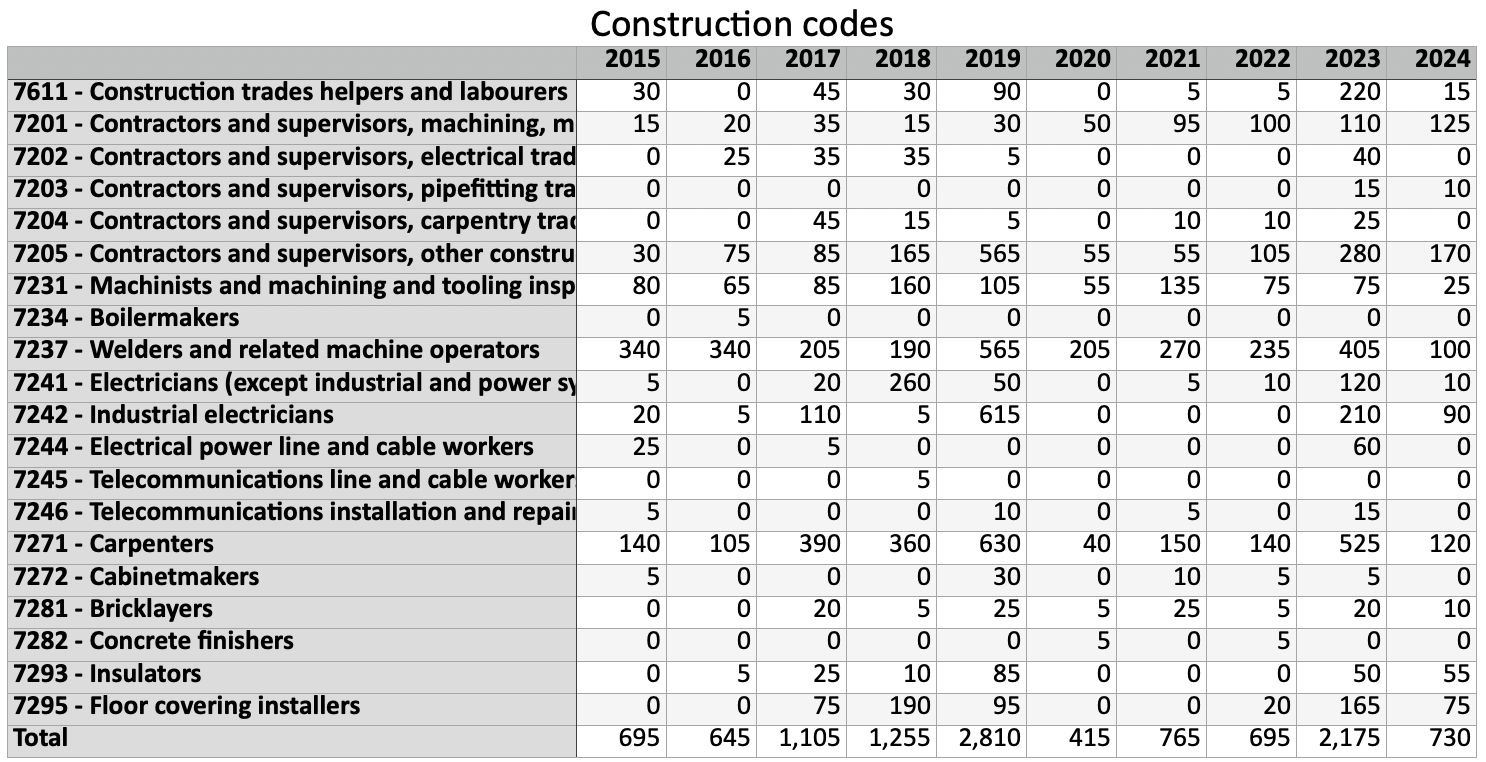
Unfortunately, Olsen didn’t check the data (Temporary Residents: Temporary Foreign Worker Program (TFWP) and International Mobility Program (IMP) Work Permit Holders – Monthly IRCC Updates – Canada – International Mobility Program work permit holders by province/territory, intended occupation (4-digit NOC 2011) and year in which permit(s) became effective). Had some time to look at the construction sector, highlighting that there has been an increase at the supervisory level (B):
Union leader Mark Olsen is frustrated Canadians know almost nothing about Ottawa’s international mobility program. And he’s afraid company bosses want it that way.

The program is the vast federal guest worker program that now brings by far the most newcomers into Canada — with more than one million in the country now.

It’s also the program that Olsen believes makes it most easy for employers to exploit guest workers, which in turn harms Canadian workers.

As the western manager of the Laborers International Union of North America, Olsen said that the international mobility program is drawing more than four times as many guest workers as the more discussed temporary foreign workers program.

Two weeks ago Prime Minister Justin Trudeau promised to modestly trim the temporary foreign workers program by up to 80,000 workers after protests that it was responsible for a high number of low-wage workers at a time of high unemployment among Canadian young people.

An Angus Reid Institute poll released Tuesday shows that 56 per cent of Canadians believe the Liberals are bringing in too many temporary workers, which they think is making it harder to access housing and obtain decent wages.

Olsen believes Trudeau’s gesture with the temporary foreign workers program is window-dressing. If the past is a guide, he said, the federal government and corporations will just use the decline of that program to funnel more foreign workers into the expanding international mobility program.

The government’s strategy, Olsen said, will continue to “institutionalize foreign worker exploitation, discrimination and abuse, distort the labour market, suppress Canadians’ wages and lead to a loss of training opportunities and jobs for Canadian workers, including Indigenous people and women.”

There is a need, Olsen said, for qualified people to come from other countries to work in Canada. That’s especially the case in Canada’s gigantic construction industry, which employs most members of the Laborers International Union of North America. But guest workers, Olsen said, must be invited to the country in a way that’s fair both to them and to Canadian workers.

The major defect in the international mobility program, Olsen said, is that, unlike the temporary foreign workers program, it doesn’t require Canadian employers to provide evidence to the government that they’re unable to find a Canadian to do the job.

“This has made the IMP (international mobility program) ripe for abuse of both the system and the temporary worker, and has fuelled explosive growth under the program,” said Olsen.

A second problem with the international mobility program is that employers are allowed to pay the foreign workers significantly less than they pay Canadians in the same job, whether they’re in the field of high tech, health care, retail or construction. That’s because bosses only have to commit to paying foreign workers a wage that is higher, even only slightly higher, than the median Canadian salary, which Olsen said is in the $23-an-hour range.

That leads to international mobility program workers often doing the same tasks as Canadian workers at far lower wages.

Obviously, Olsen said, the big wage disparity hands bosses an incentive to hire cheap labour through that program, rather than seek Canadian applicants.

“It results in employers paying substandard wages and often no benefits to foreign workers,” Olsen said in a joint memo with Eric Olsen, his brother, who is the political director for the western arm of Laborers International Union, which has about 400,000 members in the U.S. and 150,000 in Canada. “It also allows employers to pay Canadian workers less than the market would ordinarily require, distorting the market.”

The B.C. Building Trades this year put together a report on migration, with case studies showing how B.C. employers paid foreign workers much less than Canadians during construction of the Golden Ears Bridge, the Murray River mine project and the Canada Line.

Since 2015, the Liberal government has dramatically increased the number of temporary residents in Canada, to about 2.8 million. Immigration Minister Marc Miller said this year that nine per cent are in the temporary foreign workers program stream, 44 per cent are employed in Canada through the international mobility program category and another 43 per cent are foreign students, most of whom are allowed to work.

However, Mark Olsen is on to something when he worries ordinary Canadians have no idea about the country’s many guest worker programs — and the often crucial differences between them.

Canada’s migration system is complex and confusing. Even politicians, pundits and pollsters often make comments that suggest they mistakenly think the temporary foreign workers program is the only Canadian stream for “temporary” workers. It doesn’t help that the term, international mobility program, is itself fuzzy.

In the face of the public’s ignorance, which Mark Olsen believes companies capitalize on, the leaders of the Laborers International Union want to reform Canada’s guest-worker programs.

One top recommendation is that bosses using the international mobility program must prove there is a need for each guest worker. Such declarations exist with the temporary foreign workers program, when employers fill out a document called a labour market impact assessment.

And since news reports frequently arise about abuse and deception in regard to the rules of the guest worker system, the union says “there must be proper enforcement and significant penalties.”

In addition, union wants all foreign workers in Canada to “have the same rights as Canadian workers” and “be paid the same as Canadian workers in wages and benefits.”

It also recommends providing foreign workers “a pathway to Canadian citizenship.” As the union’s policy paper says: “If these workers are good enough to be invited here to build our country, they are good enough to stay and build their families and communities.”

In regard to these last two reforms, Mark Olsen acknowledged that there is sometimes resistance from members of his union.

Given changing public sentiment in Canada, that’s not surprising. One key finding in this week’s Angus Reid poll is that only 24 per cent of Canadians believe guest workers should be offered a route to citizenship.

Nevertheless, Mark Olsen said after he talks to members about the union recommendations on guest workers, they invariably end up embracing the union’s viewpoint, which he describes as “respect for all.”

Source: Little-known program dominates Canada’s massive guest-worker scheme

Lisée: Les expulsions barbares

More Quebec commentary on the need for Quebec to exercise the same control over the IMP, whose numbers have ballooned as elsewhere in Canada, as it does for TFWP:

De mauvaises langues accusent le député Sol Zanetti d’avoir atteint le summum de l’exagération en gonflant, puis dégonflant, une balloune depuis son siège de l’Assemblée nationale jeudi dernier. Je ne suis pas d’accord. Juste avant, en point de presse, un autre député solidaire avait fait pire.

Au cas où on déclare atteinte, voire dépassée, la capacité d’accueil du Québec et qu’on veuille limiter le nombre d’immigrants temporaires au Québec, passés de 47 000 en 2007 à 470 000 cette année, il a dit ceci : « Si on définit qu’elle est remplie [la capacité d’accueil], on coupe qui ? On va commencer à faire des déportations massives ? On va commencer à dire que ces 100 000 là, qui sont de trop, peut-être, qui ont déménagé ici, qui ont eu des contrats, qui ont eu un logement, qu’on leur a donné un permis, qui travaillent dans le réseau de la santé et dans l’éducation… On va leur dire : “C’est terminé ? […] Vous savez quoi, là, on s’excuse, on vous a fait venir pour rien, on s’est trompé, finalement, on n’a pas la capacité de vous avoir” ? »

Je vais vous étonner. Il s’agit d’un député qu’on estimait jusque-là crédible et posé : Guillaume Cliche-Rivard. Il est avocat, expert en immigration. Comment peut-il ne pas savoir qu’on parle ici des temporaires qui, comme leur nom l’indique, sont bien temporaires. L’immense majorité des étudiants étrangers qui peuplent McGill et Concordia et anglicisent le centre-ville prennent la poudre d’escampette dès qu’ils ont leur diplôme en poche. L’immense majorité des travailleurs agricoles volent retrouver leur famille latino-américaine une fois la récolte terminée. Les autres savent tous que leur séjour affiche une date de péremption, ce à quoi ils ont librement consenti.

Bref, si on décidait, selon le chiffre évoqué, d’admettre désormais 100 000 personnes de moins, ce qui nous maintiendrait toujours à un niveau historiquement excessivement élevé, il suffirait d’attendre que ceux qui souhaitent repartir repartent et de ne donner des autorisations qu’à 370 000 candidats, plutôt que 470 000.

L’introduction du terme « déportation » dans un débat sur l’immigration qui se déroulait depuis quelques mois dans un contexte apaisé est simplement honteuse. S’il tient à sa crédibilité, Cliche-Rivard doit faire amende honorable.

Sur le fond, il affirme ne pas savoir si, oui ou non, notre capacité d’accueil est atteinte. Il voudrait qu’une équipe d’experts se penche sur la question. C’est une idée tellement bonne que je la proposais en 2018 lorsqu’on ne comptait sur le territoire que le quart du nombre de temporaires actuel.

On peut bien, comme le fait la ministre de l’Immigration, Christine Fréchette, par un appel de projets de recherche, en obtenir une analyse plus fine et régionalisée. Mais refuser d’admettre aujourd’hui que l’ajout depuis cinq ans de centaines de milliers de personnes supplémentaires aggrave les crises du logement, de la santé et des garderies me rappelle ceux qui, face aux méfaits du tabac ou du réchauffement climatique, réclamaient davantage d’études.

Heureusement, un grand nombre de Québécois ont entendu parler de la loi de l’offre et de la demande. Début octobre, 71 % d’entre eux (comme 68 % des Canadiens) ont déclaré au sondeur Ipsos qu’imposer un plafond d’admission aux étudiants étrangers serait une bonne façon de réduire la pression sur les logements abordables. Logiques, 75 % des Québécois (71 % des Canadiens) pensent qu’il faut revoir à la baisse les cibles d’immigration le temps que se résorbe la crise du logement. (Mémo au politburo de QS : ce sentiment est partagé par 66 % des 18-34 ans, votre électorat principal.)

Qui, parmi nous, à part les élus solidaires, figure parmi les dissidents de la loi de l’offre et de la demande ? Le gouvernement fédéral, bien évidemment. L’inénarrable ministre de l’Immigration, Marc Miller, a redit récemment qu’il fallait davantage d’immigrants pour construire davantage de logements. (Marc, ça ne marcherait que s’ils les bâtissaient avant d’arriver ou s’ils les emmenaient avec eux. Un pensez-y-bien.)

Plus terre à terre, son collègue Pablo Rodriguez, qui semble admettre l’existence d’un problème, a prétendu que l’augmentation du nombre de temporaires était la faute du Québec. Mme Fréchette affirme au contraire que c’est la faute du fédéral. Peut-on savoir qui remporte la palme de cet édifiant concours de Ponce Pilate ?

Mardi, dans ces pages, la spécialiste Anne-Michèle Meggs a mis clairement la responsabilité sur les épaules du Québec.

À l’exception des demandeurs d’asile, le Québec a indubitablement le pouvoir de réduire le nombre d’étudiants étrangers, qui comptent pour 44 % des temporaires, mais il ne le veut pas ; il a indubitablement le pouvoir de limiter le nombre de travailleurs temporaires (17 %), mais il ne le veut pas.

Sur le reste, les 36 % du Programme de mobilité internationale, Québec a omis d’exiger un droit de veto lors de sa création pendant l’ère Harper. Le gouvernement Legault — au pouvoir pendant l’explosion des temporaires et en possession depuis avril 2022 d’un rapport des experts Pierre Fortin et Marc Termotte l’avisant de sa « perte de contrôle » du dossier — a choisi de ne pas utiliser le levier à sa disposition : réclamer, comme le lui permet l’entente Canada-Québec, l’ouverture de discussions qui lui permettraient d’en reprendre le contrôle.

Bref, alors que 7 Québécois sur 10 savent que l’explosion du nombre d’immigrants rend intenable — et probablement insoluble — la crise du logement, entre autres, nous sommes en présence d’une opposition solidaire fantasmant sur des « déportations » massives et d’un gouvernement caquiste qui se prétend nationaliste, mais refuse d’utiliser les pouvoirs que détient déjà la nation.

Bref, bienvenue au Québec.

Jean-François Lisée a dirigé le PQ de 2016 à 2018. Il vient de publier Par la bouche de mes crayons, aux éditions Somme toute/Le Devoir. jflisee@ledevoir.com

Source: Les expulsions barbares

Ottawa to rectify issue with massively revised temporary foreign workers data

Good quick response. And kudos to the Globe for uncovering the change. Hopefully the lesson learned is that any significant change must be openly and transparently communicated, preferably with advance consultations:

The federal government says it will publish a full accounting of temporary foreign work permit holders in Canada after The Globe and Mail discovered that more than two decades of data had been altered without explanation.

More than one million people held work permits through the International Mobility Program at the end of last year, according to figures that Immigration, Refugees and Citizenship Canada published in February.

However, the federal immigration department recently made significant downward revisions to those numbers, indicating there are now around 675,000 permit holders. The figures for all previous years, dating back to 2000, had also been reduced.

Several immigration researchers told The Globe that IRCC removed work permit holders whose primary reason for being in Canada may not be related to the labour market, such as students and refugee claimants.

The department said the revised numbers were not properly labelled. “When this new data set was published, the incorrect title/description was mistakenly published to accompany it,” spokesperson Matthew Krupovich said in a statement.

IRCC said it intends to publish figures on both the narrower and broader groups of work permit holders, but did not indicate when that will happen.

Some economists were frustrated with how IRCC handled the data revision and expressed concern that lowering the numbers would obscure how many temporary foreign workers are in the country.

“The data is just a mess,” said Mikal Skuterud, a professor of labour economics at the University of Waterloo.

By not counting international students with work permits, for example, “one would understate the growth of the IMP,” Feng Hou, principal researcher at Statistics Canada, said by e-mail.

The International Mobility Program accounts for a large share of temporary foreign workers in the country. Within the program are several categories of permit holders, including postgraduate workers and spouses of skilled workers.

Canada’s population is growing rapidly, in large part because of the influx of temporary residents, including workers and students. Many of those people are accruing postsecondary degrees and Canadian work experience in hopes of getting permanent residency.

The use of temporary foreign labour by Canadian employers has soared in recent years. The trend has been criticized by many economists for helping companies minimize their labour costs, among other reasons.

Source: Ottawa to rectify issue with massively revised temporary foreign workers data

Douglas Todd: The downside to increasing low-skill migration to Canada

Good overview of recent research on low-skill migration and the government’s repetition of the Harper government mistakes before correction after a few years:
Former Conservative prime minister Stephen Harper found himself in trouble in 2014 for jacking up the number of temporary foreign workers coming to Canada to work at places like McDonald’s and Tim Hortons.
Then-opposition leader Justin Trudeau, labour unions and the media went into overdrive — attacking Harper for pandering to the business lobby by inundating the market with hundreds of thousands of low-skilled temporary foreign workers, many of whom were vulnerable to exploitation.
To the surprise of many, Harper responded to the outcry. He sharply reduced the number of guest workers and brought in laws encouraging employers to improve working conditions and hire more people who were born in Canada or had become permanent residents.

Source: Douglas Todd: The downside to increasing low-skill migration to Canada

Transition from temporary foreign workers to permanent residents

Former Minister Alexander’s asserted before CIMM during its study of C-24 that:

…it’s very important to distinguish between the two different broad categories of status that non-Canadian citizens can have here. One is temporary resident status and the other is permanent resident status. We are saying that the time that will count toward citizenship is permanent resident status. We don’t want those lines to be blurred. (28 April 2014)

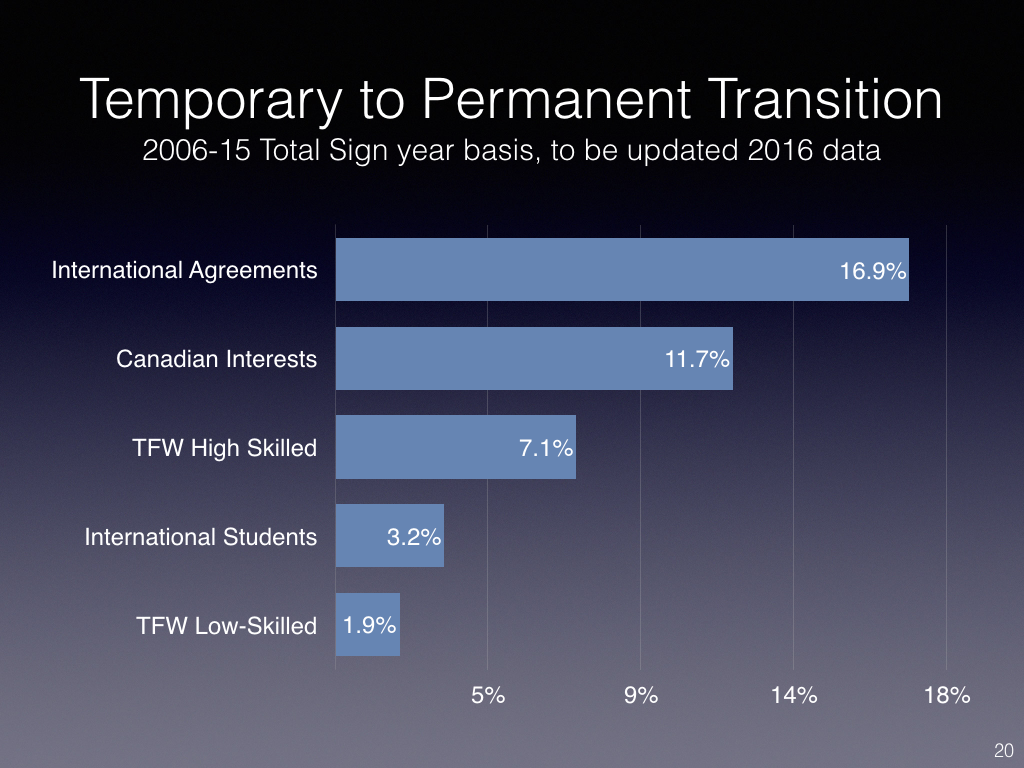
This latest Statistics Canada belies that dichotomy, as do IRCC’s Open Data data sets (my chart below based upon this series – Transition from Temporary Resident to Permanent Resident Status.

There were 310,000 temporary work permit holders on December 31, 2015, accounting for 1.7% of the national employed workforce. The number of TFWs has more than quadrupled since 2000 (Immigration, Refugees and Citizenship Canada 2017).

Over the 2000s, immigration to Canada was increasingly drawn from TFWs. For instance, the proportion of newly landed adult immigrant men already holding a job in Canada rose from 16.3% in 1999 to 28.9% in 2010. Most of this increase consisted of immigrants who had high-paying jobs in Canada before attaining permanent resident status.

About 9% of TFWs who came to Canada between 1995 and 1999 became permanent residents within five years of receiving their first work permit. This was the case for 13% of those who came to Canada between 2000 and 2004, and for 21% of those who came between 2005 and 2009.

Most transitions from TFW status to permanent resident status occurred within the five years following receipt of the first work permit. The rate rises another 1 to 3 percentage points by the 10th year, with little increase observed thereafter.

Transition rates

The rate of transition to permanent residence varied by type of work permit. Among those who came to Canada between 2005 and 2009, the five-year transition rate was highest among those in the Live-in Caregiver Program (LICP), at 56%, and the Spouse or Common-law Partner category, at 50%. The lowest rates for transition to permanent residence were among those in the Seasonal Agricultural Workers Program (SAWP), at 2%, and the Reciprocal Employment category, at 9%.

A large difference in the transition rate by type of work permit is a result of government policy. For example, while all those in the LICP are allowed to apply for permanent residence after two years of full-time work as domestic workers, SAWP workers have no dedicated stream for transition, and may only be employed for a maximum of eight months per year. Their SAWP permits, however, can be renewed over many years.

Source: Transition from temporary foreign workers to permanent residents