Hardin: Breaking the Immigration Taboo

A bit of a rant and overly rambling and unfocussed but nevertheless a signal among some who consider themselves progressive are increasingly concerned given housing and other impacts:

….And as if that weren’t enough, Justin Trudeau keeps on increasing the number of immigrants, hiking it from 400,000 annually to half a million. When Eby began the frantic drumbeating for new housing, the figure for new immigrants arriving in Greater Vancouver was an estimated 30,000 to 40,000. That had already changed by the end of 2021, when the net inflow of people to B.C. was 100,797. Of those, 33,356 people came from other Canadian provinces and territories and the remaining 67,141 from abroad, with most ending up in Greater Vancouver. Not all of them would have been immigrants; net non–permanent residents like “temporary foreign workers” and net foreign students would be in the total.

In the subsequent year, 2022, the inflow into B.C. from international migration increased to 150,783, of whom 98,763 were non–permanent residents. Canada’s population overall increased by 1,050,110 people; almost all the increase – 96 per cent – came from international migration.

Eby has mentioned what lay behind what he was facing – federal immigration policy. No wielding of the hammer on that one, however. The new housing minister, Ravi Kahlon, has belatedly gone as far as to argue with Ottawa that immigration should be tied to housing availability. But without his tackling the underlying premises impelling Trudeau and company – without even following through on his own argument – he hasn’t, as of this writing, made much headway.

The taboo is great.

Nor is Eby the only one who shies away from speaking directly to the root issue.

With some exceptions, almost everyone publicly tearing their hair out over housing unaffordability or what the attendant pressure is doing to Vancouver avoids mentioning the “i” word as something that needs to be tackled first and foremost, in the same way that everyone, except a little boy, wouldn’t say out loud that the emperor had no clothes.

What’s really behind high immigration numbers

What underlies immigration to Canada and the current numbers is not humanitarianism but economics. Indeed, immigration to Canada, save for refugees, has always largely been economic. The argument is that immigrants boost the Canadian economy and are even needed to keep the Canadian economy going. That this might be a dubious argument doesn’t discourage its promoters.

Immigration Minister Sean Fraser was quite straightforward about this in a statement to Reuters late in 2021. “Canada needs immigration to create jobs and drive our economic recovery,” he said, as if simply saying so made it true.

Fraser has since doubled down on his message box, again without in fact making the case and again without addressing housing affordability and additional pressures on health care.

The need for immigrants to keep the economy going has now become a mantra, repeated casually at large (an “economic imperative,” a National Post columnist called it), to which has recently been added a submantra: the need for immigrants to fill unfilled job positions. It’s economics – unquestioned economics – again.

NDP leader Jagmeet Singh has also, naively, claimed we are dependent economically on immigration. He and the political left in Canada, captive to their routinized thinking on immigration, have failed to understand the dynamic at work. It’s important to realize that open immigration to serve economics isn’t left-wing at all. The free movement of labour is part of classical right-wing neoliberal doctrine, complementing free trade. If community is harmed or destabilized by the application of the doctrine, whether by free trade or inflated immigration levels, “So what?” says the market-doctrine right-winger: “It’s the market at work. You shouldn’t object.”

It’s not surprising, then, that the original recommendation for hiking the level of immigration to Canada to 450,000 annually came from the federal Advisory Council on Economic Growth, circa 2017, replete with neoliberals and with nobody as awkward as even a pale socialist or environmentalist to show any dissent. The Council was chaired by Dominic Barton, a former senior executive of management consulting firm McKinsey and Company.

The Council also recommended that Canada aim for 100 million people by the end of the century. This was without reference to the environment. The connection between another 60-odd million people in a northern, high-consuming country and its impact on global warming and the environment is not part of the neoliberal frame. The doctrine on this score – justifying immigration for economic reasons outside of the environmental context – is no different, schematically and ideologically, from justifying increased oil sands production and otherwise boosting the oil patch overall for economic reasons.

There’s a further irony underlying these other ironies. The economic rationale for immigration – the majestic declaration that newcomers are the key to the future – is faulty taken by itself.

It’s false to claim that increased immigration is essential to the Canadian economy in any ordinary sense; the evidence doesn’t sustain that and it doesn’t meet the standard of common sense.

There is nothing to prevent an economy with a stable or slowly growing population from functioning well. Indeed, it is arguable that the more stable a population, the more focus can be given to employment engagement, training and education, and downstream allocation of the workforce in order to produce the maximum economic, social and environmental payoff per capita and, at the same time, enhance the quality of life.

It also begs the theoretical question of whether Canada, and every country in the world, have to keep compounding their population growth forever and ever until Doomsday if they wish to prevent their economies from falling apart. The world’s population, then, would have to increase to 15 billion people, and then 20 billion, and so on, just to keep economically afloat – a notion that we know is absurd.

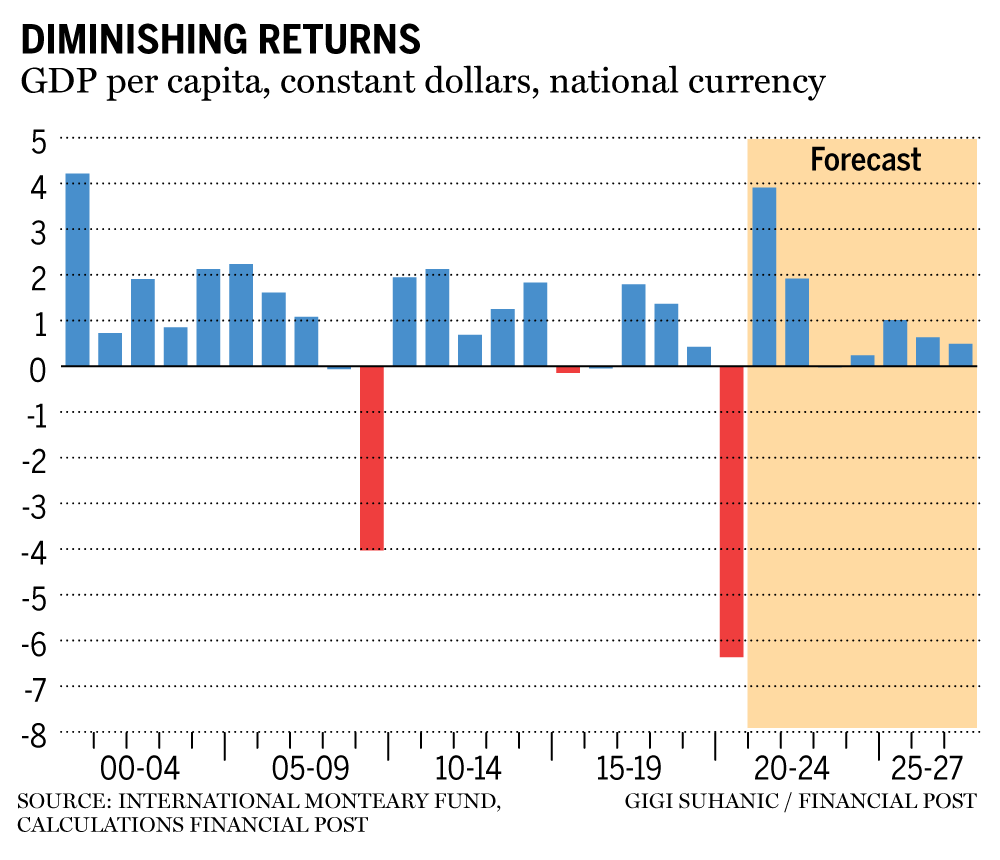
In the here and now, the argument for inflated immigration to Canada is also a counterproductive notion, economically speaking, because it measures by mass rather than by per capita economic performance and quality of life. Canada (using the International Monetary Fund measure) is 26th in the world rankings of GDP per capita, adjusted for purchasing power parity (PPP), as of current estimates. Denmark, which has strictly limited immigration, is 11th. Norway is seventh, Switzerland sixth, the United States eighth and so on. All the Scandinavian countries are higher than Canada; so are Austria and Taiwan. Singapore is second.

In 1986, just prior to immigration to Canada spiking, Canada was 15th; we’ve lost 11 places since. Our GDP per capita in 1986, again adjusted for purchasing power parity, was 89 per cent of the American one; since then it has fallen to 75 per cent.

Perhaps more instructive are the IMF’s projections through to 2027, where Canada is projected to fall to 28th place. It will also have lost, once more, a few percentage points to the United States, which itself is predicted to fall a few places in the IMF rankings. By way of explanation, the OECD has Canada dead last among the 38 OECD members in GDP per capita growth for 2020–30 (and also dead last for 2030–60).

Don Wright, former deputy minister to B.C. Premier John Horgan and a Harvard-trained economist, takes this one step further in a recent paper for the Public Policy Forum. Wright points out that by counting on immigrants and foreign workers for low-wage jobs, average per capita income and what goes with it (from quality of life to per capita tax revenue) are lowered and the professed desire to help the middle class is betrayed. He references stagnant real wages, their direct relationship to housing unaffordability and the coincidental ascendancy of neoliberalism. Raising the per capita standard of living should be the goal, he argues. He goes on to debunk the argument of the open-ended need for more and more labour:

When businesses complain about having difficulty finding enough workers, what this really means is that they cannot easily find the workers they want at a wage they want to pay. But, within reasonable limits, this is a good thing. It forces employers to pay higher wages, provide better working conditions and drives the creative destruction that leads to higher productivity, more valuable products and better business models.

A subsequent study in Policy Options by labour economists Fabian Lange of McGill, Mikal Skuterud of the University of Waterloo and Christopher Worswick of Carleton elaborated on the argument, focusing in particular on the economic case against low-wage temporary foreign workers.⁶

The submantra that we need inflated immigration levels to fill unfilled jobs nevertheless keeps resurfacing, cited as a given both by ostensible experts and by politicians desperate to rationalize consequences like the housing crisis. David Eby himself, just before being sworn in as B.C. Premier, mentioned it by way of explaining why he needed to act aggressively on housing.

It overlooks how the necessary adjustment in the labour market would happen, per Don Wright’s thesis. It’s as if there is no alternative to the neoliberal ideological fix behind the current excessive immigration level.

Well here, schematically, is the alternative, as would happen in a normal economy. Jobs are posted and if they’re more important relative to other jobs, the market or public allocation rises until they’re filled. At the same time, other jobs that cannot compete, because they’re relatively unimportant or not important at all, so that they don’t have sufficient competitive draw on the market or on public revenue, disappear. Over time, one ends up with a far more productive economy and a far more appropriate economy that dynamically follows market demand and public need.

But none of the alternatives to the current immigration level can be properly discussed, nor can a proper public debate take place, until we bury for good the neoliberal legend that we need immigration to keep our economy going. Once we do that, we can then get started on framing public policy accordingly, dramatically cutting back immigration and freely charting another course. We might even conclude that what makes most sense, for a high-energy-use country like Canada, is a stable population. But that’s for another analysis.

Source: Breaking the Immigration Taboo
Globe editorial – Immigration: Canada needs a strategy, not a numbers game [the penny drops…]

The Globe completes its shift from earlier “cheerleading” the Century Initiative, business leaders, governments and others in favour of high and higher levels of immigration to recognizing the realities of housing, healthcare and infrastructure deficiencies and raises the need for considering lower immigration levels. Fitting culmination to a good series of editorials and analysis by their journalists.

An “I told you so” moment for me (Increasing immigration to boost population? Not so fast.) and others. Better late than never…

There have been many waves of immigration that have transformed Canada in decades past. Eastern European migrants headed to the Prairies at the start of the 20th century, forever altering the heart of the country. Canada welcomed Hungarians in the 1950s, opened its doors to non-European immigrants in the 1960s, embraced Vietnamese refugees in the 1970s and, more recently, gave a new home to those fleeing the chaos of Syria.

Source: Immigration: Canada needs a strategy, not a numbers game

What’s the right number of immigrants for Canada?

In contrast to Globe editorial, Immigration: Canada needs more newcomers and (much more) housing, this article asks the needed questions, featuring business and academic economists who are increasingly challenging the current general political and economic consensus:

How many immigrants should Canada be admitting?

Economists are asking that question with increasing intensity – and for good reason. Canada’s population jumped by more than a million people last year. The surge was the largest annual increase in the country’s history, and one that was driven nearly entirely by immigration.

The skyrocketing number of new Canadians is putting added pressure on an already drum-tight housing market. People are scrambling “for a place to live in a market with no housing supply,” Bank of Nova Scotia warns. Home prices are climbing, while the rental vacancy rate is at “a generational low,” according to National Bank of Canada.

For now, the Liberal government in Ottawa is sticking to the aggressive pro-immigration policy that it introduced after being elected in 2015. It is targeting nearly half-a-million immigrants a year– roughly double the 261,000 that Canada admitted annually in the 2010 to 2014 period.

However, a growing number of critics are challenging the logic behind Ottawa’s great immigration ambitions.

Prominent business economists say they are baffled by the government’s insistence on sticking to supersized immigration quotas at a time of widespread housing shortages. Stéfane Marion, chief economist at National Bank of Canada, and David Rosenberg, president of Rosenberg Research, have urged Ottawa to consider revising its targets to allow housing supply to catch up to demand.

Meanwhile, a new working paper from a trio of Canadian academic economists digs deeper into the issues around immigration. The paper, currently circulating in draft form under the title, The Economics of Canadian Immigration Levels, offers a scholarly but withering critique of current policy.

The authors – Matthew Doyle and Mikal Skuterud of the University of Waterloo, and Christopher Worswick of Carleton University – argue that policy makers are mistaken to conclude “that if some immigration is good for the economy, then more must be better.”

Granted, how you view this issue depends on how you define “better.” The three economists acknowledge that if Ottawa’s goal is simply to swell Canada’s geopolitical clout then, yes, it does make sense to fling open the doors and welcome a massive influx of newcomers. More workers and more consumers will mean a larger economy.

But size isn’t everything. Imagine a case in which Canada’s economic output doubled while its population did, too. Would this improve life for a typical Canadian? Not really. The average person would wind up seeing no improvement in their standard of living. The increase in the size of the economic pie would be matched by an equivalent increase in the number of people sharing it.

There is also morality to consider. On paper, it’s possible to show that a country can generate an “immigration surplus” by bringing in masses of low-skilled workers to take menial jobs. This underclass of low-paid immigrants can free up the existing population to pursue better-paid occupations.

However, it’s questionable how far this idea can or should be pushed in an egalitarian country such as Canada. The notion of an immigration surplus downplays the stresses faced by low-paid immigrants. It ignores issues of income inequality and focuses only on the benefits reaped by the people already in the country.

The three professors argue for a more equitable, more inclusive approach. They say the fairest and most reasonable test of Canadian immigration policy is whether it helps to grow output per person – or gross domestic product (GDP) per capita, in the jargon.

Research has demonstrated that measures of per capita GDP are closely tied to feelings of well-being and life satisfaction. If immigration offers a surefire way to boost this number, then there is good reason to think it is benefiting the nation as a whole.

Unfortunately, for the pro-immigration camp, there is no evidence that it does much of anything to help accelerate growth in GDP per capita.

The opposite is often true. When immigration is limited and labour is in short supply, businesses can find it profitable to invest in new capital – tools, computers, factories and other gear – to boost the productivity of scarce workers. This capital investment can help to swell per capita GDP.

In contrast, when immigration is surging, the case for capital investment may look less attractive. Businesses can find it cheaper to hire an additional worker to meet new demand instead of investing in new equipment. The result can be a larger work force, but one with lower productivity and lower per capita GDP.

The three professors look back at past decades and see nothing to indicate that immigration has ever been an economic tonic.

“Using evidence for Canada and the U.S., we find either a negative relationship, or no relationship, between periods of high immigration and subsequent growth in GDP per capita,” they wrote in their paper.

Just to be clear here: The lack of any obvious economic payoff from immigration doesn’t mean Canada should slam the door shut on newcomers.

The economists point out that federal legislation lists 12 goals for immigration, ranging from family reunification to supporting minority official languages communities. Many of those goals aren’t economic in nature and can still justify substantial levels of immigration.

But the dubious economic case for immigration raises questions about why Ottawa has been basing so much of its immigration policy on economic rationales. The government’s most recent targets allot roughly 60 per cent of immigrant slots to economic-class applicants – that is, people who are, in theory, being chosen for their ability to contribute to Canada’s prosperity.

This emphasis on economic-class immigrants may reflect misconceptions.

Consider, for instance, the idea that immigration is needed to fill low-skill, essential jobs. This doesn’t make a lot of sense, according to the economists. Admitting people to fill low-wage jobs pulls down, rather than pushes up, GDP per capita.

Just as questionable is the idea that immigration can offset the effects of Canada’s aging population.

Immigrants age and eventually retire just like anyone else. While there may be a short-term demographic dividend from immigration, “leveraging this demographic dividend to produce ongoing growth would require a Ponzi-type strategy of continually increasing the immigration rate to undo the increasing size of the retirement-age population,” the economists wrote.

So what can Canada do to improve its economic-class immigration system?

The three co-authors suggest that Ottawa should focus on admitting immigrants with higher levels of skills and education than it is currently targeting. They argue that the goal should be to select immigrants who can earn at least as much as, if not more, than the average Canadian within 10 years of arrival. Over time, this policy should boost GDP per capita.

The economists don’t offer any estimate of how such a policy would affect the number of immigrants being admitted, although Prof. Skuterud and Prof. Worswick both acknowledged in interviews that the impact, at least at first, would likely be a significant decline in the number of newcomers.

They suggest this might be wise, given the stresses being put on social systems by today’s massive influx of immigrants. Their paper cautions that “the strains currently being placed on the public health care system, the public education system and the highly regulated housing sector suggest even more reason to be cautious about setting high levels of economic immigration.”

Pro-immigration voices can, of course, find plenty here with which to take issue. That is absolutely fine. A vigorous debate over immigration is exactly what Canada now needs.

Source: What’s the right number of immigrants for Canada?

Globe Editorial: Immigration: Canada needs more newcomers and (much more) housing

The Globe fails to take this argument to their logical conclusion: as it takes time to increase housing, lower permanent and temporary immigration levels are needed to address the imbalance:

The surge in immigration is no longer new news, but the size of the shift, and its implications across all of society, demand a longer, better informed – and more forthright – debate.

Source: Immigration: Canada needs more newcomers and (much more) housing

Qadeer: Canada needs new immigrants, but must plan for the consequences

Another good commentary regarding the failures of governments and stakeholders to acknowledge and address the externalities of immigration:

Despite their success, Canadian immigration and settlement policies are producing some unintended negative effects on post-secondary education, housing, the labour market, and visa and immigration processes. Because these areas are interrelated, when one becomes compromised, others are also affected.

The number of scams, false claims and fake documents in the immigration and temporary workers’ permits process points to this issue. While there appear to be no hard statistics, media accounts and government warnings indicate they are an issue.

Canada is a world leader in accepting immigration. In the past few years, it has been adding about one per cent of its population yearly by immigration. In 2022, apart from permanent immigrants (437,000), the number of non-permanent residents increased by a net of more than 607,000, some of whom were admitted as temporary workers and/or international students. Canada’s population increased by more than a million people, largely as a result of a surge in immigration and temporary residents. The federal government is aiming to add 1.5 million more immigrants by 2025.

So far, these policies seem to have worked out. There is strong support for increased immigration among Canadians. Environics Institute’s recent survey shows that seven in 10 support the present level of immigration, though there is some recognition of the challenges arising from it.

One of these challenges is false documents, which tend to follow the priorities of Immigration, Refugees and Citizenship Canada (IRCC). For example, if the protection of people persecuted because of sexual orientation in a country is the priority, suddenly claims in that area increase. Some immigrant consultants, as well as human smugglers, tutor and manufacture documents to support such claims.

A recent story in the Toronto Star found that as many as 700 Indian students were admitted to study in Canada on fake admission letters. They lived and found places in different colleges for years before it became known that the letters were bogus. A regulatory body for immigration consultants, the College of Immigration and Citizenship Consultants, has had limited success in supressing such practices.

The post-secondary education sector’s structure and purposes have been widely compromised by the drive to recruit international students. Universities, and especially colleges, including private colleges, have come to depend on the international student enrolment fees. Access to higher learning may only be partially the motivating factor behind the scramble for foreigners trying to access Canadian post-secondary education.

Being an international student also opens the door to permanent residency in Canada. This is a big draw for students from abroad. It has been turned into a business by some post-secondary institutions. Even Ontario’s auditor general has identified the dependence on these fees as a vulnerable point in post-secondary educational finances.

About 500,000 international students contributed  $16.2 billion in 2017 and $19.7 billion in 2018 to this country’s GDP and supported more than 218,000 jobs in 2018. These international students are also being used as a cheap way to combat labour shortages. Recent rule changes allow some international students to work up to 40 hours a week while attending classes. This is to serve the need of the labour market, rather than advance international students’ education. To accommodate their schedule, institutions are arranging classes in the evenings and on weekends. In Toronto, for example, young South Asians dominate the landscape working as delivery workers and van drivers. If they are students, one wonders how much time they can spend on their studies after working a full-time job.

The enrolment of large numbers of international students affects the quality of educational programs in post-secondary institutions. International students generally add to the quality of learning experiences. Many international students are among the brightest. But the aggressive recruitment — combined with studies becoming a path to permanent residence and employment — have affected the classroom. Classes dominated by students from abroad with wide variations of language skills and motivation inhibit discussion and compromise learningThis is hardly the Canadian education for which they paid.

Immigration is a positive force for the Canadian economy, making up for labour shortages and a potentially decreasing population. Yet it has been used for many unethical ends. The downdraft of capabilities and status that immigrants experience on arrival is well-known. The infusion of hundreds of thousands of new job-seekers a year prompts abuses in the labour market.

Gig jobs rather than careers have become the norm. Foreign workers are hired to replace Canadians whose seniority has raised their salaries. Many economists argue that immigration at least initially affects wages of Canadian workers in the fields where immigrant labour supply increases.

In many professions, anecdotal evidence suggests that Canadians and long-standing immigrants are displaced after they have worked out new initiatives and routinized procedures. Foreign workers and new immigrants are then brought in at lower rates to run the programs. This means new immigrants and temporary workers often compete with second-generation Canadians in the labour market.

This affects the mainstream economy. International students and undocumented workers may be paid below minimum wage and off-the-books. A continual supply of young workers at lower salaries pushes older, more expensive and more experienced Canadians off the job market. It is not a surprise that businesses lobby for more workers from abroad.

The ethical responsibilities of attracting professionals in the fields of health and other critical areas from poor countries does not appear to register in discussions of Canadian immigration policies. The Global South needs professionals for development, yet rich countries such as Canada are attracting them to leave their homes with incentives for immigration.

This brain drain has long been an issue for the poor countries. It is particularly damaging in the case of medical professionals, who are direly needed in those places. The World Health Organization has taken note of the dilemma of health professionals emigrating from the Global South. It has established a global code for their recruitment, balancing individuals’ rights of movement and the social costs borne by poor countries.

Problems of housing adequacy, affordability and availability have buffeted Canada in one way or another for a long time. The demand-and-supply laws tell us that accommodating a million persons a year should exacerbate the housing shortages, particularly in major cities. This strain is expected, but what is of equal public concern are the abuses and illegal practices that the excessive demand is fostering.

Immigration funnels “black” money from abroad into real estate, leaving many housing units vacant for speculative gains. Toronto and Vancouver have lately recognized this problem and are restricting foreign buyers and taxing housing units kept vacant for six or more months.

More egregious is the practice of international students and other immigrants crowding in illegal housing, sharing rooms among many other, with their possessions spilling into the driveways. Neighbourhoods become noisy, choked with garbage and traffic. Brampton and Mississauga have been in news for the illegal basement rentals targeted at international students recruited from India.

Of course, a house is more than just a building. It requires infrastructure, schools, parks, sidewalks and roads. Housing requires major public investments and can result in higher taxes at local and provincial levels. Canadian cities are in a frenzy of increasing densities. Regardless of their success, these measures will change the quality of urban life for everybody. Immigration policies will change the form of our cities, potentially creating even more urban sprawl if there’s no careful planning.

Canada undoubtedly needs immigration, but post-secondary education and labour market policies are so interconnected that attention must be paid to the effect of an increase of a million new permanent residents. More enforcement against immigration scams, particularly aimed at post-secondary students, and the over-reliance of those institutions on foreign students should be deterred. The implications of more migrants on a housing market, particularly in specific cities, means a need for more careful planning. All of this suggests that these new immigration targets cannot be viewed as merely an issue of welcoming more faces. It requires careful planning, which to date does not appear to be happening.

Source: Canada needs new immigrants, but must plan for the consequences

Rosenberg: Ottawa should consider a less ambitious immigration policy to help ease this epic housing affordability crisis

Asking the needed question:

The bizarre way the Trudeau government has dealt with an epic housing affordability crisis in Canada has been to exacerbate the demand-supply imbalance by pursuing the most aggressive pro-immigration policy on record. As a result, population growth keeps climbing, with Canada seeing its highest ever annual growth rate at 2.7 per cent – or more than a million people – last year .

This is truly insane.

The problem is that the country does not have the adequate supply, especially when it comes to residential real estate, to absorb this sort of immigration-led population growth without exerting further strains on the stretched housing market. The ratio of population to housing stock is 40 per cent above historical norms. And the same is true for the homeowner affordability ratio.

It would have been one thing if the Bank of Canada’s rate hikes of the past year had worked to bring real estate prices down to more reasonable levels, but the federal government didn’t let that happen with its aggressive immigration stance, which kept housing inflation intact. Canadian homeowner-wannabees have been crowded out by still-elevated prices and the central bank-induced rates shock.

The need to ramp up debt massively to afford a home has left Canadian household balance sheets extremely stretched, with a debt/income ratio at record levels of 180 per cent. And more than 14 per cent of incomes are now being drained by ever-higher debt-service costs. Even the tightest labour markets on record and expanding earnings growth have fallen short of mitigating the influence from higher rates and still-ridiculous home prices which, by the way, are back on an uptrend.

How much debt is each generation of Canadians carrying, and how do you compare?

The BoC seems unlikely to raise rates again, which means the Canada Mortgage and Housing Corp. has to start clamping down on lending guidelines.

Ottawa should seriously consider a less-ambitious immigration policy, which is doing more harm than good at this point. A country where folks in their 30s are crowded out of the housing market because of an elongated period of excessive home price inflation that is the result of government policy is not a very happy country. This will all come out in the wash in the next election, and if I were in opposition, this is the card I would be playing.

Prime Minster Justin Trudeau has aided and abetted the most onerous housing affordability conditions the country has ever faced and which are having ill effects on society at large.

To show just how egregious the situation is, for homeowner affordability to revert to its long-term average, home prices would need to fall by almost 30 per cent. But the government’s immigration policy won’t allow for this natural correction from crazy-stupid price levels. Interest rates would need to fall nearly two percentage points or we would need to see a 40-per-cent surge in incomes.

No matter, we have a very unstable situation on our hands. It seems highly unlikely that the affordability ratio can remain at such a massive deviation from its long-run average.

The question is: How will it revert to the mean? There is no way incomes will rise by 40 per cent. Maybe over the next decade, but certainly not quickly enough.

What is needed is for the BoC to allow for lower rates, and that in turn requires a fiscal and regulatory policy that will foster a return to more reasonable home prices (sorry, existing homeowners – your net worth needs to go down) and sustainably low inflation (which Ottawa’s spending and immigration policies are working against).

David Rosenberg is founder of Rosenberg Research, and author of the daily economic report, Breakfast with Dave.

Source: Ottawa should consider a less ambitious immigration policy to help ease this epic housing affordability crisis

Porter: It’s OK to ask whether immigration is intensifying our housing crisis

Reasonable question as many have increasingly been asking. Of course, housing availability and affordability affect everyone, Canadian-born and immigrants:

According to Statistics Canada, Canada’s population grew by 1,050,110 people in 2022. International migration accounted for 95.9 per cent of this growth.

Some have questioned whether Canada’s immigration policy is at odds with its efforts to address the housing crisis. Paul Kershaw of UBC has pointed out that newcomers, through no fault of their own, will amplify demand for housing and drive up home prices. CIBC CEO Victor Dodig recently expressed concern that increasing immigration levels without first increasing housing supply risks triggering Canada’s “largest social crisis” over the next decade.

Others argue that it is too simplistic, even xenophobic, to ask whether high levels of international migration could be intensifying our housing crisis. They argue that the blame for the housing crisis lies with government, which has failed for decades to build sufficient housing to accommodate predictable population growth, and that individual migrants are no more responsible for our housing crisis than they are responsible for overcrowding on public transit.

While this argument has superficial appeal, it suffers from three fallacies.

First, it conflates immigrants — individuals who, by definition, have just moved to Canada, and therefore can’t possibly be responsible for our long-standing housing crisis (indeed, they’re probably victims of it) — with immigration policy, which is set by government and is a proper subject of political debate. Individual immigrants are clearly blameless, but it is legitimate to ask whether our government could be exacerbating the housing crisis through its immigration policy.

Second, it confuses the ultimate cause of our housing crisis with its proximate causes. A multi-decade failure by government to build enough housing for our growing population may be the ultimate cause of the crisis. But that doesn’t mean that high levels of international migration to Canada in 2022 were not a proximate cause of the market conditions that tenants experienced last year, including low vacancy rates and an 18 per cent annual increase in average rent for a vacant unit.

Third, it implies that by asking whether our immigration policy is intensifying the housing crisis, we are effectively blaming immigrant families for the crisis. This is an in terrorem argument that uses fear — fear of making immigrants feel unwelcome, or fear of being labelled xenophobic — to discourage us from honestly examining the effects of our immigration policy and openly debating whether the benefits are worth the costs.

Canada’s population grew by over a million people last year, in the midst of a housing crisis that sees more than 235,000 Canadians experience homelessness annually. It is reasonable to ask whether maintaining such high levels of international migration will lead to mass evictions, displacement, and homelessness for tenants; and, if so, how many tenants we are willing to sacrifice to achieve the benefits of population growth. 

Refusing to ask and answer these questions does a disservice to ourselves and to the migrants who will someday call Canada home.

Source: It’s OK to ask whether immigration is intensifying our housing crisis

NDP leader Jagmeet Singh wants to tie federal funding to immigration levels

As the British Columbia government has also argued. Legitimate demand as federal government generally does not address or adequately fund the various impacts and costs of increased immigration in housing, healthcare and infrastructure:
Federal NDP leader Jagmeet Singh wants to use the agreement his party has with the federal Liberals to push for tying funding for housing to immigration levels.
“We, of course, need immigration. Any chamber of commerce that I’ve gone to and in any kind of industry, folks have mentioned the need for additional workforce and this requires additional immigration,” said Singh.But he added that “where there is higher immigration or there are more folks coming in, we also (need to) make sure there are more dollars being spent so there are places for people to live and we don’t just see an exacerbation of an already difficult housing market crisis.”

Source: NDP leader Jagmeet Singh wants to tie federal funding to immigration levels

Theo Argitis: Why economists – not politicians – are raising alarms around immigration

More questioning of increasing levels of immigration and their impact on housing and productivity, along with legitimate worry regarding ongoing support for high levels:
One of the most encouraging national polls in recent weeks was a survey done by Nanos Research for Bloomberg News that showed large flows of international migration into Canada continue to be widely supported by the public.
This is a relief. I’ve been worried, and not because I’m an immigrant.

Source: Theo Argitis: Why economists – not politicians – are raising alarms around immigration

Douglas Todd: B.C. desperately needs Ottawa to tie immigration levels to housing

More on housing and immigration levels:

Last week, hundreds of B.C. mayors and municipal councillors heard exactly why Ottawa’s failure to do so is causing them grief when it comes to providing adequate infrastructure, particularly affordable housing, but also schools, health-care facilities and daycares.

Delegates to the Union of B.C. Municipalities convention heard the country’s record population growth last year of one million was 96 per cent from offshore arrivals. Forty per cent of those newcomers were permanent residents and 60 per cent were temporary residents, especially foreign students.

The flood of foreign nationals is creating unprecedented demand for homes, which is pushing up rents and housing prices, which are among the highest in the world in cities like Vancouver and Toronto.

While people in Canada who already own homes, or serve as landlords, are benefiting, the rest are having to struggle with price-to-household income ratios that have soared since 2005 to among the worst in the Western world.

Chris Friesen, a national leader in providing settlement services for immigrants and refugees, told delegates it’s taking far too long for Ottawa to do the obvious and co-ordinate its migration policy with housing and other taxpayer-funded services.

Last year, British Columbia, which has almost no control over migration, took in 60,000 new permanent residents and 140,000 temporary residents, said Friesen, the longtime CEO of the Immigrant Services Society of B.C.

“And at the end of the day everybody is looking for a home,” said Friesen. Despite Kahlon’s recent efforts, Friesen criticized the way the NDP government in 2018 launched a 30-point housing strategy “and nowhere in that plan is there mention of immigrants, temporary residents or refugees.”

Friesen said service providers are increasingly talking about how the country’s “absorptive capacity” for newcomers is stretched. It’s not only affecting newcomers, he said, but Canadian-born residents, too.

A Statistics Canada report by Annik Gougeon and Oualid Moussouni showed immigrants bought 78 per cent of the homes purchased in Richmond in 2018, and more than 65 per cent of the dwellings bought in Surrey and Burnaby. Newcomers bought more than 40 per cent of homes in Vancouver, North Vancouver and New Westminster in 2018.

Dan Hiebert, professor emeritus of geography at the University of B.C., told the delegates that Canada would have to immediately build 1.36 million more houses and apartments just to reach the average homes-to-population ratios of the OECD, a club of well-off nations.

And to achieve “affordability” in the housing market, the Canada Mortgage and Housing Corporation has estimated the country would need to build 3.5 million extra housing units in the next seven years. Currently, only about 280,000 units are built each year.

The proportion of Metro Vancouver housing owned or rented by recent newcomers has doubled since 2016, according to census data. Growth rates are rocketing.

Permanent and non-permanent residents who arrived in the past five years alone now account for 14 per cent of Metro Vancouver’s population, eight per cent of all homeowners and 25 per cent of all renters.

Canada has not seen such high immigration rates since 1912, when 400,000 newcomers arrived, said Hiebert. Ottawa is now aiming for 500,000 new permanent residents each year. And that does not include hundreds of thousands of guest workers, plus the record 800,000 foreign nationals in the country on study visas.

Years ago, Hiebert referred to how Canada’s immigration policy is, in effect, Canada’s housing policy. Without knowing its origins, many UBCM attendees repeated the phrase frequently.

Hiebert suggested Canada’s dilemma is that arguably there might not be enough people to fill the country’s labour market, but there are too many for Canada’s housing market.

The vice-president of the Vancouver Board of Trade, David van Hemmen, said B.C. businesses are having difficulty attracting talent because of the alarming cost of housing. Some businesses, he said, are moving operations to Alberta or Washington state, to avoid B.C.’s daunting land costs.

While panelists and delegates consistently said the country should welcome newcomers, some civic officials who went to the microphones remarked on how Ottawa’s migration targets are “aggressive.”

Carling Helander, a provincial government immigration policy specialist who sat on the panel in lieu of Municipal Affairs Minister Anne Kang, acknowledged B.C.’s quest for new workers to address labour shortages creates a “circular loop” that tends to hike housing costs.=

A recent Gallup poll revealed 75 million people around the world want to move to Canada, the delegates heard. In addition, an Angus Reid Institute poll found newcomers are enthusiastic about getting into the housing market.

While 59 per cent of Canadian-born residents said “it’s important to own a home to feel like a real Canadian,” that figure jumps to 75 per cent among recent immigrants. While the individual earnings of recent immigrants are below average, Hiebert said household incomes are higher than most because more people tend to inhabit the same dwelling.

Friesen cited how the Liberal government’s humanitarian approach to asylum seekers from war-ravaged Ukraine exemplifies the absence of co-ordination between federal migration policy and local housing needs.

More than 175,000 asylum seekers from Ukraine have already landed in Canada, said Friesen. But 850,000 more have applied for refugee status. It’s just been announced they will have to forfeit their refugee application if they don’t get to Canada by March, 2024. All this, Friesen said, is being done without housing co-ordination.

The ISS of B.C. already has 13 full-time staff devoted to finding houses for asylum seekers and other newcomers, said Friesen. “Over 60 per cent of them land in Surrey in basement suites.”

Similar to B.C.’s housing minister, Friesen said this country badly needs a 10-year population growth strategy that matches arrivals with housing.

Source: Douglas Todd: B.C. desperately needs Ottawa to tie immigration levels to housing