Liberals to open new fast track to permanent residency for 5,000 foreign doctors

Strange that about one month after issuing the levels plan, the government has effectively increased the levels by 5,000. Hard not to understand why this was not within the current levels, as it appears more sleight of hand as were the other one-time additions. Does not help the overall message that the government is getting immigration more under control (even if it is):

The federal government is promising to open up permanent residency for foreign doctors working in Canada as temporary foreign residents in order to tackle the doctor shortage across the country. 

Immigration Minister Lena Diab announced the policy shift in Toronto Monday, saying 5,000 spots for international doctors would be opened over and above current immigration levels. 

“Many of these doctors are already treating patients in our communities. We cannot afford to lose them,” Diab said. 

The plan involves creating a new express entry category for foreign doctors starting in 2026 for physicians with at least one year of Canadian work experience over the last three years who currently have a job offer. 

A government statement said that physicians eligible for the program include primary care doctors as well as specialists in surgery, clinical and laboratory medicine….

Source: Liberals to open new fast track to permanent residency for 5,000 foreign doctors

Some numbers in the Globe article:

Across Canada, the numbers of physicians coming north this year have increased.

Ontario has issued certificates to 493 U.S.-trained physicians this year, up from 209 last year. The College of Physicians and Surgeons of BC has seen 405 applications from U.S.-trained physicians this year, nearly double the total from the previous two years. Nova Scotia has issued provincial licences to 34 U.S.-trained doctors this year, more than double the 2024 total.

StatsCan: Temporary foreign workers in health care: Characteristics, transition to permanent residency and industry retention

Points of interest:

  • Numbers of healthcare workers increased dramatically during COVID
  • Similar numbers under the TFWP and IMP but IMP growth greater than TFWP
  • Provincial average of 2.7 percent of temporary workers in healthcare sector
  • Country shift from Philippines to India
  • Almost 60 percent have transitioned to permanent residency
  • Women form about three quarters of TFWs in healthcare that transitioned to permanent residency

…Using an integrated administrative database, this study examines the number of TFWs who worked in Canada’s health care sector from 2000 to 2022, their distribution by permit type, their transition to PR and their retention in the sector.

The number of TFWs working in the health care sector has increased considerably since the new millennium, from 3,200 in 2000 to 57,500 in 2022. The composition of program types among TFWs in the health care sector has also changed over time. In the early 2000s, most TFWs held health-occupation-specific work permits, but other IMP work permit holders have become more prominent over time. In addition, TFWs’ distribution across health care subsectors also shifted over time. In the 2000s, nearly 40% of TFWs in the health care sector were in hospitals, but since 2019, more than 40% of TFWshave been employed in nursing and residential care facilities.

It is important to note that some TFWs without a health-occupation-specific work permit may work in health occupations. Furthermore, not all TFWs in the health care sector worked in health occupations. Therefore, restricting the analysis to work permit holders with specified health occupations would underestimate the overall impact of TFWs on the health care sector. 

TFWs from India have gradually replaced Filipino workers as the largest foreign workforce in Canada’s health care sector, and the role of some traditional source countries has diminished. Meanwhile, the geographic concentration of TFWs in health care became more pronounced over time, with the majority located in the largest provinces: Ontario, British Columbia and Quebec.

The long-term viability of TFWs as a stable labour source depends on two factors: the number of workers who transition to PR and the percentage of those who continue to work in the sector after obtaining PR. This study found that recent TFW cohorts had higher rates of transition to PR compared with earlier cohorts, whereas recent PR policy changes may have had a positive impact on the transition rate. After transitioning to PR, TFWs holding health-occupation-specific work permits had higher industry retention rates in the sector than those who did not have health-occupation-specific work permits.

Source: Temporary foreign workers in health care: Characteristics, transition to permanent residency and industry retention

Immigration matters in health care

Good communications initiative by IRCC, applied across different sectors. Of course, only emphasizes the positive and not the extra demand that a larger population creates but still useful reference for those covering immigration and other sectors:

More than 1.9 million people work in Canada’s health care sector and many more will be needed in the coming years to ensure continued access to high-quality care.

Over 420,000 workers in the health care sector are over the age of 55, and most of these will be retiring in the next decade or so. In addition, there are existing recruitment challenges from everywhere in Canada for nurses, residential care staff and home health care staff. There’s a clear opportunity for immigrants to play an important role in ensuring there are enough people working in the health care sector.

The sustainability and effectiveness of the Canadian health care system depends on an integrated and diverse workforce. We value the important contribution of immigrants to our health care system and welcome them to Canada!

Claire Betker, RN, MN, PhD, CCHN(C), Former President of the Canadian Nurses Association

Impact of immigration

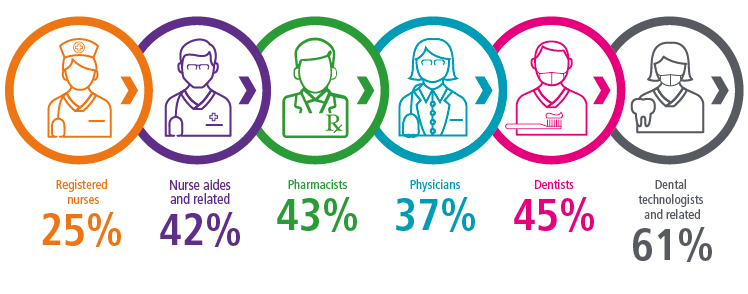
  • Immigrants account for 1 in 4 health care sector workers.
  • In Canada, immigrants make up
    • 25% of registered nurses
    • 42% of nurse aides and related occupations
    • 43% of pharmacists
    • 37% of physicians
    • 45% of dentists
    • 61% of dental technologists and related occupations
  • More than 40% of newcomers to Canada between 2016 and 2021 who were working in the health care sector were employed in the important areas of nursing and residential care facilities, as well as home health care services.

Unless otherwise noted, all statistics are from the Statistics Canada 2021 Census.

Source: Immigration matters in health care

Why the health-care sector is hiring temporary foreign workers like never before

Of note. More justifiable than fast food service workers and managers:

Persistent staffing shortages in the health-care sector across Canada in the wake of the pandemic have led some organizations, including some provincial government agencies, to increasingly call upon temporary foreign workers to fill positions in clinics, hospitals and senior care facilities across the country.

While health-care still represents a small fraction of the overall temporary foreign worker program, federal data analyzed by CBC News shows the government greenlighted the hiring of 4,336 health-care workers last year — up from 447 such positions in 2018. Health-care occupations represented roughly two per cent of the total temporary foreign worker positions that were approved in 2023.

A large share of that growth was driven by an uptick in approvals of nurse aides, orderlies and patient service associates. There were 2,514 such approvals last year, up from just 16 in 2018.

But employers have also turned to the program to fill other positions, such as nurses (612 positions approved, up from 65 in 2018) and family doctors (216 positions approved, up from 72 in 2018).

“I think this is another example of the overall health-care workforce crisis,” said Ivy Bourgeault, who leads the Canadian Health Workforce Network, a network of researchers who study issues facing health workers. She said staffing shortages driven by burnout and attrition have employers turning to increasingly novel means to bring in new workers.

The uptick in health-care hiring is reflected in the number of positions approved through labour market impact assessments (LMIAs), which employers need to prove there’s no one in Canada available to take a job before they can hire a temporary foreign worker. …

Source: Why the health-care sector is hiring temporary foreign workers like never before

Widening Racial Disparities Underlie Rise in Child Deaths in the U.S.

Of note:

Thanks to advancements in medicine and insurance, mortality rates for children in the United States had been shrinking for decades. But last year, researchers uncovered a worrisome reversal: The child death rate was rising.

Now, they have taken their analysis a step further. A new study, published Saturday in The Journal of the American Medical Association, revealed growing disparities in child death rates across racial and ethnic groups. Black and Native American youths ages 1 to 19 died at significantly higher rates than white youths — predominantly from injuries such as car accidents, homicides and suicides.

Dr. Coleen Cunningham, chair of pediatrics at the University of California, Irvine, and the pediatrician in chief at Children’s Hospital of Orange County, who was not involved in the study, said the detailed analysis of the disparities documented “a sad and growing American tragedy.”

“Almost all are preventable,” she said, “if we make it a priority.”

Researchers at Virginia Commonwealth University and Children’s Hospital of Richmond had previously revealed that mortality rates among children and adolescents had risen by 18 percent between 2019 and 2021. Deaths related to injuries had grown so dramatically that they eclipsed all public health gains.

The group, seeking to drill deeper into the worrying trend, obtained death certificate data from the Centers for Disease Control and Prevention’s public WONDER database and stratified it by race, ethnicity and cause for children ages 1 to 19. They found that Black and American Indian/Alaska Native children were not only dying at significantly higher rates than white children but that the disparities — which had been improving until 2013 — were widening.

The data also revealed that while the mortality rates for children overall took a turn for the worse around 2020, the rates for Black, Native American and Hispanic children had begun increasing much earlier, around 2014.

Between 2014 and 2020, the death rates for Black children and teenagers rose by about 37 percent, and for Native American youths by about by about 22 percent — compared with less than 5 percent for white youths.

“We knew we would find disparities, but certainly not this large,” said Dr. Steven Woolf, a professor of family medicine at the V.C.U. School of Medicine, who worked on the research. “We were shocked.”

The racial and ethnic disparities were most drastic when injuries were isolated from other causes of death. For example, Black children died by homicide at 10 times the rate of white children between 2016 and 2020. When the study’s lead author, Dr. Elizabeth Wolf, an associate professor of pediatrics at the V.C.U. School of Medicine, compared accidents with intentional injuries, the sobering realities of the mental health crisis came into focus.

Native American children died by suicide at more than twice the rate of white children, whose rate was already high.

“As a pediatrician, that really took my breath away,” she said.

Gun-related deaths, including accidents, homicides and suicides, were two to four times as high among Black and Native American youths than among white youths, and the risk of dying from a gun-related injury more than doubled among Black and Native American youths between 2013 and 2020.

The researchers also drew attention to disparities in other causes of death: Native American children died from pneumonia and the flu at three times the rate of white children, for example, and Black children died from asthma at almost eight times the rate of white children.

This particular study did not examine all of the variables that contribute to the causes of childhood illness, injury and death. Dr. Wolf said she hoped the paper would serve as a “wake-up call” and galvanize researchers to scrutinize the underlying factors.

Understanding the reasons for the increase in car accident deaths, for example, could determine whether redesigned intersections or targeted seatbelt campaigns would be the most effective intervention for a specific group.

For other childhood deaths, access to care is a likely factor, given that Black children with circulatory diseases are less likely to be referred for transplants and less likely to have a successful procedure compared to white children. Asthma-related disease and death are likely to be affected by access to interventions such as inhalers, as well as socioeconomic and environmental factors like air pollution.

At the same time, Dr. Woolf said, policymakers should not “wait for more research to identify the obvious next steps,” including mental health support for children and stricter gun laws. The public perception of gun violence among children is often focused on school shootings, he said, but statistically speaking, “the vast majority occur in communities across our country — day by day, one by one.”
Source: Widening Racial Disparities Underlie Rise in Child Deaths in the U.S.

Social justice or medical expertise: What do patients want more from their doctors?

Rhetorical question for patients. One thing to have awareness and understanding of the social determinants of health and to improve data and understanding of health factors that affect different groups, but how will anti-oppression language improve health outcomes:

For over a year Canadian physicians have been debating the CanMEDS roles, which is a framework describing the competencies required of specialist doctors certified by the Royal College of Physicians and Surgeons of Canada. These roles are taught in medical school and form part of the basis for the students’ evaluations.

The roles include physician as communicator, collaborator, leader, health advocate scholar and professional. The central role is physician as medical expert, which integrates the other roles.

In the March 2023 special issue of the Canadian Medical Education Journal, the CanMEDS 2025 interim report was distributed for open public feedback and included a suggestion to centre social justice anti-racism and anti-oppression, rather than medical expertise.

A massive push back from physicians against the decentering of medical expertise arose and has been continuing since publication of the report.

Now, in a March 2024 issue of the CJME, one of the authors of the March 2023 report and others are responding to the negative responses. They claim that opposition to the decentering of medical expertise simply represents “medicine perpetuat(ing) its own power” and maintaining “medicine as an institution steeped in power and privilege.”

This is a deadly serious issue for medical education and for the care of patients. It matters not whether a surgeon is engaged in social justice for the patient who makes it to the operating room. At that point only medical expertise counts.

I learned this during my training at St. Michael’s Hospital in the late 1970s. A man living in a shelter was admitted to hospital for an urgent heart valve replacement. The surgeons saved his life but were not focused on social justice. Their expertise and attention were directed to the patient and nothing else.

Of course, post surgically he had no place to live and hospital personnel had a duty to find him an adequate place to which he could be discharged. But that would be all for naught had it not been for the expertise of the surgeons. That determined everything else. Medical expertise trumped all.

Confronting inequities and racism in health care is inseparable from confronting system-wide and societal inequities. Doctors alone cannot solve that, but they can at least be competent physicians technically and remain current on the science and standards of care for ailing people.

Beyond that they may choose to engage as any other caring citizen and fight fiercely for justice, freedom and truth in the health care system and in general.

They cannot be taught, mandated, and scripted to do so in the detached world of academic medicine. That is elitism at its worst, as if doctors should lead the charge for social justice.

There is a certain personal irony for me. Nearly 20 years ago I gave the first advocacy lecture in the University of Toronto’s Temerty Faculty of Medicine undergraduate curriculum. I stated up front to the students that I was not sure why I was even giving the lecture. I have given the same talk dozens of times since.

Here is how I introduced my talk and then with breathtaking hypocrisy continued on with the presentation:

“In my judgment, all advocacy means is being a socially responsible and good citizen, values both personal and ideological that are part of being a human and could not possibly — and maybe, should not — be taught by the universities. After all, what business is it of medical faculties to be teaching and evaluating political philosophies within the context of a curriculum?

“But how can the matter of advocacy be incorporated into medical practice and medical school curricula? It should be expected that physicians advocate on behalf of individual patients, who might benefit from an experimental therapy for a life-threatening disease. Physicians should actively intervene on behalf of a group of patients who are being denied access to a standard treatment. And physicians must intervene when a neighbourhood is at a health risk because, for example, of an environmental hazard.”

I still do not think that it is the business of medical faculties to be teaching and evaluating political philosophies within the context of a curriculum.

The public, if they were ever asked I am certain, would choose a competent surgeon, if that is all the surgeon could offer. They can secure their social justice elsewhere, with or without doctors.

Philip Berger is an Officer of the Order of Canada and a longstanding downtown Toronto physician.

Source: Social justice or medical expertise: What do patients want more from their doctors?

Canada needs to do more to prepare for an aging, and more diverse population

Good analysis and prescription:

….Since 2018, Andrew Pinto and his team at Upstream Lab at the University of Toronto have been working on a tool called SPARK, a list of standardized questions designed for primary caregivers to collect information from patients, including race and ethnicity. Dr. Pinto hopes the questionnaire becomes standard in healthcare settings across the country.

It also includes socioeconomic questions – about income, education, disability status, housing, food security – recognizing that race and ethnicity are just part of the many factors that influence a person’s health outcomes.

“We all come from different cultures, with different ways of relating to health providers, and have different needs,” Dr. Pinto said.

“By asking these questions, we can get a better understanding of what people need.”

Source: Canada needs to do more to prepare for an aging, and more diverse population

Why is this nurse working at a Toronto insurance firm? Ontario’s battle to get foreign-trained nurses into the field

Useful analysis and report:

…The report by World Education Services (WES) Canada, a non-profit organization that assesses foreign credentials, surveyed 758 internationally educated nurses not currently working as nurses in Ontario, and found that half had not begun the province’s registration process to practise, even if they wanted to. 

The respondents cited financial barriers as the top factor affecting their ability to become registered. (Registration costs, exams and testing fees can total $3,000 at the low end.) The need to show evidence of recent nursing practice, a lack of clarity around the registration process and the time it takes to get registered also played a role.

The report also said data gaps make it “nearly impossible” to track how many internationally educated nurses are in Canada, how many intend to or are trying to qualify, and how many are practising. 

“No one can tell us how many internationally educated nurses are actually out there who could potentially be working,” said Joan Atlin, strategy, policy and research director at WES Canada. “There’s still a significantly underutilized population of nurses in the province who are still falling outside of the supports.”

The pandemic has forced health officials to confront the underutilization of skills brought by immigrants meant to fill labour needs, said Atlin, who has been engaged in foreign credential issues for two decades.

The province is well aware of the issues in the report and has worked with the College of Nurses of Ontario, which regulates the profession, to help internationally educated nurses become registered. 

In 2022, the Health Ministry introduced changes, including covering the cost of exams and registration with the college, and made it easier to meet language proficiency requirements. 

Just last month, the province made permanent a program that places these nurses under an employer’s supervision to gain work experience. The college says that as of the end of March 2024, it had matched 4,230 applicants with employers, enabling 3,324 nurses to register. 

“It has created that opportunity for health-care employers to hire those who have already applied for licensure and allow nurses to meet the practice and language proficiency requirement, by actually working and having their employer attest to their ability to work in English,” said Atlin.

In total, the college says as of April 1, it had registered more than 7,500 international applicants, with 5,215 new internationally educated nurses registered in 2022 alone. …

Source: Why is this nurse working at a Toronto insurance firm? Ontario’s battle to get foreign-trained nurses into the field

Jamie Sarkonak: Zealous DEI commissars threaten integrity of Canada’s medical profession

Captures the perspective and views of what a possible Conservative government thinks about DEI and what they might do with respect to employment equity:

…The next place DEI intends to colonize is the foundational set of themes that underpin physician training in Canada, the CanMEDS framework. Last revised in 2015, CanMEDS is up for renewal in 2025. The most radical change? DEI.

Doctors involved in the revision are proposing to make progressive-left values standard in physician training, including anti-racism, social justice, cultural humility, decolonization and intersectionality — all concepts coined by progressive, redistributive racialists who tend to despise western culture.

Health equity experts are all-in on this stuff, so expect the “experts say” coverage to be overwhelmingly positive. A preview is offered by Kannin Osei-Tutu, a medical professor at U of C, who recently hailed the upcoming CanMEDS revision as an “unprecedented opportunity” for transformation.

“Transformative change in medical education and practice demands explicit integration of anti-oppressive competencies,” he wrote in last month’s issue of the Canadian Medical Journal of Health (which only ever seems to publish one side of this great debate).

“Progress hinges on cultivating a critical mass of physicians committed to this change, thus paving the way for more equitable and just health care.”

Wondering where all this goes? Look to New Zealand, a fellow British colony that has taken to reconciling with extreme self-flagellatory policies. In 2023, some of the island nation’s hospitals began prioritizing Indigenous Māori and Pacific patients on elective surgery wait lists on the basis of race.

“It’s ethically challenging to treat anyone based on race, it’s their medical condition that must establish the urgency of the treatment,” one anonymous doctor told the New Zealand Herald.

Plenty more like-minded doctors exist in Canada, but they are drowned out by heavy-handed administrations that insist on turning their profession into another stage of ideological performance. Their best recourse? Their provincial ministers of health and post-secondary education, who are uniquely empowered to turn things around.

Source: Jamie Sarkonak: Zealous DEI commissars threaten integrity of Canada’s medical profession

Le recrutement du Québec à l’étranger est vu d’un œil critique par des pays sources

No better nor worse than others, but with real implications for source countries:

Le Québec pige dans les forces vives des pays étrangers, y compris dans des secteurs névralgiques comme la santé, et le plus souvent sans invitation officielle. Les ambassadeurs du Maroc et du Bénin ainsi qu’un recruteur à l’étranger souhaitent envoyer un signal au gouvernement québécois.

Tous reconnaissent que l’exode des cerveaux, un phénomène aussi connu sous le terme de brain drain en anglais, existe depuis longtemps. À une différence près : ce sont aujourd’hui des gouvernements qui font directement du recrutement, comme celui du Québec, sans toujours en demander l’autorisation ou offrir une contrepartie.

« Du côté des gouvernements qui recherchent cette main-d’oeuvre, ces compétences, il devrait y avoir une certaine retenue et une réflexion », affirme l’ambassadrice du Maroc au Canada, Souriya Otmani.

Après le terrible tremblement de terre qui a frappé le Maroc en septembre dernier, les médias locaux ont rapporté que les hôpitaux manquaient de personnel, une pénurie déjà aiguë et aggravée par une saignée des professionnels encouragée par des pays recruteurs.

Trois jours plus tard, une page officielle du gouvernement du Québec annonçait sans gêne une séance d’information pour ceux souhaitant immigrer dans la province, avec à la clé des emplois dans le secteur de la santé.

Le peu de ressources humaines « dont nous avons un besoin impérieux » est « pompé de manière un peu cynique par des partenaires qui sont déjà beaucoup plus développés », indique quant à lui l’ambassadeur de la République du Bénin au Canada et aux États-Unis, Jean-Claude do Rego.

La santé et l’éducation sont des domaines de préoccupation pour les deux officiels, alors que d’autres professions techniques les inquiètent moins. « Oui, il y a certaines catégories professionnelles où il y a un surplus, et le Maroc cherche à assurer des débouchés, y compris à l’étranger », explique la diplomate marocaine.

Il existe pour ces domaines des canaux officiels de recrutement « tout à fait légaux », comme l’Agence nationale de promotion de l’emploi et des compétences (ANAPEC) au Maroc. Cette agence nationale prend cependant garde de ne pas promouvoir l’exode dans « des secteurs très sensibles », comme la santé, avance Mme Otmani. Elle tient à préciser qu’elle ne donne que son point de vue, tout en admettant que le sujet est régulièrement abordé dans plusieurs arènes politiques et économiques au pays.

L’exode des infirmières, des aides-soignantes, des médecins ou des préposés est une « perte sèche pour un pays en plein développement comme le nôtre, qui a besoin de toutes ses ressources humaines qualifiées », ajoute-t-elle.

Des pays en situation critique

L’Organisation mondiale de la santé (OMS) publie depuis 2020 une liste rouge des pays dont les systèmes de santé sont les plus vulnérables, afin d’alerter les pays recruteurs.

Québec recrute directement des personnes au Bénin, au Cameroun, en Côte d’Ivoire, au Togo et au Sénégal, des pays qui figurent sur la Liste de soutien et de sauvegarde du personnel de la santé. À défaut de pouvoir l’interdire, l’OMS demande aux gouvernements recruteurs d’adhérer à un certain code de conduite et de passer des ententes avec les bassins de travailleurs.

L’ambassadeur do Rego ne vise pas expressément les efforts du Québec dans son pays d’origine, mais il croit que la province est bien positionnée pour « trouver de meilleures modalités » afin que ce type d’échange « puisse rester compatible avec les besoins de développement de la société qui laisse partir ses talents », expose-t-il.

Ce pays d’Afrique de l’Ouest finance l’éducation publique, y compris des formations postsecondaires. Or, comme l’indignation autour des médecins québécois qui vont pratiquer ailleurs, cette « équation économique nationale est négative », indique quant à lui Yves Legault, vice-président exécutif ISA Immigration et Recrutement.

« Le discours politique est : “Pas de problème, on va aller chercher des infirmières à l’étranger.” Mais on n’a pas payé pour leur éducation et il n’y a aucun mécanisme de retour. Il y a une iniquité flagrante dans ce modèle migratoire », martèle M. Legault, qui est également consul honoraire du Bénin à Toronto.

Solutions

Bien sûr, pas question d’empêcher la mobilité internationale, disent-ils tous. « Mais comment peut-on rendre moins pénibles les tensions » sur un système déjà fragilisé ? demande M. do Rego.

Les gens formulent eux-mêmes le désir d’aller vivre à l’étranger, reconnaît Yves Legault, dans la « recherche d’une vie meilleure pour eux, mais surtout pour leurs enfants ». Si toutefois les conditions étaient réunies dans leur pays d’origine, « ils n’auraient pas à s’expatrier ». Le défi est donc d’aider à « construire des opportunités » dans leur pays d’origine, à l’heure où les pays occidentaux montrent un certain désintérêt pour la coopération internationale.

« Je ne suis pas manichéen. Je comprends les raisons fondamentales pour lesquelles certains pays trouvent cette solution à leurs problèmes », affirme l’ambassadeur du Bénin, qui invite à « trouver une solution de compromis ».

Il évoque notamment la volonté de son gouvernement depuis plusieurs années d’obtenir un plus grand nombre de places à coût réduit dans le système éducatif au Québec. Les étrangers paient en effet des droits de scolarité beaucoup plus élevés que les citoyens ou les résidents permanents, mais des bourses pour en être exonérés existent. « Nous ne bénéficions que d’un quota de dix bourses, alors que nous avons 50 fois plus de demandes », illustre-t-il.

La réflexion est aussi déjà lancée au Maroc et au Bénin pour trouver des incitatifs à rester là-bas, en améliorant les conditions salariales.

Elle donne l’exemple d’une entente avec l’Allemagne, qui prévoit une formation pour les travailleurs marocains et un retour éventuel dans leur pays d’origine. « Personne ne va les obliger [à rentrer dans leur pays], mais on insiste dès le recrutement sur le fait que c’est une condition de départ, de manière que le Maroc bénéficie de cette formation aussi. »

Source: Le recrutement du Québec à l’étranger est vu d’un œil critique par des pays sources