Les francophones quasiment absents des postes clés de la diplomatie canadienne

While I focus more on visible minority representation, did a quick check of the head of mission data that I keep which confirms their concerns (the government over the past five years has improved representation of women and visible minorities in head of mission appointments):

L’ère des influents diplomates francophones au sein du réseau diplomatique canadien est révolue. Presque uniquement composée d’anglophones, la haute direction d’Affaires mondiales Canada ne fait accéder que d’autres anglophones aux postes stratégiques, forçant au passage bien des francophones ambitieux à faire carrière dans leur langue seconde.

Le Devoir s’est entretenu avec une dizaine d’employés d’expérience, cadres et ex-cadres d’Affaires mondiales Canada, dont un ambassadeur en fonction. Tous sont d’avis que l’absence de francophones aux postes clés de la diplomatie canadienne est très préoccupante. Plusieurs d’entre eux dénoncent un climat d’indifférence face au français qui s’est amplifié avec le temps, malgré les espoirs suscités par l’entrée en fonction du ministreFrançois-Philippe Champagne, lui-même francophone. Son bureau n’a pas directement réagi aux questions du Devoir, laissant la rédaction d’une réponse aux bons soins de ses fonctionnaires. Ils confirment « certains défis au niveau des cadres supérieurs », alors même qu’un grand nombre des employés du ministère sont francophones.

Tout en haut de la pyramide, les quatre sous-ministres qui dirigent l’institution fédérale sont tous anglophones, comme 11 des 12 sous-ministres adjoints des prestigieux secteurs « géographique » et « fonctionnel ». Tous secteurs confondus, les quelques sous-ministres adjoints francophones occupent les postes les moins stratégiques pour les affaires extérieures, comme les ressources humaines ou l’administration, selon une analyse de l’organigramme obtenu par Le Devoir, confirmée par des sources au sein de l’organisation. En plus, parmi les 15 sièges de directeurs généraux, patrons des ambassadeurs, seulement deux sont occupés par des francophones, dont le responsable d’Affaires panafricaines, qui n’a pas d’ambassade sous sa responsabilité.

« Affaires mondiales Canada est l’un des ministères les plus francophones de la machine fédérale, mais ça ne se traduit absolument pas au niveau supérieur. C’est un peu comme si on était dans les années 1950 : tout le monde sur le plancher de la manufacture est francophone et, au niveau des contremaîtres, tout le monde est anglophone », témoigne un employé haut placé d’une ambassade canadienne qui a requis l’anonymat puisqu’il n’est pas autorisé à parler publiquement de cette question.

« Je ne peux même pas vous nommer un francophone et dire “cette personne-là a de l’influence”. »

La dernière francophone à occuper un poste stratégique dans la haute direction des Affaires étrangères fut Isabelle Bérard, ex-cheffe de la branche Afrique subsaharienne. Elle a été remplacée en 2020 par une haute fonctionnaire anglophone ayant fait carrière dans d’autres ministères et qui n’a aucune expérience en diplomatie.

« La langue, c’est important, mais la compétence est importante aussi. Si vous ne connaissez rien à l’Afrique et vous êtes nommée sous-ministre adjointe à l’Afrique… À mon avis, c’est un sacré problème », a commenté Jocelyn Coulon, qui a été conseiller politique de l’ancien ministre des Affaires étrangères Stéphane Dion.

Sommet de la pyramide

Si le gouvernement ne nomme que des anglophones dans les postes de haute gestion les plus importants, ce n’est pas faute de relève francophone au sein de l’organisation. Selon un courriel datant de 2019 obtenu par Le Devoir qui recense le nombre de cadres d’Affaires mondiales Canada pour chacune des langues officielles, les francophones représentent une grande part des gestionnaires de premier et de second niveau (EX1 et EX2), à environ 30 %. Au fur et à mesure que l’on monte les échelons, toutefois, leur nombre s’amenuise, à approximativement 1 gestionnaire sur 8 aux hauts niveaux (EX4 et EX5). Des données plus récentes, mais moins précises, fournies par Affaires mondiales Canada confirment que les francophones sont plus nombreux à rester au bas de la pyramide.

« La haute gestion est anglophone et a de la difficulté à lire ou écrire en français. C’est presque impossible de monter au sein du ministère à un poste de haute gestion », témoigne un ex-cadre francophone d’Affaires mondiales Canada qui ne souhaite pas être nommé, par crainte de répercussions pour non-respect d’une entente de confidentialité.

Tous les cadres et ex-cadres consultés s’entendent pour dire que, même si de nombreux anglophones parlent un excellent français à Affaires mondiales Canada, les exigences linguistiques pour les anglophones permettent même à ceux qui maîtrisent très mal la langue de Molière d’accéder à la haute direction, alors qu’une faiblesse en anglais écrit est susceptible de bloquer la carrière de francophones. Pourtant, l’article 39 de la Loi sur les langues officielles garantit les mêmes possibilités d’avancement pour les fonctionnaires des deux groupes linguistiques.

« Je ne dirais pas qu’il n’y a pas de cadres supérieurs francophones, mais de plus en plus, ils sont ghettoïsés dans des fonctions, pas sans importance, mais corporatives. Et c’est la même chose pour les ambassadeurs. Les francophones sont en voie de disparition au niveau des postes à l’étranger », se désole un ambassadeur qui a requis l’anonymat pour parler librement de cette question.

Nostalgique, le diplomate posté à l’étranger se désole de la fin d’une époque où des Canadiens francophones s’illustraient sur la scène mondiale, comme au début des années 2000, avec Claude Laverdure comme ambassadeur de France, Marc Lortie en Espagne, Joseph Caron en Chine ou encore Gaëtan Lavertu au Mexique, pour ne nommer que ceux-là. Excluant les « nominations politiques » de Stéphane Dion en Allemagne et d’Isabelle Hudon en France, ainsi que deux postes vacants, aucun diplomate francophone de carrière n’est ambassadeur dans un pays du G20 en ce moment, témoignent les profils des chefs de mission en poste.

Selon plusieurs sources, certains ambassadeurs canadiens à l’étranger ne parlent pas du tout français. « De plus en plus, nos ambassadeurs ne sont pas capables de s’exprimer en français, confirme Pierre Alarie, ex-ambassadeur du Mexique à la retraite depuis 2019. Je ne comprends pas que, dans un pays de 38 millions de personnes, on n’est pas capables de trouver 175 chefs de mission bilingues. »

Lente érosion

« Il y a eu une érosion ces dernières années. On a perdu une sensibilité au français, croit Guy Saint-Jacques, ex-ambassadeur canadien en Chine, jusqu’en 2006. C’est très préoccupant. Le ministère est le visage du Canada à l’étranger. Si on n’a plus de français, c’est un problème. »

Il précise toutefois que la langue de Molière est malmenée depuis longtemps aux Affaires étrangères. Lui-même témoigne avoir tenté d’obtenir une promotion dans les années 1990 devant un jury tout anglophone, dont un membre ne parlait pas français. Plusieurs sources indiquent que cette situation se produit encore de nos jours.

« Le français s’est émietté d’unefaçon progressive, en même temps que les sous-ministres sont devenus des gestionnaires et le pouvoir du bureau du premier ministre s’est accru », confirme l’ex-ambassadeur Ferry de Kerckhove, en poste jusqu’en 2011. Selon lui, l’incorporation du Commerce extérieur aux Affaires étrangères, dans les années 1980, puis plus récemment la fusion de l’Agence canadienne de développement international (ACDI), en 2013, ont provoqué une centralisation du pouvoir qui a fait globalement diminuer l’influence des francophones dans la diplomatie canadienne.

Basée à Gatineau, l’ACDI était réputée comme étant la chasse gardée des francophones. L’institution a été engloutie par la mégastructure actuelle qui chapeaute trois ministères, renommée Affaires mondiales Canada par Justin Trudeau en 2015.

« On s’est privés de beaucoup d’expertise francophone », analyse Isabelle Roy, ex-ambassadrice retraitée depuis le début de l’année et spécialiste de l’Afrique. Selon elle, la tendance à l’anglicisation des hautes sphères diplomatique a des conséquencessur la manière dont le Canada pratique sa diplomatie. Plusieurs autres ex-ambassadeurs se désolent aussi de la perte du point de vue francophone dans la façon dont le Canada interagit avec le monde. « Ça creuse le sillon d’une sensibilité accrue envers certains pays, et une sensibilité déficiente pour d’autres pays », conclut Mme Roy.

Faire carrière en anglais

Faute de francophones dans la haute direction, de nombreux fonctionnaires du réseau diplomatique font le choix de mener leur vie professionnelle uniquement en anglais, confirment lesemployés et ex-employés interrogés.

« Faire carrière [en politique étrangère], pour un francophone, veut dire faire carrière en anglais. Si on veut faire carrière en français, c’est se cantonner dans des fonctions corporatives. Ça ne sera pas en politique étrangère comme telle », affirme un employé d’Affaires mondiales comptant 20 ans de carrière et ayant requis l’anonymat puisqu’il n’a pas l’autorisation de parler aux médias.

Les ambassadeurs et ex-ambassadeurs interrogés ont tous dressé le portrait d’une administration qui n’oblige pas explicitement l’utilisation de l’anglais dans les communications, mais qui instaure un climat dans lequel un travail sera ignoré des patrons s’il est rédigé dans la langue de Molière.

« Pour ce qui est des réunions, on nous réitère toujours qu’on est libres de parler la langue de notre choix. Mais surtout pour les réunions de haut niveau, c’est presque être le trouble-fête si on insiste à [vouloir] s’exprimer en français, parce qu’on sait qu’il y a des hauts gestionnaires qui ne maîtrisent pas le français, même s’ils ont peut-être le niveau C [niveau de compétence requis pour certains postes] », témoigne un ambassadeur actuellement en poste à l’étranger.

Affaires mondiales Canada confirme qu’une grande part de ses employés (42 %) sont francophones, un taux qui chute à 18 % chez les hauts cadres, selon son calcul. « Le ministère reconnaît qu’il existe certains défis au niveau des cadres supérieurs et cela fait partie des stratégies mises en place dans notre Plan d’action pour les langues officielles 2019-2022 », explique la porte-parole d’Affaires mondiales Canada, Ciara Trudeau, par courriel.

Dans sa réponse fournie au Devoir, le gouvernement précise qu’il met en avant le caractère bilingue du Canada en guise d’exemple d’une société ouverte à la diversité linguistique auprès des autres pays.

Source: Les francophones quasiment absents des postes clés de la diplomatie canadienne

Diversity among Canadian Heads of Mission: Two Years In | Canadian International Council

My latest:

Of the 74 appointments to date, close to half have been women compared to an end-2015 baseline of less than one-third. When considered proportionately to the 15 percent of Canada’s population who are both visible minorities and Canadian citizens, visible minorities remain slightly under-represented at 11% of appointments. Significantly, there are no identified Indigenous peoples heads of mission.

via Diversity among Canadian Heads of Mission: Two Years In | Canadian International Council

Diversity of Heads of Mission 2016

With likely all of the heads of mission (HoM) announcements made, combined with knowledge of their classification levels, we now have a more complete picture on the degree to which the government is delivering on its diversity commitments. Overall, they are.

election-2015-and-beyond-implementation-diversity-and-inclusion-040

Chart 1

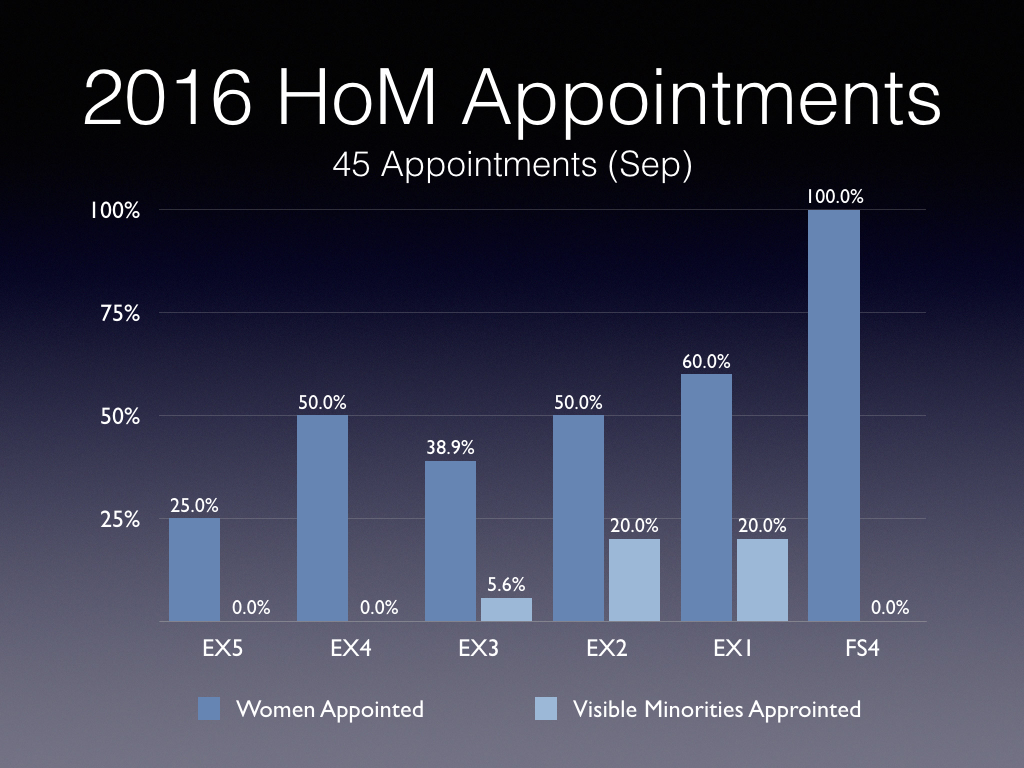
Overall, of the 45 appointments, 21 were women (47 percent, virtual parity) and five were visible minority (11 percent, or under-represented in relation to the 15 percent benchmark of visible minorities who are also citizens).

Chart 1 breaks down the these overall numbers by classification level (note that this reflects the level of the position, not necessarily the head of mission, as some positions are overfilled with former DMs and equivalents, and some are underfilled).

election-2015-and-beyond-implementation-diversity-and-inclusion-041

Chart 2

Not surprisingly, there is greater representation of women and visible minorities at more junior levels, particularly apparent between EX4-5 (ADM level) and EX1-3 (DG and Director level), as shown in Chart 2.

election-2015-and-beyond-implementation-diversity-and-inclusion-039

Chart 3

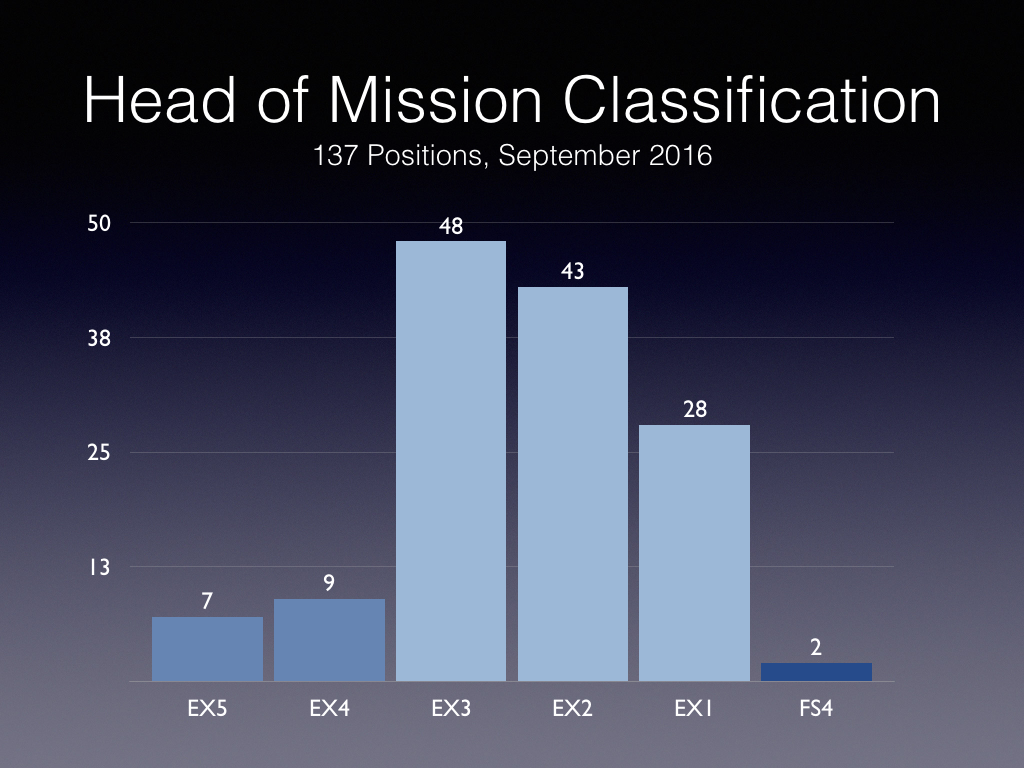
Finally, as a point of reference, Chart 3 shows the classification breakdown of all 137 head of mission positions.

Note: I am grateful to Global Affairs Canada for having provided the classification data. However, as an illustration of the limits of the newer, more open approach, they did not provide this information in spreadsheet form, using the (false) argument that: “Understandably, the GoC cannot send records in a spreadsheet format that could otherwise be manipulated or ‘edited.’ ” (fortunately, I have software that can convert a scanned pdf into spreadsheets or documents).


Why Justin Trudeau shook up Canada’s diplomatic corps, diversity

HoM 2016 appointments.001The above chart captures the diversity of all 38 Liberal government head of mission appointments in 2016 to date with respect to all appointments as well as those that are classified at the ADM level (EX4-5):

The Liberal government cleaned diplomatic house on Tuesday, announcing the appointment of 26 new ambassadors, high commissioners and consuls general from Havana to Tel Aviv. The list is heavy on foreign service experience, short on overtly political appointments and pristinely gender balanced. In a statement, Global Affairs Canada said the recalls and new postings “ensure its diplomatic leaders represent a wide diversity of Canadians.”

Ferry de Kerckhove, former high commissioner in Pakistan and ambassador to both Indonesia and Egypt over a long career in the foreign service, said the appointments signal a conscientious shift in approach for Justin Trudeau’s government. “We’re back to what I would call normalcy in diplomatic appointments,” he says. “It confirms the Prime Minister’s early statement about giving back to the foreign service its role in representing Canada abroad, and also giving back its ability to actually do their job, which is to report, comment and provide advice.”

Source: Why Justin Trudeau shook up Canada’s diplomatic corps

Tuesday morning started off with a big shuffle as 26 new diplomatic appointments were announced, some replacing political appointments made under the previous Tory government.

As it did with its last shuffle, the department included a statement at the top of the list of appointments stating the government’s “commitment to ensure its diplomatic leaders represent a wide diversity of Canadians and include a greater gender representation.”

While the appointments include 13 men and 13 women, the overwhelming majority of heads of mission being replaced are men. Only four female ambassadors have been rotated out, compared to the 22 men.

A few of the new appointments are simply rotations from ambassadorial positions in other countries, while a few brand new political appointees have been added to the heads of mission team.

Harper appointees replaced, more women added to Canada’s roster of ambassadors

Patrick Martin’s astute analysis of the postings to the Mid-East:

Israel has been watching for evidence of a shift since Canada’s Liberals won the October election. Within hours of being sworn in, Foreign Affairs Minister Stéphane Dion announced that Canada will strive for a more balanced policy in the Middle East, one that includes reaching out to “other legitimate partners in the region” besides Israel.

He even described Canada’s role as being that of an “honest broker” – no words make Israeli leaders shudder more than those two.

Stephen Harper’s government was very good to Israel and Benjamin Netanyahu’s government knew it had a staunch supporter in Canadian Ambassador Vivian Bercovici. It also knew the next Canadian representative could not be so one-sided.

But in Deborah Lyons, whose name as the ambassador-designate leaked two months ago, the Israelis are being mollified by the appointment of a fair-minded career diplomat of substantial seniority. Ms. Lyons, most recently, has been Canada’s ambassador to Afghanistan, a posting that gives her credibility in conflict zones. But prior to that is where her résumé gets really interesting.

She served as deputy head of mission in Washington, as chief strategy officer of the Department of Foreign Affairs in Ottawa and as a trade counsellor for high-tech industries in Tokyo. Few words give Israelis goosebumps more quickly than “high-tech.”

Does this high-level appointment reframe Canada’s relationship with Israel and the Middle East? Perhaps, but it depends on what policy changes follow the appointment.

The departure of Bruno Saccomani as Canadian ambassador to Jordan will be welcomed by those Jordanians who care about such things. The Royal Hashemite Court grimaced at the appointment of Mr. Harper’s former head of security to lead Canada’s mission in Amman.

Mr. Saccomani lacked the experience of a foreign service officer, but also lacked the ear of the Canadian prime minister, which would have compensated for his not being a diplomat.

In Peter MacDougall, the Jordanians are getting an upgrade. Mr. MacDougall’s expertise is in refugees and in setting standards for admission to Canada – two very valuable traits in a country hosting nearly two million Syrian refugees and the place from which Canada chooses those it will allow entry.

The change of ambassadors in the United Arab Emirates is about equal in quality – both the outgoing Arif Lalani and the incoming Masud Husain are senior officials with lots of expertise and experience.

Which is a good thing, because the Gulf countries matter more than ever – with tensions over Iran, Syria and Yemen, and concern over the Islamic State and al-Qaeda.

 Ottawa’s diplomatic shuffle signals shift in approach to Middle East 

Former Clerk and High Commissioner to London on the balance of skills that career and political backgrounds bring to appointments:

After several years watching appointments, I realized that political appointees do these jobs differently. Each person brings different strengths and skills to the job.

David MacNaughton and Gary Doer before him have a strength as Canadian Ambassador to Washington that most other ambassadors do not. They are seen as well-connected and understand politics. When they speak to American political or business leaders they know they speak with the PM’s voice. That is remarkably valuable in doing the job.

When I met political, cultural and business leaders in the U.K. and they heard I had been Secretary to Cabinet, they took me more seriously (more than I deserved to be taken). When we want to be taken seriously at the UN, or in Washington, London and Paris, then the person representing Canada may best be a career diplomat schooled in the intricacies of diplomacy, or a career public servant knowledgeable and experienced in the key issues of the portfolio, or a “political” appointee who has access to the prime minister. It depends.

However, there can be too many political appointees. To run a career foreign service we need to have senior offices available for the careerists to aspire to. However, that there are political appointees is not a bad thing.

The appointments announced Tuesday should be judged on the quality of the people and not on whether they helped get the Prime Minister elected. Every prime minister has appointed former ministers, party apparatchiks, and business people, career public servants as well as career diplomats to the rank of Ambassador or High Commissioner. They should be judged on their talents, what they bring to the job and ultimately on what they accomplish.

I like to think that because I had been a senior public servant with access, I added value to representing Canada that was more than many others could do. My predecessors each brought different strengths to the job and did it differently, not better or worse.

All those Ambassadors and High Commissioners announced Tuesday will do their best to represent Canada well. Many of them will do a very good job and accomplish great things. We should wish them all well.

 Judge diplomatic picks on talent, not their relationship with Trudeau 


Canada’s diplomatic brass: too white, too male |

Good detailed piece on the Canadian foreign service demographics and head of mission appointments (my examination of the diversity of senior heads of mission – the 16 positions classified at the ADM level – showed 3 women (19 percent) and 1 visible minority (6 percent).

Another illustration of the government being more open in sharing this data:

The Prime Minister is a feminist and there is gender parity in cabinet, but Canada’s foreign service still has a long way to go.

Sources say that the foreign service has negative gaps in regards to the number of women it employs, as well as aboriginal peoples and persons with disabilities.

According to a public report on employment equity in the government for the 2015-16 year, in the entire department of Foreign Affairs, Trade, and Development, 54.8 per cent of employees were women, 2.4 per cent were aboriginal peoples, 3.3 per cent were persons with disabilities, and 14.4 per cent were visible minorities.

However, according to numbers given to The Hill Times from an “internal workforce analysis for the foreign service group,” Canada’s foreign service is significantly lacking in women.

The department has targets for employment equity, and in terms of women in the foreign service, the foreign service has a negative gap of 166, meaning the department would need to employ 166 more women in order achieve equity. There is also a negative gap of 18 for aboriginal people, and 16 for people with disabilities. However, for visible minorities, the department is positive by 64, meaning they have 64 more visible minority employees than required to be equitable, according to the standards set by the Canada Labour Market Availability.

Screen Shot 2016-06-07 at 12.35.59 PM

Employment equity data for the foreign service, provided to The Hill Times by Global Affairs on June 6, 2016.

The document includes data as of March 31 of this year. Global Affairs confirmed the above numbers, and provided a chart demonstrating the employment equity targets and gaps in percentages. According to Eric Pelletier, a spokesperson for Global Affairs, there is a negative gap of 4.1 per cent for women, meaning women are under-represented by 4.1 per cent. It cites that there are currently 48.1 per cent women in the foreign service, and 62 per cent required representation. A negative gap of 1.5 per cent exists for aboriginal peoples, a negative gap of 1.4 per cent for persons with disabilities, and a positive gap of 5.3 per cent for visible minorities. Mr. Pelletier also said that the foreign service is 71.6 per cent anglophone and 28.4 per cent francophone.

Michael Kologie, communications director for the Professional Association of Foreign Service Officers (PAFSO), said in an interview with The Hill Times that overall, “if we’re talking about employment equity gaps, we’re doing very well when it comes to visible minorities. We’re doing okay when it comes to persons with disabilities, and where we’re really lacking is actually with respect to women and aboriginal peoples.” He said for women, the gap is “quite significant.”

Artur Wilczynski, Canada’s ambassador to Norway, further confirmed these gaps in an interview.

“I took a quick peek at the stats in terms of the employment equity. In the executive cadre, if you look at visible minorities in particular, there are no negative gaps there according to our reports, but there is still a lot of work to be done for example in increasing the representation of indigenous persons, persons with disabilities and women, and quite frankly, people of multiple backgrounds,” he said.

In a later emailed statement, Mr. Kologie wrote that PAFSO is committed to working in collaboration with Global Affairs to encourage a diverse foreign service, “with special attention on currently underrepresented groups such as women, aboriginal peoples, and persons with disabilities,” adding that visible minorities are well represented in the foreign service.

It has been reported by both The Ottawa Citizen and The Globe and Mail that Prime Minister Justin Trudeau has given Global Affairs instructions to diversify the foreign service and to specifically hire more women.

The Citizen’s columnist Andrew Cohen wrote in April that “Justin Trudeau has told Global Affairs that its list of career candidates has too many white males and asked it to do better next time.”

The Globe reported at the end of last month that Global Affairs is choosing two women to fill positions in Israel and in Great Britain, naming Deborah Lyons as Canada’s new ambassador to Israel and Janice Charette as the person to take the lead at Canada House.

The article also pointed out that Mr. Trudeau had told Global Affairs “its list of career candidates has too many white males and promised better representation in terms of gender and ethnicity.” Global Affairs would not confirm whether or not it had received these instructions from Mr. Trudeau, with Global Affairs Minister Stéphane Dion’s (Saint-Laurent, Que.) press secretary Chantal Gagnon saying she wasn’t going to answer that question. She also stressed that Ms. Charette and Ms. Lyons had not yet been officially appointed.

Speaking of official appointments, the Trudeau government will take its first crack at shuffling the foreign service this summer, anticipated in June or July.

Anne Leahy, a former Canadian ambassador, said she expects the announcements to come around the end of June. “I would watch [the announcement] because Justin Trudeau made a point of saying that he wanted more women, more diversity,” she said, adding that she “wouldn’t be surprised” to see that come to light. She said from her own experience, she expects anywhere from 10-15 new heads of mission to be appointed, if not more.

A source from Global Affairs told The Hill Times that the department will have more to say about diversity once the heads of mission shuffle happens, hinting that more diverse nominations might be coming.

The Hill Times counted the number of Canadian heads of mission posted abroad as of October 2015. The results showed that of the 134 heads of mission at the time, 90 were men and just 44 were women. That translates to 32 per cent heads of mission positions being held by women.

Source: Canada’s diplomatic brass: too white, too male |