Tighter immigration policy may push employers to expand outside the US

From the HR press, more on how the Trump administration is harming American economic interests and creating opportunities for Canada and other countries:

Employers are facing difficulties with tightening immigration policy while also dealing with the economic impact of the coronavirus pandemic. As a result, some are already expanding their presence in other countries to meet hiring needs and many others may follow, according to a recent study.

President Donald Trump signed an Executive Order in April temporarily prohibiting foreign workers from obtaining permanent residency through the green card process, along with other immigration restrictions. The action drew skepticism and far from employment lawyers and industry trade groups regarding domestic employers’ ability to recruit foreign talent.

“The President’s decision to suspend certain green card applications for 60 days could not come at a worse time,” Gary Shapiro, president and CEO of the Consumer Technology Association, said in an April 23 statement. “The White House should also refrain from pursuing future action to restrict access to temporary guest worker programs.”

Many who enter the U.S. on a work visa hope to eventually obtain permanent residency. Losing that opportunity creates greater anxiety, one that is heightened during the coronavirus pandemic. The Executive Order also prohibited green card holders from sponsoring a spouse or child for permanent residency.

“In terms of foreign nationals, these are very perilous times,” Dick Burke, CEO of Envoy Global, a legal technology solution for managing the immigration process, told HR Dive in an interview.

Burke pointed out that foreign workers on visas cannot be furloughed or have their salaries reduced. As a result, they could be more likely to be part of layoffs, and they “are afraid that because they can’t offer the same flexibility as a native-born citizen can […] they feel a bit more susceptible.”

For this segment of the workforce, which represents 17% of U.S. workers, according to the American Immigration Council, this vulnerability can have detrimental effects on mental health and productivity. Foreign STEM graduates, as well, are having challengesnavigating the Trump Administration’s immigration policy and the added impact of the pandemic to businesses. Because many =have had job offers rescinded, their ability to stay in the country is in jeopardy.

These workers are, in many instances, thousands of miles away from their families during a global public health crisis and on the front lines of the country’s response. Recent research from the New American Economy Research Fund found immigrants to be well-representedamong essential businesses, particularly healthcare, food service and manufacturing.

“The most sophisticated [HR teams] are the ones who realize that all the gifts that foreign nationals bring in terms of diversity of experience and skill set,” Burke said. “You’ve got to be empathic to all that laundry list of anxiety.”

Burke said he believes it is important to also give members of this group “a seat at the table” to ensure representation in company decisions, particularly during these challenging times.

As the Trump administration continues to tighten immigration pathways, employers are assigning more tech talent to non-U.S. offices and even expanding into new geographies. In an Envoy survey of U.S.-based employers that recruit internationally, 48% said “placing or hiring high-skilled talent for whom they were unable to secure work authorization in the U.S. was the primary driver for their outbound immigration assignments.” The report added that, “this was the most frequently cited reason.”

Canada, in particular, is becoming a popular outpost. Burke named Vancouver and Toronto as the fastest-growing destinations and the Envoy study found that 51% of employers are “considering Canada for their company’s expansion, up from 38% the previous year.”

“A lot of companies are saying, ‘we get a great educated workforce up there […] we’ve got less issues with time zones than we do with other continents. We’ve got geographic proximity. We’ve got cultural homogeneity’ in many regards,” Burke said.

While an expansion into Canada may work for some companies, even those who can afford to expand, especially right now, will face many challenges including staffing, local labor laws, office setups, business structure for entry and more, Burke noted. Tighter immigration may lead to even larger shifts in workforce allocation between the U.S. and other countries but for now employers, are waiting to make any major moves.

“What we hear anecdotally is they also are waiting to do anything [too] permanent until they see the results of the November election,” Burke said, when the direction of immigration policy may could return to historic norms of previous presidents.

Source: Tighter immigration policy may push employers to expand outside the US
Immigration Policies Threaten American Competitiveness

Interesting Harvard Business School alumni survey regarding perceived undermining of US competitiveness by Trump administration policies:

It is no secret that immigration has reshaped American innovation. Immigrants are the backbone of America’s most innovative industries, provide a quarter of our patent applications, and are numerous among our science and engineering superstars.

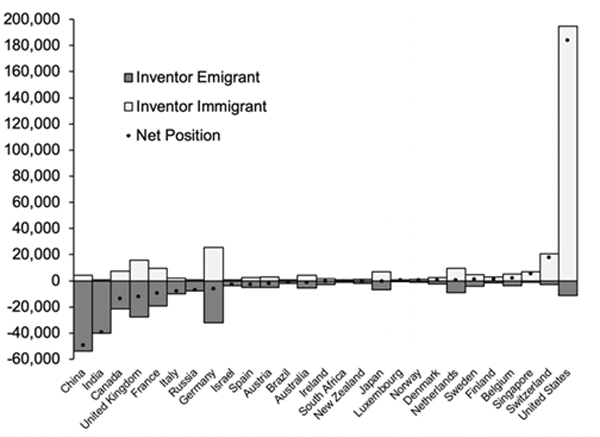
Taken from World Intellectual Property Organization data (Miguelez and Fink, 2013), Figure 1 shows that America received more than half of migrating inventors from 2000-2010.

Figure 1: Migration of inventors, 2000-2010


Immigrants can be found in times of success and times of crisis. Examples include:

  • Among the American companies leading the race toward a vaccine to end the COVID-19 pandemic is Moderna, a Cambridge company with an immigrant co-founder and an immigrant CEO.
  • Another firm already conducting vaccine trials is Inovio Pharmaceuticals of Plymouth Meeting, Pennsylvania, led by cofounder J. Joseph Kim. Kim, who came to the United States from South Korea at age 11 without speaking English, was among the pharmaceutical leaders who briefed President Trump on vaccine development in March.

The flow of global talent responsible for bringing these innovators to American shores has been a substantial driver of business creation. As I discuss in my book The Gift of Global Talent, skilled immigration is the world’s most precious resource.

Talent flows to where it’s needed

But talent is movable, and the United States must cherish and protect its prized position at the center of the global talent flow. At a time of crisis when fear is used to shift blame onto outsiders, America is at risk of signaling to global innovators and entrepreneurs, and the promising students who will one day become them, that they cannot have a future here.

Talent flows to where it is most productively utilized and welcome, and while the destination of choice has long been the United States, other countries are increasingly challenging America’s dominance.

“TALENT IS MOVABLE, AND THE UNITED STATES MUST CHERISH AND PROTECT ITS PRIZED POSITION AT THE CENTER OF THE GLOBAL TALENT FLOW.”

By some metrics, their efforts are succeeding. Between 1990 and 2010, America’s share of college-educated migrants within the Organisation for Economic Cooperation and Development nations fell from about 50 percent to 40 percent.

Our recent research captures business leaders’ rising anxiety about America’s complacency in competing for this talent and the negative impact on America’s competitiveness that could result. We surveyed(pdf) thousands of Harvard Business School alumni for their views on immigration.

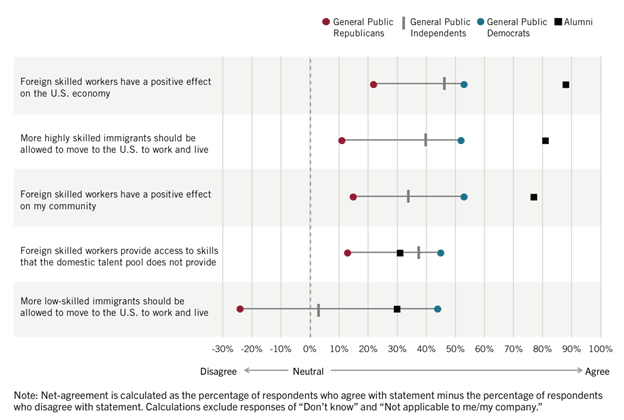
Our alumni were overwhelmingly supportive of skilled immigration. Over 90 percent said that foreign skilled workers have a positive effect on the US economy, and 87 percent believe that the United States should allow more highly skilled immigrants to move here to work and live (see Figures 2 and 3).

Figure 2: Net agreement for belief statements about immigration


Figure 3: Alumni views of immigration system and politics

Alumni also confirmed the importance of foreign skilled workers to their companies’ ability to compete. Nearly one in four said that at least 15 percent of their companies’ US-based skilled workforce was foreign born. Alumni expressed that immigrants were critical for developing better products and services, increasing the quality of innovation, and reaching international customers.

Our alumni warned us, however, that this important competitive advantage is at risk. A majority believe the current political rhetoric around immigration is harming their organization’s ability to attract foreign skilled workers. Nearly 60 percent blamed the US immigration system for causing project delays. And over two-thirds reported that their companies’ operations would be harmed if denied access to foreign skilled workers.

Because immigration is often a political third rail, there are many reasons to be skeptical that the United States will soon find a broad solution. In fact, when it comes to skilled immigration, our research shows more support for minor changes to the current system than for more fundamental reforms. Over two-thirds of alumni supported increasing the number of new H-1B visas issued each year by at least 50 percent. For much of the past decade, H-1B visas have run out within a single week (see Figure 4). Despite even the COVID-19 pandemic, the government received 275,000 applications in March of this year for the 85,000 slots in fiscal year 2021.

Figure 4: Months to reach H-1B visa cap by fiscal year

Structural changes, such as adopting wage ranking for awarding H-1B visas in place of today’s lottery system, did not achieve much support among our alumni. The gap between alumni believing the existing immigration system is harming their businesses and alumni only supporting incremental change is surprising to us. It is unclear whether this reveals a lack of knowledge or actual uneasiness about the policies themselves.

American competitiveness at risk

Either way, the stakes get higher in times of crisis: the recent H-1B visa lottery would have given the same chances to a critical researcher being recruited by Moderna and Inovio (or J&J and GlaxoSmithKline) as it would have to a software code tester working at an outsourcing company.

“WHILE WE MAY TEMPORARILY CLOSE BORDERS AS WE FIGHT COVID-19, BUSINESS MUST ARTICULATE JUST HOW DISASTROUS CLOSING OUR BORDERS LONG-TERM WOULD BE.”

One striking finding was that our alumni were in broad agreement over increasing the allocation of employment-based immigrants within the overall US immigration pool. When asked what share of total immigration to the United States should be employment-based, alumni on average proposed to quadruple today’s 12 percent share. When we surveyed a representative sample of the general public on this same question, we found a similar result—they proposed to triple the share of employment-based immigrants. That result held across all political affiliations, with both Democrats and Republicans proposing to increase the employment-based allotment.

Implementing such a shift could be quite politically controversial depending upon technique, especially if policies shifted visas from family-based channels and diversity programs rather than creating new employment-based visas. But we believe there is a path forward. We can build momentum by getting started with simpler actions like wage ranking H-1B applicants and creating immigrant entrepreneur visas. These quick wins can be stepping-stones towards further reform by proving that we can change our system for the better, despite decades of intransigence.

Most importantly, business leaders should get involved and share the burden with policymakers and academics to educate voters and build support for these policies that ultimately benefit America’s business community.

While we may temporarily close borders as we fight COVID-19, business must articulate just how disastrous closing our borders long-term would be. Some of the recent political rhetoric to halt all immigration, even if later scaled back in practice, endangers the image of America as a welcoming beacon to the next generation of scientists and entrepreneurs. Other countries are creating innovative new programs to attract talent and threaten our competitive advantage, while our government issues executive orders and espouses rhetoric that undermine our promise to the world’s brightest.

Our position at the center of global talent flows is now at risk. Business has both the pressing need, and the capacity, to accept this responsibility. It should.

About the Author

William R. Kerr William Kerr is the D’Arbeloff Professor of Business Administration at Harvard Business School.

Source: Immigration Policies Threaten American Competitiveness

USA: Immigration Review Could Lead To New H-1B Visa Restrictions

Which would likely benefit Canada and possibly other countries:

The Trump administration may soon propose another set of immigration restrictions, this time on H-1B visas for foreign-born scientists and engineers. Some observers view these public displays of limiting immigration as an effort to deflect criticism of the administration’s handling of the coronavirus pandemic. Before enacting new measures, analysts recommend the administration take into account the restrictions on H-1Bs already in current law, including the low annual limit for new H-1B petitions, and the high denial rates imposed by U.S. Citizenship and Immigration Services (USCIS). The latest data show H-1B denial rates are at record levels.

On April 22, 2020, the Trump administration issued a presidential proclamation that suspended the entry of most new immigrants for at least 60 days and ordered a 30-day review to recommend additional measures on temporary visas. Following the review, observers expect new restrictions on H-1B visa holders, F-1 students and others. A new restriction could take the form of suspending the entry of anyone on an H-1B visa coming from outside the country and/or imposing new conditions on their entry that would be difficult to satisfy.

Due to USCIS policies, the H-1B category remains highly restrictive, say attorneys, and the data support this contention. Denial rates rose from 6% in FY 2015 to 30% in the first quarter of FY 2020 for new H-1B petitions for initial employment, according to a new National Foundation for American Policy (NFAP) analysis. (H-1B petitions for “initial” employment are primarily for new employment, typically a case that would count against the H-1B annual limit.) In FY 2019, the denial rate for initial employment was 21%, while the rate was 24% in FY 2018, between 3 to 4 times higher than the FY 2015 denial rate (i.e., prior to the Trump administration.)

All 25 companies with the most approved new H-1B petitions saw their H-1B denial rates for initial employment increase from FY 2015 to the first quarter of FY 2020. (See Table 2.) Even large technology companies that had denial rates of only 1% in FY 2015 experienced much higher denial rates for H-1B petitions for initial employment in the first quarter of 2020: Amazon’s denial rate was 16%, Google’s was 14%, Facebook’s was 8% and Apple’s H-1B denial rate was 8%. Data for additional quarters will tell us how long this trend persists.

“As in earlier fiscal years, the highest denials rates are for companies that provide information technology or other business services to American companies,” according to the NFAP report. “The data indicate USCIS has established a different standard for deciding cases for companies that provide information technology (IT) services. This is the case even though, as attorneys point out, immigration law does not indicate a different standard for adjudications based on the type of firm or the location work will be performed.”

In the first quarter of FY 2020, the H-1B denial rate for initial employment increased by 20 percentage points or more compared to FY 2015 for 12 major companies that provide IT services or other business consulting services. Many of these and other companies hit by high denial rates are U.S. companies. (Data show the use of H-1B visas by Indian-based companies has declined significantly in recent years, see here.)

People who follow technology trends like Everest Group CEO Peter Bendor-Samuel say by providing technical talent many high-skilled foreign nationals and companies that offer services increase the competitiveness of American companies. “Digital transformations and digital platforms are just starting to take off and, as we look into the near future, the current skill shortages are going to grow as the demand for digital and IT skills explodes,” said Bendor-Samuel. “If this administration wanted to harm U.S. competitiveness, then restricting access to this vital labor would be an excellent approach.”

Advanced analytics and cloud computing are two elements of digital transformation. “Digital transformation is the integration of digital technology into all areas of a business, fundamentally changing how you operate and deliver value to customers,” explains the Enterpriser’s Project. “A business may take on digital transformation for several reasons. But by far, the most likely reason is that they have to: It’s a survival issue for many.”

Replacing outdated legacy information technology systems is a key element of digital transformation, notes the Enterpriser’s Project, which points out, “Often, it’s more about shedding outdated processes and legacy technology than it is about adopting new tech.” This sometimes leads to poorly managed transitions. “In a handful or so of cases in past years, H-1B visa holders were blamed for layoffs after some foreign nationals came on-site to manage the transition to new contracts – contracts that went out for bid and, industry professionals note, would have resulted in layoffs or at least a transfer of personnel whether or not the entity awarded the contract employed some H-1B visa holders,” notes the NFAP analysis. “In retrospect, these cases should have been recognized as attempts by companies to undertake digital transformations, transformations that unfortunately can leave longtime employees trained primarily on legacy systems in untenable career situations. Ongoing training efforts for such employees before being placed in these situations would offer the best career protection.”

Judges have ruled against several USCIS policies that have contributed to high denial rates, targeting restrictive agency interpretations of what qualifies as an H-1B specialty occupation, an employer-employee relationship and whether an H-1B employee must list all future work or contracts.

The March 10, 2020, decision in ITServe Alliance v. L. Francis Cissnawould allow any company that believes an H-1B petition was denied in a way ruled unlawful by Judge Collyer’s opinion to file a case in the District of Columbia, notes Jonathan Wasden of Wasden Banias, LLC. (See here.)

Following the 30-day review, the administration could recommend moving forward with an H-1B regulation already on the agenda (but not issued) that would: “[R]evise the definition of specialty occupation . . . revise the definition of employment and employer-employee relationship . . . [and] propose additional requirements designed to ensure employers pay appropriate wages to H-1B visa holders.”

Policymakers often ignore that due to a low annual limit, current immigration law already significantly restricts companies and their ability to employ high-skilled foreign nationals in technology fields. For the past 18 fiscal years, employers have exhausted the annual supply of H-1B visas due to those limits.

Under U.S. law, companies collectively can only use, in effect, 85,000 new H-1B petitions a year – an annual limit of 65,000 and an exemption of 20,000 from that limit for foreign nationals with a U.S. advanced degree. To put that number in perspective, 85,000 new H-1B petitions equals 0.05% of the U.S. labor force of 165 million.

In March 2020, employers sent in registrations for approximately 275,000 foreign-born professionals for the H-1B lottery – more than three times the annual limit of 85,000. That indicates the demand was at least 190,000 scientists, engineers and other professionals beyond current law, and likely would be higher if one included demand that might arise in later months.

It’s worth noting the sectors hardest hit by the economic downturn – airlines, hotels and restaurants – employ few H-1B visa holders. H-1Bs are typically the only practical way to hire a foreign national to work in the United States long-term. (H-1B professionals selected in the March lottery cannot start work until October 1, 2020, or later.)

A study by economists Giovanni Peri, Kevin Shih, Chad Sparber and Angie Marek Zeitlin looked at the last recession and discovered that denying the entry of H-1B visa holders due to the annual limits harmed job growth for U.S.-born professionals. “The number of jobs for U.S.-born workers in computer-related industries would have grown at least 55% faster between 2005-2006 and 2009-2010, if not for the denial of so many applications in the recent H-1B visa lotteries,” concluded the economists.

The Trump administration appears poised to enact new restrictions on foreign-born engineers and the ability of international students to work in the United States after graduation, even though the president has stated he favors “merit-based” immigration and these are the most highly skilled people admitted to America. Economists note the way to recover from an economic downturn is to attract more investors, entrepreneurs and highly productive individuals – not to drive them away to other countries.

Source: Immigration Review Could Lead To New H-1B Visa Restrictions

Trump’s immigration move may force IT firms to shift staff offsite

Further possible effects for Indian IT services companies and tech in general:

US President Donald Trump’s decision to temporarily suspend immigration could further reduce Indian IT services companies’ reliance on H1-B visas.

While tech majors such as TCS and Infosys are increasingly hiring locally in the US and Europe, changes in delivery models following the Covid-19 pandemic could bring down the need for onsite deployment of Indian techies.

Trump, in a tweet, said he intends to sign an executive order to temporarily suspend immigration “in light of the attack from the Invisible Enemy, as well as the need to protect the jobs of our great American Citizens.”

In the likelihood of immigration suspension, companies may not opt for H1-B visas as the Covid-19 pandemic has caused new headaches. TCS is already working on a delivery model that requires only 25 per cent of workforce to be present in an office. If 75 per cent of techies can do their work from outside office, it would not matter if they are in the US or in India.

“My estimate is that demand for onsite work (which requires H1-B) will come down by 50 per cent once things normalise,” said Harish HV, Managing Partner, ECube Investment Advisors.

While H1-B is a non-immigrant visa, Indians as well as others have been taking this route to get US citizenship. Indian nationals are the biggest beneficiaries of the H-1B visas, which the US Centre for USCIS issues to get “qualified” professionals into the US.

“Trump’s decision, albeit temporary, will have significant implications right from people whose citizenship is under process to H1-B renewals,” said a US immigration lawyer whose clients include Infosys, Mphasis and other tech companies. This development comes in the wake of US Citizenship and Immigration Services (USCIS) which, last week, gave its nod to extend H1-B visas which have expired or set to expire.

For the fiscal 2020-21, the US received around 275,000 fresh H1-B visa requests, of which 67 per cent were from India, US government data stated. The mandate is for granting 85,000 visas for immigrants.

According to industry estimates, there are around three million H1-B visa holders. While there are no definitive numbers on how many H1-B visa holders apply for citizenship, some lawyers peg that 24 per cent of H1-B visa holders tend to get green cards every year.

Indian software services companies have had it tough in the last few years. Visa rejection rates were around 30 per cent in 2019 and only two Indian companies were among the top ten visa recipients. Companies that BusinessLine reached out to declined to comment on Trump’s tweet since the final policy document has not been released by the US Government.

H1-B visas have been under the lens by US authorities as visa abuse cases have been reported and lawsuits filed against Indian companies, alleging that people of South Asian origin are hired to displace American workers.

On their part, Indian companies have started to hire in the US. However, such restrictions in the current scenario of weak revenue and higher local employees would have an impact in the short term, said an analyst from a brokerage house who did not wish to be quoted.

Shares of TCS, Infosys, Wipro, HCL Tech and Tech Mahindra all closed lower than Monday’s close after Trump tweeted.

Source: Trump’s immigration move may force IT firms to shift staff offsite

Immigration Filings for H-1B Visas Up 25% from 2019

A rare easing of administration requirements by the Trump administration:

Between March 1 and March 20, 2020, 275,000 individuals were entered into USCIS’ new electronic pre-registration system to obtain an H-1B for the 2020-2021 fiscal year. This is a nearly 25% increase over last year’s filings.

While it is hard to judge what led to the apparent increase in demand, the change may be a reflection of the ease of entering into the lottery, and low unemployment during the first quarter. Employers no longer are required to complete and submit full H-1B filings, but rather simply enter the individuals they wish to sponsor into the system and pay a $10.00 fee per worker. This is an enormous benefit since filing full H petitions has become much more complex under the current Administration’s focus on enforcement. More documentation is needed to try to avoid the now ubiquitous Requests for Evidence (RFEs). Last year more than 60% of H-1B cases received RFEs.

USCIS required very little information about each applicant, but it collected such information as whether the individuals hold U.S. advanced degrees and the citizenship of each applicant. USCIS has announced that about 43% of this year’s pre-registrations were for individuals holding U.S. advanced degrees (Master’s Cap cases). Eighty-one percent of the pre-registrations were for Indian (68%) and Chinese (13%) nationals. The companion figures for the cases that “won” the lottery have not been released. But the lottery system generally favors those with advanced degrees. Last year, 63% of the selected petitions were for beneficiaries with U.S. Master’s degrees.

Many petitioners have been notified which of their cases were selected in the pre-registration lottery. Those cases must be filed over the next 90 days. USCIS explained that all submitted cases will remain in the system for possible selection until the end of the fiscal year (September 30, 2020). From now until then, more cases may be selected in the lottery. Whether or not this happens may depend upon the appetite of the employers whose cases have already been selected for filing. Will COVID-19 play a role in determining how many employers will move forward and file full Cap H-1B petitions?

Source: Immigration Filings for H-1B Visas Up 25% from 2019

Keep Immigration Requirements in Mind When Preparing Coronavirus Response Plans

Practical advice from US immigration lawyers. Have not seen any indication of any impact on Canadian immigration but welcome comment from any Canadian immigration lawyers:

As employers prepare plans to handle possible alternate employee work arrangements in light of the 2019 Novel Coronavirus outbreak, it is important to keep in mind how these plans and policies—including telework policies—may affect foreign national employees working pursuant to US work visas.

H-1B Employees

Telework Arrangements May Necessitate Amended or New H-1B Petitions

It is US Citizenship and Immigration Services (USCIS) policy, based on case law, that an amended or new H-1B petition must be filed whenever there is a move to a location outside the area of intended employment. Once an employer properly files the amended or new H-1B petition, the H-1B employee can immediately begin to work at the new place of employment. Approval of the amended or new H-1B petition is not required in order for work to commence at the new site.

USCIS has made it clear that a new Labor Condition Application (LCA) and amended or new H-1B petition are not required in the following circumstances:

  • A move within an “area of intended employment”: Where the H-1B employee moves to a new job location within commuting distance, a new LCA is not required, provided there are no other changes in the terms and conditions of employment.
    • Although a new LCA and H-1B petition are not required, the employer must post the previously certified LCA in two conspicuous locations at the new work location and update the corresponding public access file.
  • Short-term placements: Under certain circumstances, an H-1B employer may assign an H-1B employee at a new worksite outside the area of intended employment for up to 30 days in a one-year period, and in some cases 60 days in a one-year period (where the employee is still based at the “home” worksite), without obtaining a new LCA. In these instances, a new LCA and H-1B petition are not required, provided there are no other changes in the terms and conditions of employment.
    • We note that short-term placement is not available where there is already an LCA covering the area of intended employment for the occupational classification. The short-term placement provisions provide H-1B employers with flexibility in assignments to afford enough time to obtain an approved LCA for a worksite outside the area of intended employment where the H-1B employer intends to have a continuing presence.
  • Non-worksite locations: Where the H-1B employee is going to a non-worksite location (e.g., going to a location to participate in employee developmental activity, or the job is primarily at one location but requires occasional travel for short periods to other locations) and there are no material changes in the authorized employment, a new LCA and H-1B petition are not required.

Our Recommendation

Before finalizing telework arrangements for H-1B employees, we recommend that employers first review the change in work location with their immigration counsel to confirm whether a new LCA and amended or new H-1B petition are required.

F-1 (Student) Optional Practical Training Employees

Telework Arrangements May Require Updates to Student and Exchange Visitor Information System (SEVIS) Records

The US Department of Homeland Security (DHS) requires that international students on any type of optional practical training (OPT) report changes, including changes in their employment, to their designated school officials (DSOs) to properly annotate their SEVIS records and maintain their student status.

Additionally, every six months, students benefiting from a two-year science, technology, engineering, and mathematics (STEM) OPT extension must work with their DSOs to confirm that their SEVIS records accurately reflect their employers’ addresses and the status of their employment, among other things. STEM OPT students and their employers are obligated to report to their DSOs any material changes to, or material deviations from, Form I-983, the formal training plan for STEM OPT students.

Our Recommendation

Once a telework arrangement is finalized for an F-1 OPT employee, we recommend that the employer remind the F-1 OPT employee to communicate the changes to his/her DSO to ensure that his/her SEVIS record is updated appropriately.

Other Situations

Other Work Visas such as L-1, E-1, E-2, E-3, TN, and O Visas

The above-listed visa classifications do not have geographic limitations in terms of work location. Unless a change in work location creates a material change in the job duties of an employee in one of these classifications, there is no need to notify USCIS about the change.

Should it become impossible to carry out the duties described in the foreign national’s visa petition, we recommend that you consult with immigration counsel to discuss appropriate steps.

Employees Working Remotely from Outside the United States

There may be situations in which foreign nationals who are outside the United States may be unable to return. For example, limited staffing at certain US embassies and consulates abroad may lead to delays in visa application processing times, which could require a foreign national employee to remain abroad for longer than originally anticipated.

While abroad, foreign national employees can work remotely and remain on US payroll without any legal implications with respect to US immigration laws. While US immigration laws are not an issue, we recommend that employers consult counsel to determine whether there are any US tax implications or tax implications in the foreign location as a result of such an arrangement.

Additionally, we note that working remotely from a country other than the foreign national’s country of citizenship may require prior approval from the local immigration authorities. We recommend that employers consult their global immigration counsel to discuss appropriate steps.

Source: Keep Immigration Requirements in Mind When Preparing Coronavirus Response Plans

H-1B Denials Remain High, Especially For IT Services Companies

Some good analysis here (and more on the “Canadian advantage”:

New U.S. Citizenship and Immigration Services (USCIS) data show denial rates for new H-1B petitions increased from 6% in FY 2015 to 21% in FY 2019. Companies that provide information technology (IT) and other services to U.S. businesses had the highest denial rates due to Trump administration policies.

“In FY 2019, USCIS adjudicators denied 21% of H-1B petitions for “initial” employment (which is primarily for new employees) and 12% of H-1B petitions for “continuing” employment (mostly for existing employees),” according to a new National Foundation for American Policy (NFAP) analysis. “The 12% denial rate for continuing employment was the same in both FY 2018 and FY 2019, indicating there has been little change in USCIS policies over the past year.”

USCIS explains that H-1B petitions for “initial” employment are primarily cases that would count against the H-1B annual limit (i.e., new employment). H-1B petitions for “continuing” employment are mostly extensions for existing employees at the same company but could also be for an H-1B visa holder changing to a new employer.

As the NFAP analysis notes, this is the first time that data for all four quarters of FY 2019 are available and can be separated into initial and continuing employment, which provides a clearer picture of USCIS adjudications. The analysis found the 12% denial rate for continuing employment in FY 2019 was four times higher than the 3% rate as recently as FY 2015. The 21% denial rate for initial employment in FY 2019, while lower than the 24% rate in 2018, was still much higher than the 6% denial rate for such cases in FY 2015.

The statistics bear out what immigration attorneys have said for more than a year: “USCIS has raised the legal standard they use to decide whether enough evidence has been presented with petitions to approve them, without any legal authority to do so and without any notice to the public,” William Stock, a founding member of Klasko Immigration Law Partners, LLP, told me in an interview.

The analysis found H-1B denial rates have risen for nearly all major companies. However, it is clear USCIS has used a different standard to adjudicate cases for IT services companies. “The denial rate for H-1B petitions (initial employment) for at least 9 major companies that provide IT services or other consulting services reached over 30% in FY 2019,” according to the analysis, “In comparison, technology product companies, such as Apple, had far lower denial rates for initial employment, ranging between 2% and 7%, although these rates were generally higher than in FY 2015.”

The denials seem focused on H-1B employees who will perform work at customer sites to service contracts. Employers that keep employees primarily in a single location, such as product companies, have much lower denial rates.

Attorneys say there is plenty of evidence that USCIS changed the standards without a change in the law or new USCIS regulations. Between FY 2015 and FY 2019, the denial rate for initial employment increased by 20 percentage points or more for at least 10 major companies that provide information technology or other business services.

For continuing employment, the denial rate for H-1B petitions was 3% between FY 2011 and FY 2015 but increased to 12% in FY 2018 and FY 2019. A USCIS memo that told adjudicators not to provide deference to prior determinations has forced long-time employees waiting for green cards to leave the United States because their cases were denied.

It should not be surprising that the most successful technology companies have needed to hire highly skilled people to grow. The leading employers for H-1B petitions for initial employment in FY 2019 included Amazon, Google and Apple, all of which have passed $1 trillion in market capitalization. When companies recruit at U.S. universities, they find 80% of the full-time graduate students in computer science and electrical engineering are international students.

In contrast, other companies are sponsoring fewer workers. “New H-1B petitions (for initial employment) for the top 7 Indian-based companies declined by 64% between FY 2015 and FY 2019,” according to the NFAP analysis. “The 7 companies had only 5,428 H-1B petitions for initial employment approved in FY 2019. Denials may have contributed to this decline but the primary reason for the drop in H-1B visas is a choice by companies to build up their domestic workforce in the United States and rely less on visas. Moreover, these and similar companies are part of an industry trend when servicing clients to use more digital services, such as cloud computing, bots and artificial intelligence, which require fewer workers.”

The supply of H-1B petitions has been gone before the end of the past 17 fiscal years. The demand for tech talent across industries and the low number of H-1Bs relative to the size of America’s economy are the major reasons. The annual limit of 65,000 H-1B petitions and the 20,000 exemption from that limit for individuals with an advanced degree from a U.S. university comes to 85,000 new H-1B petitions each year – only 0.05% of the U.S. labor force of 164 million people.

High denial rates are not the only problem for companies under Trump administration policies. The percentage of completed cases with Requests for Evidence (RFEs) increased from 22.3% in FY 2015 to 40.2% in FY 2019, according to USCIS, which increases costs and processing time for employers.

Given the problems in the United States, it’s not surprising companies, international students and foreign-born engineers are looking to the north. In Canada, the number of Indians who became permanent residents increased from 39,340 in 2016 to 85,585 in 2019, a rise of more than 117%, according to a National Foundation for American Policy analysis of Immigration, Refugees and Citizenship Canada data.

Under Canada’s Global Skills Strategy, adjudicators approve many applications for high-skilled workers within two weeks with a low number of denials. “Canada is benefiting from a diversion of young Indian tech workers from U.S. destinations, largely because of the challenges of obtaining and renewing H-1B visas and finding a reliable route to U.S. permanent residence,” said Peter Rekai, founder of the Toronto-based immigration law firm Rekai LLP, in an interview. (See here.)

In the United States, we often ignore the positive role technology professionals, both native-born and foreign-born, play in making U.S. companies more competitive. “Digital transformations and digital platforms are just starting to take off and, as we look into the near future, the current skill shortages are going to grow as the demand for digital and IT skills explodes,” said Everest Group CEO Peter Bendor-Samuel. “If this administration wanted to harm U.S. competitiveness, then restricting access to this vital labor would be an excellent approach.”

The situation may grow worse for employers and high-skilled foreign nationals. The Trump administration has pledged to publish a new H-1B visa rule in 2020 to “revise the definition of specialty occupation . . . and revise the definition of employment and employer-employee relationship.”

The rule would put into regulation many of the current USCIS practices that have resulted in higher denial rates – or may be a source of new ways for USCIS to restrict the employment of foreign nationals.

Mexican, Canadian engineers avoid US due to living expenses, immigration policy

Of note:

  • Thirty-nine percent of Canadian and Mexican engineers would prefer not to move to the U.S., according to report from Terminal released Feb. 11. The Terminal survey comprised 483 engineers.

  • Ninety percent of those who would refrain from a U.S. move cited high cost of living. Others said traffic and parking (45%), their current communities (46%) and immigration issues (40%) stop them from moving to the U.S.

  • “Tech companies can no longer ignore that the once-sacrosanct dream of moving to the U.S. to lead the next generation of innovation is fading,” said Clay Kellogg, CEO of Terminal, in a media release. “Moreover, the tech talent shortage means it’s harder to innovate and makes life harder on engineers who are already in the trenches.”

Dive Insight:

Tech professionals in a CompTIA survey shared concerns over living expenses with the Canadian and Mexican engineers. CompTIA found that 78% of the tech professionals it polled said they would relocate, with many citing affordability and the economy.

It’s not surprising that immigration would pose a barrier for Canadian and Mexican engineers. The Trump administration has restricted the number of H-1B visas available for highly skilled foreign nationals, leaving employers in need of these workers feeling short-changed. An October 2019 Indeed study found that, as immigration policies tightened and visa approvals dropped, there was a 673% increase in work visa job searches.

Source: Mexican, Canadian engineers avoid US due to living expenses, immigration policy

Canada Wins, U.S. Loses In Global Fight For High-Tech Workers

The latest article on the “Canadian advantage:”

Hundreds of tech workers pack an auditorium for a recent networking event in Toronto. The evening’s host glides around the room on a hoverboard, equal parts game show host and tech bro.

“Who here is new to Canada?” asks Jason Goldlist, the co-founder of TechToronto, an organization that helps newcomers navigate the city’s fast-growing tech ecosystem.

Dozens of hands shoot up in the air — one belonging to Alok Chitnis, who moved to Canada last year. Chitnis is originally from India. He went to graduate school in the U.S. and found a job in Colorado. But last May, he moved to Canada to launch his own startup.

“It’s vibrant. It’s very welcoming for immigrants,” Chitnis says. “There are a lot of services by the government to help newcomer entrepreneurs especially. So the whole ecosystem is pretty welcoming compared to the U.S.”

If there is a war for global tech talent, right now Canada is winning — and the U.S. may be losing its edge. Toronto saw the biggest growth in technology jobs of any North American city over the past five years, outpacing San Francisco, New York and Seattle. Vancouver also made the top five.

The tech industry across Canada is booming. And one of the biggest reasons is U.S. immigration policy. The Trump administration has made it harder for high-skilled workers to get visas. It also has blocked entrepreneurs from some majority-Muslim countries altogether under the travel ban, which it’s moving to expand to more countries.

Canada, meanwhile, has been making it easier for tech workers to immigrate there. A new streamlined visa in Canada has brought in more than 40,000 tech workers from around the world in the past two years alone.

“While the States has gone, ‘Let’s make it difficult to get the employees here on a visa,’ Canada’s gone the exact opposite, and it’s beneficial for Canada,” says Alex Norman, the other co-founder of TechToronto. “You had a fast-growing ecosystem here that’s been getting a shot of steroids.”

Under the Trump administration, high-skilled workers are getting rejected at a higher rate. In 2015, 92% of new H-1B visa applications were approved. But in the last two years, the approval rate dipped to only 75%.

Immigration authorities say they’re trying to ensure that companies follow the rules. Employers are required to show that hiring a foreign worker will not hurt Americans.

“You know, I have a high regard — as does the president — for protecting U.S. workers,” said Ken Cuccinelli, who was then the acting head of U.S. Citizenship and Immigration Services, in an interview last year.

Cuccinelli was asked about the need to crack down on fraud and abuse. “The H-1B program has been controversial in this regard,” he said. “And it is concerning.”

Meanwhile, U.S. tech companies complain that they can’t find enough qualified candidates to fill all their open jobs.

More than a dozen hiring managers from tech startups recently squeezed into a private dining room at Del Posto, a high-end New York City restaurant. One of them was Susan Riskin, the head of human resources at Bitly, which is well-known for making Web addresses shorter.

“We doubled the size of our technology team in the last year,” Riskin said. “And we feel like we have exhausted New York and Denver. And now it’s like we’re trying to figure out where to go next, what we need to do.”

All of the hiring managers at the table were confronting a similar problem. They came for the New York strip steak and Italian wine — but also to hear a business pitch from Irfhan Rawji, the founder of a Canadian company called MobSquad.

“If you’d rather fill a job than go without, call us,” Rawji said. “We’ll open a virtual subsidiary for you in Canada. You get access to the world.”

Rawji’s pitch, in a nutshell, is this: Say your firm wants to hire an international tech worker, but the worker’s visa application is rejected or the application process is dragging on for months.

“The next-best solution to keeping them here in the U.S., if you can’t do that, is to put them in Canada,” Rawji said. “The flights are an hour and a half to two hours. It’s the same business culture. And we try to match or beat the total cost for you here.”

U.S. tech companies have long relied on a steady stream of engineers and software developers from China, India and elsewhere. The process of getting an H-1B visa was often expensive and slow, says Meagan Soszynski, the head of human resources for an advertising app called Yieldmo. But at least it was predictable.

“You followed a certain process, you paid a premium, but you pretty much always got the outcome that you wanted,” says Soszynski.

She says that’s not the case anymore.

“In the last year, I would say every one of my H-1B cases have been met with some sort of delay,” Soszynski says. “So the immigration changes are certainly being felt by us on the front lines.”

The U.S. remains a popular destination for international workers. The number of applicants for H-1B visas stills exceed the annual cap of 85,000. But in recent years, fewer are applying.

“The biggest thing that’s going to hurt the U.S. competitiveness is the overall rhetoric or tone” on immigration, says William Kerr, a professor at Harvard Business School and the author of The Gift of Global Talent, who also serves on the board of MobSquad.

“If you think about migration, people are making a choice to come and invest in their lives, whether for school or for work, and they want to have long-term opportunities,” Kerr says. “And the uncertainty and the hostility really dampen that enthusiasm.”

President Trump says he understands the problem.

“We have to allow smart people to stay in our country,” Trump said in an interview with Laura Ingraham on Fox News this month.

“We don’t have enough of them. And we have to be competitive with the rest of the world too,” Trump said.

But global tech workers say the Trump administration’s policies make the U.S. less attractive.

Ozge Yoluk started a new job in Toronto this month. She was born in Turkey and studied in Europe. Yoluk worked as a postdoctoral researcher in computational biology at the University of Maryland in Baltimore. She says the field is “like playing video games” — except in these games, the characters are proteins and experimental drugs.

The company she joined, ProteinQure, is using tech to design new treatments. Pharmaceutical companies in the U.S. are doing similar work. But Yoluk says she didn’t even bother applying for those jobs.

“Getting a visa in the U.S. is not easy,” Yoluk says. “And it’s really costly, not just for the companies but also for the person itself.”

Yoluk says the higher rejection rate for work visas has made U.S. companies more reluctant to sponsor foreign workers — and foreign workers more reluctant to go through the process.

“I said I will not waste my time applying for positions in the States,” Yoluk said. “Whereas in Canada, the process was easy.”

Yoluk says she got her Canadian visa approved in about two weeks. She didn’t even need a lawyer to navigate the process.

A few blocks away, I met Milad Zabihi at a coffee shop in downtown Toronto. Zabihi is the CEO of a startup called Peekage, which helps companies target customers. Zabihi immigrated to Canada from Iran. Several of the company’s other co-founders are also Iranian.

“We are a bunch of friends from university time,” Zabihi says. “We were thinking of like, you know, starting something new.”

Zabihi says they wanted to locate this new venture in the United States. But then, Trump’s travel ban blocked most immigrants and visitors from Iran and several other Muslim-majority countries.

“Everyone’s like, OK, the U.S. is not an option,” Zabihi says. “Especially we like, you know, what is happening right now with the new administration and Islam. So we were basically thinking of, like, what would be the best next option.”

Now big U.S. tech firms are following global tech workers north of the border.

Google, Microsoft, Intel and Uber have either opened or announced plans for new offices in Canada.

“Toronto’s now the fastest-growing tech city in North America,” said Yung Wu, the CEO of the MaRS Discovery District, a technology hub in Toronto that’s home to 150 tech startups. It takes up most of a city block, with multiple buildings connected by a soaring glass atrium.

Wu says the Toronto tech industry has been growing for a while. But the U.S. immigration crackdown accelerated that growth.

“Look, every time Trump tweets, we get another sort of injection, which is all good from my perspective,” Wu says. “Companies are locating here because they can get access to foreign talent faster.”

Wu says hiring the right people at the right time can be the difference between a company that succeeds and one that doesn’t.

Canada is betting on it.

Source: Canada Wins, U.S. Loses In Global Fight For High-Tech Workers

USCIS’s Cuccinelli Boasts Of Increasing Immigration Bureaucracy

Not something to boast about, normally:

In a new press release, USCIS Acting Director Ken Cuccinelli boasted that the Trump administration has increased red tape and bureaucracy for U.S. companies. It’s the latest example of administration officials lauding efforts to make it more difficult for employers to obtain what economists often consider to be a company’s most valuable resource – talent.

Since 2017, Trump administration policies have focused on restricting the entry of immigrants and foreign nationals, including scientists and engineers. “Denial rates for new H-1B petitions have increased significantly, rising from 6% in FY 2015 to 32% in the first quarter of FY 2019,” according to a National Foundation for American Policy analysis.

In addition, expensive and time-consuming Requests for Evidence (RFEs) reached an unprecedented level of 60% in the FY 2019 first quarter. The percentage of completed H-1B cases with a Request for Evidence has doubled between FY 2016 and FY 2019. Many companies have resorted to lawsuits in federal court against USCIS to gain approvals for employees they have identified as valuable.

However, Ken Cuccinelli and USCIS describe the increased bureaucracy facing businesses in positive terms and the fulfillment of a mission. “Consistent with President Trump’s call for enhanced vetting, USCIS plays a key role in safeguarding our nation’s immigration system and making sure that only those who are eligible for a benefit receive it,” according to the October 16, 2019, press release. “USCIS is vigorous in its efforts to detect and deter immigration fraud, using a variety of vetting and screening processes to confirm an applicant’s identity and eligibility. The agency also conducts site visits, interviews applicants, and requests evidence for benefits that offer individuals status in the United States.”

The meaning of the bureaucratic language used by USCIS is clear: USCIS has made it more difficult for employers to gain approval for high-skilled foreign nationals and others.

Here are examples of increased bureaucracy and added burdens on companies hiring foreign-born scientists and engineers:

•          Government documents reveal USCIS adjudicators were directed to restrict approvals of H-1B petitions without the legal or regulatory authority to justify those decisions. The documents became public following a Freedom of Information Act (FOIA) lawsuit filed by the American Immigration Lawyers Association.

•          A USCIS internal document – “H-1B RFE Standards” – encouraged adjudicators to demand more information of employers, leading to such requests being made in 40% to 60% of H-1B cases.

•          Another USCIS document changed the standard for what qualifies as a “specialty occupation” for an H-1B visa holder – without any change in the law or regulation. While initially used to deny H-1B status to computer programmers, this analysis explains that the USCIS document states the new USCIS policy is “Applicable to Many Occupations.”

•          USCIS adjudicators have taken the unusual step of approving H-1B status for periods of very short duration. In an ongoing court case, U.S. District Judge Rosemary M. Collyer cited the plaintiff’s example of USCIS granting one applicant an H-1B approval valid for only a single day – from February 1 to February 2, 2019. (See USCIS decision here.) Such actions force businesses to waste time and money filing repeatedly for the same employees.

•          A Trump administration decision to compel employment-based green card applicants to sit for in-person interviews contributed to “increased delays in the adjudication of employment-based benefits [that] undermined the ability of U.S. companies to hire and retain essential workers,” according to an American Immigration Lawyers Association report. It also caused increased backlogs in other types of applications.

•          USCIS now often requires – without a new law or regulation – a company to list every contract on which an H-1B visa holder will work during a three-year period to prove a “valid employer-employee relationship.” This was not done previously, and companies consider it unduly burdensome and out of touch with how businesses operate in a modern economy. The policy is a source of litigation.

•          USCIS also issued a memo instructing adjudicators to no longer defer to prior determinations when adjudicating extension applications for existing H-1B visa holders. That policy change has contributed to a significant increase in denials and Request for Evidence for continuing employment for H-1B petitions, resulting in a three-fold increase in the denial rate for companies trying to retain current H-1B employees between FY 2016 and FY 2019. Employees who spent years working in the United States have been forced to leave the country after being denied H-1B extensions.

“By increasing the many hoops and hurdles that employers and foreign-born workers must negotiate to work in the United States, USCIS is making it harder for American companies to recruit and retain global talent,” said attorney Vic Goel, managing partner of Goel & Anderson, in an interview. “It is doing this through trumped-up claims of increased workload and fraud referrals, when many of those challenges are the result of its own efforts to create more work for itself and further grow the immigration bureaucracy.”

The available U.S. domestic talent pool is limited in many key fields. Approximately 80% of full-time graduate students at U.S. universities in computer science and electrical engineering are international students who need a visa to work long-term in the United States.

Research by Britta Glennon, an assistant professor at the Wharton School of Business at the University of Pennsylvania, found the types of government restrictions applauded by the acting director of USCIS are not good for America. Glennon found H-1B visa restrictions carry the unintended consequence of pushing jobs outside the United States and lead to less innovation in America. “In short, restrictive H-1B policies could not only be exporting more jobs and businesses to countries like Canada, but they also could be making the U.S.’s innovative capacity fall behind,” concluded Glennon.

When USCIS Acting Director Ken Cuccinelli ran for and held public office in Virginia, he had the support of the Tea Party and advocated against overreaching federal bureaucracy, including by filing a lawsuit against the Environmental Protection Agency. As Bob Dylan once sang, “The times, they are a-changin.’”

Source: USCIS’s Cuccinelli Boasts Of Increasing Immigration Bureaucracy