Half of racialized people have experienced discrimination or unfair treatment in the past five years
2024/05/17 Leave a comment
Latest GSS. Interestingly overall observation “Between racialized groups, there were no significant differences in experiences of discrimination.”
But “For instance, nearly half of Black people experienced discrimination or unfair treatment in a workplace setting (48%). This was significantly more than other racialized groups (39%) or non-racialized people (41%). Black people were also more than twice as likely to report discrimination when seeking housing (13%) compared with other racialized groups (6%) or non-racialized people (6%).:
Over one in three people (36%) aged 15 years and older living in Canada have experienced some form of discrimination or unfair treatment in the five years prior to the latest wave of the Canadian Social Survey. These experiences occurred in a variety of settings—while attending school, applying for jobs, working, shopping, and seeking healthcare, among others. The results, based on new data from the survey collected from January to March 2024, suggest that while the proportion of self-reported incidents of discrimination has remained relatively stable since 2021, discrimination and unfair treatment continue to disproportionally affect racialized groups, Indigenous people, women, 2SLGBTQ+ populations, people living with disabilities, and young adults.
Discrimination and unfair treatment is a headline indicator in Canada’s Quality of Life framework. This framework enables the federal government to identify future policy priorities, to build on previous actions to strengthen evidence-based decision-making and budgeting, and to improve the well-being of Canadians.
Racialized people, especially Canadian-born Black people, are more likely to face discrimination
Using pooled data from six waves of the Canadian Social Survey, it is possible to examine the intersection of various characteristics of people who have experienced discrimination. From 2021 to 2024, just over half (51%) of racialized people aged 15 years and older reported experiencing discrimination or unfair treatment within the five years prior to the survey. This was nearly double the proportion (27%) recorded for non-racialized people. Between racialized groups, there were no significant differences in experiences of discrimination.
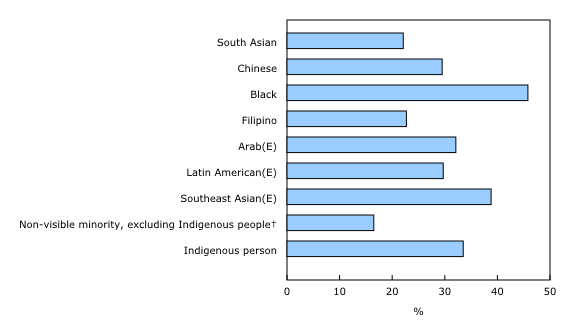
Reflecting the diversity of intersectional identities in Canada, experiences of discrimination varied across intersecting identities of racialized people and immigrants. Consistent with previous findings, reports of discrimination were more common among the Canadian-born racialized population (57%) than among racialized people who recently immigrated to Canada (48%) or who immigrated more than 10 years ago (49%). This difference was most pronounced among Black Canadians, with Canadian-born Black people being significantly more likely to report having experienced discrimination (71%) than either recent (51%) or established (59%) Black immigrants.
The higher prevalence of experiences of discrimination among racialized groups was perceived to be largely motivated by race or ethnicity. Specifically, discrimination based on race or skin colour was the leading perceived reason for discrimination against racialized people (66%). This was followed by discrimination due to ethnicity or culture (49%), accent (28%), and language (27%).
Discrimination is also more common among other historically marginalized groups such as 2SLGBTQ+populations, Indigenous people, and people with a disability
Chart 1
Discrimination in the five years prior to the survey, perceived reason for discrimination, by sex and total population, Canada, 2021 to 2024

Reasons behind discriminatory treatment varied among groups, as did the actual prevalence of discrimination. For instance, the leading perceived reasons behind discrimination and unfair treatment against 2SLGBTQ+ populations were sexual orientation, physical appearance, and sex. This population was also nearly twice as likely as the non-2SLGBTQ+ population to face some form of discrimination or unfair treatment in the five years prior to the survey (61% versus 32%).
Among First Nations people living off reserve, Métis, and Inuit, 46% reported experiences of discrimination, compared with 33% of non-Indigenous people. The reasons for these experiences were largely perceived to be due to Indigenous identity and physical appearance. Indigenous people (23%) were also nearly twice as likely to be discriminated against due to a physical or mental disability compared with the non-Indigenous population (12%).
Elevated levels of discrimination were also recorded for people living with a disability. In all, 44% of people with a disability reported experiences of discrimination, compared with 32% of people without a disability. The most frequently-cited perceived reasons for discrimination against people with a disability were due to physical or mental disability, physical appearance, and age.
Age and sex also played a role in both prevalence of and perceived reason for discrimination. Experiences of discrimination consistently decreased with age, from a high of 45% among those aged 15 to 34 to a low of 17% among people aged 65 years and older. This may be explained by the fact that the racialized population and people who are 2SLGBTQ+ tend to be younger.
Perceived reasons for discrimination varied by people in different age groups, with race or skin colour (38%) and physical appearance (38%) being the most common reasons among those aged 15 to 34, and age (50%) being the most common reason for people aged 65 years and older. There were also sex differences in prevalence of discrimination: 37% of women reported experiences of discrimination, compared with 30% of men. Women were more often discriminated against because of their sex or age, while for men, discrimination was more often on the basis of their race or skin colour, ethnicity or culture, language, accent, or religion.
The work environment is the most common context where discrimination is reported
Chart 2
Discrimination in the five years prior to the survey, situation in which discrimination was experienced, by sex, Canada, 2021 to 2024

There were differences in the context in which discrimination was experienced across groups, though the workplace (41%) was the most common location of discrimination or unfair treatment, whether it was while working, applying for a job, or seeking a promotion. This was followed by discrimination experienced in a store, bank, or restaurant (33%) and while using public areas (29%).
While differences in the prevalence of discrimination did not significantly differ between racialized groups, the contexts in which they occurred did. For instance, nearly half of Black people experienced discrimination or unfair treatment in a workplace setting (48%). This was significantly more than other racialized groups (39%) or non-racialized people (41%). Black people were also more than twice as likely to report discrimination when seeking housing (13%) compared with other racialized groups (6%) or non-racialized people (6%).
Conversely, Chinese people were less likely than other racialized groups to report experiencing discrimination while attending school (17% versus 23%), in the workplace (26% versus 44%), when crossing the border into Canada (5% versus 8%), and when seeking housing (3% versus 8%). Similarly, reports of discrimination towards Chinese people were lower than reports of discrimination against non-racialized people in the workplace (41%) and against non-racialized people when seeking housing (6%).
People who experience discrimination also report lower measures of quality of life
Chart 3
Discrimination in the five years prior to the survey, confidence in selected types of institutions, Canada, 2021 to 2024

Experiences of discrimination and unfair treatment may influence overall perceptions of health and wellbeing. People who experienced discrimination in the five years prior to the survey compared with those who did not were more than twice as likely to report fair or poor mental health (31% versus 14%), were less likely to report high life satisfaction (37% versus 57%) and were less likely to report high levels of meaning and purpose (46% versus 63%). And while two-thirds of people who experienced discrimination (66%) reported that they always or often had someone they could depend on, this was lower than those who had not experienced discrimination (79%).
People who experienced discrimination were also less likely to report a strong sense of belonging to their local community compared with people who did not experience discrimination (39% versus 51%). Furthermore, they were less likely to report confidence in various institutions, including the police, school, courts, Canadian Parliament, and media. These results were consistent with a previous study conducted during the COVID-19 pandemic using crowdsourced data.
Source: Half of racialized people have experienced discrimination or unfair treatment in the past five years





 Multicultural Meanderings