Temporary residents in Canada rise to 2.8 million ahead of government restrictions

Highlights the challenges the government has in reversing growth that it encouraged and enabled:

The number of temporary residents in Canada swelled to 2.8 million in the first quarter, underscoring the challenge facing a federal government that is looking to restrict migration to the country.

Temporary residents – a group that includes international students, people here on work permits and asylum claimants – now comprise 6.8 per cent of the total population, up from 3.5 per cent two years ago, Statistics Canada reported on Wednesday.

Over all, the population grew by roughly 243,000 or 0.6 per cent during the first quarter, bringing the total to more than 41 million.

Canada is experiencing some of its fastest population growth in decades, fuelled almost entirely by immigration. The number of temporary residents has more than doubled over the past two years, raising concerns about Canada’s ability to welcome so many people, particularly in housing markets with low supply.

Source: Temporary residents in Canada rise to 2.8 million ahead of government restrictions

Apportionment & Immigration: 95 Percent of Noncitizen Growth Went to GOP States Since 2019 – Cato Institute

Of interest:

In response to a question about restricting immigration, House Representative Yvette D. Clarke (D‑NY) recently stated, “I need more people in my district just for redistricting purposes.” When a Republican member of Congress askedwhether this was the motivation for other Democrats, including President Biden, to oppose more extreme asylum restrictions during a committee hearing at which I testifiedlast week, former head of Immigration and Customs Enforcement Tom Homan stated:

I certainly believe it’s probably associated with the decision to overturn the Trump Census rule, so now [immigrants] will be mandated to be counted in the Census. When we reapportionate [sic] seats, it’s going to have an effect.

Although former President Trump did attempt to exclude some noncitizens from the Census count and from House apportionment, multiple courts foundthose efforts to be illegal and unconstitutional. The Constitution is clear: “Representatives shall be apportioned among the several states according to their respective numbers, counting the whole number of persons in each state.” But does this provision of the Constitution—whatever its merits—give Republicans a good reason to oppose immigration?

No, the data are equally clear: recent immigration trends are benefiting Republicans in states where they control the legislature and manage redistricting. About 62 percent of the three‐​million increase in the total immigrant population from March 2019 to March 2023 has occurred in GOP states, according to the Current Population Survey Annual Social and Economic Supplement.

The American Community Survey (with a larger sample size but slightly older data) attributes 60 percent of the growth in the immigrant population to GOP states from July 2019 to July 2022. These percentages are also similar for the Latin American immigrant population growth.

What about noncitizens who might be excluded by a US citizen‐​only census? For them, an overwhelming 95 percent of the increase in the noncitizen population has been in GOP states from March 2019 to March 2023. Eliminating the growth in the noncitizen population from 2019 to 2023 would have cost Republican states 1.2 million people, or about two seats in Congress (the average congressional district has 760,367 people). Figure 1 shows the net increase in immigrant populations for states under GOP and Democratic control.

Table 1 shows the full data from the Current Population Survey’s Annual Social and Economic Supplement for March 2023 and March 2019. The Republican state leading this trend is Texas, which netted 515,970 noncitizens and 833,028 immigrants overall. Other Republican states experiencing significant growth in their immigrant populations include Kentucky (130,061 noncitizens and 146,790 immigrants), South Carolina (102,096 and 157,396), and Florida (102,055 and 178,052). It is certainly likely that these states are attracting immigrants because of their strong job growth.

The argument that recent immigration is boosting Democratic representation in Congress is unsubstantiated. In 2015, I rebutted this same claim about recent illegal immigration. I noted, “Illegal immigration from 2000 to 2010 netted the Republicans about six seats in redistricting. Democrats managed only about 4.5, giving the Republican states yet again more than a seat advantage.” Clearly, immigration has not helped Democrats in terms of apportionment for decades. Yet, this misconception has become so entrenched that the former president tried to unconstitutionally exclude some noncitizens from the Census count.

I have also explained how it is false that Republicans fare poorly during periods when the immigrant share of the population is high. Republicans have controlled at least one chamber of Congress 85 percent of the years when the immigrant share of the population exceeded 10 percent, while not controlling either chamber 83 percent of all other years. This is a staggering disparity that has been completely overlooked in current political discourse. Republicans should not fear immigration based on unfounded political concerns.

Source: Apportionment & Immigration: 95 Percent of Noncitizen Growth Went to GOP States Since 2019 – Cato Institute

Klassen: Canada, a superpower? Here’s how the country might one day fit the bill

I am always sceptical of such long-term forecasts, given that none of us will be around to see how accurate, or likely how inaccurate, they will prove to be, 100 years from now, let alone Klassen’s 200 years.

In comparison, Century Initiative’s goals of a large increase in population, are modest and more realistic (even if I have fundamental disagreements).

For the foreseeable future, the United States will probably remain the world’s most powerful nation. Yet, like any champion, it must watch for challengers and head them off. At present, China’s rise on the global stage troubles Washington. A few decades ago, it was the Soviet Union.

But will future contenders for superpower status be much closer — specifically, north of the U.S. border? The British Empire ended in the mid-20th century when it was outmanoeuvred not by one of its longtime rivals, France or Germany, but rather by its ally, the U.S. Could Canada do the same?

Canada’s population is just a fraction of its southern neighbour’s, but Prime Minister Justin Trudeau’s Liberal government has announced an ambitious plan to bring in 500,000 immigrants each year by 2025.

The vast majority will be young and selected via merit-based criteria that give priority to education and workplace skills. Canada’s population in relation to the U.S. has also been slowly increasing for decades and is growing at a faster pace.

Canada and the U.S. are roughly the same size, both accounting for 6.1 per cent of the world’s land mass. Much of Canada’s land at present is cold, barren and largely uninhabitable. But climate change has made Canada’s landscape more temperate and suitable for agriculture and other activities, a trend expected to continue in the decades to come.

Economic powerhouse

In some ways Canada is already a superpower. Its economic output is the eighth largest in the world. The seven countries with larger economies have bigger populations than Canada. Even with a short growing season and relatively small area devoted to agriculture, Canada is the fifth largest exporter of agri-food and seafood products.

But economic strength is only one measure of a global power. Another is having the resources that others need. In that regard, Canada is extraordinarily rich in natural resources, including clean water. Regardless of future economic, environmental and technological trends, the country will be an energy and natural resources superpower.

Two other elements are needed for superpower status: a political system that provides strong governance and a national culture that’s appealing to its own citizens and to people around the world.

Canadian politics prizes stability and moderation, both hallmarks of a superpower. Social change occurs with few ideological battles. For example, becoming the first developed country to legalize the use and sale of recreational cannabis happened with scant controversy or social division.

Even on expanding the scope of medical assistance in dying legislation, Canadians have remained civil, with all stakeholders willing to listen to each other.

Providing inspiration

Superpowers are not only countries that dominate in various spheres, but also countries that command the aspiration of — and provide inspiration for — people around the globe. For two centuries, the U.S. has made its national dream one that others around the world sought to attain. American-style democracy was the gold standard.

This is now less and less the case. The “city on a hill” acting as a beacon of hope for others has morphed in recent decades into a selfish “America-first” environment.

American citizens have grown disillusioned by their polarized politics, while outsiders question the excesses that drive U.S. capitalism. Donald Trump’s years in the White House have left many dismayed about the future of their country and widened the divisions between Republicans and Democrats.

As neighbours, Canadians shake their heads in wonder at the inequities, lack of public health care, lax gun control and debates over abortion and immigration that dominate and divide American politics.

Canadian culture, shaped by the country’s history of being a fragment of both the British and French empires, has aspired to promote equality, both between individuals and groups, although it’s failed in its abysmal treatment of Indigenous Peoples.

Nonetheless, in an age of globalization and demand for greater personal freedoms, Canada’s multicultural policies are a beacon of hope in a world often scarred by religious, ethnic and tribal battles.

Where will Canada be in 2223?

Much like when the U.S. steadily assumed the role of unchallenged superpower from Great Britain during the first half of the 20th century, it might be that Canada gradually becomes a great power this century — perhaps first as a partner to the United States, but then increasingly supplanting its neighbour.

For many around the world, such a transition would be preferable to other scenarios, such as China or Russia assuming more dominant roles in global affairs.

A shift in global power relations would occur at a leisurely pace and with minimal disruption.

In 1776, with a population of 2.5 million, few imagined that within two centuries, the U.S. would become the dominant superpower. It’s not inconceivable that Canada could perform the same feat by 2223.

Source: Canada, a superpower? Here’s how the country might one day fit the bill

Manning: The link between growth and immigration: unpicking the confusion

One of the better explainers on growth, immigration and productivity (i.e., per capita not overall growth):

The new UK government with Liz Truss as PM and Kwasi Kwarteng as chancellor has told the Treasury to “focus entirely on growth” as the main objective of government policy. And it is rumoured that part of this dash for growth is to be loosening controls on immigration. As immigration restrictions have been argued to be the “greatest single class of distortions in the global economy”, that is perhaps not surprising for a government that seems ideologically committed to free markets. A more liberal immigration system is an idea that has been received favourably in some parts of the commentariat that are otherwise extremely critical of other policies such as directing tax cuts to the rich. For example, Lionel Barber, a former editor of the Financial Times, tweeted that it was good news “that Truss government plans to increase immigration to boost growth”.

Many of these commentators are people whose views I normally regard as sensible. But on the relationship between immigration and growth I think much comment is deeply confused. The root of the confusion is what we mean by ”growth”.  Growth might mean an increase in gross domestic product (GDP), the total amount of goods and services produced in the economy. Because immigration means more people and more people means a bigger economy, immigration almost certainly increases growth in this sense. But we normally think of growth as being desirable because it represents an improvement in the material standard of living in the country. Then, GDP per capita (per person) is a much better measure of growth and the relationship between immigration and growth more complicated as immigration raises GDP but also the capita bit of the formula.

The confusion over the link between growth and immigration is not new. A House of Lords reportfrom 2008 criticised the government for using the impact of immigration on GDP rather than GDP per capita in its analysis. With the benefit of hindsight, the garbled economics of immigration of the government at that time was one reason it got into trouble over immigration (the others being naïve visa design and a failure to monitor what was happening).

Before the pandemic disrupted the economy, UK GDP per capita was about £33,700. An extra immigrant will raise GDP per capita if their contribution is above this figure, reduce it if its below. Using this measure, immigration is no longer necessarily pro-growth; it depends. Assessing the contribution of migrants to GDP is critical to deciding whether more open immigration rules raise or reduce GDP per capita.

One contribution of immigration to GDP is the earnings of the migrants themselves. But their work also generates profits; labour income is about 60% of total income, meaning that 60p in earnings generates £1 in GDP on average. If a migrant’s earnings generate the same profit per pound as the average, this would mean that any single migrant earning above £20k would raise GDP per capita. The lowest visa salary thresholds are currently slightly above this level. But if the migrant has a non-working partner and child, they would have to earn over £60k to raise UK GDP per capita. Rules on rights to bring dependents, rarely discussed, make a big difference for the impact of immigration on GDP per capita.

But perhaps there are other effects on GDP per capita beyond the migrant and their employer. These effects might be positive or negative. As more immigration means faster labour force growth, some investment has to be directed to equipping the new workers with capital. If investment as a whole does not increase sufficiently, this means lower investment per worker in other jobs, which means lower GDP per capita. On the other hand, there is good evidence that higher-skilled migrants lead to more innovation, which is the underlying basis for productivity growth. Some studies also claim there are positive general effects on productivity of all migrants, not just the higher-skilled. The magnitude of the impacts in these studies are, for me, beyond what is credible. For example, some studies imply that the average immigrant is 2.5 times more productive than a Brit.

Also sowing confusion is a famous theoretical result in the economics of immigration; what is known as the ”immigration surplus” result. This says that in competitive markets, immigration of any type raises the average income of the locals as long as the skill mix of migrants and locals differs. There are two problems with the way this famous result is commonly interpreted. First, the impact works through changes in wages and prices. If, as the evidence suggests is the case, these do not change very much, if at all, with immigration, then the predicted benefits are small. More importantly, the growth measure being used is the GDP per capita of the locals only; it is as if the migrants themselves count for nothing. It is a country like the United Arab Emirates that probably comes closest to what this theoretical model would say is desirable. If the UAE is not your preferred model of the good society, don’t cite these results.

The effects of migration on GDP per capita may be more positive in the short run than in the long run. Initially, the migrants are on work permits, they have to work.  But if they settle, some will end up out of work (just like everyone else) and will eventually retire.  So settlement rules, again rarely discussed, matter for the impact of immigration on growth.

Productivity per hour worked is another measure of growth we might be interested in; the UK has a well-known problem with productivity; growth has been very weak since the financial crisis and we lag behind our competitors. ,We might want an immigration policy to raise productivity per hour worked.  That would lead to a more restrictive immigration policy than one that focused on current GDP per capita, as one now has to compare working migrants with working locals, not all locals.

So, the relationship between immigration and growth is likely to be far more complicated than widely assumed. The final migration advisory committee report produced when I was chair tried to estimate the likely impacts of different migration rules on the growth outcomes described here. Those estimates were based on assumptions that are not beyond criticism.  But the bottom line was that the impact of a well-chosen immigration policy on growth was very small unless one focused on total GDP, which is the wrong measure. For high-skilled immigrants, it is likely that GDP per capita is raised but for lower-skilled immigrants it is much more debatable. And a lot of the current discussion is about reducing restrictions on immigration to address labour shortages in sectors like agriculture and hospitality, where productivity and salaries are low.

I have discussed the impact of immigration on UK growth alone.  But perhaps we should take a global perspective. There is little doubt that immigration from lower-income countries to higher-income ones (like the UK) raises global GDP per capita even if it reduces GDP per capita in the UK. That is a strong reason to look to find ways to be open to immigration.  But we need to be aware that most of the benefits go to the migrants themselves, and that some controls are needed to avoid harm to some of the locals. Pretending there is a strong case that immigration always raises growth in the local economy may be in a good cause, but when that case is exaggerated, it runs the risk of undermining public confidence in the immigration system, something that tends to lead ultimately to more restrictive policies.

____________________

Alan Manning is Professor of Economics in the Department of Economics at LSE, and co-director of the community wellbeing programme at LSE CEP. His research generally covers labour markets, with a focus on imperfect competition (monopsony), minimum wages, job polarisation, immigration, and gender. On immigration, his interests expand beyond the economy to issues such as social housing, minority groups, and

Source: The link between growth and immigration: unpicking the confusion

This Pioneering Economist Says Our Obsession With Growth Must End

Hard to see how countries will wean themselves off this obsession, even as we see the negative effects on the environment and society. Definitely asking the right ethnical and value questions:

Growth is the be-all and end-all of mainstream economic and political thinking. Without a continually rising G.D.P., we’re told, we risk social instability, declining standards of living and pretty much any hope of progress. But what about the counterintuitive possibility that our current pursuit of growth, rabid as it is and causing such great ecological harm, might be incurring more costs than gains? That possibility — that prioritizing growth is ultimately a losing game — is one that the lauded economist Herman Daly has been exploring for more than 50 years. In so doing, he has developed arguments in favor of a steady-state economy, one that forgoes the insatiable and environmentally destructive hunger for growth, recognizes the physical limitations of our planet and instead seeks a sustainable economic and ecological equilibrium. “Growth is an idol of our present system,” says Daly, emeritus professor at the University of Maryland School of Public Policy, a former senior economist for the World Bank and, along with the likes of Greta Thunberg and Edward Snowden, a recipient of the prestigious Right Livelihood Award (often called the “alternative Nobel”). “Every politician is in favor of growth,” Daly, who is 84, continues, “and no one speaks against growth or in favor of steady state or leveling off. But I think it’s an elementary question to ask: Does growth ever become uneconomic?”

There’s an obvious logic to your fundamental argument in favor of a steady-state economy, which is that the economy, like everything else on the planet, is subject to physical limitations and the laws of thermodynamics and as such can’t be expected to  grow forever. What’s less obvious is how our society would function in a world where the economic pie stops growing. I’ve seen people like Peter Thiel, for example, say that without growth we would ultimately descend into violence.

To me that suggests a fairly limited and grim view of human possibility. Is your view of human nature and our willingness to peacefully share the pie just more hopeful than his? 

First, I’m not against growth of wealth. I think it’s better to be richer than to be poorer. The question is, Does growth, as currently practiced and measured, really increase wealth? Is it making us richer in any aggregate sense, or might it be increasing costs faster than benefits and making us poorer? Mainstream economists don’t have any answer to that. The reason they don’t have any answer to that is that they don’t measure costs. They only measure benefits. That’s what G.D.P. is.

There’s nothing subtracted from G.D.P. But the libertarian notion is logical. If you’re going to be a libertarian, then you can’t accept limits to growth. But limits to growth are there. I recall that Kenneth Boulding said there are two kinds of ethics. There’s a heroic ethic and then there’s an economic ethic. The economic ethic says: Wait a minute, there’s benefits and costs. Let’s weigh the two. We don’t want to charge right over the cliff. Let’s look at the margin. Are we getting better off or worse? The heroic ethic says: Hang the cost! Full speed ahead! Death or victory right now! Forward into growth! I guess that shows a faith that if we create too many problems in the present, the future will learn how to deal with it.

Do you have that faith? [Laughs.] No, I don’t.

Historically we think that economic growth leads to higher standards of living, lower death rates and so on. So don’t we have a moral obligation to pursue it? 

In ecological economics, we’ve tried to make a distinction between development and growth. When something grows, it gets bigger physically by accretion or assimilation of material. When something develops, it gets better in a qualitative sense. It doesn’t have to get bigger. An example of that is computers. You can do fantastic computations now with a small material base in the computer. That’s real development. And the art of living is not synonymous with “more stuff.” People occasionally glimpse this, and then we fall back into more, more, more.

But how would a country continue to raise its standard of living without growing its G.D.P.? 

It’s a false assumption to say that growth is increasing the standard of living in the present world because we measure growth as growth in G.D.P.

If it goes up, does that mean we’re increasing standard of living? We’ve said that it does, but we’ve left out all the costs of increasing G.D.P. We really don’t know that the standard is going up. If you subtract for the deaths and injuries caused by automobile accidents, chemical pollution, wildfires and many other costs induced by excessive growth, it’s not clear at all. Now what I just said is most true for richer countries. Certainly for some other country that’s struggling for subsistence then, by all means, G.D.P. growth increases welfare. They need economic growth. That means that the wealthy part of the world has to make ecological room for the poor to catch up to an acceptable standard of living. That means cutting back on per capita consumption, that we don’t hog all the resources for trivial consumption.

You said “make ecological room,” which brings to mind the arguments you’ve made about how we’ve moved from an empty world to a full one. But how do we know that our world is full and that we’re operating near the limits of the planet’s ecological capacity?

What I call the empty world was full of natural resources that had not been exploited. What I call the full world is now full of people that exploit those resources, and it is empty of the resources that have been depleted and the spaces that have been polluted. So it’s a question of empty of what and full of what. Is it empty of benefits and full of cost? Or full of benefits and empty of cost? That gets to that point of paying attention to the costs of growth.

Aren’t the serious difficulties that we’ve seen during past recessions or periods of stagnant growth indicative of what would happen in a steady-state economy? 

The failure of a growth economy to grow is a disaster. The success of a steady-state economy not to grow is not a disaster. It’s like the difference between an airplane and a helicopter. An airplane is designed for forward motion. If an airplane has to stand still, it’ll crash. A helicopter is designed to stand still, like a hummingbird. So it’s a comparison between two different designs, and the failure of one does not imply the failure or success of the other. But in order to move from our present growth economy to a steady-state economy, that’s going to imply some important design principles — some changes in the fundamental design.

Let’s say that tomorrow the United States government says it recognizes the need for ecological balance and is going to de-emphasize growth. Wouldn’t every other country have to make the same decision for it to have the desired ecological effect? 

That’s a very difficult question. If you try to enact laws for counting the ecological costs of your production in the United States and then you enter into trading relations with another country that does not count the costs, they have a competitive advantage. They may ruin themselves in the long run, but in the short run they’re going to undersell you. This creates huge problems for the free traders because the answer to the problem is to have a tariff to protect the U.S. industry. At one time I would have tended to favor moving toward a global government. I don’t know what changed my mind. Perhaps spending six years at the World Bank made me think that global governance looks like a chimera. I think you’re stuck with nation-states. But this is globalism versus internationalism. Globalism says to erase national boundaries. Let’s have one global system that we manage globally. Internationalism says national boundaries are important, but they’re not the ultimate thing. This was the philosophy behind the Bretton Woods agreements.

We said we have a world of interdependent nations, which are fundamentally separate but try to be cooperative. That’s the model that we’re stuck with. So the best road forward is for nations to try to move toward a steady state and accept the fact that you’re going to need to have some tariffs and hope that the resulting benefits are sufficient to convince other nations to follow suit.

A lot of what you’re talking about has to do with getting humanity — from individuals to corporations to governments — to accept the idea of having “enough” and that constraining the ability to pursue “more” is a good thing. Those ideas are basically anathema to modern Western society and, especially, certain notions of liberty. So what would the inflection point or mechanism be that might move people away from that mind-set of “more”? 

So, how do you envision a successful steady-state economy? First, back up and say, How do you envision a successful steady-state Earth? That question is easier because we live in one. Earth is not expanding. We don’t get new materials, and we don’t export stuff to space. So you have a steady-state Earth, and if you don’t recognize that, well, there’s an education problem. But again, there’s this heroic ethic and economic ethic. Maybe the heroic ethic is the right one, but religion’s counsel is to pay attention to the cost. Don’t make people worse off.

Do your religious beliefs influence your economic ideas? 

I’ll start with the second part of that question. When you study economics, you’re looking at the relationship between ends and means. You want to allocate your means so as to maximally satisfy your ends. But traditionally economics has begun with what I would call intermediate means and intermediate ends. Our intermediate ends might be a good diet, education, a certain amount of leisure, health — the benefits of wealth. We dedicate our means toward these intermediate ends. Our intermediate means are commodities that we’re able to produce: food and industrial goods, education. Economics is going from intermediate means, which are limited, to intermediate ends, which economics says are unlimited. I say, let’s not just talk about intermediate means. Let’s ask what our ultimate means are. What is necessary to satisfy our ends and which we ourselves cannot make but must take as given? Is there an answer to such a big question? I think there is. I learned from my old professor Georgescu-Roegen

that it’s matter and low-entropy energy. You need matter and energy to accomplish your physical ends. But the first law of thermodynamics says that matter and energy can never be destroyed or created. You can change its form, and all processes change that form from low-entropy, useful energy to high-entropy, useless energy. Our ultimate means are constrained by the entropy law. But is there an ultimate end? That’s harder to answer.

Can you give it a shot for me? 

I think we’re all in the position where we have to try to answer it for ourselves. But I can rule out the current answer, which is that growth is the ultimate end. Now, instead of that you could say spiritual improvement is the ultimate end. That gets you into fundamental religious questions: What is the meaning of life? Where did I come from? What’s going to happen when I die? These are questions people used to think of as fundamental. Now they’re marginal, unscientific. My critique of economics as it exists today would be that it is too materialistic because it does not consider the relationship between the ultimate ends and the intermediate ends. At the same time, economics is not materialistic enough because it also refuses to deal with the ultimate means. It doesn’t ask questions about the fundamental limits of the entropic nature of the world, of matter and energy and adapting to these physical limits.

Let me stick with ultimate ends for a second. What do you think the meaning of life is? Everyone has an answer to that, even if it’s just to punt, but I’m a Christian. I do think there’s a creator. I don’t think that you can say life is an accident, which is really what scientific materialism says. Neo-Darwinism has gotten a free ride philosophically for a long time. When you calculate the compound probability of all these infinitesimally probable events happening at once to generate life, it becomes quite absurd. The Neo-Darwinist types say, “Yes, we accept that, that’s mathematics.” It’s totally improbable that life should have originated by chance in our universe. “But we have infinitely many unobserved universes!” Infinitely many universes, unobserved? “Mathematically it could have happened!” And our universe is the lucky one? They look down their noses at religious people who say there’s a creator: That’s unscientific. What’s the scientific view? We won the cosmic lottery. Come on.

You’ve spent a lifetime arguing rationally and diligently for your ideas, and there is real discussion happening about alternatives to an economy predicated solely on growth.But growth is still king. Is that at all disappointing? 

My duty is to do the best I can and put out some ideas. Whether the seed that I plant is going to grow is not up to me. It’s just up to me to plant it and water it. Of course, I don’t think burning the world is ethically mandated by the ultimate end, so I like to see the ideas of ecological and steady-state economics move forward. But you’re asking about disappointment. I get a lot of criticism in the sense of “I don’t like that; that’s unrealistic.” I don’t get criticism in the more rational sense of “Your presuppositions are wrong” or “The logic which you reason from is wrong.” That is a disappointment. Georgescu-Roegen made many of the same arguments, and he was also completely ignored. In his case he had made other contributions to mathematical economics, which should have given credibility to his more radical ideas but didn’t. I lacked that independent thing, so it’s even more unlikely I would be taken seriously. But unlikely things do happen.

Source: This Pioneering Economist Says Our Obsession With Growth Must End

New Zealand: #Immigration “was never a sustainable source of growth”

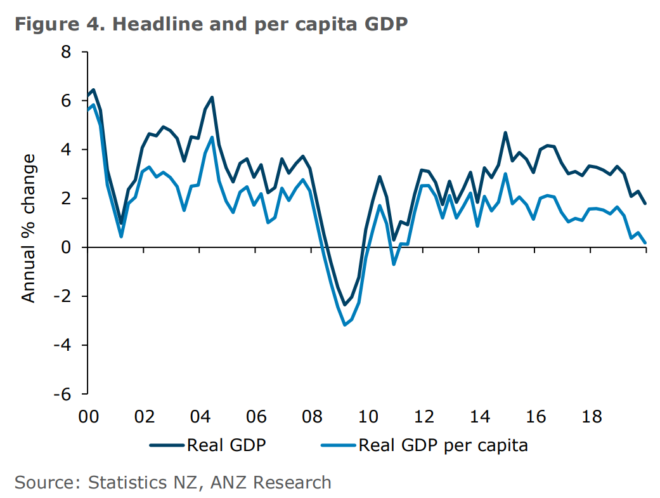
Canadian immigration policy makers should also take note on the difference of overall GDP growth and the more important measure, per capita GDP growth:

ANZ economists believe there is a “slim” prospect of a population-driven recovery for the New Zealand economy given the weak outlook for migration. They also claimed that immigration “was never a sustainable source of growth”anyway:

This crisis has turned New Zealand’s recent model of migration-driven growth on its head… Once borders reopen, we expect net inflows to rebound, but to lower levels than before the crisis (figure 1)…

Migration-induced population growth has been one of the most dominant drivers of economic activity in recent years, with per capita GDP growth trailing well below the headline measure (figure 4). This was never a sustainable source of growth.

Overall, the weaker outlook for migration means that the prospect of a population-led recovery is slim. That will put the burden on domestic stimulus and productivity. So far, we’ve seen nothing on the policy front to convince us that productivity is about to take the reins, so expect a pretty ho-hum performance on the other side.

Meanwhile, a new report for the New Zealand Productivity Commission claims that mass immigration has distorted the economy and wrecked productivity:

The substantial net migration inflows that New Zealand has received over the past 25 years has been a strong source of support for headline GDP growth, but has created a series of distortions and pressures in the New Zealand economy: infrastructure and cost pressures, greater residential real estate demand (with implications for allocation of investment capital), downward wage pressure that deters business investment, as well as upward exchange rate pressure. An explicit immigration policy that was focused on quality and filling skills gaps, with lower gross inflows, would create a more supportive environment for higher levels of international engagement by New Zealand firms.

Given the similarities between the New Zealand and Australian economies and immigration systems, these findings can be equally applied to Australia.

Source: ANZ: Immigration “was never a sustainable source of growth”