Antisemitism watchdog adds (((echo))) symbol to hate list after Jews targeted: The Guardian

Appropriate reaction by Google:

US antisemitism watchdog, the Anti-Defamation League, has added the “(((echo)))” symbol, used online by white supremacists to single out Jews, to its online database of hate symbols.

The group’s decision comes days after Google removed a Chrome extension that was being used by antisemites to add triple parentheses around the names of prominent Jewish public figures including Michael Bloomberg and New York Times journalist Jonathan Weisman.

“The echo symbol is the online equivalent of tagging a building with antisemites graffiti or taunting someone verbally,” said Jonathan Greenblatt, ADL’s chief executive. “We at ADL take this manifestation of online hate seriously, and that’s why we’re adding this symbol to our database and working with our partners in the tech industry to investigate this phenomenon more deeply.”

The intersection of old-fashioned white supremacy and antisemitism with tech-savvy online groups centred around websites such as 4chan and Reddit has given rise to a movement loosely termed the “alt-right”. The echo symbol is just the latest artefact of that group’s thinking to burst into the mainstream, thanks largely to an article in late May from the NYT’s Weisman highlighting its use.

Weisman linked the antisemitism on display with the professed political support of those abusing him: the Twitter user who referred to him as “((Weisman))” went by the handle @CyberTrump.

But the denigration of Jews online extends beyond the Trump supporters highlighted by Weisman. An investigation by Mic revealed how widespread the symbol’s use has become, largely below the radar of the mainstream.

“To the public, the symbol is not easily searchable on most sites and social networks; search engines strip punctuation from results,” wrote the publication’s reporters, Cooper Fleishman and Anthony Smith. “This means that trolls committed to uncovering, labelling and harassing Jewish users can do so in relative obscurity: No one can search those threats to find who’s sending them.”

The pair trace the origins of the symbol back to far right blog Right Stuff. “In Right Stuff propaganda, you’ll often read that Jewish names ‘echo’. According to the blog’s lexicon page, ‘all Jewish surnames echo throughout history’. In other words, the supposed damage caused by Jewish people reverberates from decade to decade.” The parentheses are used to imply that same echo textually.

While many antisemites simply write out Jewish names with the parentheses manually, using it as a deliberate taunt, there was also a popular Chromeextension that automated the function. Named “Coincidence Detector” – a sarcastic reflection of the anti-semitic conspiracy that Jews control the media – it automatically flagged up common Jewish surnames to anyone who installed it.

Google removed Coincidence Detector on Thursday, citing terms and conditions that prohibit “promotions of hate or incitement of violence”, shortly after Mic wrote about the extension.
Source: Antisemitism watchdog adds (((echo))) symbol to hate list after Jews targeted | Technology | The Guardian

Google Looks to Divert ‘Extremist’ Searches to Anti-Radicalization Sites | TIME

Interesting approach:

Google is experimenting with a program that would redirect U.K. users searching for words linked to religious extremism to content designed to counter radicalization, a company executive has said.

Anthony House, Google’s senior manager for public policy and communications, told British lawmakers in a parliamentary committee hearing about the pilot initiative, which was targeted at reducing the online influence of groups like ISIS, the Guardianreported Tuesday.

“We should get the bad stuff down, but it’s also extremely important that people are able to find good information, that when people are feeling isolated, that when they go online, they find a community of hope, not a community of harm,” House said.

At least 700 British citizens have traveled to Iraq and Syria to join jihadist organizations, the BBC reports.

Source: Google Looks to Divert ‘Extremist’ Searches to Anti-Radicalization Sites | TIME

Security agencies condemn use of encryption on iPhone 6

One of the unintended consequences of NSA over-reach in scooping up so much data. Another reason to buy an iPhone?

Apple declined to comment. But officials inside the intelligence agencies, while letting the FBI make the public protests, say they fear the company’s move is the first of several new technologies that are clearly designed to defeat not only the NSA, but any court orders to turn over information to intelligence agencies. They liken Apple’s move to the early days of Swiss banking, when secret accounts were set up precisely to allow national laws to be evaded.

“Terrorists will figure this out,” along with savvy criminals and paranoid dictators, one senior official predicted, and keep their data just on the iPhone 6. Another said, “It’s like taking out an ad that says, ‘Here’s how to avoid surveillance – even legal surveillance.’”

The move raises a critical issue, the intelligence officials say: Who decides what kind of data the government can access? Until now, those decisions have largely been a matter for Congress, which passed the Communications Assistance to for Law Enforcement Act in 1994, requiring telecommunications companies to build into their systems an ability to carry out a wiretap order if presented with one. But despite intense debate about whether it should be expanded to cover email and other content, it has not been updated, and it does not cover content contained in a smartphone.

Inside Apple and Google, company executives say the U.S. government brought these changes on itself. The revelations by former NSA contractor Edward J. Snowden not only killed recent efforts to expand the law, it made nations around the world suspicious that every piece of American hardware and software – from phones to servers made by Cisco Systems – have “back doors” for U.S. intelligence agencies and law enforcement.

Surviving in the global marketplace – especially in places like China, Brazil and Germany – depends on convincing consumers that their data is secure.

Security agencies condemn use of encryption on iPhone 6 – The Globe and Mail.

9 Rules For Emailing From Google Exec Eric Schmidt | TIME

Good working tips:

  1. Respond quickly
  2. When writing an email, every word matters, and useless prose doesn’t. Be crisp in your delivery.
  3. Clean out your inbox constantly.
  4. Handle email in LIFO order (Last In First Out). Sometimes the older stuff gets taken care of by someone else.
  5. Remember, you’re a router. When you get a note with useful information, consider who else would find it useful.
  6. When you use the bcc (blind copy) feature, ask yourself why. The answer is almost always that you are trying to hide something, which is counterproductive and potentially knavish in a transparent culture.
  7. Don’t yell. If you need to yell, do it in person. It is FAR TOO EASY to do it electronically.
  8. Make it easy to follow up on requests. When you send a note to someone with an action item that you want to track, copy yourself, then label the note “follow up.”
  9. Help your future self search for stuff. If you get something you think you may want to recall later, forward it to yourself along with a few keywords that describe its content.

9 Rules For Emailing From Google Exec Eric Schmidt | TIME.

Google diversity report highlights white male workforce

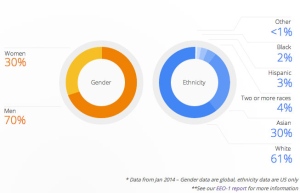
google-diversity-dataInteresting piece on Google’s efforts to increase diversity. The problem applies to much of the tech industry:

Gender and ethnic disparities are reflected throughout the tech industry. About seven per cent of tech workers are black or Latino in Silicon Valley and nationally. Blacks and Hispanics make up 13.1 and 16.9 per cent of the U.S. population, respectively, according to the most recent Census data.

In the coming months, Google said, it will work with the Kapor Center for Social Impact, a group that uses information technology to close gender and ethnic gaps in the Silicon Valley workforce. The centre will be organizing a Google-backed conference in California focusing on issues of technology and diversity.

Co-founder Freada Kapor Klein, who started the Level Playing Field Institute 13 years ago to teach and mentor black and Latino students in science and math, said Google is showing leadership “which has been sorely needed for a long time.”

“Google is the company known for the moonshot, and applying that part of Google DNA to this problem is a breath of fresh air,” she said.

Google diversity report highlights white male workforce – World – CBC News.

ICYMI: How to Get a Job at Google, Part 2 – NYTimes.com

Second part on what Google looks for and interesting remark on  liberal arts, citing behavioural economics as an example:

They are “phenomenally important,” he said, especially when you combine them with other disciplines. “Ten years ago behavioral economics was rarely referenced. But [then] you apply social science to economics and suddenly there’s this whole new field. I think a lot about how the most interesting things are happening at the intersection of two fields. To pursue that, you need expertise in both fields. You have to understand economics and psychology or statistics and physics [and] bring them together. You need some people who are holistic thinkers and have liberal arts backgrounds and some who are deep functional experts. Building that balance is hard, but that’s where you end up building great societies, great organizations.”

Steve Jobs always claimed Apple was at the intersection of liberal arts and technology…

How to Get a Job at Google, Part 2 – NYTimes.com.

How to Get a Job at Google – NYTimes.com

Good piece on Google’s hiring practices. Antitheses to how government hires:

To sum up Bock’s approach to hiring: Talent can come in so many different forms and be built in so many nontraditional ways today, hiring officers have to be alive to every one — besides brand-name colleges. Because “when you look at people who don’t go to school and make their way in the world, those are exceptional human beings. And we should do everything we can to find those people.” Too many colleges, he added, “don’t deliver on what they promise. You generate a ton of debt, you don’t learn the most useful things for your life. It’s [just] an extended adolescence.”

Google attracts so much talent it can afford to look beyond traditional metrics, like G.P.A. For most young people, though, going to college and doing well is still the best way to master the tools needed for many careers. But Bock is saying something important to them, too: Beware. Your degree is not a proxy for your ability to do any job. The world only cares about — and pays off on — what you can do with what you know (and it doesn’t care how you learned it). And in an age when innovation is increasingly a group endeavor, it also cares about a lot of soft skills — leadership, humility, collaboration, adaptability and loving to learn and re-learn. This will be true no matter where you go to work.

How to Get a Job at Google – NYTimes.com.