Conflicting loyalties? Germany debates dual citizenship 

Good report on some aspects of the debate:

Germany’s debate on dual citizenship seems to be at odds with its inclusive approach to refugees – and its economic success story. Turks, in particular, feel ostracized when German officials question their loyalty.

Dual citizenship

Earlier this week, Chancellor Angela Merkel announced that she and her government expect a “high level of loyalty” to be displayed by Germany’s largest immigrant community: the Turkish diaspora. Her divisive remarks came after mass rallies were held in support of Turkish President Recep Tayyip Erdogan following last month’s thwarted coup.

Recent security threats across the country have also prompted a re-evaluation of immigration strategy, putting the chancellor in the uncomfortable position of having to balance her welcoming approach toward refugees with the realities of Germany’s history of lacking long-term plans to integrate new residents.

Merkel questioned some Turks’ loyalty after tens of thousands rallied in support of Erdogan

Interior Minister Thomas de Maiziere also made remarks that seemed to challenge the allegiance of dual nationals, saying that allowing people to hold multiple citizenships was not a desirable long-term goal for the government.

The chairman of Germany’s TGD Turkish community association, which primarily functions as a legal network, said he welcomed the chancellor’s initiative as a way to advance the loyalty discussion, but he also criticized the idea that a series of unconnected events could call into question the allegiance of millions of people who live in Germany.

“It can’t be that a debate on loyalty is sparked purely on the basis of ethnic Turks’ participating at a rally in Cologne,” Gökay Sofuoglu told DW, adding that “milestones of social integration and participation” were suddenly being questioned – including dual citizenship.

“We have played a major role in rebuilding this country,” Sofuoglu said, referring to post-World War II reconstruction. “It is sad that the accomplishments of that first generation haven’t been honored or even acknowledged but are rather repeatedly being questioned. All these discussions only go to prove this country’s ingratitude and its total failure at its immigration policy.”

‘Mistakes were made’

Though having multiple nationalities is regarded as worldly and debonair in many cultures, Germany’s attitude is more conflicted. The subject of dual citizenship can touch a nerve as Germany tries to nail down an identity in a multicultural age; the country has become the second most popular destination for immigration after the United States, according to UN figures.

De Maiziere said facilitating dual citizenship was not in the long-term interest of the government

“Germany now has 55 years of experience of dealing with migrants,” Sofuoglu said. “We all know what mistakes were made in the past. It would be beneficial if – rather than continuing to alienate migrants and questioning their loyalties – we helped open doors and create opportunities for these people arriving in Germany now.”

The response to terror threats is a factor in the dual nationality debate, as is the potential reintroduction of compulsory military conscription. German law automatically dictates the loss of citizenship in most instances if a national joins another nation’s military, yet the armed forces are currently considering allowing citizens of other EU states to join.

A two-tiered society

The TGD’s Sofuoglu argues that threatening to revoke dual citizenship and forcing people from ethnic minorities to choose creates “second-class German nationals” who have to live in constant fear of having their privileges taken away.

Sofuoglu, a dual national, said Germany’s restrictive policy amounts to ingratitude

“No one would come up with the idea of revoking the citizenship of a native German without a migrant background who acts in an undesirable way,” Sofuoglu said. “So why do other people who were also born and raised here have to abide by a different set of standards simply because they have their roots abroad? … Because some of them chose to partake in a rally in favor of the Turkish president?”

“If loyalty to the state is such a problem, what about those right extremists protesting against Merkel and insinuating that she should be executed for allowing refugees to come to Germany?” Sofuoglu said. “Is that what they call loyalty?”

Source: Conflicting loyalties? Germany debates dual citizenship | News | DW.COM | 24.08.2016
Germany: Who′s afraid of dual citizenship? | Opinion | DW.COM

While in my opinion the article focuses too much on identify aspects of dual citizenship while ignoring the practical aspects that require many to retain their old citizenship in order to be able to easily visit their country of origin, it gives a flavour of German debates:

The issue of dual citizenship is dividing opinion in Germany. The arguments against it are old fashioned to say the least: Citizens cannot “serve two masters,” and the conflict of allegiance for those who possess two passports is emphasized. Such arguments are designed to influence mood and create fear: Opponents of dual citizenship often talk of the threat of a “fifth column” for despots and autocrats, and call into question the democratic will and capacity of those with two passports. The message is clear: Danger is on the way!

But the argument is not aimed at Trump supporters among American-Germans, Le Pen supporters among French-Germans, Kaczynski fans among the 690,000 Polish-Germans, nor those among the 570,000 Russian-Germans that are sympathetic to Vladimir Putin. No, the problem is with those among the 530,000 Turkish-German dual citizens in Germany that support Recep Tayyip Erdogan.

Erdogan is currently Germany’s favorite bogeyman, the one person that threatens European democracy and that we should all be afraid of. And we should also fear his fifth column, the Turkish-Germans living here and just waiting for Ankara to give them the signal to mobilize.

Enemies of democracy

 However: Doing away with dual citizenship will not solve any of the real or perceived problems that its opponents envision. Dual citizenship is anchored in current EU law. Thus, EU citizens cannot be deprived of it. Therefore Germans have to tolerate the Orban supporters among Hungarian-Germans as well as the nostalgic right-wing extremist Ustashe fans among Croatian-Germans.

Apparently, the real issue only has to do with the Turks. In that case it would serve us well to recall a few facts: According to the 2011 federal census, about 4.3 million people in Germany had citizenship in a second country in addition to being German passport holders. Of those, some 500,000 were Turks. In comparison: 1.5 million Turkish people were living in Germany without German passports, and 800,000 people of Turkish origin had only a German passport. So, on the whole, less than 20 percent of all Turks in Germany have dual citizenship. So where exactly does the threat to German democracy lie?

This most recent discussion on dual citizenship flared up at a pro-Erdogan demonstration two weekends ago in Cologne. Some 30,000 to 40,000 people demonstrated at the event – which figures out to about six or seven percent of all Turkish-German dual citizens, or 1.5 percent of all persons of Turkish descent living in Germany. Even if every single person at the event were an avowed enemy of democracy – it would still be no greater a number than all opinion polls and election results tend to register among ethnic Germans with no immigrant background.

Not a threat – an enrichment

The favorite argument of dual citizenship opponents is the equation: two passports = dual allegiance. That has little to do with reality. Multi-faceted identity is a matter of fact for millions of people with migrant backgrounds living in Germany. It is a matter of different languages, different cultures and different answers to the question: Where do I feel comfortable, where am I at home? Dual citizenship is a possible answer, and a clear sign of belonging to two different worlds. The belief that someone who is forced to forfeit a passport will also forfeit his or her loyalty is a fallacy. It would only lead to bitterness, hypocrisy and estrangement. For loyalty is like love: You can force someone to have sex, but you cannot force them to love you!

Of course democracy must have the possibility to defend itself against its enemies. But modern democracies can only survive and flourish as open societies. One expression of this openness is to allow citizens to live their identities as they feel them – even if that means they need two passports to do so.

Source: Opinion: Who′s afraid of dual citizenship? | Opinion | DW.COM | 09.08.2016

Germany mulls stripping citizenship in terror crackdown – France 24

To watch:

Germany’s interior minister has proposed tough new security measures including deporting foreigners and revoking citizenship after two attacks claimed by the Islamic state group.

At a press conference on Thursday Interior Minister Thomas de Maizière outlined plans to beef up federal security forces, make the promotion of terrorism a crime and strip German citizenship from dual nationals who fight for foreign militias.

After terrorist attacks on German soil this year, two of them by migrants, the minister has been under intense pressure from both the political right, who want fewer Muslim migrants, and the left, who’ve been calling for a stronger police presence.

“A lot of people … are worried about further attacks. That is understandable,” De Maizière told reporters. “No one can guarantee absolute security, but we must do what is possible.”

‘Politically reasonable’

Revoking German citizenship would go some way towards dealing with the estimated 820 Germans fighting in Syria and Iraq who may pose a threat on their return to Germany.

It’s nonetheless considered a controversial proposal with Green lawmaker Volker Beck among those condemning it as “desperate activism”.

Social Democrats (SPD) chief Sigmar Gabriel said his party — the government’s junior coalition partner — are not open to just “any populist quick fix”, but that they are “ready for discussions on anything that can contribute to reinforcing security”.

And the security package has yet to be approved by the country’s right-left coalition and German parliament.

Deportations

Beyond the issue of homegrown terrorism, the minister is proposing to make it easier to deport terror suspects and detain foreigners who have committed crimes or are a public security risk.

A tightening of German and European Union weapons laws is also on the cards.

De Maizière said he was limiting himself to policies that could be implemented quickly, and that he considered “politically reasonable”.

Source: Germany mulls stripping citizenship in terror crackdown – France 24

Islam stands above German law for half Turkish Germans – survey — RT News

Ongoing integration challenge:
Almost half the ethnic Turks living in Germany consider following Islamic teaching more important than abiding by the law, a new survey claims. They also view Islam as the “only true religion” with about one in five justifying violence if it is provoked by the West.

The study by the University of Münster titled “Integration and Religion from the viewpoint of the Turkish Germans in Germany” outline some deep divisions within the German society as 47 percent of ethnic Turks living in the country said that following religious dogmas was “more important” to them than obeying “the laws of the land in which I live,” particularly if the two were incompatible. Moreover, 32 percent from those questioned said they yearn to live in the society of the times of the Prophet Mohammed.

The results, gathered by surveying over 1,200 people, came as a surprise for the researchers from one of the biggest German universities. Detlef Pollack, spokesman for the “Religion and Politics”Excellence Cluster said that the authors “didn’t expect that,” Deutsche Welle reported.

However, the survey also revealed that Turks completely understand that it would be much easier for a law-abiding citizen to successfully integrate. Respecting laws was ranked second among the list of conditions to meet in order to integrate into German society, trailing only the language skills.

But despite the fact that an overwhelming majority of Turkish Germans, 90 percent, said they are pleased with their life in the country, over half of the respondents feel like “second-class citizens” with no chance to integrate fully into society. Some 70 percent went even further and expressed a readiness to integrate “absolutely and unconditionally.” At the same time, the phrase “no matter what I do, I will never be recognized as a part of German society,” strikes a chord with 54 percent of Turks.

Interestingly, the attitude of the respondents to the adherents of other religions and atheists differed greatly. While the total of 80 percent holds a favorable view of Christians, the number tolerating atheists and Jews is considerably lower. Only half think positively of these groups. The same number consider Islam to be the “only true religion.”

As right-wing German parties claim that Islam poses an “imminent threat” to the country with rallies being held against the so-called “Islamization” of the West against the backdrop of a migrant influx from North Africa and the Middle East, 20 percent of Turks agree that “the threat to Islam posed by the Western world” can justify violence with which Muslims “defend”themselves. A further 7 percent agree that the use of violence can be justified for the sake of spreading Islam.

Asked about the compatibility of Islam and the West, 61 percent of the Turks saw no obstacles in the way of its anchoring in western society. However, according to the study, this standpoint is not popular with the German people as a whole.

Such fundamental values of a modern western civilization as human rights and tolerance are not associated with Islam by Germans, the poll says. Fifty-seven percent of Turkish Germans link the protection of human rights to Islam while only 6 percent of all Germans nationals maintain the same opinion. Only 5 percent of all Germans associate Islam with tolerance, while 56 percent of Turks in Germany believe so.

Based on the findings, pollsters attributed the 13 percent of the surveyed 1,201 people to the category of “religious fundamentalists.” 

The survey’s authors claim that, while the Turks blame Germans for misunderstanding of the inherently peaceful nature of Islam, they note that, Muslims are also to blame for generating negative perception of their religion.

“Quite a few of them hold onto religious positions which don’t do much to counter the magnitude of suspicions and mistrust,” the report concludes.

Germany’s AfD Party and Its Anti-Islam Platform – The Atlantic

Good analysis of the demographics of the right-wing vote:

The party’s beginnings weren’t quite so dramatic. The AfD started out in 2013 with a Ph.D.-riddled member list and a wonky Euroskeptic manifesto that could have lulled a caffeinated squirrel into a midday nap. It called for empowering national governments to ditch the euro, limiting state bailouts, and mandating national referenda for certain EU policies, alongside scintillating stipulationsabout European Central Bank maneuvers and alternative funding for renewable-energy subsidies. Yet the huge influx of predominantly Muslim refugees in the past year, along with incidents such as the infamous New Year’s Eve assaults on women by men seeming mostly to be of North African descent, has helped radicalize group. Last month’s manifesto not only declared Islam incompatible with German legal and cultural values, but also endorsed a ban on burqas and the call to prayer.

The AfD’s founder Bernd Lucke, an economics professor, left the party last summer, condemning rising xenophobia. Many other founding members have likewise defected. So who are the new supporters that helped the party to its best-ever election performance a few months ago? Which people, specifically, want to kick Islam out of Germany?

Demographically, surveys show, AfD supporters fit a certain loose profile. First, despite having a woman at the helm in the figure of Frauke Petry (as well as trigger-happy aristocrat Beatrix von Storch, who has advocated using deadly force illegal migrants at the border, as deputy party chief), AfD supporters are predominantly male. In January, one poll found 17 percent of male respondents nationwide would vote for AfD in a hypothetical immediate election, while only 2 percent of women would. In the March regional elections in the state of Sachsen-Anhalt, 27 percent of male voters chose AfD, as compared to 18 percent of female voters. As the German daily Die Zeit pointed out, that means AfD support follows roughly the same pattern as support for the intensely anti-Islamic pan-European movement PEGIDA (“Patriotic Europeans Against the Islamization of the West”).

Theories abound as to why and to what extent men are more likely to vote for far-right or xenophobic platforms than women—a pattern that holds with Trump supporters in the United States, as well as voters for Austria’s far-right presidential candidate Norbert Hofer, who just barely lost that country’s election this week. But few political scientists doubt that the trend exists in some form. “That’s one finding that we all agree on,” said David Art, a political-science professor at Tufts University who studies comparative politics and right-wing extremism.

A second trend in AfD demographics involves class. Originally, professors, journalists, and business leaders dominated the party, with over half the founding members in 2013 sporting a “Dr.” in front of their names. Surveys around the March 2016 elections in three German states, however, showed the AfD drawing about a third of its support from laborers, and another third from individuals currently unemployed. Those with “higher education” were in the minority. That’s not to say that AfD supporters are entirely uneducated, or that no one with a university degree continues to support the once doctorate-led party. But in general, said Kai Arzheimer, a political-science professor at the University of Mainz who has become the go-to expert on voter behavior in the AfD, “it’s people who have done Realschule, which doesn’t qualify you for entering a university, but is still quite a respectable degree.”

Third comes age. “[AfD supporters] are youngish to middle-aged,” said Arzheimer. “Interestingly, voters over 60 seem to shy from voting for the AfD because they’re still tied to the Christian Democrats,” Merkel’s center-right party.

… What all these voters seem to share, say the experts studying them, is intense concern about immigration and Islam—issues with extraordinary capabilities for generating strange bedfellows. “Suddenly the far-right is pro-Jewish because it’s anti-Muslim,” said Lenka Bustikova, a political scientist at Arizona State University who has studied far-right movements further east in Europe. “Suddenly with the [influx] of refugees you have this new twist: You are for Western gender rights because you think the Muslims are cavemen. It’s going to be interesting to watch.”

Source: Germany’s AfD Party and Its Anti-Islam Platform – The Atlantic

What Is German? – The New York Times

Good piece by Anna Sauerbrey on German identity political debates:

IN Germany, a big question is back on the table: What is German — and how German do you have to be to belong to Germany? With the arrival in 2015 of 1.1 million refugees and migrants, it’s an important issue. But rather than having a reasoned debate, the extremists have already taken control. For a disturbing number of Germans, the answer is culture, including religion.

That’s the message coming out of the Alternative for Germany, an upstart right-wing party that has drawn double-digit support in recent state-level elections. At a convention earlier this month, the party adopted the sentence “Islam does not belong to Germany” into its official platform.

The sentence is a direct rebuke to a famous 2010 statement by a former German president, Christian Wulff, who proclaimed the opposite, earning praise from migrants, liberals and the left. At the time, it was an uncontroversial position, one supported by Chancellor Angela Merkel and most political polls. Today, about 60 percent agree with the Alternative for Germany’s position, pollsters found in May.

Anti-Muslim sentiment is just one element in the party’s fairly coherent, nativist concept of national culture. The preamble to its program promises to preserve “our occidental and Christian culture, our nation’s historical and cultural identity, and an independent German nation of the German people.” The party refers to German culture as the “einheimische Kultur” — native culture — and describes the German nation as “a cultural unit” under threat from immigrant cultures. Its program for the state election in Baden-Württemberg in March stated: “Germany’s cultural foundation is being smashed by immigration.”

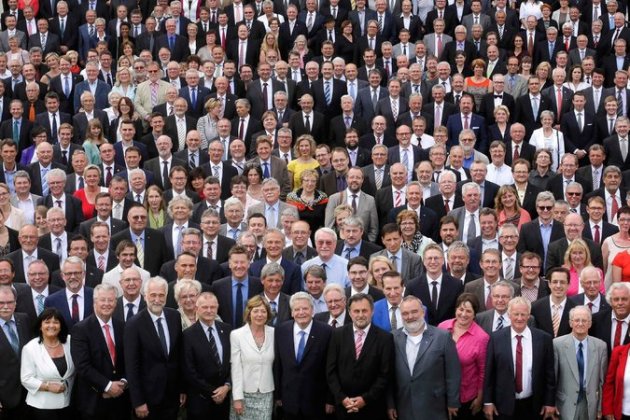
Photo

President Joachim Gauck of Germany, center, with local politicians from around the country on Monday. CreditMarkus Schreiber/Pool, via Reuters 

For many liberals and centrist conservatives, culture is defined as the ways a person or group does things. For the Alternative for Germany, it is much more — a natural fact, the core of a person or group’s essence, a thing, not a set of practices. And that thing must be kept homogeneous and pure.

It follows, at least for the new German right, that cultures can be compared and ranked — some are worth preserving, while others are invasive and inferior. German culture is under constant risk of losing its purity, and its defense is a core role of the state. It is a thinly veiled update of the old racist ideologies: culturism as the new racism.

In March, the Alternative for Germany made it into three state parliaments. Pollsters currently see the party at 10 to 15 percent of the electorate. That could be enough to force Ms. Merkel’s Christian Democratic Party further to the right. Progressive and conservative Christian Democrats are still debating the correct way to deal with the new far right, but the party has already trotted out its own answer to the “What is German” question: the concept of “Leitkultur,” or a guiding national culture.

Leitkultur is not new per se; it was introduced to the German debate on immigration in 2000 by Friedrich Merz, then head of the federal Parliament’s Christian Democratic caucus. The German government was planning an immigration reform to attract more engineers. Mr. Merz demanded that immigrants adapt to the dominant German culture: secular, German-speaking, rule-of-law abiding. The ensuing criticism was fierce, and although the Christian Democrats did include the term in their official immigration position, they more or less dropped it as an issue.

But with the Alternative for Germany sucking voters from Ms. Merkel’s party, conservatives are pushing the party to attribute a more central role to Germany’s cultural identity. Leitkultur has reappeared in Christian Democratic speeches and working papers. Ms. Merkel used the term approvingly while campaigning in March.

There’s a difference between Leitkultur and the Alternative for Germany’s einheimische Kultur — in the Christian Democratic version, the nativist element is weak; Islam is not a target, at least explicitly. Still, the reintroduction of the concept at a time when the Alternative for Germany is promoting its cultural version of the Aryan nation is as strategically clever as it is dangerous: The Christian Democrats are whitewashing the far-right version of the Cultural German.

While the political cost is high, the concept of Leitkultur is useless. Attempts at legally defining and protecting “German culture” often verge on the absurd. In April, after reports that some public cafeterias no longer served pork out of respect for the dietary restrictions of their Muslim customers, the Christian Democrats in the state of Schleswig-Holstein introduced a proposal to preserve pork dishes in public canteens. “We must not allow for a minority to determine what the majority eats,” a local Christian Democrat said. Some of the reports proved false. The “schnitzel law” caused snickering — and was rejected.

Asked in 2000 what he thought went into German Leitkultur, Mr. Merz pointed to the Constitution and to women’s rights. But it’s no use making refugees swear an oath on women’s rights. Germans won’t control what they think. But Germany can help them understand the laws protecting women’s rights — and reinforce them.

A modern nation state cannot be built on an ontological notion of who belongs and who does not, whether it’s outright ethnic or pseudo-cultural. It needs to build on the notion of the nation as a community — a community including those who were born here, those who came to stay and those who will stay for a while and then return to their homes. The rights and duties of the members of this community should be defined by their achievements, and by the rule of law — not by whether they eat schnitzel or wear a head scarf.

Source: What Is German? – The New York Times

Methods For Reforming Neo-Nazis Help Fight The Radicalization Of Muslims

More on Hayat-Germany and some of the similar counter-radicalization approaches:

Hayat-Germany grew out of a program called Exit-Deutschland, which targeted neo-Nazis and right-wing extremists, groups that German authorities have been working to deradicalize and fold back into Germany society for years. Berczk says the Hayat program is premised on the belief that the lessons from working with right-wing extremist programs can be applied to radical Islamists as well.

“There is a commonality between extremist ideologies,” she says. “But also if we are talking about sects and cults, there are certain things that all these groups have in common.”

That’s good news because it means authorities can mine their long experience with neo-Nazis and apply it to the relatively new problem they face with ISIS now. Of course, each case is different, which is what makes deradicalization complicated.

But in a general way, Hayat-Germany says the key component in these programs is family. Studies have shown that by strengthen family ties, parents and siblings end up providing the support young people were missing and subsequently sought and found in extremist groups.

Among other things, Hayat counsels the families to avoid confrontation when they are trying to convince relatives to come back from Syria. Recruiters in the jihadist camps tell new arrivals that conflict with their families is inevitable. They warn them that if they reach out to those they have left at home, they’ll be chastised and ordered to return.

The problem with their families, the recruiters say, is they just don’t understand ISIS followers and the depth of their faith. If families get angry — even if it comes from worry — this plays right into the recruiters’ hands.

That’s why Hayat tells parents not to demand a return, but instead to suggest their relatives leave Syria and settle in a third country, far away from the battlefield, and start a family and a new life. Once the young people are out from under ISIS’ spell, families have a better chance of convincing them eventually to come home. Strategies to make this happen come from counselors at Hayat.

Quintan Wiktorowicz, an academic who did field studies on radicalization in Jordan and the U.K., now runs Affinis Labs, which tries to use innovation and entrepreneurship to solve community problems like radicalization. He was responsible for engagement programs at the White House and developed counter-radicalization initiatives for the State Department. He says Hayat’s remedies — from hotlines people can call to engaging the families of radicalized youth in counseling sessions — are strategies that have been effective across ideologies.

“Although there are different pathways to radicalization and the ideologies vary across extremists groups, the underlying drivers are very similar,” he said.

The drivers usually come in three parts: an extreme level of frustration, a sense of powerlessness and exposure to an ideology that not only resonates emotionally, but also offers a solution to the frustration.

“The mechanics, whether you are a right-wing extremist or embracing ISIS, are very similar,” he says.

Source: Methods For Reforming Neo-Nazis Help Fight The Radicalization Of Muslims : Parallels : NPR

Muslim theology faculties develop an ‘Islam for Germany’ | Religion News Service

Placing Islam in the Western tradition of critical scholarship:

While Germany’s politicians are loudly debating whether Islam is compatible with democracy, five of its state universities are quietly developing pioneering new Islamic theology faculties to try to ensure that it is.

The five universities — in Muenster, Osnabrueck, Frankfurt, Tubingen and Erlangen-Nuremberg — recently passed their first official evaluations by Muslim and Christian experts and were granted 20 million euros (or $22 million) to continue for another five years.

The programs now have a total of over 1,800 students and plan to grow. The largest program, in Muenster, has 700 students in its three-year bachelor’s program and received more than double that number of applicants this academic year alone.

Their example has been such a success that Berlin decided to introduce Islamic theology at one of its universities, even though it will not get federal funds for it.

The practical approach these faculties have taken towards training Muslim religion teachers, conducting research into Islam and fostering interfaith dialogue contrasts sharply with the increasingly shrill declarations coming from Germany’s far-right, especially the Alternative for Germany party.

The party will hold a convention April 29-30 to agree on its new platform. Its deputy leader, Beatrix von Storch, said Islam violates Germany’s democratic constitution and its public symbols such as minarets, muezzins (people who call Muslims to prayer) and full-face veils should be banned.

Johanna Wanka, Germany’s federal minister for education and research, struck a different tone in January when she approved the renewed funding for the five theology centers.

“With these centers, the Muslim faith has found a home in Germany’s academic and theological debates,” she said. “This is an important contribution to interreligious dialogue.”

German state schools have religious education classes that students attend according to their beliefs. Instruction in the majority Protestant and Catholic faiths are available countrywide and a few areas also offer Jewish education.

With the growing number of Muslims in Germany, four states have introduced regular Islamic education for their Muslim public school students. The courses need university-trained teachers, so some universities had to start offering academic programs in Islam.

The faculties teach standard courses on the Quran, Islamic law and classic Muslim philosophy, as well as Arabic and pedagogy.

Marrying traditional Islamic learning with German academic standards has not been easy.

Muslim associations like DITIB, the local arm of Turkey’s Religious Affairs Department that runs mosques and employs imams around Germany, have a say in hiring professors. They have rejected or opposed some candidates they thought were too liberal.

But the universities insisted Islam had to be subject to the same critical approach as any other subject and academics must be able to do research and publish freely.

Conservative guardians of Muslim tradition have some reason to be wary.

German theologians developed the historical-critical method of biblical scholarship in the 18th and 19th centuries, an approach most Islamic scholars have resisted because they view such analytical methods as undermining the faith.

If Islamic theology faculties followed this example, some conservatives worried, they could become hotbeds of heresy spreading a reformist Islam unfit to teach to young Muslims.

In Muenster, Muslim groups led a bitter campaign against the faculty’s director Mouhanad Khorchide, who received several death threats and was given police protection. But the university stood by him and the criticism eventually ebbed.

The Lebanese-born son of Palestinian refugees, Khorchide, 44, has irritated conservative Muslims with popular books such as “Islam Is Mercy” and “God Believes in People,” and appearances on German talk shows where he is treated like the new spokesman for Islam.

He speaks out clearly against the ultra-conservative Salafi Muslims, who have a tiny but growing following among young German Muslims, and call for Shariah to be the law of the land.

“It is not the job of religions, including Islam, to pass laws,” Khorchide said. “The real concern of Islam is that people perfect themselves, both as individuals and as a society, in order to reach the community of God.”

Source: Muslim theology faculties develop an ‘Islam for Germany’ | Religion News Service

Germany to consider stripping IS fighters of citizenship: document | Reuters

Unclear whether this is just the normal draft looking at options or whether it is something the government is seriously considering:

Germany’s ruling coalition plans to look into stripping Islamic State fighters of their German citizenship to prevent them from coming back to the country, a draft document seen by Reuters on Wednesday shows.

More than 800 people have traveled from Germany to Syria and northern Iraq in recent years and around 70 returnees took part in combat or military training there, the head of Germany’s domestic intelligence agency said earlier this month.

“To prevent jihadists from returning to Germany, we want to examine the legal possibilities for depriving people of German citizenship if they fight for a terrorist militia abroad and have another citizenship alongside their German one,” read the draft document, which the coalition of conservatives and Social Democrats are to discuss on Thursday.

The coalition is also considering depriving German supporters of Islamic State of identity cards and passports to prevent them from traveling to areas controlled by Islamic State, the document said.

Increasing video surveillance of public areas to better tackle threats from Islamists as well as right and left-wing extremists is another measure the coalition is considering, according to the document.

Any talk of boosting surveillance generally causes controversy in Germany, where many people still remember the Stasi secret police and its network of informants in the former Communist east.

The coalition may also consider whether people returning from fighting for IS could be given electronic tags.

Source: Germany to consider stripping IS fighters of citizenship: document | Reuters

How Germany Has Resisted the Influence of ISIS | TIME

Good article on some of the initiatives Germany is taking to reduce the influence of ISIS (likely other factors also at play):

But Germany also acted early to counteract Islamist propaganda, dating back to before ISIS even emerged as a global terror network. Soon after the deadly shooting at Frankfurt airport in spring 2011, the government instituted a program that may seem counter-intuitive: it began making Islamic studies available to students of all ages, particularly around North-Rhine Westphalia, Germany’s most populous region and home to its largest Muslim communities.

Teachers in this region, whose capital is Düsseldorf, were given a “crash course” in the new Islamic curriculum, which was designed with the help of local imams and religious experts, says Ali Bas, a regional lawmaker who lobbied for this initiative and helps oversee its implementation.

As of this year, 17,000 students in the region were taking courses on Islam, a small fraction of the roughly 300,000 Muslim students in the region but double the number at the start of 2015. By next year, Bas expects the program to grow at an even faster pace, as the first group of teachers are due to complete their degrees in Islamic education and join the faculties of schools across the region.

One of their aims, says Bas, is to make young Muslims feel accepted, “to give them the feeling that they are important in our society.” The broader intention, he says, is to undermine the work of ISIS recruiters, who typically stoke feelings of alienation and social resentment. “Accepting this religion is, for us, a very important aspect of making younger people stronger against extremism,” says Bas, who is an ethnically Turkish Muslim.

The Signpost program, which Sauerborn established in 2014, takes a more targeted approach. With three offices around North-Rhine Westphalia, it offers parents and teachers a place to turn for advice when they see signs of radicalization among young men. In many cases, the program’s counselors go to the schools and hang-outs of devout Muslims in Düsseldorf and other cities to offer guidance, not only on questions of religion but also on social or financial issues, like finding a job or resolving a conflict with a teacher.

German converts to Islam are also invited to seek help from Signpost counselors, who often try to ensure that a convert does not become estranged from his family. “We’d call his mother and say, ‘Look, he’s just a Muslim,’” says Sauerborn. “’That’s not a crime. That’s his choice. That doesn’t mean he’s being radicalized.’”

The hardest part of the program’s mission is winning the trust of the Muslim community, especially among young men who might already feel persecuted or unjustly scrutinized by the authorities. The Federal Office for the Protection of the Constitution, Germany’s domestic intelligence service, pays the salaries of all of the program’s counselors, defines their responsibilities and oversees their work.

But the agency does not use them as informants, says Sauerborn, who sits on the executive board of the Düsseldorf police department. “There is no information exchange, and on that point the Federal Office is very consistent,” he says. “They have never asked for personal information about the people we work with. They just want us to be here to meet their needs.”

One of the program’s counselors agreed to talk to TIME, but only on the condition of anonymity so as not to alert other members of the Muslim community that he works for the German intelligence service. Over the past two years, he says he has worked with about 30 young men in Düsseldorf, some of whom had plans to travel to Syria and join ISIS.

“They think they need to go there and defend Islam, because of these propaganda videos and everything they’ve been told,” he says. In their attempts to dissuade such people, “we don’t say directly that [ISIS] is wrong, that it’s all lies. We have to speak with the people in such a way as to analyze the situation, to see what [Islamist] groups they are attached to, what they want to do in Syria. And then we try to provide concrete help.”

Source: How Germany Has Resisted the Influence of ISIS | TIME