First group of Canadians departs Gaza as Israel ramps up offensive

Some of these personal stories may raise questions about “Canadians of convenience” as in the case of the Lebanese Canadian evacuation in 2006 (same might apply to Israeli Canadians evacuated):

Shortly before 9 a.m. on Tuesday, Mansour Shouman met with his family to say goodbye.

An e-mail from Global Affairs Canada had arrived early in the morning. After a month of being trapped in the Gaza Strip, Mr. Shouman’s wife and five children had been included on a list of 80 Canadians permitted to escape the besieged enclave through the Rafah border crossing to Egypt. His name was also on the list, but he didn’t intend to leave.

By day’s end, Ottawa said that 75 Canadian citizens, permanent residents and their eligible family members had managed to flee the strip – the first group of Canadians to make the passage since the outbreak of war a month ago, when the militant group Hamas, which controls Gaza, launched attacks that killed more than 1,400 people in Israel.

While the total number of Canadians trying to escape Gaza has fluctuated, Global Affairs says it is in contact with more than 600 people there, as Israel escalates its assault on Hamas in the Palestinian territory.

Mr. Shouman’s family was among the group that left, after a bittersweet farewell.

The family, all Canadian citizens, had discussed what they would do if this moment ever came. The children would leave for Egypt with their mother, Suzan Harb, and Mr. Shouman would remain behind. He feels an obligation to help Gazans struggling to survive Israeli air strikes and a scarcity of food and water. “I have obvious feelings for my family, but as a human I also feel an obligation to alleviate the challenges people are going through here,” he said in a phone interview from Khan Younis, just north of the border crossing.

When the moment came to part ways, his two youngest children, aged four and six, objected. “They asked why we couldn’t go together, telling me to come with them,” Mr. Shouman said.

Mr. Shouman knew they wouldn’t comprehend his need to stay behind. He searched his mind for terms they would understand and settled on the family cat, who had gone missing shortly after Israel began its retaliation for Hamas’s attack.

“I said I had to find our little cat Milo,” Mr. Shouman said. “And they laughed and said, ‘You’re right, dad.’ “

They hugged, parted ways and, a few hours later, Ms. Harb let him know the family had crossed safely.

Canadian officials are facilitating bus travel to Cairo, roughly six hours away. Global Affairs said it will provide accommodation, food and basic necessities in Egypt. The Egyptian government has given border-crossers just 72 hours to leave once they arrive in the country.

Defence Minister Bill Blair told reporters in Ottawa he doesn’t anticipate military assistance being required to transport Canadians out of Egypt, because there are commercial flights available. When asked who would pay for the flights, Mr. Blair said the responsibility will fall to individuals. But he added that “if they’re unable to afford that, then there are some provisions that Global Affairs can draw upon to assist them.”

As dozens of Canadians made the crossing, hundreds of others were left to endure at least one more day of the month-long war.

“The most frustrating thing is to be going through hell while the Canadian government is in LALA land!” Asia Manthkour, a Canadian living in Gaza, wrote in an Instagram post. She added that she had contacted Canadian officials to ask if she should show up at the Rafah crossing with her two children even if their names didn’t appear on the Tuesday list, only to be told she could do so at her own risk.

Speaking on Parliament Hill, Prime Minister Justin Trudeau said the government will work to ensure “all Canadians and their families are out of Gaza.”

Canada is one of many countries that has been working to facilitate departures from the Palestinian territory. The situation on the ground there is dire. Access to food and water is restricted, and the risks to personal safety are grave. The Palestinian Ministry of Health in Gaza says more than 10,300 people in the territory have been killed in the war. The Rafah border crossing, which is controlled by Egypt, is the one way out.

Late last week, the crossing was open for limited evacuations. It closed again over the weekend with little explanation, exasperating Canadians in Gaza and their loved ones.

“It’s been torture, absolute torture,” Mohanad Shurrab said of the many false starts at the border. Mr. Shurrab lives in Brampton, Ont., and has been working to secure passage to Canada for his wife and two youngest children, aged eight and 11, who were stuck in Gaza. When Canadian officials called on Tuesday to tell him they had been cleared to cross at Rafah he at first refused to believe it.

But by Tuesday afternoon he had received confirmation that they were on their way to Cairo.

“Today I am grateful,” he said. “I thank God. I thank everyone who played a part in this.”

A new father in Brantford, Ont., had a similar reaction. Ahmad Abualjedian’s wife, Yara, was eight months pregnant when the war began, trapping her in Gaza. She gave birth to the couple’s daughter Sila on Oct. 23, still stuck in the territory.

On Tuesday, Mr. Abualjedian learned that his wife and the daughter he has never met were among those authorized to leave.

“I know they are safe now,” he said. “But I still won’t sleep until they are here.”

Source: First group of Canadians departs Gaza as Israel ramps up offensive
Palestinians in the GTA appeal to federal government to help loved ones flee Gaza

As always, the response will be judged in relation to other groups fleeing violence like Syria, Ukraine, Afghanistan and others. Also as always, there will be degrees of inconsistency, and, security concerns regarding possible Hamas supporters.

Largely academic for the moment until there is a corridor for civilians to flee, which likely will be a secondary priority compared to Canadian citizens and Permanent Residents:

A group of Palestinians living in the GTA are appealing to the federal government to bring family members living in Gaza to Canada faster than standard immigration policies allow.

Milton local and permanent resident Abdallah Alhamadni says they’re hoping Immigration, Refugees and Citizenship Canada (IRCC) will create a humanitarian pathway for Palestinians fleeing from the Israel-Hamas war, similar to those implemented for people escaping violence in places like Syria and Ukraine.

“I have a great hope, it’s not impossible to do that,” said Alhamadni, adding Canada has a reputation for helping people around the world find safe haven in the country during times of crises.

Source: Palestinians in the GTA appeal to federal government to help loved ones flee Gaza – CBC.ca

Nicolas: Devant la catastrophe, les mièvreries

Historical parallels. And of course, decolonization language, like land acknowledgements and “land back”, while helpful for some, are easier than addressing many of the underlying intractable issues. Concrete measures and policies are much harder to seek agreement and implement. Particularly, of course, given fanatic, unrealistic and weak leadership from all sides:

Depuis la frappe meurtrière de l’hôpital Ahli Arab et devant l’horreur des corps qui jonchent le sol de la bande de Gaza, le monde entier est en état de choc. Devant la catastrophe, le Nouveau Parti démocratique continue d’être le seul parti de la Chambre des communes à réclamer un cessez-le-feu immédiat. Une poignée de députés libéraux demandent aussi un terme aux bombardements, tentant visiblement de faire pression sur leur propre gouvernement.

Justin Trudeau a certes appuyé l’ouverture d’un corridor humanitaire au poste frontalier de Rafah en début de semaine. Mais face à l’horreur de la guerre, ce sont plutôt les mots que le gouvernement canadien ne prononce pas qui résonnent le plus fort.

« Crimes de guerre » : un terme qu’on avait tout de suite employé lorsque l’armée de Poutine s’était mise à bombarder les civils ukrainiens.

« Sanction collective » : un crime de guerre, plus précisément, qui peut prendre notamment la forme d’une coupure d’eau, de vivres et d’électricité à une population de plus de deux millions de personnes, dont la moitié est des enfants.

« Déplacement forcé de population » : un autre potentiel crime de guerre à avoir en tête alors que l’armée israélienne oblige un million de personnes à quitter la partie nord de la bande de Gaza pour se réfugier (pour l’instant) au sud du territoire, déjà surpeuplé et sans ressources.

Ces mots et tant d’autres, pourtant partout dans l’espace public, ne trouvent pas leur place dans les débats de la classe politique canadienne. Devant l’ampleur du décalage, une question : comment expliquer la faiblesse de l’empathie et du soutien de notre gouvernement au peuple palestinien ? Ci-bas une piste de réponses trop peu nommées qui complète l’analyse de la relation du Canada avec le reste du monde en explorant le rapport de notre pays à lui-même.

Le gouvernement canadien a maté les dernières grandes résistances militaires autochtones à la dépossession de leurs terres à la fin du 19e siècle. À l’échelle des milliers d’années d’histoire autochtone en Amérique du Nord, c’est hier. La plupart d’entre nous n’avons jamais entendu parler du mouvement de Tecumseh lors de la guerre de 1812. Et si on nous a rebattu les oreilles avec la pendaison de Louis Riel, on ne s’est pas étendus sur ce qui a suivi le rachat des prairies canadiennes à la Compagnie de la Baie d’Hudson par le gouvernement fédéral.

Le peuple métis a été chassé de ses terres et condamné à plusieurs générations d’errance. Les Premières Nations ont été enfermées dans des réserves dont le gouvernement d’Ottawa contrôlait chaque aspect de la vie quotidienne : l’accès à la nourriture et aux médicaments, le droit d’aller et venir. Puis, on a pris les enfants pour « tuer l’Indien » en eux. On s’est assurés de briser les âmes pour que de résistance militaire à grande échelle il n’y ait jamais plus.

Quelques décennies après que le danger de révolte s’est bien passé, on s’est mis à relâcher les règles et à « moderniser » la Loi sur les Indiens peu à peu. Mais quand on voit, par exemple, quelles ont été les réactions populaires et politiques à la crise d’Oka, on se dit que nos fantômes collectifs ne sont pas encore bien loin. Depuis quelques années, du haut de la sécurité des vainqueurs, on nous parle de réconciliation — préférablement que symbolique, s’il vous plaît.

On pourrait faire une série de cartes du Canada et des États-Unis où l’on pourrait voir les territoires sur lesquels les Autochtones peuvent circuler et vivre librement, rapetisser, puis rapetisser encore. Bien que chaque contexte historique compte toujours son lot de réalités uniques, on ne peut pas s’empêcher de penser que ces cartes ressemblent, à bien des égards, à celles qu’on a l’habitude de nous montrer d’Israël et de la Palestine en 1948, en 1967 et aujourd’hui.

Déjà, depuis plusieurs années, il y a un écart important entre le territoire théorique de la Cisjordanie et la réalité sur le terrain. L’entreprise de colonisation et d’occupation des terres, accélérée par le gouvernement de Nétanyahou, ne laisse plus grand-chose aux Palestiniens.

Ce n’est pas un hasard que la grande puissance qui nous a donné l’âge d’or d’Hollywood et tous ses films de « cow-boy et d’Indiens », où l’on glorifie la dépossession violente, soit la plus incapable de sens critique aux décisions de Benjamin Nétanyahou. Il est tout à fait logique que le Canada et les États-Unis, où l’on refuse encore de réfléchir un peu sérieusement à l’origine de la souveraineté de l’État sur le territoire, adoptent des postures morales sur la scène internationale en cohérence avec leur propre histoire.

Une bonne partie des militants propalestiniens les plus fervents, d’ailleurs, peinent encore à saisir pleinement qu’en immigrant au Canada, on s’inscrit de facto dans un projet colonial qui n’est pas si dissemblable de celui qu’ils condamnent. Plusieurs sont issus de familles venues ici pour fuir la guerre (ou les conséquences structurelles du colonialisme, plus largement) dans leur coin du monde. Le mouvement sioniste, lui, a pris racine dans le trauma de siècles de pogroms, puis de l’Holocauste en Europe.

Partout, le rêve de sécurité des uns s’assied sur la dépossession des autres. S’attarder à cette question, c’est perdre quelque peu sa posture de supériorité morale, réfléchir de manière moins abstraite à la proximité humaine dans une « colonie de peuplement », envisager d’autres formes et possibilités de paix. C’est prendre acte qu’on est tous inéluctablement liés et pris dans le grand bourbier de l’Histoire humaine.

Il y a bien sûr plusieurs grandes différences entre la conquête du « Wild West » canadien et américain et la colonisation en Cisjordanie et l’occupation de Gaza, notamment. Aucune comparaison n’est parfaite. L’une de ces grandes différences, c’est qu’ici, on a plus d’un siècle de distance émotive depuis la fin des grandes résistances militaires autochtones.

À moins de renverser la vapeur — et peut-être sommes-nous à un moment décisif de l’histoire —, on peut imaginer un jour des événements officiels israéliens s’ouvrant avec de belles déclarations de reconnaissance des territoires traditionnels plus ou moins cédés. Ce sera probablement très émouvant.

Anthropologue, Emilie Nicolas est chroniqueuse au Devoir et à Libération. Elle anime le balado Détours pour Canadaland.

source: Devant la catastrophe, les mièvreries

The Guardian view on Gaza and the rise of antisemitism | Editorial | Comment is free | The Guardian

The Guardian’s take on increased antisemitism in relation to Israeli government actions:

It should not need saying, but it does: people can be as angry as they like at the Israeli government, but to attack a synagogue, threaten children at a Jewish school, or throw a brick through the window of a Jewish grocery store is vile and contemptible racism. It cannot be excused by reference to Israeli military behaviour. The two are and should be kept utterly distinct.

Some may counter that that is impossible, given the strong attachment of most Jews to Israel. But this is less complicated than it looks. Yes, Jews feel bound up with Israel, they believe in its right to survive and thrive. But that does not mean they should be held responsible for its policy, on which some may disagree and over which they have no control.

Nor should they be required to declare their distance from Israel as a condition for admission into polite society. We opposed such a question being put to all Muslims after 9/11 and, though the cases are not equivalent, the same logic applies here. This is a test for those who take a strong stance in support of the Palestinians, but in truth it is a test for all of us.

The Guardian view on Gaza and the rise of antisemitism | Editorial | Comment is free | The Guardian.

Mirror Images: Antisemitism and Islamophobia – New Canadian Media – NCM

My take on the similarities and differences between antisemitism and islamophobia:

And for those protesting or supporting Israel, a do’s and don’t guide see How to Support Israel without Being Racist and How to Criticize Israel without Being Antisemitic for additional thoughts:

1.       Protest against the political entity Israel, Hamas, not the religion or ethnicity Jews, Muslims, Arabs.

2.       Never protest outside a mosque or synagogue. Find a neutral place e.g., federal or provincial parliaments, City halls.

3.       Avoid any use of Nazi imagery and language no ‘death to the Israelis, no death to the Jews,’no death to the Arabs, no death to the Muslims’ language.

4.       No violence or threats of violence.

5.       Hard as it may, try to understand where the other side is coming from. Not necessarily to accept, but to understand.

Mirror Images: Antisemitism and Islamophobia – New Canadian Media – NCM.

Israel, Gaza, War & Data — i ❤ data — Medium

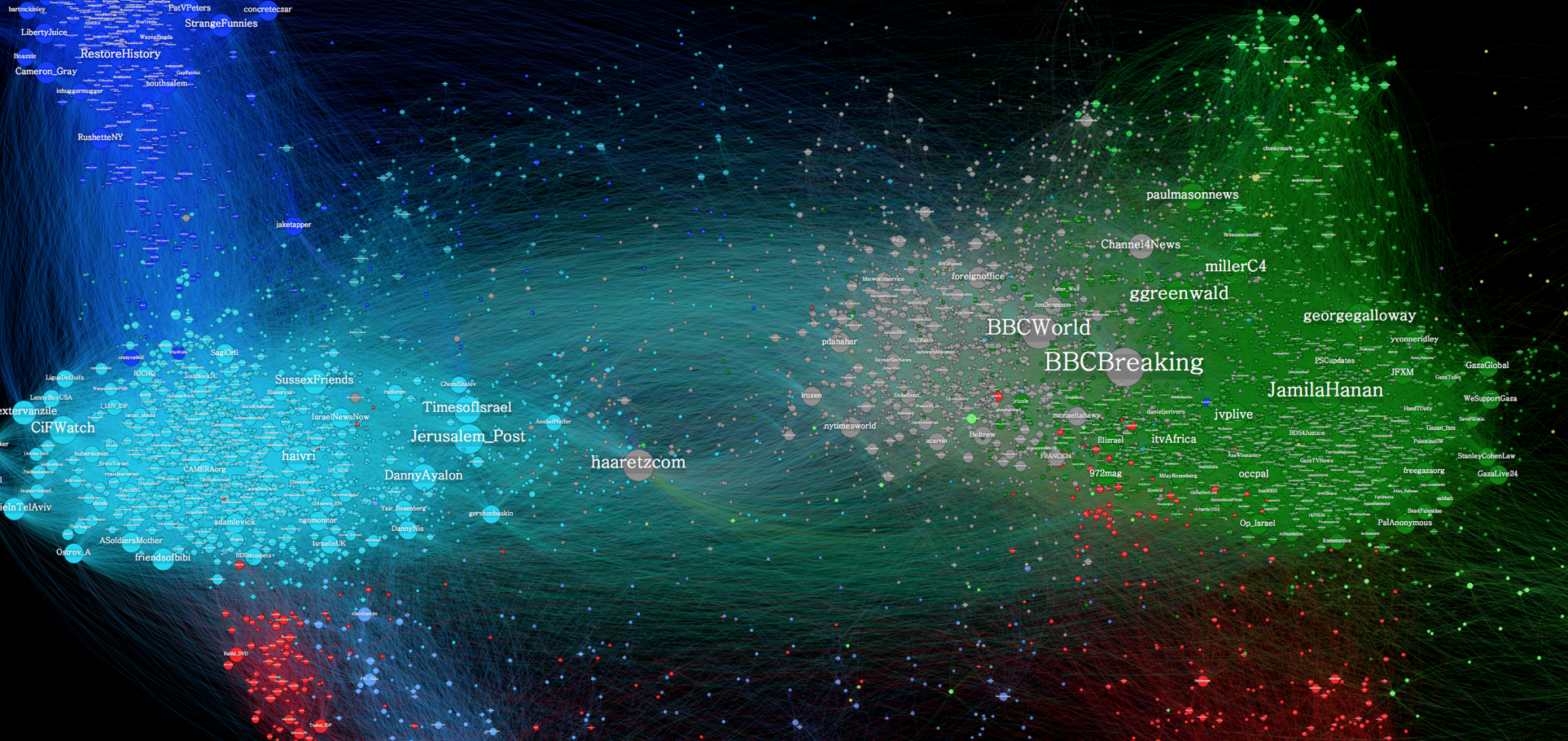
Twitter Mid-East solitudesFor data visualization geeks, as well as those more broadly interested in social networks and how they reinforce our existing views, this article by Gilad Lotan is a must read (Haaretz, the left-wing Israeli newspaper, draws the most from both sides):

Facebook’s trending pages aggregate content that are heavily shared “trending” across the platform. If you’re already logged into Facebook, you’ll see a personalized view of the trend, highlighting your friends and their views on the trend. Give it a try.

Now open a separate browser window in incognito mode Chrome: File->New Incognito Window and navigate to the same page. Since the browser has no idea who you are on Facebook, you’ll get the raw, unpersonalized feed.

How are the two different?

Personalizing Propaganda

If you’re rooting for Israel, you might have seen videos of rocket launches by Hamas adjacent to Shifa Hospital. Alternatively, if you’re pro-Palestinian, you might have seen the following report on an alleged IDF sniper who admitted on Instagram to murdering 13 Gazan children. Israelis and their proponents are likely to see IDF videos such as this one detailing arms and tunnels found within mosques passed around in their social media feeds, while Palestinian groups are likely to pass around images displaying the sheer destruction caused by IDF forces to Gazan mosques. One side sees videos of rockets intercepted in the Tel-Aviv skies, and other sees the lethal aftermath of a missile attack on a Gazan neighborhood.

The better we get at modeling user preferences, the more accurately we construct recommendation engines that fully capture user attention. In a way, we are building personalized propaganda engines that feed users content which makes them feel good and throws away the uncomfortable bits.

Worth reflecting upon. I try to have a range of news and twitter feeds to reduce the risk.

Israel, Gaza, War & Data — i ❤ data — Medium.

Behind British Minister of Faith Sayeeda Warsi’s Resignation Over Gaza | TIME

Good article in Time about the dramatic resignation of Sayeeda Warsi, the former UK Minister of Faith, over the UK government’s approach to the crisis in Gaza.

Warsi, as the article and her frequent speeches and interventions, played a significant and positive role in the ongoing UK debates about Muslims, integration and radicalization:

At first glance, one might assume that this story is simply “Muslim minister resigns over U.K. support for Israel.” Warsi is, after all, the first Muslim to serve in so high a position, and soon after her resignation, she called for an immediate arms embargo against Israel in an interview with the Huffington Post UK.

But that’s almost certainly too simplistic an understanding of what happened. Warsi has built her professional career on a foundational principle that religious and historic divides do not necessitate irreconcilable divisions or violence. She made it her mission to help create a government that, as she often said, would “do God” and advocate for faith’s place in society. That meant working for people of all faiths. She spoke out against Islamophobia and worked to make sure British government was inclusive for Muslims. In 2012 she let the U.K.’s largest ministerial delegation to the Vatican. Last year she came to Washington, DC, to speak out against the global persecution of Christians. One of her main goals was to encourage the international community to develop a cross-faith, cross-continent commitment to protect Christian minorities. Religious persecution, she told me at the time, is the biggest challenge of the 21st century. “It is about working up the political will,” she said. “It is about getting some consensus, it is about politicians being prepared to take on these difficult challenges.”

Her personal faith story is also one that bridges divides often thought to be unbridgeable. She is the daughter of Pakistani immigrants and grew up in a Muslim family with a blended theological background that included both Shias and Sunnis. “We were taught to respect and love other faiths as much as we loved our own, and I suppose, you know, quite strong teachings that you can only truly be a Muslim if you also are Christian and Jewish before that, that actually Islam is just an extension of the other faiths and it has been a process where various books have been revealed at various times,” she told me. “I don’t see there is a collision course between people of faith, I actually do think it is instinctively based up on the same values.”

Her whole story is rooted in commitment to a higher calling. It makes her decision to resign is all the more dramatic, and it sends a strong statement that political will requires moral courage. “I always said that long after life in politics I must be able to live with myself for the decision I took or the decisions I supported,” she said in her resignation letter. “By staying in Government at this time I do not feel I can be sure of that.”

Behind British Minister of Faith Sayeeda Warsi’s Resignation Over Gaza | TIME.

Peacemaking through film and pastrami: Caplanskys signs on to sponsor Toronto Palestine Film Festival

Nice contrast with some of the ugliness in display during recent demonstrations supporting or opposing Israel’s actions in Gaza:

Caplansky’s desire to find common ground traces back to high school, when as president of York Mills Collegiate, he visited the home of the school’s vice-president, who was Palestinian.

“He had a map of Israel on the wall, and it said, ‘Palestine,’” he recalled. “I realized he has a different perspective, and we can still be friends.”

He said he made the decision several months ago to supply the film festival with one of his signature blue-and-white food trucks, emblazoned with the slogan, “Sometimes you just have to Jew it up.” “I’m not sure how well that’s going to go over,” he said, with a laugh.

On offer during the screening of Laila’s Birthday, a dark comedy by Palestinian director Rashid Masharawi, will be a selection of the Caplansky classics: smoked meat sandwiches; barbecue brisket; smoked meat poutine; maple beef bacon doughnuts.

“I hope they eat. I hope they enjoy,” Caplansky said. “I hope they understand that we’re in this together. This isn’t us and them. This is just us.”

Peacemaking through film and pastrami: Caplanskys signs on to sponsor Toronto Palestine Film Festival | Toronto Star.

I hate the hatred | Coren Toronto Sun

Michael Coren, whose writings I generally disagree with, nevertheless is worth reading in general for a different perspective, and particularly this piece on Israel and Gaza:

I hate the way some on the right and in Zionist circles refuse to listen to the Palestinian experience and believe Israel can do no wrong. I hate the way some evangelical Christians think the ghastly battle over Israel and Palestine is some sort of Biblical combat and modern Armageddon to be fought vicariously by Jews and Arabs. I hate the hatred.

I hate it when North African thugs in Paris attack synagogues in the name of Palestine, beat up Jews in the street and then scream about human rights. I hate it that kids from Pakistan will say not a word about their home country’s blasphemy laws and murder of Christians but roar their hatred of Israel when they probably couldn’t even find it on a map. I hate the hatred.

I hate the singling out of Israel for condemnation but the ignoring of the murderous regimes that surround it. I hate the fact that Iran can hang young gay men, Syria can murder tens of thousands and Turkey can occupy two countries and deny the Armenian genocide but there are no demonstrations. I hate the hatred.

I hate it that when supporters of Israel, like myself, argue that there has to be another way, that Palestine has to exist and that the settlements are wrong, we are mocked as compromisers – I actually wear that badge with pride. I hate it when the same people who welcomed Soviet diplomats, sportsmen and artists and now welcome diplomats, sportsmen and artists from repugnant Arab dictatorships, boycott Israeli kids who can kick a ball or play an instrument. I hate the hatred.

I don’t have a solution, I don’t even have much hope — and for someone who has spent so long in the Middle East, read so much, met so many people, listened to so many stories, I am I suppose a terrible disappointment. I’m obviously not as clever as those on both sides who know exactly how all of this can be settled. But I do know that I hate the damned hatred.

I hate the hatred | Coren | Columnists | Opinion | Toronto Sun.

How Politics and Lies Triggered an Unintended War in Gaza – Forward.com

I don’t normally post on the Mid-East, but given the current events, a few articles worth reading which may have escaped attention, including the Government’s.

Starting with J.J. Goldberg in the Jewish Daily Forward on how the crisis escalated and Netanyahu’s role:

In the flood of angry words that poured out of Israel and Gaza during a week of spiraling violence, few statements were more blunt, or more telling, than this throwaway line by the chief spokesman of the Israeli military, Brigadier General Moti Almoz, speaking July 8 on Army Radio’s morning show: “We have been instructed by the political echelon to hit Hamas hard.”

That’s unusual language for a military mouthpiece. Typically they spout lines like “We will take all necessary actions” or “The state of Israel will defend its citizens.” You don’t expect to hear: “This is the politicians’ idea. They’re making us do it.”

Admittedly, demurrals on government policy by Israel’s top defense brass, once virtually unthinkable, have become almost routine in the Netanyahu era. Usually, though, there’s some measure of subtlety or discretion. This particular interview was different. Where most disagreements involve policies that might eventually lead to some future unnecessary war, this one was about an unnecessary war they were now stumbling into.

Spokesmen don’t speak for themselves. Almoz was expressing a frustration that was building in the army command for nearly a month, since the June 12 kidnapping of three Israeli yeshiva boys. The crime set off a chain of events in which Israel gradually lost control of the situation, finally ending up on the brink of a war that nobody wanted — not the army, not the government, not even the enemy, Hamas.

The frustration had numerous causes. Once the boys’ disappearance was known, troops began a massive, 18-day search-and-rescue operation, entering thousands of homes, arresting and interrogating hundreds of individuals, racing against the clock. Only on July 1, after the boys’ bodies were found, did the truth come out: The government had known almost from the beginning that the boys were dead. It maintained the fiction that it hoped to find them alive as a pretext to dismantle Hamas’ West Bank operations.

The initial evidence was the recording of victim Gilad Shaer’s desperate cellphone call to Moked 100, Israel’s 911. When the tape reached the security services the next morning — neglected for hours by Moked 100 staff — the teen was heard whispering “They’ve kidnapped me” “hatfu oti” followed by shouts of “Heads down,” then gunfire, two groans, more shots, then singing in Arabic. That evening searchers found the kidnappers’ abandoned, torched Hyundai, with eight bullet holes and the boys’ DNA. There was no doubt.

Prime Minister Benjamin Netanyahu immediately placed a gag order on the deaths. Journalists who heard rumors were told the Shin Bet wanted the gag order to aid the search. For public consumption, the official word was that Israel was “acting on the assumption that they’re alive.” It was, simply put, a lie.

How Politics and Lies Triggered an Unintended War in Gaza – Forward.com.

Secondly, former head of Shin Bet, 2005-11, Yuval Diskin’s A Prayer of a Father in a War of No Choice? (The Gatekeepers captures the hard-headed assessment of six former heads of Shin Bet, including Diskin):

My heart is with my brothers and sisters and the masses of Israeli citizens currently under attack from rockets and missiles. My heart is also with those Palestinians in the Gaza Strip that did not choose this war, have become, against their wills, human shields for the terrorists of Hamas, Islamic Jihad, and the other terror organizations, and have absorbed hundreds of tons of explosives from the air.

My heart is with all the parents whose sons are on the front and who may – in a few more hours or days – enter this miserable place whose name is the Gaza Strip. Everyone who has seen and spent days and nights with sewage flowing in the streets of the miserable refugee camps in Gaza, the West Bank (or for those who want, Judea and Samaria), and Lebanon is able to understand how much we must find a way to resolve this bloody conflict at least partially.

And yes… in the current situation, I think that it is necessary to do everything possible in order to the stop the rockets from the Gaza Strip. And, if there is no other choice, also a ground invasion provided the invasion will have real goals and will not be intended just for the consumption of the incited masses in the hands of the religious fanatics and cynical politicians.

Whoever is familiar with this endless cycle of bloodshed and hatred knows how much the next war is already filled with the blood of the current war. I know and remember this frustrating sense before every operation or war. It is the moment when you realize deep inside yourself the futility and the foolishness of it and, especially, how much in war there are not really any winners…as much as the war escalates and continues, one can see more and more clearly how much it is unnecessary and how much one could have been spared from it if only we had been truly talking out of a desire to solve the conflict, to compromise and build a better future for all of us…

I pray that after everything is finished, we will remember that really at that moment everything starts anew…And when the hourglass is turned over and we begin to count down until the next war, I hope that we will remember that is forbidden for us and for our enemies to pay attention to the same religious fanatics and war-mongering politicians seeking to satisfy the lust of their supporters – on both sides. And how much it is preferable to sit and to resolve what is possible in this bloody conflict.

Until then, I offer a deep prayer that peace and quiet will return quickly to the citizens of Israel in the south, the center, and the north, and that all our regular, reserve, and career soldiers return home in peace, including our four beloved sons. Let it be.

Diskin’s Prayer: On Israel, Gaza, and the next war

And from Gaza, a youth manifesto expressing their frustration:

“Fuck Hamas. Fuck Israel. Fuck Fatah. Fuck UN. Fuck UNWRA. Fuck USA! We, the youth in Gaza, are so fed up with Israel, Hamas, the occupation, the violations of human rights and the indifference of the international community!

“We want to scream and break this wall of silence, injustice and indifference like the Israeli F16s breaking the wall of sound; scream with all the power in our souls in order to release this immense frustration that consumes us because of this fucking situation we live in…

“We are sick of being caught in this political struggle; sick of coal-dark nights with airplanes circling above our homes; sick of innocent farmers getting shot in the buffer zone because they are taking care of their lands; sick of bearded guys walking around with their guns abusing their power, beating up or incarcerating young people demonstrating for what they believe in; sick of the wall of shame that separates us from the rest of our country and keeps us imprisoned in a stamp-sized piece of land; sick of being portrayed as terrorists, home-made fanatics with explosives in our pockets and evil in our eyes; sick of the indifference we meet from the international community, the so-called experts in expressing concerns and drafting resolutions but cowards in enforcing anything they agree on; we are sick and tired of living a shitty life, being kept in jail by Israel, beaten up by Hamas and completely ignored by the rest of the world.

“There is a revolution growing inside of us, an immense dissatisfaction and frustration that will destroy us unless we find a way of canalising this energy into something that can challenge the status quo and give us some kind of hope.

“We barely survived the Operation Cast Lead, where Israel very effectively bombed the shit out of us, destroying thousands of homes and even more lives and dreams. During the war we got the unmistakable feeling that Israel wanted to erase us from the face of the Earth. During the last years, Hamas has been doing all they can to control our thoughts, behaviour and aspirations. Here in Gaza we are scared of being incarcerated, interrogated, hit, tortured, bombed, killed. We cannot move as we want, say what we want, do what we want.

“ENOUGH! Enough pain, enough tears, enough suffering, enough control, limitations, unjust justifications, terror, torture, excuses, bombings, sleepless nights, dead civilians, black memories, bleak future, heart-aching present, disturbed politics, fanatic politicians, religious bullshit, enough incarceration! WE SAY STOP! This is not the future we want! We want to be free. We want to be able to live a normal life. We want peace. Is that too much to ask?”

Gazan youth issue manifesto to vent their anger with all sides in the conflict | World news | The Observer.