Highlighting retention issues, relative wage gaps between visible minorities and not visible minority remain a concern:
Canada is “relatively successful” at attracting highly educated immigrants, but their counterparts in the United States earn more and have access to better opportunities, a new study says.
The neighbouring countries that have been largely at odds since the Trump administration took over are not only competing when it comes to industries, like the steel and auto sectors. They are also competing for skilled and educated people, especially those in the science, technology, engineering and math (STEM) fields.
Researchers noted that now is the time for Canada to push for the “best and the brightest” to come to the country, as the U.S. adopts “a far less welcoming immigration policy.”
The study from the Fraser Institute published on Thursday is shedding light on how certain Canadian immigrants are not reaping as many benefits as their U.S. counterparts who “perform better in terms of both employment status and earnings.” Those two factors are compared to native-born Canadians and Americans, respectively, as benchmarks.
In Canada, highly educated immigrants earned 16 per cent less than native Canadians. In the U.S., immigrants had a higher employment rate (1.2 per cent) and higher compensation (8 per cent) than Americans born in the country.
In 2020, visible minority immigrants in Canada with a bachelor’s degree or higher earned a median of $57,200, whereas native Canadians with a bachelor’s degree earned $68,300 on average.
“The differences were even greater when focusing on cohorts with advanced degrees,” said researchers. “Specifically, the median income of visible minority immigrants with a master’s degree was $65,500. For those with an earned doctorate, it was $84,000.” Canadians born in the country with a master’s earned an average of $84,400, while those with a doctorate earned $100,000.
The wage gap was likely due to “difficulties around the recognition of foreign credentials (and perhaps non-Canadian work experience) for newcomers seeking opportunities in the Canadian labour market,” researchers noted.
In the United States, data from 2022 showed that highly educated American immigrants earned US$122,000, while those born in the U.S. in with the same qualifications earned US$113,000. Researchers said that immigrants out-earning their American counterparts could be due to their “superior performance.”…
Yet more commentary on the link between immigration and housing, and the time lags involved in expanding the latter:
According to a recent Statistics Canada report, Canada’s population has just hit the level it was previously expected to reach in 2028. That startling finding underscores the extraordinary growth of the country’s population since the pandemic, driven by record inflows of permanent and “temporary” immigrants.
A rapidly expanding population can bring benefits, notably by stimulating overall economic activity and providing additional workers. But it’s not an alloyed good. The number of Canadian residents is increasing faster than economic output (gross domestic product), which has translated into an unprecedented series of per-person Gross Domestic Product declines over the last several quarters. Productivity is stagnant as newcomers struggle to find their way in the economy and job market. In addition, a significant share of new immigrants don’t seek or obtain employment, dampening immigration’s contribution to the growth of economic output.
Meanwhile, unusually brisk population growth is putting considerable strain on public services and infrastructure, in part because the federal government did essentially nothing to plan or prepare for the dramatic surge in immigration that its own policies sanctioned. The “downstream” challenge of managing the pressures flowing from turbo-charged immigration falls mainly to provinces and municipalities, not far away Ottawa.
All of this has implications for the hottest issue in Canadian politics today — housing affordability and supply. Like the rest of us, newcomers need a place to live. Immigration is the predominant source of incremental housing demand in much of the country, particularly big cities. Demand for housing also comes from the existing Canadian population, as young adults establish separate households, marriages dissolve, and people move to other communities or neighbourhoods for work, education or retirement.
Unfortunately, homebuilding has been running far behind what’s necessary to accommodate immigration, let alone meet the demand from household formation among current residents. In 1972, when the population stood at 22 million, roughly 220,000 new homes were added to the Canadian housing stock. In 2023, with a population of 40 million, housing starts were only a little higher than half a century ago.
This brings us to the Trudeau government’s multi-faceted housing plan, rolled out over the past year and finalized with great fanfare in the 2024 federal budget. The government has pledged to somehow build 3.9 million new homes by 2031 — just seven years from now. This is equivalent to 550,000 housing starts per year. It’s an aspirational target, but also a patently unrealistic one.
The federal government has little control over what happens in the towns, cities and provinces where most of the policy and regulatory decisions affecting homebuilding and community development are made. Moreover, the Canadian construction sector doesn’t have the spare human resources or organizational capacity to quickly double housing starts.
Even today, the construction sector’s “job vacancy rate” is higher than the all-industry average.
The year 2021 marked a record for Canadian housing starts at 270,000. Starts fell over 2022-23, amid higher interest rates.
This year, RBC Economics projects housing starts of 251,000, rising to 273,000 in 2025. To put it mildly, these figures are inconsistent with Ottawa’s ambitious plan to deliver 550,000 new homes per year.
We’ll likely see more and faster homebuilding over the next few years, as governments at all levels direct more money and
political attention to housing. But a doubling of housing starts simply won’t occur within the Trudeau government’s politically manufactured timeline. One thing seems certain — Canada’s housing “crisis” will continue to fester.
Jock Finlayson is a senior fellow at the Fraser Institute
Rather naive in terms of minimizing the practicalities of ensuring adequate housing, healthcare and infrastructure, one of the key points that Saunders needed to be addressed in Maximum Canada. And the nation-building aspect overstated, given this gap and persistent low productivity that current policies, with few exceptions, are not addressing. Same large population fallacies:
A lot of people — at least, a lot of people who read this blog — know of Matt Yglesias’ book One Billion Americans. It’s good, you should read it. But not as many seem to know that it’s actually a riff on a book that came out three years earlier called Maximum Canada: Why 35 Million Canadians Are Not Enough, by Doug Saunders. In fact, the books are pretty different; Saunders spends most of his time justifying the idea of a bigger Canada with appeals to the country’s history, culture, and politics, where Yglesias mostly discusses the practical details of how we’d fit the newcomers into the country.
But what these two books share is that they’re both advocating a certain type of nation-building strategy — the idea of deliberately promoting large-scale immigration in order to expand a country’s population toward a numerical target. This isn’t something the U.S. has really done in the past. We enacted laws to make immigration more or less restrictive, but this was typically done either as an ad-hoc reaction to a wave of immigration pressure from abroad (e.g. in 1924), or out of moral and ideological concerns (e.g. in 1965). To a large extent, we didn’t really have to do this; people were almost always beating down our door to get here, and all we had to do was sit back and decide who to let in. (In the two decades after the Civil War, there was some talk of recruiting immigrants from abroad to populate the Midwest and West, but this was shelved when it turned out lots of people wanted to come of their own accord.)
Canada, for much of its own history, was similar. But in recent years, the Canadian government has begun to set hard targets for immigration, such as last year’s target of 1.5 million more by 2025. And the country is deliberately encouraging more people to come, with one of the world’s most aggressive recruitment strategies.
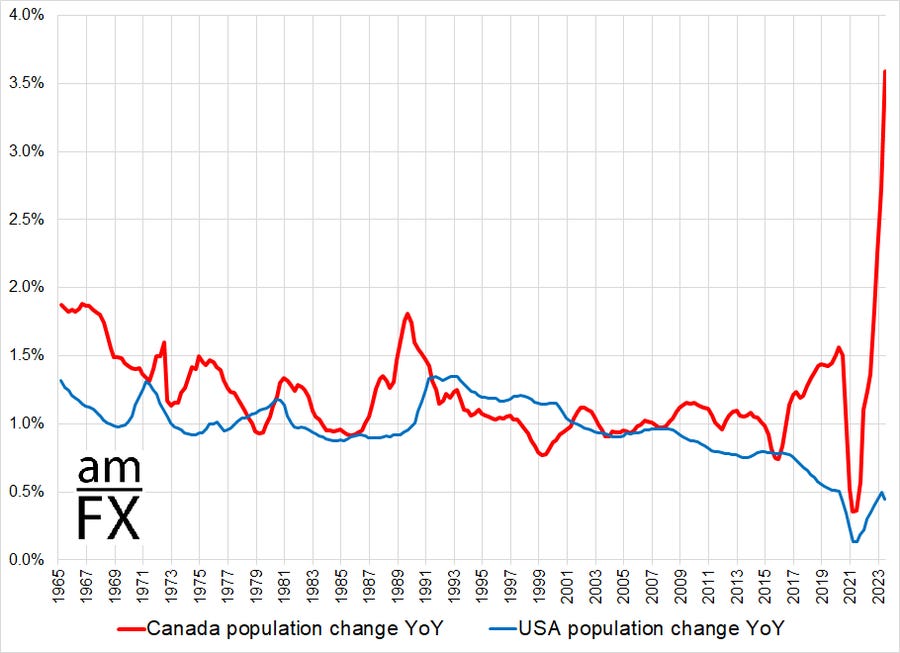
First, let’s just take a look at the results Canada is achieving. The country’s population has just passed 40 million — a 14% increase from when Doug Saunders published Maximum Canada. The national statistics agency loudly celebrated the achievement. And the country’s population growth rate has just shot up to over 3.5%, which is among the world’s fastest:
And this is all from immigration. The country’s total fertility rate is 1.4, far below the replacement rate. Yet population is booming because Canada is recruiting from abroad.
This isn’t quite Maximum Canada yet, but it’s clearly headed in that direction.
And Canada’s zeal for greater population inflows is matched by its determination to recruit the best and the brightest en masse. The country’s points-based immigration system, the Federal Skilled Worker Program, is well-known, as is the Provincial Nominee Program that allows individual Canadian provinces to recruit immigrant workers to specific locations. But the country keeps adding more programs for grabbing talent. Its latest idea includes an offer of permanent residency to people working in the United States on H-1B visas — basically, poaching America’s own skilled immigrants! Here are some excerpts from the announcement:
As part of Canada’s first-ever Tech Talent Strategy, Minister Fraser announced the following aggressive attraction measures:
the creation of an open work permit stream for H-1B specialty occupation visa holders in the US to apply for a Canadian work permit, and study or work permit options for their accompanying family members
the development of an Innovation Stream under to the International Mobility Program to attract highly talented individuals…
the promotion of Canada as a destination for digital nomads
the creation of a STEM-specific draw…under the Express Entry program…
improvements to the Start-up Visa Program
Canada also has family-based and humanitarian immigration programs like the U.S. does, but the big difference here is that they take absolutely massive numbers of skilled immigrants from all over the world.
All of this adds up to what looks to me like a nation-building strategy. Canada has a clear vision for itself as a multicultural mecca for all of the world’s smart and hard-working people. It’s a bit like Singapore, except more democratic, and without that country’s emphasis on preserving a single ethnicity’s demographic dominance. If you’re smart and you want to work and you like Canadian culture, it doesn’t matter what you look like; you’re in the club.
What’s amazing is that the vast majority of the country’s populace appears to have signed onto this strategy. As Derek Thompson writes, immigration has not produced a big backlash in Canada, outside of some highly localized concerns (like Chinese capital flight buying up property in Vancouver). A little of this might be from the Anglophone majority’s desire to reduce the political influence of Quebec, but much of it is just that multiculturalism and immigration are deeply rooted in the country’s self-defined national identity. And on top of that, the fact that so much of Canada’s immigration is based on employment prospects and skills probably reduces social friction; immigrants are likely to make a lot of money and not commit much crime.
There’s also one additional factor that no one talks about, but which would definitely be on my mind if I were Canadian: national security. Canada has a very large, very powerful, and occasionally politically unstable neighbor to its south. It has already defeated one invasion from that southern neighbor, and while more recently relations between the two countries have been friendlier, you never know when attitudes might shift. A country of 100 million would be a lot more capable of resisting the U.S. than a country of 40 million.
Of course, there are major challenges for Canada’s nation-building strategy. Chief among these is NIMBYism; Canada is huge, but you can’t just scatter your population randomly across the plain (I mean, you can try, but the results are comedic). Modern knowledge-based economies harness clustering and agglomeration effects, which means Canada needs to fit those new millions into its cities. And despite very low crime rates, Canada is having a bit of trouble doing this. Unlike Japan, Canada does not have simple national zoning laws administered by a competent technocratic bureaucracy; instead, local municipalities are free to block housing as they choose.
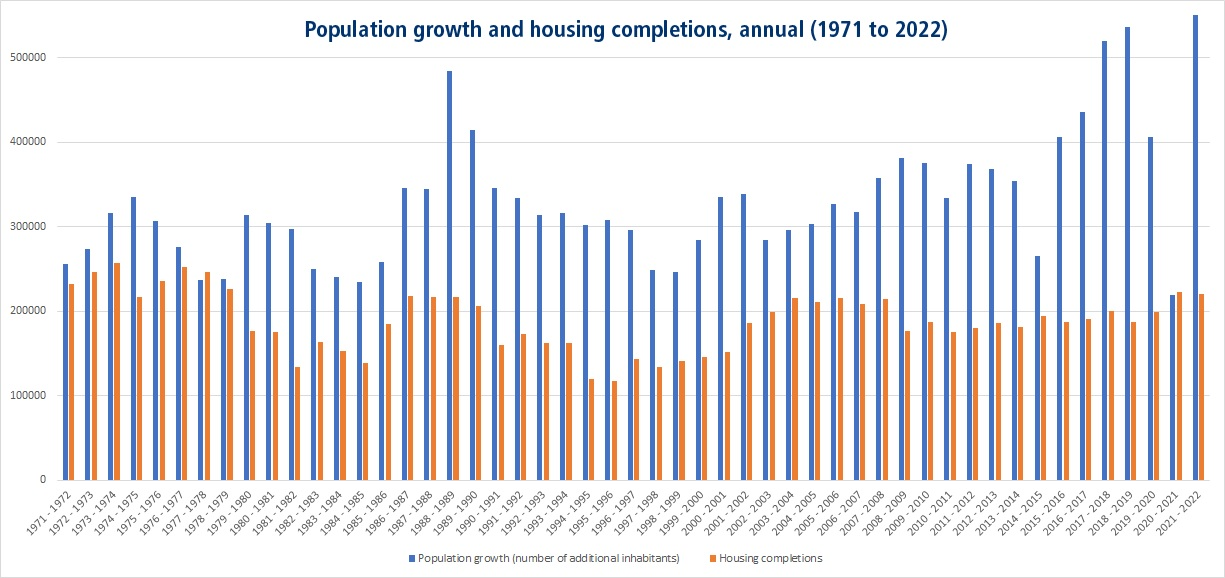
And block it they do. The Fraser Institute notes that Canada is not building nearly enough housing to house its massive population inflows:
And the mismatch has been getting worse over time:
Jean-François Perrault of Scotiabank notes that Canada has fewer housing units per 1000 people than France, Germany, Japan, the UK, or even the United States. He writes:
A key challenge is finding an approach that can overcome the political obstacles to a better supply response. Very often within city limits, measures to increase density pit current owners versus prospective residents. Municipal councillors are politically responsive to their voters given the nature of the democratic process. What may be great policy from a national perspective, like high immigration, runs into obstacles when it means finding practical solutions at the local level to increase the housing stock…
To get a sense of the main obstacles to a more elastic supply response, we have polled several of our clients in real estate and development across the country to find the cross-cutting factors they see as most limiting supply growth. To no surprise, the key impediments are in the planning and approval process. In many major cities, the entitlement process is very lengthy and unduly political. Many processes can delay or derail development applications and this can be exacerbated by under-resourced planning departments within cities.
Even Canada’s commitment to multiculturalism is starting to come into conflict with its anti-housing NIMBY instincts. The government returned a plot of land in the middle of downtown Vancouver to the Squamish Nation, which promptly planned a very cool dense housing development with solarpunk aesthetics. The project is still going ahead, but urban planners are now starting to complain about the density, and local residents are trying to stop an access road to the development.
This will simply not do. If you let in tens of millions of people, you must house them; there is simply no other option, other than to let rents continue to skyrocket until the people revolt. Canadian leaders would do well to supplement Doug Saunders’ book with Matt Yglesias’ pragmatic tome. If Canada can’t figure out how to beat its entrenched NIMBY instincts and replace its old ideal of quiet pastoral low-rise cities with one of dense, bustling, efficiently functioning metropolises, it will never achieve Maximum Canada.
In the meantime, though, we Americans to the south need to take a hard look at what Canada is doing, and ask ourselves why we can’t do something similar. Like Canada, the U.S. is a highly diverse nation of immigrants. Like Canada, our fertility is below replacement (though not quite as bad), and we rely on immigration for population growth. Like Canada, we face the inherent economic disadvantage of being located far from the world population supercluster in Asia, and thus we will always be fighting an uphill battle to get high-value industries to want to locate here. So like Canada, we should be importing huge numbers of skilled immigrants — especially because our software and finance and biotech industry clusters, and our world-beating research universities, make it easier for us to attract skilled immigrants in the first place. We should be playing to our strengths.
And yet in the U.S., immigration of any kind is now at the center of a vicious culture war. The political right may occasionally claim that they only oppose illegal immigration, or that they want skilled immigration, but when it comes time for actual policy proposals, what they want is just to decrease all types of immigration. The days of pro-immigration Republicans like George W. Bush are gone. In fact, various hard-right figures have specifically railed against immigration from India, which is America’s most important source of skilled immigrants.
Meanwhile, American progressives, unlike their Canadian counterparts, seem generally unenthusiastic about the idea of mass recruitment of high-skilled foreign workers; my suspicion is that they fear the competition the children of these immigrants will provide for their own children in the academic system. Instead, in recent years, some progressives have begun to lean toward the idea that immigration should be viewed as a form of reparations for colonialism, rather than a strategy for nation-building. Naturally, that absurd idea just triggers the right even more.
This is a terrible political equilibrium. Survey after survey finds that Americans very strongly support high-skilled immigration, but because it’s a political football, only centrists like Biden seem interested in doing anything about it. Without a popular political mandate, any nation-building strategy like Canada’s is doomed.
I wish Americans could tell themselves a positive narrative like Canada’s — of immigration as the way to build a multicultural nation. Many of us have tried to tell that narrative, and have foundered on the rocks of America’s age of division. As John Higham wrote, when America is underconfident — when we start to doubt who we are as a people and a nation — we instinctively think about closing the door. Right now, America definitely doesn’t know who we are, as a people and as a nation. Maybe next decade we’ll remember.
Canada, however, does know who they are. And good for them. Now all they have to do is build a bunch of housing, and they’ll be golden.
Need also to question the demand side of the equation, which includes high levels of permanent and temporary residents:
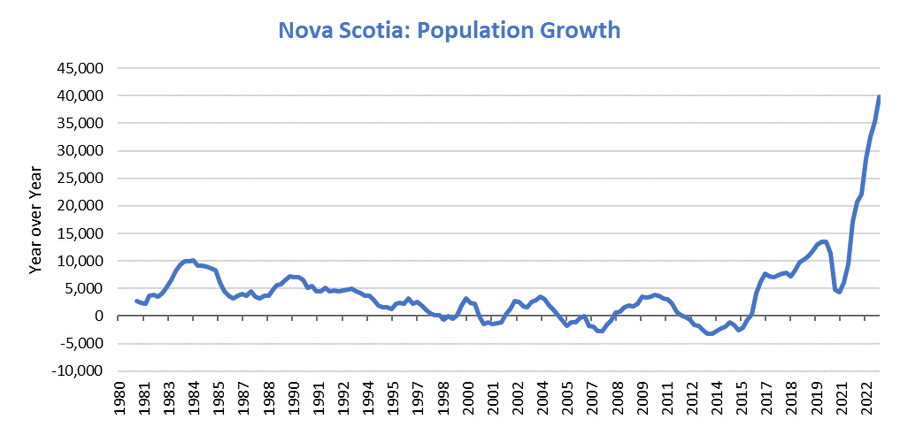
Canada recently reached a milestone of 40 million people after growing by more than one million people in one year for the first time in 2022. But while we’re adding people at record levels, the same can’t be said about homes.
According to recent research, while the number of people Canada-wide has accelerated in recent years, the number of housing units completed has stagnated and even fallen to levels well below previous peaks. Specifically, from 1971 to 1980, Canada’s population grew by 283,737 people annually on average while an annual average of 226,524 housing units were completed.
By comparison, from 2013 to 2022, Canada’s population grew by 427,439 people annually on average yet only 196,872 housing units were completed annually on average. Put differently, during the 1970s, roughly four housing units were constructed for every five new people in Canada, compared to slightly less than one housing unit constructed for every two new people in recent times.
These dual trends spell trouble for many Canadians, especially those already struggling to find affordable housing. The severe imbalance between the number of homes available and the number required have squeezed many renters and would-be homebuyers who increasingly find themselves bidding for a dwindling supply of available units.
The result? Higher rents and home prices, and not just among the “usual suspect” communities in the greater Toronto and Vancouver areas, but in small- and medium-sized cities across the country. Last year, communities including London, Ont., Waterloo Region, Peterborough, Ont., Hamilton, Ont., Kingston, Gatineau, Quebec City and Halifax all saw their rental vacancy rates (a measure of rental unit availability) fall below 2 per cent, which places them in the same league as Toronto, Vancouver and Victoria. And when vacancy rates fall, rents rise.
Canada’s shortage of housing has negative consequences for almost everyone, from the most vulnerable individuals and families to employers struggling to find workers. It also hurts newcomers to Canada – the single largest group contributing to Canada’s population growth. Most new arrivals to Canada rent their homes, leaving them especially exposed to rapidly tightening rental markets. Rising rents and worsening availability hamper their prospects – and indeed the prospects of all renters or would-be homeowners – of achieving upward mobility, arguably one of Canada’s main draws.
Thankfully, solutions are available, although policymakers must act big and act fast. There’s tremendous opportunity to open up more neighbourhoods to help achieve the levels of homebuilding required to adequately house a growing Canada. Several cities have already started implementing policies making it easier to add housing units. For example, Edmonton is overhauling its zoning bylaws to allow more housing options citywide, including duplexes, secondary suites and small apartments in current low-density residential areas. Similarly, Toronto City Council recently adopted plans to allow up to four units per lot citywide without the need to rezone. And elsewhere in Ontario, British Columbia and Nova Scotia, provincial and local governments are making similar changes.
However, such policies are only the first of many necessary steps, and their effects will only be felt over the longer term so there’s no time to waste.
As Canadians and policymakers ponder our 40 million demographic milestone, they should give honest consideration to Canada’s worsening housing situation. In the right circumstances, a growing population can bring numerous benefits – economic, cultural and more. By not allowing homebuilding to keep up with population growth, however, governments across the country have hampered prosperity for both existing Canadians and newcomers. Governments, especially municipalities, must change the way they plan for and approve the millions more homes we need today and in the future if we’re to restore the promise of a thriving Canada with upward mobility.
Josef Filipowicz and Steve Lafleur are senior fellows at the Fraser Institute.
While I disagree with Grubel on many of his points and overall approach, he is right on the negative impacts and externalities of current and projected high levels of immigration.
His proposed solution, essentially only admitting economic class immigrants with a job offer is completely unrealistic (what government would stop family reunification, given the impact in ridings with large numbers of immigrants, or completely stop refugees, which is practically and legally impossible). While sidestepping the numbers questions, a column a few years back referenced 50,000 if I recall correctly.
And Leger is only one poll and its question phrasing, as it often is, was designed to elicit this response:
Canadians are increasingly worried about immigration. A recent Leger Poll found that 49 per cent of us think the federal government’s new target of 500,000 immigrants a year is too many, while fully 75 per cent are concerned the plan will result in excessive demand for housing and social services. For his part, the immigration minister, Sean Fraser, tells us we need not worry: immigrants themselves will provide the labour needed to build the housing stock they’ll need.
The majority of Canadians have always welcomed immigrants and believe they benefit the economy and themselves. What worries them today is the prospect of mass immigration that they believe the housing market cannot absorb without much higher prices. They know the minister’s soothing reassurance is not supported by experience. Past immigration did increase the labour force but did not prevent high housing costs. Excessive regulations and rent control are the main reasons housing is so expensive, not a shortage of labour.
Immigrants not only add to the demand for housing, they also increase congestion for a wide range of public services: doctors, hospitals, schools, universities, parks, retirement homes, and roads and bridges, as well as the utilities that supply water, electricity and sewers. In theory, the supply of all these things could be expanded reasonably rapidly. In practice, expansion is slow. But the main reasons for that are, not a shortage of labour, but inadequate planning, insufficient financial resources and, as a result, construction that lags demand.
The case for keeping annual immigration at traditional or even somewhat lower levels rests on more than the effect on house prices and public services, however. Immigration also depresses the wages of low-income workers, which results in greater income-equalizing transfers and the higher taxes required to pay for them. It also reduces employers’ incentives to adopt labour-saving technology, an important source of growth in labour productivity and wages, and it allows employers to avoid the cost of operating apprenticeship programs to train skilled workers.
Japan’s widespread success in using robots to deal with labour shortages caused by its aging population illustrates what could be done in Canada. In Germany employers operate apprenticeship programs to train skilled workers in the numbers industry needs. In this country, such programs could relieve the shortage of skilled labour while benefiting people already here, rather than new immigrants brought in specially to take highly paid skilled jobs currently going asking.
Despite the Leger numbers suggesting many Canadians have concerns about big increases in the rate of immigration, the debate about it tends to be one-sided. We hear from the many groups that benefit from mass immigration: employers, immigration lawyers and consultants, real estate developers, political parties that traditionally do well in immigrant communities, idealists who want us to “imagine there’s no countries” and so on.
On the other side, the Leger numbers suggest, is a majority that is not at all opposed to immigration in principle but begins to inform itself on the subject and maybe even become politically active only when the costs become so large they can’t be ignored any longer.
In Switzerland during the 1970s an economic boom led to labour shortages and immigration was liberalized. It turned out that the need to produce housing infrastructure and public services for these immigrants actually worsened the labour shortage. The silent majority of Swiss citizens organized and took advantage of the opportunity to get government policy changed by demanding a public referendum that ultimately ended the liberal immigration policy.
In Canada, changes in policies come through Parliament and the election of politicians. Numbers like those in the Leger poll may begin to suggest to politicians that they can increase their election chances by catering to the majority who would prefer somewhat reduced immigration but also a fundamental reform of the system currently used to determine the number and characteristics of immigrants.
Such a reform would put greater emphasis on market forces rather than politicians and bureaucrats in setting immigration levels. Immigrants would be admitted only if they possessed a formal offer of employment in Canada that paid at least the average earned by workers in the region where they would be employed.
Under this system, employers’ self-interest would ensure that workers would have the skills and personal characteristics required for success on the job. The requirement for minimum pay would prevent floods of immigrants competing with Canada’s low-wage workers and ensure that those who did come had the income needed for a life free from the need for public subsidies.
Worrying about immigration is not enough. Only the election of politicians committed to this kind of reform will restore mental peace.
Herbert Grubel, himself an immigrant to Canada, is an emeritus professor of economics at Simon Fraser University and a senior fellow at the Fraser Institute.
Fifth, the most important difference between modern Canada and when previous waves of immigrants entered this country is the existence of the welfare state. In the absence of its universal social benefits in the past, only healthy immigrants with strong work ethics, drive and skills came to Canada. Under present conditions, potentially many immigrants would not possess these qualities and impose heavy fiscal burdens on our welfare programs and ultimately bankrupt them. It is for this reason that Milton Friedman, one of the world’s most ardent advocates for human and economic freedom concluded that, “The welfare state and free immigration are incompatible.”
The problem identified by Friedman has been quantified in a study by myself and Patrick Grady, in which we found that the average incomes and tax payments of recent immigrants (documented by Statistics Canada) are much lower than those of the average Canadian and that the immigrants consume roughly the same amount of government services as the average Canadian. The difference between the taxes paid and services consumed by the average recent immigrant equals about $6,000 annually. Given the total number of these immigrants, the annual fiscal burden on Canadian taxpayers comes to about $30 billion.
Sixth, immigrants in large numbers cause a substantial redistribution of income, decreasing the incomes of workers and increasing the income of employers. Drawing on the basic results of a study of the redistribution effect in the United States by Harvard University Professor of Economics George Borjas, in Canada the decrease of the annual income of labour is $40 billion and the gain of employers is $43.5 billion, resulting in a net gain of $3.5 billion for the latter. This gain is called the immigration effect and is due to increased opportunities to trade.
Advocates for free immigration make much of this gain but the data show that it is very small relative to the redistribution of income. These advocates also laud the increase in Canada’s aggregate national income resulting from the immigrants’ economic activities. However, all of this increase accrues to the immigrants in the form of wages, lowers per capita incomes and is accompanied by greater congestion and pollution in metropolitan areas. Increased demand for and cost of housing reduces the ability of young Canadians to own homes and start families, creating frictions between generations.
The economic and social costs just discussed do not make the case against all immigration but make the case for the selection of immigrants with prospects for economic success that are high enough to eliminate the fiscal burden and the admission of immigrants in numbers small enough to prevent the risk of creating the substantial redistribution of income, the establishment of ethnic enclaves, the threat of jihadist terror and the problems associated with substantial and rapid population increases.
In the context of the current debate over policies for the admission of refugees from the Middle East, it is important for all Canadians that these considerations are given proper weight in the selection of immigrants and decisions about their numbers.
How the Fraser Institute can maintain this kind of letter by former Ontario Premier Harris is non-partisan defies credibility and common sense:
A fundraising letter written by Fraser Institute senior fellow and former premier Mike Harris criticizing the Ontario government highlights a double standard in the way the Canada Revenue Agency audits charities, critics charge.
The letter takes swipes at the province for lacking a “credible plan” to balance the provincial budget within two years, and goes on to criticize Ontario’s debt and the province’s unemployment rate.
“As my fellow Ontarian you must be outraged — that is why I am writing to you today to help us educate Ontarians about the severity of Ontario’s problems and the potential solutions,” Harris writes.
The letter asks the reader to “join in the pursuit of policies that will re-establish Ontario as the envy of Canada” by financially supporting the Fraser Institute’s new research program.
Ontario Premier Kathleen Wynne and her Liberal government aren’t mentioned in the letter, a copy of which was obtained by the Star.
The letter is drawing criticism because while charities are permitted to engage in political activities as long as they don’t spend more than 10 per cent of their funds doing so, the Fraser Institute claims the Harris letter isn’t political, and that the group doesn’t engage in any political activities.
Critics argue the letter cuts to the heart of the problem they see in the way the Canada Revenue Agency audits charities.
“This is a great example of the enormous lack of clarity in the rules governing charities and inconsistency in the application by the CRA of those rules,” says NDP MP Murray Rankin, his party’s Canada Revenue critic.
“I just want a level playing field where other charities that may not be aligned with the Conservative government are subject to the same rules,” he said, adding the CRA’s rules are “all over the place.’’
Since Jan. 1, 2012, the CRA’s Charities Directorate has completed roughly 2,000 audits of charities through its regular audit program, and identified more than 50 charities for “political activities” audits.
The government budgets $13 million a year for these political “super audits,” as some people refer to them.
Critics charge that charities espousing views that run counter to Prime Minister Stephen Harper’s Conservative government — including some environmental groups — have been unfairly and disproportionately targeted for the political activity audits.
Charities that have been subjected to these audits say having to pull together the paperwork for the inspections is a daunting process. Several groups have voiced concerns the audits are intended to silence them.
The president of the Fraser Institute, a right-leaning think-tank and registered charity, says “in no way” is the Harris letter political.
“It’s written by a long time senior fellow of the Fraser Institute, Mike Harris. All of the data in the letter is based on Fraser Institute research,” says president Niels Veldhuis, who adds that his organization is non-partisan.
Veldhuis says his organization has been audited by the CRA three times — the last time being in the late 1990s.
Groups that have been audited since 2012, however, say it’s a stretch to say there’s nothing political about Harris’ fundraising letter.
“We would not have it signed by an ex-politician especially with that level of profile as a Conservative politician,” says Bruce Campbell, executive director of the Canadian Centre for Policy Alternatives, a non-partisan research body devoted to social, economic and environmental justice issues.
In order to address the critics, the Government needs to be more transparent on the criteria used and needs a few high profile examples of right-leaning organizations that are being audited.
Given the last time the Fraser Institute was audited was in the late 1990s, perhaps it could volunteer for an audit?
The more information that comes out, the more it smells of bias in the choice of charities it audits:
The CRA says it will do 60 audits, and there are 86,000 charities in Canada. So that’s a one-in-1,400 chance of being audited by random selection. Only it’s not random. The CRA admits it’s looking for red flags, including “bias.”
“Audit selection occurs after a substantial screening process,” the CRA said in an email. “This may include considering issues such as ‘point of view,’ ‘bias,’ or ‘one-sidedness.'”
In Dying With Dignity’s case, its offending activities apparently included attempts to change public opinion.
“It is not legally charitable to engage in pressure tactics on governments such as swaying public opinion, promoting an attitude of mind, creating a climate of opinion,” the CRA’s auditor wrote to Dying With Dignity.
Still, there is a whole class of charities, known as think tanks whose major purpose is creating a climate of opinion or promoting an attitude of mind, activities that fall under the general category of “research as a charitable activity.”
“Think tanks make it very clear from the beginning that their objective is to shape public opinion, and public policy,” says Western University political science professor Donald Abelson. He has spent two decades studying think tanks in Canada and the U.S. and he’s currently writing a book about them.
Just read the annual reports from some of Canada’s leading think tanks to find proud claims of “shaping the national discourse”, “prodding governments, opinion leaders and the general public,” “changing the minds of decision makers,” yet none of that activity apparently trips the wire between political and charitable activity.
“We’re in kind of a grey area, particularly over the last several years, where the lines between policy research and political advocacy have become increasingly blurred,” Abelson said.
Which circles back to the prickly question of how to define “political activities.”
Why the Canadian Centre for Policy Alternatives and not the Fraser Institute? Why Dying with Dignity and not the Justice Centre for Constitutional Freedoms or the Canadian Constitution Foundation?
Unfortunately, all too typical of shallow economic analysis, aligned with ideology.
Of course, one can and should always question value for money with respect to taxation, as well as reviewing the need for government intervention and programs.
But an increase in the share of taxation from 33.5 percent in 1961 (pre-medicare) to 41.8 percent in 2013 without a corresponding analysis of the change in government services is the kind of sloppy “stop the gravy train” Rob Ford unsubstantiated bumper sticker.
A more serious approach would be to compare the increase in program spending with the increase in programs and services, and focus the discussion on whether or not the existing policy rationales and needs are still appropriate:
“Telling people that almost 42% of their income goes on taxes, that’s the first important takeaway. Then people can say, ‘Hold on, that’s one area that can be scaled back.’ We want to start that conversation and this is the data to do that,” he said.
Given that incomes have increased substantially since 1961, it’s inevitable taxes would also rise in terms of the amounts paid, but tax rates have increased because governments provide a wider range of services.
Since 1961, the average family’s tax bill rose by 1,832%, dwarfing increases in the costs of housing, clothing and food.Last year, the average family earned $77,381 and paid $32,369 in total taxes, or 41.8%. Food, shelter and clothing ate up another 36.1%.
For 1961, the numbers were $5,000 in income, $1,675 on taxes (33.5%) and food, shelter and clothing 56.5%.


 Multicultural Meanderings