Hollande’s plans to strip dual nationals of citizenship stirs the Left – France

Healthy debate to have:

French government plans to toughen security laws in the wake of the Paris attacks, which include stripping dual nationals of their citizenship, have come under fierce scrutiny from members within its own ranks. Lille mayor and former labour minister Martine Aubry has called into question the moral basis of the move.

“I’m not sure stripping dual nationals of their citizenship is absolutely necessary,” Martine Aubry told French TV channel BFM on Thursday.

The French government has introduced a raft of security measures since the Paris attacks on 13 November. The police has carried out over 2000 raids on suspects with terrorist links as part of new emergency state laws. Today President François Hollande wants the state to have even more sweeping powers, such as being able to strip dual nationals of their citizenship if they’re involved in terrorist offences.

The prospect has sent alarm bells ringing within his Socialist party, concerned that the Left is jerking dangerously towards the Right.

“Should we treat dual nationals born in France differently? Should we be suspicious of anyone whose parents come from abroad?” Aubry continued.

In essence, the former Labour minister is criticizing what she considers to be a knee-jerk reaction on the part of the president “to give the allusion that he’s going far enough.”

Her comments come three days before regional elections, in which the Far-right Front National is slated to win.

The Paris attacks have reshaped the context. The focus is now less on social issues–although unemployment is higher than ever according to fresh statistics published on Thursday-and now more concentrated on security. A growing number of candidates are opting for stringent security measures in their manifestos to compete with Marine Le Pen.

“It’s out of the question to let the Front National win,” Aubry added, pledging her “full” support to François Hollande in regional elections, of which the first round kicks off this Sunday.

The fact remains however, that she still has doubts on whether his security face-lift suits him.

Source: Hollande’s plans to strip dual nationals of citizenship stirs the Left – France – RFI
How France’s diversity problem became a security problem

Konrad Yakabuski on the failure of France to integrate Muslim youth:

But eradicating the Islamic State, were it possible, would not end the alienation that has turned so many young French Muslims into violent jihadis. While the immediate imperative remains combating one particular brand of terrorism, Mr. Hollande’s efforts cannot end there. Unless Muslim youth can envision a future of semi-equal opportunity in France, one violent cause will simply replace another.

“A more nuanced response than total war is needed to deal with the underlying rage that fuels this confrontation. And that is almost impossible to imagine in the current atmosphere,” American University professor Gordon Adams wrote this week on the Foreign Policy website. “Islam has not been welcome in France, and the hostility of non-Islamic France is only growing.”

Source: Hollande faces the enemy from within – The Globe and Mail

Dana Wagner digs deeper:

Tidjane Thiam couldn’t get a job in France. Mr. Thiam is an Ivory Coast native who studied in France at the elite INSEAD business school. After failing to advance his career in France, he left for an offer in Britain, and in March became chief executive officer of Credit Suisse. The problem was not Mr. Thiam.

It’s unknown how many other visible minorities are unemployed or underemployed in France. The country doesn’t count. It’s against the law to collect data on race or ethnicity – liberté, egalité, fraternité.

But gender gets counted, as does disability. And in business, what gets counted gets done. Some French employers have found creative ways to count and improve work force diversity, using proxies such as names or home neighbourhoods. But in general, there is no counting, no target, no change.

The reluctance to count has made important subjects taboo. Ask a group of employers to a talk about immigrant and visible minority employment and few will show up. The very subject of race is an offensive topic of conversation. Affinity groups (Vietnamese professionals, Indian women, Algerian engineers) are considered insulting.

This summer, I met with staff of organizations that help disadvantaged young people get jobs. Most clients are poor and non-white. One manager I spoke with knows that the qualified young people he works with have worked twice as hard to get where they are. And still, hiring managers often express surprise at how well dressed they are, without the slightest awareness of how patronizing their comments are.

If this is what France’s educated, skilled visible minorities can expect, imagine what it’s like to be someone less privileged than that. Imagine knowing that you don’t stand a chance.

This is the undercurrent we will hear about in coming weeks: French people who don’t see themselves in France’s face or future. The integration problem has become a security problem that better intelligence will never solve.

France’s Real Crisis Is About More Than Just Refugees | TIME

More on the French integration challenges and how laïcité has not helped:

“France is a diverse open minded society, but France also as a collective country has a dark history that they have to acknowledge. But not it’s really just about looking at the past, but facing up to the past in order to claim a common future. That’s still missing in France,” says Amel Boubekeur, a researcher on European Islamic issues at Grenoble University. “I believe that it is something that the U.K. has dealt with much more successfully than France, though it wasn’t the same experience—it was a less violent one. “

France utterly rejected the notion that being French included women covering their heads. Enshrined in its laws is the concept of laicité, or secularization. France moved to protect its culture and in the years since has, for the most part, banned Muslim girls from wearing headscarves to school. To level the playing field, they also banned Christian and Jewish symbols, including yarmulkes. Almost every year since there have been French-Muslim protests to allow their girls to wear foulards to school. The protests ebbed and flowed with the news: after the invasion of Iraq they found new life and have only grown since.

But this enforced secularism isn’t unique to France. In 2009, Antwerp in Belgium moved to ban foulards in schools, a move that spread across Belgium, though not uniformly. At the same time, a new Islamist group, Sharia4Belgium, flourished by opposing the prohibitions on head scarves in the name of religious and civil liberties. The ban “was a major rally point for organizations like Sharia4Belgium,” says Guy Van Vlierden, editor of a blog on Belgian foreign fighters. “A lot of spontaneous action started for that. That has driven a lot of young people into the arms of terrorism, that’s very clear.”

Sharia4Belgium, like many French extremist recruiters and imams, preyed on the immigrants’ sense of not belonging—of unsuccessful assimilation—even when those immigrants were second or third generation. It was the sense of being robbed of their “roots” that set the Kouachi brothers down their destructive path toward Al-Qaeda, that would prove fatal for the employees of Charlie Hebdo.

Europe is a society still grappling with its minority groups, even thousands of years later; just look at the Catalonian and Scottish pushes for independence. It’s also a continent of ancient, beautiful cultures that are fighting to survive within the bigger entity of the European Union; many of the things that make a nation a nation have been subsumed: currency, borders, even to some degree, military action. One means of resistance for France is to protect, at all costs, what makes French people French at a time when its cultural traditions seem under threat — both from the top, with the economic necessity of the European Union, and from the bottom, with the waves of immigrants, and the foulards in the schools. In an increasingly existential crisis, France is attempting to assimilate by force: no foulards, expel radical imams, speak French not Arabic, learn the Marseillaise. But the more they win, the more they lose.

“There has to be some nurturing otherwise people feel like second class citizens, when they’re only invited to speak out against terrorism but say nothing else,” says Boubekeur. “They will say: ‘I have other opinions, other voices and I have the right to express opinions that aren’t loyal to France if I want to do so.’ When you can’t speak to the mainstream, you withdraw from the mainstream.” Culture wars have no winners.

Source: France’s Real Crisis Is About More Than Just Refugees | TIME

Immigration museum in Paris is harsh and honest but incomplete: Keith Boag

Keith Boag highlights one aspect of France’s failure to integrate immigrants and their children, their portrayal in its national immigration museum:

Displays of books, magazines, pamphlets and buttons catalogue a history of French xenophobia.

There is poignant art representing the loneliness of exclusion and isolation from mainstream society.

It’s a pretty harsh and honest account, but still incomplete.

If there was anything said of the massacre of Algerians by Paris police in 1961, for instance, it wasn’t presented to draw my attention, and I missed it.

Nor was there much emphasis on why France should actually be proud to have immigrants settle here.

Marie Curie, who was born in Poland and became a French citizen, gets some attention. So does the German-born French composer Jacques Offenbach.

But the overall impression from the museum is one of “objectification, stereotyping and silencing,” in the words of Sophia Labadi, a scholar of cultural heritage.

She quotes the writer Ian McEwan to explain why it matters that a museum help us to understand the experiences of other people: “Imagining what it’s like to be someone other than yourself is the core of our humanity. It is the essence of compassion and the beginning of morality.”

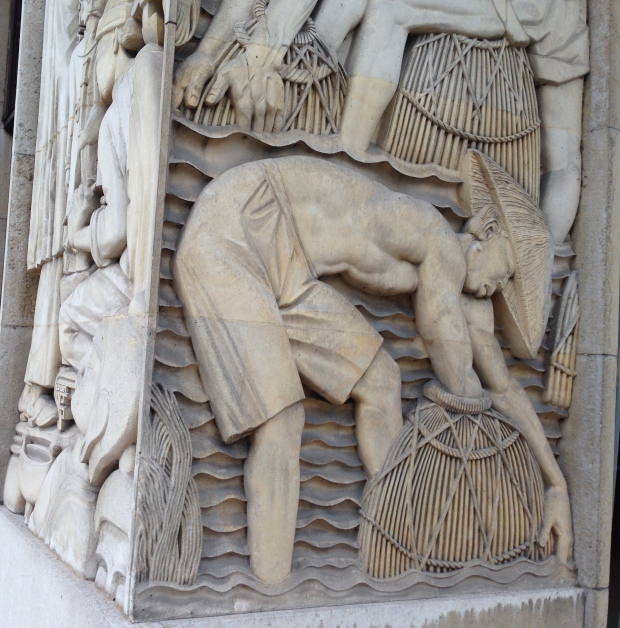
Bas-relief at The Centre for the History of Immigration, Paris

Bas-relief supposedly depicting immigrants’ experiences at the Centre for the History of Immigration. (CBC)

There are ways to do it all this better, writes Labadi. She points to the immigration museum called 19 Princelet Street in London.

There you’ll find overt attempts to put you into the shoes of someone who, for instance, must decide which three possessions — and only three — to take as he or she leaves home for a new beginning in a different country.

There are interactive experiments to uncover the submerged racism hidden inside us.

It’s a teaching museum in modern ways that its French counterpart is not.

On one wall of the National Centre for the History of Immigration in Paris there is text titled “Welcoming Land, Hostile France.”

It reads in part, “In every era, public opinion reinvents the image of the non-integrating foreigner.”

The familiar prejudices

It describes the familiar prejudices: “Too many foreigners, too many competitors for work, bringing disease, potentially delinquent, politically threatening, irreducibly different.”

But then it finishes: “Nowadays more and more people are opening up to diversity.”

Really?

That optimism seems misplaced at the moment. The anti-immigrant National Front party led by Marine Le Pen is on the rise in France.

Here and elsewhere in the Western world political leaders are trying to outbid each other on tough-minded and hard-hearted promises to push back against refugees.

A video by the anti-immigrant group Open Gates that talks of the forced collective suicide of European nations went viral in Europe a week ago before YouTube took it down.

And all that was before the attacks in Paris on Friday.

So if France’s National Centre for the History of Immigration is to help us imagine “what it’s like to be someone else” and discover “the essence of compassion and the beginning of morality,” then it is at best a well-intentioned failure and at worst, not even well-intentioned, just a failure.

Source: Immigration museum in Paris is harsh and honest but incomplete: Keith Boag – World – CBC News

Terrorism has come about in assimilationist France and also in multicultural Britain. Why is that? | Kenan Malik

Kenyan Malik contrasts Britain and France in their approaches to multiculturalism and integration, ending up, with slightly different wording, with Canadian integrative multiculturalism:

In the past, when London was seen as the capital of Islamism and of terror groups – Londonistan, many called it – French politicians and policy-makers suggested that Britain faced a particular problem because of its multicultural policies. Such policies, they claimed, were divisive, failing to create a common set of values or sense of nationhood. As a result, many Muslims were drawn towards Islamism and violence. “Assimilationist” policies, French politicians insisted, avoided the divisive consequences of multiculturalism and allowed every individual to be treated as a citizen, not as a member of a particular racial or cultural group.

So how do we account for the way that terrorism has been nurtured in assimilationist France too? And how different are French assimilationist and British multicultural policies?

Many of the French criticisms of multiculturalism were valid. British policy-makers welcomed diversity, but tried to manage it by putting people into ethnic and cultural boxes, defining individual needs and rights by virtue of the boxes into which people are put, and using those boxes to shape public policy. They treated minority communities as if each were a distinct, homogenous whole, each composed of people all speaking with a single voice, each defined by a singular view of culture and faith. The consequence has been the creation of a more fragmented, tribal society, which has nurtured Islamism. The irony, though, is that the French policies, from a very different starting point, have ended up at much the same place.

…. Yet, far from including North Africans as full citizens, French policy has tended to ignore the racism and discrimination they have faced and institutionalised their marginalisation. Many in France look upon its citizens of North African origins not as French but as “Arab” or as “Muslim”. But the second generation within North African communities are often as estranged from their parents’ cultures and mores, and from mainstream Islam, as they are from wider French society.

….Kouachi’s [responsible for the Charlie Hebo killings] story is not that different from that of Mohammad Sidique Khan, the leader of the 7/7 bombings in London. They are of a milieu caught not between two cultures, as it is often claimed, but between no cultures. As a consequence, some of them have turned to Islamism and a few have expressed their rage through jihadi-style violence.

There are aspects of both the multiculturalist and assimilationist approaches that are valuable. The multicultural acceptance of diversity and the assimilationist resolve to treat everyone as citizens, not as bearers of specific racial or cultural histories, are both welcome. And there are aspects of both that are damaging – the multiculturalist tendency to place minorities into ethnic and cultural boxes, the assimilationist attempt to create a common identity by institutionalising the differences of groups deemed not to belong.

An ideal policy would marry the beneficial aspects of the two approaches – celebrating diversity while treating everyone as citizens, rather than as simply belonging to particular communities. In practice, though, Britain and France have both institutionalised the more damaging features – Britain placing minorities into ethnic and cultural boxes, France attempting to create a common identity by treating those of North African origin as the Other. The consequence has been that in both Britain and France societies have become more fractured and tribal. And in both nations a space has been opened up for Islamism to grow.

Source: Terrorism has come about in assimilationist France and also in multicultural Britain. Why is that? | Kenan Malik | Comment is free | The Guardian

La laïcité à la française se cherche: Abdennour Bidar

Reflections on the French model of laïcité, of importance given its reflection is some Quebec discourse:

Beaucoup de Québécois vouent un culte quasi religieux à la laïcité à la française. Allons-y voir. Comment se porte-t-elle ? « Mal », répond Abdennour Bidar, lui-même pur produit de la république laïque, docteur en philosophie, enseignant (2004-2012), membre de l’Observatoire de la laïcité et chargé de mission pour la « pédagogie de la laïcité » à la direction de l’enseignement scolaire du ministère de l’Éducation nationale.

Mais encore ? « La laïcité en France se porte mal au sens où on ne trouve pas un consensus national sur la façon d’appliquer son principe, de telle sorte qu’il nous serve dans une société multiculturelle, qu’il prouve son efficacité à nous faire vivre ensemble, à la fois avec et au-delà de nos différences, autour d’un certain nombre de valeurs partagées. Il n’y a pas du tout consensus autour de cette question qui nous divise sans arrêt. »

M. Bidar était à Montréal la semaine dernière à l’invitation de l’organisme Pour les droits des femmes du Québec. Il a donné des conférences et participé à des débats dans le cadre du Festival du monde arabe, notamment sur le thème du blasphème, de la censure et de l’autocensure.

« Notre modèle est en crise, poursuit-il. On tient toujours au principe qui permet, selon la formule, à ceux qui croient au ciel et ceux qui n’y croient pas de vivre ensemble avec les mêmes droits et devoirs. Seulement, on n’arrive pas à l’appliquer et ça tire de tous les côtés. »

Pour lui, deux extrêmes « phagocytent » le champ du débat public. Il y a d’un côté les tenants d’une laïcité extrêmement dure qui voudraient chasser toute expression du religieux hors des espaces publics. De l’autre côté, il y a un certain nombre de mouvements religieux qui voudraient faire de la laïcité un principe de neutralité laissant s’exprimer dans l’espace public à peu près n’importe quelles revendications religieuses.

Résultat : la laïcité qu’il dit « équilibrée » se retrouve coincée entre les deux extrêmes. Cette option « ferait justice à l’unité et la multiplicité », selon la formule du philosophe. L’équilibre idéalisé reconnaîtrait le droit à la différence et se soucierait en même temps de fabriquer du commun.

N’est-ce pas l’option multi ou interculturaliste développée ici, au Canada et au Québec ? « C’est vraiment la recherche de l’équilibre qui m’importe, répond le Français. Je ne sais pas si ici vous y arrivez. Mais je peux dire qu’en France on n’y arrive pas du tout. Ce n’est pas seulement une question d’organisation spatiale, de ghettos ou pas. Est-ce qu’on vit vraiment les uns avec les autres ? Après Charlie [Hebdo], on s’est rendu compte qu’on n’arrivait plus à fabriquer du commun. »

Source: La laïcité à la française se cherche | Le Devoir

After attacks, France walks narrow line on Islam in schools

Secularism as religion – not providing pork alternatives:

This was the week that schoolchildren in one Paris suburb got a stark choice at the cafeteria: pork or nothing at all.

Chilly-Mazarin joined a handful of towns run by right-leaning mayors which have ended a practice of offering a substitute for students forbidden by their religion from eating pork.

The decisions have come amid increased discussions in France about its secularist ideals following the terror attacks in January that were blamed on French Islamic extremists — a discussion critics say has been hijacked by anti-Muslim forces on the far right.

On Wednesday, the Socialist government issued unusually direct criticism against the schools that have ended the pork substitutes as it was training dozens of appointees to mediate tense questions about the role of religion in schools and in public life.

In back-to-back speeches, the education and interior ministers walked the country’s increasingly narrow line on religion in schools, with the unspoken threat of Islamic extremism hovering over the auditorium in Paris’ tony 16th arrondissement.

Education Minister Najat Vallaud-Belkacem said teachers at schools have to impart the secularist ideal, but “not a secularism that is a declaration of war against a religion, as we see when a mayor here or there decides that in the name of a so-called secular ideal, children will be forced to eat pork or skip school lunch.”

France forbids “ostentatious” symbols of religion in schools and government buildings, a mandate generally interpreted to mean Muslim head scarves and one that includes parents who accompany school outings wearing them. Schools take seriously their mission to educate the next generation of secular French citizens, never more so than since the January terror attacks.

Source: After attacks, France walks narrow line on Islam in schools – US News

India, France and Secularism – The New York Times

Interesting comparison between Indian and French secularism by Sylvie Kauffmann:

Hindu fundamentalists have a more radical view of beef consumption and the slaughtering of cows. Some states, like Maharashtra, have banned the sale of beef, and calls for a national beef ban are growing. The fact that Muslims and Christians are traditional beef eaters is not an obstacle. The B.J.P.’s Tarun Vijay, expressing a more stringent interpretation of secularism on the opinion website Daily 0, sees “beef eating as a challenge to India, its public display as an act of bravado,” adding, “It is a political act that has nothing to do with culinary practice or religion.”

In both countries Muslim minorities complain about discrimination — and with reason. But while many French Muslims, who make up about 7.5 percent of the population, feel targeted by “laïcité,” Indian Muslims see secularism as their best protection. One important difference is that radicalization is an almost nonexistent phenomenon in Indian Islam, while it is a dangerous (but limited) trend among European Muslims. Only 30 Indian citizens are known to have joined the Islamic State so far, out of 176 million Muslims; in France, the number of home-grown jihadists is close to 2,000, out of 4 to 5 million. So while in France, fundamentalism comes from the Muslim minority, in India it comes from the Hindu majority.

India has been home to Muslims since the 8th century; Mughals ruled most of India and Pakistan 400 years ago. In contrast, Islam’s implantation in Europe is only a few decades old; France’s law on laïcité predates their arrival. Today, as minorities, Muslims feel vulnerable. In France, the January terrorist attacks against Charlie Hebdo and a Jewish supermarket deepened the malaise, as many Muslims stayed away from the #JeSuisCharlie movement. When 4 million French people took to the streets in support of freedom of expression right after the attacks, they assumed that French Muslims would make a point to be part of this show of unity. Only a small number did. For many of those who did not show up, laïcité has gone too far. Allowing cartoonists to make fun of religious figures, including their Prophet, may be a French tradition; it is not their idea of secularism.

In India, the threat against secularism goes even deeper, down to the values dear to its founding fathers, Gandhi and Nehru. “This is an India which is crying out for a Mahatma who puts compassion and tolerance above all else,” wrote the well-known journalist Rajdeep Sardesai after the recent attacks. An India that could rally behind #JeSuisIkhlaq.

Source: India, France and Secularism – The New York Times

An Immigrant in France – Updated Version of an American in Paris?: Mira Kamdar

Interesting account of the immigration process in France:

Most foreigners begin with a one-year permit. In principle, you are eligible for a 10-year permit after five years, and may also be eligible to apply for citizenship. In practice, many people must renew their residency permit every year, a humiliating exercise that makes it nearly impossible to do things that would actually help them integrate into French society, like getting a permanent job or applying for credit.

The real problem is France’s attitude toward immigrants. The populist right has whipped up hysteria with visions of the country being overrun by Muslims from former colonies. In fact, nearly half of all immigrants who arrived in France in 2012 were born in Europe.

In July, France’s National Assembly passed an immigration reform bill after much debate. The right argued it would open the floodgates. Immigrant defense groups said it did not go far enough, and posed new problems. The bill, which is expected to be considered by the Senate by year’s end, would create a multiyear residency card aimed at reducing lines and processing costs at the prefectures. It would allow illegal immigrants awaiting deportation to be assigned to a residence rather than a detention center.

The bill would also give the prefectures intrusive new powers to verify information about foreigners with the health care and employment administrations. Most immigrants in France are required to sign a “contract” pledging to learn French and the values of the republic. Under the bill, they could, depending on their progress, be given another multiyear permit, be bumped back to a one-year permit or be denied residency altogether. The bill would do nothing to guarantee access to the 10-year residency card employers and banks look for as proof of a long-term commitment to stay in France.

In June, my updated residency card finally in hand, I filled out the form to apply for a 10-year permit. Like all immigrants here, I know there are no guarantees.

Source: An Immigrant in France – The New York Times

10 chiffres qui vont vous surprendre sur l’immigration en France

Apologies for the capitalization but the original site had these all in caps and I couldn’t find an easy way to reformat.

Good and interesting data:

  1. CHAQUE ANNÉE EN MOYENNE, ENTRE 2004 ET 2012, 200 000 IMMIGRÉS SONT ENTRÉS EN FRANCE, SOIT MOINS QUE LA MOYENNE DES PAYS DE L’OCDE.
  2. 226 FILIÈRES D’IMMIGRATION CLANDESTINE ONT ÉTÉ DÉMANTELÉES EN 2014
  3. 63 % DES IMMIGRÉS ENTRÉS EN FRANCE EN 2012 SONT AU MOINS TITULAIRES D’UN DIPLÔME DE NIVEAU BACCALAURÉAT
  4. 40% DES IMMIGRÉS DE PLUS DE 16 ANS, NON ÉTUDIANTS, ENTRÉS EN FRANCE EN 2012, DÉCLARAIENT AVOIR UN EMPLOI L’ANNÉE DE LEUR ARRIVÉE.
  5. DANS L’ENSEIGNEMENT SUPÉRIEUR FRANÇAIS, 289 274 ÉTUDIANTS SONT DE NATIONALITÉ ÉTRANGÈRE (⅛)
  6. LE “PASSEPORT TALENTS” OUVRIRA UN DROIT AU SÉJOUR VALABLE JUSQU’À 4 ANS
  7. LA FRANCE A ENREGISTRÉ 64 310 DEMANDES D’ASILE EN 2014 (Germany 202,815).
  8. LA RÉFORME DE L’ASILE PERMETTRA DE RÉDUIRE LE DÉLAI D’EXAMEN DES DEMANDES À 9 MOIS (reduction from current 2 years)
  9. EN 2014, 105 613 PERSONNES ONT ACQUIS LA NATIONALITÉ FRANÇAISE.
  10. PRÈS D’UN IMMIGRÉ SUR DEUX ENTRÉ EN FRANCE EN 2012 EST NÉ DANS UN PAYS EUROPÉEN, contre trois sur dix dans un pays africain.

10 chiffres qui vont vous surprendre sur l’immigration en France | Gouvernement.fr.