US expat groups vow to continue fight to end citizenship-based tax regime, repeal FATCA

Despite the efforts, too small an interest group, and not domestically-based, to effect change to date:

After the US Senate voted early on Saturday morning to approve a version of a major tax reform bill that failed to include certain fiercely-fought-for changes that would have benefited expatriate Americans, spokespeople for some of the organisations that lobbied on behalf of these changes said they didn’t regard the battle as over – and that in any event, the fight would go on.

They also stressed that much had been achieved in terms of educating Americans at home and abroad to the issues, and organising and building groups that will continue to work for a change. Said Marylouise Serrato, executive director of the American Citizens Abroad, one of the organisations at the centre of the campaign: “Thanks to everyone’s efforts, the awareness and interest in the topic of residency-based/territorial taxation for Americans overseas is the highest its ever been.”

As reported,  the ACA, along with such other organisations as the Republicans Overseas, the Democrats Abroad, Americans for Tax Reform, the Heritage Foundation and a number of American chambers of commerce have fought hard for months to convince US lawmakers to do away with the current US system of citizenship-based taxation.

Some of these and others, including the Campaign to Repeal FATCA, and certain members of Congress such as Republican Senator Rand Paul of Kentucky, have been campaigning for the US to get rid of the Foreign Account Tax Compliance Act, which has made life difficult for expatriate Americans since it was signed into law by president Obama in 2010.

Saturday’s Senate vote saw 51 Republican lawmakers vote to approve the Senate version of the so-called Tax Cuts and Jobs Act, and 49 senators – all Democrats – voting against it.  Neither a proposal to replace the current citizenship-based tax regime nor one that would have called for the repeal  of FATCA was included in the version that was passed, even though, as reported, such key lawmakers as the Republican head of the House Ways and Means committee, Kevin Brady, had publicly indicated that Washington officials were taking “seriously” the call for a shift away from the citizenship-based income tax system.

via US expat groups vow to continue fight to end citizenship-based tax regime, repeal FATCA

A potentially historic number of people are giving up their U.S. citizenship – The Washington Post

More on the increasing number of American expats renouncing citizenship for tax reasons (FATCA), not Trump. Again, while the increase is dramatic, still small in relation to the number of expatriates (State department estimates between three and eight million):

It can be difficult to become a U.S. citizen. A lot of people put a large amount of time, effort and money into the process of gaining an American passport or, failing that, the right to permanent residency.

But to some people, U.S. citizenship can apparently be a burden. And it’s a burden that people seem to be shaking off in increasing numbers. This week, the Treasury Department released its quarterly list of individuals who had chosen to “expatriate” — i.e., renounced their U.S. citizenship or gave up their rights to permanent residence.

The list is notable for a couple of reasons. First off, Britain’s Foreign Secretary Boris Johnson is on it. This means that Johnson, a dual-national who was born in New York City, has finally renounced his citizenship (as he had long promised he would). Secondly — and far more importantly in the grand scheme of things — the list shows that Johnson is just one of a total 5,411 individuals to expatriate in 2016.

The number of people giving up their U.S. citizenship may in fact be higher. Ryan Dunn, a lawyer with Andrew Mitchel LLC, explained via email that his firm has suspicions that the lists released by Treasury are incomplete. However, this would not change the trend. America is seeing what is likely a historically high level of expatriation. And it seems only likely to rise further.

“Given that we’ve seen year-over-year increases in expatriation since 2012, we speculate that the trend will continue,” Dunn explained.

But why would anyone renounce their citizenship to the United States? Dunn said that in his firm’s experience, it wasn’t usually political. “We have not been contacted by anyone saying that they wanted to give up their citizenship because Trump won the election,” he said. Instead the motivation was simpler: money.

The United States is one of the only countries in the world that requires its citizens and permanent residents to file taxes even when they live abroad. Eritrea is the only other country to have a similar policy. This unusual policy a relic of the Civil War and the Revenue Act of 1862, which called for the taxing of U.S. citizens abroad — in part to punish men who fled the country to avoid joining the Union army.

This is no new policy — Americans abroad have always been covered by federal tax laws. However, things changed in 2010, when the Foreign Account Tax Compliance Act (FATCA) was enacted. This law essentially requires foreign financial institutions to check whether an account holder is a U.S. citizen or permanent resident. In some cases, Dunn said, they would ask for proof that the account holder is not a U.S. citizen.

The end result here is that whereas in the past a U.S. citizen abroad might be able to get away with not filing their U.S. taxes, that has become vastly less likely under these new circumstances. In some cases, this can be extremely costly: Johnson was known to have racked up a large U.S. tax bill for the sale of his home in London, even though he had not lived in Britain since he was a small child.

But even for those without Johnson’s wealth, it can be tricky. “FATCA is a dirty word to Americans abroad,” Peter Spiro, a Temple University law professor and the author of “At Home in Two Countries: The Past and Future of Dual Citizenship,” explained. “Think lots of extra forms that have to be filed even by citizens who aren’t wealthy by any standard. Americans abroad used to be able to do their taxes just like Americans at home. Now they have to hire expensive accountants.”

Giving up your citizenship isn’t necessarily cheap either. It can take a long time to get an appointment in some places, and the processing fee is around $2,350. More important, Dunn said, was the “exit tax” that some high-earning or high-net-worth individuals have to pay — and also some people who forget to file their forms correctly too. But evidently, for some people it’s worth it. (Green-card holders have a simpler and cheaper process.)

Source: A potentially historic number of people are giving up their U.S. citizenship – The Washington Post

Why Americans are giving up citizenship in record numbers – The Washington Post

Latest data:

And indeed, government statistics show record numbers of people are renouncing their U.S. citizenship. But it’s not Trump that has persuaded them to go. It’s taxes.

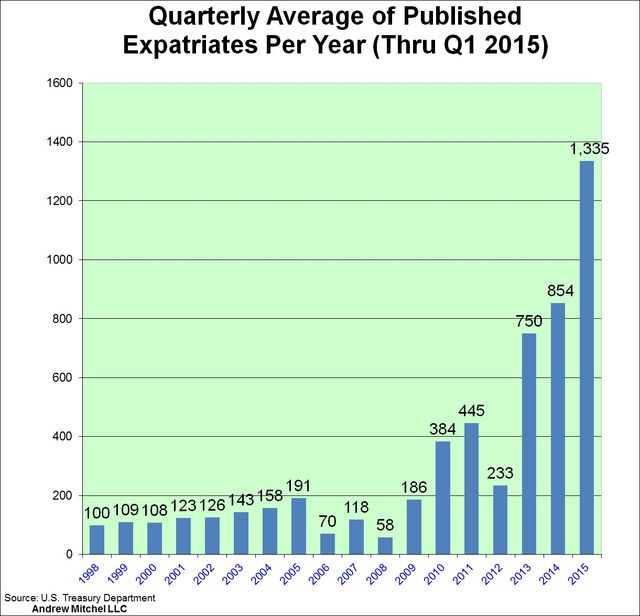
The IRS publishes the names of each American who gives up his or her citizenship. The list comes out every three months, and international tax lawyer Andrew Mitchel has tallied them up. In the first quarter of this year, 1,158 people expatriated — more than 10 times the number in the first quarter of 2008, when Mitchel began his count. Last year, a record 4,279 people renounced their citizenship.

Expatriations have grown steadily since 2008 but began to spike in 2013. That timing undermines the theory that Trump is responsible. (Back then, he was busy suing talk-show host and comedian Bill Maher for calling him the spawn of an orangutan.) But the increase dovetails with the implementation of new federal reporting requirements and penalties for assets held overseas by U.S. citizens.

The rules were passed back in 2010 as part of legislation intended to encourage businesses to hire more employees and jump-start the nation’s economic recovery. Attached to the law was a provision called the Foreign Account Tax Compliance Act (FATCA) that was supposed to “detect, deter and discourage” tax evasion through offshore bank accounts.

Source: Why Americans are giving up citizenship in record numbers – The Washington Post

Record Numbers Renounce Their U.S. Citizenship – Forbes

Virtually none of the reporting I have seen situates this increase in the context of the total number of American expatriates. Estimates vary between 2 and 7 million, meaning that the 4,300 expatriations are tiny in relation to the expatriate population, between 0.2 and 0.06 percent.

Notwithstanding this, Victoria Ferauge, whose blog The Franco-American Flophouse I highly recommend for her insightful posts on citizenship issues, notes that the small numbers do not mean that it is unimportant.

For American expatriates affected by FATCA, it is.

More broadly,given the wide attention placed on citizenship renunciation in American media, it appears to strike a chord with many Americans who wonder why any American would voluntarily renounce their citizenship.

The numbers are less important perhaps than the symbolism, and the implications of a more instrumental view of citizenship than American citizenship having an intrinsic value by itself:

Once again, the number of Americans renouncing U.S. citizenship has gone up, up 560% from its Bush administration high. In 2015, there were approximately 4,300 expatriations according to the published names of individuals who renounced. The name and shame list is published quarterly, with the most recent three-month total being 1,058. That brings the total to 4,279 for 2015.

These numbers seem tiny compared to the influx of immigrants. Yet expatriations have historically been much lower. Moreover, the published list is also incomplete, with many not counted. Surprisingly, no one seems to know exactly how big the real number is, even though the IRS and FBI both track Americans who renounce citizenship. There is no single explanation, though with global tax reporting and FATCA, the list of the individuals who renounce keeps increasing,

(Photo credit: Victor J. Blue/Bloomberg)

2014 was also a record year with 3,415 published expatriates. The reasons that Americans renouncing citizenship is at an all-time high can be over family, tax and legal complications. Dual citizenship isn’t always possible, as this infographic from MoveHub shows. Some countries make citizens pay a fee to hand in their passport. Some countries have no fee, but America’s $2,350 fee is more than twenty times the average level in other high-income countries.

Source: Record Numbers Renounce Their U.S. Citizenship – Forbes

The Franco-American Flophouse: US State Department Confirms the New Consular Fee for Expatriation

Victoria Ferauge on the explanation of the fee structure for renouncing US citizenship:

The US State Department has finally responded to those of us who took exception to the rather extraordinary rise in the fee to renounce US citizenship.  It now costs $2,350 USD for an American citizen to exercise his or right under international law to expatriate.

Does this fee constitute a barrier to exercising that right?  The State Department doesn’t think so.  I disagree and it’s not just the fee that’s the problem, it’s the entire process which is cumbersome, time-consuming and, yes, costly for everyone – renunciants and State Department alike.

A US citizen wishing to renounce or relinquish citizenship must travel to the nearest US consulate which may be in a city far from where he or she actually lives.  There can be more than one interview required which means multiple trips.   Some of the paperwork is complex enough it would be wise to consult a lawyer before filling them out and filing the tax and bank account declarations.   All of these things taken together can make paying that high consular fee another burden laid on top of the others that already exist.  The onus should be on the State Department to prove that these burdens placed before someone seeking to exercise the human right to expatriate are legitimate and necessary.

In the State Department response they offer their justifications for the fee raise and answer those of us who sent comments.  For this they have my thanks.  I and others have answered other agencies’ requests for comments on matters concerning Americans abroad, and never received the dignity of a reply.  I may not like the answers but I appreciate that they took the time.

State argues that there is no burden, no restrictions on the right to expatriate and there is nothing punitive about the fee raise.   It is, they say, a matter of money.

Rather, the fee is a cost-based user fee for consular services. Conforming to guidance from the Office of Management and Budget (OMB), federal agencies make every effort to ensure that each service provided to specific recipients is self-sustaining, charging fees that are sufficient to recover the full cost to the government.”

A perfectly reasonable argument if we were talking about something like, say, camping in a national park.  Not so reasonable when it concerns a fundamental human right guaranteed by national or international law.  It certainly costs money for US civilians and military to vote from abroad, but could we really argue that the FVAP and the local consulates should start charging overseas voters for providing services like the Federal Write-in Absentee Ballot?

That analogy is not perfect but the underlying principle is the same.  There are things that government does for which it has both a monopoly and a duty to provide services to its citizens in the exercise of their rights.  Voting is not just another service , and neither is expatriation.

My take on this is that there should be no fee for renunciations, relinquishments or requests for CLNs.  The first two concern a fundamental human right for which I contend cost should never be an issue.  As for the last, the CLN, this is a necessary document, the only one that exists to prove that one is no longer a US citizen and is often required by states that do not allow dual citizenship.

If that’s not possible then I’d propose an option to waive the fee if the renunciant can demonstrate that it would be a financial hardship to pay it.  That would be a very reasonable compromise and one that would be more consistent with what State claims is their goal:  protecting a US citizen’s right to expatriate.

Source: The Franco-American Flophouse: US State Department Confirms the New Consular Fee for Expatriation

Another Front in the Fight Against FATCA: The Alliance for the Defence of Canadian Sovereignty

Victoria Ferauge, who writes extensively about FATCA and its impact on US expatriates, provides an update on the lawsuit against the Government of Canada’s implementation of FATCA by the Alliance for the Defense of Canadian Sovereignty (ADCS):

The Foreign Account Tax Compliance Act is, in its own weird way, a kind of census.  Among other things, it tells the American government where those it considers to be taxable under US law live and work and raise families.

Having tried and failed miserably at conducting an accurate census of Americans abroad, the American government looked for other ways to find those “US Persons” (a term that includes US residents and Green Card holders, as well as US citizens).  Their method was delegation – an admission of failure in a sense – because FATCA requires foreign financial institutions (FFIs) to do what the US government couldn’t manage to accomplish on its own:  to seek out all US persons in the world: their names, addresses, and account balances.

Those of you who have already been FATCAed, know all too well what that means.  Those of you who have not yet signed a W-9 or had your accounts closed, please don’t feel left out, your time will come.

Americans abroad organizations like AARO, ACA, Democrats abroad and Republicans Overseas are fighting FATCA and you can read about their efforts here.

But I would be remiss if I did not mention other efforts which are equally important.  The one I have been following (and cheering on) is the other lawsuit filed in Canada by the Alliance for the Defense of Canadian Sovereignty (ADCS).

This is a grassroots initiative that pushes back against FATCA in Canada. ADCS argues that the Canadian legislation that implements the FATCA intergovernmental agreement with the United States “violates the Canadian Constitution, Canada’s Charter of Rights and Freedoms, the principles of Canadian sovereignty and democracy, and the fundamental rights of all Canadians.”

By signing an agreement to turn over the private information of Canadian citizens to a foreign government (the United States) the Canadian government is violating, they say, the rights of those whom the US is unilaterally claiming as taxable US Persons, but who consider themselves to be Canadians first and foremost.  They reject utterly the idea that another country can simply demand that Canada provide the private information of individuals who have some connection to the United States, however nebulous it may be.

The plaintiffs in the case are two Canadian women “who have never held a U.S. passport or developed any meaningful relationship with the U.S.” but who are, nonetheless, considered to be US citizens by virtue of being born in the US.”  They never consented to that citizenship and see no reason why it should be foisted on them now just because the US says so.

There are citizens in just about every country in the world right now who are in exactly the same position as the two plaintiffs:  people who thought they were “just French” living in France or “just Thai ” living in Thailand.  Many are finding out that they are indeed US Persons when they receive a note from their local banks informing them that they appear to be US citizens under US law.

I could not think of a worse way (or a worse source) for someone to learn that he or she might be a US citizen.  I find this not just shameful on the part of the US, but an extreme and worrisome delegation of sovereign power.  Foreign financial institutions should not be in any way arbiters of US citizenship or status, or be tasked with implementing a US extraterritorial national census of any sort for any purpose whatsoever.

Among the different fronts against FATCA, this is a very worthy effort because it asks a nation-state like Canada to take a stand:  Are these people claimed by the US really Canadian citizens with all the right enumerated in the Charter? Or has the Canadian government downgraded them to semi-citizenship status based on the claims of a foreign power?

Funded entirely by small donors, ADCS has miraculously raised enough money so far to hire very competent legal counsel, and on August 14, 2014 they filed their suit in Canadian Federal Court.  I back them 100% and have contributed even though I am not an “Accidental American” or even a dual.

The Franco-American Flophouse: Another Front in the Fight Against FATCA: The Alliance for the Defence of Canadian Sovereignty.

A Record Number of Americans Are Renouncing Their Citizenship

Expat-ExpressWhile the numbers are small, the trend is clear:

People giving up their nationality at U.S. embassies rose to 1,062 in the fourth quarter from 776 in the year-earlier period, according to Federal Register data. That’s the highest quarterly total since the second quarter of 2013, according to Bloomberg News calculations based on records starting in 1998.

The annual total reached 3,415 in 2014, from 3,000 in the year-earlier period, according to Federal Register data. The five highest totals have been recorded since the U.S. Congress passed the 2010 law.

There are an estimated 6 million U.S. citizens living abroad. More than 10,000 Americans living overseas have given up their passports over the past five years.

A Record Number of Americans Are Renouncing Their Citizenship – Bloomberg Business.

New Un-American Record: Renouncing U.S. Citizenship

FATCA Paris Meeting: Lee and Bopp: A Chance to Turn the Tide

Victoria Ferauge’s reporting on a FATCA meeting with American expatriates in Paris this week:

Bright and early Monday morning, Senator Mike Lee and superlawyer James Bopp, Jr. addressed a full house of frustrated and forlorn US citizens over at Reid Hall in Paris.  Some came in suits, some in jeans. There was a very young woman with blue streaks in her hair and men whose touches of gray were a testimonial to a lot of living.  There were lawyers, stay at home mothers, IT workers and artists.  A diverse group that was far more representative of the true face of Americans abroad than the usual caricatures of champagne-sipping yacht-owners living it up in Gay Paree.  It was coffee and croissants and a frank discussion that at times was fraught with emotion.

Senator Lee spoke first and he began with some anecdotes from the time when he was first elected to the Senate.  He’s a young man with a quiet and modest demeanour.  He recounted how in the very beginning he had moments where because of his youth and appearance he was taken for something other than a member of that august body, the US Senate, and how he finally had to quietly but firmly assert himself as the elected-by-the-people junior Senator from Utah.  He invited us to laugh with him and we did. But the funny stories took a very serious turn when he shared the lesson he drew from that experience: “We must assert what is rightfully ours,” he said, “if it is to have any meaning.”

US citizens wherever they live, he said, have constitutional rights that cannot be taken away by anyone.

The Franco-American Flophouse: Lee and Bopp: A Chance to Turn the Tide.

I was terrified we’d lose all our money: banks tell US customers they won’t work with Americans

Good profile on the American dual national expatriates being caught up by FATCA:

Angry Canadians are rare. But Patricia Moon qualifies. Until 2012, Moon was actually an American – albeit one who had lived in Canada for 32 years. She settled in so well that in 2008, she added Canadian citizenship to her US one.

But Moon cut ties with America three years ago, after new banking laws aimed at tax evaders required expats like her to file more thorough US tax returns. She was five years behind on the news. “I was terrified we’d lose all our money,” she says.

After back-filing years of tax returns, Moon renounced her US citizenship in 2012. It was a defiant act she describes as being one of the first canaries to leave the coalmine as US banking laws make life more difficult for American expatriates. She wasn’t pleased she had to do it.

“It was like cutting off my right arm,” to not be American any more, says Moon, who only became a Canadian citizen in 2008. “Now, I’m simply angry.”

….On a Skype call with a reporter, Victoria Ferauge sits in her sunlit Paris house, smoking the occasional cigarette, and following the day’s French Parliament session with particular interest. Ferauge, a Seattle-born American married to a Frenchman, has been following and blogging about US tax laws for the last three years.

On this Thursday afternoon, France’s parliament is voting to approve an inter-governmental agreement with the US on Fatca compliance.

“A vast majority of Americans suddenly woke up to what’s going on,” Verauge says. She relates stories of fellow expatriates who have had to take their names off joint accounts – some holding small family inheritances – because banks would not accept US customers.

“My bank will not answer questions,” she says about her enquiries regarding their Fatca compliance.

Verauge is preparing to move to Osaka, but she has doubts how the law will play out in Japan. She is infuriated to be put in the position of suddenly finding herself in a foreign country and not having a dollar she can spend.

“I will give up my citizenship if it came to that.”

I was terrified we’d lose all our money: banks tell US customers they won’t work with Americans | Money | theguardian.com.

FATCA/CBT: See You in Court

The Canadian angle:

Today, the Alliance for the Defence of Canadian Sovereignty ADCS-ADSC retained Jim Butera, a Washington D.C. attorney with Jones Walker LLP. Mr. Butera will explore legal options to reverse practices of the United States government preventing Canadian citizens who are “Accidental Americans” from freeing themselves of U.S. citizenship and obligations.

Accidental Americans include those born in the U.S. but who left the United States at a young age to live permanently in another country. Although they have no meaningful ties to the U.S., they are claimed as “U.S. citizens” and subject to lifetime taxation on their non-U.S. income. Accidental Americans not compliant with the Internal Revenue Service IRS are considered by the U.S. to be “tax cheats” not paying their “fair share”.

The Franco-American Flophouse: FATCA/CBT: See You in Court.