Thousands of stories are coming out of the country’s ethnic-language media — and only pockets of Canadians know anything about them.
More than 800 ethnic media outlets reach a range of distinct communities across this country, publishing and broadcasting in more than 30 major languages — including Mandarin, Punjabi, Farsi and Ukrainian.
It’s only rarely that the so-called mainstream English- and French-language media learns what issues are hot at such media outlets, given the barrier of language. But buried within the country’s proliferating ethnic-language media are potentially high-impact stories.
Since I write about diversity and migration, sources have helped me find other stories enclosed in Metro Vancouver’s ethnic-language media outlets, of which there are more than 100 in B.C. Some stories revealed, for instance, how local South Asians are in an uproar about a recent surge in foreign students, about how B.C.-based Iranians fear spies from their theocratic homeland and about how Canadian politicians frequently give speeches inside Chinese-language churches and Sikh gurdwaras.
Two well-placed Canadians, Andres Machalski, a veteran media monitoring specialist, Andrew Griffith, a former Immigration Department director, are doing the country a service by trying to make ethnic-media journalism more transparent to the public, bringing it out of its language silos.
They’ve just created the online tool, Diversityvotes.ca, to monitor and translate stories from Canada’s ethnic media, which Machalski says may be more pervasive in this country than almost anywhere. Diversityvotes.ca emphasizes articles with political implications, since politicians of every stripe already use ethnic media outlets to try to grab the precious votes of minority members and immigrants.
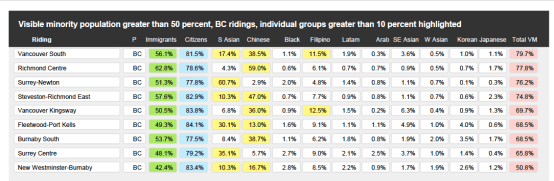
The electoral stakes are high. Canada has 41 federal ridings in which more than half the population is made up of people of colour. Metro Vancouver alone has four ridings in which more than 70 per cent of the population are people of colour, plus five more in which the proportion is above 50 per cent. They’re concentrated in Richmond, Vancouver, Surrey and Burnaby.
Winning as many high-immigrant ridings as possible in Metro Vancouver and Greater Toronto is key to national success for any federal party. And so far Justin Trudeau’s Liberals are doing the best at wooing such minorities, with a recent poll suggesting they’re primed to take 39 per cent of the votes of immigrants, compared to the Conservatives’ 29 per cent, NDP’s 14 per cent and Green’s nine.
Monitoring the ethnic-language media will be informative for all, regardless of ethnicity or place of birth, since Machalski is convinced most Canadians have no clue about the sway of the ethnic-language media. Keeping informed can also help expose when politicians speak out of both sides of their mouths, telling one ethnic group one thing and the general population something else.
That’s in part what happened this year when the mainstream media learned the Liberal candidate in the riding of Burnaby South, Karen Wang, was posting in Chinese-language social media that she was the “only” Chinese candidate, while her opponent, NDP leader Jagmeet Singh, was “of Indian descent.” Wang resigned and apologized.
Ethnic diversity has been formally celebrated in Canada for more than three decades, since former prime minister Pierre Trudeau promoted it through the official multiculturalism policy, said Machalski, president of Mirems, which created the online tool that each day translates many ethnic-media headlines and some specific articles. But the situation is increasingly, he said, becoming polarized.
“Is the ethnic media strong? Is it influential? In a country that’s bringing in 300,000 newcomers a year, what do you think? Just look at the demographics and make up your own opinion,” Machalski, an immigrant from Argentina whose ethnic background is Anglo-Polish, said from Toronto.
The Italian-language media in Canada, which has more than 25 different outlets, is full of stories about Trudeau promising to apologize for detaining 700 Italian-Canadians during the Second World War, Machalski said. It’s a huge issue for some Italian-Canadians, but off the radar of most others Canadians, he said, acknowledging an apology could be loaded for the families of thousands of Canadian loved ones who died or were wounded fighting Italian fascism.
Vancouver-based Blythe Irwin, who directs media monitoring for Diversityvotes.ca, said the feedback she gets is most Canadians have no idea that ethnic media has grown so pervasive across Canada, with 110 Punjabi-language alone media outlets alone. There are also more than 100 various Chinese-language outlets, 62 in Spanish, 31 in Farsi, 29 in Arabic, 24 in Russian, 16 in Hindi, 12 in Greek, 12 in Polish and three in German.
The more that all Canadians can learn about what’s being prioritized in ethnic-language media, the more they will understand the diverse political forces at play in this fast-changing country. Machalski is onto something when he says, “We have to vaccinate the public against political gullibility.” Canadians in general, he said, are wet behind the ears in the way that they think: “If I can’t read it, it doesn’t exist.”
Given my work with MIREMS matching riding-level data with ethnic media election coverage (diversityvotes.ca), found this article regarding Australia of interest. Did a quick check on the Canadian Heritage site for information on the situation in Canada, where it appears that the main source would likely be the Canada Periodical Fund:
The fact that the community ethnic and multicultural broadcasting sector didn’t receive additional funding in the latest budget reflects a misunderstanding of the important role of ethnic media in Australian society.
Ethnic print and broadcasting have a long history in Australia, dating back to at least 1848 with the publication of Die Deutsche Post.
Early foreign language broadcasting featured on commercial radio in the 1930s, and throughout the middle of the 20th century. This was before the boom days of the 1970s, when both the Special Broadcasting Service (SBS) and community radio were firmly established.
Today, along with SBS, more than 100 community radio stations feature content in over 100 languages. There are also ethnic media organisations that broadcast or print content in English.
How ethnic media are funded
Much like mainstream print, ethnic newspapers receive little if any direct government funding. They rely on advertising dollars, as well as occasional small grants.
Ethnic broadcasting is primarily funded through two streams:
government funding of SBS
funding of community ethnic broadcasters through the Community Broadcasting Foundation (CBF), which is itself funded federally.
According to the peak body of ethnic community broadcasting in Australia, the National Ethnic and Multicultural Broadcasters’ Council (NEMBC), an annual indexation freeze in funding introduced by the Liberal government in 2013 has cost the sector almost A$1 million. That’s approximately 20% of their total support.
A significant fund of A$12 million over four years has been granted to the community broadcasting sector. But this is generalist funding rather than aimed at ethnic broadcasting specifically. It’s directed towards assisting community stations to transition to a digital signal, the production of local news in English, and management training.
The NEMBC is also in its third year of a new competitive grants process introduced by the Community Broadcasting Foundation.
According to the NEMBC, many ethnic broadcasters are facing a precarious funding environment. This is due to the lack of specialist funding, the costs associated with transitioning to digital broadcasting, and the complexity of the Community Broadcasting Foundation grants process.
Why it’s important
The difficulties facing ethnic broadcasting impact the unique contribution it can make to modern Australia. And it’s a problem that extends beyond policy – media funding for public service, community and ethnic broadcasting is regularly under siege. It’s also a broader social issue.
Ethnic media are often thought of as either quaint services for nostalgic migrants, or as dangerous sources of ethnic segregation. For many, the role of ethnic media rarely, if ever, extends beyond a specific cultural, ethnic or linguistic community.
What’s missing from this image is the role of ethnic media in facilitating successful migrant settlement. Research shows that ethnic media can facilitate feelings of belonging and social participation among first and subsequent generation migrants. Ethnic media connect migrants and culturally and linguistically diverse Australians with other social groups, as well as with their own local communities.
On a more practical level, ethnic media are important sources of information. When advice is needed on a range of issues, from health care services to migration law, ethnic media play a vital role.
This is not a case of migrants staying in their linguistic “ghettos” and building separate ethnic economies. Rather, it involves seeking sources of relevant, and culturally and linguistically appropriate, information in order to live and thrive in Australian society.
That might be providing advice on voting or taxation to migrants from Sudan. Or informing elderly German migrants of changes to aged care services. Ethnic media provide information that is attuned to the particular needs of their audience.
This is a service that mainstream media are largely unable to provide, with their focus on a broad audience. But without it, migrants potentially miss out on important information.
These are also services that benefit both recent migrant groups, such as those from Africa or the Middle East, and more established communities. For elderly Germans in South Australia, information today comes in the form of German broadcasting in Adelaide, with presenters and producers who understand the needs and histories of their audience.
Essential sources of vital information
Ethnic media may also be valuable allies to relevant government departments and settlement service providers. My own ongoing work with ethnic broadcasters and community leaders indicates a level of dissatisfaction with the way government services are communicated to migrant groups from non-English speaking backgrounds.
Ethnic broadcasting is often able to capture the subtleties and nuances that one-size-fits-all government communication campaigns cannot. They are therefore in a unique position to effectively communicate government initiatives at a local, state and national level.
It is no surprise that what would become SBS Radio was originally designed to inform migrants about the introduction of Medibank health insurance scheme.
It’s important that the services provided by the ethnic media sector, particularly those that cannot be measured in purely economic terms, are understood and supported.
Ivy Li worries that the Chinese Communist Party might be able to affect the outcome of Canada’s fall election using a campaign of disinformation and by silencing critics.
Li is not alone. Li helped organize a recent dialogue that featured Jonathan Manthorpe, author of the best-selling book, The Claws of the Panda: Beijing’s Campaign of Influence and Intimidation in Canada, where she and others talked about their fears and experiences.
In his book, Manthorpe — the former Vancouver Sun Asia correspondent and foreign affairs columnist — writes that Canada has become “a battleground on which the Chinese Communist Party seeks to terrorize, humiliate and neuter its opponents.”
It is “a war of intimidation and harassment” that seeks to smother, silence or discredit dissenters, especially those from “the Five Poisonous Groups — advocates of independence for Tibet, Xinjiang and Taiwan, promoters of democracy in China, and adherents of Falun Gong.”
Manthorpe documents how Chinese-language publications in Canada have muzzled and fired journalists and how wealthy Chinese-Canadians with business ties to China and organizations linked to the Chinese government’s United Front have been involved with candidates from various parties in past elections.
Perhaps unsurprisingly, there wasn’t a single journalist from the Chinese-language media at the speaking event organized by Friends of Hong Kong and the Vancouver Society in Support of Democratic Movement.
Only one Chinese media representative responded to organizer Fenella Sung’s invitation. But that journalist declined to come. Why? The journalist was leaving soon for China.
Sung noted that the challenges faced by Chinese-Canadians are real because of family and business ties that they may have to China and the fact that the communist party and the Chinese government regard the overseas diaspora as a bloc.
But she said, “We are in Canada. We don’t have to abide by community norms. Here, it’s okay and normal to think differently. … We have to stick to our own values and principles.”
Yet, as both Manthorpe and Reporters Sans Frontieres note, the Chinese government has made substantial investments in international TV broadcasting, foreign media outlets, advertising, and junkets for foreign journalists and politicians. It has embedded the Confucius Institute in schools and universities.
As for social media, the Reporters Sans Frontieres report calls it the new battleground where disinformation is spread by an army of paid and unpaid trolls on the government-linked messaging service WeChat and on micro-blogging sites.
While disinformation campaigns have mainly been directed at Taiwan and Singapore, Reporters Sans Frontieres says WeChat is increasingly being used to spread fake news in Canada and the United States.
In Canada, WeChat initially censored news of the December arrest of Huawei executive Meng Wanzhou in Vancouver pending extradition to the United States on fraud charges.
The report says the Chinese government’s expansion into media “poses a direct threat not only to the media but also to democracies.” It goes on to say that unless democracies resist, Chinese citizens will lose all hope of ever seeing press freedom in their country.
And it warns, “Chinese-style propaganda will increasingly compete with journalism outside China, thereby threatening the ability of citizens everywhere to freely choose their destiny.”
Li echoed those fears.
“We can’t succumb to intimidation,” she said. “The more we do it — especially those who are in the Chinese-Canadian media — the more we play into the hands of the (Chinese Communist Party). If we toe the line, we become silent partners of the (party).”
Others spoke about being torn between the country they have chosen and the country where they were born. They talked about fearing reprisals against family they have left behind or the businesses they are running, if they are critical of the Chinese government.
As one of the organizers, Li spoke last. She urged Chinese-Canadians to speak up in support of non-Chinese critics when Chinese officials and their supporters try to silence them with accusations of racism.
In December, China’s ambassador in Ottawa, Lu Shaye, accused Canada and Canadians of “white supremacy” in response to Ottawa’s request for the release of two Canadians detained without charges and held in an unknown location in retaliation for Meng’s arrest.
It was intended as a slap in the face to all Canadians. Instead, it serves as an ironic reminder that everyone in this country has the right to speak openly and critically without fear of reprisal, even if they don’t have diplomatic immunity.
Freedom and democracy is why Li chose Canada and why she urged Chinese-Canadians to be “the leading force to counter (Chinese Communist Party) campaigns of influence and intimidation.”
“Are we protecting the things that we came here for? That’s our responsibility as immigrants,” she said. “Because if we endanger those things, it’s not fair to Canada. And it’s not fair to ourselves.”
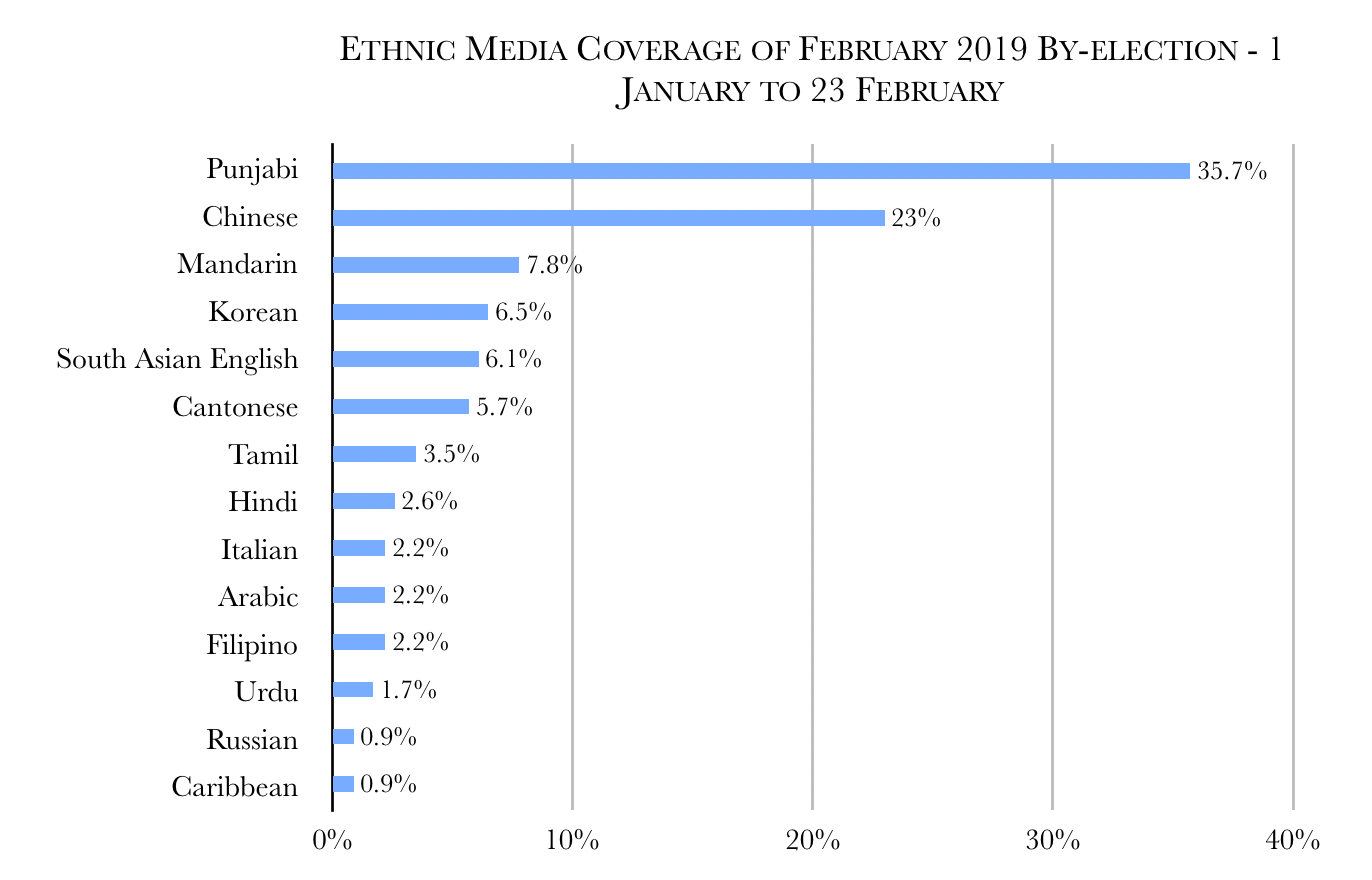
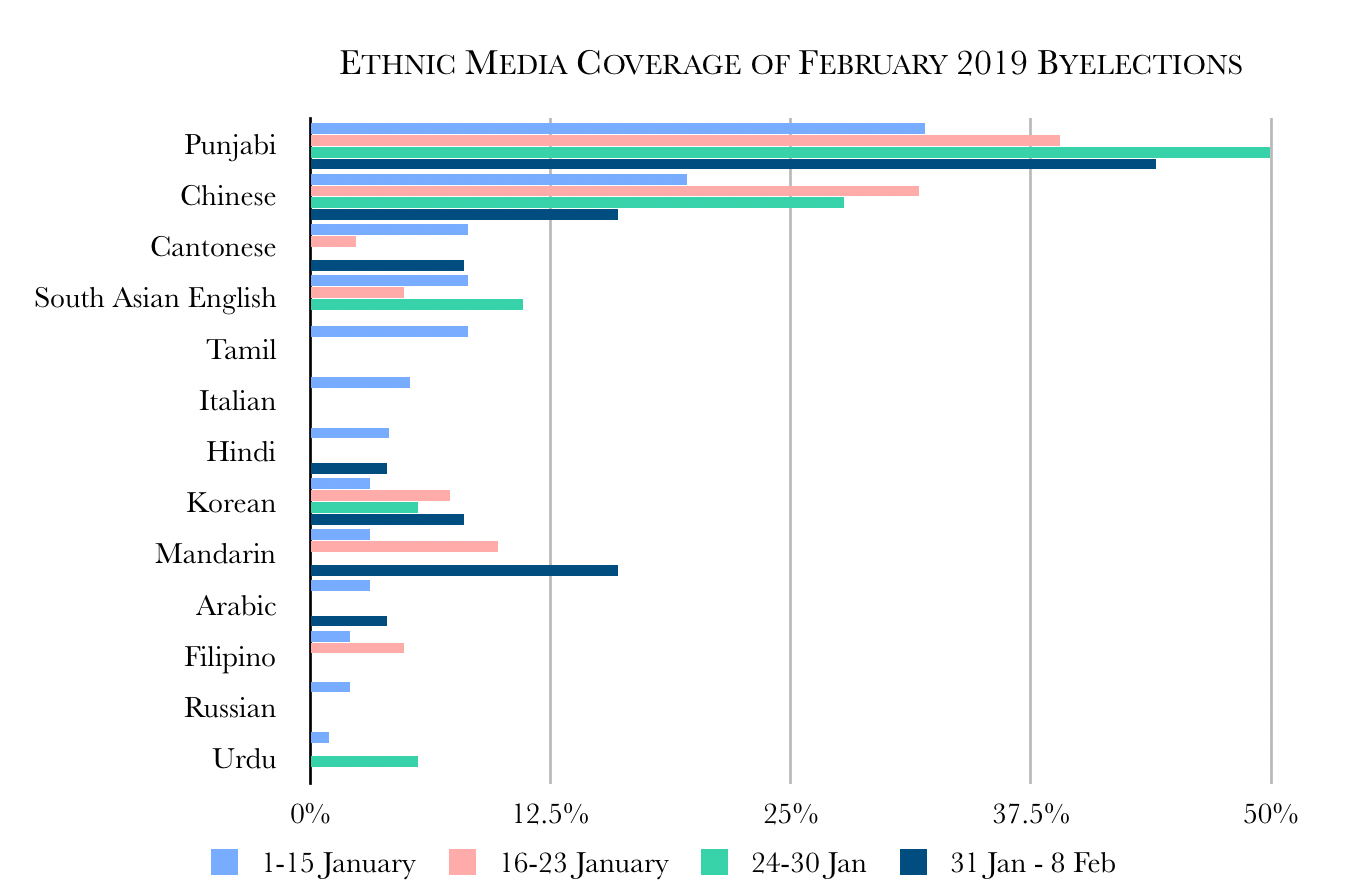
Note: While Chinese in the chart of ethnic media coverage refers to written media, Cantonese and Mandarin to broadcast oral media, I generally summarize all three as Chinese media except where indicated.
Ethnic Media Coverage
All articles focussed on Burnaby South. Overall, coverage remained stable at 25 articles The chart below shows the by-election coverage by language from the start of the year.
During the past week, Chinese (44 percent) and Punjabi (28 percent) media continued to comprise the majority of ethnic media coverage of the by-elections, with more articles in Korean media (16 percent) than in previous weeks.
Most stories focussed on NDP leader Singh’s campaign (7 articles, many focussing on his call for a public enquiry regarding the pressure placed on former Justice minister Wilson-Raybould regarding the SNC Lavalin case), PM Trudeau’s visit (6 articles) with Peoples Party of Canada leader Bernier’s visit also covered (2 articles in Mandarin media only).
Stories of note included the dispute between PPC candidate Tyler Thompson and Conservative candidate Jay Shin regarding the PPC’s position on cannabis legislation (Chinese), the Conservative fundraiser in which he noted his challenge of wanting to be the first MP of Korean origin to be elected (Korean), the resignation of the NDP’s national communications director (Punjabi) and the lawsuit against the PPC against its use of the PPC name (Punjabi).
Two commentaries in Punjabi media focussed on the possible fall-out of the SNC Lavalin scandal, noting that recent polls had shown a decline for the Liberals. One commentary in Chinese media noted support for the PPC among Chinese Canadians, particularly regarding sex education, and that while the Conservative party appeared favoured to win the national election, Burnaby South Conservative candidate Shin had “almost no interaction” with the local community.
See the MIREMS blog for some of the stories being covered: MIREMS blog.
Note: While Chinese in the chart of ethnic media coverage refers to written media, Cantonese and Mandarin to broadcast oral media, I generally summarize all three as Chinese media except where indicated.
Ethnic Media Coverage
The ongoing focus on Burnaby South continued, with more articles commenting on the risks toJagmeet Singh’s leadership of the NDP should he not win the by-election in both Punjabi and Chinese (Chinese, Cantonese and Mandarin) media. Overall, coverage increased slightly to 25 articles compared to 18 the previous week (earlier weeks had 41 and 97 articles) .
Media coverage was roughly evenly split between Punjabi (44 percent) and 40 percent in Chinese media.
In addition to the risks to Jagmeet Singh’s leadership, NDP fund-raising difficulties were covered as well as the Party’s poor prospects in Outremont based on polling data in Punjabi media. Singh’s universal pharmacare plan received coverage but was largely drowned out by stories concerning the risks to his leadership.
Stories covered in Chinese media included the risks to Singh’s leadership, that former Liberal candidate Karen Wang would not run as an independent (and noting her pregnancy), the visit of Andrew Scheer and his criticism of how the Liberals have handled the dispute with China over the requested extradition of Huawei executive Meng Wanzhou, and that NDP leader Singh appeared to be in the dark regarding the change in his caucus’s position on the legitimacy of Venezualan leader Maduro.
The all candidates meeting for Burnaby South was covered in both Punjabi and Chinese media, with the latter noting the “fiery debate.”
Korean media coverage focussed on the visit to Burnaby South of Conservative leader Scheer and the formal launch of Conservative candidate Jay Shin, who is of Korean descent. Scheer’s visit was also covered in Chinese media but curiously not in Punjabi or South Asian English media. An article in Arabic media focussed on the importance of Outremont to both Liberals and the NDP, as well as Quebec ridings overall to the Liberal re-election plans.
Five commentary pieces in Punjabi media appeared this past week. Three of these focussed on the electoral prospects of Singh and the NDP, with two highlighting the risks to his leadership and the generally poor prospects of the NDP. One noted that Singh’s prospects had improved given the controversial remarks of former Liberal candidate Karen Wang while another one criticized those who circulate fake news and rumours regarding Singh. Tarek Fatah’s previously published critique of ethnic voting (The Bankruptcy of Ethnic Vote Banks) was reprinted in English in the Punjabi media.
In general election coverage, the government’s announcement of measures to reduce foreign interference in the federal election continued to receive considerable coverage. Other stories of interest included former NDP leader Mulcair’s comments regarding the possible shift of NDP voters to the Green Party, and questions surrounding the controversial $300,000 fundraiser by Brampton area MP Raj Grewal in both Punjabi and Chinese media. Cantonese media covered the Conservative plans to assist candidates in their communication skills.
See the MIREMS blog for some of the stories being covered: MIREMS blog.
The absence of controversy in Burnaby South following previous weeks resulted in fewer articles in the ethnic media, with again the focus being on Burnaby South, with only 18 articles compared to 41 and 97 in previous weeks .
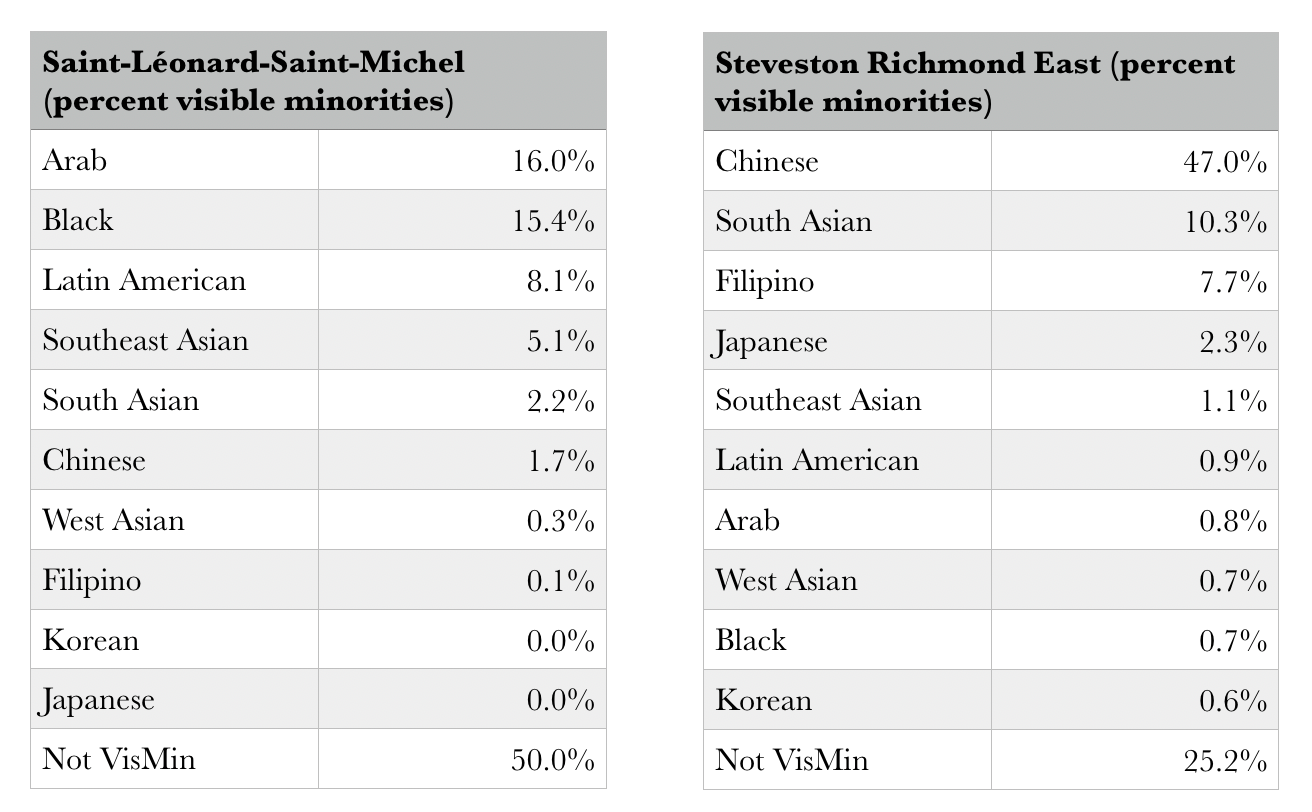
Media coverage was overwhelmingly in Punjabi (50 percent) and 27.8 percent in Chinese, Cantonese and Mandarin language media. Punjabi media covered the belated resignation of Liberal MP Di Iorio (Saint-Léonard-Saint-Michel). Chinese media covered the opening of the campaign office of PPC candidate Laura-Lynn Thompson and the nomination of James Seale in Outremont.
NDP leader and candidate Singh’s focus on affordable housing received widespread coverage in Punjabi media and was the focus of the one article in Korean media, with no coverage in Chinese media. The one article in Urdu media referenced immigration as an issue given Singh’s pledge to end the Safe Third Country Agreement with the USA and the number of asylum seekers.
In terms of commentary (including analysis and opinion pieces), Punjabi and South Asian English media predominated with two items apiece and Chinese one.
Three pieces were neutral in tone while an editorial in Punjabi media was sharply critical of “cheap minority politics and the cry for Canadian values.” In Chinese media, one commentary accused the mainstream media of “deliberately alienating ethnic groups from each other” in terms of how they characterized criticism of former Liberal candidate Karen Wang’s divisive remarks on WeChat.
In general election coverage, the government’s announcement of measures to reduce foreign interference in the federal election received widespread coverage in virtually all languages.
Other stories include the PPC having raised $300,000 was covered in Gujarati media and former Liberal candidate Wendy Yuan having “jumped ship” to seek the nomination for the Conservatives in Steveston Richmond East (she had previously run for the Liberals in Vancouver Kingsway in 2008 and 2001 and had sought the nomination in Steveston Richmond East in 2015).
See the MIREMS blog for some of the stories being covered: MIREMS blog.
In contrast to coverage in the previous weeks, which included coverage of the general by-election announcement by more different language ethnic media, the past week was almost exclusively focused on Burnaby South and the ongoing controversy over the divisive remarks by former Liberal candidate Wang and overall issues related targeting ethnic votes, with only 41 media items compared to the 97 earlier in the month.
Media coverage was overwhelmingly in Punjabi (39 percent) and 43.9 percent in Chinese, Cantonese and Mandarin language media. There was only one tangential media reference to Outremont in the context of NDP prospects.
The focus of candidate specific coverage was former Liberal candidate Wang and her efforts (unsuccessful) to distance herself from her comments on WeChat that basically said vote for the Chinese Canadian candidate, not the Indo-Canadian candidate. Conservative immigration critic Michelle Rempel’s revealing that Wang had sought being nominated and being rejected as a Conservative candidate was covered, as were Rempel’s press conference criticizing the Liberal government immigration record, including her statement that poor vetting had resulted in the killing of Burnaby teen Marrisa Shen by a Syrian refugee (charged, not yet convicted). The announcement of Wang’s replacement, Richard Lee, a former provincial politician was covered in summary fashion.
While NDP leader Singh’s housing, immigration (withdrawal from the Safe Third Country Agreement with the US)and other policy proposals were covered, there was still some lingering coverage of his apparent unawareness of the implications of the Canadians detained in China in retaliation for the extradition proceedings against Huawei executive Meng Wanzhou.
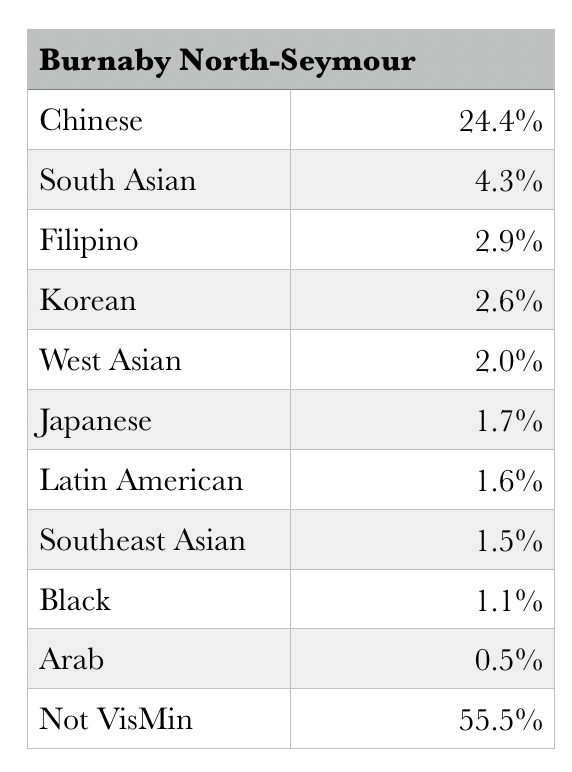
Svend Robinson’s nomination as the NDP candidate for Burnaby North-Seymour after an 11 year absence was covered in Chinese media (the largest visible minority group in the riding).
In terms of commentary (including analysis and opinion pieces), Punjabi media predominated with seven items and Chinese three.
While most of these were neutral in tone, there were three critical pieces. Two of these were in Chinese media, which were highly critical of Wang and how ethnic politics was playing out among Chinese Canadians, and one in Punjabi media, making similar points with respect to Canadian Sikhs. There was one more positive piece on ethnic politics, noting that all candidates seek support from their ethnic group and that the Wang controversy was“not a big deal.”
Related issues such as the ongoing dispute between Canada and China over the extradition request of Huawei executive Meng Wanzhou and the inappropriate comments regarding her possible extradition by Canada’s now former ambassador to China have not seen much by-election related coverage but are being covered by ethnic media separately.
See the MIREMS blog for some of the stories being covered: MIREMS blog.
As some of you may be aware, I have been working through census data to develop profiles of all 338 federal ridings that focus on key demographic, economic, social and political indicators.
I have beenworking with Canada’s multilingual media monitoring service, MIREMS (www.mirems.com) to test out matching their ethnic media coverage with the census data.
The current by-elections provide an ideal opportunity to test out this approach and to assess how useful this could be for this year’s October 19th general election.
Table 1 contrasts some of the key indicators for the three ridings, two urban and one rural. Burnaby South has the greatest number of immigrants and visible minorities, York Simcoe the least, with Outremont in the middle. None of these ridings have a significant Indigenous population. Outremont has the youngest population with the least number of married or common law relationships and the lowest average household size.
York Simcoe, given its lower number of immigrants, has the highest number of citizens of voting age.
Outremont has the highest number of men and women with university degrees, York Simcoe the lowest. Unemployment rates for men and women are highest in Outremont. Median total annual income is highest for men in York Simcoe and lowest in Outremont; for women, it is also highest in York Simcoe but lowest in Burnaby South. The percentage of low income individuals (Low income measure after tax) is lowest in York Simcoe and highest in Outremont for both men and women.
Burnaby South and Outremont elected NDP MPs in 2015, York Simcoe a Conservative.
The language most often spoken at home, the indicator that correlates most closely with ethnic media readership, is captured in Table 2. Predominate non-official languages are Mandarin and Cantonese (about 25 percent) whereas Outremont and York Simcoe have few non-official languages most often spoken at home.
Ethnic Media
As one would expect, Chinese and South Asian media dominate in the by-election coveragegiven riding demographics, mainly Chinese Canadians, and the highly visible candidacy of NDP leader Jagmeet Singh. The ill-advised remarks of former Liberal candidate Karen Wang, her forced resignation and replacement by Richard Lee have further increased the riding visibility.
As a result, of the 97 media articles monitored 1 to 18 January, one third of ethnic media coverage is in Punjabi, with an additional 8 percent in the South Asian English media. Written Chinese media forms one fifth, with radio and TV in Cantonese forming 8 percent and in Mandarin, three percent.
In terms of candidate specific coverage, NDP leader Singh was covered in about two-thirds of the media, with many articles focussed almost exclusively on his campaign and related challenges (e.g., his inability to answer questions regarding the detention of Canadians in China). His Liberal and Conservative opponents were only mentioned in about 15 percent of media, with of course the controversy over former Liberal candidate Wang’s divisive remarks being mentioned. PPC candidate Tyler Thompson was mentioned by close to six percent.
There was only one article (reprint really of her website bio) focussed on Outremont, a profile of Liberal candidate Rachel Bendayan in Arabic, with no coverage of the Conservative and NDP candidates (Jasmine Louras and Julia Sanchez respectively). Outremont has a significant Jewish population (11 percent in 2011). Bendayan is Jewish (likely Sephardic given her surname) as appears is Louras. Overall voting preferences of Canadian Jews have shifted from Liberal to Conservative reflecting the previous government’s focus on combatting antisemitism and a more overt pro-Israel policy.
Basic news reporting and reprinting of mainstream media news article form the majority of ethnic media articles. However, close to 40 percent of the Punjabi and South Asian English, and about 13 percent of the Tamil mediamedia are commentary. Only Punjabi talk shows featured by-election coverage (Burnaby South).
Out of the 16 commentaries analyzed, 12 were in Punjabi, three in South Asian English and one in the Tamil media. For the most part, these were more in the form of neutral analysis than presenting opinions. Only three commentaries expressed opinions. All were negative, two were in the Punjabi media (NDP leader Singh’s ignorance of China’s arrest of Canadians in relation for the extradition case of Huawei executive Meng Wanzhou, former Liberal candidate Wang’s divisive ethnic appeal on social media) and one in the South Asian English media (the same critique of NDP leader Singh).
Next week will likely feature more commentary on ethnic politics given the debate is has provoked among many Canadians, including those in the language groups covered.
In related election coverage, the Supreme Court of Canada’s striking down the five-year limit for Canadian expatriate voting received coverage, particularly in Cantonese, Chinese and Mandarin media but also with significant coverage in Tamil media.
MIREMS, Multilingual International Research and Ethnic Media Services, kindly shared what they are picking up on birth tourism in the ethnic media:
Study shows birth tourism much more prevalent in Canada than reported by StatsCan – Cantonese
Description: A new study shows that the number of births in Canada to non-residents, known as “birth tourism,” is much higher than previously reported by Statistics Canada. The study was done by Andrew Griffith for Policy Options, a policy think tank. It was found that the level of birth tourism nationally in Canada is at least five times greater than the 313 births recorded by Statistics Canada in 2016, sitting at 3,223. Immigration Minister Ahmed Hussen said they will look into the number of people coming into Canada to give birth and will investigate “immoral birth consulting services.” Conservative Leader Andrew Scheer said at the time one of the goals would be to end the practice of women coming to Canada simply to give birth to a child who will automatically have Canadian citizenship.
TV – Fairchild TV Ontario (400000 – Daily7) – Toronto, 23/11/2018 – News, 1 – 2 min, 02/05, Cantonese
Federal government to investigate impact of “maternity tourism” on the country – Chinese
Description: Based on the figures from the Canadian Institute for Health Information (CIHI), researcher Andrew Griffith found that in 2016, there were 3,200 babies born to “maternity tourism” mothers in Canada; that number is 9 times higher than the 313 babies recorded by Statistics Canada. Immigration Minister Ahmed Hussen said that his department has commissioned CIHI to conduct a study to fully understand the extent of the impact of maternity tourism on Canada.
WEB – Ming Pao Toronto (227000 – Daily7) – Toronto, 23/11/2018 – NEWS, 3/4 page web, 2nd, Chinese
Ottawa probes birth tourism as new data shows higher non-resident birth rates – Punjabi
Description: With new research showing that more babies are born in Canada to foreign residents than Statistics Canada realized, the federal government is studying the issue of “birth tourism” in the hope of better understanding how many women travel to Canada to have babies who are born Canadian citizens. Using numbers from the Canadian Institute for Health Information (CIHI), which captures billing information directly from hospitals, researcher Andrew Griffith found over 3,200 babies were born here to women who weren’t Canadian residents in 2016. Ontario immigration lawyer Gordon Scott Campbell said he’s had several clients in recent years who have given birth while in Canada while in the middle of legitimate refugee or immigration processes. For example, he said some women with visitor status live with their spouses while applying for spousal sponsorship, and some refugees arrive pregnant or become pregnant while waiting for their claims to be processed. But it doesn’t mean that birth tourism is a widespread practice, Campbell added. Immigration Minister Ahmed Hussen responded by saying his department has commissioned research to get a better picture of the scope of the issue in Canada.
RADIO – Red FM 106.7 Good Morning Calgary (Daily5) – Calgary, 23/11/2018 – News, 1-2 mins, 12/14, Punjabi
Tendance à la hausse au pays pour le tourisme de naissance – Haitian
Description: François Jean Denis – Une nouvelle étude démontre que plus de bébés sont nés au Canada d’une mère vivant à l’étranger que ne le croyait Statistique Canada. Les statistiques affichent une hausse croissante du nombre et du pourcentage de ce genre de naissances dans toutes les provinces, sauf au Québec. Le gouvernement fédéral étudie ce qu’il appelle le « tourisme de naissance » dans l’objectif d’avoir une idée plus précise du nombre de femmes qui voyagent au Canada pour avoir des bébés qui naissent citoyens canadiens. Le chercheur Andrew Griffith a utilisé des données de l’Institut canadien d’information sur la santé (ICIS) qui obtient des informations de facturation directement des hôpitaux. Elles ont révélé qu’en 2016, plus de 3200 bébés étaient nés ici de femmes qui n’étaient pas résidantes canadiennes, comparativement aux 313 bébés enregistrés par Statistique Canada. Ces femmes viennent au Canada pour donne la citoyenneté canadienne à leurs enfants. La découverte suggère non seulement que le nombre est 10 fois plus élevé que celui précédemment rapporté, mais que c’est une tendance à la hausse, selon M. Griffith. Le député libéral Joe Peschisolido a récemment déposé à la Chambre des communes une pétition appelant le Canada à prendre des mesures plus énergiques pour mettre fin au tourisme de naissance, affirmant qu’il porte atteinte au système de protection sociale du Canada. Est-ce que cela va remettre en question le droit du sol ? Désormais, plusieurs pays ont mis au point ou modifié leurs lois sur le droit de naissance, notamment le Royaume-Uni, l’Australie, l’Irlande, la Nouvelle-Zélande, l’Inde, la République dominicaine, la Thaïlande et le Portugal. Auparavant, des femmes venaient au Canada et partaient sans payer les frais d’hospitalisation. Aujourd’hui, les hôpitaux ont pris des dispositions pour empêcher ce problème. Aujourd’hui, c’est impossible pour des femmes étrangères d’accoucher sans payer parce qu’avant même de les admettre, on leur demande de payer. En tout cas, on ne va pas contester le droit du sol au Canada.
RADIO – CPAM 1410 AM – Immigration (Weekly) – Montreal, 24/11/2018 – NEWS, 3 mins, 02/04, French
 Media coverage was roughly evenly split between Punjabi (44 percent) and 40 percent in Chinese media.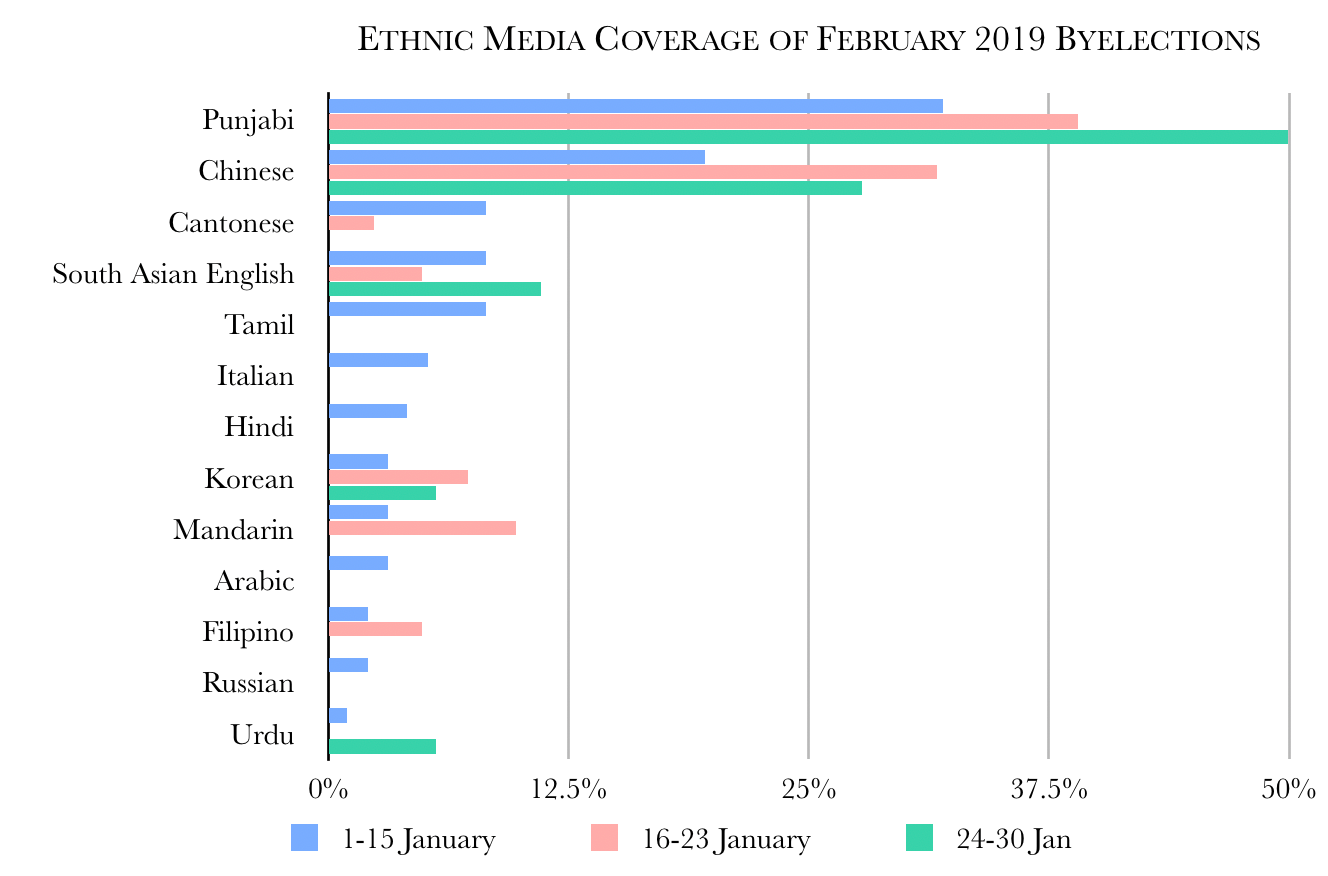
 Media coverage was overwhelmingly in Punjabi (39 percent) and 43.9 percent in Chinese, Cantonese and Mandarin language media. There was only one tangential media reference to Outremont in the context of NDP prospects.
 While NDP leader Singh’s housing, immigration (withdrawal from the Safe Third Country Agreement with the US) and other policy proposals were covered, there was still some lingering coverage of his apparent unawareness of the implications of the Canadians detained in China in retaliation for the extradition proceedings against Huawei executive Meng Wanzhou.


 Multicultural Meanderings