Daphne Bramham: Misleading Conservative ads fan fears in Chinese community

Chinese Canadians were among the most opposed to cannabis legalization which continues to be covered in Chinese language media. This fake news exploits this opposition:

The close-up image of lines of white powder, a razor blade and thick, white fingers is startling enough for most Facebook users. But it’s the words in the Conservative Party of Canada’s Facebook ad — in Chinese characters — that are more attention grabbing.

“(Liberal Leader Justin) Trudeau has already legalized marijuana, he now plans to legalize hard drugs! If you want to get the latest in Chinese, please press Like in our Facebook page.”

Alarming? Yes, it is. It’s also not true.

The message is repeated in a bilingual (Chinese/English) post dated Oct. 5 on the Conservative Party’s Chinese-language Facebook page. “Do you want Justin Trudeau to legalize hard drugs in your community?” reads the headline. “Justin Trudeau has a plan to legalize hard drugs!”

No similar posting was made on the party’s main English-language Facebook page.

The Conservatives base the fake claim on an exchange between Conservative leader Andrew Scheer and Trudeau during a recent leaders’ debate. In French, Scheer accuses the Liberals of having a “secret agenda to legalize or decriminalize hard drugs.”

But Liberal spokesman Guy Gallant said Wednesday, “That (legalization) is not in our plans.”

What the Liberals’ platform says is that the “default option for first-time, non-violent offenders” would require going to drug court where they would get “quick access to treatment,” which in turn would “prevent more serious crimes.”

To make it work, the Liberals promise more community-based services, more residential treatment beds as well as a scaling up of the most effective harm-reduction services such as supervised consumption sites.

Although it lacks many details, it sounds similar to what Portugal did in 2001 in response to its opioid addiction crisis.

There, all street drugs (including marijuana) are illegal. But anyone found with drugs within the set limits for personal use is sent to the Commission for the Dissuasion of Drug Addiction, where counsellors and therapists come up with a plan to direct the user to whatever services are needed to help them quit taking drugs.

Anyone found with larger amounts is charged with trafficking, goes through the criminal justice system, and can be sent to jail for up to 12 years.

Drug use in Portugal, once the highest in Europe, is now amongst the lowest, especially among youth, according to the European Monitoring Centre for Drugs and Drug Addiction’s 2019 report.

While Portugal had only 30 overdose deaths in 2016, the year quoted in the report, 4,588 Canadians died from overdoses in 2018, and another 1,082 died in the first three months this year.

“If Justin Trudeau tells us precisely when he is going to legalize dangerous drugs, we will amend our ads to reflect the new information,” Conservative spokesman Simon Jefferies said Wednesday in an email.

All but one of the links provided by Conservatives to “prove” that Liberals would legalize illicit drugs — the French-language debate clip, a Trudeau interview with Global TV, news stories about individual Liberal candidates, and a YouTube videofrom the 2018 Liberal convention — all refer not to legalization, but to decriminalization. Some even include specific references to the Portuguese model.

The exception was a 2014 tweet from Michael Den Tandt, the Liberal candidate in the Ontario riding of Bruce-Grey-Owen Sound. At the time, he was a National Post reporter and his tweet urged legalization and control of recreational drugs and prostitution, along with an end to supply management and lower taxes. None of those are Liberal party policies.

Conservatives deny a deliberate attempt to confuse voters by using “decriminalization” and “legalization” interchangeably.

The Conservatives have yet to release their full platform, but last week Scheer promised to “tackle drug addiction” in an announcement that focused on guns, gangs and sentencing.

A background paper released at the same time said Conservatives would invest in treatment and recovery centres, including recovery high schools, have a national campaign warning children and youth about the dangers of drug use, and partner with municipalities and schools to clean up used needles.

Illicit drugs are anathema for many new Canadians from Asia and for those who recall China’s opium wars. In Hong Kong, for example, penalties for possession of illicit drugs can be up to seven years in jail and a fine of C$170,000. In China, drug trafficking can bring the death penalty, as two Canadians found out earlier this year. Vietnam, Malaysia, Singapore and Thailand also have a death penalty for trafficking.

As was apparent when Trudeau’s government legalized marijuana, changing drug laws is much less acceptable to many Asian voters than to other Canadians. And it just so happens that Chinese-speaking voters account for a significant percentage in some of the most heavily contested ridings — including Richmond Centre, Steveston-Richmond East, and Vancouver Kingsway.

Deliberately creating confusion and misunderstanding has, unfortunately, proven to be a far too effective strategy south of the border, and it seems to have made its way north.

Bad at any time, it’s worse when it targets voters whose first language isn’t English, and especially confuses an issue that affects thousands of Canadians with addictions whose lives are at stake every day.

Yet, that’s what Conservatives are willing to risk in this ugly, too-close-to-call election.

Source: Daphne Bramham: Misleading Conservative ads fan fears in Chinese community

Douglas Todd: How the election is playing out in local Chinese-language media

More in-depth look at Chinese-language media election and related coverage:

The conflict between Hong Kong and China. The pros and cons of immigration and refugees. Beliefs on abortion and same-sex issues. The tension between paying taxes and benefiting from social services.

Specialists who monitor Canada’s roughly 290 Chinese-language newspapers, websites, radio stations and TV channels say the political coverage not only echoes the mainstream media, it also reveals the distinct concerns of people with origins in East Asia.

Immigration and refugee issues garner more attention in the Chinese-language media than they do among the general Canadian public, say professional observers.

And even though Chinese-Canadians with roots in Hong Kong, Taiwan and China show a complex range of political opinions, Andrew Griffith, a former senior director in Ottawa’s immigration department, has concluded: “There is more of a conservative trend among Chinese-Canadians than, for example, South Asians.”

Like other Canadians, the 1.3 million people of Chinese origin switch party allegiances according to broader political patterns, said Griffith, who works with Diversityvotes.ca, a website highlighting political coverage in the country’s ethnic media. But their votes could make a crucial difference in dozens of urban swing ridings with large immigrant and visible-minority populations.

Roughly three out of four Chinese-Canadians live in either Greater Toronto, where they make up 11 per cent of voters, or Metro Vancouver, where they account for 20 per cent of voters. In the Vancouver suburb of Richmond, which has two federal ridings, 54 per cent of the population is ethnic Chinese.

Andres Malchaski, president of MIREMS International, which monitors the ethnic-language media and helped create Diversityvotes.ca, says that, while a large portion of Canadians tell pollsters the environment is their top election issue, that issue is far outweighed in the Chinese-language media by debates over immigration and refugees.

Chinese-Canadian media outlets, including their discussion forums, contain frequent criticism of Liberal leader Justin Trudeau for bringing in more than 60,000 Syrian refugees since 2015, said Machalski, who has analyzed Canada’s ethnic media for three decades.

Media outlets that target Canadians from China are often wary of refugees from Muslim countries, Machalski said, an attitude that reflects the way China’s authoritarian leaders have restricted the religious freedom of millions of Uighur Muslims.

“The feelings expressed by some of the calls and comments on phone-in shows and in newspaper columns (in Canada) certainly support the idea there will be segments of Chinese voters that might even go so far as to support the People’s Party of Canada,” which is calling for reducing immigration and refugee levels, Machalski said.

Still, Machalski emphasized that the views expressed in the Chinese-language outlets in Canada offer a “kaleidoscope” of perspectives, which often reflect whether their respective audiences are connected to Hong Kong, Taiwan, Hanoi or Beijing.

That is especially so in regards to the recent anti-Beijing protests in the financial centre of Hong Kong.

More than 300,000 people living in Hong Kong hold Canadian passports — and Oct. 21 marks the first Canadian election in which they can cast a ballot, says a Diversityvotes.ca article by Blythe Irwin.

The Chinese media is picking up on everything Canadian politicians are saying about the special administrative region of China. Ethnic-Chinese media commentators, she says, are both approving and sceptical of the way Trudeau says he is “extremely concerned” about Hong Kong, while Conservative leader Andrew Scheer went further by declaring in a tweet: “We are all Hong Kongers.”

Fenella Sung, a former Chinese-language radio show host, said that Chinese-media perspectives about the conflict largely reflect whether the Canadian-based outlets are aimed at audiences rooted in Hong Kong or China.

It’s not surprising that readers of media directed at the large mainland-Chinese population in Canada “would think the Hong Kong issue is China’s internal affair and that it would not be appropriate for Canadian politicians to comment,” said Sung, who is a member of Canadian Friends of Hong Kong.

Long-time immigrants from Hong Kong, Taiwan and other parts of East Asia, Sung said, tend to have political concerns that are in line with Canadians at large, such as jobs, housing and protecting the environment.

“But newer and younger immigrants, mostly from mainland China, are very consistent and focussed on economic growth, expansion of trade, less government bureaucracy, and lower taxation. They don’t like social spending.”

Prior to the B.C. election in 2016, some opinion polls suggested that, even while the province’s more than 500,000 ethnic Chinese voters held diverse views, they generally leaned to the centre-right B.C. Liberals, and had almost no interest in the Greens.

In an article on politics and Canada’s ethnic media published Wednesday in Policy Options magazine, Griffith said Liberal and Conservative party approaches to same-sex marriage and abortion have been widely commented upon, suggesting so-called “family values” are important to many recent immigrants and people of colour.

“While the Liberals and Conservatives get widespread coverage of their electoral promises and commitments, the NDP and Green Party are under-covered,” Griffith added, after reviewing 1,200 recent articles in the ethnic media.

“In contrast, the People’s Party of Canada, given its focus on restricting immigration and its initial exclusion from the leaders’ debate, received more than twice as much substantive coverage as the NDP and Greens combined.”

Chinese-language and other ethnic media outlets in Canada don’t necessarily reinforce cultural silos, Griffith says. But it’s clear they also offer a special window into political discussions of particular concern to certain ethnic groups.

Source: Douglas Todd: How the election is playing out in local Chinese-language media

Ethnic media election coverage 29 September to 5 October

Latest weekly analysis of ethnic media coverage. For the analytical narrative, go to Ethnic media election coverage 29 September to 5 October: UPDATE

How does ethnic media campaign coverage differ? My analysis in Policy Options

Drawing on over 1200 ethnic media pieces in the eight weeks prior to the election call as part of diversityvotes.ca, my analysis assesses the major themes and issues covered:

Canadians who rely on ethnic media as their main information source receive coverage of issues comparable to that of mainstream media.

A major focus of this 2019 election for the various campaigns will be courting voters from immigrant and visible minority communities, who are a majority of the population in 41 ridings, and 20 percent or more in an additional 93 ridings.

For full article: How does ethnic media campaign coverage differ?

Ethnic media election coverage 22-28 September

Latest weekly analysis of ethnic media coverage. For the analytical narrative, go to Ethnic media election coverage 22-28 September:

Ethnic media election coverage 15-21 September

Latest weekly analysis of ethnic media coverage. For the analytical narrative, go to Ethnic media election coverage 15-21 September:

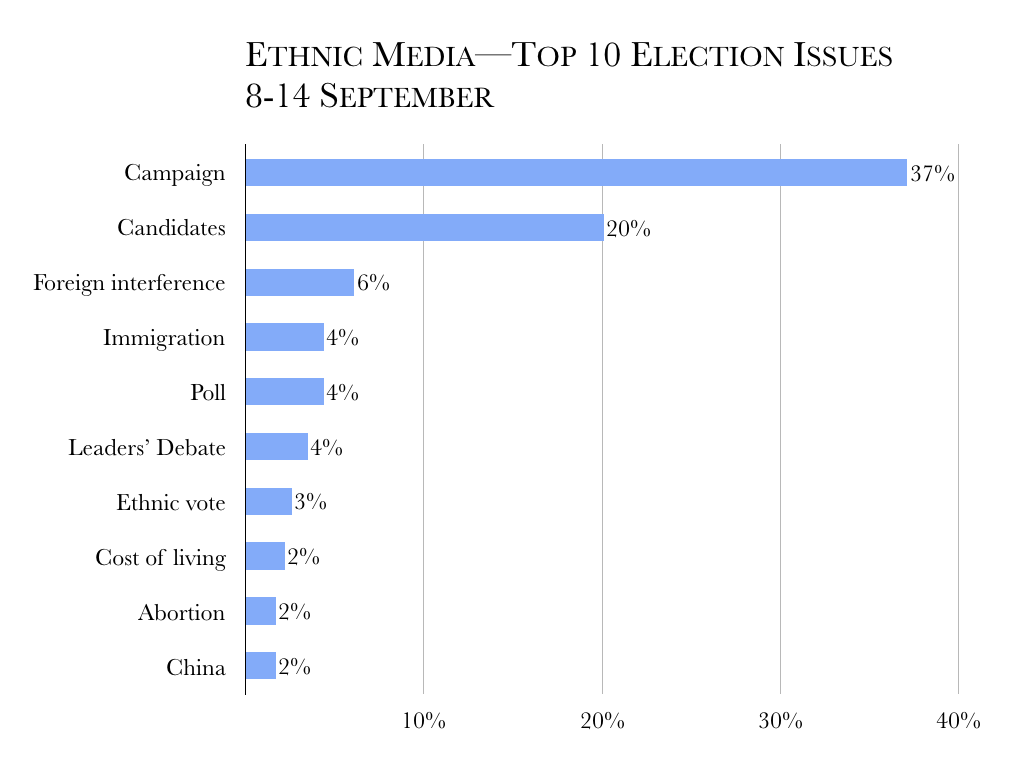
Ethnic media election coverage 8-14 September

Latest weekly analysis of ethnic media coverage. For the analytical narrative, go to Ethnic media election coverage 8-14 September:

Ethnic media election coverage 1-7 September

Latest weekly analysis of ethnic media coverage. For the analytical narrative, go to Ethnic media election coverage 1-7 September

Ethnic media election coverage 25-31 August

Latest weekly analysis of ethnic media coverage. For the analytical narrative, go to Ethnic media election coverage 25-31 August

Ethnic media election coverage 18-24 August

Latest weekly analysis of ethnic media coverage. For the analytical narrative, go to diversityvotes.ca Ethnic media election coverage 11-17 August 2019: