Want more diversity in politics? Start by looking at political parties: Tolley
2019/06/20 Leave a comment
Good piece by Tolley. The only other point I would add is that visible minority candidates tend to run in ridings with significant numbers of visible minorities and immigrants, where likely the local riding party memberships reflect that diversity:
The 2015 federal election saw a record number of women, Indigenous peoples, and racialized Canadians elected to the House of Commons. When he selected his ministry, Justin Trudeau lauded it as “a cabinet that looks like Canada.” These gains are notable, but they should not be taken for granted. There are still representational gaps: women, Indigenous peoples, and racialized Canadians all occupy proportionately fewer seats in the House of Commons than their share of the Canadian population.
To get at the root of electoral under-representation, forget the electoral system. You need to look no further than Canada’s political parties. Parties control access to the House of Commons because they select nearly all of the candidates who appear on the ballot. Even so, the processes that parties use to recruit and select candidates are so opaque that the nomination stage has been referred to as the “black box” of Canadian politics. One thing is clear: if there is a representational deficit in the House of Commons, it’s because when parties nominate candidates, the ones they choose are still disproportionately white and male.
The problem isn’t voter bias. Of course voters harbour prejudice, but on election day, their preference for a particular party or leader tends to override whatever reservations they might have about a candidate’s race, gender, or demographic background. As a result, researchers have largely concluded that when women and minorities run, they win. What this means is that if parties nominated more diverse candidate slates, there would be more diversity in Parliament. The representational gap begins with parties, and the demographic mismatch between Parliament and the population only widens as prospective candidates move through each stage of recruitment, beginning with the decision to run for office and continuing until the ballots are counted.
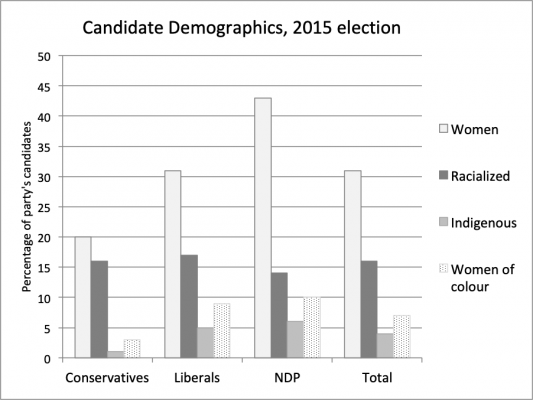
Parties are not obligated to release data on the diversity of their candidate slates, so researchers and journalists are left to tally the statistics. They do this by consulting candidate biographies and other publicly available information, but even then, it’s hard to compile a full picture beyond the three main parties. In 2015, our best estimates suggest that at least 80 per cent of candidates were white, and 70 per cent were men.
Data compiled by the author, using candidate biographies and other publicly available sources. Women of colour includes both Indigenous and racialized women.
So, why don’t parties nominate more women and minorities? In some cases, political parties underestimate the electoral prospects of candidates who don’t fit the profile of the prototypical politician. There is also evidence that they filter women into unwinnable ridings and pigeonhole racialized candidates into only the most diverse districts. Gatekeeping matters.
My research shows that racialized candidates are more likely to emerge when the party’s riding association president is also racialized; otherstudies confirm that women riding association presidents are positively related to the selection of women candidates. Perhaps it’s because women and racialized gatekeepers have more diverse networks and can draw on these resources when identifying potential candidates, but it also appears that under-represented groups respond more positively to recruitment from gatekeepers with backgrounds like their own. Diverse local party leadership might also signal the party’s openness to a variety of candidates.
Despite this, my own research suggests that at least three-quarters of riding association presidents—the most prominent local party gatekeepers—are white and male. Candidate search committees typically assist riding association presidents, but the face of local recruitment efforts is still relatively homogenous. Parties might have more success in their efforts to recruit candidates with a wider range of characteristics and life experiences if the executives of their local riding associations were themselves more diverse.
The NDP has tried to tackle the challenge through an equity policy that commits to running women candidates in at least 50 per cent of all districts, and members of other equity groups in a further 30 per cent; “equity groups” is a catch-all for racialized minorities, Indigenous peoples, persons with disabilities, individuals who are LGBTQ, and youth. Although in 2015, the party nominated more women candidates than either the Liberals or the Conservatives, they nominated the fewest racialized minorities. This suggests that even an explicit commitment to more diversity is not enough. In 2017, the Liberals and Conservatives defeated a private member’s bill that would financially penalize parties for not running more women candidates
Other less formal means have also been tried. For example, prior to the last election, the federal Liberals launched an initiative called #AskHer. The idea was simple and grounded in research that shows women candidates need far more encouragement to run for office than men do. The Liberal Party asked Canadians to identify qualified women candidates whom they thought the party should approach to run. From these submitted names, just one woman—Celina Caesar-Chavannes— was ultimately elected as a Member of Parliament.
Parties have long been the gatekeepers to elected office, but apart from requiring them to disclose the names of their donors and abide by some basic electoral rules, there is little—aside from public pressure—to hold them to account. The 2019 election is an opportunity to do so. How many candidates from equity-seeking groups did parties approach and encourage to run for office? What measures are they putting in place to recruit diverse candidates to office? And how are parties supporting new candidates, whether that’s through training, a financial contribution, or volunteers? Last election, parties told voters to #AskHer. This time, we need to ask more of parties.
Source: Want more diversity in politics? Start by looking at political parties
 In fact, most municipalities in Canada are governed by councils that are predominantly White and mostly male. Women, racialized minorities, Indigenous peoples, persons with disabilities and LGBTQ individuals are numerically underrepresented on most city councils. The lack of diversity means many voices are excluded from the decision-making process. This puts municipalities at risk. Large swaths of the population may feel underrepresented or ignored, and council may miss out on important views.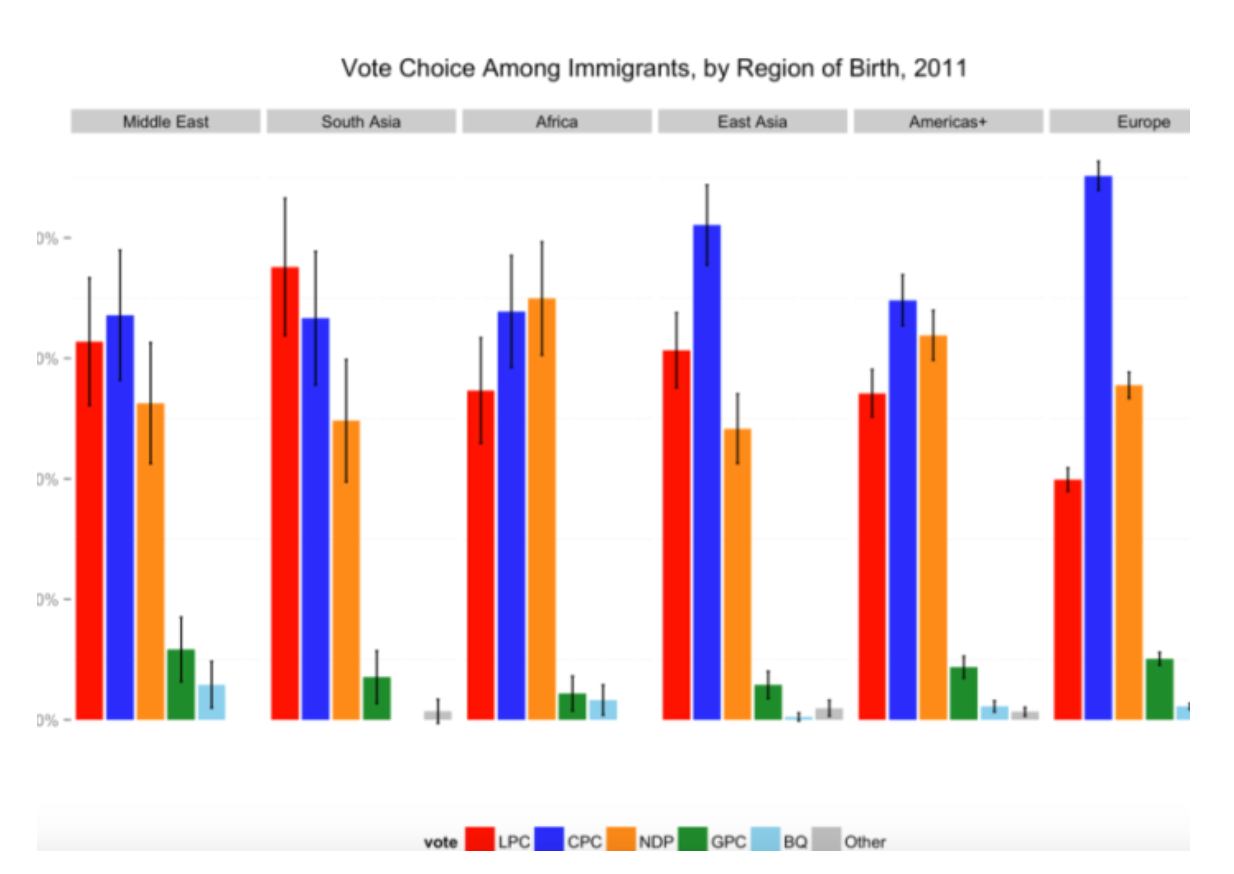

 Multicultural Meanderings