Multiculturalism and related posts of interest

Last of my ‘catch-up’ series.

Starting with the Environics Institute’ Canada’s World Survey, which highlights the degree to which Canada has a more open and inclusive approach than most other countries, as highlighted in the Executive Summary:

Canadians’ views on global issues and Canada’s role in the world have remained notably stable over the past decade.

In the decade following the first Canada’s World Survey (conducted early in 2008), the world experienced significant events that changed the complexity and direction of international affairs: beginning with the financial meltdown and ensuing great recession in much of the world, followed by the continued rise of Asia as an emerging economic and political centre of power, the expansion of global terrorism, increasing tensions with North Korea and risks of nuclear conflagration; and a growing anti-government populism in Western democracies. Despite such developments, Canadians’ orientation to many world issues and the role they see their country playing on the international stage have remained remarkably stable over the past decade. Whether it is their perception of top issues facing the world, concerns about global issues, or their views on the direction the world is heading, Canadians’ perspectives on what’s going on in the world have held largely steady.

As in 2008, Canadians have maintained a consistent level of connection to the world through their engagement in international events and issues, their personal ties to people and cultures in other countries, frequency and nature of their travel abroad, and financial contributions to international organizations and friends and family members abroad. And Canadians continue to view their country as a positive and influential force in the world, one that can serve as a role model for other countries.

This consistency notwithstanding, Canadians have been sensitive to the ebb and flow of intenational events and global trends.

While Canadians’ perspectives on many issues have held steady over the past decade, there have also been some shifts in how they see what’s going on in the world and how they perceive Canada’s role on the global stage, in response to key global events and issues. This suggests Canadians are paying attention to what happens beyond their own borders, and that Canadian public opinion is responsive to media coverage of the global stage.

Canadians today are more concerned than a decade ago about such world issues as terrorism, the spread of nuclear weapons, and global migration/refugees. And the public has adjusted its perceptions of specific countries as having a positive (e.g., Germany) or negative (e.g., North Korea, Russia) impact in the world today. Canadians are also shifting their opinions about their country’s influence in world affairs, placing stronger emphasis on multiculturalism and accepting refugees, our country’s global political influence and diplomacy, and the popularity of our Prime Minister.

Canadians increasingly define their country’s place in the world as one that welcomes people from elsewhere.

Multiculturalism, diversity and inclusion are increasingly seen by Canadians as their country’s most notable contribution to the world. It is now less about peacekeeping and foreign aid, and more about who we are now becoming as a people and how we get along with each other. Multiculturalism and the acceptance of immigrants and refugees now stand out as the best way Canadians feel their country can be a role model for others, and as a way to exert influence on the global stage.

Moreover, Canadians are paying greater attention to issues related to immigration and refugees than they did a decade ago, their top interest in traveling abroad remains learning about another culture and language; and they increasingly believe that having Canadians living abroad is a good thing, because it helps spread Canadian culture and values (which include diversity) beyond our shores. Significantly, one in three Canadians report a connection to the Syrian refugee sponsorship program over the past two years, either through their own personal involvement in sponsoring a refugee family (7%) or knowing someone who has (25%).

Young Canadians’ views and perspectives on many aspects of world affairs have converged with those of older cohorts, but their opinions on Canada’s role on the world stage have become more distinct when it comes to promoting diversity.

It is young Canadians (ages 18 to 24) whose level of engagement with world issues and events has evolved most noticeably over the past decade, converging with their older counterparts whose level of engagement has either not changed nor kept pace with Canadian youth. Young people are increasingly following international issues and events to the same degree, they are as optimistic about the direction of the world as older Canadians, and they are close to being as active as travelers. At the same time, Canadian youth now hold more distinct opinions on their country’s role in the world as it relates specifically to diversity. They continue to be the most likely of all age groups to believe Canada’s role in the world has grown over the past 20 years, and are now more likely to single out multiculturalism and accepting immigrants/refugees as their country’s most positive contribution to the world.

Foreign-born Canadians have grown more engaged and connected to world affairs than native-born Canadians, and are more likely to see Canada playing an influential role on the global stage.

Foreign-born Canadians have become more involved in what’s going on outside our borders over the past decade, opening a noticeable gap with their native-born counterparts. They continue to follow international news and events more closely than people born in Canada, but have developed a much greater concern for a range of issues since 2008, while native-born Canadians’ views have not kept pace. Canadians born elsewhere have grown more optimistic about the direction in which the world is heading, while those born in the country have turned more pessimistic. And Canadians born in other countries have also become more positive about the degree of influence Canada has on world affairs, and the impact the country can have on addressing a number of key global issues.

Source: Canada’s World Survey 2018 – Executive Summary, Canadians believe multiculturalism is country’s key global contribution: study 

Some other stories that I found of interest:

The very different pictures of how well integration is working for visible minority and immigrant women between Status of Women Canada (overly negative) and Immigration, Refugees and Citizenship Canada (not enough granularity between different visible minority groups, captured by Douglas Todd: Secret immigration report exposes ‘distortions’ about women  .

Todd continues with some of his interesting exploration immigration issues, including regarding different communities (Douglas Todd: Canadian Hindus struggling with Sikh activism) and highlighting the work of Eric Kaufmann (Douglas Todd: Reducing immigration to protect culture not seen as racist by most) who, in my view, overstates “white flight” and related ethno-cultural tensions and has an overly static view of society.

Timothy Caulfield asks the questionIs direct-to-consumer genetic testing reifying race?:

From a genetic point of view, all humans are remarkably similar. Indeed, when the Human Genome Project was completed in 2003, it was confirmed that the “3 billion base pairs of genetic letters in humans [are] 99.9 percent identical in every person.” There are, of course, genetic differences that occur more frequently in certain populations — lactose intolerance, for example, is more common in people from East Asia. But there is simply no reason to think that your genes tell you something significant about your cultural heritage. There isn’t a lederhosen gene.

More important, we shouldn’t forget that the concept of “race” is a biological fiction. The crude racial categories that we use today — black, white, Asian, etc. — were first formulated in 1735 by the Swedish scientist and master classifier, Carl Linnaeus. While his categories have remained remarkable resilient to scientific debunking, there is almost universal agreement within the science community that they are biologically meaningless. They are, as is often stated, social constructs.

To be fair, DTC ancestry companies do not use racial terminology, though phrases like “DNA tribe” feel close. But as research I did with Christen Rachul and Colin Ouellette demonstrates, whenever biology is attached to a rough human classification system (ancestry, ethnicity, etc.), the public, researchers and the media almost always gravitate back to the concept of race. In other words, the more we suggest that biological differences between groups matter — and that is exactly what these companies are suggesting — the more the archaic concept of race is perceived, at least by some, as being legitimate. A 2014 study supports this concern. The researchers found that the messaging surrounding DTC ancestry testing reifies race as a biological reality and may, for example, “increase beliefs that whites and blacks are essentially different.” The authors go on to conclude that: “The results suggest that an unintended consequence of the genomic revolution may be to reinvigorate age-old beliefs in essential racial differences.”

Other research has found that an emphasis on genetic difference has the potential to (no surprise here) increase the likelihood of racist perspectives and decrease the perceived acceptability of policies aimed at addressing prejudice.

Some less-than-progressively-minded groups have already turned to ancestry testing as a way to prove their racial purity. White supremacists in the United States, for example, have embraced these services — often with ironic and pretty hilarious results (surprise, you’re not of pure “Aryan stock”!).

But I am sure most of the people who use ancestry companies are not thinking about racial purity, the reification of race or antiracism policies when they order their tests. And I understand that these tests are, for the vast majority of customers, providing what is essentially a bit of recreational science. In fact, I’ve had my ancestry mapped by 23andMe (I am, if you believe the results, almost 100 percent Irish — hence my love of Guinness). It was a fun process. Still, as the research suggests, the messaging surrounding this industry has the potential to facilitate the spread and perpetuation of scientifically inaccurate and socially harmful ideas about difference. In this era of heightened nationalism and populist exceptionalism, this seems the last thing we need right now.

So, don’t believe the marketing. Your genes are only part of the infinitely complex puzzle that makes “you uniquely you.” If you feel a special connection to lederhosen, rock the lederhosen. No genes required.

Lack of diversity in highlighted is sectors as varied as entertainment (The Billion-Dollar Romance Fiction Industry Has A Diversity Problem) and education (Lack of diversity persists among teaching staff at Canadian universities, colleges, report finds). Chris Selley: Granting Sikh bikers ‘right’ to ride without helmets only adds to religious freedom confusion provides a good critical take on whether religious freedom extends to riding motorcycles (Ontario does not allow, British Columbia and Alberta do).

Kim Thúy on how ‘refugee literature’ differs from immigrant literature provides an interesting perspective:

“Refugee and immigrant are very different,” she says in an interview. “A refugee is someone ejected from his or her past, who has no future, whose present is totally empty of meaning. In a refugee camp, you live outside of time—you don’t know when you’re going to eat, let alone when you’re going to get out of there. And you’re also outside of space because the camp is no man’s land. To be a human being you have to be part of something. The first time that we got an official piece of paper from Canada, my whole family stared at it—until then, we were stateless, part of nothing.”

Letters from Japanese-Canadian teenagers recount life after being exiled from B.C. coast enriches our understanding of the impact of their uprooting and exile under Japanese wartime internment (similar to Obasan):

“I don’t know of any other archival collections that are like this,” she said. “They might exist, but I don’t know of any. The combination of young people’s letters and letters to a non-Japanese Canadian person is just incredible to me. This is really special.

“One of the things I love about them is that they’re so clearly ordinary people. I think sometimes when the story gets told, that gets missed — that these are teenagers who are bored, and curious. It’s just really touching.”

And a variety of interesting articles on Islam and Muslims: Why so many Turks are losing faith in IslamCan Muslim Feminism Find a Third Way?  Ursula Lindsey and Gender parity in Muslim-majority countries: all is not bleak: Sheema Khan.

One of the most interesting is The Conversion/Deconversion Wars: Islam and Christianity using Pew Research data to assess respective trends:

It turns out that (American) Islam is losing Muslims at a pretty high rate. About a quarter of adults raised Muslim deconvert.

The problem is, from a secularist’s point of view, is that just as many convert to the religion. It has a high conversion rate, especially when compared to Christianity. Islam is growing by about 100,000 per year.

Per Research recently released a report that said:

“Like Americans in many other religious groups, a substantial share of adults who were raised Muslim no longer identify as members of the faith. But, unlike some other faiths, Islam gains about as many converts as it loses.

About a quarter of adults who were raised Muslim (23%) no longer identify as members of the faith, roughly on par with the share of Americans who were raised Christian and no longer identify with Christianity (22%), according to a new analysis of the 2014 Religious Landscape Study. But while the share of American Muslim adults who are converts to Islam also is about one-quarter (23%), a much smaller share of current Christians (6%) are converts. In other words, Christianity as a whole loses more people than it gains from religious switching (conversions in both directions) in the U.S., while the net effect on Islam in America is a wash.

A 2017 Pew Research Center survey of U.S. Muslims, using slightly different questions than the 2014 survey, found a similar estimate (24%) of the share of those who were raised Muslim but have left Islam. Among this group, 55% no longer identify with any religion, according to the 2017 survey. Fewer identify as Christian (22%), and an additional one-in-five (21%) identify with a wide variety of smaller groups, including faiths such as Buddhism, Hinduism, Judaism, or as generally “spiritual.”

The same 2017 survey asked converts fromIslam to explain, in their own words, their reasons for leaving the faith. A quarter cited issues with religion and faith in general, saying that they dislike organized religion (12%), that they do not believe in God (8%), or that they are just not religious (5%). And roughly one-in-five cited a reason specific to their experience with Islam, such as being raised Muslim but never connecting with the faith (9%) or disagreeing with the teachings (7%) of Islam. Similar shares listed reasons related to a preference for other religions or philosophies (16%) and personal growth experiences (14%), such as becoming more educated or maturing.”

There is perhaps an interesting explanation for some of this deconversion data:

“One striking difference between former Muslims and those who have always been Muslim is in the share who hail from Iran. Those who have left Islam are more likely to be immigrants from Iran (22%) than those who have not switched faiths (8%). The large number of Iranian American former Muslims is the result of a spike in immigration from Iran following the Iranian Revolution of 1978 and 1979 – which included many secular Iranians seeking political refuge from the new theocratic regime.”

How does this compare to people who converted to Islam?

“Among those who have converted to Islam, a majority come from a Christian background. In fact, about half of all converts to Islam (53%) identified as Protestant before converting; another 20% were Catholic. And roughly one-in-five (19%) volunteered that they had no religion before converting to Islam, while smaller shares switched from Orthodox Christianity, Buddhism, Judaism or some other religion.

When asked to specify why they became Muslim, converts give a variety of reasons. About a quarter say they preferred the beliefs or teachings of Islam to those of their prior religion, while 21% say they read religious texts or studied Islam before making the decision to switch. Still others said they wanted to belong to a community (10%), that marriage or a relationship was the prime motivator (9%), that they were introduced to the faith by a friend, or that they were following a public leader (9%).”


Canadian exceptionalism in attitudes toward immigration

More on Focus Canada 2018 findings from Michael Adams and Keith Neuman:

Xenophobic retrenchment has been evident in many societies lately. Anti-immigrant parties have made or consolidated gains in countries such as Hungary, Germany, the Netherlands and, most recently, Italy. Resentment of immigration helped to motivate at least some British voters who supported Brexit. And of course, President Donald Trump’s rhetoric about immigrants to his country has been hostile — whether they come from Mexico, Muslim-majority countries or African countries.

Many commentators have speculated that Canada may take a similar turn. Certainly, Canada is not immune to bigotry. In addition to forms of discrimination that reveal themselves in economic data and survey findings, this country experienced a singularly violent attack on Canadian Muslims last year: a hate-motivated mass shooting at a Quebec City mosque that killed six people.

Are Canadians souring on their country’s traditionally high levels of immigration? Are they becoming more likely to support political candidates who channel ethnic and nationalist resentments? Are immigrants themselves souring on life in Canada?

Remarkably, recent survey findings suggest the opposite. New research by the Environics Instituteindicates two important and hopeful findings. First, Canadian attitudes toward immigrants remain open and positive. This pattern, which has been in evidence since the early 1990s, has not reversed in recent years. Second, Canada stands out internationally in the happiness that immigrants themselves report, and in the general public’s positive attitudes toward their foreign-born compatriots. (One driver of these mutually positive feelings may be that around 4 in 10 Canadians are themselves immigrants or the children of immigrants — meaning that immigrants’ attitudes are public attitudes to a significant extent.)

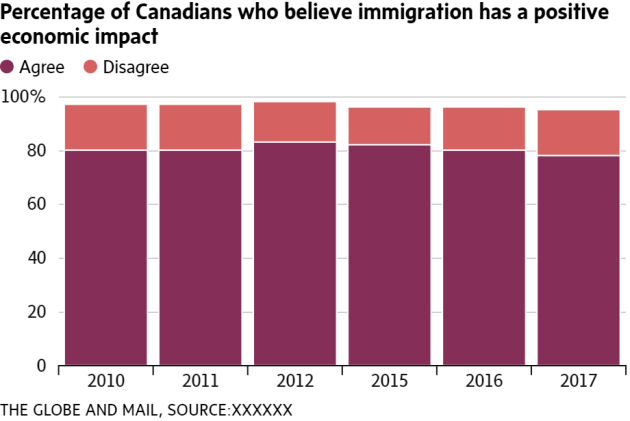
In spite of high and growing levels of immigration into Canada (around 300,000 in 2017), 6 in 10 Canadians recently  surveyed by Environics disagree that immigration levels are too high, compared with 35 percent who agree. Eighty percent believe the economic impact of immigration is positive, a conviction that goes a long way in explaining the success of the Canadian model.

Attitudes toward the legitimacy of refugee claims has grown more positive than they have been in the past three decades. More Canadians disagree (45 percent) than agree (38 percent) with the statement: “Most people claiming to be refugees and not real refugees” — and that disagreement has more than tripled since 1987.

Canadians do express concern about the speed with which they think immigrants adopt “Canadian values.” Today half of us (51 percent) do not think immigrants adopt Canadian values quickly enough, but rather than surging in recent years, the proportion of Canadians who hold this attitude has actually declined from 72 percent in 1993. Such concern is now at the lowest level in the 25 years over which this survey question has been put to Canadians.

Canadians stand out internationally in the way they think about immigration and diversity in their society.

Gallup’s Migrant Acceptance Index is a composite score for a society’s openness toward immigrants, made up of responses to three questions about whether it is a good thing or a bad thing that immigrants live in their country, become their neighbours, and marry a close relative. The survey covered 140 countries, and Canada ranked fourth overall in its acceptance of migrants. Among those in the OECD, Canada ranks third and the United States ranks tenth, while major European countries like Germany, the UK, Italy and France are farther down the list, followed by those in Eastern Europe.

What about immigrants themselves? Do they feel at ease in Canada? The just-released 2018 World Happiness Report finds Canadian immigrants’ assessment of their “subjective well-being” is among the most positive in the world: ranking seventh out of those of 156 countries. Immigrants’ happiness in Canada is fairly consistent regardless of where they’ve come from and where they’ve settled in Canada. Their self-reported well-being is also more similar to that of other Canadians than it is to people in their countries of origin.

The World Happiness Report’s authors note that newcomers tend to arrive in their new societies full of optimism, but in societies that prove unwelcoming, happiness declines over time, meaning that settled migrants end up less happy than new arrivals. Among more accepting countries, newcomers’ optimism is affirmed by experience, and happiness remains high among settled migrants. The data show this is clearly the case in Canada.

It’s not unreasonable to think that an accepting society and happy, optimistic immigrants create a virtuous cycle over time — with most people doing their best to be fair and friendly and to give others the benefit of the doubt. It’s worth noting that, as immigrants become more numerous — and, increasingly, spread beyond the traditional catchment areas of Toronto, Vancouver and Montreal — the proportions of Canadians who report direct experiences with immigrants and various groups different from their own is on the rise. Generally speaking, personal experience with difference breeds good feeling (and probably helps to inoculate people against fear-mongering in the media or online).

Still, large majorities of Canadians acknowledge the reality of racism and discrimination. For instance, 84 percent of Canadians believe Canadian Muslims face discrimination often (50 percent) or occasionally (34 percent). Large majorities also believe immigrants from the Middle East, Indigenous people and Black people face discrimination at least occasionally. These findings indicate that most of us recognize there’s still much work to be done to live up to some of our rhetoric about diversity and inclusion, but acknowledgement of society’s shortcomings is a better place to start from than denial.

For now, it’s worth bearing in mind that, even amid gloomy headlines from both here and abroad, millions of people are quietly getting along in Canadian communities every day. Moreover, things can and do change for the better; people have a record of changing their minds in our imperfect country. According to a 2016 Environics survey, little more than 20 years ago only 35 percent of Canadians felt that two people of the same sex who live together should be regarded as being the same as a married couple. In 2016, the proportion was 73 percent.  (Some of this change is intergenerational: tolerant young people replacing older traditionalists. But many Canadians (including many older people) have changed their minds on same-sex marriage.

As some other societies retrench, Canadians — those born here and those born elsewhere — appear to be continuing their evolution toward greater mutual acceptance and greater acknowledgement of where their society falls short on equity. These recent findings suggest that Canada has a strong foundation from which to work toward a country where even more of us can report happiness, well-being and optimism for the future.

via Canadian exceptionalism in attitudes toward immigration

ICYMI: Canadian attitudes toward immigrants, refugees remain positive – Environics Focus Canada 2018

The latest Focus Canada 2018 data, overall ongoing positive trends:

The arrival of Syrian refugees, as well as thousands of asylum seekers over the United States border, along with the global growth in anti-immigrant sentiment have barely moved the positive attitude most Canadians have toward new arrivals, a study has found.

Six-in-10 Canadians chose “disagree” when asked the question “Are immigration levels too high?” in the February survey by the Environics Institute for Survey Research – a finding that has remained relatively stable for a decade. Eight-in-10 said immigrants have a positive economic impact. Compared with last year’s survey, more respondents believed that immigrants adopt Canadian values. Most of the national results extended a steady 30-year trend toward greater acceptance of immigrants.

“I think some people felt retrenchment was happening, or at least feared it was happening, but since last year the change is pretty small and is still more positive than negative,” said Keith Neuman, executive director of the Environics Institute that conducted the survey of 2,000 Canadians.

Canadians also inched away from the polarization over immigration issues seen in Europe and in the United States under Donald Trump. Canadians were less likely to strongly agree or disagree with several poll questions and more likely to express uncertainty and doubt, according to Dr. Neuman. “It’s not a big change, but it’s enough to say opinions are a little less polarized than last year,” he said. “It’s dangerous to assume what’s happening in the United States or elsewhere is also happening here. ”

The trends, however, are not universally positive toward immigration. Albertans and, to a lesser extent, Quebeckers, expressed more doubt about the legitimacy of refugee claims than in the previous survey, lowering the national score slightly. Respondents in both provinces also expressed more doubt about whether immigrants are adopting Canadian values.

“It’s Alberta rather than Quebec that has the hardest attitudes toward immigrants and refugees, which is not what we tend to assume,” Dr. Neuman said. “But it’s too early to say it’s a trend.”

Some 49,775 people claimed asylum in Canada in 2017, including 20,593 who came in at irregular crossings, mostly in Quebec. About 300,000 landed in other immigrant categories.

The irregular crossings received enormous attention in Quebec, including a lot of commentary expressing doubts about the legitimacy of the asylum claims. The province also saw the rise in profile of small, far-right fringe groups hostile to immigration, but the phenomenon seems to have limited reach.

The poll showed 42 per cent of Quebeckers agreed with the statement “Many people claiming to be refugees are not real refugees.” That number is up three percentage points from last year. Forty-three per cent disagreed, down six points. Nationally, 38 per cent agreed, while 48 per cent disagreed.

In Alberta, 48 per cent said they agree that many refugee claimants are not real refugees, an increase of three percentage points, while 35 per cent disagreed, a drop of nine points. Sixty-two per cent of Albertans said too many immigrants don’t adopt Canadian values compared with the national score of 51 per cent.

Even before the results were shared with him, Fariborz Birjandian, chief executive of the Calgary Catholic Immigration Society, anticipated the Alberta difference.

Once he heard the numbers, Mr. Birjandian said the higher level of negative attitudes captured in the poll disguise an Alberta paradox: Some Albertans donate and volunteer to help settle refugees more than most Canadians while others express suspicion or hostility toward them.

“My conclusion is this: Albertans have stronger opinions on immigration. Those who support it support it wholeheartedly and those who have questions have stronger opinions, too. Albertans are more opinionated,” Mr. Birjandian said.

Alberta’s economy has also been in bad shape with the collapse of oil prices. Economic uncertainty often increases negative feelings about immigration, said Sarah Aimes, director of the immigrant-services department at Lethbridge Family Services. But, she said, positive sentiment about the Syrian refugees has tempered the negatives.

The Environics Institute poll of 2,000 Canadians, conducted by telephone between Feb. 5 and Feb. 17, has asked the same questions for three decades. It has a margin of error of 2.2 percentage points, in 19 out of 20 samples.

On a global scale, Canada still stands out for the public’s positive attitudes toward new comers and in the happiness that immigrants themselves report. When asked about their well-being, Canadian immigrants were ranked seventh-happiest out of 140 countries.

via Canadian attitudes toward immigrants, refugees remain positive: study – The Globe and Mail

2016 Census Environics Presentation: Release 6 – Education, Labour, Journey to work, Language of work, Mobility, migration

Really good detailed series of slides on the latest Census release. Not just for policy and data nerds:

via 2016 Census: Release 6 Education, Labour, Journey to work, Language of work, Mobility, migration

In the era of extreme immigration vetting, Canada remains a noble outlier: John Ivison

Ivison’s take on my MPI article Building a Mosaic: The Evolution of Canada’s Approach to Immigrant Integration):

While Donald Trump used Tuesday’s deadly attack in New York to promote immigration restrictions, a remarkable consensus continues to hold in Canada, evident in the response to the government’s announcement that nearly 1 million newcomers will be welcomed over the next three years.

Immigration minister Ahmed Hussen said late Wednesday 310,000 new entrants will arrive next year, 330,000 in 2019 and 340,000 in 2020.

In response, Conservative immigration critic Michelle Rempel complained about the Liberals over-promising and under-delivering on the immigration file, pointing to a backlog at the Immigration and Refugee Board, a lack of mental health services for Yazidi women, wait times for permanent residency for caregivers, and an uneven spread of immigrants across the country. But crucially, those complaints were about management of the system by the Liberals, not the significant uptick in numbers.

In a world where the U.S. president is pushing to step up “extreme vetting,” where even countries like Germany and Denmark with a reputation for being havens are turning against immigrants, Canada is a notable, noble outlier.

As Andrew Griffith, a former senior bureaucrat at the department of Citizenship and Immigration, notes in a new paper for the Washington-based Migration Policy Institute, Canada’s successful immigration policy has its roots in the country’s history and geography.

“The ongoing creative tension between groups (English, French and Indigenous peoples) produced a culture of accommodation central to Canada’s ability to absorb and integrate newcomers. Further, the widely held perception among Canadians that immigrants are an economic boon and cultural asset to the country has made public opinion on the subject generally resilient, even as sharp backlashes have unfolded in the United States and Europe,” he wrote.

The polling bears that out. In fact, fewer people are concerned about immigrants not adopting “Canadian values” than at any time in the past 20 years, according to a major study carried out last year by the Environics Institute.

The study said 58 per cent of Canadians disagree with the statement that immigration levels are too high, compared with 37 per cent who agree. Views on the issue in Quebec reflected the national average.

It said 80 per cent believe the economic impact of immigration is positive, compared to just 16 per cent who disagree.

And it found 65 per cent think immigration controls are effective in keeping out criminals, up from just 39 per cent in 2008.

Since the major liberalization of immigration in the 1960s, when Canada abandoned race-based selection criteria and paved the way for the country’s current diversity, there has been a consistency about the broad parameters of immigration policy, regardless of which party has been in power.

Since 1995, immigrants admitted under economic preferences have consistently accounted for half or more of newly arrived immigrants.

The OECD’s migration outlook survey suggests the Canadian system is successful at attracting some of the world’s best and brightest. In 2014, 260,400 permanent residents were admitted, and more than half of the 25-to-64 year olds in that group had completed post-secondary degrees. The employment rate for foreign-born men was higher than for native-born men.

None of that is to suggest that the system is not used as a source of electoral fodder — particularly by the Liberal Party.

While the Conservatives reduced family-class immigration and increased economic immigration when they were in power, new programs introduced by the Liberals threaten to reverse some of that progress.

In the last election, the Liberals campaigned on prioritizing family reunification, granting points under the Express Entry system to applicants with siblings in Canada and doubling the number of applications allowed for parents and grandparents.

There was plenty more political pandering — watering down language requirements, lifting Mexican visa requirements and reducing the residency requirement for citizenship from four years to three.

The Trudeau Liberals’ emphasis on rights over the responsibilities promoted by the Harper government — and the prioritization of diversity over Harper’s insistence on shared Canadian values and history — paid electoral dividends, shifting the allegiance of a number of visible minority communities toward the Liberals.

Yet the changes were at the margins.

Both governments adhered to the distinctly Canadian model of integration, based on broad agreement about the way immigrants are selected, settled and melded into society.

The demographics defy partisanship and both Conservatives and Liberals have tried to offset the effect of an ageing population, where the working age to retired ratio is set to fall from 6.6:1 in 1971 to 2:1 by 2036.

Beyond the economics, there is a common approach to integration.

Griffiths notes that as far back as 1959 in Statistics Canada’s Canada Year Book, integration was defined as being clearly distinct from assimilation — it provided for the retention of cultural identity.

The niqab ban in Quebec suggests the debate on accommodation is not resolved.

But it is easy to lose sight of the fact that Canadians are broadly at ease with mass immigration to this country, even as it has resulted in a country with one of the largest foreign-born populations in the world.

Source: John Ivison: In the era of extreme immigration vetting, Canada remains a noble outlier | National Post

Groundbreaking project explores Black experience in the GTA

Good detailed coverage in the Star and Globe (not much if anything in the Sun):

Whenever he is asked about his racial identity, Carl James always says “Black” instead of Antiguan, especially in Canada, where race is often defined by skin colour.

But there is more to the York University education professor’s preferred response to the question.

“I generally see myself as a Black person who happens to be from the Caribbean,” said James, who came to Toronto in the 1970s as a university student.

“It’s the politics about being Black that we are thinking in skin-colour terms. That’s the way we have come to define and see ourselves in our struggles.”

He is not alone in feeling that way.

According to the Black Experience Project, a groundbreaking survey of 1,504 self-identified Black individuals in Greater Toronto, 53 per cent of the participants identified themselves as Black regardless of their heritage, country of origin, and ethnocultural and other identities.

The participants were sampled to represent the population across census tracts, taking into account age, gender household income and ethnic/cultural backgrounds.

The study led by the Environics Institute, released Wednesday, posed 250 questions to participants about their daily experiences as Black people in the GTA. Most interviews were conducted in person and each took between 90 to 120 minutes.

“What struck me is how the experience of the Black community is so similar,” said Marva Wisdom, the project’s director of outreach engagement, whose family moved here from Jamaica 40 years ago.

“Being Black is an important identity for us despite our diversity. It is our shared experiences that help bind us together.”

Black people make up 400,000, or 7 per cent, of Greater Toronto’s population and the community has more than tripled in size over the last three decades.

Until 2011, young Black adults living in GTA were much more likely to be born in the Caribbean than in Canada, but the trend has reversed. Black youth today are twice as likely to be born in Canada than in the Caribbean, while those from Africa have been on the rise.

While people with Caribbean heritage make up 55 per cent of GTA’s Black population, those with African origins now account for 31 per cent of the community, with the rest being a mix of both and/or with other ethnicities.

The study also found:

  • Two-thirds of survey participants said they frequently or occasionally experience racism and discrimination because they are Black;
  • Eight in 10 reported experiencing one of several forms of day-to-day “microaggression” such as having others expect their work to be inferior or being treated in a condescending or superficial way;
  • Although those with lower incomes are affected more intensively by these incidents, when it comes to getting randomly stopped in public by the police, those in the higher socio-economic stratum are not immune;
  • About four respondents in 10 said they felt accepted by their teachers “only sometimes” or “never”;
  • One-third identified challenges in the workplace linked to being Black, whether those involved explicit racism or discrimination, or an uncomfortable workplace culture in which they do not feel they are treated professionally accepted.

“Teenagers growing up feel they’re experiencing all these things on their own. You feel you have to work hard to prove Blackness is a positive thing. Now we can confirm and validate our experiences with data,” Wisdom said.

“There have been incremental changes, but things haven’t changed that much, either.”

Source: Groundbreaking project explores Black experience in the GTA | Toronto StarBlack Experience Project a heart-rending snapshot of Black lives in Toronto: Paradkar

In an interview with The Globe and Mail, Carl James, an education professor at York University and one of the researchers behind the study, explains the lasting effect frequent police interactions has on the black population as a whole and how wealth and education offer little protection against profiling.

Half the black people you surveyed said they’ve been stopped by police in public but that number surges to 80 per cent when it comes to black males between 25 and 44. What’s behind the targeting of this demographic?

I think it has to do with how black males are thought about in society. These stereotypes operate to influence the relationship we’re going to have with the police, with teachers, with our neighbours. The sense [police] have of these people is that they are probably up to no good, probably mischief makers. In order to prevent any of those things that might take place, let us take pre-emptive action.

Get the latest political headlines.

What’s the effect of having so many of these interactions with police?

One youth sent me an e-mail where he talked about going home at 11:30 and police stopped him and searched him and in the process roughed him up. We then think we can’t be out at 11 at night or drive a nice car or live our lives. It affects how we might trust police or a teacher.

We’ve seen a lot of reports in the past couple of months prepared by judges or human-rights organizations that look at policing and the recommendations are always the same: collecting race-based data, providing implicit bias training to police. Are these the right solutions?

I think collecting the data is absolutely important and critical but what we do with it is important afterward. Even though the data might be there, in a society where institutional racism exists, people might not believe the evidence because that’s not their personal experience.

With personnel training, I’m not sure it helps unless people start thinking about how they’re complicit, and also responsible for working at the issues, instead of, “I got some training. Black people aren’t exactly all what I thought.” I think we need a deliberate attempt coming from federal policies and programs.

We need different representations in media. It’s not just when we hear about issues related to blacks that we get a black person on the radio. If a personal story is the only way that the larger society can be able to respect and understand and get to know the black person, I think that’s a very sad situation.

Your results show that black people from the GTA from all class backgrounds had negative interactions with police. Your social standing, your education, it can’t really protect you. Was that surprising?

No. If you’re a doctor, a lawyer, a professional, the fact is, outside of those contexts, you’re seen as who we construct you to be. We have to shift the thinking, shift the ideas to challenge the stereotypes.

You have a Ph.D. You’re a faculty chair at York University. How does that have an effect on your experience being black in this city?

There are assumptions of what my research might be about. Assumptions I might be biased based on how I come to my research. The assumptions of how I might teach or perceive some students. We all are marinated in the same stew of stereotypes and we’re going to bring that to the world and interactions we’re going to have.

Eighty per cent of the people you surveyed said that they believed that others – specifically non-black people – saw them in a somewhat negative or very negative light. Do you think it’s worthwhile trying to change the perception of adults? Or are those stereotypes too ingrained?

We have to get at the perception of adults. These are the people that set the laws, set the rules, set out the school curriculum, set out the kinds of processes that people need to live by. If they are allowed to maintain their ideas, nothing will change. Even if we worked with kids to have them see the world differently than the adults, after a while, they’re inculcated by ideas held by adults and are going to think they’re right. To be able to succeed, you might not be able to challenge the existing ideas, the status quo, so sooner or later these kids will have to fall in line.

I don’t think it’s just the individual ways it must be done. It has to be done with institutional practices. Since the police occupy a very significant place in society in which we live, the government’s going to have to play a significant role in bringing them into understanding and respecting the role that they play and their relationship with the community.

Source: Majority of black people in Toronto feel targeted and disrespected: study 

Other commentary of note, from a more activist perspective:

Black Experience Project exposes Canada’s big lie: Mochama – Multiculturalism is a national policy that promises to embrace diversity while doing nothing to address a long history of punishing Black people.,

The tragic echoes in the cycle of Black death – As a verdict loomed in the Andrew Loku inquest, Pierre Coriolan was killed in Montreal—reminders of why Black Canadians fight for change


Trump, Trudeau and the patriarchy: Adams

Another interesting piece by Michael Adams on the contrast between the US and Canada:

As icons of masculinity, it would be hard to find a more vivid contrast than that between U.S. President Donald Trump and Canadian Prime Minister Justin Trudeau. One is a macho bully who demands deference, the other a people-pleasing metrosexual. These men are not one-of-a-kind phenomena but very much expressions of the societies that produced them.

This is the obvious conclusion from an analysis of the evolving social values in each country Environics has been conducting every four years since 1992.

In order to understand the orientation to the structure of authority in the family in each country, we periodically ask representative samples of people 15 and older if they agree or disagree with the statement: “The father of the family must be master in his own house.”

In 2016, 50 per cent of the 8,000-plus Americans surveyed agreed with the statement. In Canada, the equivalent proportion (with a sample of 4,000-plus) was 23 per cent.

When we first asked this question in 1992, the proportion in the United States agreeing was 42 per cent. It rose to 44 per cent in 1996, and to 48 per cent in 2000. It remained at that level throughout the post-9/11 George W. Bush years and then declined somewhat during the Barack Obama era, to 41 per cent in 2012.

However, as U.S. Republicans and Democrats were in the process of selecting Mr. Trump and Hillary Clinton as their respective presidential candidates, the proportion returned to its historic high.

It will surprise no one that support for Mr. Trump is highly correlated with support for patriarchy and, conversely, support for gender equality is highly correlated with support for Ms. Clinton.

Meanwhile in Canada, the proportion of patriarchy supporters has been hovering in the low 20s throughout the past two decades. This is in spite of the inflows of migrants from more male-dominated countries (35 per cent of foreign-born Canadians believe dad should be on top), as well as a mild backlash against feminism among Generation X men at the ages of 25 to 44 (foreign-born and Canadian-born alike). In the United States, 56 per cent of immigrants opt for patriarchy in the home.

There was a time when informed Canadians felt the values of the two countries were converging, or that any observed differences in average opinion in the two societies were simply the result of the South pulling the U.S. number in a conservative direction and Quebec pulling Canada the other way. When it comes to this measure of patriarchy, neither generalization stands up to the evidence. Yes, in the United States, there is substantial regional variation. In the Deep South (Tennessee, Alabama and Mississippi), 69 per cent believe the father must be master chez lui, whereas in New England, the figure is only 42 per cent; other regions fall in-between. In Canada, the range is from a high of 26 per cent in Alberta (birthplace of former Republican contender Ted Cruz) to a low of 18 per cent in Atlantic Canada. Canada’s most patriarchal province is significantly less patriarchal than the least patriarchal region of the United States. So much for the theory that nations don’t have national values.

Digging deeper into the demographics, we see some telling patterns: 60 per cent of American men think father should be master at home compared with 41 per cent of American women. In Canada, only 31 per cent of men think dad should be boss, compared with 16 per cent of women. Presumably some of these people live in the same house; must be interesting.

There is little variation by age in either country, or by income, occupational status or community size (rural to urban). In Canada, there is not much difference by education either – but in the United States education matters a lot: 56 per cent of people with a high-school education or less think father should be boss; among those with postsecondary degrees, it is 39 per cent.

Consensus in Canada; some substantial variations in the United States. Patriarchy is only one of more than 50 values we track, but it is clearly among the most meaningful. It is also a value that is highly correlated with other values such as religiosity, parochialism and xenophobia, and views on issues such as abortion, guns and the death penalty.

In 2002, EKOS asked Canadians if Canada was becoming more like the United States or less like it. At that time, 58 per cent said we were becoming more like the United States and only 9 per cent thought we were becoming less like our American cousins. A few weeks ago, we repeated this question in a national survey and found a change of opinion: Only 27 per cent think Canada is becoming more like the United States and a nearly equal proportion (26 per cent) say we are in fact becoming less like our southern neighbour. Perhaps the latter group read The Globe and Mail.

Source: Trump, Trudeau and the patriarchy – The Globe and Mail

Canadians still pro-immigration, but souring on United States: Environics survey 

Useful and encouraging post-Trump update of Focus Canada’s annual survey:

As debates rage through much of the developed world over whether to close doors to newcomers, Canadian attitudes toward immigration remain positive.

Canadians’ sentiment towards immigration hasn’t wavered in the past six months, with eight in 10 people still agreeing that immigrants benefit the economy, a national survey released exclusively to The Globe and Mail shows.

“Public opinion about immigration among Canadians generally has either remained stable or become even more positive” in the past half year, said Keith Neuman, executive director of the Environics Institute for Survey Research, which released the results publicly on Monday.

The survey was conducted last month as a follow up to a similar set of questions in October. It sought to gauge whether public sentiments have shifted since the election of Donald Trump in the United States, and amid intensifying public debate in the United States and Europe over whether to tighten immigration rules. It comes as France’s defeated presidential candidate, Marine Le Pen, campaigned on an anti-immigrant, anti-EU platform, and as Britain preps for Brexit while Mr. Trump remains intent on deportations and building a U.S.-Mexico border wall.

Some views in Canada have shifted, markedly. Attitudes towards the United States have soured, with fewer than half of Canadians now holding a favourable view of the United States – the lowest level since the survey started tracking this in 1982.

In opinions about the United States, “there’s been a dramatic change,” said Mr. Neuman. Nearly a fifth of respondents said they have already changed their travel plans for visiting the United States this year due to the current political climate there, and another 8 per cent are thinking about doing so.

On immigration, Canadians appear still supportive. When asked if there is too much immigration in Canada, more than six in 10 people disagreed, the highest level in nine years.

Nearly eight in 10 respondents said immigration has a positive impact on the economy, little changed from the previous survey and over the past 15 years. Young people are more likely to agree that immigration boosts the economy, along with those in Toronto, people born outside of Canada and those with higher levels of education and income.

Several reasons may explain why Canadians have not jumped on the nationalist, anti-immigrant bandwagon. Immigration is an integral part of this country’s recent history and most Canadians are themselves newcomers or children of immigrants; Canada does not have to contend with mass migration at its borders; and it “doesn’t have the same strong national identity as in many European countries,” Mr. Neuman said.

Canada’s “not perfect. We do have racism, and there are lots of challenges in terms of finding jobs – it’s hardly utopia. But compared to those other countries, it has been relatively smooth,” he said.

Census numbers last week show the pace of aging in Canada’s population is accelerating, with the share of the working-age shrinking. That demographic shift will put more fiscal pressure on governments and, some experts say, underscores the need for Canada to maintain or increase its immigration levels.

The numbers come as Canada has accepted 40,100 Syrian refugees since November, 2015, about half of whom are government assisted and 14,000 of whom are privately sponsored. In recent months, more asylum seekers have crossed the border from the United States to claim refugee status.

The survey showed a growing share of people now disagree that refugee claimants are not legitimate. In fact, disagreement with this statement is at its highest level since 1987.

Opinions are split on whether too many immigrants are not adopting Canadian values. Just over half of respondents agree with that statement, a level that’s unchanged from October, though still the lowest level recorded in more than two decades.

Respondents in Alberta were more cautious on immigration. The province “stands out as the one part of the country where attitudes have become more negative,” since October, the survey noted. This could stem from economic concerns and more vulnerability in the jobs market – Calgary continues to have the highest jobless rate in Canada, at 9.3 per cent.

Respondents are divided on whether anti-government populism, underway elsewhere, could happen in Canada, with nearly half saying it is somewhat or very likely in the next few years.

Attitudes towards immigration differ according to party lines. A separate online survey by Abacus Data, conducted last month of 1,500 Canadians, shows Liberal voters tend to see immigration as helping Canada’s future economic prospects; Conservatives see it as negative while New Democrats are evenly split. Those more likely to see immigration as beneficial are millennials and higher-income earners, it found. Its survey suggests a more divided opinion on immigration, with 53 per cent per cent saying it will help the economy and 47 per cent saying it is harmful.

The Environics survey is based on telephone interviews conducted with 2,002 Canadians between Apr. 3 and Apr. 15, and is considered accurate to within plus or minus 2.2 percentage points in 19 of 20 samples.

Terry Glavin: Sorry, Canada, when it comes to political leadership it turns out you’re not uniquely feminist

Interesting study by Environics Institute, underlying the importance of data and analysis in challenging assumptions:

Sorry to disappoint you, Canada, but it turns out you’re nowhere near as uniquely feminist in your ideas about political leadership as you seem to think you are. With Prime Minister Justin Trudeau’s inaugural gender-parity cabinet, and his Jan. 10 shuffle which the majority of cabinet posts to women, Canada is better than the average, sure.

But when asked whether women are just as qualified to lead their country as men, Canadians are less likely to agree than respondents in such stereotypically macho countries as Spain, Portugal, Italy and Venezuela. Going strictly by the numbers, Canadians are less likely to agree with the proposition than Kenyans.

That’s just one of the surprising findings in a groundbreaking international survey undertaken late last year by the Toronto-based Environics Institute, made available exclusively to the National Post. Involving 62,918 respondents in 60 countries, the Environics survey is the most ambitious of its kind that the institute has ever undertaken.

Here’s another one of its surprises: age and education levels play no clear role in whether people will agree that women are as qualified as men to serve in political leadership positions. In some countries, the older and less educated you are, the more likely you’ll be content with women holding political power.

The Swedes, whose government boasts that it’s “the first feminist government in the world,” are not statistically different than Chileans or Mexicans, or Canadians for that matter. And the rigidly theocratic Saudis, who are notorious for requiring women to cover themselves from head to toe in niqabs and won’t even allow women to drive, come in only slightly below the thoroughly democratic Japanese, who are only barely likely to agree that women are as capable as men in political leadership.

In most countries, there’s not much difference between what women and men say on the subject, either. Here’s a shocker: people who are most emphatic that women are as capable in national leadership positions as men are more likely to cleave simultaneously to the “patriarchal” notion that a man should be the head of the family.

Of the United Nations’ 193 member states, only 19 heads of state or heads of government are women. If this isn’t mainly because of institutional barriers or differences in political systems, and if it doesn’t simply reflect what men want, or what old people want, or what people without much schooling want, then what’s going on?

“It looks like it’s mainly culture,” says Keith Neuman, the Environics Institute’s executive director. Another lesson from the study is that the assumptions Canadians tend to make about certain cultures, and the implications for the status of women, might also be more than just a bit wonky.

“Nobody’s ever asked these questions of all these countries so we didn’t have clear expectations, but what surprised me I guess was the level of support in a number of patriarchal societies. I was surprised by the level of support, for instance, in Latin America,” Neuman told me. “Part of me assumed that it would be the western progressive feminist countries, the countries with the strongest feminist leanings, that would be the counties where people would be be inclined to say, yes, absolutely, women of course are just as qualified as men. That didn’t come out the way I’d expected.”

Globally, nearly eight in ten people are pretty much like Canadians, at least mildly agreeing with the statement: “Women are just as qualified as men to lead our country.” Respondents were given a ‘totally agree’ or ‘totally disagree’ option, to identify responses that were emphatic and not merely indications of a ‘Yeah, sure, whatever’ attitude. Latin America comes in with a higher “totally agree” score than any region in the world, at 85 per cent, exceeding even Western Europe’s 77 per cent average.

But in that same “totally agree” category, Canada comes in at 62 per cent, below Spain (72 per cent), Portugal (71 per cent), Italy (65 per cent), and Kenya (66 per cent).

Cold comfort: at least Canadians score higher than Americans. Only 43 per cent of American respondents “totally” agree. Canada gets to rub it in, too: the United States scores lower than Pakistan, where 48 per cent of respondents “totally” agree.

Unsurprisingly, the Arab countries come in low in the total-agreement category, at 38 per cent of Syrians, for instance, 22 per cent of Algerians, and 24 per cent of the Saudis — roughly half of whom, surprisingly, at least basically agree that women are as qualified to lead as men. Respondents in the East Asian countries came in generally low in “total agreement” with the idea that women are as qualified in politics as men. But the Japanese come in close to the Saudis. While 63 per cent at least agree, only 27 per cent totally agree.

Undertaken in collaboration with Environics Communications and Environics Analytics — two commercial firms in the Environics group — roughly 1,000 people were surveyed in each of the 60 countries in the study. The surveys relied on technology pioneered by Toronto’s RIWI Corp., which gets around the usual recruited online panels by teasing out random samples of country populations through cellular phones and laptop computers. (RIWI has racked up quite a few predictive bullseyes lately, pinpointing the tipping point in Egypt’s popular uprising against dictator Hosni Mubarak in 2011 and correctly forecasting Donald Trump’s electoral college win despite Hillary Clinton’s popular-vote lead in the U.S. presidential elections. RIWI also called the margin of defeat in Italy’s constitutional referendum within a single percentage point last December.)

Source: Terry Glavin: Sorry, Canada, when it comes to political leadership it turns out you’re not uniquely feminist | National Post

Canadians lack faith in upper ranks of public service: survey

Interesting and worrisome for the public service:

The findings of a survey, conducted by Environics Institute and the Institute on Governance, into how Canadians view accountability and oversight in government underscore a troubling level of mistrust among Canadians in their government, both elected officials and public servants.

Canadians put more faith in front-line public servants delivering services — as long as they have the resources and authority to do the right thing — than they do for MPs and senior bureaucrats.

The majority have at least some trust in front-line workers and MPs, but views of senior public servants are almost equally divided between some trust and little or no trust.

At the same time, Canadians overall perceptions about government and its effectiveness — even among its harshest critics who believe government is broken — improved significantly since a similar survey in 2014, which some attribute to the “Trudeau Effect.”

 The two surveys into Canadians’ views into how we are governed were conducted 18 months apart.  One survey was conducted during the final stretch of the Conservatives’ near decade in power, and the second was conducted during the early months of the Liberal government of Justin Trudeau.

The latest study was conducted online in February with 2,000 Canadians over the age of 18.

In that survey, only six per cent of those surveyed expressed a lot of trust in senior public servants compared with 18 per cent who reported trusting front-line federal workers.

Maryantonett Flumian, president of the Institute on Governance, said Canadians’ growing trust appears to rest with the prime minister, not government institutions such as the public service.

That, she argued, poses a big challenge for the public service.

Expectations of Prime Minister Justin Trudeau and his government are running high, but it’s the public service that has to deliver on their promises. She said the bureaucracy’s bungling of its new pay system and foul-ups installing a new email system raise questions about management.

“It’s Trudeau they trust, not the public service,” she said. “Now the question: Is the public service up to the challenge?

“A public service mired in trying to think through how to manage a new pay system and consolidate email systems is not a good match for the aspirations of an activist government and a Canadian populace who seem to have elected this government with a blank cheque.”

Canadians in the survey pointed to the public service and the Senate as two federal institutions that need changes. Those surveyed said the Senate needs a bigger overhaul than the public service and they ranked Senate fixes as a top priority.

About 56 per cent of those surveyed said the Senate needs major changes and 23 per cent said minor reforms. For the public service, 33 per cent said it needs major change and 47 per cent thought minor changes were needed.

In all cases, support for major changes is strongest among two groups:

  • Those who also said they feel the government is broken; or

  • Those who said they had faced bad service or an unpleasant experience dealing with government over the past year.

Source: Canadians lack faith in upper ranks of public service: survey | Ottawa Citizen