One in Five Canadians Is Now an Immigrant, and the Nation Approves

NYT on Canada being an exception:


Immigrants now make up a record portion of Canada’s population.

It’s bigger than the one that resulted from the aggressive promotion of European settlement on Indigenous land on the prairies during the early 20th century and bigger than the one that took place after World War II when a wave of immigrants reshaped urban Canada.

And according to polling data, most Canadians like it that way, though more tension over immigration could be on the horizon. At a time when immigration has become an increasingly divisive political issue in many Western countries, particularly the United States, indications are that most Canadians are welcoming newcomers even as their numbers rise.

“There is growing recognition that immigration is important in terms of the economy and that immigrants, the country kind of needs them,” Keith Neuman, a senior associate at the Environics Institute for Survey Research, a nonprofit polling firm, told me.

Census data released this week, revealed by Statistics Canada, said that immigrants made up 23 percent of Canada’s population this year, the highest proportion since Confederation in 1867.

If current patterns in immigration remain and Canada’s birthrate continues to be lower than what is necessary to maintain current population, the census agency estimates that immigrants may form 29 to 34 percent of the population 19 years from now.

To accompany the Statistics Canada announcement, the Environics Institute released a survey of Canadians’ attitude toward immigration. The survey, which dates back in various forms to the 1970s, found a record level of support: 69 percent of people it contacted disagreed when asked if Canada was taking in too many immigrants. Fifty-eight percent said they wanted more immigration to increase Canada’s population.

That positive view of immigration, the survey found, even extended to Quebec despite its adoption of a law banning the wearing of religious symbols by public employees and officials at work, a move that many have seen as targeting Muslim immigrants.

Mr. Neuman and Amyn B. Sajoo, a lecturer at Simon Fraser University School for International Studies who writes extensively about immigration and citizenship, shared some thoughts about the source of the country’s good will toward immigration.

Perhaps at the top of their lists is that geographic isolation from places experiencing high levels of emigration means that the country can be selective about who comes here. There has never been a period when most refugee claimants walked into the country, despite all of the attention once paid to asylum seekers coming into Quebec from New York State. On the whole, Canada chooses who can come.

Then 60 percent of the 431,645 immigrants who became permanent residents of Canada last year fell into the “economic” category. They qualify for that status by being either highly educated, willing and financially able to start a business, possessing a needed job skill or committing to make a substantial investment in an existing business in Canada.

“We filter who can come in as refugees and immigrants,” Dr. Sajoo said. “Therefore, the public has more confidence in the system.”

On top of that, Dr. Sajoo noted the strong approval for Canada’s official multiculturalism policy. In the Environics Institute survey, an overwhelming 90 percent of the respondents said that it was an important part of the Canadian identity.

“More than ever, Canadians are accepting the idea that we’re better off in a pluralist, democratic space,” he said. “That we’re not just an Anglo-French demographic.” The growing awareness of Indigenous issues since the Truth and Reconciliation Commission, Dr. Sajoo added, has also increased this sentiment.

While the Environics Institute survey found that Conservative voters make up the largest number of people who think there is too much immigration, Pierre Poilievre, the leader of the Conservative Party, has focused on wooing immigrants and regularly reminds voters that his wife, Anaida, emigrated to Canada from Venezuela with her family at the age of 8.

But before Canadians become too self-satisfied about their openness to immigration, Dr. Sajoo said that one finding in the survey suggests the country is not fully immune to some of the political sentiment growing in other nations.

Respondents were almost evenly divided when asked if there are too many immigrants “not adopting Canadian values.” Forty-nine percent rejected that statement, 46 percent agreed with it.

“There is a flattering, fairy tale narrative that we’re wonderful and all is good,” Dr. Sajoo said. “But there is not at all enough attention to that 50/50 split on Canadian values,” he added, saying it “suggests that populism and populist rhetoric, supremacist rhetoric is coming across the border and also developing locally.” 

Source: One in Five Canadians Is Now an Immigrant, and the Nation Approves

Yakabuski: We cannot take Canadians’ positive views on immigration for granted 

Rare mainstream media commentary questioning the current orthodoxy regarding increased immigration and public support. Have wondered for some time whether housing, healthcare and other pressures will lead to a tipping point but as the latest Environics survey, no sign yet:

Canadians are global outliers in holding almost unfailingly positive attitudes about immigration.

Across the world, particularly in countries that have seen large and sudden waves of migrants in recent years, public opinion has turned harshly negative toward newcomers. The opposite has happened here, even in Quebec. Despite big increases in the number of immigrants this country accepts annually, fewer and fewer Canadians think our immigration levels are too high.

That is the finding made by the Environics Institute for Survey Research, which has been polling Canadians on this issue since 1977. Back then, more than 60 per cent of respondents thought the country was accepting too many immigrants. Now, only 27 per cent feel that way.

This should not come as a surprise to anyone. Canada has had the luxury of selecting immigrants in an orderly fashion. We even “choose” most of our refugees based on applications made outside Canada. And the Canada-U.S. border is an oasis of calm compared to the U.S.-Mexico border, notwithstanding the steady stream of asylum seekers arriving via Roxham Road in Quebec in recent years.

There is another, perhaps even more salient, explanation for why Canadians are so bullish on immigration. Fully 44 per cent of us are first- or second-generation immigrants, according to 2021 census data compiled by Environics chief demographer Doug Norris.

In the Greater Toronto Area, the proportion of first- and second-generation newcomers is 79.6 per cent. In Vancouver, it is 72.5 per cent. Even in most of the country’s smaller urban centres, outside of Quebec, about half of residents are now immigrants or the children of immigrants.

You are much more likely to view immigration positively if you are an immigrant yourself or the child of one. Immigrants account for more – much more – of the population here than in any other developed country except for Australia. And the proportion is set to rise sharply – to as much as 34 per cent of Canada’s population in 2041, from 2021′s record level of 23 per cent, according to Statscan’s projections.

What’s not to like? Well, for a country that is already experiencing a severe housing-affordability crisis and a major infrastructure deficit, welcoming around 450,000 new permanent residents on an annual basis, on top of tens of thousands of temporary foreign workers and international students, involves significant challenges.

Unfortunately, there are few signs that policymakers in Ottawa have thought through how the country can accommodate this influx without further straining our already strained health-care and education systems. While immigration can offer a partial solution to severe shortages of nurses and teachers – if provinces move more rapidly to recognize their credentials – overall it creates more consumers than providers of health-care and education services.

In a study prepared last year for Quebec’s immigration ministry, economist Pierre Fortin threw cold water on the idea – advanced in 2016 by Ottawa’s Advisory Committee on Economic Growth – that higher immigration levels could help resolve intractable labour shortages that have only grown worse since then.

“Resorting to immigration can relieve worker shortages at the individual firm level, though the great administrative complexity and the long wait times often render this process ineffective; but, unfortunately, at the macroeconomic level, the [council’s] idea that immigration can reduce labour shortages because it increases the working-age population is nothing more than a big fallacy of composition,” Prof. Fortin wrote. “This idea is based on incomplete logic that ‘forgets’ that immigration ends up increasing the demand for labour and not only the supply of labour.”

Next week, Immigration Minister Sean Fraser is expected to announce Ottawa’s revised immigration targets for 2023, 2024 and 2025. That announcement needs to be followed by a more elaborate strategy than Canada has seen to date to enhance the country’s capacity to integrate ever-increasing numbers of newcomers. Otherwise, we are only asking for trouble down the road.

Canada has been spared the backlash against immigration experienced in other countries, in part because few politicians see any mileage in stoking resentment toward newcomers. That is likely to remain true as long as our multicultural suburbs continue to determine electoral outcomes. But no one should take it for granted.

With the country’s emergency rooms running beyond capacity, its housing shortage leaving too many people on the sidelines and its public infrastructure in a steady state of disrepair, it would be a mistake to assume that attitudes here toward immigration will always remain so positive.

Source: We cannot take Canadians’ positive views on immigration for granted

Adams, Neuman: Canadians need to keep talking about racism [to facilitate change in social norms]

On the importance of social norms and how discussion and conversation needed influence social norms change:

Combatting racism is now firmly on the public agenda in Canada, reflecting an evolving acknowledgment of the systemic mistreatment of racialized people. This evolution has accelerated in response to important events, including the horrific murder of American George Floyd and the continuing discoveries of unmarked graves at former Indian Residential Schools. But progress in eradicating racism in our country has been slow and at best uneven. Many Canadians are frustrated by what they see as all talk and no action.

What is holding us back? Efforts to eradicate systemic bias in our institutions, including our local police departments, have shown little progress given how deeply it is ingrained. Many organizations have made considerable investments in diversity and inclusion training to educate people and make them aware of their unconscious biases, but studies have shown this training has not had a lasting impact. This shouldn’t be surprising, as it is next to impossible to change people’s deeply held attitudes and values, at least in the short term.

Where else can we turn? One avenue yet to be explored is in changing the social norms that allow racism to promulgate and flourish.

Social norms are widely held, yet mostly unspoken, expectations about what is, and is not, acceptable to say and do in particular situations. Such norms exert a powerful influence over how people act in public and in social situations, apart from what they may think or feel.

Social norms play a key role in the dynamics of racism and prejudice because they establish the boundaries around which people act toward those they see as “the other.” While internally held attitudes, beliefs and stereotyping are stubbornly resistant to short-term change, the way individuals choose to express themselves can be easily influenced by social pressure. Over time, norms can change – in some cases through efforts to positively shape our collective behaviour.

Take, for example, the successful campaign to change norms around tobacco use in public. Just over a generation ago, smoking in public was common, even cool. Today, the behaviour has become effectively “denormalized” as inconsiderate and self-defeating. While a significant minority of the population continues to smoke in private, few dare to do so in the presence of others because they correctly understand it would not be tolerated.

The concept of social norms is not new, but it has been missing from the scope of anti-racism initiatives in Canada and elsewhere. With this in mind, the Environics Institute recently conducted a national survey of Canadians that measured social norms in relation to common types of micro-aggressions directed at people who are Indigenous and/or Black.

Our research reveals that a significant majority of Canadians acknowledge the reality of racism in their communities and social circles. Regardless of their racial background, many of those surveyed say they have personally witnessed, or know others who have witnessed, racist behaviour directed against Indigenous or Black people. This racism has taken many forms, from insensitive jokes or racist gestures in public and private spaces, to derogatory comments on social media or even broad claims that racism simply doesn’t exist.

Most of those surveyed personally believe these types of behaviours are morally wrong. At the same time, our research demonstrated that the current social norms acting to inhibit these racist actions are not especially strong. The survey revealed that Canadians may believe such actions are morally wrong, but often feel unsure about what others around them think and whether they would also disapprove of what is going on in that situation. They may also be unclear about whether the social norms are sufficiently encouraging to support someone who steps up to intervene when witnessing a racist act in public, such as harassment on a bus.

What the research tells us, in essence, is that racist behaviour persists, despite growing disapproval, in large part because Canada’s social norms – the unspoken rules about what is and is not acceptable in public – governing respectful treatment of racialized people are not strong enough to discourage transgressors.

What does this mean for tackling racism? The research tells us that a major obstacle to reducing racism is the absence of social pressures that are strong enough to compel us to treat others with respect (even when we harbour prejudicial opinions about them) and to speak up when transgressions occur. Many Canadians are caught in a form of limbo when confronted with someone acting in a racist manner, not knowing if others around them recognize what is taking place or agree about what it means and what to do about it.

This is why it is so important that we keep talking about racism. The more public conversations we have on this subject, the more people may recognize a shared understanding of what is acceptable and what is no longer tolerated. Each of us needs to think individually about racism and take responsibility for our own behaviour, but this is not enough. We need to engage with others on this issue, in order to create a shared understanding of what we expect from each other in how we live together and treat one another.

Canadian institutions also need to demonstrate leadership in establishing social norms and expectations, and in cultivating spaces that prioritize respect for all. Social norms are often well entrenched but can and do change. Here lies a new opportunity to focus our efforts and realize a more just society.

Keith Neuman is a senior associate with the non-profit Environics Institute for Survey Research. Michael Adams is the institute’s founder and president.

Source: Canadians need to keep talking about racism

Canada’s racist social norms — and how we can change them

Significant survey along with some suggestions, learning from previous shifts such as attitudes on smoking and LGBTQ2+:

In a Facebook group, a white woman responds to a post about new government funding for clean water at an Indigenous reserve, complaining that Indigenous people already get too much support and should do a better job of looking after themselves.

At a bar, a man of European descent joins a discussion about police treatment of Black people and insists that racism and racial profiling happens in other countries, but not in Canada.

Why is it that some people make these kinds of perceivably racist and offensive remarks publicly even as others who might share the views hold their tongue? Whether someone makes such comments out of ignorance, prejudice or insensitivity, people tend to conduct themselves in accordance with what’s socially acceptable.

“Thirty years ago, smoking in public was acceptable. It was cool. It was just part of the framework. And there was an actual long-term public health campaign, if you will, in essence, to de-normalize smoking in public. It’s a complex intervention that, over time, was quite successful,” says Keith Neuman of the Environics Institute, author of the Canadian Social Norms and Racism study.

“That’s where we’d like to go with racism. Anti-racism initiatives may benefit by focusing more on social norms, which are more easily changed than ingrained attitudes and prejudices.”

Researchers did a national online survey and asked 6,601 participants to respond to a range of vignettes of racist or anti-racist actions directed at Indigenous or Black people. The data was weighted to ensure national representation by province, gender, age and education.

Each respondent was presented with a randomized selection of six of the 12 scenarios — three involving each community — that include responding to a white person who was: 

  • Speaking up when someone tells an insensitive joke;
  • Appropriating Indigenous or Black attire; 
  • Asking where an Indigenous or Black person came from;
  • Claiming racism doesn’t exist in Canada;
  • Intervening when an Indigenous or Black person is hassled in public;
  • Making a derogatory comment on Facebook; or
  • Making a racial gesture at a hockey game.

The respondents were then asked if they had witnessed such events or knew someone else who had; if they believed what the person did was right or wrong; how many people in their social circle would say what that person did was right or wrong; and how likely they thought it that others would intervene.

Many of the respondents said they have either personally seen or know someone who has seen the racist actions directed at Indigenous Peoples, with the most common witnessing someone claiming racism doesn’t exist against Indigenous Peoples (49 per cent); followed by derogatory comments on Facebook (38 per cent); telling insensitive jokes (35 per cent); others hassling an Indigenous person (22 per cent); and making a racial gesture like “a vigorous tomahawk gesture with a loud whooping cry” at a sports event (21 per cent).

In their response to the vignettes directed at Black racism, 79 per cent of participants have witnessed or know someone who has seen a Black person being asked where they came from; claiming racism doesn’t exist against Blacks (45 per cent); telling an insensitive joke (38 per cent); hassling a Black person (31 per cent); appropriating Black attire (30 per cent); and making derogatory comments on Facebook (21 per cent).

Based on participants’ responses, researchers came up with an index that represents how acceptable the specific demeanour or behaviour was in the general population.

The indexes range on a scale from zero to 100 — from the most to least socially acceptable. That means the behaviour with the low score has the greater consensus of social approval or disapproval.

The study found that social norms are somewhat stronger in situations where people witness someone stepping up and intervening when a person acts in a racist manner toward an Indigenous or Black person, such as telling an insensitive joke or harassing someone in public. 

Expressing racism through social media posts and claiming racism doesn’t exist in Canada were both deemed socially unacceptable, under the index, while appropriating Indigenous or Black attire was believed to be uncommon and not a big social transgression.

Neuman, director of the research project, said the study showed most respondents were aware that the conduct in these vignettes were wrong but uncertain what others would think or respond to the situation.

“There are unspoken rules how people behave with others. People know whether certain things are OK or not OK to do. When people choose to say a racist thing, it matters whether they think it’s OK or not OK with the people they are with,” Neuman explained.

“This is an important part of racism in society. This is the first time we look racism in Canada from the perspective of what is acceptable or not acceptable in your social circles. So lots of people think these racist actions are wrong, but they’re really not certain what the people around them think. So these norms are not very strong and that helps explain why this kind of behaviour is still so prevalent.”

Neuman hopes the findings of the study will serve as the benchmark to measure how the social norms of racism evolve as what’s tolerated and accepted in society does change with time, as in the cases of antismoking and the recognition of the LGBTQ2+ community after the Supreme Court 2004 ruling over gay marriage.

Government policies and social norms should go hand in hand in encouraging or hindering the manifestation of unacceptable behaviour, he added.

“The likelihood of encountering people who are smoking in public spaces is very low today. It’s not because there are laws and enforcement, but it’s because people who smoke picked up on the fact that it’s not OK to do that. It’s the way social norms work and there’s very strong norms against something like smoking,” he said.

“If you go back 20 years, the attitudes, treatments and norms around LGBTQ people have changed tremendously. Canadian opinions about gay marriage and LGBTQ people changed because there’s something legitimate about it by the state. It caused people to subsume their personal prejudice and discomfort.”

Neuman said similar successes could be found in developing social norms about what’s acceptable and what’s not with racism through modelling and trendsetting.

Advertising and educational campaigns that reinforce positive norms and denounce negative norms could help develop a collective sense of what’s acceptable, he added.

“What you’re trying to do is to communicate that some kinds of behaviours are OK and others aren’t. But you need to understand what the norms are to begin with, You have to do diagnosis to figure out what they are and how strong they are,” he said.

“It may be a situation where everybody has the same personal belief that something is wrong. By making everybody aware of how everybody thinks, it strengthens that norm.”

Source: Canada’s racist social norms — and how we can change them

Parkin, Triandafyllidou, Aytac: Newcomers to Canada are supportive of Indigenous Peoples and reconciliation

Particularly relevant on National Indigenous Peoples Day and current high levels of immigration:

Public education about Canada’s treatment of Indigenous Peoples is an important component of the process of reconciliation.

Knowing the history can better help citizens understand current challenges and equip them with the tools to work respectfully with Indigenous Peoples to build a better future, in keeping with the section on “education for reconciliation” in the Truth and Reconciliation Commission’s final report

Much of this public education occurs in schools, through the media and even via discussions among friends and within families. But new immigrants to Canada might miss some of this socialization (depending on their age of arrival) because they’ll have less exposure to Canadian schools and media in their formative years. 

This could affect their attitudes to Indigenous Peoples and support for the process of reconciliation itself. Given that one in five Canadians was born abroad, this would pose a significant political risk. 

Alternatively, it’s possible that, despite less exposure to Canadian schools and media, immigrants might be more supportive of Indigenous Peoples because they could be more aware of the legacies of colonialism worldwide, more open to learn about their new country or more conscious of their responsibility as newcomers to learn Canadian history.

Supportive of Indigenous Peoples

The question of how immigrants perceive Indigenous Peoples in Canada, and vice versa, is therefore relevant but rarely explored. 

But data from the Confederation of Tomorrow 2021 survey, conducted by the Environics Institute and including sufficiently large samples of both immigrants and Indigenous Peoples, allows us to examine these issues.

Specifically, we can explore perceptions of immigrants towards Indigenous Peoples and reconciliation, and look at responses to three questions: 

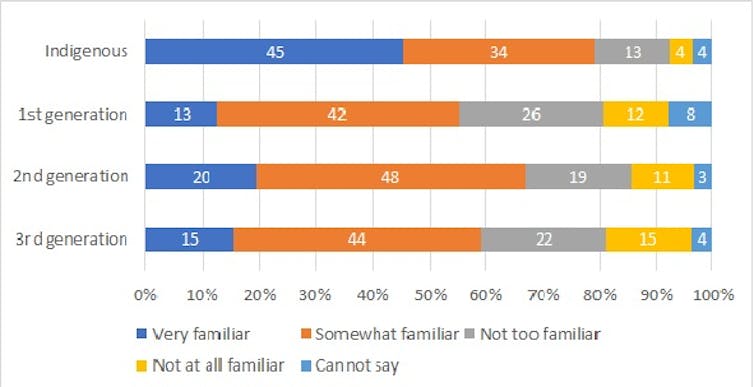
  1. How familiar do you feel you are with the history of Indian Residential Schools in Canada?
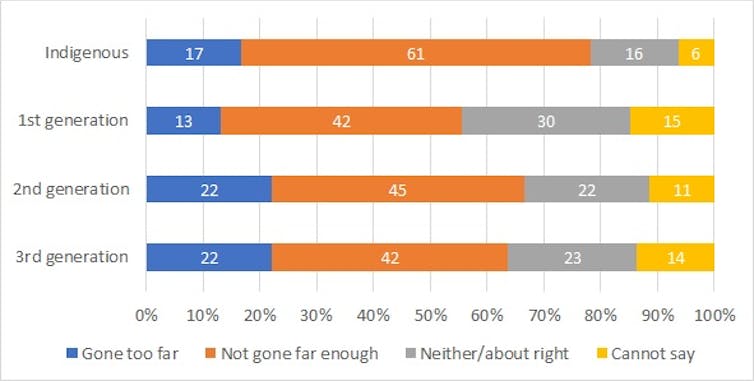
  2. In your opinion, have governments in Canada gone too far or have they not gone far enough in trying to advance reconciliation with Indigenous peoples?
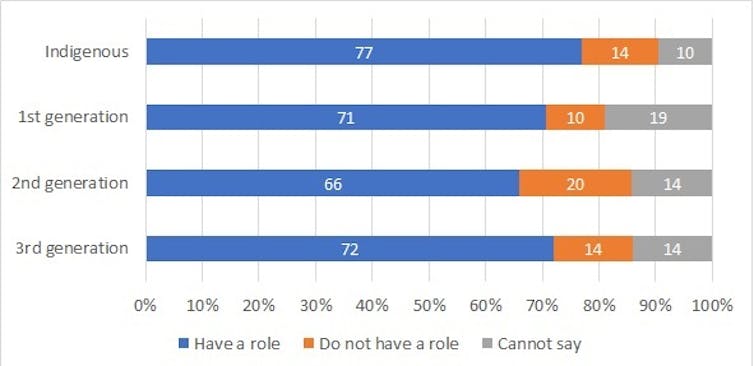
  3. Do you believe that individual Canadians do, or do not, have a role to play in efforts to bring about reconciliation between Indigenous and non-Indigenous people? 

The survey results generally show that, despite less familiarity or certainty about these issues among new immigrants compared to those born in Canada, they are more likely to support Indigenous Peoples.

Gap in knowledge

The survey shows a big gap between how familiar Indigenous Peoples and non-Indigenous people — both immigrants to Canada and non-immigrants — are with the history of Indian Residential schools.

The findings suggest first-generation immigrants are less likely than non-Indigenous Canadians to say they’re “very familiar” with this history, and are more likely to express no opinion.

These results indicate that first-generation immigrants don’t know as much as other Canadians about the history of Indian Schools in Canada. It is notable, however, that second-generation Canadians are more likely than third-generation Canadians to feel “very familiar” with the history of Indian Residential Schools.

A graph shows how familiar immigrants to Canada feel they are with the history of Indian Residential Schools in Canada compared to Indigenous Peoples.
A graph shows how familiar newcomers to Canada feel they are with the history of Indian Residential Schools in Canada compared to Indigenous Peoples. Author provided, Author provided

This lesser familiarity among first-generation immigrants, however, does not translate into lower support for efforts to advance reconciliation. 

Government response

This support is evident when they were asked about whether governments have gone too far, or not far enough, to advance reconciliation. 

The most striking difference — not surprisingly — is that Indigenous Peoples are much more likely than non-Indigenous Canadians to say that governments have failed to go far enough to advance reconciliation. 

But first-generation immigrants are just as likely to hold this view than second- or third-generation Canadians. First-generation immigrants are also less likely to say that governments have gone too far in their efforts to promote reconciliation — a result that’s significant when controlling for education (which is an important step since first-generation immigrants are more likely to be university-educated than the rest of the population). 

First-generation immigrants are also less likely to take a definitive position either way, and are more likely to say “neither” or “cannot say.”

A graph shows whether Canadians believe governments have gone far enough in trying to advance reconciliation with Indigenous Peoples.
A graph shows whether Canadians believe governments have gone far enough in trying to advance reconciliation with Indigenous Peoples. Author provided, Author provided

The role of Canadians

Similarly, Indigenous Peoples are unsurprisingly the most likely to say that individual Canadians have a role to play in reconciliation. 

But first-generation immigrants are just as likely as second- or third-generation Canadians to hold this view (although first-generation immigrants are also more likely to have no opinion on this question). 

A graph shows whether individual Canadians have a role to play to bring about reconciliation between Indigenous and non-Indigenous Peoples.
A graph shows whether individual Canadians have a role to play to bring about reconciliation between Indigenous and non-Indigenous Peoples. Author provided, Author provided

These results are encouraging because they suggest that even if immigrants aren’t socialized in Canada at a young age, that’s not an obstacle to building understanding and support for reconciliation. 

Indigenous support for immigration

Interestingly, the survey also allows us to explore the other side of the relationship between immigrants and Indigenous Peoples in Canada, namely support among Indigenous Peoples for immigration. 

This is a potentially contentious issue. On the one hand, diverse sources of immigration in the post-Second World War period have already disrupted the narrative of Canada as a nation of two founding peoples (British and French). That in turn suggests a view of Canada that is not only multicultural but multi-national, and inclusive of Indigenous Peoples and nations. 

In this sense, the interests of immigrants and Indigenous Peoples could be aligned. But at the same time, the ongoing arrival of newcomers can be seen as a continuation of the settler/colonization process. 

Thoughts on immigration

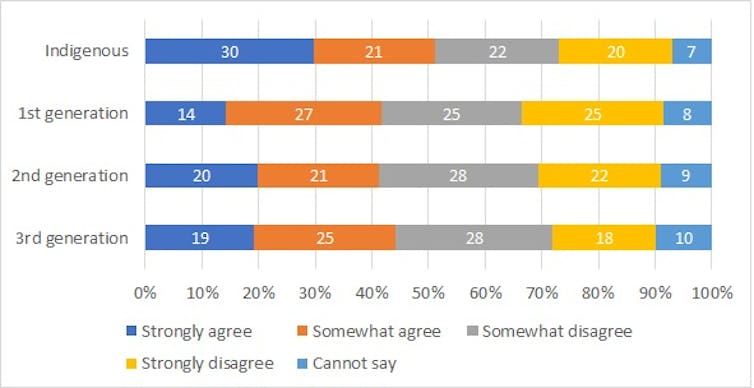
We can explore this issue by referring to a question in the survey asking Canadians whether they agree or disagree that “overall, there is too much immigration to Canada.” 

The results show that there are significant differences in attitudes about immigration between the general population and Indigenous Peoples. Thirty per cent of Indigenous peoples “strongly agree” with the statement, the highest proportion among all groups. 

A graph shows whether Canadians and Indigenous people believe there is too much immigration to Canada.
A graph shows whether Canadians and Indigenous people believe there is too much immigration to Canada.Author provided, Author provided

However, this general difference about immigration levels is driven in large part by the difference in views between Indigenous Peoples and first-generation immigrants. While Indigenous Peoples, compared to first-generation immigrants, are more likely to strongly agree than strongly disagree that there is too much immigration to Canada, there are no statistically significant differences between Indigenous Peoples and second- or third-generation Canadians.

This suggests that the key factor influencing attitudes towards immigration might not be Indigenous identity, but being born in Canada.

Nonetheless, this finding is important because it’s a reminder to proponents of more immigration that they should be open to and engage with Indigenous Peoples’ perspectives on this issue. Immigration, as a policy objective, should be pursued with an eye on how it might be perceived by those who were displaced by the earlier arrival of settlers.

Source: Newcomers to Canada are supportive of Indigenous Peoples and reconciliation

Who voted for the People’s Party of Canada? Anti-vaxxers and those opposed to vaccine mandates

Preliminary analysis. Will be interesting to see what others come up with such as the Canada Election Study. As it is likely that COVID and vaccination will not be a top issue (we hope!) in the next election, likely the PPC will focus on immigration and other related issues, and their advocacy for more restrictive policies:

At first glance, the 2021 federal election appears to have changed very little. Each party was returned to the House of Commons with about as many seats as it had previously held. 

Beneath the surface, however, some shifts occurred. Most notably, while the People’s Party of Canada failed to win any seats, its share of the popular vote grew to five per cent — more than double what it earned two years earlier.

The PPC’s support is small yet not easily dismissed. The 841,000 votes it earned makes it the fifth most popular party in the country, well ahead of the Greens (who have appeared on the ballot, addressing the prominent issue of climate change, for decades). The People’s Party won three times more votes than the Reform Party did when it first fielded candidates in 1988, one election prior to its breakthrough in 1993.

Understanding exactly what to make of the PPC’s growing support is especially important for the leadership of the Conservative Party of Canada. If PPC voters are former Conservative supporters disappointed with the party’s attempt to appeal to middle-of-the-road, suburban Canadians, it signals a serious dilemma — each voter the Conservatives gain by moving to the centre could be matched by a right-leaning voter lost to the PPC.

PPC voters bemoan ‘loss of freedom’

What, then, do we know about PPC voters? At first glance, our fall 2021 survey shows PPC voters have the profile many would expect. They’re dissatisfied with the way things are going in our country today, feel the economy is getting weaker, think there are too many immigrants coming to Canada who don’t adopt the country’s values and hold a favourable opinion of the United States.

Yet these opinions do not really set them apart. Most Conservative Party supporters also hold these views. What does distinguish current PPC voters is their views on the COVID-19 pandemic, and specifically on the issue of vaccination, vaccine mandates and vaccine passports. 

Our survey, conducted during the 2021 election campaign, asked Canadians to identify the most important problem facing the country today. 

Both Liberal and Conservative Party supporters were most likely to mention the COVID-19 pandemic in general. Climate change was most likely to be mentioned as the most important problem by NDP, Bloc Québécois and Green Party supporters. 

But for PPC supporters, the No. 1 issue was the loss of freedom stemming from vaccine mandates — a concern barely mentioned by anyone who supported other parties. 

A more rigorous analysis of the survey results, which tests the significance of different factors while holding others constant, confirms the importance of vaccination issues to current PPC voters. 

Someone who singled out “loss of freedom” during the pandemic as the most important issue facing the country had a 59 per cent chance of supporting the PPC, compared to only a five per cent chance for someone who mentioned any other issue. 

Similarly, someone who singled out “COVID-19 vaccination issues” as the most important issue facing the country had a 44 per cent chance of supporting the PPC, compared to a six per cent chance for someone who mentioned any other issue. 

Immigration not a decisive factor

This last example, furthermore, likely underestimates the impact of PPC voters’ irritation with vaccination requirements. It can be assumed that the very few number of Liberals who also singled out “COVID-19 vaccination issues” as the most important issue probably had something very different in mind — perhaps frustration with those who won’t get vaccinated — than their PPC counterparts. 

Nonetheless, the main point is clear: voters concerned about the push to be vaccinated and what they perceive as a loss of freedom during the pandemic were much more likely to vote PPC than voters concerned about anything else. 

Equally important is the finding that PPC voters stand out much less for their attitudes on immigration. The impact of immigration views on someone’s likelihood of supporting the PPC is barely significant, in stark contrast to their opinions on vaccination.

This does not mean that PPC voters are strong supporters of immigration; rather, it means simply that their views on the subject do not differentiate supporters of the PPC from supporters of some other parties — notably, the Conservatives. 

Incidentally, it should be noted these findings apply only to Canadians indicating they intended to vote for the PPC, not to the party’s leadership, organizers or funders who may regard closing our borders to newcomers as more of a priority.

A message for Conservatives

Nonetheless, the fact that the growth in PPC support is tied to the unusual issue of vaccination against COVID-19 is no guarantee that the party’s popularity will fade once the pandemic ends. Other issues may come along to take its place. 

But it does send a cautionary note to Conservatives who might be wondering what the party can do to bring PPC voters back into the fold. Rejecting new policies on climate change or social diversity is unlikely to help so long as PPC supporters continue to be motivated largely by a single issue — their opposition to vaccines. 

As the election outcome itself showed, showing flexibility on vaccine mandates in order to win back defectors to the PPC risks putting more distance between the Conservative Party and the mainstream of Canadian public opinion

In short, PPC voters were not simply typical Conservative supporters leaning furthest to the right on a range of issues that include government spending, taxation, climate change and immigration. They were, on average, a unique cluster of voters who have rejected the overwhelming public consensus on the need to be vaccinated to contain the spread of COVID-19.

The growth potential for the Conservative Party lies not in chasing the small number of voters angered by vaccine mandates, but in appealing to the much larger pool of voters whose top priorities include bringing the pandemic to an end and refocusing attention on the fight against climate change.

Source: https://theconversationcanada.cmail19.com/t/r-l-triyyhjl-kyldjlthkt-n/

Canadians increasingly pessimistic about progress on racism and equity, survey finds

Useful redoing this survey after two years to help understand the change and evolution of public attitudes. Interesting difference between perceptions and general stability regarding reporting of racism save for Chinese and South Asians:

A growing number of Canadians say the state of race relations in the country is poor, with Black and Indigenous people the most likely to say issues around racism are worsening.

Those findings are among the results of a nationwide survey released today by the Canadian Race Relations Foundation (CRRF), a Crown corporation dedicated to the elimination of racism.

The survey, conducted in partnership with the Environics Institute, found that 23 per cent of respondents chose “generally bad” when asked how well people of different races get along in Canada, up from 17 per cent when the CRRF conducted the same survey in 2019.

Source: Canadians increasingly pessimistic about progress on racism and equity, survey finds

Link to report: https://www.crrf-fcrr.ca/en/news-a-events/articles/item/27441-race-relations-in-canada-2021-a-survey-of-canadian-public-opinion-and-experience

Canada needs more immigrants — and not only for the economy

Good nuanced commentary and the need for a broader lens than just demographic and economic:

There’s a problem in persistently defining immigrants as economic drivers that will take Canada to a more prosperous place.

It’s not that the pitch is wrong.

It’s that it is myopic, and it’s pushing Canada to evaluate the movement of people as a pure dollars-and-cents exercise. And that’s short-sighted at a time when we need all the compassion we can get.

Canadians’ impressions of their country as an open and tolerant nation that thrives on diversity have been deeply challenged over the past two weeks — first with the discovery of the remains of 215 children in unmarked graves at the site of a former residential school in Kamloops, B.C., and then by what police say was an intentional attack on a Muslim family in London, Ont. that left four people dead.

“There’s a growing feeling that we aren’t holding together as best we should,” says Sen. Ratna Omidvar, a vocal proponent of ramping up immigration — and in a way that is not just about economics.

“We need to be more intentional about social cohesion,” she says.

Repeatedly making the case for increasing diversity almost solely on an economic basis doesn’t help — as the federal Liberals themselves used to sense.

In 2016, a group of influential economic advisers led by Dominic Barton, now Canada’s ambassador to China, came up with a list of strategies to ensure Canada’s prosperity over the long term — a list that carries weight to this day. Barton told the federal Liberals that among other things, they should dramatically ramp up immigration as a way to propel Canada’s economy forward

A few cabinet ministers thought it was a great concept at first, but even as the Liberals embraced most of Barton’s other growth recommendations, they eventually balked at the idea, unsure of their ability to sell the public on a complex argument.

Five years later, however, not only are they making the argument, it’s almost to the exclusion of anything else when it comes to immigration. And yes, it’s complex.

Canada’s economy isn’t growing fast enough to maintain our standard of living and fund all the social safety nets we have come to expect, it goes. Plus, labour shortages are all around us, and if they’re not here now, they soon will be.

Since Canadians are retiring faster than they can reproduce, we need to replenish the workforce and bolster the financial foundation of our social safety net by adding many, many more immigrants.

The pandemic set us back in our immigration plans because of closed borders, but the federal government is now actively making up for lost time and then some — a key plank in the recovery strategy. The economic messaging is central — everywhere in Immigration Minister Marco Mendicino’s comments in the House and speeches to the public, the policy documents issued through the immigration department and the pitches Liberal MPs make to their constituents. 

Immigrants create small businesses, fill job vacancies, make our health-care system work, spend money, and support their children to make more money than they did, the message goes.

While Omidvar makes those arguments herself, she says there’s a danger in thinking narrowly.

“You make it about one thing only,” she says. “We have turned immigration into too much of a transactional experience.”

She talks about her own experience moving to Canada from Iran in 1981 and finding her way by joining a local gardening club and planting daffodils with her neighbours.

While she appreciates all the politicians’ speeches about diversity and inclusion in the wake of the London attack, she warns that social cohesion — an essential for quality of life, economic and beyond — comes from a community-based, proactive approach and not the reactive approach she has seen on display over the past couple of weeks. And that means a focus on immigrants as whole people who are valuable members of our communities.

Economist Mikal Skuterud, a professor at the University of Waterloo, doesn’t buy many of the economic arguments around immigration that the federal government is making these days. “It’s hyperbolic, it’s completely exaggerated, and it’s not honest in a lot of cases,” he says.

He argues that immigration could bolster Canada’s prosperity if newcomers are more productive than existing workers, but that’s not always the case. He also points out that if immigrants have the same age distribution as the existing workforce, they won’t do much to change the way the labour force pays for a growing contingent of retirees.

But he does agree with Omidvar that it’s important to evaluate immigration on factors that go well beyond labour and economics, especially if we want to enrich our culture and not just our wallets.

Public opinion polling suggests that Canadians generally view immigration as beneficial to Canada, but the top reasons people give for being pro-immigration are around diversity and multiculturalism. Contributions to the economy come second, says Andrew Parkin, executive director of the Environics Institute for Survey Research. 

For the sake of social peace, perhaps our political rhetoric should take its cue from the public in this case.

Source: https://www.thestar.com/politics/political-opinion/2021/06/10/canada-needs-more-immigrants-and-not-only-for-the-economy.html

Working from home is here to stay — and for some Canadians, that’s a big problem

Good highlighting of the inequalities between those able to work from home and those not, mainly younger, visible minority or immigrant workers with lower income. Working from home appears to be a good overall proxy for privilege and class:

Working from home has a bright side for a lot of us, and we really hope it will outlast the pandemic.

No morning commute, no mad scramble out the door with packed lunches and wet laundry left in the machine to grow mildew all day, no race at the end of the day to tie up all the loose ends before rushing home to make dinner.

But that’s not the case for everyone, and new research shows working from home over the long term is often far less than ideal for young workers, immigrants, racialized workers and people living with disabilities.

In other words, the very same people who have been at the sharp end of the stick during the pandemic now risk being thrust into a precarious situation yet again in a post-pandemic world where working from home becomes a norm.

We can decide right now not to do that.

The Environics Institute teamed up with the Future Skills Centre and Ryerson University’s Diversity Institute to figure out what the workforce of the future looks like and how COVID-19 has disrupted so much. They surveyed almost 5,400 people across the country on what their work-from-home experience has been like, and they also dug down into how age, race, immigrant history and income make a difference. 

And they do make a difference — both during the pandemic and, if the survey is a good indication, afterwards too.

Generally, those of us who are working from home are content with the way things are going, and hope to be able to continue spending at least a couple of days a week in our home offices when the pandemic winds down.

“There’s no going back,” says Andrew Parkin, executive director of the Environics Institute.

The stigma of working from home from time to time has dissipated now that so many people have shown it can be done without compromising quality, he added, and employers will need to figure out how to incorporate work-from-home arrangements over the long term.

Of course, not everyone has shared in that experience during the pandemic. As we know, it’s been mainly white-collar workers who have been able to set up shop at their kitchen tables. About half of us have been going into the workplace regularly throughout the pandemic, while 36 per cent of us have been able to work from home full time, according to a report published last week by the Canadian Chamber of Commerce and Abacus Data. 

Low-income workers, people of colour and young people have been more likely to have to keep going into their traditional workplaces. They’ve also been most likely to lose their jobs during the pandemic, according to employment data over the past few months. They’ve had a harder time getting back into the workforce. And they’ve also been more likely to be on the front lines of contagion, holding down essential jobs in taking care of the rest of us.

And now, because their jobs are more precarious, they face more uncertainty about how a work-from-home culture that outlasts the pandemic will benefit them. Doing without frequent face time with colleagues, bosses and networks does not sit well with those who have a fragile connection to their workplaces.

“While it’s reassuring to confirm that many workers in Canada have altered their work arrangement in order to minimize the risk of contracting and spreading COVID-19, these survey results serve as an important reminder that the ability to do so is closely tied to one’s socio-economic situation,” states the Environics report obtained by the Star.

Young people, for example, say they like working from home and can maintain the quality of their work there. But they’re also more worried than others that working from home will hurt their career prospects — which are already hurting because the pandemic has knocked their employment levels severely.

The same fear is expressed by first- or second-generation immigrants as well as racialized workers, and they, too, have seen more of their jobs disappear during the pandemic.

On top of that, immigrants and racialized workers also say, more than others, that they aren’t properly equipped to work from home, and they’re worried the quality of their work has deteriorated.

Workers with disabilities are also far more likely to say they don’t have the right equipment to work from home.

The implications for post-pandemic work are far-reaching. Business groups have emphasized the need to make sure workplaces are safe to return to, with whatever personal protective equipment and health measures are needed to assure employees aren’t going to get sick.

But the new research shows it’s a lot more complex than that. Some people won’t want to come back, but at the same time, a full embrace of a work-from-home culture will penalize those who are already facing intimidating barriers to their careers and futures.

“The key word is flexibility,” says Parkin, pointing to a need to rethink office space and work flow to make sure a range of needs are accommodated.

We have a few months left of lockdown, constraint and forced work-from-home conditions before we have more options open to us in the world of work. Let’s use them to ensure the reopening is done carefully, giving a fair opportunity to those workers who have already paid such a steep price.

Source: https://www.thestar.com/politics/political-opinion/2021/04/12/working-from-home-is-here-to-stay-and-for-some-canadians-thats-a-big-problem.html

Changing social norms is the key to addressing racism

Good piece by Michael Adams and Keith Neuman:

When the COVID-19 pandemic began to spread in North America last March, it was hard to imagine anything else capturing a large share of public attention in the ensuing months. And then, in May, video footage of the horrific killing of George Floyd at the hands of the Minneapolis police ignited a blaze of protest that spread across the United States and also Canada, a country with its own history of colonialism and racism. The depth of the reflection and conversation – public and private – provoked by the protests was unprecedented. For the first time, many of this country’s leaders unequivocally acknowledged the existence of systemic racism in Canada, and reflected the predominant public sentiment. Our own research shows that a significant majority of Canadians now recognize the reality of racial discrimination in this country, especially as it affects people who are Indigenous and Black.

Such recognition of racism in our society is a significant milestone, long in coming. Doing something about it becomes the next step, and represents an even greater challenge given how deeply such prejudice is embedded in Canada’s dominant culture and institutions. Evidence of its pervasiveness confronts us both in personal anecdotes and in hard data on racial disparities across many areas of society – from policing and health to education and social welfare.

It is commonly believed that the biggest obstacle to meaningful change is our inability to recognize our own racial prejudices. The prevalence of unconscious racism or “implicit bias” has been well documented by American social psychologist Jennifer Eberhardt (in her seminal book, Biased) and others. Some have responded by taking steps to make the implicit explicit through education generally, and diversity and anti-racism training in particular. Governments and corporations have invested in programs to teach employees about bias and stereotypes, hoping that raising consciousness will change attitudes, assumptions and behaviour. But the evidence is emerging that this strategy is not effective in producing lasting change, as recently reported in a meta-analysis of close to 1,000 studies of anti-bias interventions.

Efforts to reduce bias through education and training may simply not work because it is impossible to change people’s ingrained mindsets and emotions, at least in the short term. A more promising avenue to consider is the social context in which people operate when they interact with others. Implicit in diversity training is the idea that racism is fuelled mainly by what people know and think, but what matters more is what people say and how they behave in the presence of others. Outward expressions of racism are governed in large part by collective social norms about acceptable behaviour. The term “norms” sometimes gets mentioned in the context of problematic content on social media, but what has yet to receive any serious attention is the concept of “social norms” as a fundamental aspect of society that contributes to the systemic nature of racism and where we might focus to address the problem.

Social norms are widely held expectations about what is, and is not, acceptable to say and do in particular situations. What is distinctive about such norms is that they are not defined by what people think is important to them personally, but by what they see as the social expectations of others whose opinions matter to them. As such, norms exert a powerful influence on how people act in public and social situations, quite apart from what they may think or feel inside.

These norms are typically well entrenched, but do change over time. The Holocaust led many people to decide it was no longer acceptable to articulate anti-Jewish stereotypes. The growing awareness of LGBTQ individuals in society and the legislative endorsement of same-sex marriage both improved attitudes and also made it no longer socially acceptable to trade in homophobic slurs. Many people may still harbour negative views about Jews and LGBTQ people, but most now understand it is no longer okay to express them.

Sometimes social norms change as a result of intentional efforts. Arguably the most striking example is the successful campaign to change norms around tobacco use in public. Just over a generation ago, smoking in public was common, even cool. Today, the behaviour has become effectively “denormalized” as inconsiderate and self-defeating, even as a significant proportion of the population continues to smoke in private. Regulatory measures that restrict smoking in public settings are also important, but it is the norms more than the laws that govern behaviour. By contrast, consider jaywalking, which is also legally forbidden but widely socially accepted.

Social norms play a key role in the dynamics of racism and prejudice because they establish the boundaries around which people act toward those they see as “other.” While internal attitudes and stereotypes are stubbornly resistant to short-term change, action and speech are more amenable to influence and normative pressures. This means that focusing on social norms can be an effective strategy for addressing racism in a meaningful way – especially if the collective norms against intolerance and discrimination are strengthening, which now appears to be happening. Evidence for this can be found in the recent public condemnation of wearing “blackface” in costume, which in a different era was considered by many to be harmless party attire.

There is nothing new about the concept of social norms, which social scientists have studied in academic settings and applied to public health challenges in developing countries. What has been missing is the practical application of this science to important societal problems such as racism, as well as other pressing challenges such as promoting physical distancing during a pandemic. The essential starting point is to first properly define and measure specific social norms about race-related actions and speech in order to determine their breadth and strength across the population (a type of research our institute now plans to undertake). Such information can then point to where interventions might be directed – to reinforce “positive norms” that are currently prevalent in society (no wearing of blackface) and de-normalizing “negative norms” (e.g., telling jokes that demean the “other”). This might take the form of public awareness campaigns (as was done to de-normalize public smoking) or employee-directed programs. Government and corporate leaders might be effective communicators of appropriate normative behaviour, to the extent they are credible and can exert influence over relevant audiences (which research might confirm).

Today in Canada, our understanding of the current reality of racial injustice is at odds with our stated aspirations of justice and inclusion. This tension provides us with a valuable opportunity to create a more just society by developing new strategies that effectively apply normative pressures on each other to do a better job of treating each other as we ourselves expect to be treated.

Source: https://www.theglobeandmail.com/opinion/article-changing-social-norms-is-the-key-to-addressing-racism/