Immigration has taken a back seat in this election, and business is pleased

More on the biggest (non) surprise in the election campaign:

In the waning days of the last Parliament, Canada’s CEOs publicly called on the country’s political parties to keep immigration off the table in this fall’s election campaign.

Their wish came true, more or less, until this week.

With Alberta Premier Jason Kenney bursting into the suburbs around Toronto on the weekend, and the presence of People’s Party Leader Maxime Bernier at the English-language leaders’ debate on Monday, what had mostly been a discussion at the riding level finally emerged nationally.

But the worst fears of the business community have not materialized.

Rather than degenerating into an anti-immigrant brawl with racist overtones, the discussion has been rational and measured for the most part, with Bernier’s opponents labelling his call for lower immigration levels as irrational and intolerant.

Canadian business leaders had looked at the anti-immigration sentiment developing in the United States. They looked at some of the backlash in Canadian politics as thousands of asylum-seekers walked across the border from the U.S. And they looked at the state of their workforces, their need for labour and the projections for growth going out a few years into the future.

They didn’t like what they saw.

“We are 10 years away from a true demographic pressure point,” Business Council of Canada president and CEO Goldy Hyder told reporters in April. “What I’ve said to the leaders of the political parties on this issue is, ‘Please, please do all you can to resist making this election about immigration.’ That’s as bluntly as I can say it to them.”

Business leaders and many economists argue that Canadian immigration levels need to rise if the economy is to grow fast enough to support a burgeoning number of seniors into retirement. Without increased immigration, the workforce won’t expand, and the number of people depending on that workforce for benefits and supports will be insufficient.

The Liberal government admitted 310,000 immigrants in 2018, with a goal of 350,000 by 2021. About 58 per cent of those are meant to be economic migrants, selected to meet federal and provincial labour needs.

Bernier proposes to cut that number to 150,000, and polling over the past few months suggested he might have the ear of a growing minority of voters.

But instead of taking the bait, as business leaders feared, the other parties were steadfast. Bernier’s federalist opponents found a rare moment of agreement on Monday night, with all of them expressing support for increasing immigration levels.

It actually started last week, when Conservative Leader Andrew Scheerblurted out in a television interview that yes, he would support the Liberals’ general immigration plan.

“That’s a legacy that I’ll continue to build on,” Scheer told the CBC, explaining that an open and inclusive immigration policy is crucial for a growing population and a healthy workforce. Canada’s role as a safe haven for migrants is something to be valued, he added.

Scheer also said a Conservative government would find better ways to allow temporary foreign workers to stay at length in Canada and become permanent residents — a boon to employers looking to bolster their staffing over the long term.

While the business community may have its wish of no bitter immigration debate, it comes with a side effect: there is also very little discussion around how to improve the integration of immigrant workers so their skills are put to best use.

Meanwhile, there are signs the immigration discussion is not always so genteel at the riding level, and some Conservative promotional material has been more aggressive in attacking the way the Liberals have handled refugees. Kenney played into that sentiment last weekend in a tour through an array of diaspora gatherings around the GTA.

When the Conservatives were in government, he said in Richmond Hill, “we sent a message that if you wanted to come to Canada, you should come legally through the front door, waiting your turn in line, not sneaking around it by cutting the queue.”

And the Scheer campaign has issued bumper-sticker style social media slogans urging a fairer immigration system.

While that’s a far cry from the anti-immigrant backlash that the business community feared, corporate Canada has not exactly seen all of its campaign dreams come true.

Global growth is slowing, free trade patterns have been deeply disrupted by U.S.-China tensions, and Canada’s prospects are anemic. In a new forecast from the Conference Board of Canada on Monday, economists pegged Canada’s gross domestic product to expand by just 1.6 per cent this year, despite a pace of nearly four per cent in the second quarter. The culprits? Global trade, hesitant business investment in Canada, and exports.

The longer term challenges for Canadian growth are equally troubling, with the prospects of widespread automation, a world turning away from fossil fuels, and an aggressive knowledge-based economy on the horizon.

But if the discussion around immigration at the national level is practical and pro-business, the discussion around Canada in a rapidly changing economy is nearly absent.

Source: Immigration has taken a back seat in this election, and business is pleased

Bernier challenged over ‘extreme multiculturalism’ tweet during leaders’ debate

For the record:

People’s Party of Canada Leader Maxime Bernier was directly challenged during the federal leaders’ debate over his past comments about “extreme multiculturalism” and the effects diversity has on Canada.

Debate moderator Lisa LaFlamme read several of Bernier’s past tweets about immigration and diversity aloud, challenging the leader over his use of the words “ghettos” and “tribes” in describing new immigrants to Canada.

LaFlamme also pressed Bernier over his concerns that newcomers bring with them “distrust” and “potential violence.”

“Are these the words of someone with the character and integrity to lead all Canadians and represent us on the world stage?” LaFlamme asked.

“You must tell the truth to Canadians if you want to be the leader of this country,” Bernier said.

“What I’m saying about extreme multiculturalism, it is not the way to build this country. Yes, this country is a diverse country and we must be proud of that, but we don’t need legislation like the Multiculturalism Act to tell us who we are.”

Bernier has campaigned on a promise to significantly reduce immigration levels to Canada. He says the number of people allowed to enter the country as permanent residents should be cut in half — to about 150,000 new immigrants a year.

“We must have fewer immigrants in this country to be sure for these people to participate in our society,” he said.

Other leaders respond

NDP Leader Jagmeet Singh was quick to attack Bernier on his past positions regarding immigration, calling his tweets “pretty horrible.”

“It should come as no surpise to you that I believe a leader is not someone who tries to divide people or to pit people against each other. A true leader is someone who tries to find bridges, bring people together,” Singh said.

Conservative Leader Andrew Scheer also criticized Bernier.

“What Mr. Bernier fails to understand is that you can absolutely be proud of Canada’s history, you can be proud of our identity, be proud of the things we’ve done and accomplished in the world, while at the same time welcoming people from all around the world,” he said.

Scheer also said Bernier had changed from someone who used to believe in an immigration system that was fair, orderly and compassionate to someone who bases his policies on the number of likes and retweets he gets on social media from the “darkest parts of Twitter.”

Green Party Leader Elizabeth May also called Bernier’s past comments about immigration “completely appalling,” while Bloc Québécois Leader Yves-François Blanchet asked Bernier if he realized that his own family decended from immigrants.

Liberal Party Leader Justin Trudeau said polarization and fear over immigration issues has become “easy currency for politicians who do want to strike up uncertainties in peoples hearts.”

He said Bernier is “playing a role” to make people more fearful about migration, globalization and what it means to be Canadian.

Bernier, meanwhile, defended himself against the other leaders, saying he’s not a “radical” because he believes in lower immigration levels.

Source: Bernier challenged over ‘extreme multiculturalism’ tweet during leaders’ debate

Experts surprised immigration didn’t play more prominent role in federal leaders’ debate

I was less surprised than those listed, as the parties have (correctly) calculated that making immigration a major issue has electoral risks in ridings with large numbers of immigrants and visible minorities (905, BC’s lower mainland, and elsewhere), as Kurland and Smith note.

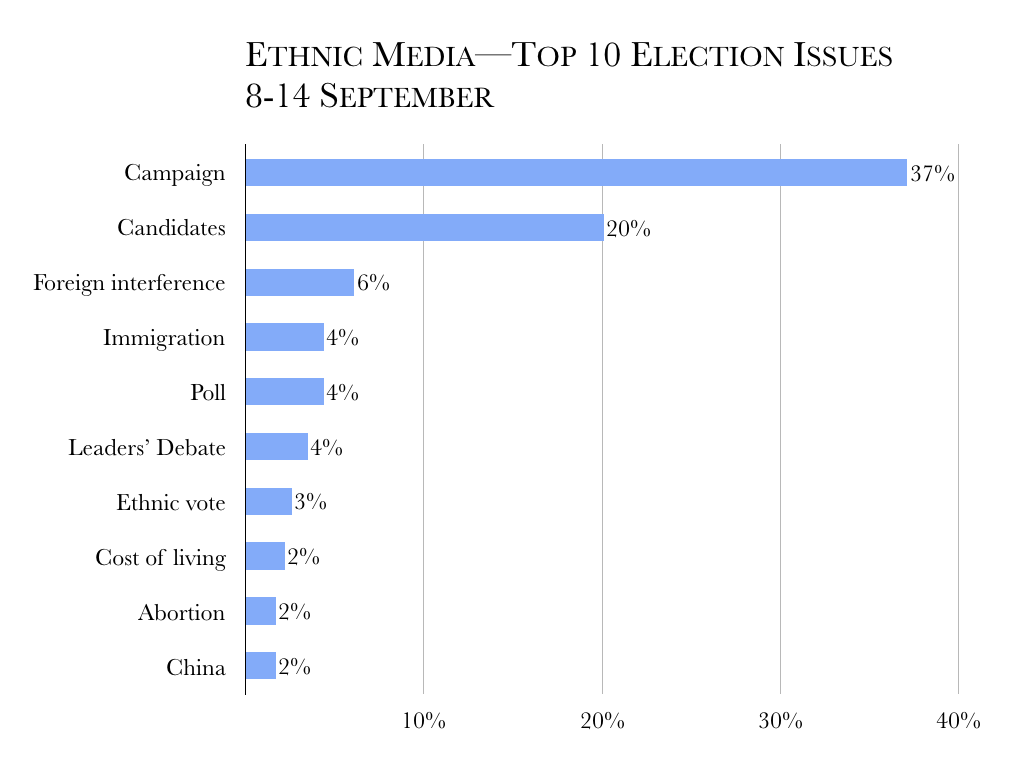
The same could be said for the campaign in general, although immigration issues get more play in ethnic media as my weekly analyses for diversityvotes.ca shows.

Apart of course from the PPC:

Excluding an early question that provoked a barrage of attacks against People’s Party Leader Maxime Bernier, Monday night’s leaders debate featured few questions about immigration — and none about refugees, specifically.

This left some migration experts feeling surprised and disappointed that immigration issues — which have been the source of heated political exchanges in Canada over the past two years — didn’t play more prominently in the debate.

“There was no substance on immigration policy, on Canada’s refugee policy, on Canada’s role in the world on these issues,” said Queen’s University law professor Sharry Aiken.

“I was disappointed that there wasn’t much there.”

Aiken says that the section of the debate dedicated to “polarization, human rights and immigration” focused almost entirely on Quebec’s contentious Bill 21, the religious symbols ban that bars religious head coverings in some sections of the public service, and that immigration issues were overshadowed by the discussion about discrimination.

The rising rhetoric around refugees is fuelling many falsehoods about whether these new arrivals pose a threat

The rising rhetoric around refugees is fuelling many falsehoods about whether these new arrivals pose a threat

Aiken believes discussing Bill 21 is very important, but she thinks debate moderators could have been better at focusing their questions on specific issues, such as the recent challenges faced by Canada’s asylum system.

The standout moment for Aiken on immigration was Bernier’s claim that Canada takes in more immigrants than any other western nation.

Aikeen says this claim is untrue. Citing a recent report from the World Economic Forum, she says Australia has a higher ratio of immigrants — 28 per cent of its population compared to Canada at 21 per cent.

She also questions Bernier’s math about letting in more economic immigrants. Bernier has claimed Canada should reduce immigration levels to 150,000 a year, while at the same time taking in more economic immigrants.

But in 2017, Canada accepted roughly 159,000 economic immigrants, she said. If Bernier’s immigration policy was implemented, Canada would actually see an overall reduction in economic immigration.

Meanwhile, Sean Rehaag, director of York University’s Centre for Refugee Studies, was also surprised by the fact that “a debate where immigration was expected to play a major role” had so few questions about immigration.

He noted that neither the influx of irregular border crossings that began in April 2017 nor the Safe Third Country Agreement between Canada and the United States figured prominently in the debate.

This is also one of the issues where the parties have distinct policy options when it comes to how Canada should handle its asylum system.

No ‘political capital’ to be gained on immigration

Others were less surprised that immigration wasn’t a bigger topic for party leaders.

Richard Kurland, a Vancouver-based immigration lawyer, thinks the lack of attention on immigration means political parties have decided that no “political capital” can be gained from this issue.

“It was a good move on the part of all the parties not to go there,” Kurland said.

Craig Damian Smith, director of the Global Migration Lab at the Munk School of Global Affairs and Public Policy in Toronto, agrees that it was wise for the leaders not to focus on immigration, particularly the divisive issues around refugee resettlement and how to handle irregular migration at unofficial ports of entry.

Scheer claims asylum seekers are ‘skipping the line’

Like Kurland, Smith thinks the party leaders have realized that immigration isn’t an issue where voters can be won or lost.

This doesn’t mean immigration isn’t important, Smith said. It just means that when it comes time to vote on Oct. 21, he believes most Canadians will be focused on issues like health care, education and the economy.

Smith also pointed out what he saw as a significant moment in the debate — that is, when Conservative Leader Andrew Scheer lashed out at Bernier for his past comments about immigrants, saying Bernier had changed from someone who used to believe in an immigration system that was fair, orderly and compassionate to someone who bases his policies on the number of likes and retweets he gets on social media from the “darkest parts of Twitter.”

According to Smith, this “well-rehearsed” line shows that the Conservatives now realize Canadians, on average, support the country’s current approach to immigration.

Smith still thinks that who wins the election could have big consequences on the future of immigration in Canada — especially for refugees — but in Monday’s debate, at least, it looked like everyone other than Bernier agreed immigration is important to Canada’s future.

“Even when they had the section on polarization, human rights and immigration, they all took that opportunity to steer it towards other issues, either to attack one another or to bolster their own position on other issues,” he said.

“It’s a good thing, or it’s at least a good sign, that they decided to steer the debate away from [immigration] because it means that that’s not going to be an issue that Canadians are going to vote on.”

Source: Experts surprised immigration didn’t play more prominent role in federal leaders’ debate

Liberals step up attacks with 2 weeks left, but Conservative campaign most negative, data shows

Nice to see this kind of social media analysis. But depressing the reliance on negative attacks by both major parties:

The Conservatives lead other major federal parties in the amount of negative attacks on Twitter and in press releases this campaign, but at the midpoint of a close race the Liberals are increasingly turning negative, an analysis by CBC News shows.

CBC News analyzed more than 1,800 press releases and tweets from official party and party leader accounts since the start of the campaign. We categorized them as either positive, negative, both positive and negative or neutral. (See methodology below.)

Overall, the Conservatives have put out the highest volume of negative communications to date, the analysis revealed. The party tends to put out communications attacking the Liberals about as often as they promote their own policies.

That doesn’t mean the Conservatives were the only party to go negative early on. At the outset of the campaign, the Liberals went after Conservative Leader Andrew Scheer on Twitter for his 2005 stance on same-sex marriage and other Conservative candidates for anti-abortion views or past social media missteps.

But almost half (47 per cent) of Conservative communications have been negative or partly negative. The share of negative messages is 37 per cent for the NDP, 26 per cent for the Liberals, 18 per cent for the Greens and 13 per cent for the Bloc Quebecois, which has run the most positive campaign.

Liberals, NDP step up attacks

While the Conservatives have been consistently negative since the start of the campaign, other parties have become markedly more so in the last two weeks.

The uptick in attacks appears to be driven by two factors: the climate marches across the country on Sept. 20 and 27 and the French-language debate hosted by TVA on Oct. 2.

The NDP and Greens took aim at the Liberals’ environmental record around the time of the climate marches. It was also during the last week of September that the Liberals announced a number of environmental policies they would enact if re-elected, which were promptly criticized by the NDP and Greens.

The tone of Liberal communications turned markedly critical during the TVA French-language debate on Oct. 2. This was the first debate Liberal Leader Justin Trudeau took part in, and the Liberal war room put out press releases and tweets countering statements made during the debate by Scheer and the Bloc Quebecois’ Yves-Francois Blanchet.

The TVA debate also marked the first instance during the campaign of the Liberals targeting a party other than the Conservatives with critical tweets and press releases. The party took the Bloc leader to task over his environmental record, among other things.

Liberals the target of most attacks

The Liberals were the target of more than two-thirds (70 per cent) of negative or partly negative communications.

The Conservatives have yet to target a party other than the Liberals with a critical press release or tweet.

The Liberals also have been the primary target of the NDP and, to a lesser extent, the Greens.

While these two parties may be closer ideologically to the Liberals than to the Conservatives, the NDP and Greens are focused on stopping progressive voters from rallying around the Liberals. University of B.C. political science professor Gerald Baier said this reflects a coordination problem on the centre-left.

“The NDP and Greens, I think, would presumably prefer the Liberal record on the environment to what the Conservatives would do, but at the same time their main points are against the existing government,” he said.

The lack of Liberal attacks on the NDP and the Greens is telling, Baier said.

“It suggests that they know that their path to a majority to some degree is to appeal to some of those NDP and Green voters,” he said.

It also could be because the Liberals may need the support of those parties to govern in a minority Parliament, Baier added.

NDP and Green attacks against the Liberals have focused largely on the environment, while the Conservatives have zeroed in on themes of accountability, taxes and spending.

Environment, taxes the two biggest themes

Much of the official party communications focus on the campaign trail, specific candidates and where the party leaders are.

The two policy exceptions are the environment — a popular subject for all parties except the Conservatives — and tax policy, on which the Conservatives have focused. Affordability and housing are also common themes.

Methodology

CBC News analyzed every press release and tweet from official party and party leader accounts since the start of the campaign. We categorized each communication as positive (if the focus was promoting a party’s own policies or candidates), negative (if the focus was criticizing another party), both positive and negative (if the communication was equally split between the two) or neutral (leader itineraries, event announcements). We also kept track of the topics of communications and who, if anyone, was targeted.

We did not include retweets and treated identical tweets in English and French as one communication.

To keep the project’s scope manageable, the methodology excludes other platforms such as Facebook, YouTube, radio, television and print ads.

Source: Liberals step up attacks with 2 weeks left, but Conservative campaign most negative, data shows

Ethnic media election coverage 29 September to 5 October

Latest weekly analysis of ethnic media coverage. For the analytical narrative, go to Ethnic media election coverage 29 September to 5 October: UPDATE

Ridings to watch: My picks

With the election about two weeks away, virtually every media outlet has  articles and analyses of ridings to watch. with largely the same lists, based upon a mix of electoral margins and prominent candidates (i.e., Jody Wilson-Raybault).

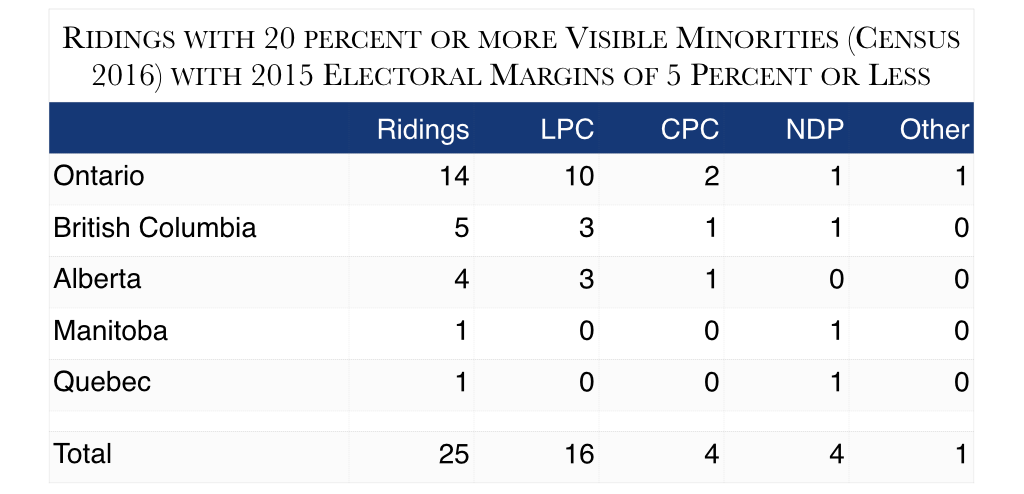
I took a somewhat different tack, taking a look at ridings where visible minorities form 20 percent or more of the population and where the electoral margin was less than 5 percent.

This provides a different perspective than simply looking at ridings that are visible minority majority (only four of these 25 ridings). Most are in Ontario, followed by British Columbia and Alberta, with only one riding in Manitoba and Quebec.

All are urban as one would expect and there is some overlap with the various lists of the media.


The full list can be found here, along with the relevant demographics and 2015 margins.

Ridings with 20 percent vismin and margins 5 percent 2015

For my series looking at those ridings with significant numbers of visible minority, European ancestry (non British or French), religious minority and Indigenous peoples, check out these data tables:

Top ridings by group

Ethnic media election coverage 22-28 September

Latest weekly analysis of ethnic media coverage. For the analytical narrative, go to Ethnic media election coverage 22-28 September:

Ethnic media election coverage 15-21 September

Latest weekly analysis of ethnic media coverage. For the analytical narrative, go to Ethnic media election coverage 15-21 September:

Ethnic media election coverage 8-14 September

Latest weekly analysis of ethnic media coverage. For the analytical narrative, go to Ethnic media election coverage 8-14 September:

Ethnic media election coverage 1-7 September

Latest weekly analysis of ethnic media coverage. For the analytical narrative, go to Ethnic media election coverage 1-7 September