The security at the New Synagogue, located in Berlin’s city center, is regrettably familiar in Germany.
The approach is well protected: A chain-link barrier keeps vehicles at a distance, two guards flank the main entrance, and a metal detector arcs over visitors’ heads. It takes about five minutes to get through.
“In the U.S. you can go into a synagogue without any kind of controls,” says Sigmount Königsberg, the commissioner against anti-Semitism for the Jewish community in Berlin. His office is housed within the synagogue. “In Germany, we hardly remember a time like this. Even when I was 10, growing up in the 1970s, there was always a police officer standing in front of the synagogue.”
Such security remains critically necessary, as anti-Semitic incidents in Germany are on the upswing. A shooting outside a synagogue in Halle captured global attention in October, but the gunman couldn’t foil security measures to enter. Metal detectors also stand at the entrance to Jewish kindergartens, primary and secondary schools, and homes for senior citizens.
Christian Mang/Reuters
Security like these police officers outside the New Synagogue in Berlin has long been used at Jewish institutions in Germany to protect from anti-Semitic incidents.
But Mr. Königsberg and other activists warn that though such measures are still needed, to root out anti-Semitism it must be fought someplace where it cannot be physically blocked: in schoolyards and classrooms. To stop an anti-Semitic hate that seems at once more aggressive and also more subtle, they say, it needs to be addressed at an early age. And that means ground zero must be schools.
“Nine of 10 children are in public schools,” Mr. Königsberg says. “You can start there.” Yet efforts to date are underfunded and a bit random; more systemic action is needed, he says.
Anti-Semitism in the schoolyard
Society-wide, the numbers around anti-Semitism are stark. Six of 10 Jews in Germany have experienced anti-Semitic “hidden insinuations,” while 9 of 10 Jews in Germany feel “strongly burdened” by anti-Semitism directed at their family, according to a 2017 qualitative study out of Bielefeld University titled “Jewish Perspectives on Antisemitism in Germany.”
Schools in Berlin have seen an uptick in incidents, reporting 41 incidents in 2018, up one-third from the previous year, according to RIAS, a monitoring agency that tracks anti-Semitic incidents.
Recently, at one Berlin public school, Mr. Königsberg says, a teacher was instructing a unit on religion. One boy offered up that he was Jewish, only to hear a classmate mutter in response, “I’ve got to kill you.” The teacher heard the remark, but did nothing to intervene, says Mr. Königsberg.
Other school situations can be understated or offhand, and even perpetrated by teachers, he adds. Take the time a Berlin public school took a field trip to the city’s Holocaust memorial. A 14-year-old Jewish girl, emotional over what she was seeing, began to sob. Her German teacher told her, “Why are you crying? It was so long ago.”
“There is no typical story, no typical solution,” says Mr. Königsberg. “Sometimes I need a lawyer, and other times I need a psychologist.”
Other times, one might need the police. A Jewish woman whose child attends an elite Berlin public school says she volunteered to run the Israel booth at the school’s international fair. She says she immediately felt uncomfortable. First, a child of about 5 years passed by and told her, “Israel is bad.” Later, as students assessed the falafel offered at the booth, several offered that the food had “nothing to do with Israel.”
Toward the end of the fair, a teenager leaned over the table to get in her face, snarling, “I wish the falafel were grenades, and that they would explode in your face.” Another parent intervened and moved the teen away from the table.
The woman visited with police over the verbal assault, but ultimately decided not to file a report. “I didn’t feel a 15-year-old should have a criminal record,” she says.
When she reported the incident to the school principal, she came away disappointed. “The issue was never raised with the community,” says the woman, who wished to remain anonymous since her child is still enrolled in the school. “Eventually the principal left. Nothing was done.”
That incident brings up the question: Where is the anti-Semitism coming from? Reporting around incidents doesn’t often include the background of the perpetrator, so good data is unavailable, says Mr. Königsberg. Yet, while it’s clear that some problems stem from increasing immigration from the Middle East, a greater hostility originates inside Germany’s increasingly vocal far-right, exemplified by the Halle shooting. The far-right is hostile to both Muslims and Jews, says Mr. Königsberg, and it’s important to tackle both. “People need to learn to accept minorities.”
Teaching teachers how to respond
Doing nothing is easiest in the face of an issue that’s “massively complex,” says Levi Salomon, lead spokesman for a lobbying group called Jewish Forum for Democracy and Against Anti-Semitism. “Anti-Semitism is the oldest form of group-targeted hatred, and 2,000-year-old stereotypes are archived in European memory. Teachers are hesitant and unclear how to deal with that history.”
On top of that, teachers are overwhelmed and overworked in the face of a massive educator shortage, says Heinz-Peter Meidinger, president of Deutscher Lehrerverband, Germany’s largest teachers association. In other words, even if there were a nationalized curriculum for addressing the issue of prejudice, there’s little time to implement it.
There are also institutional problems: Reporting an anti-Semitic incident is not universally required. “Teachers should be required to report,” Mr. Meidinger says. “I also wish that every German state appointed an independent contact person in the school ministry to take reports.”
Administrators’ instincts also might be to keep the issues quiet. “For example, if a student does the Hitler greeting, school management is often afraid of reporting because they think, ‘If this reaches the outside world, we’re ruined,’” says Mr. Meidinger.
Other times, educators who are sensitive to the issue feel isolated or alone, found a 2017 survey of anti-Semitism in schools out of Frankfurt University of Applied Sciences.
The German government has implemented a number of measures against anti-Semitism broadly in society. For example, denial that Jews were murdered during the Holocaust is a crime, as is the display of a swastika. Golden Stolpersteine, concrete cubes with inscribed brass plates, are displayed at thresholds to commemorate victims of the Holocaust.
Regarding schools specifically, anti-Semitism has been introduced as a category of discrimination in the emergency response plans for schools in Berlin and two other states. This requires administrators to report any incidents to a government office starting the 2019-20 academic year. Politicians in other German states are considering following suit.
Yet the people working on this issue feel that much more awareness around anti-Semitism and structural change inside the education system is needed. “We’re hoping for a continuous conversation, rather than one-off approaches around single incidents,” says Marina Chernivsky, head of the Competence Center for Prevention and Empowerment. Her organization is focused on bringing change via outreach and providing educational workshops to teachers, families, and the public. “We can help educate and teach, but there needs to be a shift and systemic change.”
She’s working toward a time when a Jewish child won’t be asked to draw a family tree in class, without the teacher first thinking about the context and possible repercussions of such a request.
In that recent case, says Ms. Chernivsky’s colleague Romina Wiegemann, a child given such an assignment suddenly came home asking questions of a mother who wasn’t prepared to field questions about relatives lost to the Holocaust. When the mother raised the question with administrators, she found little support.
“We must think about the effect this has on children, and make sure schools engage with topics,” says Ms. Wiegemann.
Mr. Königsberg at the New Synagogue thinks that there’s reason to hope. “When I call the schools now, I get an appointment,” he says. “Last year, they ignored me.” But he sees the fight against anti-Semitism as a fight for democracy. “A true democracy doesn’t work with discrimination.”
Unfortunate as the aim was to improve understanding:
Le ministre de l’Éducation, Jean-François Roberge, affirme que « la place de la religion » était trop importante dans ce cours, mis en place en 2007 par le gouvernement libéral de Jean Charest.
« On l’abolit pour le remplacer par quelque chose de neuf. Mais comme il va y avoir des éléments du cours actuel qui vont rester, comme l’éthique, la pratique du dialogue, le respect de soi et des autres, la lutte contre les stéréotypes. On appelle ça une réforme en profondeur », a-t-il dit en entrevue avec La Presse.
Chose certaine, « je ne sais pas comment s’appellera [le nouveau cours], mais je sais qu’il ne s’appellera pas Éthique et culture religieuse », a poursuivi le ministre.
L’hiver dernier, le Parti québécois (PQ) réclamait que le cours soit aboli parce qu’il propageait des stéréotypes et des dogmes religieux, entre autres. Québec avait alors affirmé qu’il entamerait un processus pour le revoir de fond en comble.
Quelle place pour les religions ?
Le ministre de l’Éducation a déjà déterminé huit thèmes qui guideront l’élaboration du cours devant remplacer le programme d’éthique et culture religieuse au primaire et au secondaire. Il s’agit de la participation citoyenne et la démocratie, de l’éducation juridique, de l’écocitoyenneté, de l’éducation à la sexualité, du développement de soi et des relations interpersonnelles, de l’éthique, de la citoyenneté numérique et de la culture des sociétés.
La religion, présente dans le titre du cours actuellement enseigné, est-elle jetée aux oubliettes ?
Il faudra un espace beaucoup plus petit que celui que l’on a actuellement, mais un espace quand même.
« Si on veut comprendre la carte géopolitique du monde, la religion est un élément qui permet de comprendre les actions de certains pays », a-t-il ajouté.
M. Roberge reconnaît toutefois que certains manuels utilisés en classe perpétuent actuellement des stéréotypes. « Par les représentations visuelles choisies, ils représentent tout le temps les mêmes groupes de la même façon, avec les mêmes vêtements », a-t-il dit.
La question de l’éducation à la sexualité, qui a fait couler beaucoup d’encre ces dernières années, doit également être intégrée dans le nouveau cours. Depuis quelques années, les enseignants de différentes matières incluent certains contenus dans leurs cours, sans être nécessairement toujours à l’aise de le faire. Par le passé, des syndicats enseignants ont déploré que le programme ait été implanté de façon inégale selon les écoles.
Trois forums
Les thèmes du nouveau cours que doit élaborer Québec seront soumis les 7, 14 et 21 février prochains à des experts et à des partenaires du milieu de l’éducation dans trois forums qui se dérouleront respectivement à Trois-Rivières, Québec et Montréal. Un rapport final sera ensuite soumis au printemps afin qu’un nouveau cours soit mis à l’essai dans certaines écoles dès la rentrée scolaire 2021-2022, avant de faire officiellement son entrée dans le programme d’études l’année suivante.
Le gouvernement Legault a également mis en ligne jeudi sur le site internet du ministère de l’Éducation une consultation publique qui permet aux citoyens de transmettre leurs opinions.
More on education, equality and integration, and the overall strong Canadian reality:
Functional families celebrate their members’ achievements, be they graduations from school, promotions at work, or personal bests in weekend pursuits. The Canadian federal family is going through another dysfunctional phase, so it is no surprise that its achievements in education, documented last month by the OECD, went largely unnoticed. That’s too bad. We missed a chance not only to pat ourselves on the back, but to reflect on what it is that holds our family together.
Every three years, the Organisation for Economic Co-operation and Development (OECD) publishes the results of the Programme for International Student Assessment (PISA) – a worldwide test of 15-year old students in reading, mathematics and science. This year, out of 36 OECD countries and 79 jurisdictions around the world, Canada finished third. Canadian students do a little better in science and reading than they do in math. But Canada was one of only five OECD countries that finished in the top five in two of the three subjects, and one of only four that finished in the top 10 in all three subjects. Only Estonia and Korea can boast that they did better.
Looking across all the jurisdictions that participated – including not only OECD countries but Asian megacities such as Singapore and Hong Kong – Canada stands out as the second-best Western country after Estonia, the top performing federation, and the top performing country where many students write the tests in their second (or third) language.
In a world where education underpins both individual and collective success, this strong showing is reassuring. But it should also serve as a reminder of some of the things that make this country tick.
One of these is how we share the country’s wealth. Three types of redistribution matter: between individuals, between neighbourhoods, and between provinces. Canada’s system of progressive taxation, and income supports like the Canada Child Benefit, mean that more children go to school ready to learn. Our strong provincial governments have the ability to move funding to where it is needed most, so that it matters less which side of the tracks your local school is located on. And equalization means that there is an evenness to the quality of public education provided across the country.
The net result of this redistribution is that Canada’s education systems are among the most equitable in the world. Countries like Germany and the United States are world leaders when it comes to their most affluent students but trail when it comes to their most disadvantaged. Canada, by contrast, performs well across the board.
Countries like Germany and the United States are world leaders when it comes to their most affluent students but trail when it comes to their most disadvantaged. Canada, by contrast, performs well across the board.
Canada’s other forté is its ability to bring significant numbers of students with immigrant backgrounds into its schools and ensure they succeed. More than one-third of Canada’s 15-year-old students are first- or second-generation immigrants. But while some countries struggle to ensure their immigrant students can keep up, Canada’s immigrant students propel us forward. In fact, in no other OECD country do second generation immigrant students score as high in reading as they do in Canada. No other OECD country does as good a job as Canada does at combining a high proportion of immigrant students with high achievement for those students.
Certainly, there is still room for improvement. Canada’s PISA scores have edged downward over time – a trend that needs to be addressed and reversed. While PISA does not report on the situation of Indigenous students, we know that this remains one area where our education systems are letting children down. Schools in Canada, as elsewhere, face the challenge of balancing the learning opportunities afforded by new communications technologies with the risks that they bring to students’ focus, civility and safety.
But overall, if PISA is a mirror held up to the societies that participate, the reflection that Canadians should see is that of a country offering an almost unparalleled combination of excellence and equity. That we have achieved this in our unique Canadian way – by combining decentralized governance, support for redistribution, and openness to others from around the world – should only serve to liven up our celebration.
Good analysis of the data by StatsCan of both the comparatively large gap among recent immigrants and a minimal gap with respect to immigrants who have resided in Canada or USA for 10 years or more:
Recent immigrants in Canada with a university degree were more likely to be over-educated for their jobs compared to immigrants in the United States, a new study from Statistics Canada has found.
The Tuesday release from the federal agency found 35 per cent of working-age, university-educated immigrants who arrived in Canada within the last 10 years were over-educated for their jobs.
In comparison, only 21 per cent of their counterparts south of the border were deemed to be over-educated for their jobs.
Overeducation in the study refers to situations where workers with at least a bachelor’s degree hold a job that requires only a high school diploma or less.
Statistics Canada said the gap was little changed when difference in socio-demographic characteristics among recent immigrants in the two countries were factored in.
The findings raise questions about whether Canada’s immigration system can be better linked to its economic needs and is efficiently employing its highly-educated workforce.
While Canada’s economy in recent years has grown at a steady rate, much due to lockstep expansion of its labour force, the growth of productivity remains sluggish.
Labour productivity, which measures real GDP per hours worked, only increased 0.2 per cent in the second quarter of 2019 for Canadian businesses. The U.S., meanwhile, saw productivity grow by three times as much in the same period. Statistics Canada will release its third quarter figures on Wednesday.
“Overeducation leads to inefficient use of human capital and lost productivity,” Tuesday’s report reads.
While helping to sustain long-term economic growth, productivity gains can lead to wage increases that raise the standard of living.
Tuesday’s report noted that compared to the U.S., “Canada’s industrial structure is less knowledge-intensive and has a weaker demand for university-educated workers.”
As well, the study said up until the early 2010s, university-educated immigrants in Canada were mostly admitted through a points system that selected those based on their human capital characteristics, such as education, language, age and work experience.
Such factors have led to a large supply of university-educated immigrants “relative to labour market demand for skilled workers in Canada than in the United States.”
“The differences in supply–demand balance and how new immigrants are selected could affect immigrants’ relative performance in the labour market in the two countries,” the report read.
University-educated immigrants in the U.S. were generally selected and sponsored by employers.
Pedro Antunes, chief economist at the Conference Board of Canada, said better employing immigrants to their qualifications could improve Canada’s economic performance.
“What we’re talking about is bringing in qualified workers that aren’t being fully employed. So we certainly could improve our productivity if we fully utilise their skill sets and their credentials,” he said.
But Antunes said economic outcomes for highly-educated immigrants have improved in recent years, in part due to a tightening of the labour market. He said Canada has also done a better job in creating arrival streams that ensure there are opportunities for highly-skilled immigrants.
The report had observed that new immigrants admitted through the Canadian Experience Class had the lowest overeducation rate of 18 per cent among economic streams.
The entry stream introduced in 2008 allows immigrant to arrive as temporary foreign workers who can then apply for permanent residence after working for one year.
“I do think we’re doing some things right,” Antunes said. “I wouldn’t want to be too critical of the system.”
While new immigrants in Canada were more likely to be over-educated for their jobs compared to those in the U.S., the disparity for immigrants who arrived more than a decade ago was much smaller.
Twenty-one per cent of long-term immigrants in Canada were over-educated, compared to 18 per cent for similar immigrants in the U.S.
The report said this finding suggests immigrants to Canada are able to find jobs better aligned with their qualifications in the long run.
Among domestic-born workers, the overeducation rate for also slightly lower in Canada than in the U.S.
Antunes added that more could be done for highly-skilled immigants to support arriving spouses and by reducing employer bias.
Classic challenge between competing objectives, experiences and diversity. Experience should not be used as a proxy for merit or suitability :
A regulation that forces boards to hire the most experienced supply teacher for full-time jobs — rather than the best fit — hinders efforts to bring in educators from more diverse backgrounds in schools, Education Minister Stephen Lecce said after hearing from parents in Peel who are concerned about racism in the board.
“What is really the challenge that impedes the ability of boards to make decisions based on merit or equity is Regulation 274, which creates some impediments to hiring talented educators based on their qualifications,” Lecce told the Star in an interview Monday.
He said the rule “eliminates the ability of boards to find, to choose, merited candidates that happen to be (diverse) or of specific backgrounds to better reflect the communities they represent. Their advice to me was to very seriously look at removing those impediments and I committed to them to doing so.”
Lecce has sent in two troubleshooters to probe complaints of anti-Black racism at the Peel District School Board, and last week personally met with families.
The issue, however, is one provincial negotiators will raise during the current round of talks with teacher unions, who support Regulation 274. It was originally implemented to curb nepotism, a huge concern for the Ontario English Catholic Teachers’ Association, OECTA.
OECTA declined to comment on the regulation, saying it is a matter for the bargaining table.
The hiring rule was brought in by the former Liberal government during contract negotiations in 2012 with OECTA, requiring principals to hire from among the five most qualified senior candidates in the supply pool for long-term and permanent jobs.
The regulation was later extended to cover all other school boards in Ontario over the objections of the boards themselves, as well as directors of education and deans of Ontario’s faculties of education.
Teachers have also complained that they lose seniority if they move to another board.
By 2013, even then-premier Kathleen Wynne admitted the regulation was an “overcorrection” and said her government would work to “get it right” during the next round of contract talks, though no changes were made.
Then, last April, Lecce’s predecessor Lisa Thompson called the regulation was “outdated” and that the government would address it because it “rewarded teachers based on seniority and did not recognize teachers who were excelling at their jobs.”
Lecce said changing the regulation “will have implications at the bargaining table, but I made commitments to understand the problem and work in good faith with all the parties, given this is about student success,” he said.
“ … The point really is taken that if you are not able to have a mechanism to draw upon talented people from various visible minority communities and racialized communities then we don’t do justice to our kids from those communities,” Lecce also said.
Earlier this year, the Elementary Teachers’ Federation of Ontario said a 2014 provincial report allayed concerns about the regulation and found that boards were not hiring unqualified candidates, nor was it preventing more diverse candidates from getting jobs, though boards and principals disagree.
Unions have, however, said they are willing to look at the lack of mobility to switch boards that Regulation 274 has created.
An 18-year-old senior at Battle Ground High School in Washington State was immersed in a fighting video game with a couple of online friends in March when news broke about a violent shooter targeting New Zealand mosques.
The three friends, including one in Virginia and another in Britain, often frequented the chat platform Discord while playing Melty Blood, their favorite game. Sometimes they dabbled in extremist material — like videos claiming that Jews control America — that white supremacists have propagated via Discord in recent years, the senior explained.
Intrigued by the attack, they quickly found the gunman’s lengthy manifesto and an Instagram account that appeared to be his, so the senior dashed off a message in the jargon of white supremacists. “WAR IS ON THE HORIZON WE SHALL NOT LOSE WE SHALL SURVIVE,” he wrote, according to a screenshot.
Much to their astonishment, an answer popped up within 15 minutes: “This is my final message, this is my farewell.” Soon afterward, the account went dark.
A battle for public opinion over China and the protests in Hong Kong is playing out at schools in British Columbia.
Last week, supporters of greater democratic freedoms in Hong Kong set up an information booth at an annual professional development conference attended by hundreds of social studies teachers in the province. At the event, activists with the Vancouver Society in Support of Democratic Movement, a non-governmental organization, handed out information kits to educators.
The pamphlets, which organizers hoped would reach mainland Chinese students, draw attention to the Tiananmen Square killings in 1989 as well as information about the Hong Kong protests, criticizing China’s increasing suppression of the city’s freedoms.
“We are not against China, we are against the communist regime,” says one flyer.
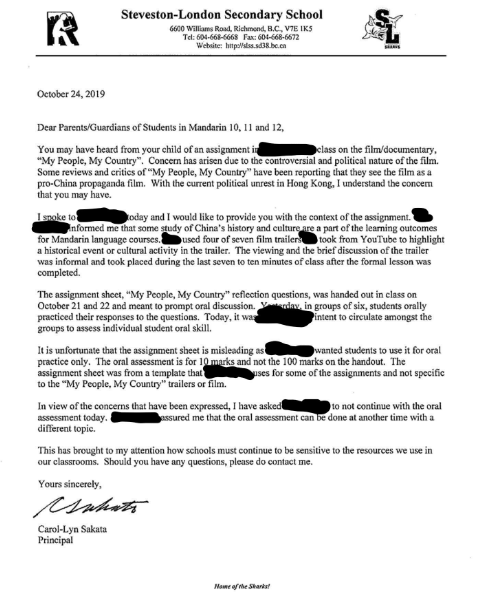
The campaign took place days after a teacher at Steveston-London Secondary School in Richmond, just south of Vancouver, showed her Mandarin class students trailers for a patriotic Chinese film celebrating the 70th anniversary of the founding of the People’s Republic of China. The students were given a list of questions to discuss the trailers, but the assignment sparked complaints from parents that the trailers were pro-China propaganda and the school asked the teacher to withdraw the assignment. The principal sent a letter to parents saying the teacher intended to use the trailers to show students a historical event or cultural activity in China and the assignment was for “oral practice only.”
The two events were not linked, but are both examples of heightened tensions in B.C. around Hong Kong’s struggle for greater democratic rights from China – an inflammatory subject in the sizable ex-pat community in Vancouver. The tensions spilled out in demonstrations on Vancouver street corners this summer, with pro-Hong Kong activists squaring off against pro-Beijing demonstrators. Scuffles over the destruction of pro-Hong Kong signs have also been videotaped and posted to social media.
According to Greg Neumann, vice-president of the B.C. Social Studies Teachers Association, 46 organizations, including Amnesty International and the Vancouver Holocaust Education Centre, set up booths on Friday to hand out materials to the province’s educators.
“We would not accept any organization that promotes any sort of illegal activity, or hatred in any form toward any group, especially those which are marginalized. We will not censor the messages of those promoting peace, justice, love, democracy, or any of the key values we have in our Charter of Rights and Freedoms,” Mr. Neumann said in an e-mail.
He added it is up to the teachers attending the conference to judge for themselves the usefulness and appropriateness of the resources provided by the exhibitors.
Prof. Wanda Cassidy, director of Simon Fraser University’s Centre for Education, Law and Society, said the topic of the materials being offered to teachers by the pro-Hong Kong society fits with social studies education.
“Social studies education encourages debate and discussion about all sorts of current local and world topics and teachers generally introduce students to a variety of perspectives on any given controversial topic,” she wrote in an e-mail.
“This might include examining different sorts of materials and messages that various groups convey. This fosters critical thinking, a main goal of social studies.”
Mabel Tung, chair of the pro-democracy society, said her group has been spreading the history of Tiananmen Square protests and massacre for years and providing tools and resources for teachers, but last week’s campaign was their first attempt to promote information about Hong Kong protests to B.C. educators.
“We want to tell the message to all Canadians to stand up for Hong Kong, to stand for the Hong Kong people, to fight for democracy,” she said. “Whatever is happening in Hong Kong, it may be happening anywhere in the world.”
One flyer distributed to teachers listed several reasons why many Hong Kongers are protesting, and why they fear Hong Kong being governed by the Chinese Communist Party.
“Because the Hong Kong government and the Chinese Communist Party is eroding Hong Kong’s autonomy: Communist infiltration of Hong Kong legislature; suppressing journalistic freedoms and free speech …” the flyer says.
Ms. Tung said her group hopes teachers can help reach students from mainland China with what she said was the correct information about the protests, such as that the movement isn’t demanding independence.
Officials with the Chinese consulate in Vancouver objected to the pamphlet campaign, saying it’s an effort by agitators from a foreign country trying to interfere in Hong Kong affairs, which they consider China’s domestic affairs.
“We think this should also be brought to the Canadian authorities’ attention and should be stopped from happening again. Furthermore, the indicated behavior should be condemned as it has nothing to do with freedom of expression but purely attempts to provoke political dispute by using public platform,” the statement reads.
When asked for comment, a spokesman with the Ministry of Education provided a statement noting that B.C. boards of education are responsible for choosing the resources that are used in their local schools.
Ken Tung, former chair of social service organization SUCCESS and a volunteer for the pro-democracy group, said activists also discussed modern China with participants at the teachers’ event.
“People need those backgrounds to talk about our international relationship – Sino-Canada relationship,” he said.
“The students definitely need to understand the international relationship, international trade, [and] how we work with Canadian values with those countries.”
It has been described by people both in China and outside as the best propaganda film that country has ever produced and it may be the first Chinese-produced film to earn more than US$1 billion.
So it’s not surprising that parents and others are questioning the appropriateness of the trailers for My People, My Country being used as teaching material in Grade 10, 11 and 12 Mandarin language classes at a high school in Richmond.
The film is a 254-minute, patriotic review of seven historic high points since Mao Zedong and the Communist Party came to power 70 years ago.
Co-produced by a state-owned company, there is no mention of the Cultural Revolution or the 1989 Tiananmen Square crackdown. The return of Hong Kong to Chinese control is portrayed as a triumph.
The South China Morning Post’s review described the film as a “jingoistic anthology,” while the Chinese news agency Xinhua said the film’s aim was to “awaken shared memories of Chinese people around the world.”
“After 70 years, our culture and propaganda departments finally figured out how to combine propaganda with art,” Yan Feng, a Chinese literature professor at Shanghai’s Fudan University wrote in a Weibo post quoted by the New York Times.
Even without English translation, the YouTube trailer is nothing like what you might imagine propaganda looks like — aside perhaps from the Hollywood patriot movies like Top Gun.
That’s what makes it so powerful.
There are seven trailers in all for the film and four were shown to Grades 10, 11 and 12, Mandarin-language classes at Steveston-London Secondary School.
After viewing them, students had a brief informal chat about what they saw before being handed written questions as a prompt for another discussion the following day, according to an Oct. 24 letter that principal Carol-Lyn Sakata sent to parents.
A copy of the principal’s letter with the teacher’s name redacted that was posted to the Canada Hong Konger Facebook page.
That discussion was cancelled because of parents’ concerns about using Communist Party propaganda in the school.
“We believe the teacher intended to engage students in an informal and open discussion to ‘analyze personal, shared, and others’ experiences, perspectives, and world views through a cultural lens,’ as contemplated in the provincial curriculum,” Richmond School District spokesman Dave Sadler wrote in an emailed response.”
But is propaganda culture? Or is it simply politics?
There’s a plausible argument to be made that My People, My Country is a cultural and even historic phenomenon. Certainly, it’s being widely shown and widely seen.
Released on Oct. 1 to coincide with 70th anniversary celebrations, it had 135,000 daily screenings on the first weekend, earning US$102 million, according to Variety. Online reviewers in China scored it as high as 9.7 out of 10, but as Variety diplomatically pointed out “in the past there has been doubt about the reliability of such scores.” Still, Variety suggests, it may be the first Chinese film to earn US$1 billion.
But if the teacher’s intent was to talk about it as cultural phenomenon, that’s not evident from the principal’s letter or from the assignment itself.
Under the Chinese caption “I love my motherland,” students were given “reflection questions.” Among them were: How did this movie make you feel? What words or phrases made you feel good? What was your favourite part? What four adjectives would you use to describe the movie? Does it remind you of your life?
Further down, there were questions about what they thought the movie’s message is and why it was produced.
Sakata noted the “controversial and political nature of the film” in her letter to parents. “With the current political unrest in Hong Kong, I understand the concern that you may have.”
There’s no doubt that that may be what has made parents and students more acutely aware of what is being taught in Mandarin classes.
But to suggest that is the only reason for concern is a disservice to both students and parents who are raising important questions far beyond a single teacher, some trailers and three classrooms.
What is being taught under the guise of Mandarin language learning in British Columbia’s public and private schools? How are teaching materials chosen? Who chooses them? Are they being supplied at no cost by the Chinese government?
While the provincial government sets curriculum, it doesn’t choose the resources used in local schools. That’s up to the school districts using the province’s rather vague criteria.
According to an education ministry spokeswoman, teaching materials must: support learning standards and outcomes of the curriculum; make connections with real-life examples; be age appropriate; meet copyright and privacy requirements; and, content must be socially acceptable.
There’s enough leeway that the Coquitlam School District, for example, has partnered directly with the Chinese government to set up a Confucius Institute with teachers and teaching resources provided by China at no cost.
It’s not clear how the choices are made in Richmond. Sadler wasn’t able to provide the answers Friday as it was a professional development day and the people who deal with curriculum issues were away.
But it begs the question of the province’s responsibility.
Canadian students and foreign students studying in Canada deserve an education untainted by political influence or interference especially from another country’s government. And that should be something the province is doing.
Nice to see the government set out publicly the countries targeted which will allow evaluation of the success of diversification. The line “We don’t want to be poachers of talent, we want to be partners” appears ingenuous.
Courageous for a government to encourage Canadians to study abroad given that a certain percentage will likely remain in other countries to pursue opportunities.
Concerned that more than half of the international students in Canada come from just two countries, China and India, the federal government has pledged nearly $30-million over the next five years to diversify global recruiting efforts in the postsecondary sector.
The government is targeting countries with a large and growing middle class that may not yet have the higher-education capacity to educate all their students, or where the prospect of a Canadian education in English or French holds appeal.
The government said the initial focus of its marketing efforts will be in Mexico, Colombia, Brazil, Vietnam, the Philippines, Indonesia, Thailand, Morocco, Turkey, France and Ukraine. It will also aim to attract students to schools outside of Canada’s largest cities, bringing economic benefits to provinces and regions that have tended to receive fewer immigrants.
“We’re really pleased with the countries [the government] has chosen,” said Paul Davidson, president of Universities Canada, the national lobby group that represents 96 universities across the country.
“We don’t want to be poachers of talent, we want to be partners.”
The government’s efforts to broaden the source countries of international students are part of a five-year, $148-million international education strategy released last week.
The strategy also allocates $95-million to encourage Canadian students to study and build ties abroad, particularly in Asia and Latin America, rather than the common destinations of the U.S., Britain and Australia.
“The higher-education community has been looking for this for about 20 years,” Mr. Davidson said. He cited statistics that show only 11 per cent of Canadian undergraduate students study in another country, lower than in some other wealthy nations.
Mr. Davidson said particular efforts will be focused on opportunities for Indigenous and low-income students, as well as those with disabilities who historically have been less likely to venture abroad for study.
The strategy fits neatly with the government’s skills agenda, Mr. Davidson said. The hope is that a future work force with an international outlook, contacts and cultural fluency in new markets will be a source of strength for Canada. Similarly, some of the international students who study in Canada are expected to apply for and be selected as permanent residents, bringing with them knowledge and networks that extend beyond Canada’s borders.
“International education is an essential pillar of Canada’s long-term competitiveness,” Jim Carr, Minister of International Trade Diversification, said in a statement. “Canadians who study abroad gain exposure to new cultures and ideas, stimulating innovation and developing important cross-cultural competencies. Students from abroad who study in Canada bring those same benefits to our shores.”
Last year, India surpassed China as Canada’s top source of foreign students. There were more than 172,000 study permit holders from India in Canada on Dec. 31, 2018, and more than 142,000 from China, each representing slightly more than a quarter of the total of 570,000. Although those countries will continue to figure prominently as source countries for Canada, there is risk associated with such concentration.
There were fears at the height of Canada’s diplomatic conflict with China over the arrest of Huawei executive Meng Wanzhou that China would prevent or discourage students coming to Canada in such large numbers. Many universities expressed anxiety about that possibility last December, having seen a similar scenario play out in Canada’s relations with Saudi Arabia. The Saudis recalled hundreds of students studying in Canada after their government objected to a Canadian government tweet. Some schools lost significant amounts in tuition revenue as a result.
The economic contribution of education has grown rapidly in recent years. International students spent more than $21-billion in Canada in 2018, according to a study by Global Affairs Canada, and had a larger economic impact than exports of auto parts, lumber or aircraft.
The number of foreign study permit holders in Canada has more than doubled since 2012.
Haven’t done a similar analysis on Canadian participation and employment rates but income data shows similar pattern, but which reflects length of time in Canada. Similar pattern regarding eduction as well:
Foreign-born residents had higher rates of full-time employment than those born in the United States last year, and naturalized immigrants were more likely to have advanced degrees than the native-born, according to figures released Monday by the U.S. Census Bureau.
The new figures show that the economic gap between the native-born and the foreign-born in the United States appears to narrow with citizenship.
Immigrants who weren’t citizens had higher rates of poverty, lower income and less education compared with native-born citizens last year. But immigrants who were citizens had less poverty, close to equal earnings and higher rates of advanced degrees than native U.S. citizens.
“Usually immigrants start off in the U.S. lagging behind a bit in terms of income, as they need to find the right job, learn local skills and so on and then catch up,” said Giovanni Peri, an economist at the University of California, Davis. “Immigrants also are very different among each other, and those naturalized may be a selection of those more educated and with better jobs.”
Naturalized immigrants had a full-time employment rate of about 83 percent last year, noncitizens had about 81 percent and native citizens had 77 percent.
“Some immigrant groups have to be employed to stay in this country — those on work visas, which would raise the proportion,” said Stefan Rayer, a demographer at the University of Florida.
About 1 in 6.5 naturalized immigrants have a master’s degree or higher, while that is true for only about 1 in 8 native-born citizens and noncitizens.
The 2018 Current Population Survey figures offer a view of immigrants’ education levels, wealth and jobs as the U.S. engages in one of the fiercest debates about the role of immigration in decades.
Stopping the flow of immigrants into the U.S. has been a priority of President Donald Trump’s administration, which has proposed denying green cards to immigrants who use Medicaid and fought to put a citizenship question on the decennial census questionnaire.
Monday’s figures also look at differences between naturalized immigrants and those who aren’t citizens. In 2018, the U.S. had 45.4 million foreign-born residents, or about 1 in 7 U.S. residents.
Education appears to play a role in narrowing the income gap between the native-born and the foreign-born.
Overall, naturalized immigrants had a slightly smaller median income than the native-born — $50,786 compared with $51,547 — but noncitizen immigrants trailed them both with a median income of $36,449.
But naturalized immigrants with a college degree surpassed college-educated natives’ income, and both naturalized immigrants and noncitizens with advanced degrees had higher median incomes than U.S. natives with advanced degrees.
“Immigrants with advanced degrees, whether naturalized or not, may be more clustered in occupations with higher pay than the native population,” Rayer said.
About half of the U.S. foreign-born came from Latin America, less than a third came from Asia and 10 percent came from Europe. European immigrants’ median age — 50 — was roughly six years older than other immigrants.
More than a quarter of noncitizen immigrants were in service jobs, while almost a quarter of immigrants who were citizens were in professional jobs, according to the Census Bureau figures.
Asians and Europeans had the highest rates of advanced degrees — about a quarter of both immigrant groups had a master’s degree or higher. About 1 in 20 immigrants from Latin America had a master’s degree or higher.
Immigrants, both naturalized and noncitizens, were overwhelmingly urban and suburban dwellers. Less than 1 in 20 immigrants lived outside of a metropolitan area last year, compared with about 1 in 7 for native-born citizens, according to the figures.



 Multicultural Meanderings