Douglas Todd: Ethnic politics is already a science in the U.S. It’s on the way in Canada

It already is well entrenched at the federal and provincial levels and candidate nominations and members of legislatures and electoral strategies indicate. Todd’s points are based on municipal elections, where the general absence of parties and more locally-based and less sophisticated data analysis prevails:

In the U.S. polls are run constantly into the political preferences of voters based on ethnicity, in addition to gender, age, religion and other demographics.

Race-based politics has long been established in multi-ethnic cities like Chicago, New York and Miami. American pundits have also analyzed how religion and ethnicity combine, particularly since 1960 when 80 per cent of Catholics of European descent voted for John F. Kennedy.

With people of Hispanic, Black and Asian origins now accounting for more than 80 million Americans, politicians are not the only ones who find it valuable to keep up with scientific polling.

Polls generally show two thirds of Hispanic Americans vote Democrat, while one third lean Republican. Only one in 10 Black voters are Republican and just 26 per cent of Asian-Americans. About one third of people of European descent cast ballots for Democrats, and just over half go Republican.

Canadians are more shy about how ethnicity connects to politics. We don’t often learn about surveys that probe how minority groups tend to think about political issues.

When I’ve asked Canadian politicians if their party conducts private polling on ethnicity, they all say, of course they do: Race-based strategies are crucial to any campaign. But no party has ever handed me their internal data.

Political scientist Shinder Purewal of Kwantlen Polytechnic University has had a similar experience. “I’ve spoken to a number of pollsters and they’re very reluctant to give ethnic numbers, while they’ll give numbers in general.”

One recent exception to this hands-off Canadian approach was a poll by YouGov, which revealed that Indo Canadians lean liberal-left. More than 38 per cent of respondents said last year they would cast a vote for the Liberals — twice the number that planned to go with the Conservatives.

This fall, a Leger poll for Postmedia detailed how ethnic groups would affect October’s tide-shifting elections in the cities of Vancouver and Surrey.

Understanding the hopes and fears of ethnic groups can be a big political deal. In the city of Vancouver, 44 per of the population is of European descent, 20 per cent is of Chinese descent and 14 per cent are of South Asian descent. Indo Canadians are the largest group in Surrey, at 38 per cent compared to 33 per cent who are of European descent.

The Leger poll found the eventual winner in Vancouver, Ken Sim, who highlighted how he would be the city’s first Chinese Canadian mayor, appealed to 21 per cent of those of European ancestry, 15 per cent of South Asian voters and 35 per cent of those with Chinese roots.

Meanwhile, defeated mayor Kennedy Stewart — who was the last of an amazing streak of seven Vancouver mayors in a row of Scottish ancestry — appealed to 12 per cent of European-descent voters, 21 per cent of Indo Canadians and only five per cent of those of Chinese background.

Surrey was a different scenario. There, the three mayoral candidates who received the most votes are of European ancestry: Brenda Locke, Doug McCallum and Gordie Hogg. McCallum, the incumbent, did best in the districts that are overwhelmingly Punjabi, Purewal said.

“That tells you that people are actually paying attention to what politicians have to say, what they stand for,” Purewal said. “Many don’t care what (ethnic) flock you’re from.”

In Vancouver, what issues drew voters to Sim?

Housing affordability came out the top worry when Leger’s respondents named their top three issues: But that concern ran equally across ethnic lines. 

Property taxes and spending were Vancouver residents’ third biggest issue, particularly since council had sharply increased both under Stewart’s guidance. Sim promised to be fiscally prudent, which would be important to ethnic Chinese voters, 36 per cent of whom cited taxation as a leading issue compared to 26 per cent overall.

Policing, public safety and crime was the fourth big issue. And Sim’s promise to hire 100 more police officers would have also played well with Chinese Canadian voters, 30 per cent of whom worried about crime compared to 25 per cent in general.

Sim also played down themes that Stewart and his council had pushed hardest — such as climate change, and especially social justice, equity and First Nations reconciliation. These were of low concern to all voters, particularly to those of Chinese background.

Such trends suggest to Purewal that, even while Sim often cited the scourge of anti-Asian racism and campaigned strongly through Chinese-language media outlets, he and his ABC party didn’t win simply because he was Chinese Canadian.

“I would say the vast majority voted for him because they agreed with his plan.”

What of Surrey, B.C.’s second largest city? South Asians in Surrey, many of whom are foreign-born, were significantly more likely to rank housing affordability as a top worry, at 56 per compared to 38 per cent of people descended from Europeans. And Indo Canadians were the least likely to zero in on homelessness.

Even though the Leger poll initially suggested Surrey mayoral candidate Sukh Dhaliwal was the favourite of South Asians, the support did not carry the day for him. Locke and McCallum, who came in a close second, were able to draw votes from both South Asians and those of European descent.

A similar lesson about the value of cross-ethnic appeal can be taken from growing Richmond, B.C.’s fourth most-populous city.

Mayor Malcolm Brodie has been winning elections there for 21 years, despite people of European ancestry now being only 20 per cent of the population, down to 40,000 from 68,000 in 2001. Purewal said Brodie has cultivated the loyalty of a solid portion of the 113,000 Richmond residents of Chinese origin.

Sometimes race-based politics can burst into controversy, as it did this fall in Los Angeles, where a national furor erupted after top Latino politicians were caught in a secret recording making crude, racist remarks about Black rivals and voters. Similar things can happen in Canada.

But for the most part, U.S. and Canadian politicians don’t appear to take advantage of ethnic-based data to manufacture wedge issues: They simply see ethnic differences, as well as similarities, as fundamental factors to understand.

Let’s hope most North Americans politicians try to balance their desire to appeal to voters from specific ethnic groups with a larger commitment to social harmony.

Source: Douglas Todd: Ethnic politics is already a science in the U.S. It’s on the way in Canada
Douglas Todd: Singapore has impressive housing success. Can we?

Singapore is unique in so many ways and hard to see how its approach could ever be adopted here apart from some of the tax and surcharge approaches:

If you’re Canadian, you might feel envious learning the quest for affordable housing is basically a success for many of the 5.7 million people of Singapore.

That is not a story you hear often, or at all, in Canada, especially not in Greater Toronto, Metro Vancouver or Victoria, three of the world’s more unaffordable cities.

The wealthy city-state of Singapore, in South-East Asia, is like Metro Vancouver and Toronto in many ways: A megapolis that acts as a magnet for foreign people and capital, which has faced daunting housing problems.

Like other fast-growing cities, Singapore is known for its capitalism and cultural diversity, albeit with a stronger emphasis on orderliness, which leads to cleanliness and low crime. Despite free elections, it has had only one party in government since it gained independence from Britain in 1959. Its legendary first prime minister, Lee Kuan Yew, committed to every citizen being able to own a home.

The city-state approaches Canada for its religious and ethnic diversity: 75 per cent of residents are of Chinese descent, 15 per cent are Malay and seven per cent are from the Indian subcontinent. More than one quarter of Singapore’s population is foreign born, which is less than the proportion in Vancouver and Toronto.

Yet, despite broad similarities, the upcoming book Housing Booms in Gateway Cities, from David Ley, a UBC professor emeritus of geography, explores how Singapore, through innovative taxation, has conducted an impressive experiment in housing.

When Demographia analyzed the worst gaps between house prices and income in 92 cities in Australia, Canada, Hong Kong, Ireland, New Zealand, Singapore, Britain and the U.S., it found this year that Vancouver is the third most unaffordable city, while Toronto is 10th. Singapore is in the middle of the 92 cities.

Singapore has accomplished relative affordability with what Ley calls “its own version of municipal socialism” — a term that will either repel or attract Canadians.

“Typically, Singapore gets the prize of being the most business-friendly and economically open society there is. But, when it comes to housing, it battens down the hatches hard,” said Ley, author of Millionaire Migrants, whose new book will detail housing issues in the gateway cities of Vancouver, Singapore, Hong Kong, Sydney and London, England.

“It’s plan from the beginning was that everyone who is a (citizen) would be a homeowner, buying housing from the government, which is the principal landowner, or from a much smaller private sector.”

The megalopolis’s housing model, unlike in Canada, is based on differentiating three levels of citizenship rights. Restrictions on foreign investment are also tight.

“If you are born in Singapore you are called a Singapore ‘resident,’ and you have basically all the rights that are available,” Ley said. “You can also become a permanent resident and get a chunk of the rights, but not all of them. Or you’re a temporary migrant and you have almost no rights.”

As a result, nine out of 10 citizens of Singapore own a dwelling, said Ley, nearly all of which are apartments, ranging from run-of-the-mill to elegant. Most are leased for 99 years from the government. Another 20 per cent of housing is exchanged on the private market.

Here’s how Singapore’s experiment in housing works.

If you are a full citizen of Singapore, you get access to the apartments built and made available by the Housing and Development Board, or HDP, a high-powered government agency.

“And if you’re a permanent resident, but not born in Singapore, you get access to HDP apartments, but with conditions,” Ley said. “If you’re a temporary migrant you get no access at all.”

That means the majority of citizens are allowed to choose from decent or stylish government-built apartments in well-planned communities, which slowly grow in value because prices are controlled by taxation policy. It results in most residents being able to move up the housing ladder.

It also means the minority of temporary residents in Singapore mostly compete for private housing. The business people from China, Indonesia and the West who work in Singapore’s dynamic financial sector, who are called “Talents,” tend to buy nice flats. On the other hand, migrant nannies often make their homes in extra bedrooms, while many foreign construction workers live in dormitories.

While Ley joins many housing specialists around the world in observing most Singaporeans seem happy with the model, it’s not perfection. A non-Singaporean professional who lives there (and doesn’t want to be identified) told me this week that young adults complain they will not start having children until they own a dwelling. And some charge the government isn’t building them fast enough.

The debate has led to former Singapore cabinet minister Josephine Teo, who calls on citizens to produce more babies even if they don’t own, famously blurting: “You need a very small space to have sex.”

Singapore ‘tenacious’ at limiting housing speculation

“Singapore has been really tenacious in terms of controlling foreign investment in its housing market,” Ley said.

While Ley wonders if Singapore inspired B.C. and Ontario’s foreign-buyers taxes, the surcharges in Canada are modest compared to those in Singapore, where foreign nationals are taxed a solid 30 per cent on any purchase whatsoever.

Singapore’s politicians also curb speculation by local investors. A year ago they slapped a 17 per cent tax on citizens who buy a second property and 25 per cent tax on their third property. They do not, on the other hand, tax citizens who are first-time buyers.

And while Canada treats permanent residents the same as citizens when it comes to housing taxes, that’s not the case in Singapore. It has imposed a five per cent tax on permanent residents purchasing a first dwelling and 30 per cent on those snapping up a third.

While Ley generally supports a surcharge on foreign purchases, he was uncertain about Canada copying Singapore’s taxes on permanent residents who invest in primary properties to live in. To some extent, he said, such speculation is already tempered by Canada’s capital gains taxes.

What can Canada learn from Singapore’s remarkable system of relative affordability? “In some ways, sadly, it’s a rather unique place,” Ley says.

But that doesn’t mean some of the city-state’s effective policies couldn’t inspire creative adaptation here.

Source: Douglas Todd: Singapore has impressive housing success. Can we?

Douglas Todd: Chinese travellers to Canada plunge. What does it mean?

Visitor visas from China have also plumeted, by close to 80 percent compared to pre-pandemic (January to August, 2022 compared to 2019):

Three years ago, 55 jumbo jets from China were touching down at Vancouver International Airport every week.

Now there are only eight flights a week from the world’s most-populous country.

There has been an almost similar plunge in the proportion of Chinese nationals applying for Canada’s 10-year visas. A related decline means fewer people from China are seeking student visas, and showing relatively modest interest in permanent-residence status.

China’s draconian pandemic lockdowns — which are more strict than anywhere in the world — have reduced travel in and out of the country, with the number of international air passengers across all of China’s airports falling from 74 million in 2019 to 1.5 million last year.

But that’s not the only reason for the decline.

With China’s Communist leaders poised this month to hand strongman Xi Jinping an almost unprecedented third five-year mandate, crackdowns are increasing on Chinese citizens, including through digital surveillance, censorship, arrest of dissenters, party infiltration of private businesses — and far less travel to other countries. Most observers believe obsessive control will be China’s new normal for a long time.

The drastic decline in the transnational mobility of the people of China feeds into the debate in the West over what it means to have far less engagement with China’s regime and its citizens, even while many are not necessarily tied to the authoritarian government.

In response to tighter controls in China, Canada has been shifting. While five years ago people from China made up the largest group of visitors and students, Indian nationals now comprise by far the largest group.

Two new books argue each side of the China engagement coin. In The United States vs. China: The Quest for Global Economic Leadership, economist Fred Bergsten argues corporate engagement has been a success, despite tragic failures on the human rights front.

Bergsten belongs to the camp that champions the free global movement of money and humans, saying Western countries should continue to offer a warm reception to entrepreneurs, students, workers and visitors from China. It’s good for business.

However, another book, by Princeton University professor Aaron Friedberg, titled Getting China Wrong, calls the West’s engagement with China a gamble that didn’t pay off. He says the challenge now is how to reduce ties to a threatening regime run on draconian Leninist principles.

Wherever one comes down on such arguments, the reality is the flow of people from China into the U.S., Canada and other Western countries has reduced dramatically.

Canada’s travel industry is among those hurting, especially in B.C. And that’s only partly because, as Destination B.C. official Kristen Learned says, visitors from China spent the most of any tourists: $2,021 each.

In 2019, more than 15,500 people were flying each week into Vancouver from China, now it’s just 2,600. That’s as airport officials say international flights from every other nation are almost back to pre-COVID levels.

Three years ago Canada brought in 712,000 visitors from China, who stayed an average of four weeks. Destination B.C. figures show 334,000 of them spent their days in B.C., which made them to the province’s second-largest international tourist market, after the U.S.

In 2019, travellers from China bought over $586 million worth of goods and services while on the West Coast, especially on hotels, luxury resorts and Airbnbs, as well as dining out while visiting relatives.

But by midsummer of this year, only 36,000 visitors from China had flown into Canada, with just 18,000 to B.C. That’s reflects a drastic overall rate of decline in three years of about 91 per cent.

Meanwhile, travellers into Canada from India, Britain and France are soaring.

Additional data reveal just a few years ago people from China were by far the biggest group applying for Canada’s popular 10-year visas.

Since the 10-year visa program began in 2014, allowing people to travel to the country for six months at a time as many times as they want, Chinese citizens have accounted for 3.2 million of the 13 million visas issued.

But a sharp drop in visa applications from China occurred even before the pandemic hit. At the same time, requests from India skyrocketed.

As a result, by midsummer of 2022 a relatively low number of people from China, 49,000, had applied this year for the 10-year visas. In the same period, applications from India skyrocketed to 355,000.

The highly valued multiple-entry visas are generally a benefit to Canada’s economy, say immigration lawyers. But they caution they can be abused by “shadow investors” in housing to avoid property and income taxes in Canada.

Educational relationships between China and Canada have also declined, although not as precipitously.

In 2017, study visa application rates from both China and India were equal — amounting to roughly 82,000 students a year from each giant nation, together accounting for almost half of all foreign students.

But in 2021, the second year of the pandemic, the numbers of Chinese international students seeking to come to Canada dropped to 56,000, while expanding from other countries — especially India, at 169,000.

The trend has continued into October of this year, with students from India accounting for 38 per cent of all study visa applicants and those from China just 11 per cent.

Meanwhile, the number of Chinese nationals gaining admission to Canada as permanent residents remains flat — at the rate of about 30,000 a year, compared to 127,000 from India.

The immigration path into Canada is not as strong an indicator of China’s internal politics as other measures — because anyone from China who becomes a Canadian citizen, technically, forgoes their Chinese citizenship and the ties that go with it.

What does it mean? As Xi tightens his hold on power, no one absolutely knows what’s on in his mind.

But even figures who advocate the unrestrained movement of financial and human capital realize Xi is dangerously bent on weakening democratic governments and further policing Chinese citizens in both his country and abroad.

This month, the pro-free-trade Economist magazine called on the West to continue to “welcome Chinese students, executives and scientists, rather than treat them as potential spies. Remember, always, that the beef should be with tyranny, not the Chinese people.”

That appears to sum up the federal government’s open approach, even while China’s autocrats are ensuring there will be fewer people-to-people connections between our two countries.

Source: Douglas Todd: Chinese travellers to Canada plunge. What does it mean?

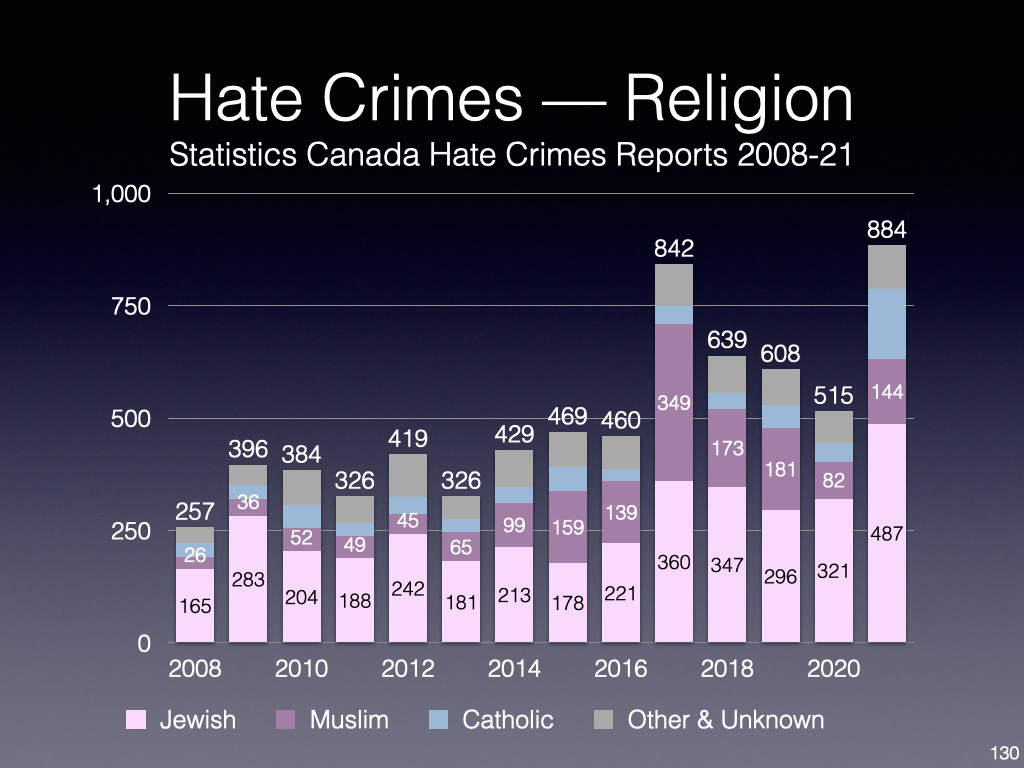
ICYMI: Douglas Todd: Hate crimes against Catholics almost tripled. Do Canadians care?

The Canadian Catholic church and its members, many of whom are Indigenous or immigrants, were last year buffeted by a horrendous 260 per cent spike in hate crimes.
Of note, from a small base of 42 in 2020 to 155 in 2021. Suspect largely due to the discovery of possible unmarked graves and greater attention to the Catholic Church’s involvement in residential schools:
Catholics were subject to a far higher escalation in police-reported hate incidents than any other religious or racial group, according to a Statistics Canada study.

Source: Douglas Todd: Hate crimes against Catholics almost tripled. Do Canadians care?

Douglas Todd: The downside to increasing low-skill migration to Canada

Good overview of recent research on low-skill migration and the government’s repetition of the Harper government mistakes before correction after a few years:
Former Conservative prime minister Stephen Harper found himself in trouble in 2014 for jacking up the number of temporary foreign workers coming to Canada to work at places like McDonald’s and Tim Hortons.
Then-opposition leader Justin Trudeau, labour unions and the media went into overdrive — attacking Harper for pandering to the business lobby by inundating the market with hundreds of thousands of low-skilled temporary foreign workers, many of whom were vulnerable to exploitation.
To the surprise of many, Harper responded to the outcry. He sharply reduced the number of guest workers and brought in laws encouraging employers to improve working conditions and hire more people who were born in Canada or had become permanent residents.

Source: Douglas Todd: The downside to increasing low-skill migration to Canada

Douglas Todd: How does Indigenous reconciliation square with big business?

Understandable on the one hand that residents are critical of the lack of consultation but ironic that settlers did not consult Indigenous communities when establishing farms and cities:
Leaders of the 4,000-member Squamish Nation, who are behind one of the most dense property developments in Canadian history, have signed an agreement with Vancouver councillors saying one of the five aims of its 11-tower Senakw project is to “promote further reconciliation between the Nation and the City.”
But to what extent will this Indigenous-controlled multi-billion-dollar skyscraper project, which is unprecedented in North America, actually contribute to reconciliation between Indigenous and non-Indigenous peoples?

Source: Douglas Todd: How does Indigenous reconciliation square with big business?

Douglas Todd: People of Indian descent a rising force in the U.S. and Canada

While the understandable focus is with respect to those of Indian descent holding leadership and senior positions, there is a larger group of workers in such industries as agriculture and trucking. From a political perspective, the outsized influence of Sikh and other Indo-Canadians reflects their geographic concentration: 47 ridings in Canada have 10 percent or more South Asian residents (2016 Census).

List: VM Ridings South Asian 10 percent

India is on the rise across the United States and Canada — in education, high-tech and politics.

The CEOs of five of the most powerful high-tech companies in North America have origins in India. They’re heading Microsoft, Google, IBM, Twitter and Match Group (which owns Tinder).And people of Indian ancestry are punching above their weight in politics in the U.S. and Canada. “There may well be an Indian-American president before there is an American Indian one,” says The Economist.

The educational achievements of people of Indian origin are above the norm in North America. And their are among the strongest of any ethnic group in the U.S. and Canada. This is not to mention one study showing people of Indian origin are almost four times more likely to own a home than the average Canadian.

India is the second highest source country for immigrants to the U.S., where 4.6 million have Indian origins, or 1.4 per cent of the total. They are mostly from southern India and tend to live in the U.S. South and East.

In Canada, India is the No. 1 source country for immigrants by far, accounting for 30 per cent of all newcomers since 2016.

There are 1.4 million people with Indian roots in Canada, most of whom are immigrants. They make up four per cent of the population. Generally from Northern India, most live in Toronto, Vancouver, Calgary and Edmonton.

Even though many are already flying high in U.S. high-tech, the impact of people of Indian background on Canadian business, especially, is growing sharply.

The influence of Indo North Americans is destined to expand further. Let’s look at why.

The tech sectors in Toronto, Montreal and Vancouver are expanding on the strength of a workforce where two of five are foreign born. And U.S. immigration rules designed to protect homegrown workers means our southern neighbour is losing thousands of Indian high-tech experts and others to Canada.

With the U.S. restricting its coveted H-1B working visa (including with a rule that no one country can be the source of more than seven per cent of recipients), many computer specialists are among the more than 217,000 people from Indian who can work in Canada as foreign students (they make up 30 per cent of all international students).

Canada also accepted 128,000 people from India last year as new immigrants, many of them programmers. And it’s on track for a similar number in 2022. That compares to just 39,000 immigrants from India in 2015, when Justin Trudeau’s Liberals were first elected.

Such business success is made possible in large part because educational levels soar among those of Indian descent.

In the U.S. three of four of adults of Indian background have bachelors degrees or better, according to Pew Research. That’s the highest of any Asian immigrant group, with Chinese Americans coming in at 57 per cent. The overall bachelor’s degree average in the U.S. is 38 per cent.

In Canada, educational achievement is also pronounced. A recent Statistics Canada study by Theresa Qiu and Grant Schellenberg found 50 per cent of South Asian-Canadians (mostly from India) had bachelors degrees or more. The portion rose to 62 per cent among South Asian women.

The portion of bachelors degrees among Canadians with origins in South Asia is much higher than the 24 per cent for white men and 38 per cent for white women, as well as the 17 per cent for Latin American men and 28 per cent for Latin American women. One of the few ethnic groups scoring higher than South Asians are Chinese Canadians.

And wages reflect education levels. The median household income in the U.S. of Indian households is by far the highest of any ethnic-Asian group, at US$119,000, according to Pew.

The typical Chinese American household brings in US$82,000. The median household income across the U.S. is US$67,000.

While U.S. figures on housing are not readily available, a consumer survey by Vivintel, based in Toronto, found that South Asians, a solid majority of whom are from India, are almost four times more likely to buy a homethan the average Canadian.

“Home ownership is very important to South Asians … because they’re told by their parents that renting is just throwing away your money,” says Rahul Sethi, a 38-year-old director of Vivintel who immigrated to Canada from India with his family.

One of the most intriguing aspects of the rise of Indians in North America is their oversized affect on politics.And it’s not just because of U.S. vice-president Kamala Harris, who went to an English-language high school in Montreal after her scientist mother from India, Shyamala Gopalan Harris, got a job researching breast cancer at McGill University.

Even though Harris is a front-runner as a future Democrat presidential nominee, she’s far from alone in U.S. halls of power.

Karthick Ramakrishnan, who surveys Asian American attitudes from the University of California, maintains Indo Americans are far likelier than other immigrant groups to get involved in politics as donors, voters and candidates. They tend to favour Democrats by a margin of three to one.

Ram Villivalam, a state senator in Illinois, says having Harris running to be president gives confidence to Indo Americans. Pramala Jayapal, the first woman of South Asian descent to preside over the Congress, is now one of four influential Indo American politicians, dubbed the Samosa Caucus, in the House.

A similar movement is happening in Canadian politics.

The Indo Canadian population, like the Indo American, leans liberal-left. More than 38 per cent of respondents to a 2021 YouGov poll would cast a vote for the Liberals — twice the number that planned to go with the Conservatives.

One in five backed the left-wing New Democratic Party, the country’s third largest party, which has been lead for five years by Indo Canadian Jagmeet Singh.

More than 12 per cent of cabinet ministers in the Liberal government of Prime Minister Justin Trudeau are Indo Canadian, including Harjit Sajjan and Anita Anand. At least 14 Liberal MPs are Indo Canadian.

This impact list goes on in politics, as well as in business and education. Indo North Americans are on a roll.

Source: Douglas Todd: People of Indian descent a rising force in the U.S. and Canada

Douglas Todd: SFU prof targeted by China for groundbreaking Uyghur research

Not surprising but not acceptable:
SFU professor Darren Byler has been frequently attacked by China’s state media, which accuses him of being an agent of the U.S. government. Something he denies.
During four groundbreaking expeditions into China, the latest in 2018, Byler has witnessed many colleagues and research subjects disappear into the mass “re-education” camps and forced labour factories endured by more than 1.5 million Uyghur Muslims.

The author of In the Camps: Life in China’s High-Tech Penal Colony, was interviewed during a downtown Vancouver conference about the clampdown in Xinjiang. It was attended by 60 people, including Uyghur Canadians, international students from China, Muslim academics and activists.

Participants at the Simon Fraser University event required Postmedia’s commitment to protect their identities, so their families would not be harassed or threatened by police in China. There are about 400 ethnic Uyghurs in Metro Vancouver, the largest group of any Canadian city.

China’s authoritarian leaders are engaged in a planetary campaign to challenge and intimidate anyone who points to the incarceration, mass surveillance and draconian clampdown of the Uyghurs, which the Canadian government has called a “genocide.”

The Global Times, a tabloid newspaper arm of the Chinese Communist Party, has accused Byler of being an “anti-China figure” who makes “fabricated” allegations about “genocide and crimes against humanity” in the Xinjiang region of western China, which is inhabited by about 11 million Uyghur Muslims. The professor is sure China’s agents have attended his classes.

Byler has been with Uyghur people on the streets of China when police have stopped them, taken their mobile phones and demanded, “What is the password for your phone?” A specialist in high-tech surveillance, he says China uses 9,000 police surveillance hubs to routinely search personal data for evidence of resistance and what they consider a dangerous commitment to Islam.

Facial recognition technology is widely used in Xinjiang. Byler has first-hand knowledge of Uyghur students who have studied in North America being detained in China after omnipresent cameras found them walking outside their confinement. Families are often broken up when a Uyghur whom authorities deem suspicious is sent to a work camp, many of which produce textile goods for the West. The U.S. and Canada have laws banning such goods, but many argue they’re ineffective.

A prolific author and widely cited scholar, Byler, 40, is among the Western researchers who argue that China’s Han ethnic majority has in the past decade been escalating a colonialistic internal effort to smear the Uyghur people and systematically erase their Indigenous culture and faith. Chinese authorities often label the Uyghurs as “separatists” and “terrorists,” as well as lazy and slow.

One frequent tactic of the state-controlled Global Times is to try to silence Canadian criticism of the treatment of Uyghurs by condemning this country’s residential-school system for Indigenous children, which the federal government began in 1881 and for the most part ended by the 1970s.

This month, The Global Times enthusiastically reported on Pope Francisrecently referring to Canada’s attempt to assimilate First Nations through residential schools as “a genocide,” even while the Truth and Reconciliation Commission has referred to it as “cultural genocide.”

The Global Times article cited how Canada’s Inquiry into Missing and Murdered Indigenous Women and Girls also called it a “genocide,” while reporting that last year “more than 1,100 unmarked graves have been discovered at former residential school sites.” Canadian media outlets now largely refer to them as “suspected” graves.

The Global Times and China’s diplomats are making a clear attempt to claim, “You in the West have no right to criticize us, because look what you did to Indigenous people,” Byler said. “They’re kind of saying, ‘You did it. So we are doing it, too.’”

While Byler believes Canada’s residential-school system was a colonialistic attempt at assimilation, he notes the Truth and Reconciliation Commission has formalized a decades-long process of restitution in Canada, unlike in Australia and the U.S. And definitely unlike 21st-century China.

During the several years that Byler, a German American who is now a permanent resident of Canada, has spent living among Uyghur people in Xinjiang, he came to realize how outward-looking and sophisticated they were before China accelerated efforts to wipe out their culture.

One of many of his research papers that is drawing global attention explores how Uyghurs had been keenly taking courses from 2004 to 2014 in the English language, with students developing a special interest in novels about totalitarianism, like Animal Farm and 1984 by George Orwell.

Han Chinese prejudices often portray Uyghurs as “backward,” so the language students especially devoured books about Black Americans like Malcolm X, Muhammad Ali and Barack Obama. The paper, co-written with an unnamed Stanford professor, reveals the Uyghur valued learning about a society in which members of a minority could hold power.

But the English-language schools were shut, and teachers Byler knew were detained, after a 2014 visit by President Xi Jinping.

Even though most attendees at the SFU conference demanded anonymity, Byler introduced one local Uyghur who was willing to be interviewed because he has already gone public as an activist. Now a high-school science teacher in Surrey, Kabir Qurban came to Canada with his family from Afghanistan as a refugee.

Since he has become a high-profile activist in Canada, including with his own websites, Qurban said that sometimes he has attended Uyghur events, such as weddings, where attendees have asked that he not sit at the same table with them.

In this era of facial recognition technology, the Uyghur Canadians fear Chinese authorities could catch them together in a photo with the staunch critic of China. That could easily lead to a brother, sister, mother or father back in Xinjiang getting harassed by police. Or worse.

“It’s unfortunate,” Qurban said, “but I have to respect their stance.”

Source: Douglas Todd: SFU prof targeted by China for groundbreaking Uyghur research

Douglas Todd: Why China’s woes matter to Canada

While China’s numbers have largely recovered to pre-pandemic levels, they have declined as a share of total immigration, compared to India in particular. And not convinced that attracting the “ultra-rich” will benefit Canada and Canadians (part from Realtors, luxury car dealerships etc):

China is in turmoil.

The once-roaring housing market of the world’s second-largest economy is collapsing.The regime’s harsh zero-COVID restrictions are causing bitterness and anger.

Beijing’s stepped-up quest for “common prosperity” has many worried their savings and assets aren’t being treated as actually theirs — and could be confiscated by Communist party rulers in the name of equality.

More people, especially the rich, want to escape.

In the past 30 years, Canada has been one of the top destinations for people from China seeking a financial haven and more stable lifestyle. China has long been Canada’s second-largest source country, after India, for new immigrants.

And the country’s recent outbreaks of both financial and social chaos are igniting more desire to get out. A global investment migration consultancy, Henley & Partners, estimates 10,000 to 13,000 ultra-wealthy residents of China are seeking to pull $48 billion out of the country this year.

Canada is a big draw. The Migration Policy Institute found two years ago that Canada was the third most-popular choice for Mainland’s China’s migrants. That was before this summer, when China’s real-estate sales dived by 59 per cent compared to 12 months earlier.

Now, the 2022 Hurun Report, which surveys the desires of high-net-worth Chinese, has found their No. 1 choice for a country to move to is Canada.

But there’s a problem. The people of China, population 1.4 billion, face increasingly strict homegrown barriers to starting a new life abroad.

The Hurun Report, which each year measures the desires of rich people from China, found that this year that Canada had risen to become their No. 1 destination for immigration. (Source: 2022 Hurun Report)

That’s even while there is an emerging term for the exit-minded phenomenon in China — “run-ology.” It’s used widely online to capture both the desire to leave the country and tips on how to do it.

While many Chinese are no doubt happy to stay in their country of birth, many are seeking another shore because of intense frustration over the country’s COVID-19 restrictions.

And that’s not all. A deeply felt mistrust of Chinese leaders came to the fore his month when video emerged of tanks blocking the entrances to some banks in China, ostensibly to stop people from withdrawing their money.

While debate ensued between official Chinese media and Western news outlets over the exact purpose of the tanks, few disputed that China’s police have crushed mass demonstrations after depositors’ funds were frozen as banks have been investigated for fraud.

The backdrop to the bank-savings anxiety has been President Xi Jinping’s stepped-up efforts to develop a patriotic “common prosperity.” It’s already lead him to crack down hard on, among others, the country’s more than 600 billionaires.

One of many notorious cases centres on billionaire Xiao Jianhua, a Canadian passport holder who disappeared after being abducted in Hong Kong five years ago. He is now apparently facing a secret trial in China

China doesn’t recognize that Canada has any diplomatic influence in regard to Xiao. Even though Xiao gave up his Chinese passport because China does not allow dual citizenship, China is still treating him, roughly, as one of its own.

In a related move, Beijing has announced strict 2022 curbs on all “non-essential” overseas travel, purportedly because of COVID. In the face of a spike in outbound trips, leaders have cut the number of travel passports and visas it will issue to a fraction of previous levels.

It’s also harder to get money out of the country.Canadian legal specialist David Lesperance, who specializes in migration for the rich, says he’s receiving three times as many requests from China that he had last year. And Jenga, a firm that handles international money transfers, reports it has seen demand from China double in 12 months.

That’s especially worrying for China in light of its troubled economy. The mammoth speculative bubble that was China’s real estate market, which accounts for an incredible 30 per cent of the nation’s GDP, has been bursting.

China’s Evergrande, the world’s most indebted real-estate developer, is on the verge of bankruptcy. Construction on its new residential towers has halted. China’s housing crisis has wiped a trillion dollars off the value of the sector.

The U.S. Federal Reserve has expressed concern the dramatic downturn in China’s housing market will spillover into Western economies, as many Chinese citizens’ debt grows and an economically weakened China is forced to retrench. The vacancy rate in major Chinese cities is now 15 to 35 per cent, according to the journal Foreign Policy.

Many Chinese nationals who have held onto their assets and wealth are looking elsewhere to invest, even as their leaders make it a challenge. China is talking tougher about enforcing its foreign exchange controls, which allows citizens to send offshore only US$50,000 a year.

But Canadian mortgage broker Ron Butler is among those who share the “growing belief that more capital from China will flow out to other countries’ real estate.”

Yes, we are hearing capital controls are running hot in China. But we know that a workaround is always found and tightness eventually slackens.”

In addition, people from China who obtain foreign residency or citizenship can move money out of their country more easily. Immigration lawyers and consultants say that’s a prime reason for the attractiveness of Canada, which already has 1.8 million people of Chinese ancestry, about half of whom are from China, mostly living in greater Toronto and Metro Vancouver.

Ottawa has long generally welcomed outside money, which typically goes into real estate rather than other businesses. B.C., through its foreign-buyers tax, beneficial ownership registry and speculation tax, is now one of the only provinces trying to monitor such offshore wealth.

Last year, Canada approved 31,005 individuals from the People’s Republic of China as permanent residents. While by no means are all well-off enough to immediately buy a dwelling, that was a jump from 16,525 migrants in the pandemic year of 2020. It was similar to 2019. The pace of immigration from China in the first half of 2022 appears more rapid than ever.

Meanwhile, others from China who want to put money into Canadian real estate, but don’t want to give up their Chinese citizenship, have been opting for Canada’s popular 10-year multiple-entry visas, which permits them to live here six months at a time. Although the Immigration Department didn’t provide the latest figures, Canada had previously issued more than three million 10-year visas to Chinese nationals.

Whichever way you look at it, recent developments confirm that what happens in China matters to Canada.

Source: Douglas Todd: Why China’s woes matter to Canada

Douglas Todd: B.C.’s housing-addicted economy not sustainable, experts fear

Same could be said for Canada as a whole. Good observations by those quoted in the article (Don Wright, David Williams, Stephen Punwasi):

B.C.’s economy is not as healthy as it might appear, since it relies too much on housing and newcomers to keep it above water, say prominent economists and analysts.

The real estate sector makes up a much larger section of the B.C. economy than in the rest of the country. The B.C. economy is heavily reliant on large-scale flows of people arriving each year from other provinces and countries, say the specialists.

They maintain B.C. has not been effective at developing its resources, businesses and industrial capacity in a way that increases wages and improves productivity. This B.C. phenomenon, going on for two decades, puts demand pressure on housing prices.

Don Wright, former head of B.C.’s civil service, says there is a general feeling among British Columbians that the economy is healthy because unemployment is relatively low and government revenues stable.

But there is a distinct possibility the economy is not sustainable, Wright says.

B.C.’s trade deficit has been growing steadily since 2005. The province, he said, is “spending about $28 billion more per year than we are earning.”

Both Wright and David Williams, senior policy analyst for the Business Council of B.C., say the provincial economy is too dependent on large-scale in-migration to bring in capital, which fuels the housing sector and props up spending on goods and services.

Last year, according to the B.C. government, the province welcomed a record 100,000 new people. About 33,000 came from other provinces, which is the highest amount in three decades. The other 67 per cent arrived from other countries, a lower proportion than normal, and most chose Metro Vancouver.

B.C. has an unusual economy because it hinges so heavily on “outside money;” on new arrivals coming in to “buy real estate and support consumption with income earned elsewhere,” says Wright, an economist who gives presentations on the issue to Ottawa politicians and business organizations.

“In essence we are ‘exporting’ the right to reside in B.C.,” Wright says.

“This has become our largest ‘export industry.’ It accounts for more than twice the annual level of forest industry exports. In the short run, this injection of dollars does create the impression of a healthy economy, but how long can this go on?”

The business council’s Williams generally agrees. A tremendous amount of B.C. money is going into “housing-related consumption,” he says.

But investment dollars are not flowing strongly enough into such things as new machinery and equipment and intellectual property rights, said the business economist. Those sectors can much more add to the “economy’s future productive capacity” and potentially increase stagnant wages.

In-migration should not be seen as a cure-all for the economic woes of Canada or B.C., says Williams.

He questions the way Canada, particularly B.C., depends on “record immigration levels to turbocharge population growth and housing demand.” Canadian economists believe immigration numbers have an overall neutral effect on real wages and gross domestic product per capita.

According to Stephen Punwasi, of Better Dwelling, B.C.’s economy is almost twice as reliant as neighbouring Alberta on real estate, which accounts for 20 per cent of B.C.’s GDP.

That compares to an average of 13.5 per cent across the country, a proportion that is still much higher than in the United States. If B.C.’s construction industry is included, it adds up to almost one third of B.C.’s GDP coming from real-estate related services.

Canada, and especially B.C., are “addicted” to real estate-driven growth, says Punwasi, who maintains it’s an unhealthy dependence that won’t be easy to break.

Wright, who was NDP Premier John Horgan’s deputy minister until stepping down last year, cites the danger of over-relying on new arrivals.

When 100,000 people move into B.C. and buy houses and services “it creates the illusion that the economy is strong. But for me the question is, ‘Is it sustainable?,’” Wright says.

“Let’s say somebody from outside B.C. retires to Comox and buys a place. And they’ve accumulated a lot of net wealth over their life. Whenever they spend money, it’s money that’s not being earned in B.C. In the short term it’s not bad for the economy, because it creates employment when somebody goes out and eats at a restaurant.”

But Wright doesn’t think relying on imported wealth is sustainable — for two reasons.

The first is that “you only get to sell off a piece of real estate to somebody outside the province once,” he said.

“And another reason is it’s not socially sustainable: Young people cannot afford a house anymore.” And too many new real-estate units are not suitable for families.

“A whole generation is going to be frozen out of the housing market, unless they have a well-capitalized, generous bank of mom and dad.”

What might happen to B.C. “when the party stops?” Wright asks, referring to a time when newcomers stop bringing in tens of billions of dollars each year from beyond provincial borders?

B.C., he said, will need to restructure by strengthening sectors such as forestry and mining, manufacturing and high tech — all of which are capable of producing superior middle-class wages.

“We better know,” Wright says, “how to rebuild the standard of living of the next generation.”

Source: Douglas Todd: B.C.’s housing-addicted economy not sustainable, experts fear