If Philosophy Won’t Diversify, Let’s Call It What It Really Is – The New York Times

Jay L. Garfield and Bryan W. Van Norden on the lack of diversity, in terms of both content and staff,  in philosophy departments in the US and Canada:

The vast majority of philosophy departments in the United States offer courses only on philosophy derived from Europe and the English-speaking world. For example, of the 118 doctoral programs in philosophy in the United States and Canada, only 10 percent have a specialist in Chinese philosophy as part of their regular faculty. Most philosophy departments also offer no courses on AfricanaIndianIslamicJewishLatin AmericanNative American or other non-European traditions. Indeed, of the top 50 philosophy doctoral programs in the English-speaking world, only 15 percent have any regular faculty members who teach any non-Western philosophy.

Given the importance of non-European traditions in both the history of world philosophy and in the contemporary world, and given the increasing numbers of students in our colleges and universities from non-European backgrounds, this is astonishing. No other humanities discipline demonstrates this systematic neglect of most of the civilizations in its domain. The present situation is hard to justify morally, politically, epistemically or as good educational and research training practice.

We each — alongside many colleagues and students — have worked for decades to persuade American philosophy departments to broaden the canon of works they teach; we have urged our colleagues to look beyond the European canon in their own research and teaching. While a few philosophy departments have made their curriculums more diverse, and while the American Philosophical Association has slowly broadened the representation of the world’s philosophical traditions on its programs, progress has been minimal.

Many philosophers and many departments simply ignore arguments for greater diversity; others respond with arguments for Eurocentrism that we and many others have refuted elsewhere. The profession as a whole remains resolutely Eurocentric. It therefore seems futile to rehearse arguments for greater diversity one more time, however compelling we find them.

Instead, we ask those who sincerely believe that it does make sense to organize our discipline entirely around European and American figures and texts to pursue this agenda with honesty and openness. We therefore suggest that any department that regularly offers courses only on Western philosophy should rename itself “Department of European and American Philosophy.” This simple change would make the domain and mission of these departments clear, and would signal their true intellectual commitments to students and colleagues. We see no justification for resisting this minor rebranding (though we welcome opposing views in the comments section to this article), particularly for those who endorse, implicitly or explicitly, this Eurocentric orientation.

Some of our colleagues defend this orientation on the grounds that non-European philosophy belongs only in “area studies” departments, like Asian Studies, African Studies or Latin American Studies. We ask that those who hold this view be consistent, and locate their own departments in “area studies” as well, in this case, Anglo-European Philosophical Studies.

Others might argue against renaming on the grounds that it is unfair to single out philosophy: We do not have departments of Euro-American Mathematics or Physics. This is nothing but shabby sophistry. Non-European philosophical traditions offer distinctive solutions to problems discussed within European and American philosophy, raise or frame problems not addressed in the American and European tradition, or emphasize and discuss more deeply philosophical problems that are marginalized in Anglo-European philosophy. There are no comparable differences in how mathematics or physics are practiced in other contemporary cultures.

Of course, we believe that renaming departments would not be nearly as valuable as actually broadening the philosophical curriculum and retaining the name “philosophy.” Philosophy as a discipline has a serious diversity problem, with women and minorities underrepresented at all levels among students and faculty, even while the percentage of these groups increases among college students. Part of the problem is the perception that philosophy departments are nothing but temples to the achievement of males of European descent. Our recommendation is straightforward: Those who are comfortable with that perception should confirm it in good faith and defend it honestly; if they cannot do so, we urge them to diversify their faculty and their curriculum.

This is not to disparage the value of the works in the contemporary philosophical canon: Clearly, there is nothing intrinsically wrong with philosophy written by males of European descent; but philosophy has always become richer as it becomes increasingly diverse and pluralistic. Thomas Aquinas (1225-1274) recognized this when he followed his Muslim colleagues in reading the work of the pagan philosopher Aristotle, thereby broadening the philosophical curriculum of universities in his own era. We hope that American philosophy departments will someday teach Confucius as routinely as they now teach Kant, that philosophy students will eventually have as many opportunities to study the “Bhagavad Gita” as they do the “Republic,” that the Flying Man thought experiment of the Persian philosopher Avicenna (980-1037) will be as well-known as the Brain-in-a-Vat thought experiment of the American philosopher Hilary Putnam (1926-2016), that the ancient Indian scholar Candrakirti’s critical examination of the concept of the self will be as well-studied as David Hume’sthat Frantz Fanon (1925-1961), Kwazi Wiredu (1931- ), Lame Deer (1903-1976) and Maria Lugones will be as familiar to our students as their equally profound colleagues in the contemporary philosophical canon. But, until then, let’s be honest, face reality and call departments of European-American Philosophy what they really are.

We offer one last piece of advice to philosophy departments that have not already embraced curricular diversity. For demographic, political and historical reasons, the change to a more multicultural conception of philosophy in the United States seems inevitable. Heed the Stoic adage: “The Fates lead those who come willingly, and drag those who do not.”

Source: If Philosophy Won’t Diversify, Let’s Call It What It Really Is – The New York Times

White Student Sues Diversity Internship – The Daily Beast

Sigh – time to start an #ArtsSoWhite hashtag?

The Getty Foundation’s Multicultural Internship for arts studies had strict guidelines. Only undergraduate students of African-American, Asian, Latino, Native American, and Pacific Islander descent—groups frequently underrepresented in the arts—were eligible.

But one white applicant missed the memo.

Samantha Niemann, an undergraduate at Southern Utah University, is suing the Getty Foundation for discrimination, claiming the group wrongfully barred her from its program aimed at increasing diversity in the arts. In a lawsuit filed last Friday in Los Angeles’ Superior Court, Niemann accused Getty of “harassment, discrimination, and retaliation” for failing to hire or consider her for an internship.

“The internship positions are intended specifically for students who are members of groups traditionally underrepresented in the staffs of museums and visual arts organizations,” the Getty Foundation’s internship description reads, “those of African-American, Asian, Latino/Hispanic, Native American, and Pacific Islander descent.”

The Getty Foundation isn’t understating the art world’s diversity issue. Analysis of 2012 U.S. census data found that nearly four out of five people who make a living from art are white. Arts administration jobs also skew overwhelmingly white. A National Endowment for the Arts study of cultural institutions found that “91 percent of board members were white, 4 percent were African-American or black, 2 percent were Hispanic, and 3 percent were in the ‘Other’ category.”

Still, Niemann says she was qualified for the internship, with a 3.7 GPA at her southern Utah college.

But “despite Plaintiff’s qualifications, Plaintiff was not hired and excluded from consideration,” Niemann’s lawsuit reads, adding that the Getty Foundation and its staffers “harassed, discriminated, and retaliated against Plaintiff due to and substantially motivated by Plaintiff’s race/national origin.”

The lawsuit does not describe any “harassment” outside of Getty’s failure to hire Niemann, though it helpfully describes her national origin as “German/Italian/Irish.”

Niemann’s suit seeks unspecified compensatory damages, and significant punitive damages, which would eclipse the pay she might have earned through the internship program.

Source: White Student Sues Diversity Internship – The Daily Beast

Canadian universities fail to meet diversity hiring targets

Another program likely to be examined in the context of  the diversity and inclusion agenda, as Minister Duncan has indicated:

The Canada Research Chairs program – one of the country’s premier tools to attract and retain top academic talent – has failed to meet its own targets for the hiring of women, visible minorities, people with disabilities and indigenous Canadians, and the federal program’s steering committee says it is urging universities to meet their equity goals.

In a letter sent to university presidents last month, the head of the committee said its members are concerned about the “very slow progress” that has been made on diversity among the 1,880 regular chairs.

“We are calling on you and your colleagues to sustain and intensify your efforts, in order to address, as soon as possible, the under-representation of individuals from the four designated groups within the program,” wrote Ted Hewitt, president of the Social Sciences and Humanities Research Council, one of three agencies with representatives on the committee.

Federal Science Minister Kirsty Duncan, who had a long career in academia before entering politics, says she ordered a review of the program and is taking the equity issue “enormously seriously.”

“I have spent the last 25 years of my life fighting so that young women wouldn’t face the same challenges I did,” she said.

Targets are set based on an estimate of how many people that belong to each group are in the pool of eligible academics. For women, the target was 30.6 per cent, but only 28.9 per cent of research chairs were female; the number of chairs who identified as being a member of a visible minority was 13.1 per cent, against a target of 15 per cent; indigenous scholars made up 0.95 per cent of the program, compared with a goal of 1 per cent; and persons with disabilities had only 0.59 per cent representation, although the target was 4 per cent.

Universities’ compliance varies widely across the country, and can differ slightly from year to year as scholars move among institutions. Of the top 15 research universities in Canada, most met two of four targets, with the University of British Columbia and Queen’s University meeting three. The University of Calgary and the University of Ottawa met none of their four targets.

Dalhousie and the University of Montreal could not provide figures upon request. All schools said the designations are self-reported and, for that reason, identification among the equity categories may not be complete.

Source: Canadian universities fail to meet diversity hiring targets – The Globe and Mail

Diversity of Marvel comics not reflected in movies

More on the lack of diversity in Hollywood:

Powered by a cast of comic-book characters generations have grown up with, Captain America: Civil War appears set for another record-breaking weekend.

But while the familiar faces are part of the allure, drop by your local comic shop (it is free comic book day after all) and you’ll see many of your old favourites undergoing radical makeovers.

….But the recent controversy over the new trailer for Doctor Strange suggested there’s still hesitation when it comes to displaying diverse characters. In the upcoming Marvel movie Tilda Swinton portrays the Ancient One, a character who was originally Tibetan.

Actor and activist George Takei was among those who blasted Marvel’s move.

“They cast Tilda because they believe white audiences want to see white faces,” he wrote on Facebook. “Audiences, too, should be aware of how dumb and out of touch the studios think we are.”

Considering a top-selling comic title reaches an audience of only about 200,000 readers in North America, it’s amazing the industry has any impact at all.

Yet the movies and the comics books are tied together in other ways. De Landro points out that many of the TV and film producers working for Marvel started in the publishing division. They understand the characters and the desire for change.

“There’s that hunger, that real need to see these characters out there and for people to see themselves represented. I think that’s going to translate,” he said.

And while publishers spin out new stories every month, multi-million dollar blockbusters have much longer gestational period. Considering the fact both Warner Brothers and Disney both have committed to film schedules stretching into 2020, the movies will be playing catch-up for many more years to come.

Source: Diversity of Marvel comics not reflected in movies – Arts & Entertainment – CBC News

Diversity among federal and provincial judges

This article appeared originally in IRPP’s Perspectives:

With the federal government’s general commitment to increased diversity in appointments, and Justice Minister Jody Wilson-Raybould’s current review of the judicial appointment process, there needs to be a baseline of information about the current diversity situation in order to measure implementation of these commitments.

Overall, women, visible minorities and Indigenous people are under-represented among the over 1,000 federally appointed judges (65 are in federal courts, the balance are in provincial courts). There is a similar but less pronounced pattern of under-representation among the over 700 provincially appointed judges.

Does this matter given that judges by are expected to be objective, impartial and neutral? Their legal education, training and experience prepare them for this end. However, judges are human and, like all of us, they are influenced by their past experiences, influences and backgrounds. We know from Daniel Kahneman (author of Thinking, Fast and Slow) and others that no one is completely neutral and bias-free, even if the judicial process does represent “slow” or deliberative thinking, and thus greater objectivity, rather than “fast” or automatic thinking. Diversity of background and experience is another way to improve neutrality in decision-making.

Moreover, given the over-representation of some groups who are tried in the courts, such as Black people and Indigenous people, a judiciary in which these groups are significantly under-represented risks being viewed as illegitimate to those communities. The current debate over murdered and missing Indigenous women and police carding practices exemplify this risk.
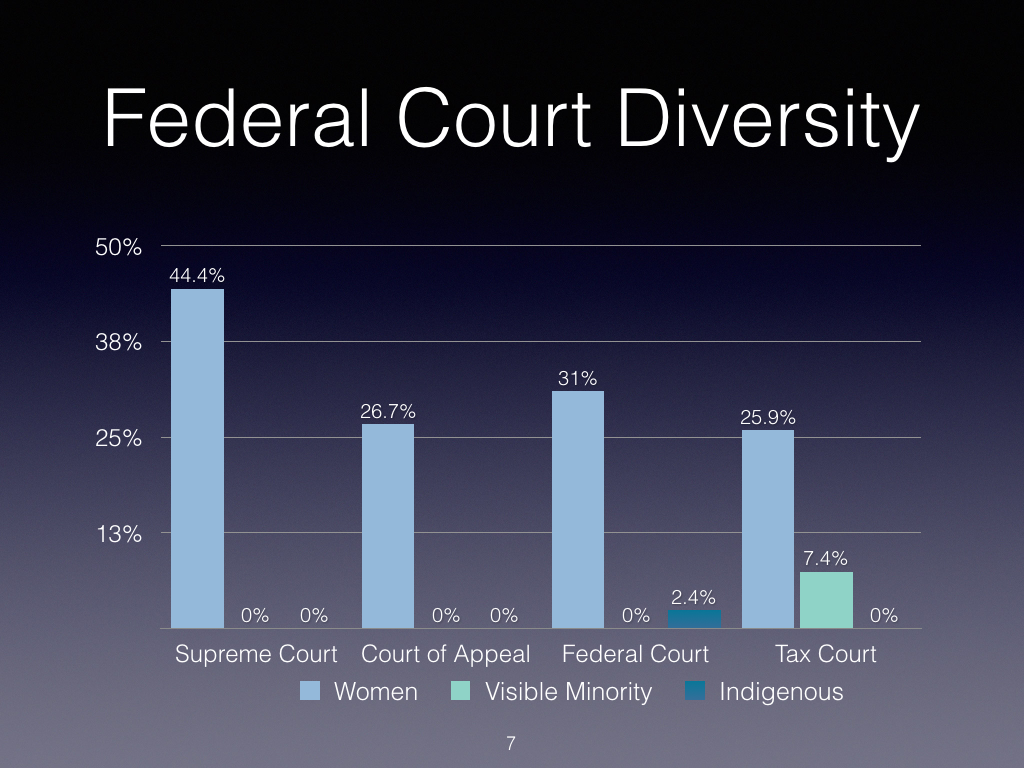
Figure 1 highlights the extent of this under-representation: there are no visible minority or Indigenous judges in the Supreme Court and Court of Appeal, no visible minority judges in the Federal Court and no Indigenous judges in the Tax Court. In all the courts except for the Supreme Court, women are significantly under-represented.

Judicial Diversity 2016 - DRAFT.009Figure 1

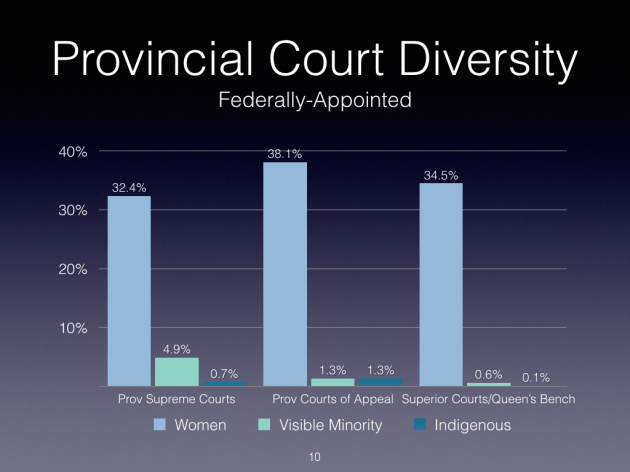
If we look at federally appointed judges to provincial courts (figure 2), the picture is slightly better in terms of both visible minority and Indigenous judges, but in both cases the representation is significantly lower than these groups’ population shares. In the superior courts/Queen’s Bench women are particularly under-represented, but they are better represented when the representation is compared with that of the federal courts.

Judicial Diversity 2016 - DRAFT.010Figure 2

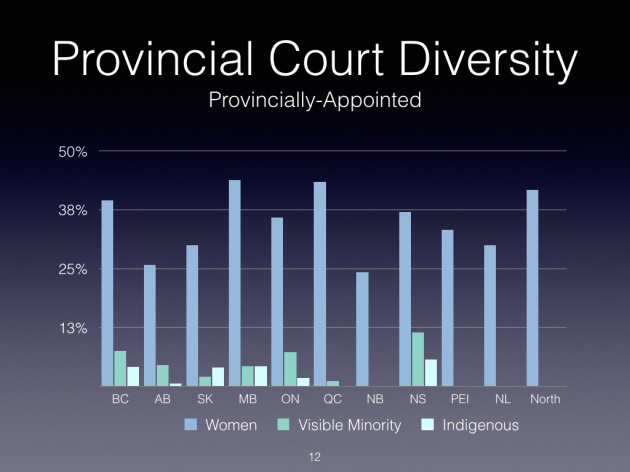
The picture for provincially nominated judges to provincial and territorial courts (figure 3) varies by province, but overall the provinces resemble each other in their under-representation of these groups. The Atlantic provinces, with the exception of Nova Scotia, have no visible minority or Indigenous judges. In the North, despite the large Indigenous population, there are no Indigenous judges. Quebec has relatively few visible minority judges and no Indigenous judges. Saskatchewan and Manitoba, despite their large Indigenous populations, have relatively few Indigenous judges.

Judicial Diversity 2016 - DRAFT.012Figure 3

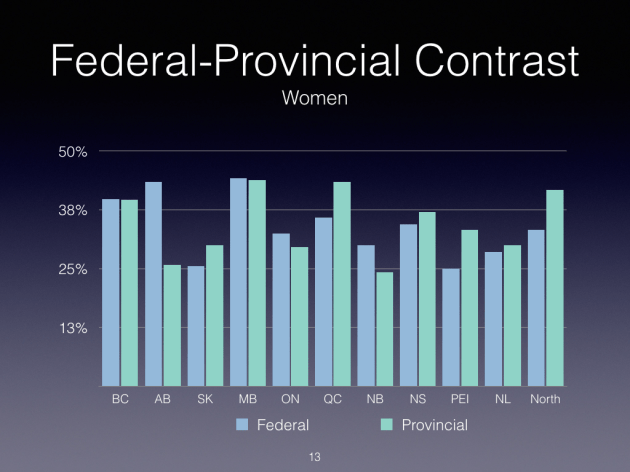
In the next series of charts federally and provincially appointed judges are compared for each under-represented group, by province, starting with women (figure 4). Here there is no overall trend: the federal and provincial appointment of women is similar in British Columbia, Manitoba, Nova Scotia, and Newfoundland and Labrador; in Saskatchewan, Quebec, Prince Edward Island and the North, provincial appointment of women is higher; and in Alberta the appointment of women is significantly lower, given the relatively large share of part-time and supernumerary appointments that are men (about a third of full-time judges are women).

Judicial Diversity 2016 - DRAFT.013Figure 4

Looking at visible minorities (figure 5), when we compare federal and provincial appointments by province, we see a trend in all provinces except Saskatchewan: provincial judicial appointments are more representative of their populations than federal nominations, although visible minorities are still significantly under-represented.

Judicial Diversity 2016 - DRAFT.014Figure 5

Lastly, with respect to Indigenous appointments (figure 6), we see the same pattern: provincial appointments are more representative of provincial populations than federal appointments in all provinces and territories, except, surprisingly, in the North, where there are no Indigenous territorial judges.

Judicial Diversity 2016 - DRAFT.015Figure 6

Looking at senior judges (chief and associate-chief justices), there are no federally appointed visible minority or Indigenous judges, and there are only a handful number of provincially appointed senior judges (figure 7).

Judicial Diversity 2016 - DRAFT.011Figure 7

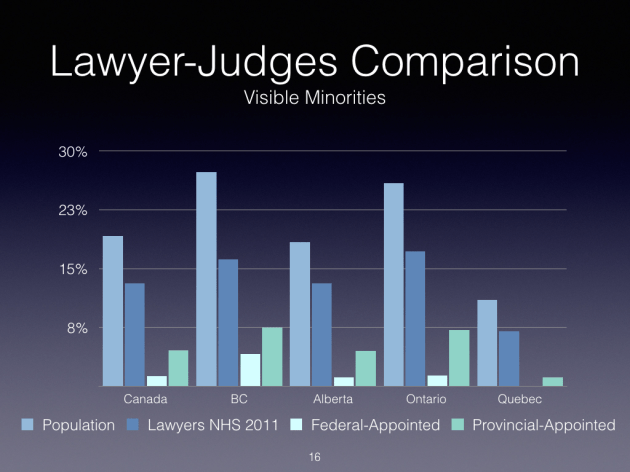
While judicial diversity is low, particularly for visible minorities and Indigenous people, the number of visible minority lawyers continues to increase. Figure 8 presents the proportions of visible minority lawyers aged 25-64 Canada-wide and in the largest provinces, which gives an idea of the size of the pool that can be drawn from. Given that visible minorities are, in general, younger than the general population, visible minority lawyers are also likely to be younger and, therefore, the percentage who would be aged 45 years old or older, the usual age people are considered for these positions, would be lower.

Judicial Diversity 2016 - DRAFT.016.pngFigure 8

As part of its review of the judicial appointment process, the Office of the Commissioner for Federal Judicial Affairs should expand the existing information on the gender of judges and include visible minorities and Indigenous people. With this information, the government could be held to account for its diversity and inclusion commitments, and it would be easier to track its progress over time.

The provinces and territories that do not already do this should do so, and they should use Ontario’s annual reports on appointments as a model, ensuring that the annual reports cover the overall diversity of the entire bench.

*A few notes on methodology. The federal government publishes statistics on gender but not on visible minority or Indigenous appointments. All provinces except Alberta and Saskatchewan indicate gender through the use of “Mr.” or “Madam” justice (the departments of justice provided the number of women judges). Gender information is thus complete.

To identify visible minority and Indigenous origin name checks, appointment announcements and, when available, photos and biographies were used. All provincial judicial councils or departments of justice were approached (only Ontario reports publicly but Saskatchewan, Quebec and Nova Scotia provided the breakdowns used). The Canadian Bar Association, national and regional branches, and law societies were approached and a number of individual lawyers also helped improve the quality of the data collected. I believe this provides a reasonable assessment of current diversity.

Stop making these excuses for the lack of diversity at your company: Johnathan Nightingale, Hubba

Some practical advice on how to increase diversity in the tech industry and elsewhere:

Learn to search blindfolded

A funny thing happens when you take faces and names off of resumes and LinkedIn profiles. People who would insist that they have no bias or prejudice suddenly start evaluating candidates differently. You find candidates you somehow missed before. Unconscious bias isn’t a bleeding-heart liberal codeword, it’s a real threat to your business and your ability to find top talent. We now use the Unbias browser addon to automatically hide names and faces on LinkedIn. Try it. It really does change the quality of candidate searches, whether it ought to or not.

Cast a broader net

A job posting has one goal: to get good candidates excited enough to start a conversation. Every time a position you post reaches some great people, but they decide not to apply, your hiring program has failed. When a marketing program fails the answer is not to complain that there aren’t enough people out there; the answer is to market smarter. A job posting is no different.

Services like Textio can help you analyze your job descriptions to find obvious points for improvement, but they’re also useful for starting conversations about what you’re really looking for. A long list of bullet-point requirements feels natural, but understand that those lists implicitly select for men, who will apply when they meet a much smaller portion of them. In tech, a common pattern is for hiring managers to say “I don’t care who you are, just show me your hobby projects on Github, or your think pieces on Medium” – but a bit of reflection is all it takes to realize that screening based on free-time pursuits gets you more affluent white men than it does underemployed single moms.

Build the best team

The most pernicious theme I hear from people in hiring positions is that they don’t want to “lower the bar” – that they’d happily hire a more diverse group but not at the cost of individual candidate quality. It sounds rational but it’s wrong-headed for two reasons. First, the implication that any current diversity gap must be a result of lower quality stinks, and ignores everything we know about the barriers many groups face. But second is that it misunderstands your job as a leader.

Your job is to build the best team. You can choose a lot of strategies to get there. But if your strategy is to hire “the best candidate” for each role without regard to the team’s composition, and it’s leaving you with a weaker, less diverse team, then your strategy is failing and it needs to change.

Source: Stop making these excuses for the lack of diversity at your company – The Globe and Mail

Federally appointed courts grow restive as Ottawa slow to fill vacancies

Judicial Diversity 2016 - DRAFT.001Good piece by Sean Fine of the Globe on the questions around new processes of judicial appointments.

I am currently in the process of analyzing the diversity of current federally and provincially appointed judges (preliminary federal court numbers in above chart) and hope that as part of the process review, the Government will commit to diversity statistics for visible minorities and Indigenous Canadians (some provinces already do this with respect to provincial court judges):

Ms. Wilson-Raybould would not commit to a starting date for appointments when she spoke to the judicial council, said an Alberta lawyer with knowledge of the meeting. “The government is considering the full scope of the appointments process, including the composition and operations of the Judicial Advisory Committees,” a spokeswoman for the minister said in an e-mail to The Globe.

“Any potential changes will be examined in light of the government’s objectives to achieve transparency, accountability and diversity in the appointments process and they will be carefully considering how best to achieve this goal, taking into account views of key stakeholders and interested Canadians in this regard.”

The appointments process is not up and running yet. And Ms. Wilson-Raybould has made little progress toward putting a new process in place – having not even begun consultations with the legal community and leaving a critical position unfilled.

At the system’s foundation are 17 judicial advisory committees – eight-member groups that screen candidates for federally appointed courts such as provincial appeal and superior courts, the Federal Court and the Tax Court. Several of these committees have no members at all – two of Ontario’s three committees, both of Quebec’s, plus all four committees in Atlantic Canada.

The Alberta committee, however, has all eight of its members, and met as recently as mid-March to recommend candidates for the bench, Chief Justice Wittmann said.

“Nobody is against reform if it betters the system,” he said, “but you can’t change locomotives and stop the train; the train’s got to keep running while you’re doing it.”

Criminal and civil trials that need more than five days are being scheduled for “well into 2017,” Chief Justice Wittmann said. “If the public through their elected representatives say that’s fine, well, I guess it’s fine. But there seems to be an expectation that it’s not fine.”

For the court’s judges, “it increases their stress and their sense of helplessness, because they can’t handle everything they’re asked to do. The public thinks they’re not getting the access they’ve come to expect. We cannot sacrifice quality to increase the quantity of cases that we process. It just can’t work that way.”

Ms. Wilson-Raybould has yet to discuss the system’s pressing questions with the legal community: what to do about the changes to the process that the former Conservative government put in place, whether to commit to gender parity in judicial appointments, and whether to begin tracking the numbers of visible minority and aboriginal applicants.

Source: Federally appointed courts grow restive as Ottawa slow to fill vacancies – The Globe and Mail

We’re Making the Wrong Case for Diversity in Silicon Valley: Pittinsky HBR

A different take than the usual narrow business case for diversity in favour of one that looks at organizational culture and societal benefits:

One of the most compelling reasons for aspiring to workplace diversity is the self-evident social good it brings: fairness, opportunity, and a society that appreciates and enjoys its natural diversity rather than constantly struggling to accommodate and negotiate it. Remember that throughout the 1950s and 1960s having few African Americans, few Latinos, few Asian Americans, and few white women in management and professional ranks didn’t keep U.S. businesses from creating the most successful economy on earth. But it was a problem for members of those groups and for our society. The conditions needed to be corrected for their own sakes. And, of course, there is still a lot of correcting to do.

Interestingly, the social case for diversity does become a business case when one is willing to look ahead to the longer term. The more the members of an organically diverse society enjoy that diversity and see the visible benefits of investing in shared prosperity and the common good, the more secure and resilient that society will be — possibly not at a given moment, but in the long run. Over a span of decades, a safe and resilient society is very good for business. Here in the United States, this stability goes a long way toward explaining why this country has been such an economic success. And around the globe, research finds that countries with greater social cohesion experience greater economic growth. But this is a long-term and diffuse effect, not a clear boost to anyone’s bottom line this quarter, or even the next.

A More Accurate Business Case for Diversity

Although diversity alone does not increase company profitability in the near term, there is a lot to be gained by investigating the conditions under which it does help. That is, under what conditions does diversity lead not to “us versus them” or even “us and them” but rather to the more desirable, productive, and innovative outcome — “us plus them”?

Research is starting to address this question, pointing the way to a more accurate business case for diversity. Put simply, the negative emotions that tend to go along with bias — fear, anger, contempt, and the like — are damaging. Replace those feelings with positive emotions and we all will benefit. There are, for example, solid empirical research findings suggesting that group- and team-level innovation are more likely in the context of positive emotions. Both classic and more-recent research have found that positive emotions such as joy, interest, and anticipation broaden our awareness and encourage novel, varied, and exploratory thoughts and actions. Over time, this expanded behavioral repertoire helps us build skills and resources. In contrast, negative emotions prompt narrow and immediate behaviors. We narrow our focus to shut out distractions — which is important for survival in the wild but often counterproductive in business. In studies reported by Prof. Barbara Fredrickson, participants watched films that induced positive emotions such as amusement and contentment, negative emotions such as fear and sadness, or no emotions. Viewers who experienced positive emotions then showed more creativity, inventiveness, and big-picture perceptual focus. Taken together, these research findings suggest that because positive emotions make us more open and more creative, they help us discover and build together.

Can diversity encourage such positive emotions? Yes, it can. Although as a society we focus almost exclusively on the negative prejudices, frictions, and conflicts among social groups, research has also found that many individuals have not just a lack of prejudice but also positive feelings such as admiration, comfort, and kinship toward those who are different. Research also finds that leaders who hope to tap this positive power of difference must ferret out any negative prejudices and promote those positive feelings about members of other groups. A company that does so may then expect to find that its own workplace diversity, by encouraging positive emotions, is improving its capacity for innovation.

This is in line with the accumulating body of research confirming that organizational culture plays a key role in sustained innovation. My own research, for example, finds that when we measure the presence of allophilia — positive (not just tolerant) attitudes toward a group other than one’s own — in teams and organizations, we can better predict positive outcomes such as open communication, feelings of inclusion, mentoring across genders and ethnicity, and “bringing one’s whole self” to work. Such benefits are not predicted by a company culture of mere tolerance — that is, not minding the presence of other groups but not having particularly positive attitudes towards them either.

The Case for Patience and Results

Business leaders respect results, and rightly so. But pushing businesses, in Silicon Valley or elsewhere, to increase diversity for bottom line reasons, arguing that it inherently boosts innovation, won’t do. It’s too simplistic and too often just not true.

Instead, we should rely on science to tell us more about which diversity conditions prove productive and which counterproductive. We should be encouraged that positive attitudes such as allophilia and their positive results do exist and can be measured, monitored, and developed in organizations and other groups.

Finally, we should embrace diversity because it provides a foundation for a healthy society. If we can become more disciplined and precise in learning how to create and maintain it in the right ways, this will make for a more prosperous and productive economy in the future.


Todd L. Pittinsky is Professor of Technology & Society at Stony Brook University and a Senior Lecturer at Harvard University.

Source: We’re Making the Wrong Case for Diversity in Silicon Valley

Canada can do better on getting more women elected, 60th place in world right now

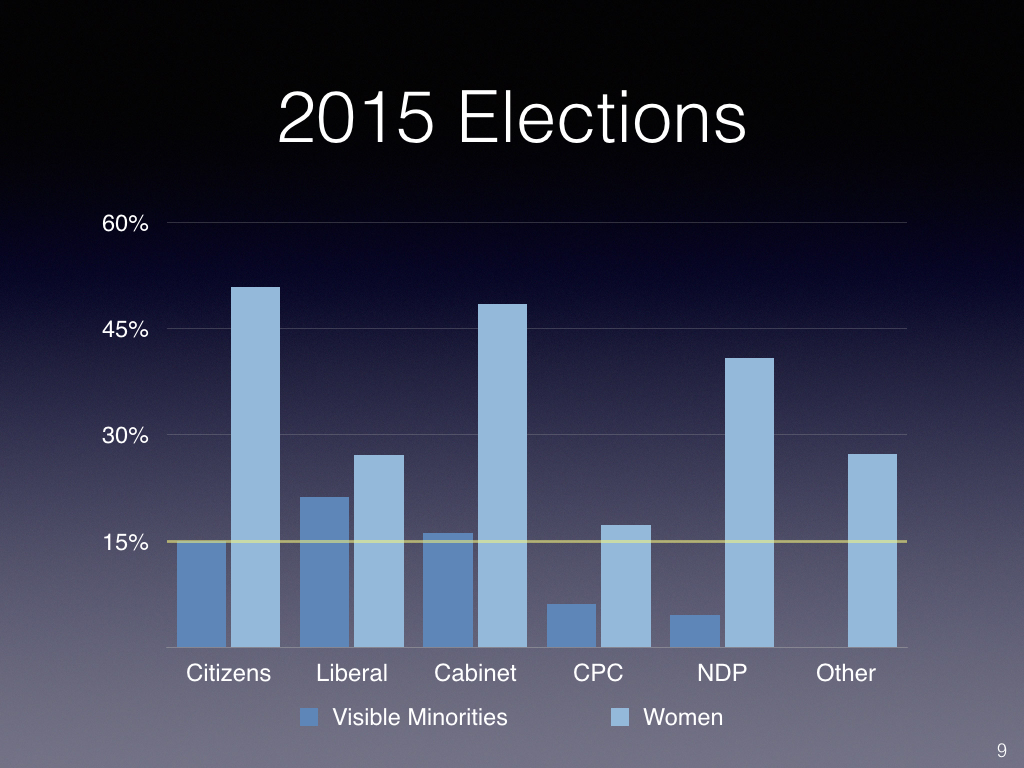
Election 2015 - VisMin and Foreign-Born MPs.002Nancy Peckford and Grace Lore of EqualVoice argue for a gender-based lens with respect to evaluating electoral reform proposals. Women who are now more under-represented than visible minorities, where all parties have made major and successful recruiting efforts:

But, it is crucial to understand that “proportional representation” is not one thing and neither is “women’s political representation.” Proportional representation systems vary widely in how individuals become candidates, how votes are cast, and how those votes are translated into seats. UBC political scientist Grace Lore, and EV’s senior researcher, has just finished a multi-country study of electoral systems in Europe and North America with a specific focus on their effect on women’s representation. The data from that research strongly reveals that while the number of women elected is an important indicator of success, so is the ability of these women to act to represent their constituents, including women.

In ‘closed list’ PR systems, parties determine a set list of pre-approved candidates and voters simply pick a party and, de facto, accept the list of candidates in the ordered that is proposed by the party. In ‘open list’ systems, voters have the opportunity to indicate preferences between candidates. In some countries that use open list proportional representation, voters can even indicate a preference for candidates from multiple parties. Like open list proportional systems, alternative vote systems give voters the chance to rank parties instead of just indicating their top choice.

These are not minor or mechanical details—they matter greatly to how one participates in the democratic process. The nuts and bolts of each system also shape the role of parties and the choices available to voters, including the possibilities for women’s political representation. Some features of electoral systems, whether based on proportional representation or not, lead to the election of a greater number of women, while potentially reducing women’s capacity to represent women’s and other interests once they are in office. Other features improve the power of individual women to have influence, but do not maximize the possibilities for the sheer number of women elected. Lore’s extensive research of electoral systems on two continents and 15 countries underscores that if women representatives are more beholden to a political party for their election (versus having a direct relationship with constituents), their lack of independence frequently prevents them from effectively advocating on behalf of other women.

In short, proportional representation is neither necessary nor sufficient to ensure women’s equal representation. Political culture matters significantly, i.e. voters and parties need to seek more women to appear on the ballot and create the conditions for their participation. More women also need to choose politics as the place to dedicate their time, energy, and skills. If we do not also tackle other systemic barriers, including inequality in access to political resources and the uncertainty of the nomination processes, we cannot count on this happening. These concerns can and should be part of the electoral reform discussion. Revisiting the rules around financing and timing of nomination races are two key areas where there is much room for improvement.

Canada can do better than its current 60th place in the global community for its representation of women. Open discussion around electoral reform provides us all—voters, parties, MPs, and organizations, with an opportunity to take action. Action, however, must be thoughtful and evidence based. A consideration of the impacts on women in politics should be incorporated at every stage of the process—from broad principals to basic mechanics.

Source: Canada can do better on getting more women elected, 60th place in world right now |

The Largest Ever Analysis of Film Dialogue by Gender: 2,000 scripts, 25,000 actors, 4 million lines

The_Largest_Ever_Analysis_of_Film_Dialogue_by_Gender__2_000_scripts__25_000_actors__4_million_linesA really good example of the kind of detailed analysis that provides a more rigorous evidence base for trends, preferences, and biases. Check out the interactive graphics, which are particularly well-designed, informative and effective:

This project was born out of the less-than-stellar response to our analysis of films that fail the Bechdel Test. Commenters were quick to point out that the Bechdel Test is flawed and there are justifiable reasons for films to fail (e.g., they are historic). By measuring dialogue, we have much more objective view of gender in film.

Many of the findings are anecdotally obvious to women in the film industry. But nobody wanted to do the grunt work of gathering the data. We spent weeks just matching scripts to IMDB pages. It’s still not perfect, but we’re now in a much better place than “you know…women are never love-interests when they’re older than 40. ¯\_(ツ)_/¯”

All of our sources are available in this Google Doc and as much data as we can share (without getting sued) is available here on Github. Or if you don’t know how to code, here’s an easy way to comb through every film, genre, and year.

Source: The Largest Ever Analysis of Film Dialogue by Gender: 2,000 scripts, 25,000 actors, 4 million lines