What Jonathan Kay Has Wrong About Diversity in Journalism – New Canadian Media

Dan Rowe takes issue with Jon Kay’s explanation of the lack of diversity among journalists:

Canada’s journalism schools, not to mention independent campus newspapers and radio stations, are filled with people from almost every imaginable background—people trying to enter a field where job opportunities seem to be dwindling and salaries are stagnating. This is not because they don’t understand the situation but because they are passionate about what journalism, at its best, can and should do.

There is no reliable data specific to Canada that I’m aware of to support or refute this—there doesn’t seem to be much after former Ryerson professor John Miller’s Diversity Watch project which hasn’t been updated in 10 years—but a perception exists that there is a disparity in who gets jobs. “Journalism schools are pumping out so many visible minorities and plenty of women, and they do not get jobs the way white kids do,” Hazlitt managing editor Scaachi Koul was quoted by J-Source as saying at a recent Massey College Press Club event in Toronto on the generational gap in Canadian journalism.

Meanwhile, Amber Gero, a radio reporter who was laid off from her job at CFRB 1010 last year, effectively made the same point in a mid-March interview on the Toronto Mike podcast. “I’d also like to see more Asian people, more native people, more Hispanic people. Where are they? They’re graduating every year from the media schools so don’t tell me they’re not there and ready to work,” Gero said. “It has to change from the top down.”

Koul and Gero are right. Change will require action on many levels, including journalism schools. Journalism educators need to spend more time ensuring that all students are better prepared for success with a clear-eyed understanding of the challenges they face when they enter the field. Journalism departments need to offer a more diverse faculty, guest speakers and even examples of good works of journalism discussed in class.

Faculty also need to continue to use our resources and job security to agitate for change and highlight the problem—particularly with empirical data and not just anecdotal accounts, such as this one. For decades, journalism professors in the U.S., led by David Weaver at Indiana University, have done extensive surveys of American journalists. Without anything comparable in scope in Canadian journalism, legitimate concerns about diversity in the workplace can be brushed aside with greater ease.

Increasing diversity in workplaces will require leadership, risk-taking and time. It will require creating opportunities for younger, less proven journalists to take on assignments more challenging than what they’ve done before.

There needs to be more stories in this country like the one Ta-Nehisi Coates tells of David Carr. “In the February of 1996, I sent David Carr two poorly conceived college-newspaper articles and a chapbook of black-nationalist poetry,” Coates wrote of his time at the Washington City Paper in The Atlantic after Carr’s death earlier this year. “And David Carr hired me. I can’t even tell you what he saw.”

People in the position to hire and develop journalists need a more proactive approach than the one Kay exhibited in his interview with Brown, where he regretted the lack of diversity, but ultimately threw his hands up in the air. It was as though he—now the editor of a magazine and a longtime managing editor of the comment pages at a national newspaper prior to that—could not have played any greater role in opening up more opportunities for voices that are more reflective of Canada’s demographic makeup.

If Kay’s assertion that there are very few good essayists in the country is true, then why not use his position, resources and experience to develop new voices? Instead, when Brown asked Kay to name some people he would like to add to the Walrus’s roster, two of the three people he mentioned were Conrad Black and Rex Murphy—both of whom are exemplars of the status quo. (Not to mention bad writers.)

Kay’s comments are a perfect example of what Don Heider was writing about: someone who is not necessarily opposed to change but has no good reason, personally, professionally or politically, to act.

Source: What Jonathan Kay Has Wrong About Diversity in Journalism – New Canadian Media

Canada’s diplomatic brass: too white, too male |

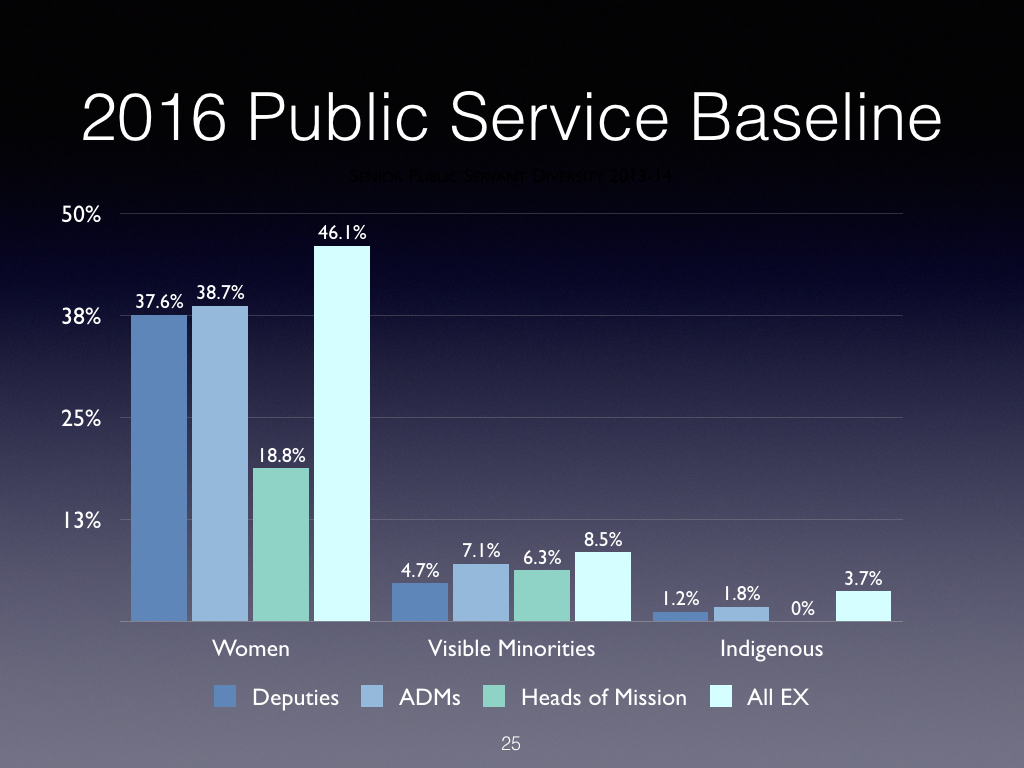
Good detailed piece on the Canadian foreign service demographics and head of mission appointments (my examination of the diversity of senior heads of mission – the 16 positions classified at the ADM level – showed 3 women (19 percent) and 1 visible minority (6 percent).

Another illustration of the government being more open in sharing this data:

The Prime Minister is a feminist and there is gender parity in cabinet, but Canada’s foreign service still has a long way to go.

Sources say that the foreign service has negative gaps in regards to the number of women it employs, as well as aboriginal peoples and persons with disabilities.

According to a public report on employment equity in the government for the 2015-16 year, in the entire department of Foreign Affairs, Trade, and Development, 54.8 per cent of employees were women, 2.4 per cent were aboriginal peoples, 3.3 per cent were persons with disabilities, and 14.4 per cent were visible minorities.

However, according to numbers given to The Hill Times from an “internal workforce analysis for the foreign service group,” Canada’s foreign service is significantly lacking in women.

The department has targets for employment equity, and in terms of women in the foreign service, the foreign service has a negative gap of 166, meaning the department would need to employ 166 more women in order achieve equity. There is also a negative gap of 18 for aboriginal people, and 16 for people with disabilities. However, for visible minorities, the department is positive by 64, meaning they have 64 more visible minority employees than required to be equitable, according to the standards set by the Canada Labour Market Availability.

Screen Shot 2016-06-07 at 12.35.59 PM

Employment equity data for the foreign service, provided to The Hill Times by Global Affairs on June 6, 2016.

The document includes data as of March 31 of this year. Global Affairs confirmed the above numbers, and provided a chart demonstrating the employment equity targets and gaps in percentages. According to Eric Pelletier, a spokesperson for Global Affairs, there is a negative gap of 4.1 per cent for women, meaning women are under-represented by 4.1 per cent. It cites that there are currently 48.1 per cent women in the foreign service, and 62 per cent required representation. A negative gap of 1.5 per cent exists for aboriginal peoples, a negative gap of 1.4 per cent for persons with disabilities, and a positive gap of 5.3 per cent for visible minorities. Mr. Pelletier also said that the foreign service is 71.6 per cent anglophone and 28.4 per cent francophone.

Michael Kologie, communications director for the Professional Association of Foreign Service Officers (PAFSO), said in an interview with The Hill Times that overall, “if we’re talking about employment equity gaps, we’re doing very well when it comes to visible minorities. We’re doing okay when it comes to persons with disabilities, and where we’re really lacking is actually with respect to women and aboriginal peoples.” He said for women, the gap is “quite significant.”

Artur Wilczynski, Canada’s ambassador to Norway, further confirmed these gaps in an interview.

“I took a quick peek at the stats in terms of the employment equity. In the executive cadre, if you look at visible minorities in particular, there are no negative gaps there according to our reports, but there is still a lot of work to be done for example in increasing the representation of indigenous persons, persons with disabilities and women, and quite frankly, people of multiple backgrounds,” he said.

In a later emailed statement, Mr. Kologie wrote that PAFSO is committed to working in collaboration with Global Affairs to encourage a diverse foreign service, “with special attention on currently underrepresented groups such as women, aboriginal peoples, and persons with disabilities,” adding that visible minorities are well represented in the foreign service.

It has been reported by both The Ottawa Citizen and The Globe and Mail that Prime Minister Justin Trudeau has given Global Affairs instructions to diversify the foreign service and to specifically hire more women.

The Citizen’s columnist Andrew Cohen wrote in April that “Justin Trudeau has told Global Affairs that its list of career candidates has too many white males and asked it to do better next time.”

The Globe reported at the end of last month that Global Affairs is choosing two women to fill positions in Israel and in Great Britain, naming Deborah Lyons as Canada’s new ambassador to Israel and Janice Charette as the person to take the lead at Canada House.

The article also pointed out that Mr. Trudeau had told Global Affairs “its list of career candidates has too many white males and promised better representation in terms of gender and ethnicity.” Global Affairs would not confirm whether or not it had received these instructions from Mr. Trudeau, with Global Affairs Minister Stéphane Dion’s (Saint-Laurent, Que.) press secretary Chantal Gagnon saying she wasn’t going to answer that question. She also stressed that Ms. Charette and Ms. Lyons had not yet been officially appointed.

Speaking of official appointments, the Trudeau government will take its first crack at shuffling the foreign service this summer, anticipated in June or July.

Anne Leahy, a former Canadian ambassador, said she expects the announcements to come around the end of June. “I would watch [the announcement] because Justin Trudeau made a point of saying that he wanted more women, more diversity,” she said, adding that she “wouldn’t be surprised” to see that come to light. She said from her own experience, she expects anywhere from 10-15 new heads of mission to be appointed, if not more.

A source from Global Affairs told The Hill Times that the department will have more to say about diversity once the heads of mission shuffle happens, hinting that more diverse nominations might be coming.

The Hill Times counted the number of Canadian heads of mission posted abroad as of October 2015. The results showed that of the 134 heads of mission at the time, 90 were men and just 44 were women. That translates to 32 per cent heads of mission positions being held by women.

Source: Canada’s diplomatic brass: too white, too male |

Liberal government’s new public appointment process fails to improve system, says Conacher

Like many such changes, the proof will only become apparent after a few years, when over 50 percent of GiC positions have been renewed or replaced.

From my perspective, the application of the diversity and inclusion agenda to appointments, hopefully accompanied by annual reporting, will help judge whether Duff Conacher or Alex Marland are correct in their initial assessments.

My take, given my focus on diversity issues, is that we will see an increase in women, visible minorities and indigenous peoples, along with other aspects of diversity, although the “values” of appointments will be largely aligned to the Liberals, just as the previous appointee values were aligned to the Conservatives.

For the baseline of current GiC appointments, see my article, Governor in Council Appointments – 2016 Baseline, or my book, “Because it’s 2015 …” Implementing Diversity and Inclusion, available as a free download (iPad/Mac version (iBooks)Windows (PDF) Version):

“The Conservatives, for most appointments, put an ad up on that website, sometimes put an ad in a newspaper, usually had a headhunter firm, for lack of a better term, do the search for candidates … the Conservatives kept on claiming ‘we’re doing this new way of appointments,’ but the key is the headhunting firm or whoever did the search would just put a list that was a completely advisory list to cabinet and cabinet or the prime minister could choose whomever they wanted,” said Mr. Conacher.

On Feb. 25, 2016, the Liberals quietly announced a new approach to governor in council appointments, which will “apply to the majority of non-judicial appointments, and will make hundreds of part-time positions subject to a formal selection process for the first time.”

“We are committed to raising the bar on openness and transparency in government to make sure that it remains focused on serving Canadians as effectively and efficiently as possible. Government must serve the public interest, and remain accountable to Canadians,” reads a quote from Mr. Trudeau on the release (there is no corresponding event or actual in-person announcement indicated).

As indicated online, the “new approach will” require all GIC opportunities to be advertised online, as well as in the Canada Gazette, and GIC candidates will complete an online profile of their personal background (including language and identity group) in order to try to ensure diversity in appointments.

“Additional online and/or print media may be used in some cases,” reads the website. “Each rigorous selection process will be based on advertised selection criteria developed for the position, and assessment of candidates against the criteria,” it reads, adding this assessment is then provided to the minister responsible.

Members of these selection committee “will be chosen to represent the interests of those who are responsible for decision-making on appointments (the minister, the prime minister), as well as individuals who bring a perspective on the specific interests and needs of the organization,” reads the frequently asked questions section.

The February release indicates this “will be” the new process for GIC appointments, and “the Governor in Council appointment process does not require the approval of Parliament,” said PMO press secretary Cameron Ahmad, when asked what’s required to formalize the new process posted online.

“The process is currently being implemented and applies to Governor in Council appointments. It was made public in February,” he said, adding “the Privy Council Office supports the prime minister with respect to governor in council appointments” when asked which department drafted the new process.

The Liberal government’s new “rigorous approach to appointments is based on the principals of open, transparent and merit-based selection processes that will support ministers in making appointment recommendations for positions in their portfolio,” said Mr. Ahmad, when asked why ultimate discretion to recommend to the GG lies with cabinet and the PM.

“The new approach raises the bar on openness and transparency in government and supports accountability to Canadians,” his response continued.

Mr. Conacher said the Liberal government’s new GIC process is ultimately “no different than what the Conservatives did,” and by allowing ministers or the PM to ignore selection committee recommendations it’s “maintained the patronage crony system.” He said he thinks the Liberals are reluctant to fully take decisions out of the hands of government because “the Liberals have a whole bunch of people who volunteered for 10 years while they lost three elections and some of those people want a reward.”

“This is one of the greatest areas of cabinet power,” said Mr. Conacher.

Mr. Conacher said instead, there should be a new process introduced federally similar to Ontario’s judicial appointments committee which has 13 members, six of whom are members of the public—though he said the “flaw” is seven members are from the ruling party. Mr. Conacher said with a minority of members from the ruling party and a majority from opposition parties, or require membership to be approved by all House leaders. This committee would “come up with a short list” of candidates and then cabinet would “have to choose from the short list.”

As well, he said all positions should be advertised widely online, including on popular public job sites (like Monster Jobs, for example).

Alex Marland, associate professor of politics at Memorial University, said if the “composition of the group of people making the [GIC appointment] recommendations have deep Liberal connections” it’s hard to “put a lot of faith that this is any more than window dressing.” But he also said he doesn’t worry about cabinet or the PM having discretion over such appointments.

“I actually think that’s necessary, because ultimately cabinet is accountable to Parliament, and ultimately cabinet has to run the government, so how could the government function if somebody is being recommended to a position and cabinet is bound to appoint someone who they realize the can’t possibly work with or who will undermine what they’re trying to do,” said Prof. Marland.

Prof. Marland said more transparency is good, and the fact that the process is publicly available “does reduce the possibility” for cronyism and at the end of the day, “you have to trust that these groups take their jobs seriously and will actually make recommendations that they believe are the right ones.”

The Liberals have also committed to review the judicial appointment process and in an email response to questions from The Hill Times, including on timing, Justice Minister Jody Wilson-Raybould said she “will work with interested stakeholders, including the judiciary, and Canadians on these appointments.”

“In the interim, our Government is moving forward on measures that will facilitate appointments to fill highly pressing judicial vacancies as soon as possible,” reads her response. There are currently about 46 vacant seats on the benches of federally appointed superior courts across Canada.

As well, back in December, the Liberals announced the creation of a new Senate appointment process with the Independent Advisory Board for Senate Appointments.

Source: Liberal government’s new public appointment process fails to improve system, says Conacher |

The Times’ Idea of Lagging Diversity | commentary

Even though I value the reporting and commentary of the New York Times, valid to point out the contradiction:

In today’s New York Times, there is a front-page article on the new Chairman of Carnegie Hall, Robert F. Smith. Mr. Smith, who made his fortune in software, ranks #268 on the Forbes 400 list, is worth $2.5 billion, and is the country’s richest African-American after Oprah Winfrey.

The Times noted with characteristic snooty disapproval that, with his new appointment, Smith “became the first African-American to hold the post at a time when diversity at leading cultural organizations lags — a recent survey of New York’s cultural institutions found that nearly 78 percent of their board members were white.”

Given the fact that board members of major cultural institutions such as concert halls and museums are expected, along with performing their duties, to write major checks every year, 78 percent white doesn’t seem so disproportionate. However much racial diversity has improved in most of American life, the very, very rich are still mostly white. That can’t be changed by government fiat (although I hate to give the Obama administration any bright ideas). It will take a couple of generations before the Forbes 400 List “looks like America.”

I wondered what percentage of the New York Times editorial board was white, but have found its membership strangely hard to track down on the Internet (the Wall Street Journal editorial board is here). So I looked up the membership of the New York Times Board of Directors instead. It’s over 91 percent white. The top executive team is likewise more than 91 percent white.

As usual with the Times, it seems, it’s do as we say not as we do.

Source: The Times’ Idea of Lagging Diversity | commentary

Employment Equity: What the Latest Government Report says – Policy Options

TBS EE 2015 Analysis.007My latest piece comparing the 2015 and 2008 numbers in IRPP’s Perspectives. Detailed charts and tables, including departmental rankings of best and worst representation for women, visible minorities and Indigenous peoples:

The latest Treasury Board (TBS) report, Employment Equity in the Public Service of Canada 2014-15, provides useful information regarding the relative representation of employment equity groups: women, Indigenous peoples, visible minorities and persons with disabilities. Overall, the public service is reasonably diverse for the three groups which are the subject of this article — women, visible minorities and Indigenous peoples.

Unlike Labour Canada’s Employment Equity Act: Annual Report 2015, the TBS report does not present how representation has improved over time. To provide some historical context, this article contrasts the 2014-15 report with the 2007-8 TBS report with respect to overall representation, as well as diving into some of the 2014-15 numbers.

In contrast to earlier TBS reports, the current report only provides a summary analytical narrative for its data tables (one page, compared to over 10 previously), with fewer data tables (six compared to 16).

The following charts and narrative aim to fill that gap and help tell the overall story. While representation for all employees has improved, visible minorities and Indigenous people are relatively less well represented at the executive level, particularly at the Assistant Deputy Minister level (EX4-5).

Source: Employment Equity: What the Latest Government Report says – Policy Options

Because it’s 2015 … Implementing Diversity and Inclusion – My latest ebook

because-its-2015_pdf__page_1_of_59_Over the past months, as many of you know, I have been doing a series of articles on the 2015 election, Cabinet and other senior appointments, along with baseline data for the public service, Governor in Council and judicial appointments by which to measure the government’s implementation of its diversity and inclusion commitments.

I have integrated and updated these in mini-book form, available as a free download from:

iPad/Mac version (iBooks)

Windows version (PDF)

I hope you find this compilation and the reference data it provides of interest and use.

The description is below.


——————-

Because it’s 2015 … Implementing Diversity and Inclusion

Canada’s 2015 election provided a sharp contrast between the social cohesion focus of the Conservative party and its use of identity politics, and the Liberal party’s emphasis on diversity and inclusion. This was not only reflected in policy and language but in candidate recruitment, with the Liberals having the largest number of visible minority candidates, although Conservative and NDP numbers also increased.

The overall voting shift to the Liberals was particularly strong among new Canadian voters, reflecting a mix of the overall shift to the Liberals in this election, perceived anti-immigrant bias and identity politics, and lack of support for Conservative restrictive citizenship and immigration policies.

In power, the Liberals implemented their diversity and inclusion commitment through the establishment of a Cabinet Committee on Diversity and Inclusion, Cabinet and Parliamentary Secretary appointments, Ministerial mandate letters and initial Senate appointments. They also set expectations for other senior appointments.

This short book provides data and related analysis with respect to the election results, political representation and leadership positions, and establishes the 2016 baseline for senior public servants, Governor in Council and judicial appointments by which to judge the Government’s implementation.

With over 40 charts and tables, Because it’s 2015 … is an invaluable reference for those interested in Canadian politics and diversity. iPad optimized.

Table of Contents

  1. Introduction
  2. Political Institutions
  3. Public Service Impact
  4. Governor in Council Appointments
  5. Judicial Diversity
  6. Concluding Observations

The complicated task of getting more women involved in politics

The debate over how to get more women involved in politics, contrasting the NDP’s Kennedy Stewart’s private members bill linking election expense reimbursement with female candidate share with Michelle Rempel’s encouragement and education approach:

Mr. Stewart’s academic research has shown that the party selection processes are biased, and that men are five times more likely to win nominations just because the selectors are biased against women.

So, the problem is with the political parties, and their old-boy networks and structures.

Equal Voice, a non-partisan group that advocates for more elected women, notes that only 32 per cent of candidates in last year’s federal election were women.

Based on the formula in his bill, Mr. Stewart says $1.25-million would be deducted from the Conservatives’ reimbursement for the 2015 election, because 20 per cent of their candidates were female; the Liberals, with 31 per cent female candidates, would lose about $900,000, and the NDP, which ran 43 per cent female candidates, would have lost about $200,000.

Mr. Stewart’s bill was debated earlier this month in the Commons; it comes back for a vote in September.

Some note that, even if it passes, the desired change might not come. Equal Voice says that in France, for example, the major parties will simply take the financial hit.

For Ms. Rempel, the bill would not make “real change.” She says women need to be educated on how to win nominations – raising money, dealing with the media, and building networks – to prepare them for the “fiery furnace” of a federal election. She believes going through rigorous internal party vetting is a positive exercise for women.

“The propensity is – and frankly you see it in all political parties in Canada – I don’t want to see women that are thrown into non-winnable ridings just to be a token so that [the party] is not financially penalized,” she says. “I think that actually takes women a step back.”

She fears a bill such as Mr. Stewart’s will change the calibre of women in the Commons: “There are women in our House of Commons across party lines that have really strong CVs or really strong life experiences. All of the women that are in the House of Commons are there because they won elections, full stop. They are not there because of tokenism.”

The NDP has the strongest female representation in caucus (41 percent), the Conservatives the weakest (17 percent, identical to 2011 election), the Liberals 27 percent.

Source: The complicated task of getting more women involved in politics – The Globe and Mail

Trudeau chooses two women to fill top diplomatic positions – and broader diversity emphasis

Telling and consistent with overall diversity and inclusion agenda:

The Prime Minister has told Global Affairs that its list of career candidates has too many white males and promised better representation in terms of gender and ethnicity.

Overall numbers for all Global Affairs employees: 54.8 percent women, 14.4 percent visible minorities (TBS EE report 2014-15).

Source: Trudeau chooses two women to fill top diplomatic positions – The Globe and Mail

With civil service shakeup, Trudeau brings youth, diversity to top jobs

Election 2015 and Beyond- Implementation Diversity and Inclusion.001Simon Doyle on changes to Deputy ranks but more anecdotal than evidence-based.

My count of the 19 Deputy appointments to date by PM Trudeau: 10 men, 9 women, 1 visible minority, no Indigenous people. Gender parity but weak visible minority and Indigenous peoples representation, reflecting in part weaknesses in ADM diversity as shown in the above chart:

Retirements of Ottawa’s highest-ranked bureaucrats have accelerated under the Justin Trudeau government as the Liberals shuffle the leadership of the public service after years of management under Stephen Harper.

The government has made a series of moves with its highest-ranked bureaucrats since coming into office last fall, most recently promoting senior officials who had worked on the Environment and Foreign Affairs portfolios.

…..David Zussman, a former senior government official and a professor of public-sector management at the University of Ottawa, said the number of appointments are high, with more than 20 changes in the senior ranks of the public service since late December, including retirements.

“I’m sure word would have gone out that: ‘We’re in a process of renewal, and any of you guys thinking of leaving, do me a favour and tell me now,’ ” Dr. Zussman said.

“A lot of them are really long-standing public servants who I think hung around for the election to help out [former clerk] Janice Charette, and now, six months into it, they decided to trigger their retirements. They’ve all got their 35 years,” he said, indicating they can collect pensions.

…“Some ministers may want a new deputy, and it’s their prerogative to say they would like someone new. The clerk may decide that he feels someone should move, or sometimes deputies will go and say they would like to move,” said C. Scott Clark, former deputy minister of finance and a senior adviser to the prime minister under the Jean Chrétien government.

“It takes time for a minister and a deputy to form what I would call a good relationship, a professional, working relationship. Sometimes they do, sometimes they don’t,” Mr. Clark said.

…The new deputies also reflect efforts by Mr. Trudeau and the clerk to renew the public service and, as with the makeup of the Prime Minister’s cabinet, introduce some youth and diversity into the government’s leadership.

“He’s been very clear about the importance he attaches to having a professional, non-partisan, responsive, agile, creative public service,” Mr. Wernick told The Globe and Mail in an interview earlier this year. “It’s the only way he’s going to accomplish the goals he put in front of Canadians.”

One senior government official said Mr. Trudeau, in late January, made a rare appearance at the Deputy Ministers’ Breakfast, a gathering of all the public service’s most senior mandarins who meet in Langevin Block. Prime ministers typically address the breakfast once or twice per year.

While it’s unclear what was said, the PM has been emphasizing with senior officials a program for getting results and revitalizing the public service. Mr. Trudeau attended the meeting shortly after he appointed Mr. Wernick as Clerk.

….Mr. Scott expects more changes in the fall after the government takes the summer to regroup. “I would expect there will probably be more moves coming,” he said. As Mr. Wernick said in a recent letter to the PM: “It is clear to me that we are entering a period of dramatic generational change in the Public Service.”

Source: With civil service shakeup, Trudeau brings youth, diversity to top jobs – The Globe and Mail

How and Why You Diversify Colleges – The New York Times

Frank Bruni on the efforts by USA elite colleges to broaden socioeconomic diversity of their student populations:

The socioeconomic diversity at elite colleges is hardly the most vital concern about higher education. These colleges serve a small fraction of the country’s students.

But that diversity is important nonetheless. It’s a mirror of our values — in particular, of how well we own up to stacked decks and how willing we are to make adjustments.

Amherst is an exemplar of such adjustments. It’s tweaking campus operations to recognize that some less affluent students stick around during breaks. It’s marshaling extra resources so students from low-income families can take on the sorts of unpaid internships and research opportunities that other students do.

I mentioned community colleges before: About 10 years ago, Amherst took just seven transfers from those schools. It has taken 34 in each of the last two years.

The college’s president told me that one of her current passions is to admit more military veterans, who bring to the campus abilities, experiences and outlooks that other students don’t possess.

She wasn’t talking about doing them a kindness. She wasn’t outlining a social experiment or anything gimmicky. She was embracing the reality that real learning and a real preparation for citizenship demand the intersection of different life stories and different sensibilities. Colleges should be making that happen.

Source: How and Why You Diversify Colleges – The New York Times