Quebec police forces have best representation of women in Canada

police-gender-chart-2The companion piece to the analysis of visible minority representation (Police diversity fails to keep pace with Canadian populations). Waiting for the next piece on Indigenous peoples representation:

Quebec’s major police forces have among the highest proportions of female officers in the country, a CBC News analysis has found.

Leading the country is the Montreal Police Service, where nearly 32 per cent of its sworn officers are women.

At the tail end for major cities is the Winnipeg Police Service, where the proportion is less than half of Montreal`s at just under 15 per cent.

Of the 332 RCMP officers in Nunavut and the Northwest Territories, less than 11 per cent are women.

For the last three decades, women and girls have formed a slim majorityof Canada’s population, Statistics Canada says.

In May, CBC News surveyed all major municipal, provincial and RCMP divisions in Canada in order to establish a national snapshot of the number of women working in the major law enforcement agencies.

The average proportion of women in these police forces stands at just over 20 per cent.

‘I thought we had done a much better job’

The woman who climbed to the highest rank in the Winnipeg Police Service’s history says she was not expecting these results.

“It was surprising. I thought we had done a much better job at recruiting women,” said former deputy chief Shelley Hart.

“I think there’s so much diversity in our police departments already that compared to what they were 38 years ago when I started, that everybody … sees policing as an option,” she said.

Hart believes that part of the challenge for some forces has been a general drop in applicants.

“Members of the public, young people, they sit back and think, do I want to be in the line of fire and have that kind of scrutiny on the decisions I make and the level of disrespect and violence on the street now and do they look at it now as one of those occupations that is desirable?” she said.

Danny Smyth, Winnipeg’s deputy chief, says he’s unsure how Montreal has managed to close the gender gap to such a degree, but despite the numbers his force has been actively recruiting women for years.

“In the ’90s we made some specific efforts; there was a time when we put in a full class that was exclusively women. I don’t know if other cities have done that and perhaps it’s something we may consider in the future again to bring more parity.”

He says the Winnipeg Police Service does not have set targets for gender recruiting, but it has set objectives for hiring more Indigenous officers.

Women bring ‘different perspectives’

Const. Nancy Roussel, spokesperson for the Quebec City Police Service, says while she knew women were relatively well represented, she was not aware of where they stood compared to their peers.

“If we consider [27.7 per cent] as a good score, then yes we’re happy, however, we haven’t undertaken any specific initiatives to target women. … The process doesn’t give preference to women,” she said.

“Throughout every level of the organization, the presence of more women brings forward different perspectives,” she said.

Source: Quebec police forces have best representation of women in Canada – Canada – CBC News

Police diversity fails to keep pace with Canadian populations

Police_diversity_fails_to_keep_pace_with_Canadian_populations_-_Manitoba_-_CBC_NewsSurprised they were able to get this much data.

When I asked for the date from the major police forces – Toronto, Vancouver, Calgary, Montreal – the quality of data was mixed (Alberta does not collect employment equity information):

Only one major city in Canada — Halifax — staffs a police force that is as racially diverse as its community, CBC News has found.

All other major law enforcement agencies across the country fail to reflect their communities’ diversity among their ranks, leaving large swaths of visible minorities and Indigenous populations without representation.

  • While 57 per cent of Peel region, outside Toronto, is diverse, its police force has only 19 per cent non-white officers.
  • 54 per cent of Vancouverites are from minority groups, whereas 22 per cent of its police force match that profile.
  • For York region, also neighbouring Toronto, that ratio is 44 per cent for the population, but 17 per cent for the police force.
  • In Edmonton, 35 per cent of its citizens are visible minorities or Indigenous, yet those groups are represented in less than 10 per cent of its police force.
  • In Nunavut, 12 per cent of the police force is Aboriginal, but the territory is almost 90 per cent Indigenous.

These findings come as minority groups across North America are shining the spotlight on allegations of abuse of authority and discrimination among polices forces.

In May, CBC News surveyed all major police forces in Canada in order to establish a national snapshot of the racial diversity of key law enforcement agencies.

These figures were then compared to the demographic makeup of the public for each community using the results of the 2011 National Household Survey to calculate the disparity between the racial profiles of police and general populations.

…The Toronto Police Service says one of the key impediments to achieving better representation is that the rate of officer turnover has been outpaced by the rapidly changing community.”In 2000 we were at about nine per cent visible minority. We’re now at about 24 per cent,” says Mark Pugash, director of corporate communications for the force.

“People who join tend to stay for 30 years, or in other cases 35 years or longer. So there’s not a great turnover. We’ve also had hiring freezes for a number of years in recent times.”

Pugash says that when Toronto police hire, they have focused on recruiting Somali Canadians, and have also been successful in debunking certain myths about policing through a program that teams up youths with officers.

Source: Police diversity fails to keep pace with Canadian populations – Manitoba – CBC News

Beyond Integration: How Teachers Can Encourage Cross-Racial Friendships : NPR

Lessons that can also be applied at later stages in life? In the workplace?

There’s a reason Jose Luis Vilson’s students learn in groups: He wants them to feel comfortable working with anyone in the classroom, something he’s realized in his 11 years of teaching doesn’t always come naturally.

“I don’t really give students a chance to self-select until later on, when I feel like they can pretty much group with anybody,” he says.

Vilson teaches math at a public middle school just north of Harlem in New York City. Most of his students are Latino and African-American, and Vilson pays close attention to the fact that their racial identities affect their experiences in the classroom.

Children entering adolescence, he knows, are less likely to maintain cross-racial friendships as they grow older. But teachers like him may be able to help change that, according to a new study led by researchers from New York University.

In past decades, it’s become increasingly clear that diversity in classrooms isn’t just a buzzword. A growing body of research points to classroom diversity as an important aspect of childhood development. Kids who make friends with kids of other races tend to be more socially well-adjusted, more academically ambitious and better at interacting with people who are different from them.

The NYU researchers knew of these findings and wondered if just putting kids of different races in classrooms together is enough to foster lasting connections. Their hypothesis was that, as kids grow into early adolescence, they increase their same-race friendships and decrease their cross-race friendships.

So they looked at data from the Early Adolescent Development Study (EADS), a longitudinal survey where researchers questioned more than 500 elementary and middle-schoolers over the course of two academic years: fall 1996 to spring 1998. The students in the study all went to school in one district in the American northeast where the racial makeup of each of their classrooms was roughly half black and half white.

And the researchers were right, says Elise Cappella, head of the project: “Cross-race friendships diminish over the course of one academic year; same-race friendships increase.” The finding bore out among all of the students in the study, particularly those who were older and/or white.

Integration, she says, “[is] a very important step” to fostering cross-race connections. “But it’s not the only step.”

This is where teachers like Jose Vilson can have an impact. All of those group activities he encourages in his classroom, he hopes, will help students learn to learn from each other.

The difference comes down to the kind of environment teachers created: did students collaborate with one another, or did they compete?

“Teachers who were warm and responsive to students’ needs and created a classroom context characterized by respect and trust — in those classrooms, students had lower increases in same-race friendships over the course of that year,” Cappella says.

In other words, students who started the year with cross-race friendships were more likely to keep them throughout the year with the help of a friendly teacher.

The third, fourth and fifth-graders in this sample, Cappella says, are just entering the age where they start to become more self-conscious. “Sometimes, during those times, you begin to associate with people who you think may have shared identities as you as a way of building an understanding of who you are,” she says.

Teachers who build supportive atmospheres “[allow] students to get to know one another across differences,” Cappella says. “And when you get to know each other across differences, you see other kinds of similarities that may be more hidden as well.”

It’s relatively rare to find classrooms that look like the ones profiled in the EADS: more or less an even split between black and white students. Vilson’s classroom doesn’t look like that, but he says that cross-cultural contact in school will help his students outside the classroom.

“The real world is such that people have to find a way to get along with each other, but also work with each other,” he says. “There’s a lot of value in actually getting to know different people — how they work and what their values are and what their experiences are.”

Source: Beyond Integration: How Teachers Can Encourage Cross-Racial Friendships : NPR Ed : NPR

U of T gets personal with staff to track race, gender data

Lessons for the federal public service and other organizations?

Particularly significant is the removal of names from resumés to remove implicit (and explicit) bias.

Ontario EducationI was able to drill down to visible minority groups using NHS data for the  education sector as in the chart above for Ontario, as differences among groups are increasingly more important than between visible minorities and non-visible minorities:

Canada’s largest university is asking its employees remarkably personal questions — from what race they are and where they come from to whether they’re transgendered — in a bid to make sure certain groups aren’t being left out of jobs and promotions.

In a new survey given this week to all 10,000 employees from professors to secretaries, the University of Toronto goes beyond asking staff if they see themselves as “persons of colour” or “racialized,” to whether they are black, white, Asian, Latin/Hispanic, Middle Eastern or mixed.

And that’s just to start.

The updated Employment Equity Survey then dives to a level believed unmatched on any other Canadian campus: If you answer ‘black,’ are you African, Caribbean, European, North American or South American?

If you said Asian, do you mean East Asian (Chinese, Japanese, Korean), South Asian (Indian, Pakistani, Sri Lankan), Southeast Asian (Malaysian, Filipino, Vietnamese) or Asian Caribbean from, say, Trinidad? Hispanic employees are asked if their heritage is Caribbean, Central American, European or South American.

The questions also offer a sneak peek at what the university’s 85,000 students will be asked this fall on its first student demographic survey.

“Students have made it very clear they don’t see themselves reflected in faculty and staff, so collecting data is part of an overall move to get a better sense of who is under-represented so we can do better outreach and targeted recruitment,” said Angela Hildyard, vice-president of human resources and equity.

Like other organizations that do a certain amount of business with the federal government, U of T has for decades been required to track its employees by gender, disability, whether they’re aboriginal or members of a ‘visible minority.’

“But this language no longer makes sense,” said Hildyard, especially with students. “If you’ve been to one of our convocations lately, you’ll see we’re so diverse, the visible minority would likely be white.” Even changing the category last year to “person of colour or racialized person” shed little light on the true diversity of campus workers.

“If equity and diversity are linked to excellence — and we are the only university in North America to have a statement making it clear we’ll only be excellent with diversity and equity — then we need to collect more information on how different groups are represented on campus.”

Some black faculty members have been vocal about the need to increase their ranks, she said, “but we have no idea how many we have because we don’t have data. This gives us a better sense of who we have here and if they are under-represented, and target candidate pools.”

Moreover, the university will start giving the survey to job applicants as well, so it can track where the gaps begin.

“Black students feel woefully under-represented (among U of T faculty and staff), so this will allow us to actually see the numbers of black applicants in the first place, and are they being shortlisted? Is there some kind of discrimination going on?”

Too, U of T will take the unusual step of removing names from job applicants’ resumés “to see if that enhances certain groups’ possibility of being interviewed. We always want to be sure we hire the best candidate, but is there something happening (that blocks particular groups) like hiring committees having a bias against certain kinds of names?”

Anecdotally, the ranks of professors at Canadian universities “are not very representative of the wider population,” noted David Robinson, executive director of the Canadian Association of University Teachers, “so gathering this kind of information is a positive thing.” It also could help reveal which university departments are less diverse than others, not only with regards to race, but also gender and abilities.

The U of T survey asks about disabilities and sexual orientation, and a new question on gender includes check-boxes for man, woman, two-spirit, “another gender identity” or “trans: a person who identifies with a gender other than the one assigned to them at birth, or differs from stereotypical masculine and feminine norms.”

Said Hildyard: “The data can help us learn who applies, who gets shortlisted, who gets interviewed for jobs, so if we find the candidate pool is not diverse, that’s where we can focus our efforts.”

Source: U of T gets personal with staff to track race, gender data | Toronto Star

We Just Can’t Handle Diversity: HBR

We_Just_Can’t_Handle_DiversityGood long read by Lisa Burrell at HBR and the difficulties in ensuring diversity given our implicit biases and automatic thinking:

Senior leaders need to recognize their organizations’ inequities—probably more than anyone else, since they have the power to make changes. But once they’ve climbed to their positions, they usually lose sight of what they had to overcome to get there. As a result, Rosette and Tost find, “they lack the motivation and perspective to actively consider the advantages that dominant-group members experience.” This is especially true of successful white women, who “reported [even] lower perceptions of White privilege than did highly successful White men.” It’s fascinating that their encounters with sexism don’t help them identify racial advantage after they’ve gotten ahead. Perhaps, the authors suggest, their hard-earned status feels so tenuous that they reflexively tighten their grip.

Beyond murkily defined concepts and somewhat defensive motivations, we have an even-higher-level conceptual obstacle to overcome: our bias against diversity itself. Recent research by Ohio State University’s Robert Lount Jr. and colleagues (Oliver Sheldon, of Rutgers; Floor Rink, of Groningen; and Katherine Phillips, of Columbia) shows that we assume diversity will spark interpersonal conflict. Participants in a series of experiments all read, watched, or listened to the exact same conversations among various groups. They consistently perceived the all-black or all-white groups as more harmonious than those with a combination of blacks and whites.

If we expect people to behave less constructively when they’re in diverse organizations or teams, how do we interpret and reward their actual performance? Under the influence of those flawed expectations? Quite possibly.

So, Is It Hopeless?

According to the renowned behavioral economist Daniel Kahneman, trying to outsmart bias at the individual level is a bit of a fool’s errand, even with training. We are fundamentally overconfident, he says, so we make quick interpretations and automatic judgments. But organizations think and move much more slowly. They actually stand a chance of improving decision making.

Research by John Beshears and Francesca Gino, of Harvard Business School, supports that line of thought. As they have written in HBR, “It’s extraordinarily difficult to rewire the human brain,” but we can “alter the environment in which decisions are made.” This approach—known as choice architecture—involves mitigating biases, not reversing them, and Beshears and Gino have found that it can lead to better outcomes in a wide range of situations. The idea is to deliberately structure how you present information and options: You don’t take away individuals’ right to decide or tell them what they should do. You just make it easier for them to reach more-rational decisions. (For more on this idea, also see “Designing a Bias-Free Organization,” an interview with Harvard behavioral economist Iris Bohnet.)

There’s still an element of manipulation here: The organization sets the stage for certain kinds of choices. But that brings us back to what most of us can agree on, at least in the abstract: Diversity improves performance, and people who apply themselves and do good work should be treated fairly.

If the members of an organization could get behind those broad ideas, would it bother them that they were being nudged to do what they wanted to do anyway? It might—and that would be another cognitive roadblock to clear.

Source: We Just Can’t Handle Diversity

Interesting that the recent public service discussions on diversity, judging by reports I have seen, show no evidence of this deeper thinking of the challenges involved (even if, judging by the numbers, the public service is reasonably diverse – see Diversity and Inclusion Agenda: Impact on the Public Service, Setting the baseline).

When making a presentation on multiculturalism and the government’s inclusion and diversity agenda this week at Canadian Heritage, my assigned ‘homework’ for attendees was to take the Harvard-developed Implicit Association Test to be more mindful of their internal biases and prejudices. It certainly was revealing to me, as it has been to those I know who have taken it:

Public Servants Get Real About Diversity in the Public Service

Liberal appointments signal intent to diversify Canadian judiciary

More analysis by Sean Fine on the Government’s first batch of judicial appointments:

The Liberal government has begun to change the face of the Canadian judiciary, appointing an aboriginal judge, an Asian-Canadian judge and a prominent member of the LGBT community in its first set of 15 appointments – of which just three were white males.

Justice Minister Jody Wilson-Raybould also signalled the government’s intention to take a different approach from its Conservative predecessors by promoting two human-rights specialists, including one who fought for gay rights in a landmark case, to Alberta’s highest court.

The Liberals waited more than seven months to name a single judge to the federally appointed courts (provincial superior and appeal courts, the Federal Court and Tax Court), even as vacancies swelled to nearly 50 from about a dozen last summer before the election was called.

The first group indicates a shift in who sits as a judge in federally appointed courts – and who gets promoted. It includes Jonathon George of the Kettle and Stony Point First Nation in southwestern Ontario; like the Justice Minister herself, he is a second-generation lawyer. He was promoted to the Ontario Superior Court from the Ontario Court of Justice.

Douglas Mah, an Asian-Canadian, joins the Alberta Court of Queen’s Bench.

Lucy McSweeney, the Children’s Lawyer of Ontario, was named to the Ontario Superior Court. She received a professional leadership award in 2013 from Out On Bay Street, a group that helps LGBT law graduates transition to working life.

“I think it’s sending a strong signal that for [the Liberals], merit involves considering the diverse perspectives that people bring to the law, and that includes the backgrounds and the communities they identify with,” said Paul Saguil, a Toronto lawyer and board member of Pride Toronto, who described Ms. McSweeney as a mentor to him. “That signal is important in instilling public confidence in the judiciary.”

Sheila Greckol, one of the two appointees to the Alberta Court of Appeal, represented Delwin Vriend, a teacher who was fired because he was gay, and fought all the way to the Supreme Court of Canada to establish that Alberta’s human-rights code discriminated by excluding gays from its protections. Justice Greckol was a labour lawyer who represented unions. Ms. Wilson-Raybould promoted her from the Court of Queen’s Bench to replace Russell Brown, who was an irreverent right-wing blogger as an academic.

Sheilah Martin, the other Alberta appeal court appointee, was the law dean at the University of Calgary with a long list of publishing credits to her name focused on the equality section of the Charter of Rights and Freedoms. She, too, was promoted from the Court of Queen’s Bench.

During the decade-long tenure of prime minister Stephen Harper, that court became home to small-c conservative judges such as Justice Brown, who referred to Justin Trudeau in a 2008 blog as “unspeakably awful,” and Thomas Wakeling. (Mr. Harper later promoted Justice Brown to the Supreme Court of Canada.) And new judges appointed by Mr. Harper across Canada included barely a handful from visible minorities.

“The Liberals are back to doing what they’ve always done, which is to appoint people who are obviously left-wing,” Tom Flanagan, an adviser to Mr. Harper when he was opposition leader, told The Globe and Mail. He disputed that the conservatives appointed conservative judges. “The Conservatives were afraid to play the game,” he said.

Another observer said the Liberals were playing the same game as the Conservatives, but in reverse. “Individuals with those kinds of backgrounds [as Justices Greckol and Martin] were not being appointed under the Harper appointment process,” University of Alberta law professor Eric Adams said in an interview.

He said the Trudeau government’s first appointments, like those made during Mr. Harper’s decade in power, show “there is more than simply pure merit that’s at play. These aren’t appointments that are being made without consideration for candidates’ previous ideologies. And that’s not a criticism – I want to make that clear. In exercising its power of appointment, governments look for judges who, yes, are talented and fair-minded, but also align with the particular worldview of the government of the day.”

In all three promotions from superior courts to appeal courts, Ms. Wilson-Raybould shut out judges appointed by the Harper government, reaching back each time to the Liberal era of Paul Martin and Jean Chrétien. (The third of the three promotions put Judith Woods, a member of the Tax Court of Canada, on the Federal Court of Appeal.)

Source: Liberal appointments signal intent to diversify Canadian judiciary – The Globe and Mail

Ottawa appoints 15 new judges to bench amid complaints from Alberta [corrected]

Early days and will see whether this trend towards more women judicial appointments continues throughout the year. One visible minority and one Indigenous people also sent signals of increased diversity:

The Liberal government has appointed its first judges since coming to power seven months ago, after a senior Alberta judge complained publicly that the courts were growing desperate, and as vacancies nationwide approach the peak numbers seen in the Harper years.

Of the 15 people appointed, 10 are women, in contrast to the decade-long Harper era, in which just 30 per cent of judges chosen were female [of the judges replaced by the new appointments, 9 were men]. All three of Friday’s appointments to powerful appeal courts – two in Alberta, and one to the Federal Court of Appeal in Ottawa – went to women.

But the appointments barely made a dent for the province with the most vacancies, according to Chief Justice Neil Wittmann of the Alberta Court of Queen’s Bench. He told The Globe in April that the lack of judicial appointments had left his court in “desperate shape.” Of the six Alberta appointments on Friday, two were promotions from his court to the Court of Appeal, leaving the Court of Queen’s Bench with a net gain of just two judges – of which one was filling a vacancy from last summer.

“Marginal at best,” he said in an interview on Friday of the effect of the appointments.

In Calgary, he said, anyone trying to book a family or civil court trial of more than five days must wait 97 weeks, until April, 2018; for a short trial, the wait is 42 weeks. In Edmonton, long trials and short are being booked 66 weeks away. Criminal trials of more than five days are being booked 55 weeks ahead in Calgary and Edmonton, and nearly as many for short trials.

Liberal Justice Minister Jody Wilson-Raybould has promised to make the appointment process more transparent and increase gender and racial diversity.

“As promised, the Government has moved forward on filling urgent judicial vacancies by drawing on existing lists of recommended candidates,” spokeswoman Joanne Ghiz said in an e-mail.

“The Government will be considering ways to strengthen the judicial appointments process, guided by the principles of openness, transparency, and merit. It is also committed to ensuring that Canada’s judiciary truly reflects the face of Canada. Significant reforms of the judicial appointments process will take time, and require appropriate consultations, including with the judiciary, the legal community and the general public.”

Source: Ottawa appoints 15 new judges to bench amid complaints from Alberta – The Globe and Mail

Why targets and data trump wishing and hoping in gender parity battle: Joanne Stanley

Indeed:

For those of us still working for full gender equality in Canadian society, there were two extraordinary announcements out of Ontario recently that deserved more fanfare than they initially received.

The first was from Municipal Affairs and Housing Minister Ted McMeekin, indicating that he would leave his cabinet position in order to help Premier Kathleen Wynne achieve gender parity. It is rare in the quest for equality for a member of the dominant group to altruistically set aside self-interest to achieve a larger goal. He said he was inspired by his own daughters to take this step. He also said he was dreaming of the day when questions of gender parity won’t even arise any more.

Many of us share this dream, including Ms. Wynne herself. Her announcement of new gender-diversity targets to ensure more women have the opportunity to reach top leadership positions at government organizations gives a clear indication that she is not prepared to tolerate the glacial pace of the march toward equality. It is a welcome interruption not only for government, but also for the signal it sends to the business community that similar behaviour will be expected from them.

This announcement is powerful for two reasons. First, it sets the drive to parity in an economic context. The linkages between diversity and an organization’s capacity for innovation and good governance are indisputable. Many leading corporations governments understand this and aim to build fully inclusive organizations, yet relatively few have set targets and made commitments to report on progress as forthrightly as Ms. Wynne has. We hope her leadership is emulated.

In the struggle for diversity and inclusion, numbers matter. That’s the second reason this announcement is so powerful. Substantive change rarely happens by accident. Rather, it is accomplished by knowing your current position and setting targets and strategies for improvement. When Ontario achieves its target of ensuring that women make up at least 40 per cent of all provincial boards and agency appointments, substantive change will ensue. This is a vastly more intelligent approach than simply talking about equality as a philosophical concept and hoping that it will take care of itself.

Measuring, setting targets and reporting progress is a proven alternative to wishing and hoping. It is a strategy that Women in Communications and Technology itself has adopted to make change happen in Canada’s digital economy. We’ve been talking about the need for stronger engagement of women for years. And yet, for at least a generation, our gender rate has been stuck at around 25 per cent.

So WCT created an “Up the Numbers” initiative, which will invite digital companies (in broadcasting, communications and technology) to share their gender data with us. We will aggregate this data into an annual report that will track our industry’s progress toward parity. It will also provide a focus for industry-wide initiatives to get us there.

Not only is this a more productive approach, it is also bolder. As soon as an important step toward equality is taken, detractors will object. They predictably haul out time-worn arguments about merit. But these are usually transparent attempts to defend privilege. If after nearly a century of female enfranchisement and a revolution in women’s education we really believe that corporate boards with no women on them or industries where men outnumber women by four to one reflect a “merited” level of female inclusion, then our attempts at nation-building have failed.

So hats off to Mr. McMeekin and Ms. Wynne, and to all those private- and public-sector organizations working intelligently to end the conversation about gender equality by finally achieving it.

Source: Why targets and data trump wishing and hoping in gender parity battle – The Globe and Mail

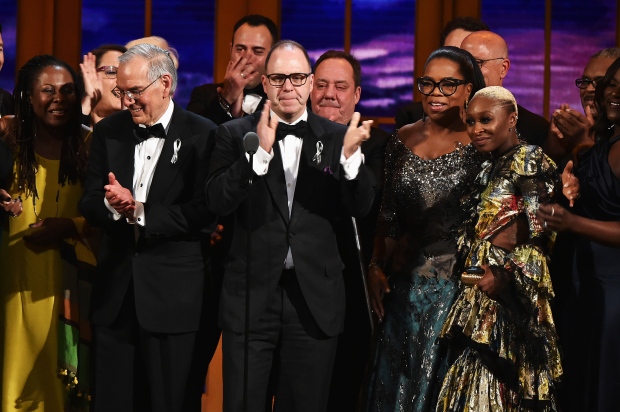
Memo to the Oscars from the Tonys — this is what diversity looks like

Stark contrast with Hollywood:

This is not to say that Broadway has solved racism. In fact many of this year’s most-lauded actors say there’s more work to be done. Speaking with the Hollywood Reporter, Leslie Odom Jr., who won for his role as Aaron Burr in Hamilton, has said the lack of complex roles for black actors is so acute he plans on focusing on his music career following Hamilton. Looking into 2017, few expect the range of plays and musicals for the year ahead to rival this season. The real question is what comes out of the seeds that Hamilton is sowing — perhaps a new generation of actors and writers inspired to tell their own stories.

645679121JN00223_2016_Tony_

The cast of The Colour Purple accepts the award for Best Revival of a Musical onstage. (Getty Images for Tony Awards Productions)

Meanwhile, when it comes to diversity, the hip-hop history lesson is just the beginning. From Spring Awakening, where actors perform American Sign Language, to the Latin rhythms of the Gloria Estefan-inspired On Your Feet, Broadway is breaking boundaries and wooing new audiences. While Hollywood is busy arguing about who should direct the inevitable Hamilton movie, executives should be taking notes. Instead of playing it safe with familiar faces and bland remakes, shake things up. As Kevin Costner once said: “Build it and they will come.”

Source: Memo to the Oscars from the Tonys — this is what diversity looks like – Arts & Entertainment – CBC News

Apple’s WWDC 2016 onstage lineup was more diverse than it has ever been – Recode

Changing the public image:

Like virtually all of Silicon Valley, Apple is both extremely white and extremely male in its upper ranks. And for many years, it has been mostly white men onstage at Apple keynote events.

Last year, that began to change. And at today’s Worldwide Developers Conference, it changed some more.

Of the 10 people onstage at WWDC today, there were six men and four women, including one African-American woman. According to 2015 figures on Apple’s website, the company has a 70/30 gender split, and is 54 percent white, 18 percent Asian, 11 percent Hispanic and 8 percent black. At last year’s WWDC, there were two women onstage for the event.

The women onstage were Apple Music’s Bozoma Saint John, Apple Watch software exec Stacey Lysik, software engineering VP Cheryl Thomas and iOS software exec Bethany Bongiorno. Imran Chaudhri, on the Apple design team, was the one nonwhite guy. (Apple iTunes executive Eddy Cue — a regular presenter at Apple events, including today’s — is Cuban American.)