More than 2,700 Canadians applied to be senators – diversity analysis

senate-working-deck-016For those interested in employment equity and diversity reporting, this first report provides a model for future reporting on judicial and other GiC appointments.

While I have some quibbles – the reference number for visible minorities should be the percentage of those who are also Canadian citizens (15 percent), not the age adjusted workforce population as they have appeared to use (17.8 percent), a breakdown of the ethnic/cultural groups self-identified would be helpful, along with some methodology notes – this is really a good and comprehensive report.

Of course, this report does not include other aspects of diversity such as education, work and the like.

By way of comparison, the 28 Senate appointments of PM Trudeau were comprised of 16 women (57 percent, higher than the 40 percent of applications), six visible minorities (21 percent, slightly lower than the 25 percent who applied) and two Indigenous persons (7 percent, twice that percentage of those that applied).

Hopefully, this will serve as a template for future reporting on the diversity of GiC appointments, including judges:

The independent board that advised Prime Minister Justin Trudeau on a recent round of Senate appointments says 2,757 people applied to be senators when the Liberal government went looking to fill vacancies for seven provinces.

Canadians were invited to apply when nominations were opened in July to fill 21 spots in the upper chamber. The independent advisory board that reviewed the applications is part of Trudeau’s plan to reform the Senate.

According to the advisory board’s first report, 60 per cent of applicants were male and 68 per cent selected English as their first language.

Twenty-five per cent identified as a visible minority, 13.6 per cent described themselves as indigenous and four per cent as LGBT.

“We were very pleased with the number of applications received, as well as with the calibre of individuals who put their names forward as part of the open application process,” the board writes.

The board says that “nearly 750 national, provincial and local organizations” were also contacted to encourage applications.

Applicants were screened by board members to identify “a list of priority candidates who … best met the merit-based criteria.” The prime minister was then provided with a list of five candidates for each of 20 vacancies, with additional names passed along to fill an unexpected opening for Manitoba.

“Recommended candidates were not prioritized; the proposed candidates were listed in alphabetical order,” the board explains. “The advice to the prime minister included a short synopsis to highlight the merits of each of the recommended candidates, as well as more detailed information from their candidacy submission.”

The board also clarifies that the prime minister’s choices for appointment came from their recommendations.

“We were very pleased that the prime minister made his recommendations to the Governor General from the list of candidates that we had provided to him,” they write.

The total cost for the advisory process so far is estimated to be approximately $900,000.

Maryam Monsef, minister of democratic institutions, also announced on Wednesday that the federal government has opened applications to fill another six vacancies: three in Nova Scotia, two in Ontario and one in New Brunswick.

Source: More than 2,700 Canadians applied to be senators – Politics – CBC News
Report of the Independent Advisory Board for Senate Appointments – Permanent Process (July to November 2016)

Diversity in tech too often means ‘hiring white women.’ We need to move beyond that. – Recode

Good discussion of the broader dimensions of diversity by Audrey Blanche of Atlassian:

Maybe it’s all the recent data about the sad state of equitable pay and glass ceilings. Or the millions of women leaning in without a sea change in senior-level representation. Or the waves of thinly disguised to blatant sexism that surfaced during the recent presidential election. Or the fact many of us are women ourselves.

More likely, it’s a combination of many things that contribute to the workplace diversity zeitgeist being focused primarily on achieving gender parity.

The problem is when diversity programs focus on “women” as a whole, they often fall into the trap of prioritizing the majority: White women. This is an issue I know intimately well, having been tasked with designing diversity programs for leading tech companies that go beyond “just (white) women.”

Take me, for instance. I’m not only female but also Latina and queer, both of which color my experience and the obstacles I’ve faced in the workplace. To make progress for all women, we need to acknowledge that women are also black, senior, immigrants, LGBT and so forth — and often many other things at once. Each of these identities faces unique biases and challenges that must be accounted for if we want to get closer to true gender parity. After all, a company dominated by men hiring women from similar racial and socioeconomic backgrounds is not diversity in a meaningful sense, it’s one small step away from homogeneity. Fighting for all women is even more important now, with outright discriminationincreasing rapidly after the election.

Mind you, fighting for all women is not as easy as it may sound. Even Pinterest, which is one of the leading companies on diversity issues, recently updated its goals for what it could feasibly accomplish in a single year. However, it’s even more important for us to do so now with outright discrimination increasing rapidly after the election.

In designing company wide programs at Atlassian, I focus on expanding initiatives to address three crucial areas alongside gender: Race, age and geography.

Race

When I joined Atlassian as the company’s first Global Head of Diversity & Inclusion, it was clear to me that leadership understood the importance of diversity and was invested in creating and maintaining it. But the biggest question was how and where to start. Race quickly jumped to the top of the list for a simple reason: People of color — and specifically women of color — often have more difficulty entering and staying in the technology industry than their white counterparts.

To address this first piece of the puzzle, we partnered with Galvanize to create a high-touch scholarship program specifically for black, Latina and Indigenous women. Because tech workers are significantly more likely to be white or Asian, women of color are less likely to have close friends or family who have worked in technology, smaller professional networks and more difficulty accessing their first jobs. Our program is designed to address each of these specific challenges: Each recipient is paired with a current Atlassian employee who acts as their mentor and personal cheerleader (to get through those moments of doubt) and are invited to our company events to grow their network. They also work with a member of our recruiting team for feedback on their resume and to explore internship opportunities at Atlassian. Our first recipient is already working with our HipChat team in Austin, Texas.

Age

Ageism is the elephant in the room in many industries. Older workers are often seen as out of touch or less capable, despite often being highly qualified for the roles they apply for. Some 64 percent of older workers have experienced ageism in the workplace. In industries like technology, the average age of a worker is often well below 30, fostering an environment where anything but “young and hungry” (read: able to stay at the office until 10 pm) is seen as abnormal and a disruption to workplace culture. Age discrimination is notoriously worse for women too, thanks to a culture where a woman’s worth is intrinsically tied to her physical appearance.

One of the first steps to combat ageism is to actually track the age of your workforce, something many companies have been hesitant to do. At Atlassian, we included age in our annual diversity report as a way of holding ourselves publicly accountable. It’s also critical to consider how to market company culture and the work environment (and how you live up to that branding). For Atlassian, this means ensuring that our Careers page doesn’t solely focus on perks like ping-pong and beer on tap. Instead, we promote benefits like comprehensive health coverage, flexible work policies and even backup childcare offerings. This helps us attract candidates at multiple stages of life and sets them up to be successful once they join us.

Geography

Diversity programs are often built from a local viewpoint, but what diversity means may vary drastically based on where you are in the nation or world. For example, while the conversation in the United States is often centered around gender and race, those concepts don’t always resonate in the same way beyond U.S. borders. In Atlassian’s Sydney headquarters, women’s cultural backgrounds and Indigenous identities are more salient. In Manila, womens’ religious identities are a key driver of the diversity discussion. In Europe, issues of national origin and immigrant status are more resonant.

As businesses become more global, diversity programs must be globally cohesive but locally relevant, and take into account the unique makeup of talent in each location and how (and with whom) people conduct their work. For example, while developing Atlassian’s unconscious bias training, I quickly realized that some nuances wouldn’t translate for certain offices. Talk to people who live in the Philippines about unconscious biases against black people created by a history of oppression and slavery, and you’ll have a hard time helping them understand how these biases can affect their teams, for example. I quickly changed our approach, moving to develop versions specific to each region in which we operate to make the content relevant and actionable for every Atlassian.

While we teach the same core concepts in each location, we now vary the terminology (tailored to local English), the research we cite (biasing toward research conducted locally), and even the level of activity versus lecture for participants (based on local feedback and customs). Because there are different types of unconscious biases often held against women from different backgrounds, customizing our training materials by geography meant that we could address those biases more effectively and benefit all women across the organization.

Diversity is one of the most important issues in modern business, and it’s more important that we fight harder for it than ever. Working to increase the representation of a group that makes up 51 percent of the world population seems like the logical first step to maximize impact. But to get closer to achieving true gender equality, we need to start by taking into account the multiple components that make up women’s identities. Only then will we be able to build better, more inclusive programs that benefit everyone and accomplish our goal of building companies made up of truly diverse teams.

Preaching the Gospel of Diversity, but Not Following It – The New York Times

Some good critical self-examination but need to check in 5 years to assess degree of change:

Many journalists hoped a new era was beginning two and a half years ago, when Baquet became the first African-American to oversee the newsroom. But whatever progress has been made is only beginning to show up on a scorecard. Overall, newsroom diversity is at 22 percent, up slightly but below newsrooms in most big metropolitan areas. And of those who head departments here, only three are people of color.

I asked Baquet what he believes minorities in the newsroom would say about his senior team’s dedication to diversity.

“I think they’d say we have a problem,” he said. “We’re not diverse enough. But I think they’d say I have a commitment to it and that it’s gotten better in the past year.” He added, “My effort to diversify has been intense and persistent.”

By that, Baquet particularly means the handful of prominent black journalists he’s helped attract or promote, stars like Nikole Hannah-Jones, Wesley Morris and Jenna Wortham, all coveted by The Times’s competitors.

Their writing styles offer a refreshing break from The Times’s rather institutional voice, which — as one black editor put it to me — is older, white, male, Ivy League and authoritative. “That’s who The Times is at a dinner party,” she said.

Many of those I spoke with, including Latinos and Asians, said the arrival of a few stars can take the focus away from the real issue of bringing in and retaining diversity across the room. In other words, while big names are rightfully celebrated, they can give the appearance of more diversity than there really is.

What’s more, just because an African-American is at the helm, it doesn’t mean all is well in the newsroom he runs. “We can’t look to Dean as proof that everything is O.K., and we also can’t look solely to him for solutions,” said Nikita Stewart, a Metro staff reporter.

When you ask managers about the issue individually, everyone genuinely seems to care. Collectively, however, not much changes.

They begin by saying this is an industrywide problem, not just a New York Times problem. That is true, unquestionably. On the other hand, it’s also true that data from the American Society of News Editors shows that The Times is less diverse than large papers like The Washington Post (31 percent), The Los Angeles Times (34 percent) and The Miami Herald (41 percent). The Times is more diverse than The Boston Globe (17 percent) and The Philadelphia Inquirer (14 percent).

Given The Times’s ambitions across global cultures and languages, it would seem that instead of being a lagger, it would insist on being a leader — and make that an explicit goal. I see no sign that this is happening. Nor do I get the impression from many journalists of color I spoke with that they believe progress is on the horizon.

“There’s always a reason for such little diversity in newsrooms. Over the course of time, the reasons always change, but the underrepresentation never does,” said Hannah-Jones, who writes for the Times Magazine, one of the few notably diverse staffs in the building.

Ernesto Londoño, who sits on The Times’s editorial board — and on an Opinion staff lacking both gender and racial diversity — believes the problem lies in a failure of editors to step outside their white-knows-white circles. “It takes a concerted effort to break out of that habit and tap talent pools that are more diverse,” Londoño said.

Which means that unless the pattern breaks, the whiter the newsroom is, the whiter it will stay.

Mark Thompson, The Times chief executive officer, told a group of top leaders across the corporate and news sides last spring that managers could face dismissal if they failed to diversify their staffs. Baquet, who was at the meeting, didn’t sound that militant in our conversation, saying that his editors feel the most pressure through a stringent expectation to bring forth a diverse applicant pool for every job opening. No one has been punished, he says.

I can tell diversity isn’t a priority here by looking at what is. Think digital transition or global expansion or subscriber growth or visual innovation. Those are mandates that really power up the engines. Diversity is not at that level, at least yet.

This issue has challenged most every newsroom manager, myself included. The newsroom I came from, The Washington Post, is quite diverse, but its leadership is heavily white and male. At The Times, on the other hand, people of color seem shut out of all sorts of coveted jobs: the top digital strategists, the top managers, the precious ranks of cultural critics, the White House press corps, the opinion columnists, the national politics jobs — all are overwhelmingly white.

It is possible to change this. But The Times will need more humility, introspection and openness than has been its habit in the past.

Is 2016 the Year That Fashion Finally Embraced Diversity? – The Daily Beast

I don’t follow the fashion press but this analysis is both interesting and revealing, particularly the contrast between different publications:

2016 is shaping up to be the most diverse year yet for the fashion industry, according to a new report tracking racial representation on glossy magazine covers.

Released Wednesday by the Fashion Spot, a 70,000 invitation-only community of industry insiders, the annual report found that more women of color were featured on glossy covers this year than the past three years (the Fashion Spot began conducting its annual report in 2013).

The report tracked 679 cover appearances from 48 top international fashion publications and found that 29 percent (197 covers) featured nonwhite women. Fashion runways have become increasingly diverse as well, suggesting a shift in the industry at large.

In October, the Fashion Spot’s biannual report gauging diversity on the catwalk found that 25.4 percent of nonwhite models walked the runway during Spring 2017 fashion week in New York, Milan, Paris, and London, making this season the most diverse in history.

New York had the most models of color (30.3 percent) this year, while Milan scored the lowest points for diversity on the runway (20.9 percent).

That glossy magazine covers are featuring more women of color coincides with a larger cultural demand for more diversity in the entertainment industry, particularly in Hollywood and on network television.

Last year, some of Hollywood’s most famous black actors called for a boycott of the Academy Awards when it was revealed that—for the first time in two decades—every single acting nominee was white.

The #OscarsSoWhite hashtag began trending with the controversy, prompting the Academy to announce an initiative promising greater diversity in its future voting body.

Actresses and entertainers make up a large percentage of fashion magazine cover models, and stars like Beyoncé, Zendaya, and Rihanna are regulars on top glossy covers. While the Fashion Spot has no data on how covers showing women of color affect sales of magazines, it’s clear that famous women of color—Beyoncé, Rihanna, and Michelle Obama, to name a few popular cover stars—sell.

Still, the only nonwhite woman in the report’s list of top 10 cover models this year was actress Lupita Nyong’o, who graced five covers. By contrast, top model Gigi Hadid snagged 14 covers, while her Instagram-famous peer Kendall Jenner and sister Bella Hadid landed 10 and 8 covers respectively.

“I think nonwhite actresses are seen as a ‘safer’ bet over traditional models of color in terms of sales,” Jennifer Davidson, the Fashion Spot’s editor in chief, told The Daily Beast, noting that Zendaya, Zoe Kravitz, Selena Gomez, Jessica Alba, Rihanna, and Beyoncé were “more likely to earn multiple cover appearances” than models of color.

Among the worst diversity offenders were Harper’s BazaarLoveMarie Claire U.K., PorterVogue Germany, Vogue Netherlands, Vogue Paris, and Vogue Russia (all failed to feature a single woman of color on their covers this year).

I-DInStylePaperTeen VogueVogue India, Vogue Korea, and Vogue Taiwan had the most racially diverse cover stars, though the fact that Vogue Indian, Korea, and Taiwan featured nonwhite models is likely owed to their buying demographic’s predominantly nonwhite ethnicities rather than a conscious effort to be more diverse.

Government appointments and diversity – Policy Options

election-2015-and-beyond-implementation-diversity-and-inclusion-042My latest piece in Policy Options, reporting on the Liberal government’s commitment on increasing diversity in government appointments (political, deputy minister, judges and heads of mission) – spoiler alert, it largely has.

Source: Government appointments and diversity – Policy Options

New policy template aims to encourage gender diversity on boards

Good initiative and one benefit of having a policy is the discussion it engenders:

Canada’s leading association for corporate directors is hoping to nudge more companies to add women to their boards by offering a free template of a board-dversity policy.

The Institute of Corporate Directors has teamed up with law firm Osler, Hoskin & Harcourt LLC to develop a general model of a board-diversity policy, aiming it at smaller companies that have not complied with new diversity-reporting guidelines. The template includes alternative wording options so companies can customize the content and it is free to download from both organizations’ websites.

ICD chief executive officer Rahul Bhardwaj said his organization launched the project after seeing the results of a review of diversity-reporting rules by securities regulators in September. The review showed that just 21 per cent of 677 companies listed on the Toronto Stock Exchange clearly disclosed that they have adopted a gender-diversity policy for their boards and their executive ranks. While that is an improvement from the 15 per cent of last year, it still signals slow progress since regulators introduced new “comply or explain” rules in 2015 requiring companies to report on their approach to gender diversity.

Mr. Bhardwaj said he was concerned about the lukewarm response by companies to the new reporting rules and concluded that many smaller companies weren’t acting because they didn’t know where to start or didn’t have the resources to hire consultants and lawyers to help them develop policies.

“The first step is to actually turn their mind to it,” he said. “For organizations saying, ‘How do we actually start to craft a policy?’, we’re saying, ‘Here’s an easy way to do it.’ It will get you into the game and thinking about it.”

He said his hope is that boards will not simply “tick the box” by quickly downloading the sample policy and adding it to their disclosure documents, but will instead have a discussion about their approach to diversity.

Osler lawyer Andrew MacDougall, who wrote the policy, said many small companies could find it helpful to have access to a model that is similar to policies adopted by larger companies with help from professional advisers.

“Often the hardest part about making any change is taking that first step,” Mr. MacDougall said. “We thought that the easiest way to jump-start a dialogue at the board level would be to help them with the first step, which is the adoption of a policy.”

The template allows boards to choose whether to make a general statement about diversity, including having an “appropriate number of women directors,” or whether to commit to a specific target level of diversity on the board. They can also choose to add a time frame for reaching the target.

The policy also includes a provision that any search firm hired to help identify board candidates will include multiple women on the possible hiring list, as well as a clause that says female candidates will be included on any “evergreen” list of potential nominees.

Mr. MacDougall said he hopes many who use the template will opt to implement a concrete target for women on the board, but that might be a step too far for some.

“We wanted to make sure that they at least had a policy that forced them to have a dialogue about whether or not to adopt a target,” he said.

Source: New policy template aims to encourage gender diversity on boards – The Globe and Mail

Science review panel must tackle barriers to funding, encourage diversity: researchers

Actually, I suspect the diversity of visible minorities may be stronger than Jeremy Kerr, a biology professor at the University of Ottawa, asserts, given that they are relatively over-represented in universities (about 24 percent compared to the 19 percent of the overall population):

Funding issues aside, Mr. Kerr urged the panel to tackle the lack of diversity in the scientific community, highlighting, specifically, the under representation of women in senior positions.

“For those of us in this younger cohort of researchers, we recognize that there are terrible disparities in terms of the presence of women…in senior research ranks, and this is not changing at anything like an acceptable pace,” he said.

“We need to do a much better job of bringing [in] diversity. We’re basically leaving half of our talent out of our science enterprise, and that’s frankly nuts.”

Although he didn’t have the statistics, Mr. Kerr said he assumed indigenous peoples and minorities were likely even more underrepresented than women.

He also said researchers must do a better job in communicating and engaging with the general public to help inform national and local decision-making.

Source: Science review panel must tackle barriers to funding, encourage diversity: researchers – The Hill Times – The Hill Times

Apple’s executive ranks are still overwhelmingly white and male – Recode

The latest diversity reports from Apple and Microsoft:

Even tech companies with a commitment to boosting the diversity of their workforce are finding gains hard to come by.

A case in point is Apple.

The iPhone maker released new data Monday night showing that the company’s highest ranks remain even more white and male than the company as a whole.

Just 20 of Apple’s top 107 executives are women, according to a government filing, while only five are from underrepresented minority groups (defined as black, Hispanic/Latino, Native American or Hawaiian/Pacific Islander). Another 14 executives are Asian, while the remaining 88 are white.

Those numbers are roughly unchanged from a year ago.

In the next layer of management, women made up 27 percent of the workforce. More than 65 percent of those managers and mid-level executives are white, 23 percent are Asian, with just 11 percent from underrepresented minority groups and 1 percent who define themselves as multiracial. As with the executive ranks, those numbers are little different than they were in 2015.

The data is included in a form known as the EEO-1, which companies must file with the U.S. Equal Employment Opportunity Commission.

Even while publicly sharing the data, Apple has said that the EEOC data doesn’t reflect how the company itself breaks down its workforce, and is not the way it measures its diversity progress.

In August, Apple released its last public numbers, noting that 32 percent of its workforce was female and 22 percent of employees were from underrepresented minorities. The numbers, which represented slight increases from 2015, reflect global hiring for women, and only the U.S. with regard to underrepresented minorities.
Apple HR executive Denise Young Smith, speaking with Recode's Ina FriedApple

In terms of new hires, Apple’s figures were higher than its workforce as a whole, with 37 percent being women and 27 percent being from underrepresented minorities. (The data used for both the EEOC and Apple’s companywide diversity report covers the same time period.)

But if Apple’s gains are small, at least it’s moving in the right direction.

Microsoft, by contrast, released figures last week showing that the overall number of women at the company dropped in 2016 for the second year in a row. Microsoft blamed layoffs in its phone unit for the decline. The total number of black and Latino employees at Microsoft did go up compared to last year, but just barely.

And at least Microsoft and Apple continue to share their data. While many tech companies started sharing diversity reports several years ago, many have yet to offer updates this year, and fewer still have shared this year’s EEO-1 filing.

The EEOC, meanwhile, has used aggregate data to highlight that whites, men and Asians are overrepresented in high-tech jobs, while women, blacks and Latinos are less present in the high-tech industry than in the workforce as a whole.

While Apple is ahead of many peers in its percentage of women, and a leader in terms of employing underrepresented minorities, it has not been immune to criticism. Earlier this year, reports from Mic and Gizmodo raised allegations that some corners of Apple were home to a significantly sexist culture.

In an exclusive interview with Recode, Apple HR chief Denise Young Smith said the incidents described in the articles didn’t reflect the Apple she knows, but that the company did investigate, adding that “commensurate actions have been taken.” Such actions can range from an informal conversation to dismissal, and Apple didn’t disclose what actions it took.

Source: Apple’s executive ranks are still overwhelmingly white and male – Recode

Catching up

The main story over the past few weeks has of course been the US presidential election and Trump winning the presidency. Far too much commentary both before and after to follow, with the full consequences to be seen once Trump selects his Cabinet and other senior appointments, and his initial acts in office (the appointment of Steve Bannon of Breitbart as chief strategist is hardly encouraging).

As chance would have it, we were visiting the Dachau concentration camp near Munich on voting day. While my knowledge of the Holocaust is generally quite good from books, film and Holocaust centres, along with my time as Canadian head of delegation to the International Holocaust Remembrance Alliance, nothing can bring the horror and scale of horror than visiting an actual site.

In the film Denial (well worth seeing), about Deborah Lipstadt’s legal battle against Holocaust denier David Irving, her lawyer takes time during his visit to Auschwitz to pace the  the camp, as he needs to come to grips with its scale  as part of his preparation of his strategy for the case.

But one of the more interesting moments in the current context was our guide’s discussion of the rise of Hitler and how both the political leadership and institutions failed to prevent his rise. While always aware of the perils of Godwin’s Law, there are some uncomfortable parallels with the rise of Trump, reinforced with Republican control of both houses of congress, and the related authoritarian and undemocratic tendencies among some.

Of course, one of the stories making the rounds is the degree to which Americans vowing to move to Canada will actually do so. Some articles that provide a good selection of immigration experts and lawyers essentially say unlikely (Don’t expect to just pack up and move to Canada, Americans told, Americans eye move to Canada, but immigration not so easy, and in the New York Times, As Americans Look North to Flee Donald Trump, Canada Peers Back in Worry, where I am quoted).

Other news items that I have been following include:

Immigration levels for 2017: Interesting, in contrast to the expectations of much higher immigration levels based on comments by the Minister and the recommendations of the Barton committee of 450,000 per year, the end result was more modest: a new baseline of 300,000, and increase of about 15 percent compared to the previous government. Moreover, there is some rebalancing towards the economic stream (58 percent compared to 54 percent in 2016, but still lower than the 63 percent under the Conservatives).

citizenship-data-slides-033There have been a number of articles pro or against a “big Canada” of 100 million by 2100. I am more convinced by the critical pieces, particularly those by Munir Sheikh, How can immigration improve our standard of living? and Tony Keller A supersized Canada is so 20th century.

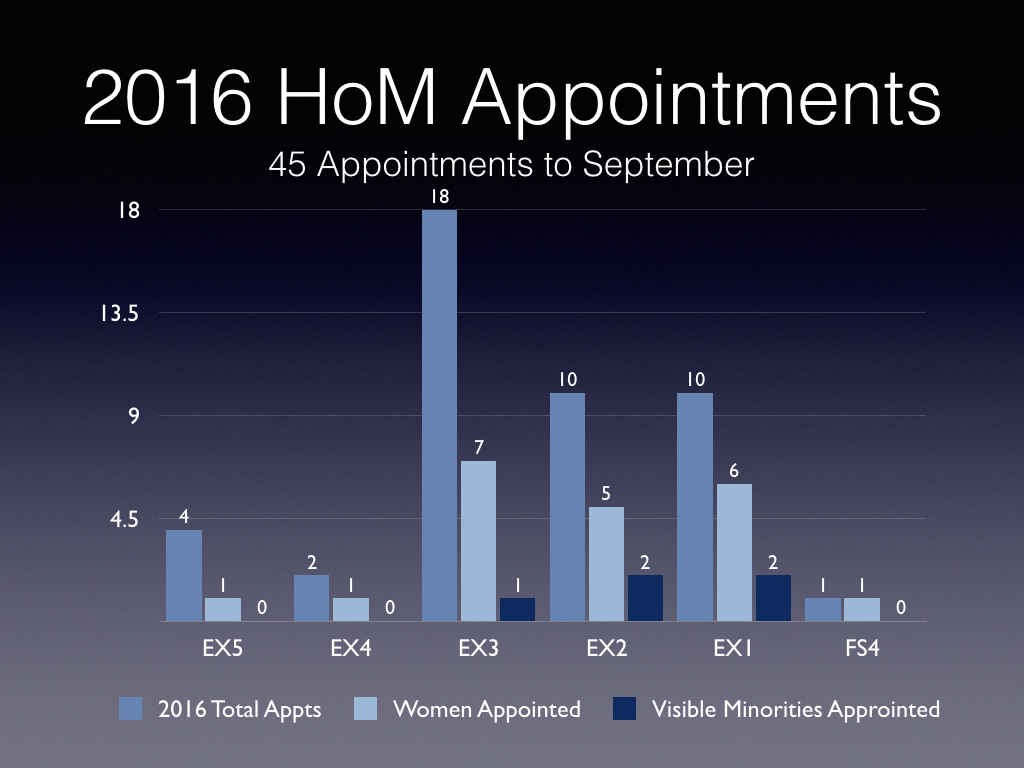
Diversity of appointments: With the 41 judicial appointments and 28 Senate appointments in 2016, we can see that the government is largely living up to its commitment to improve diversity (56.1 percent women, 4.9 percent visibility minorities, 7.3 percent Indigenous with respect to judges; 57.1 percent women, 21.4 percent visibility minorities, 7.1 Indigenous with respect to Senators), with the government committing to diversity reporting.

Citizenship judge appointments: It appears that, along with other GiC appointments, there have been delays in appointing citizenship judges, with the result that the number of judges available has dropped to 13 from 26 in place September 2015. As C-24 largely reduced the role of judges to presiding over citizenship ceremonies, this likely has less impact than stated in the article, Waiting to become Canadian: Citizenship ceremonies delayed by judge shortage,
compared to the fee increase and other changes  I have flagged (The impact of citizenship fees on naturalization – Policy Options).

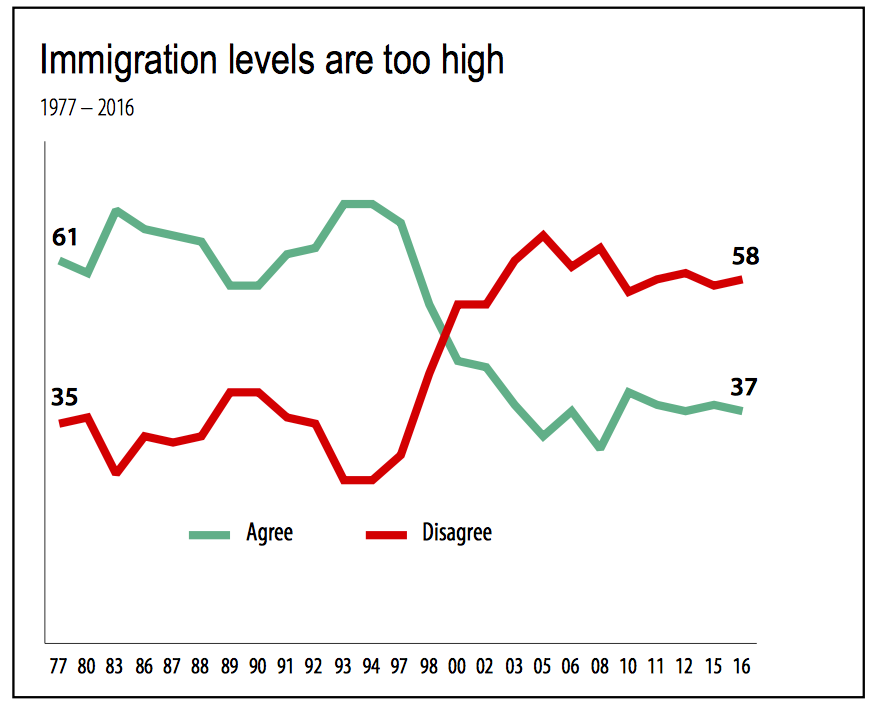
Support for immigration and multiculturalism: A series of somewhat contradictory polls and interpretations, starting with Angus Reid, CBC-Angus Reid Institute poll: Canadians want minorities to do more to ‘fit in’, where roughly two-thirds of Canadians believe immigrants should adopt Canadian values while a similar two-thirds believe immigration levels are just about right. Environics Institute’s Focus Canada – Fall 2016 Canadian public opinion about immigration and citizenship 20 year tracking of support for immigration shows little recent change:

Environics Focus Canada 2016

Environics Focus Canada 2016

Nick Nanos’s survey of What makes Canadians proud of their country? has the following results:

“Asked an open-ended question about what made them proud to be Canadians, the top unprompted response was our commitment to equality/equity/social justice (25.2 per cent), followed by our reputation as peacekeepers (19.4 per cent), multiculturalism (12.0 per cent) and respect for others (11.3 per cent).”

All of which helps explain the divergence of positions among Conservative leadership candidates, ranging from those openly playing identity politics (Blaney, Leitch) to those with inclusive approaches (Chong, Obrai, Raitt).

Candice Malcolm continued her obsessive coverage of Minister Monsef (see Jason Ling’s Some Folks Really Want to Deport Maryam Monsef) and the question of birthplace and possible misrepresentation by her mother in her immigration and citizenship applications. Malcolm legitimately asks whether the government is treating her case differently than other such cases, given a number of revocations in what appear to be comparable cases (Lawyers lose battle for moratorium on contentious part of citizenship law).

However, unless I have missed it, Malcolm has remained silent on whether she supports the C-24 changes that removed the previous right to recourse to the Federal Court, without providing any right to a hearing, unlike Farzana Hassan, who objects to the “unfairness of the law” while still questioning Monsef’s story (Monsef shouldn’t be above the law).

Reforms to the Superior Courts Judicial Appointments Process: Diversity element

The operative paragraph on diversity, including reporting:

To promote diversity, the new JACs will be mandated with identifying outstanding jurists from a wide range of backgrounds and practice areas, with a view to having a judiciary that reflects the diversity of Canadian society. JACs will be supported in this task by the diversity-related training provided to members noted above. The collection and publication of statistical data on judicial applicants and appointees will provide transparency and enhance accountability with respect to progress towards a more diverse bench.

Source: Reforms to the Superior Courts Judicial Appointments Process – Canada News Centre