This is what you get wrong when you talk about diversity in the workplace – Recode

Just one more approach to help people understand and appreciate diversity issues:

A lot of tech companies say they want to make progress on diversity and inclusion. Code2040, a nonprofit that gets its name from the year people of color are projected to be the majority of the U.S. population, argues that just saying that isn’t enough. Businesses need to act.

“It’s often positioned as an add-on,” Code2040 CEO Laura Weidman Powers said on the latest episode of Recode Decode, hosted by Kara Swisher. “What really needs to be the case is to change the core of what you’re doing. We’re not saying, ‘Keep hiring the way you’re hiring and also do this diversity thing on the side.’ [We are saying,] ‘You need to change the way you hire in order to be more inclusive.’”

You can listen to Recode Decode on iTunes, Google Play Music, TuneIn, Stitcherand SoundCloud.

Code2040 focuses specifically on “underrepresented minorities” — black and Latino/Latina students who have 18 percent of computer science degrees but only three percent to five percent of the jobs in Silicon Valley.

Powers said that since the nonprofit launched in 2012, Code2040 has found more and more support for its annual “fellows program,” which charges companies to connect them with talented minorities whom they might otherwise overlook. This summer, it will place more than 100 black and Latino students in tech offices.

But there’s still a long way to go. She said managers and employees, even the ones who mean well, often fall into traps that set everyone back — for example: “unconscious bias” training that doesn’t give attendees the ability to apply anything they learn.

“Talking about unconscious or implicit bias can seem to let people off the hook,” Powers said. “It’s been shown if you do unconscious bias training and it’s like, ‘Hey, everybody’s got bias,’ then the takeaway is, ‘Oh, phew, it’s not me! It’s just humans because we need to learn how to be scared of snakes so you make assumptions!’ You can get farther away from making progress.”

“Folks go to our trainings, they go back to their desks, and there’s half a dozen black and Latino interns who are working there,” she added. “They actually get a chance to see: ‘How inclusive is my culture? What is the experience of these individuals coming through?’ That makes a big difference, putting a face to the work and actually having a chance to build those skills.”

Source: This is what you get wrong when you talk about diversity in the workplace – Recode
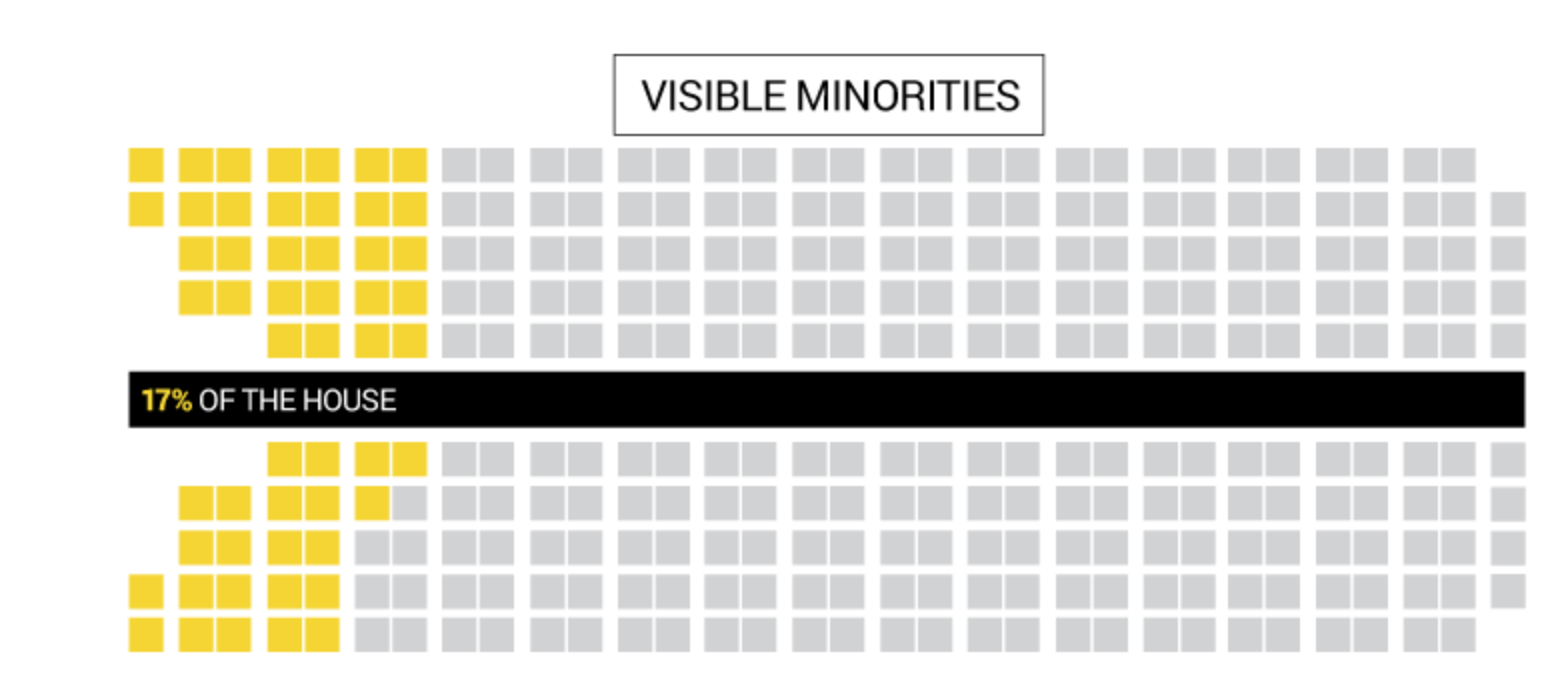
Samara’s 2017 Democracy 360 Second Report Card on How Canadians Communicate, Participate and Lead in Politics – Visible Minority Methodology Issues

While I have great respect for the work Samara does and continues to do, as exemplified in their latest report, I would be remiss in not pointing out some serious methodological mistakes made with respect to visible minority representation.

Their diversity numbers:

While our current Cabinet was selected to be more reflective of the Canadian population, Parliament generally, with 74% men, still has a long way to go. Women represent half of Canada’s population, but they are only 26% of its MPs. Visible minorities are better represented—they make up 17% of MPs and 19% of the population. Indigenous MPs make up 3% of the House and 4% of the population. In terms of representation of the youngest cohort of voters Canadians, representation has lost ground since 2015. Only 4% of MPs in the 41st Parliament are aged 18 to 30, a cohort that comprises 17% of the Canadian population.

The two mistakes are:

  • Using the wrong baseline for visible minority representation. Samara uses the overall population of visible minorities (19 percent) rather than the correct baseline of 15 percent, those visible minorities who are also Canadian citizens and thus able to vote. This is the second time that this incorrect baseline has been used and should be corrected for future reports; and,
  • Their count of the number of visible minority MPs is wrong. The correct count is 47, not the 53 indicated in the chart below.

The corrected numbers show visible minorities forming 14 percent of the House of Commons (2015 election), compared to 15 percent of the visible minority voting population. A good result.

Samara and I have shared our respective data sets and discussed these concerns and they have been forthcoming on the reasons for the discrepancies. Their count of visible minorities included some Indigenous MPs and Alexandra Mendès (but not Pablo Rodriguez) and they used the overall visible minority population to be consistent with their earlier report.

For future reports, my main recommendations:

  • for women, foreign-born and Indigenous MPs, use the authoritative parlinfo biographical information which would avoid mis-categorization of Indigenous as visible minority MPs;
  • use existing analysis rather than re-inventing the wheel. Erin Tolley, Kai Chan and I all came up with the 47 number (Erin and I compared notes to ensure that neither of us missed anything, Kai did his work independently; and,
  • use the population of visible minorities who are also Canadian citizens as the baseline, not the total visible minority population.

Their numbers for foreign-born, women and Indigenous MPs are correct, taken from the parl.gc.ca site (however the graphics are not – 40 versus the correct figure of 41 foreign-born, 81 versus 88 women, 9 versus 11 Indigenous peoples).

Source: 2017 Democracy 360

Byelection results: Tories hold Calgary seats, Liberals keep Ottawa, Montreal, Markham: Increase in diversity

These results further increase diversity: four women elected, all replacing men, one visible minority elected, replacing a non-visible minority man.

Overall totals: 92 (up from 88) women or 27 percent, 48 visible minorities (up from 47) or 14 percent.

Source: Byelection results: Tories hold Calgary seats, Liberals keep Ottawa, Montreal, Markham – Politics – CBC News

Why so many Canadian universities know so little about their own racial diversity

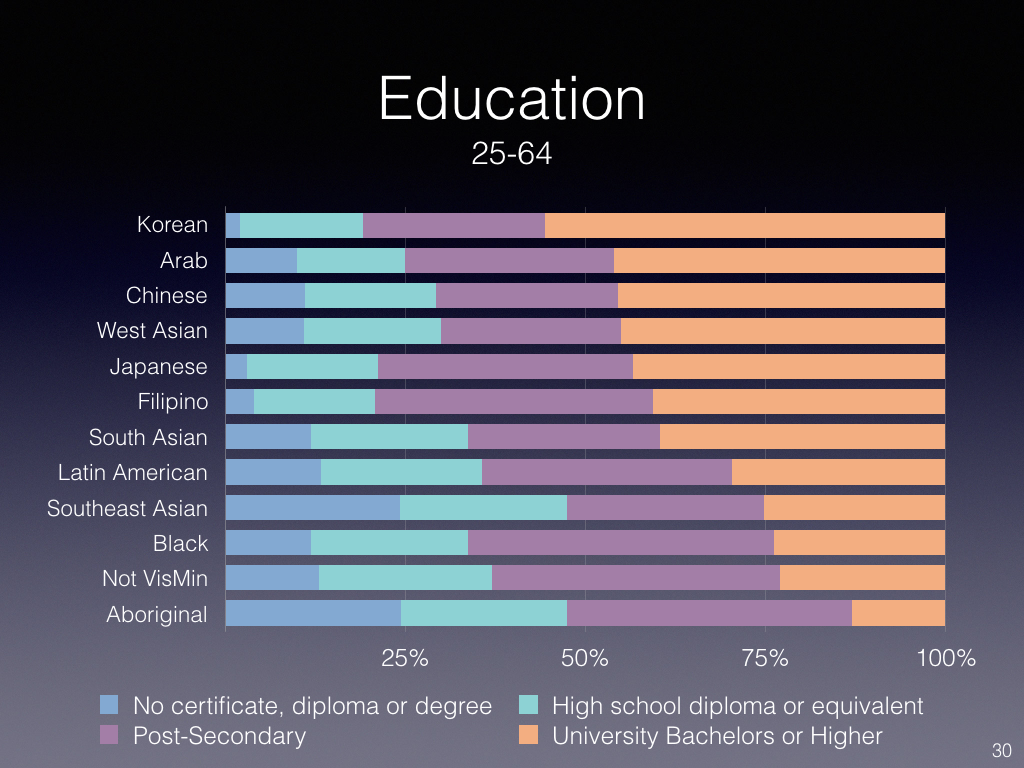
Census data allows one to analyse university graduation rates by visible minority and ethnic origin, and first and second generation immigrants are more educated than non-immigrants, although there are variations among groups as shown in the above chart.

However, this is not at the individual university level, where it may help identify issues and gaps:

Many Canadian universities proudly promote the diversity and inclusiveness of their communities, but a CBC News investigation has found that most can’t provide data about how their students identify racially.

As part of an investigation of race and racial discrimination at Canadian universities, CBC News discovered that most of the country’s largest institutions have an incomplete picture of the racial diversity within their student populations, with more than 60 schools saying they don’t collect the data.

Experts, human rights advocates and recently the government of Ontario have endorsed the collection of race-based data as a means of uncovering inequality and better understanding the needs of racialized groups. Racialized is a term used to describe people who identify as being part of a visible minority.

Vettivelu

Ryerson University student Renee Vettivelu says she would have no problem indicating on a school survey how she identifies racially. (CBC News)

“Personally I wouldn’t mind sharing my background and my identity, I’m quite comfortable with it, proud of it,” said Renee Vettivelu, a second-year aerospace engineering student at Ryerson University in Toronto.

She’s Tamil-Canadian and says her parents helped to foster her appreciation for her culture through community events and Saturdays spent at Tamil school.

Ryerson is one of many schools that couldn’t provide details about how members of its student community identify, but it recently confirmed it intends to start gathering this data from students.

“I think that there’s a lot that Ryerson would be able to do if they had that knowledge,” said Vettivelu. She says counselling services for racialized students and financial support for cultural groups and events are examples of where more data would make a difference.

Dua

York University professor Enakshi Dua says universities have been reluctant to collect race-based data from students. (CBC News)

Enakshi Dua, a professor in York University’s gender, feminist and women’s studies department, agrees.

“We need to collect data to have an understanding of how accessible our universities are and where there are barriers and hurdles,” Dua said.

Dua has worked on equity issues in the university environment for more than 15 years and says universities haven’t been receptive to calls to collect information about race.

No clear picture of student diversity

Over the past five months, CBC News asked 76 universities from across the country to provide a breakdown of their student populations by race. While some gave more detail than others, most schools couldn’t provide much information about the diversity of their students.

Some universities pointed to data from third-party surveys that target specific groups like first- or senior-year undergraduates. Other schools provided information in broader categories like “visible minority,” or only offered information about specific groups such as black or Indigenous students.

In all, 63 universities said they couldn’t answer the question on racial demographics because they don’t ask students to provide information about their racial identity. In many cases, data about Indigenous students is already available to universities.

Benefits of collecting data

“If you want to really serve the population, I think you first need to know who’s in your student body,” said Renu Mandhane, chief commissioner of the Ontario Human Rights Commission. “And not just at an eyeballing it sort of way, actually understanding in a much more discrete way.”

She says it isn’t just students who benefit from data collection, but the institutions themselves because they can track the effectiveness of their programs.

“Many of these universities have anti-racism departments or diversity offices. Well, are they able to actually track how students feel about their experience based on, you know, data?”

Mandhane

Renu Mandhane, chief commissioner of the Ontario Human Rights Commission, says race-based data can help universities address racial discrimination. (CBC News)

Mandhane says the need for more race-based data goes beyond higher education into sectors like policing and child welfare, even though it’s rare for institutions to collect it.

She suspects some universities are still concerned about addressing the uncomfortable topic of race. “If I collect the data and it reveals that you know this many per cent of my students are black, what does that mean? What does that require me to do?” she said.

Concerns about collecting race data

The 63 schools that said they don’t collect race data include larger institutions like York University and the University of British Columbia, along with smaller schools like Huron University College in London, Ont., Cape Breton University and the University of Prince Edward Island.

Concordia University in Montreal was up front about why it doesn’t ask students for race information: “In Quebec, this is not an option and it is considered illegal to ask.”

Source: Why so many Canadian universities know so little about their own racial diversity – Canada – CBC News

Supreme Court judge [Justice Wagner] says Canadians shouldn’t worry about arrival of refugees, migrants 

Thoughtful and pertinent comments, particularly interesting his comments on identity:

Wagner said the notions of identity, human dignity and democratic values permeate the Charter and “lay the foundations for looking beyond our own borders.

“We can welcome refugees and migrants with the confidence that our society is able not only to manage our differences, but to thrive on them,” said Wagner.

Speaking to reporters later, Wagner acknowledged that, while his speech was delivered to a legal and academic audience, there was a message for Canadians concerned about the influx of refugees and migrants.

“We should, I think, welcome all those people and we should be willing to accommodate them and not change them,” he said.

“People should not be afraid of having migrants and refugees in their own countries. I think we’re strong enough and . . . we have strong moral values, and one of those values is the respect for human dignity. And, if we take our role seriously, we’ll look, we’ll adopt the perspective of the other, and it could only, I think, as far as I’m concerned, grow society much better in the future.”

Asked if that means there should be room for face veils and other individual expressions of religious identity, Wagner declined to answer, saying: “I don’t know if those cases will come before the court, so I don’t want to comment.”

Wagner holds one of the three high court seats reserved for Quebec. Quebec’s legislature is now studying a bill to require “religious neutrality” of those who deliver or receive public services, amid calls to ditch the bill in the wake of the slaying of six Muslims at a Quebec City mosque.

Wagner said judges have an “obligation” to try to understand the perspective of a person who says their equality rights are breached, but he added “that doesn’t mean that the claimant is right . . . that doesn’t mean that I would adopt his way, or his reasoning, or his opinion, or his end result.”

In his speech, Wagner admitted early approaches to how judges analyzed discrimination did not stand up to the task. He said Charter interpretation is still “a work in progress,” but, he added, over the past 150 years “the constitution has enabled us to navigate difficult questions of identity.

“Personal and group characteristics are the starting point of Charter equality jurisprudence, but identity is not about labels; it is a shorthand for how people see themselves, how others see them, and how those two things interact in people’s lives.”

Wagner said the Supreme Court looks to the context and experiences of a person claiming discrimination, and seeks to understand the person’s perspective, which is an especially important consideration in cases of aboriginal law or where there are overlapping characteristics of a person’s identity that influence how they experience discrimination.

Wagner said the experience of a woman who is part of a visible minority can be totally different from that of a young man who has the same characteristics. “If one of the two is not a citizen, or has a different sexual orientation, their experience could be even more different.”

“When the court eventually faces a question touching on trans-gender identity, these two propositions will provide essential frames of reference: that identity is not fixed, but changing, and that identity is not innate, but contextual,” he said.

Wagner predicted that, although the principle of “dignity” fell out of favour in judicial analyses of equality claims, it would find new traction in future Charter litigation. It is a crucial consideration when judges weigh whether a rights violation is reasonable and justified. “Equality infringements ought to be increasingly difficult to justify to the extent that it strikes at the heart of someone’s individual or group identity and, with it, their recognition as full participants in Canada’s ongoing democratic dialogue,” he said.

University of Ottawa law professor Errol Mendes said Wagner’s speech would please equality-seeking groups on the one hand, but he said Wagner also emphasized “democratic values” and “substantive” equality over any superficial concept of equality.

To Mendes, it was a signal from a judge who some suggest could one day become the chief justice of Canada, that the balance won’t always tip in favour of those who feel their rights are breached.

Senate staff diversity under a microscope #cdnpoli

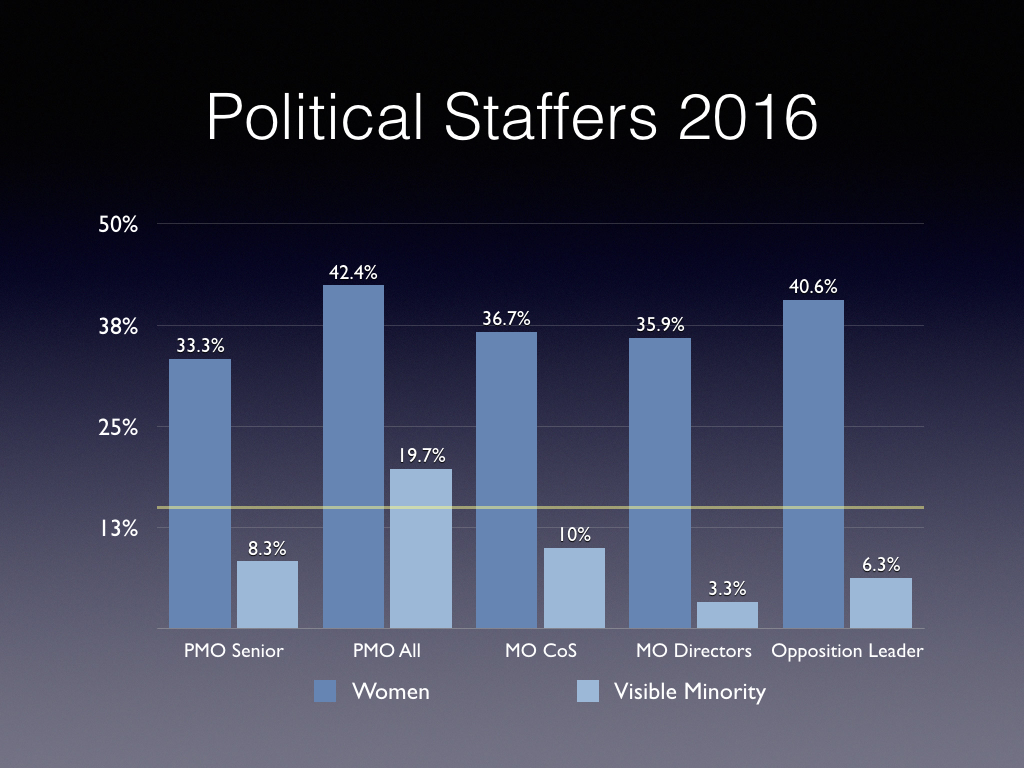
The same study should be made with respect to MP and Ministerial staff (the latter, when I looked at in late 2015 and early 2016, showed considerable under-representation in Ministerial offices, particularly of visible minorities and Indigenous peoples):

Women made up 59 per cent of Senate administration staff as of March 2016, according to the Senate administration report tabled in December. That’s a bump of 10 percentage points from the same month a year prior, and the highest level since at least 2009.

That shift was enough to prompt Sen. Marshall to ask the subcommittee’s witness, Senate human resources director Luc Presseau, whether the Senate’s efforts to ensure equal representation for women had created an overrepresentation.

The Senate administration has been working for several years to ensure proper representation of women, aboriginal people, disabled people, and visible minorities.

“When you swing one way to fix something, sometimes you swing the other way a little too far,” Sen. Marshall told The Hill Times in an interview.

In this case, the large jump in representation seems more dramatic than it really was; there were actually six fewer women working in the Senate administration staff last year than the year prior, but the total number of Senate staff had declined by an even greater proportion over that time, from 437 employees (215 women) to 354 (209 women). The Senate administrative staff dropped by 83 people last year after the Senate Protective Service was merged into the Parliamentary Protective Service, which is now a separate entity.

Last year women represented more than half of the top-earning Senate staff—55 per cent of those making six-figures—and exactly half of those in senior and middle management.

The Senate administration report, the fifth of its kind, shows modest changes to representation of visible minorities (15 per cent last year), aboriginal peoples (3.4 per cent), and persons with disabilities (5.6 per cent) since 2009. The report did not cover staffers working in the offices of Senators, but included all components of the Senate bureaucracy.

Mr. Presseau flagged underrepresentation of individuals with disabilities as a problem, telling the subcommittee, “our numbers are not quite as good as what the availability of the population might be.” He also said that indigenous people, particularly from the North, continue to be underrepresented.

None of the Senate administration’s 30 managers identified themselves as aboriginal last year, according to the report.

The Senate has been working to improve diversity among the ranks of its administrative staff for years. The Senate diversity subcommittee isn’t unprecedented either, as a similar subcommittee was set up in 2011 and tabled a report on the subject in 2012.

Mr. Presseau noted that the statistics included in the Senate report are based on individuals identifying themselves as belonging to a minority group—though that is not the case for gender—and said the numbers might look different if staff were reminded to self-identify.

Sen. Tannas, who also sits on the Senate Aboriginal Peoples Committee, asked whether the Senate could track whether those who identify as aboriginal could be verified as having official status—registered with the government as “status Indians”—as a way to prevent false claims.

“It’s becoming a bit of an urban legend that if you want to get ahead in the civil service that you suddenly identify with your aboriginal roots. And we don’t want that,” he told The Hill Times, adding it seemed unlikely that the Senate would be able to meet that request.

Sen. Tannas also urged the Senate to focus on increasing regional diversity among its staff, suggesting a program to temporarily exchange staff with provincial legislatures, in part to combat the perception out West that the government is run by people from Central Canada.

“I think it’s important in the national Parliament that we don’t wind up with a perfectly sealed bubble, where everybody involved in the affairs of the country drives no more than an hour to work,” he told The Hill Times.

Senators on the subcommittee also stressed the importance of hiring more veterans to work in the Senate, and finding a way to guard against name-based bias, wherein job applicants are overlooked, consciously or unconsciously, because their name suggests they belong to a minority group.

Sen. Jaffer told The Hill Times she hoped the subcommittee could wrap up its work and put together a report before June.

Source: Senate staff diversity under a microscope – The Hill Times – The Hill Times

Diversity in GiC appointments – 2016 Update

My latest in IRPP Policy Options:

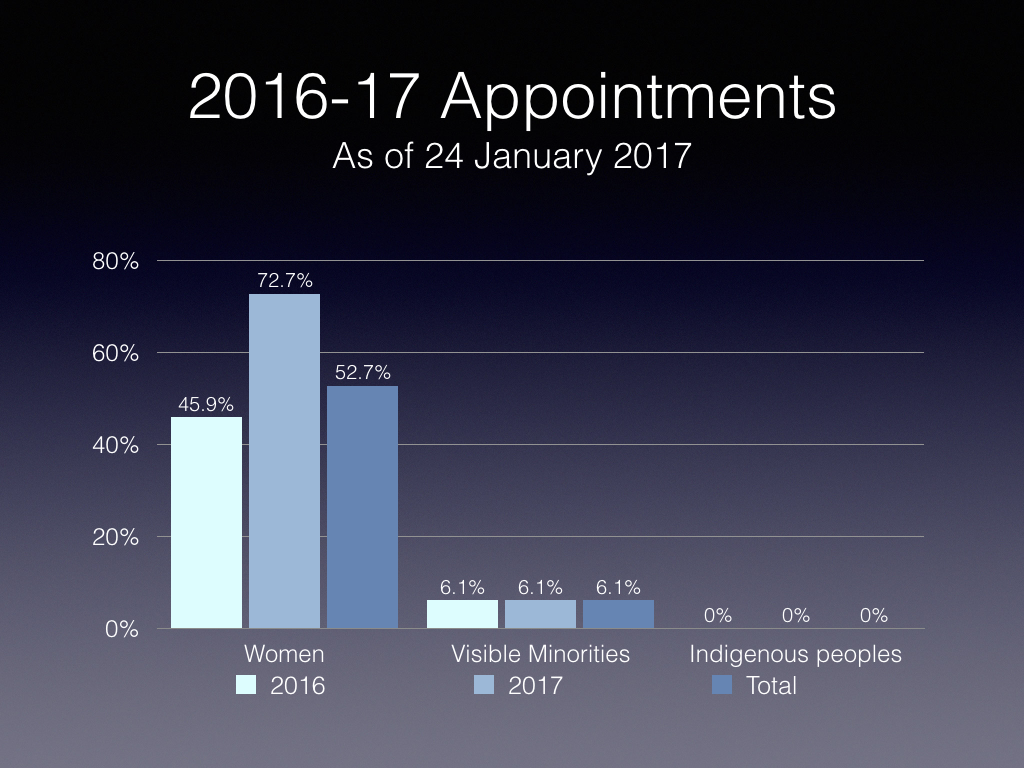
election-2015-and-beyond-implementation-diversity-and-inclusion-062Following my 2016 baseline study of the diversity of Governor in Council (GiC) appointments (Governor in Council Appointments – 2016 Baseline), I have analyzed 2016 and early 2017 appointments using the GiC appointments index. There has been a strong push towards gender parity but no clear trend with respect to visible minorities and Indigenous peoples.

Baseline data below:

GiC Baseline 2016.010

Source: Diversity in GiC appointments

For a more diverse Oscars, Hollywood must go back to high school

Despite the major improvement in the diversity of those awarded Sunday night, a needed and good initiative for the next generation of film makers:

Over the last two years, much of the talk around Oscar season has been about the lack of diversity. The American Academy of Motion Picture Arts and Sciences, now headed by an African-American woman, has made several high-profile moves to increase the number of diverse Academy members. But to truly transform the industry, Mowat says, Hollywood has to go back to high school.

The program at Washington Prep helped the now 19-year-old Mariah Green land an internship at CBS, where she shadowed sitcom writers. Without the mentorship from Mowat and the other professionals, she says there’s almost no way she would be at Cal State Northridge, where she has founded a student production company.

“Most communities don’t have to feel discouraged, feeling like I don’t have time to pursue this because I could lose my life tomorrow,” Green says.

The problem, Mowat says, is that mentoring programs are surprisingly rare. The one that brings him to Washington Prep is organized and funded by the British film academy BAFTA; he says neither the American nor Canadian academies have anything comparable.

“Canada and the US … seems to be a lack of ability to train or willingness to mentor,” Mowat says. “Not everyone can go to school and go to those three- and four-year programs.”

Rachel Miller, a partner at the L.A. production company Haven Entertainment, is the founder of a year-old mentorship program called Film2Future that gives high school students the chance to make a short film with real pros. She says when it comes to diversity, the industry talks a good game, but often isn’t willing to fund initiatives that would actually address the problem.

Talk easier than action

“I think there’s a lot of inertia,” Miller says. “I think that it’s easy to talk about something than to do something. Doing something is hard. It’s tough.”

And it’s short-sighted, according to Franklin Leonard. He founded the Black List, a highly regarded yearly collection of top scripts that haven’t been made into films.

“These communities are historically being shut out of opportunities that would allow them to prove their talent,” Franklin says.

Bringing students from diverse backgrounds into the pipeline at a young age isn’t just good for their individual futures, it’s good for the industry as a whole, Franklin says, referring to a recent UCS study that suggests movies with diverse casts make more money at the box office.

“It’s good for the bottom line, and I think that when you look at Hidden Figures being the top box office grosser of the Best Picture nominees and you look at the extraordinary success of Moonlight, I think it’s really hard to argue,” Leonard says. “The least expensive and most significant thing that the industry could do to change its economics in a radical fashion is to embrace diversity wholeheartedly.”

But when many young students from poor backgrounds can’t access university arts programs, Miller says there’s a very limited window to really effect change.

“We really have to address the pipeline issue and the only way to do that is to start in high school; if we’re waiting until college, it’s just way too late,” Miller says. “People have either dropped out of high school or gone into more traditional fields. While I was at NYU I taught a public school in Manhattan, and the lack of resources are shocking. So I think this idea in Hollywood that we’re suddenly going to find diverse kids that go into Harvard or NYU or USC is a bit crazy. We have to start in ninth grade and help kids who are going to public schools who don’t have computers or don’t have Wi-Fi, who don’t have art programs to help them be competitive, help them find their way through, and help them find the spark.”

Just ask Elgin James. Not many directors in Hollywood come from as troubled a background as he. In his youth, he ended up homeless. In 2009, he served a year in prison for gang-related activities. But he found his escape in movies and, as an adult, moved to Hollywood where the 45-year-old has written and directed for television and film.

“I would have killed to have this program when I was a kid,” James says. “To know that there’s another way to be seen and to be heard in the world rather than just causing damage and havoc or just disappearing. So if there’s anything that I can give it’s that if I can do this, anybody can do this.”

Source: For a more diverse Oscars, Hollywood must go back to high school – Entertainment – CBC News

Diversity in the Senate – My latest in Policy Options

My latest, analyzing the diversity of Senators. Intro teaser below:

With the large number of Senate appointments made by Prime Minister Justin Trudeau and a more independent role for individual senators, a look at the current level of diversity in the Upper Chamber is timely.

In essence, the Trudeau appointments have made the Senate more diverse in terms of gender, visible minorities, and Indigenous peoples and thus more representative of the people it serves.

However, when viewed from the perspective of education and occupation, there is less diversity: more senators with higher degrees, and more senators with an activist background and less with a business background.

Given the increased independence of senators, the increased ethnic and gender diversity and decreased educational and occupational diversity    may play a role in terms of how the Senate responds to legislation and plays its sober second thought role.

This analysis contrasts the various aspects of diversity between the 43 non-affiliated senators (33 form the Independent Senators Group, of whom 28 were appointed by Prime Minister Trudeau),  and the 41 Conservative and 21 Liberal senators (December 2016).

Source: Diversity in the Senate – Policy Options

Lady Gaga’s Super Gay Super Bowl Halftime Show Came When We Needed It Most – The Daily Beast

While the overall view appears to be that Lady Gaga played it safe, her goals were less so:

It was actually rather inspiring to listen to Lady Gaga talk about the goals she had for the performance at a press conference last week.

“Music is one of the most powerful things the world has to offer. No matter what race, religion, nationality, sexual orientation, or gender that you are, it has the power to unite us, so this performance is for everyone. I want to, more than anything, create a moment that everybody who’s watching will never forget—not for me, but for themselves,” she said.

This whole political statement debate? “The only statements I’ll be making during the halftime show are the ones that I have been consistently making throughout my career,” she said. “I believe in a passion for inclusion, I believe in the spirit of equality, and [I believe] the spirit of this country is one of love and compassion and kindness, so my performance will uphold those philosophies.”

It’s one thing to hear that, and another to watch it unfold over the course of 13 minutes on TV, fatigued from another week of horrifying headlines and cultural frustration that’s long passed its boiling point. Who knew how much we’d need Lady Gaga right now?

“Essentially, that kid that couldn’t get a seat at the cool kids table and that kid who was kicked out of the house because his mom and dad didn’t accept him for who he was? That kid is going to have the stage for 13 minutes,” she said. “And I’m excited to give it to them.”

And we needed to receive it.

Source: Lady Gaga’s Super Gay Super Bowl Halftime Show Came When We Needed It Most – The Daily Beast

CBC did a nice round-up of the messages of the ads, largely explicitly or subtly in favour of diversity and inclusion:

It’s rare that you want to watch the commercials. Normally you want to change channels, go get a snack or fast forward through them — except during the Super Bowl.

For Americans, commercials have long been part of the attraction. And this year — finally — Canadians got to take part in the fun, thanks to a CRTC decision.

Every year, more than 30 advertisers spend roughly $5 million US and aim to create the most memorable 30 to 90 seconds by stuffing commercials with celebrities, slapstick humour, cute animals or children.

This year’s crop of ads filled all the categories, but several nodded to the political climate since Donald Trump became president.

The messages

Shortly before kickoff, Coca-Cola’s replayed an ad originally from 2014, which featured America the Beautiful sung in eight different languages. The commercial seems to be a reaction to increased racial tensions in the U.S. New or not, this commercial struck a nice tone.

The most obviously political ad was from 84 Lumber, which had an earlier version rejected for being too controversial. The commercial features the journey of a woman and her daughter travelling through Mexico. The ad directs viewers online to see the conclusion.

At the end of the six-minute piece, you see the characters arrive at a towering wall and appearing defeated until they discover a gate in the wall. The ad ends with the words, “The will to succeed is always welcome here.”

The commercial is clearly in opposition to Trump’s plan to build a border wall between the U.S. and Mexico.

 The hits, misses and messages of the Super Bowl commercials