The uproar about the anti-diversity memo may turn out to have been a good thing for Google – Recode

Good business perspective on diversity and tech by Steve Herrod, a managing director at General Catalyst:

The outpouring of emotional responses to a now-fired Google engineer’s internal memo about diversity and hiring practices can be painful to read. But contrary to what you might think, this controversy may turn out to have been a good thing for Google — and for every engineering team. I’m glad it’s calling out the myth that only coding prowess matters, and that backchannel gripes about diversity in tech are now out in the open.

I helped grow VMware’s stellar engineering team from 30 to more than 3,000, and I’m now an investor in the next generation of startups. Scaling a team is a complex, nuanced process. It requires diligence, perseverance and open discussion of ideas.

Today’s engineering teams are nothing like the old stereotype — a bunch ofloner nerd boys who grew up playing video games and tinkering with code by themselves in their parents’ basements. To build successful products, you need a diverse group of personalities: People with strong customer empathy, others who can innovate on user experience, still others with the “brown thumb” for finding bugs before they ship, and those who take pride in fixing those bugs for good. And the personalities you need to hire will change as you grow to 10, then 100, then 1,000 engineers.

No engineer works in solitude today — even a code ninja is part of a team. That’s why you also need people who can keep track of product priorities and schedules, who can make difficult trade-offs, and who have the people skills to keep team members focused on the goals and deadlines that matter. Technical teams also need people who can interface with marketing, sales, operations, human resources, customers and everyone else so that the company, as it grows bigger, stays headed in the right direction. “Soft skills” are just as critical as coding chops.

For a company to scale successfully, its engineers not only must be the best hires, they need to be given paths to develop the aforementioned skills and to grow according to their abilities and interests. And it’s up to technical management to incentivize that development and to establish the best ways to measure that growth.

You need to make moving the company forward a requirement for individual advance. You might set growth milestones for engineers to reach, including some that get them away from their screens and into more extroverted, public roles — publishing papers, giving presentations at conferences and mentoring new team members.

At VMware, we gave cash bonuses for having a paper accepted to present at a top-tier conference, just as we did for patent filing. The pure technical achievement was given the same weight as being able to clearly define and present those technical ideas to a qualified and questioning audience. We also made mentorship an explicit qualification for promotions up the technical ladder. Individual contributors are important, but those who can effectively share knowledge and help shape the skills of more junior technical staff are just as critical.

As a manager, you must send a strong signal that communication and organizational skills are equally as important as technical skills, especially as the team grows too big to all know one another. Needless to say, you must set a strong example for this balance as well. VMware created a parallel management career track alongside the technical track, and made clear there was no stigma in switching from one to the other and even back again.

Why do communication skills matter so much? Diversity of ideas is what leads to innovation. Software companies in particular — built on new abstract concepts — take pride in encouraging employees to speak their minds, even when their co-workers resent it. “Everything is up for question and debate,” Google’s SVP of People Operations, Laszlo Bock, asserted not long ago. Free-speech culture and its blowups — familiar to everyone on open source software projects — are the foundation of great software companies.

But this also requires a culture of mutual respect. The loudest complaints on both sides of the ongoing showdown share common themes: My co-workers don’t respect me. My co-workers don’t take me seriously. My co-workers enjoy saying things they know make me feel unwelcome. The challenge for leaders is to maintain openness and respect in parallel as three engineers become 30, then 300, then 3,000.

A successful team is diverse, driven, communicative, vocal … and often argumentative. Imagine a world where everyone shuts up and does their job as assigned. Where you get ahead by not rocking the boat. Where you learn to nod in agreement with the common wisdom. Where there’s never a workplace spat and “disrupt” is a slogan rather than a verb. Those are the companies that have been run off the Internet, one after another, over the past two decades.

If you want to build the next Google, you’ll need to create a company that fosters this kind of open dialogue — including complaints about the dialogue that results. The larger your company gets, the more it will matter. You’ll need to hire a broad range of people and guide them to grow together — even when they fight.

At some point, we’ll be glad everyone has stopped holding back their feelings about diversity conflicts in tech. Remember when Yahoo’s Peanut Butter Manifesto was considered a scandal? Finally we’re talking about the real issues.

Source: The uproar about the anti-diversity memo may turn out to have been a good thing for Google – Recode

To the James Damores of the world: Focus on your own flaws: Marie Henein

Great column by Henein on the Google/Damore controversy. Witty and pointed:

As debate rages about whether it was fair to fire Google employee James Damore for the now-infamous Google manifesto that explored women’s so-called limitations, I can’t help but think, why can’t everyone just leave my gender alone? Once again, we are being filleted, dissected, and discussed as though we barely exist. Yet another round of public debate began about how our under-representation in various fields and in leadership roles has nothing to do with hundreds of years of inequality but rather is attributable to insurmountable biological limitations. Writers in article after article actually went out of their way to justify Mr. Damore’s view of women. Was this seriously still happening?

A recent column explained that our biological differences, among other things, makes female lawyers better negotiators but worse litigators. Just as I was about to switch jobs, the author kindly pointed out that I was an outlier. I didn’t know whether to be flattered that I am some sort of unicorn, concerned that I am considered more male in my disposition (a comment I have been the recipient of since elementary school) or disappointed that I now had to break it to countless talented female litigators that they should probably give it up and limit themselves to negotiation or more gentle, womanly professions. I look forward to more enlightenment on what our biology allows us to do. Given that technology, science, leadership roles, or any jobs requiring assertiveness are clearly out, we better hurry up as scores of young girls are being grossly misled into thinking they can actually do what they wish.

Mr. Damore, in the course of his unscientific stream of consciousness, unequivocally makes the following point: “The distribution of preferences and abilities of men and women differ in part due to biological causes and that these differences may explain why we don’t see equal representation of women in tech and leadership.” (Note: the italics are mine; the asinine quote is his.) He then goes on to mansplain – which was nice given the female biological aversion to ideas – that it is highly unlikely we are going to resolve the problem ourselves. He points out that females do not succeed because they are more inclined toward feelings and aesthetics rather than ideas. Women in general, he argues, have a stronger interest in people rather than things; our extroversion is expressed as gregariousness instead of assertiveness; we are agreeable, neurotic, and have a low stress tolerance. I get it. We feel more and think less. We are an emotional, under-thinking, overstressed gender. But it’s not all bad news: we have a hell of a lot of empathy and mushy feelings.

Golly gee, if only I could overcome my natural biological disposition toward feelings rather than ideas, maybe I could understand Mr. Damore’s point. Or just maybe his biological disposition skews toward feelings rather than well-articulated, grounded, scientific ideas. Who knows? Maybe I can find a man to explain it all to me.

Look, if you want to debate the pros and cons of diversity policies, knock yourself out. If you want to dispute a company that extends certain benefits or opportunities differentially, go right ahead. There are ways to meaningfully challenge an employer’s policies. But a manifesto explaining to a substantial portion of your colleagues that they are underperforming because they were made that way – that has very little to do with meaningful discussion.

Let me be clear, you can say whatever you wish. I am a staunch believer in freedom of speech and the expression of opinions, even offensive ones. Fragility of mind when faced with opposing thought and shouting people down does not in any way advance our pressing democratic goals. And there is no crime in being stupid, but if you are an employee you are fireable. Mr. Damore should have thought of that, but perhaps his biological male assertiveness got in the way.

So I have a proposal for the James Damores of the world: why don’t you focus on your own biological inadequacies, and stop thinking about ours. After all, you know them best. He and his compatriots can feel free to write as many manifestos explaining male deficiencies, of which my feeling, female self – with aggressive male undertones – is convinced there are many. This exercise would consume both time and thousands of pages, but please, please leave my gender alone. We do not need you to explain what you perceive to be our limitations, thank you very much. We do not need to be told that we will fail and not lead because we are “more compassionate” or our brains are wired differently. We’ve got this. Focus on yourself. If only Mr. Damore had spent 8 of his 10 pages setting out the flaws in his personality, he probably would still have a job. The only inferiority that Mr. Damore definitively demonstrated is his own.

Finally, a word of advice: Girls, do not bother to read the manifesto. It isn’t worth your time. Read about Marie Curie instead who said: “We must believe that we are gifted for something, and that this thing, at whatever cost, must be attained.”

She was a scientist, by the way. Mr. Damore didn’t mention her.

Source: To the James Damores of the world: Focus on your own flaws – The Globe and Mail

How Tech Companies Lose Women During the Hiring Process – The New York Times

Some good suggestions on how to walk the talk on diversity in the recruitment process:

When my company is approached to help diversify some of America’s most gender-unbalanced tech teams, here’s how it usually goes in the introductory meeting: A well-meaning executive boasts that his company has been financially supporting a number of nonprofit coding organizations that aim to train female engineers. He tells us he’ll have a booth at the Grace Hopper conference, the largest annual gathering of women in tech. He complains about how hard it is to “move the needle” on diversity numbers, especially when a staff is in the thousands.

But what the executives don’t give as much thought to are some of the simplest determinants of how successful a company will be in hiring diverse candidates. Will women have any input in the hiring process? Will the interview panels be diverse? Will current female employees be available to speak to candidates about their experiences? Many times, the answer to each of these questions is no, and the resistance to make simple changes in these areas is striking.

My colleagues and I often see companies work to make themselves appealing to candidates by emphasizing perks like Ping-Pong tables, retreats and policies that let employees bring their dogs to work. Those things can be appealing to candidates of any gender. But one size doesn’t fit all: We have to tell these companies to talk just as proudly about their parental-leave policies, child-care programs and breast-pumping rooms. At the very least, they need to communicate that their workplaces have cultures where women are valued. They need to show they’re not places where attitudes like that of the now-infamous Google engineer who wrote a memo questioning women’s fitness for tech jobs dominate.

At first, the executives balk at my suggestions and even wonder if explicitly talking about the place of women is sexist. But I remind them that when it comes to gender, they have to play catch-up, after long histories of eroding trust by grilling women about how they’ll be able to do the job with children at home and years of negative stories in the press with tales of how women are mistreated at tech companies. Candidates rightfully want assurances about whether the companies have improved — or whether they even care. Treating everyone the same won’t accomplish that.

Silicon Valley companies are in love with themselves and don’t understand why the love isn’t always returned by the few women to whom they extend employment offers. That’s why they’re so proud of so-called boomerangs — candidates who have left a company for reasons that may or may not be related to how it treats women and, after advancing their careers elsewhere, return. Executives hope these employees will add to their diversity numbers and provide evidence that the company has evolved. But even potential boomerangs are looking for hiring-process hints that they’ll be able to thrive. They want to know, what policies have changed for us? Is the environment more inclusive? Can I have a family without compromising my career? When tech firms in Silicon Valley and beyond decide to proactively answer those questions as part of their regular processes, they have a chance to successfully recruit and hire more women.

I’m often asked which companies are getting diversity and inclusion right in Silicon Valley and across the country. Most aren’t. But some are seeing small successes. Last year, we worked with a company that set a goal that women would make up 50 percent of the engineers on one of its teams. They did it by holding a webinar led by female employees, with 100 female candidates who asked questions about how the organization was changing to become more inclusive to women. They asked recruiters to follow up with the candidates to offer fuller responses and address other concerns. The company realized it needed to take extra time to convince women that it truly valued them.

It worked. The women hired through that effort are all still at the company. Now we’re working with it to bring in even more female engineers. When the next round of candidates show up for interviews, this is one place in tech that will have a story about an inclusive culture that it’s proud to tell.

We’ve studied gender and STEM for 25 years. The science doesn’t support the Google memo. – Recode

Of all the commentary written about Google’s firing of James Damore, this long read and assessment of the science and evidence appears to me the most comprehensive and convincing one given the range of studies cited.

Most of the op-ed type commentaries – Jon Kay’s The Google Manifesto contained truths that we can’t say, Debra Soh’s No, the Google manifesto isn’t sexist or anti-diversity. It’s science, David Brooks’ somewhat hysterical Sundar Pichai Should Resign as Google’s C.E.O. – tend to be overly simplistic and selective in their presentation of the issues involved.

I am also less than convinced by free speech arguments, perhaps reflecting my time in government where it was clear that any public comment should not undermine, or appear to undermine, the government. While the rules may not be so ironclad in other organizations, employees in all organizations need to be mindful of the impact of their public commentary on the overall reputation, image and policies of their employer.

For the account of the Google board deliberations, see How CEO Sundar Pichai made the decision to fire James Damore was just as hard as Google’s all-hands meeting today will be which highlights the superficialiity of Brook’s piece in particular:

James Damore, 28, questioned the company’s diversity policies and claimed that scientific data backed up his assertions. Google CEO Sundar Pichai wrote that Damore’s 3,300-word manifesto crossed the line by “advancing harmful gender stereotypes” in the workplace. Pichai noted that “To suggest a group of our colleagues have traits that make them less biologically suited to that work is offensive and not OK.”

Damore argued that many men in the company agreed with his sentiments. That’s not surprising, since the idea that women just can’t hack it in math and science has been around for a very long time. It has been argued that women’s lack of a “math gene,” their brain structures, and their inherent psychological traits put most of them out of the game.

Some critics sided with Damore. For example, columnist Ross Douthat of The New York Times found his scientific arguments intriguing.

But are they? What are the real facts? We have been researching issues of gender and STEM (science, technology engineering and math) for more than 25 years. We can say flatly that there is no evidence that women’s biology makes them incapable of performing at the highest levels in any STEM fields.

Many reputable scientific authorities have weighed in on this question, including a major paper in the journal Science debunking the idea that the brains of males and females are so different that they should be educated in single-sex classrooms. The paper was written by eight prominent neuroscientists, headed by professor Diane Halpern of Claremont McKenna College, past president of the American Psychological Association. They argue that “There is no well-designed research showing that single-sex education improves students’ academic performance, but there is evidence that sex segregation increases gender stereotyping and legitimizes institutional sexism.”

They add, “Neuroscientists have found few sex differences in children’s brains beyond the larger volume of boys’ brains and the earlier completion of girls’ brain growth, neither of which is known to relate to learning.”

Several major books have debunked the idea of important brain differences between the sexes. Lise Eliot, associate professor in the Department of Neuroscience at the Chicago Medical School, did an exhaustive review of the scientific literature on human brains from birth to adolescence. She concluded, in her book, “Pink Brain, Blue Brain,” that there is “surprisingly little solid evidence of sex differences in children’s brains.”

Rebecca Jordan-Young, a sociomedical scientist and professor at Barnard College, also rejects the notion that there are pink and blue brains, and that the differing organization of female and male brains is the key to behavior. In her book “Brain Storm: The Flaws in the Science of Sex Differences,” she says that this narrative misunderstands the complexities of biology and the dynamic nature of brain development.

And happily, the widely held belief that boys are naturally better than girls at math and science is unraveling among serious scientists. Evidence is mounting that girls are every bit as competent as boys in these areas. Psychology professor Janet Hyde of the University of Wisconsin–Madison has strong U. S. data showing no meaningful differences in math performance among more than seven million boys and girls in grades 2 through 12.

Also, several large-scale international testing programs find girls closing the gender gap in math, and in some cases outscoring the boys. Clearly, this huge improvement over a fairly short time period argues against biological explanations.

Much of the data that Damore provides in his memo is suspect, outdated or has other problems.

In his July memo, titled, “Google’s Ideological Echo Chamber: How bias clouds our thinking about diversity and inclusion,” Damore wrote that women on average have more “openness directed towards feelings and aesthetics rather than ideas.” And he stated that women are more inclined to have an interest in “people rather than things, relative to men.”

Damore cites the work of Simon Baron-Cohen, who argues in his widely reviewed book “The Essential Difference” that boys are biologically programmed to focus on objects, predisposing them to math and understanding systems, while girls are programmed to focus on people and feelings. The British psychologist claims that the male brain is the “systematizing brain” while the female brain is the “empathizing” brain.

This idea was based on a study of day-old babies, which found that the boys looked at mobiles longer and the girls looked at faces longer. Male brains, Baron-Cohen says, are ideally suited for leadership and power. They are hardwired for mastery of hunting and tracking, trading, achieving and maintaining power, gaining expertise, tolerating solitude, using aggression and taking on leadership roles.

The female brain, on he other hand, is specialized for making friends, mothering, gossip and “reading” a partner. Girls and women are so focused on others, he says, that they have little interest in figuring out how the world works.

But Baron-Cohen’s study had major problems. It was an “outlier” study. No one else has replicated these findings, including Baron-Cohen himself. It is so flawed as to be almost meaningless. Why?

The experiment lacked crucial controls against experimenter bias, and was badly designed. Female and male infants were propped up in a parent’s lap and shown, side by side, an active person or an inanimate object. Since newborns can’t hold their heads up independently, their visual preferences could well have been determined by the way their parents held them.

Source: We’ve studied gender and STEM for 25 years. The science doesn’t support the Google memo. – Recode

Tech leaders must stop treating humanity like computer code: Navneet Alang

Good commentary on the broader issues related to the tech industry culture:

The science in question, such as it is, is something better left to experts to debate. But there are nonetheless reasonable questions laypeople can ask. Among them: Even if one were to take the extreme position that genetics neatly determines behaviour, how might the ancient arrangement of nucleic acids so neatly line up with results in a field barely 50 years old – particularly since, early on when it was considered a menial task, computer programming was a field dominated by women?

More to the point, to argue that engineering or coding are simply mechanical or an abstract set of mathematics or logic misses the aim of the field. Software is made for people, to help them accomplish tasks, connect with one another, or filter through massive amounts of information in intelligent ways.

Those goals require a complex set of skills that cannot be reduced to mere coding, but require an understanding of sociology, psychology and no small amount of empathy. Putting aside the dubious assertion that we are hard-wired by gender to favour one of these skills over the other, to argue that engineering or coding should be left to those with the most abstract skill is akin to saying structural engineers should design buildings or that mechanical engineers should market cars. The creation of code and software is ultimately holistic, relying on a broad range of traits that cannot and should not be reduced to one dimension – particularly tired, gendered stereotypes.

But despite this obvious fact, the manifesto does ring true in one way: It represents the tech world’s too-common, incredibly reductive view of humanity that tries to think of humans are just like computer code itself, a complex, but predetermined series of input and output.

This view itself leads to a blind faith in a hyper-rational world dictated by metrics, competitive bro culture and faux notions of meritocracy. It’s reflected in so much in the tech world: in Facebook’s belated concerns about privacy, or their impact on political polarization; in Twitter’s arguably too-late focus on abuse and harassment, in part brought on by prioritizing resources for advertising over the standards team; or Uber’s unending troubles with sexual harassment, driver exploitation or its constant flouting of the law. In each, it was unwillingness to think about the complexity of human reaction in favour of an algorithmic or mechanistic understanding that caused the problem.

It’s a deeply naive view, one that runs roughshod over humanity when a handful of companies on the U.S. West Coast are given enormous power. In trying to create something new, they have simply repeated the past, carrying along beliefs in neutral meritocracy, the capacity of humans to power through all problems with brawn and that we are predestined to be who we are.

That is not the truth of what it means to be alive and we cannot let the tech world insist that it is. If you want a manifesto to line up behind, let it be that.

Source: Tech leaders must stop treating humanity like computer code – The Globe and Mail

ICYMI: Some Colleges Have More Students From the Top 1 Percent Than the Bottom 60. Find Yours. – The New York Times


Students at elite colleges are even richer than experts realized, according to a new study based on millions of anonymous tax filings and tuition records.

At 38 colleges in America, including five in the Ivy League – Dartmouth, Princeton, Yale, Penn and Brown – more students came from the top 1 percent of the income scale than from the entire bottom 60 percent.

38 colleges had more students from the top 1 percent than the bottom 60 percent

STUDENTS FROM … THE TOP 1%
($630K+)
BOTTOM 60%
(<$65K)
1. Washington University in St. Louis 21.7 6.1
2. Colorado College 24.2 10.5
3. Washington and Lee University 19.1 8.4
4. Colby College 20.4 11.1
5. Trinity College (Conn.) 26.2 14.3
6. Bucknell University 20.4 12.2
7. Colgate University 22.6 13.6
8. Kenyon College 19.8 12.2
9. Middlebury College 22.8 14.2
10. Tufts University 18.6 11.8
These estimates are for the 1991 cohort (approximately the class of 2013). Rankings are shown for colleges with at least 200 students in this cohort, sorted here by the ratio between the two income groups.

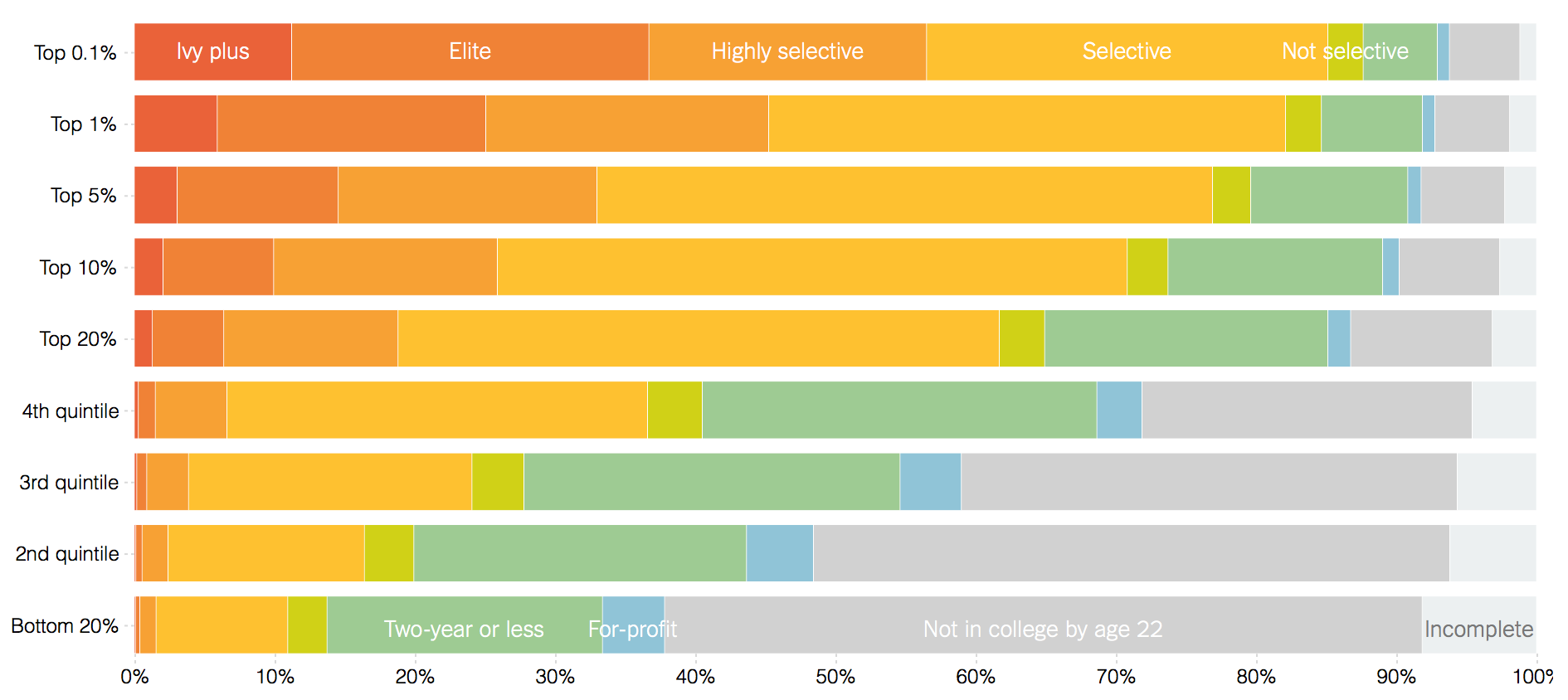
Roughly one in four of the richest students attend an elite college – universities that typically cluster toward the top of annual rankings (you can find more on our definition of “elite” at the bottom).

In contrast, less than one-half of 1 percent of children from the bottom fifth of American families attend an elite college; less than half attend any college at all.

Where today’s 25-year-olds went to college, grouped by their parents’ income

About four in 10 students from the top 0.1 percent attend an Ivy League or elite university, roughly equivalent to the share of students from poor families who attend any two- or four-year college.

Colleges often promote their role in helping poorer students rise in life, and their commitments to affordability. But some elite colleges have focused more on being affordable to low-income families than on expanding access. “Free tuition only helps if you can get in,” said Danny Yagan, an assistant professor of economics at the University of California, Berkeley, and one of the authors of the study.

The study – by Raj Chetty, John Friedman, Emmanuel Saez, Nicholas Turner and Mr. Yagan – provides the most comprehensive look at how well or how poorly colleges have built an economically diverse student body. The researchers tracked about 30 million students born between 1980 and 1991, linking anonymized tax returns to attendance records from nearly every college in the country.

We’re offering detailed information on each of more than 2,000 American colleges on separate pages. See how your college compares – by clicking any college name like Harvard, U.C.L.A., Penn State, Texas A&M or Northern Virginia Community College – or search for schools that interest you.

At elite colleges, the share of students from the bottom 40 percent has remained mostly flat for a decade. Access to top colleges has not changed much, at least when measured in quintiles. (The poor have gotten poorer over that time, and the very rich have gotten richer.)

How biased are hiring decisions? Wente

Wente does raise a valid question whether blind cvs will necessarily improve representation of women given that there may be some conscious biases in favour of more women  to redress current imbalances (see my earlier Ottawa pilots ‘name-blind’ recruitment to reduce ‘unconscious bias’ in hiring).

One of her better columns as does not present studies that only favour her main argument – a positive bias in favour of women – but also those studies that demonstrate the impact of implicit biases.

That being said, the current federal public service pilot will provide some useful data for the public service in this regard with respect to all four employment equity groups:

Australia did this too. Twenty-one hundred civil servants were asked to assess hypothetical candidates for senior jobs. Half the résumés had identifying information, and half did not. But the results were a shock. Blind hiring made things worse. It turns out that when recruiters had identifying information, they actively discriminated in favour of women and minorities – just as they’d done all along.

“Participants were 2.9 per cent more likely to shortlist female candidates and 3.2 per cent less likely to shortlist male applicants when they were identifiable,” the researchers said. “Minority males were 5.8 per cent more likely to be shortlisted and minority females were 8.6 per cent more likely to be shortlisted. … The positive discrimination was strongest for Indigenous female candidates who were 22.2 per cent more likely to be shortlisted.”

“We anticipated this would have a positive impact on diversity,” Michael Hiscox, the Harvard academic who oversaw the project, said sheepishly. “We found the opposite.” He recommended that the experiment be put on hold.

Privately, plenty of people in government and academia will tell you that hiring bias now favours women, especially in male-dominated fields. In France, researchers found, female applicants for teaching jobs in math and physics at all levels are now preferred over men. (Conversely, men have a slight edge in traditionally feminine fields such as literature.) What’s going on? The researchers concluded that the examiners are probably trying to counteract gender stereotypes.

In another famous (and hotly controversial) study, psychologists Stephen Ceci and Wendy Williams submitted hundreds of résumés from hypothetical candidates applying for tenure-track positions in STEM fields. They foundthat the women were favoured by a ratio of 2 to 1.

No one would argue that gender discrimination does not exist. But maybe it isn’t the monster problem some folks think it is. And maybe twisting ourselves into pretzels to erase imaginary biases in hiring is a poor idea.

Source: How biased are hiring decisions? – The Globe and Mail

It’s not just Google — many major tech companies are struggling with diversity – Recode

Some good comparative diversity data:

An internal memo written by a male Google engineer has reignited a heated debate about representation in Silicon Valley. Google’s new diversity VP has since come out against the memo’s central claims — which include statements about women being biologically unsuited to engineering jobs — but the debate still rages on.

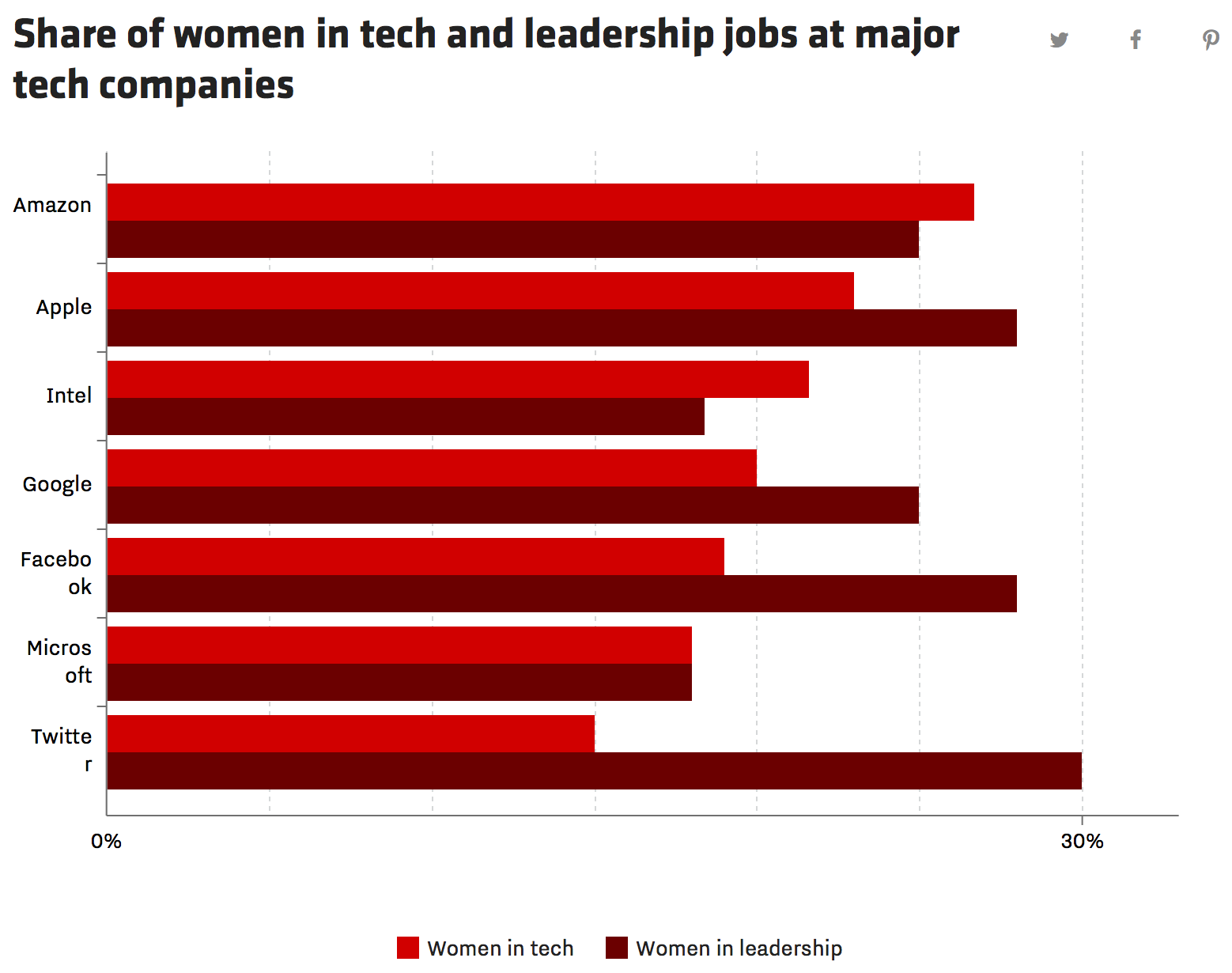
Here’s a look at major tech companies’ comparative diversity, according to their most recent reports. Women make up at most 30 percent of leadership roles and less than 27 percent of technical roles at these companies.

Twitter, the smallest company by number of employees, has the highest rate of female leadership at 30 percent. It also has the lowest rate of women in technical positions, such as engineers at 15 percent.

Racial demographics aren’t much brighter.

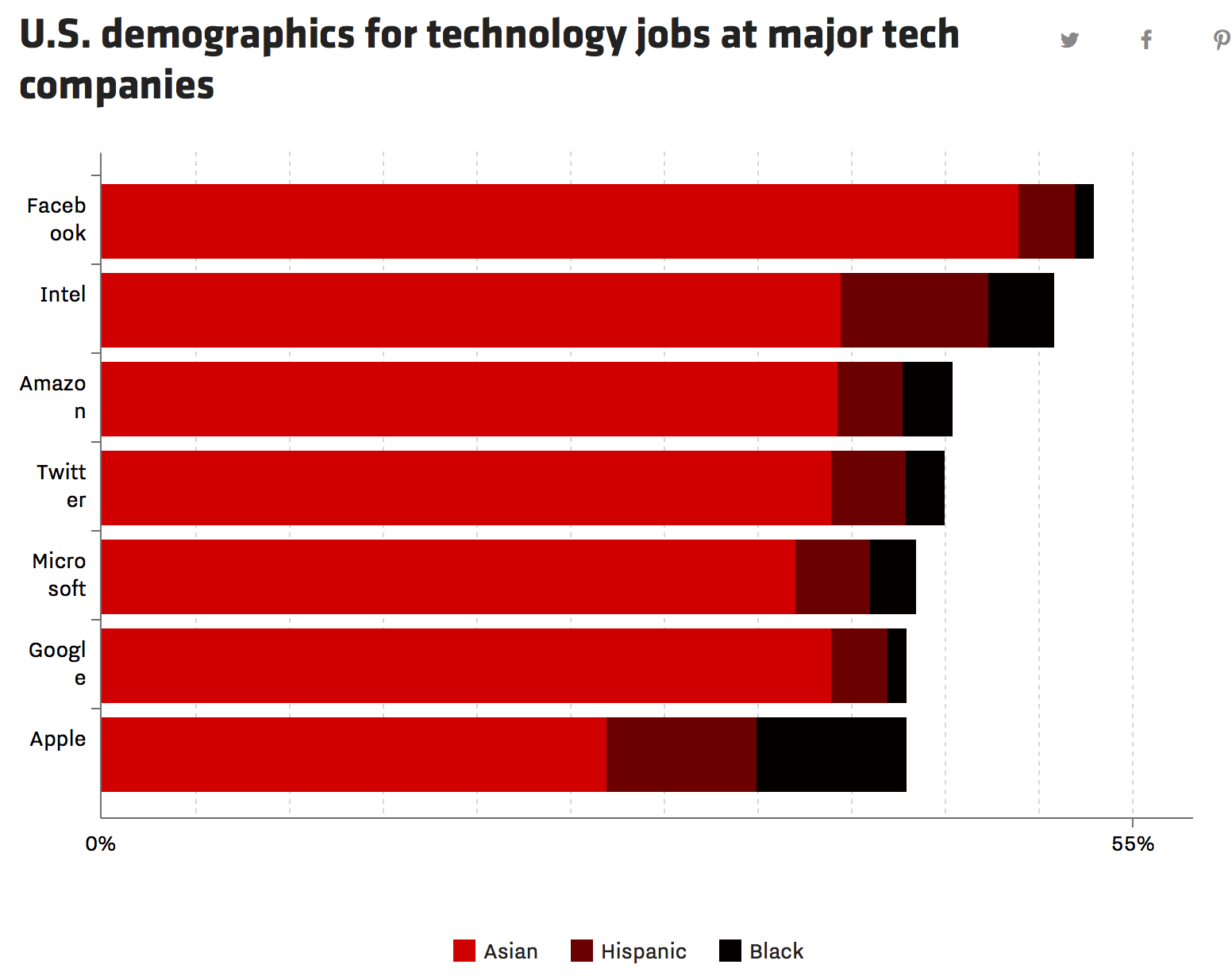
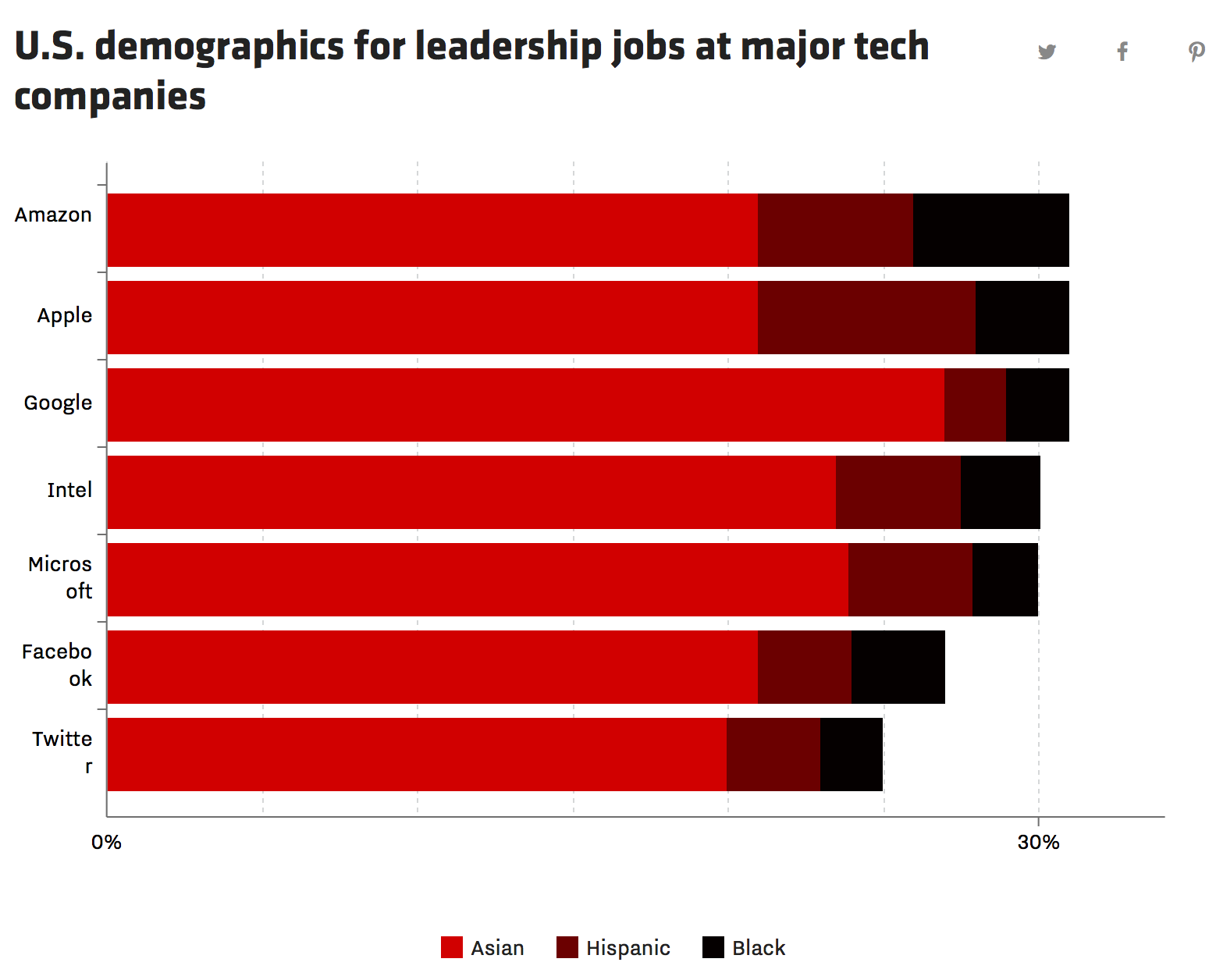
Blacks and Latins are represented at a much lower rate than their U.S. population. Facebook, which most recently reported new diversity numbers, had the highest share of people of color, particularly Asians, in technology jobs. Asian Americans tend to be overrepresented in technical roles but underrepresented in leadership positions.

Amazon, Apple and Google all had 31 percent of their leadership consisting of Asian, Latinx and blacks. These companies also report “other” and people who are two or more races, but those are usually under two percent.

Inequality exists at all levels of the job pipeline, but so do solutions. Look, for example, at the record number of women and minorities taking college-level computer science in high school this year.

Source: It’s not just Google — many major tech companies are struggling with diversity – Recode


Google just hired a diversity VP — just as it struggles with a sexist memo from an employee – Recode

Culture change is hard:

Google recently announced a new head of diversity, just as it has had to deal with a controversial 3,000-word internal memo sent across the company by an employee.

It contains a series of what I can only describe as sexist twaddle, wrapped in the undeserved protection of free speech. (Hey bros who don’t agree, that’s just my opinion, so you’ll have to take it because … First Amendment and all!)

Danielle Brown, who was previously at Intel, was named the search giant’s new VP of diversity, integrity and governance several months ago and arrived a month ago. But she now has her first big test and it has to do with Silicon Valley’s latest problem.

Which is: Some male techies don’t seem to like women around computers.

She did note that in her memo she just sent to the company, noting she would not link to the employee’s memo because, ‘it’s not a viewpoint that I or this company endorses, promotes or encourages.”

The employee memo —which has been up for days without action by the company — went viral within Google this weekend with some decrying it and others not. Sources said execs have been struggling with how to deal with it and the fall-out, trying to decide if its troubling content crosses a line or should be allowed to be aired.

It’s not an easy line to walk. The employee — whom I am not naming since he seems to be the subject of threats online — penned a piece he sent across the company that said, among other things, that women just can’t do tech.

Titled “Google’s Ideological Echo Chamber,” it begins promisingly enough:

“I value diversity and inclusion, am not denying that sexism exists, and don’t endorse using stereotypes. When addressing the gap in representation in the population, we need to look at population level differences in distributions. If we can’t have an honest discussion about this, then we can never truly solve the problem.”

But then, in what is pretty much the main premise, he went on in detail: “I’m simply stating that the distribution of preferences and abilities of men and women differ in part due to biological causes and that these differences may explain why we don’t see equal representation of women in tech and leadership.”

Also men like status and, apparently, ladies like me are too nice to code.

More to come, but here is a memo Brown just sent out about the other memo:

“Affirming our commitment to diversity and inclusion—and healthy debate

Googlers,

I’m Danielle, Google’s brand new VP of Diversity, Integrity & Governance. I started just a couple of weeks ago, and I had hoped to take another week or so to get the lay of the land before introducing myself to you all. But given the heated debate we’ve seen over the past few days, I feel compelled to say a few words.

Many of you have read an internal document shared by someone in our engineering organization, expressing views on the natural abilities and characteristics of different genders, as well as whether one can speak freely of these things at Google. And like many of you, I found that it advanced incorrect assumptions about gender. I’m not going to link to it here as it’s not a viewpoint that I or this company endorses, promotes or encourages.

Diversity and inclusion are a fundamental part of our values and the culture we continue to cultivate. We are unequivocal in our belief that diversity and inclusion are critical to our success as a company, and we’ll continue to stand for that and be committed to it for the long haul. As Ari Balogh said in his internal G+ post, “Building an open, inclusive environment is core to who we are, and the right thing to do. ‘Nuff said.”

Google has taken a strong stand on this issue, by releasing its demographic data and creating a company wide OKR on diversity and inclusion. Strong stands elicit strong reactions. Changing a culture is hard, and it’s often uncomfortable. But I firmly believe Google is doing the right thing, and that’s why I took this job.

Part of building an open, inclusive environment means fostering a culture in which those with alternative views, including different political views, feel safe sharing their opinions. But that discourse needs to work alongside the principles of equal employment found in our Code of Conduct, policies, and anti-discrimination laws.

I’ve been in the industry for a long time, and I can tell you that I’ve never worked at a company that has so many platforms for employees to express themselves — TGIF, Memegen, internal G+, thousands of discussion groups. I know this conversation doesn’t end with my email today. I look forward to continuing to hear your thoughts as I settle in and meet with Googlers across the company.

Thanks,

Danielle”

Source: Google just hired a diversity VP — just as it struggles with a sexist memo from an employee – Recode

Update: Google has apparently fired the employee who wrote the offending memo.

Canada’s real strength? It’s not diversity: Catherine Little

Valid point regarding diversity of choice that Canada offers regardless of origins, in terms of identities (but I wouldn’t necessity place it in opposition to the general point about diversity being a strength, just a reminder that of diversity within diversity, and the importance of choice):

Recently, I have been puzzling over Prime Minister Justin Trudeau’s comments during his interview with CTV’s Your Morning co-host Anne-Marie Mediwake. Ms. Mediwake described her family’s journey to Canada and the Prime Minister stated that he sometimes felt “jealous” of immigrants. His reasoning was that immigrants got to choose Canada while those born here were Canadians by default.

I don’t think there is anything to be jealous about. No matter how we came to be Canadian, our role in strengthening this country is dependent on the choices we make everyday. As an immigrant who did not personally choose Canada but has gratefully lived here for more than 90 per cent of my life, my perspective is this: I don’t believe the diversity of the population is our country’s greatest strength. Canada’s greatest strength is the diversity of the choices the population is free to make once we are here. Our future is dependent on enough people making wise ones.

Source: Canada’s real strength? It’s not diversity – The Globe and Mail